


Dance performances accompanied by singing and percussion music are widespread in West Africa. The participants often form a circle, thereby defining the open ground at its centre as a performance space through their shared body orientations and lines of sight, an arena for dance performance in an amphitheatre built from musicking and spectating human bodies. Some genres in such music–danceFootnote 1 circles privilege specialized dance forms, including masked dance, which has been extensively researched from various angles.Footnote 2 In many other music–dance genres in West Africa, all those present are invited to step into the ring as dancers, meaning that they take the leading role and temporarily become the focus of public attention, coordinated through turn-taking mechanisms.Footnote 3 In such performance contexts, which music and dance scholars have described as ‘functional’ and ‘participatory’, there is often no group of participants who are not themselves directly involved as performers, that is, no audience in the strict sense.Footnote 4 As a result, audience research in both musicology and theatre and performance studies has shown comparatively little interest in such contexts.Footnote 5 In this article, therefore, I ask how and by whom the function of audiency is fulfilled in such contexts. Conceiving audiency as forms of attention and engagement that bring about the social recognition of performance and that co-construct its meanings, I argue that the indirect but critical contribution of audiency to performance does not depend on a separate audience group (Position 4 in ‘Theorizing Audiency’ above). Such contributions can also be made by participants who are themselves simultaneously involved as performers. Goffman has famously demonstrated this for everyday interaction;Footnote 6 this article shows how audiency can be embedded in music performance.
Ethnographic Fieldwork
This article draws on longitudinal ethnographic fieldwork conducted in rural southern Mali since the 1990s. My materials and observations were made in a village called Saguele, about seventy-five kilometres southwest of Bamako, during three stays in 2018, 2019, and 2020. The population of Saguele at that time was roughly estimated at five thousand. The villagers worked primarily in family-based smallholder agriculture. They identified as Maninka, an ethnolinguistic group in the south and southwest of Mali and in neighbouring northern Guinea assumed to represent a successor group to the bearers of the medieval Malian Empire of the thirteenth to sixteenth centuries. Some instruments of Maninka music, such as the djembe drum, have become icons of national culture in Mali and Guinea since the 1960s and have been globalized since the 1990s.Footnote 7
In Saguele and its immediate surroundings, music and dance performances occurred several dozen times a year, according to a survey I carried out in 2018–19, mainly as public celebrations on ritual and social occasions, especially weddings. The performances always combined modes of expression that are semantically distinguished in the Maninka language as song (dònkili), instrumental, often percussion, music (fòli), and dance (dòn); the term for song is a compound word that translates literally as ‘call to dance’. The integration of these modes of expression is very close, forming a composite but unified performance genre from a local perspective. The percussion music played by djembe-centred drum ensembles and/or clapping and calabash rattles was never performed in isolation from song and dance. When people spoke of, for instance, a djembe celebration (jenbetulon), they referred not only to the percussion ensemble music but also to the corresponding forms of dance and song. In this context, people spoke of djembe dance (jenbedòn) and djembe song (jenbedònkili) as naturally as they spoke of djembe drumming (jenbefòli). The performances invariably took place in the music–dance circle format I outlined in the introduction and will revisit below; in fact, the expression ‘to set up an arena’ (ka kènè sigi) in the local language means hosting a celebration.
The following two sections present detailed descriptions and interpretations of music–dance interaction in two performance genres from southern Mali: one a genre centred upon community members’ joint handclapping, the other featuring a specialized djembe drum ensemble. What both types have in common is that, while a critical requirement of the performance is the mutual recognition and interaction of all song, percussion, dance, and spectatorship, the dancing is always at the centre and often plays the leading role, while the music follows and supports the dancers. At the same time, the two genres differ in terms of size, officialness, and degree of role differentiation. The motivation for contrasting these different cases is to develop the theoretical concept of embedded audiency with an example of musical audiency alongside a first estimate of its possible generalizability across performance contexts. Each section refers to a video of a performance selected from a larger corpus of recordings as its primary source.Footnote 8
Study 1: A Clapping Celebration
On the afternoon of Saturday 15 January 2020, a djembe drum/dance performance was to take place in Dogoro, a village eight kilometres east of Saguele. The Djalabatigui voluntary association from Saguele, whose objective is to support its members logistically and financially in organizing their family celebrations, had been recently expanded to include a branch founded by women peasants from Dogoro.Footnote 9 The connection to the existing club in Saguele made it easier for the members of the Dogoro branch to book the Saguele djembe drum ensemble, some of whose players are also members of the association. This was necessary since in Dogoro, the local djembe ensemble had not been functional for many years; a senior player had retired and a younger one had migrated to Bamako, so only one player was still available. The celebration scheduled for that day was meant to deepen the bonds between the association’s two branches.
In the morning before the scheduled celebration, a team of five male drummers, a group of about thirty female members of the association, and a research team consisting of two assistants from Bamako and myself travelled from Saguele to Dogoro. I was a supporting member of the Djalabatigui association from 2018 to 2020; I have also been known as a drum apprentice and research partner of the association’s chief drummer, Namakan Keita, since the 1990s. Thus I was recognized as part of the delegation from Saguele. Upon arrival, a delegation from the group of male drummers and female Djalabatigui officials embarked on a tour of the village, where various dignitaries, including the traditional village headman, the head of the mosque, and the chairpersons of the local women’s, men’s, and youth associations, were greeted and presented with ritual gifts. This customary sign of respect was performed in the hope of holding the upcoming public event with the blessing of these local dignitaries.
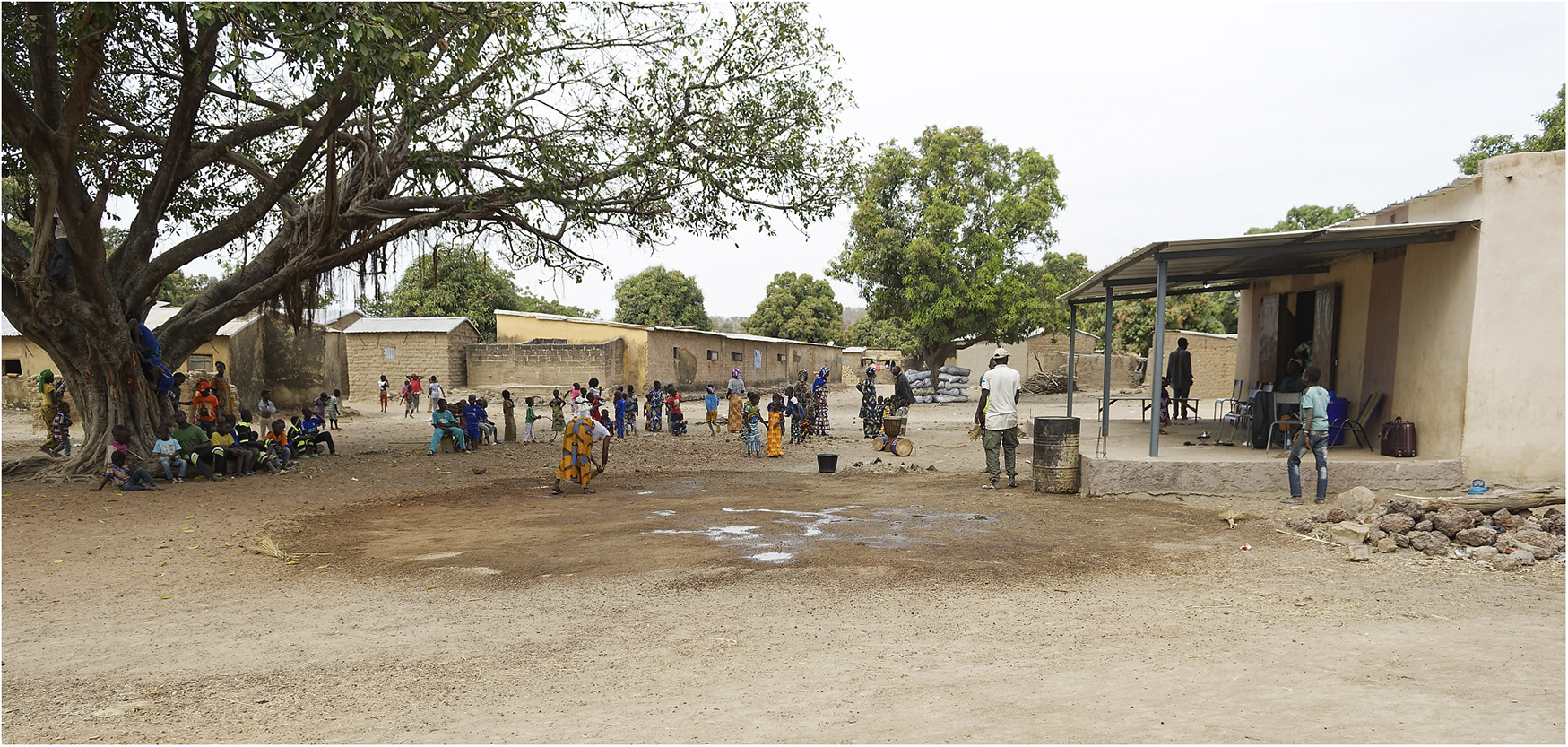
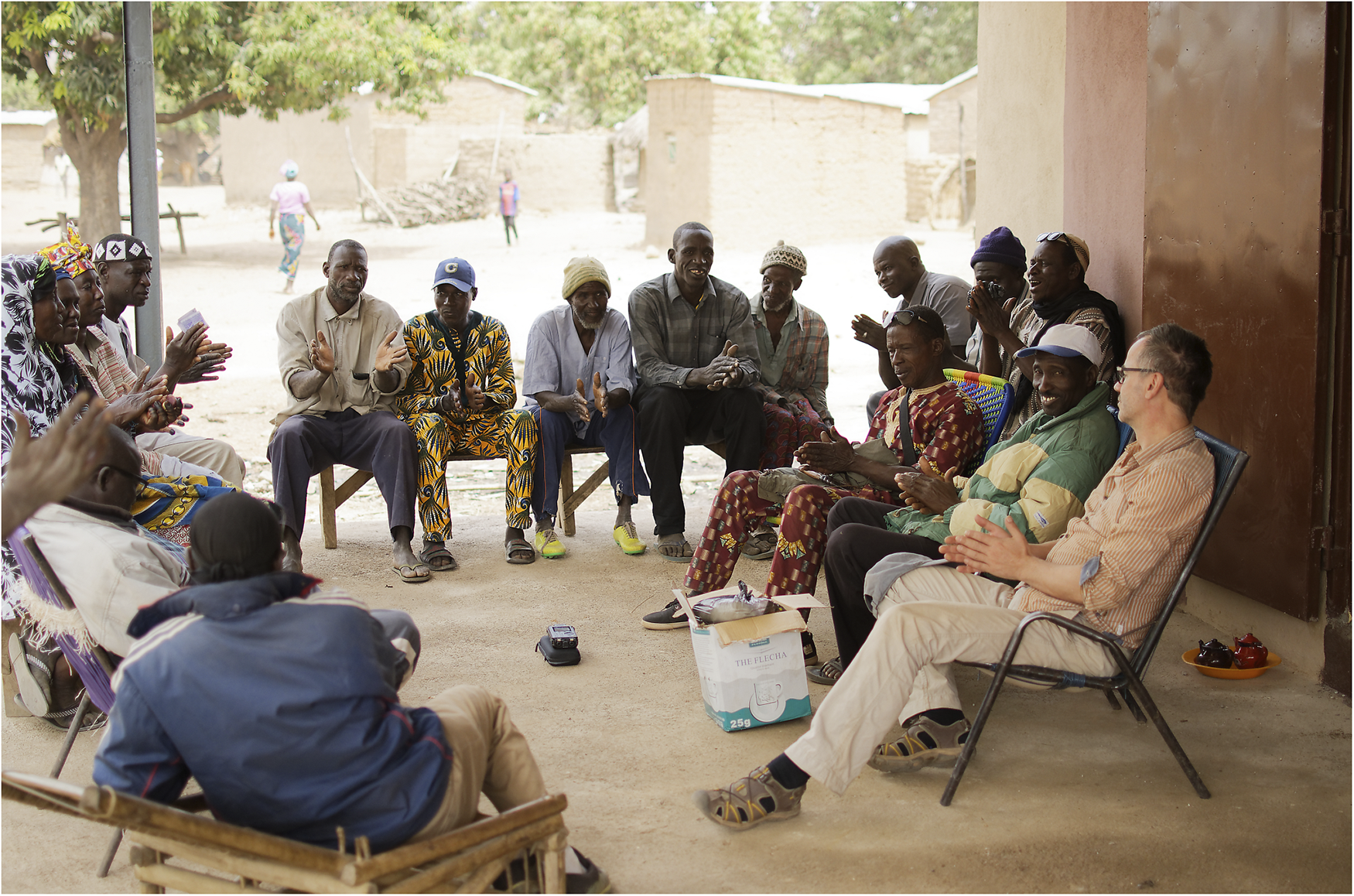
At around 11:45, a delegation of the Dogoro branch of the association arrived at the granary where the female Saguele delegates had taken up quarters; the building is adjacent to the village square where the afternoon celebration was to unfold (see Figure 1). This official welcome visit started with ritual greetings and a series of mini speeches that explained the reasons and social relations underlying the invitation, visit, and current gathering. Each attendant gave a little speech, usually rephrasing some aspects of the previous speeches and adding something novel. The speech-based part of the event closed with a long round of applause performed in the round, a form of audiencing that helped the participants signal and recognize their mutual understanding of the current situation (see Figure 2). Quickly after the applause, one participant began singing a song, immediately transforming the event into a small celebration in its own right taking place on the roofed veranda of the granary. The performance involved about thirty-five adult participants plus perhaps a dozen onlooking children. It lasted about fifteen minutes and consisted of seven pieces of one to three-and-a-half minutes’ duration. In what follows, I will analyse this performance via a video recording of ‘Fura’, the third of these seven pieces and the first one that brought the party into full swing regarding the collective joy and enthusiasm characteristic of a successful celebration.Footnote 10 According to interviews and conversations I shared with the participants, these pleasurable experiences are the primary reasons for staging and attending such music and dance performance events. Yet the performance was also held in celebration of, and to socially validate, the mutual understanding that was reached verbally immediately before. In some sense, this performance was a semi-public celebration of an agreement about an upcoming public celebration. All of these are social interactions requiring verbal and artistic performances, which in turn necessitate audiencing activities for social recognition.
Village square of Dogoro. Centre: Preparing the dance floor for the upcoming celebration described in Study 2. Right side: Empty granary hosting the guests from Saguele, serving as the venue for the performance described in Study 1. Photograph: Rainer Polak.

Figure 1. Long description
A wide-angle outdoor photograph of a village square.
* At the center foreground is a large, circular patch of dark, cleared earth being prepared as a dance floor. A person in a yellow and patterned wrap is bent over, working on the surface.
* To the left, a massive, ancient tree with thick, sprawling roots and hanging vines provides shade. A large group of children and adults are seated or standing around the base of the trunk.
* To the right, a long, tan-colored rectangular building with a corrugated metal porch roof serves as a venue. Several people are gathered under the porch and near the entrance, where chairs and equipment are visible.
* In the background, several other low-slung, tan-colored earthen buildings with flat or metal roofs are scattered across the dry landscape under a bright, overcast sky.
* Lush green trees are interspersed between the buildings in the distance.
Representatives and musicians from the Saguele and Dogoro branches of the Djalabatigui association (including the author) meeting on the roofed veranda of the granary shown in Figure 1. Photograph: Noumouké Doumbia.

Figure 2. Long description
A group of approximately fifteen people are gathered on a shaded concrete veranda. In the foreground, two individuals are seated with their backs to the camera, one in a blue jacket and another in a light-colored shirt. Moving clockwise to the left, several women in traditional patterned headwraps and clothing are seated, some clapping. Continuing the arc along the back, a row of men sit on wooden benches and chairs. They wear a mix of traditional and Western-style clothing, including a man in a bright yellow patterned suit and others in button-down shirts or caps. On the far right, the author, a man in a striped shirt and glasses, sits in a folding chair facing the group. Many members of the group are clapping their hands in unison. At the center of the circle on the ground sits a small black electronic recording device and a white cardboard box labeled THE FLECHA. To the right, near the wall, a small tray holds teapots. The background shows an open, sandy courtyard with several mud-brick buildings and a few distant figures walking under the shade of trees.
The activities shown in ‘Fura’ are of four basic types. Firstly, there is singing in call-and-response form, in which a single lead singer gives the call and the adult participants collectively give the response. Secondly, percussion music in the form of joint clapping is reinforced by several quite loud calabash rattles (jabara); because of this instrumentation, such events are known as ‘handclapping celebrations’ (tègèrètulon).Footnote 11 Thirdly, there is dancing in two forms — group dancing in the first section and individual dancing in the second section of the three-minute piece. About twenty-five women out of the total thirty-five adult attendees participate in the group dancing, of whom about fifteen also contribute individual solo dances, some of them soloing twice. Fourthly, there is the spectatorship, by which I mean a bundle of audiencing behaviours, including those of bodily orientation and gaze, cheering, and applause.Footnote 12
While a critical requirement of the performance is the mutual recognition and interaction of all four of these activity modes (song, percussion, dance, and spectatorship), the dancing represents the central mode and the one that often leads the interaction. This focus is manifest in a variety of ways. Firstly, the two-part form of the performance is mainly shaped by the dancing. The first part (0:10–1:15) is characterized by a collective group dance in which the performers form a concentric circle inside the outer circle and move around the arena in single file with a simple walking dance step at a moderate tempo (100–110 bpm). In the second part, the tempo increases quickly from 110 to about 150 bpm (1:15–1:30) and remains stable at this level from then on (1:30–3:18). The dancing in this second part consists of a sequence of nearly twenty energetic solo dance contributions by individuals performing either alone or in parallel with other solo dancers. In contrast to this two-part formal structure introduced by the dancing, the song and percussion music is performed almost without variation throughout the piece.
A second aspect that brings the dancing to the centre of attention is the spatial arrangement. In the moments when there is no dancing (e.g. before the start of the piece, 0:00–0:10), all participants are in the outer circle by default, while the arena within the circle remains empty. When there is dancing, it takes place at the centre, which is framed by the music and spectatorship from the outer circle. A third relevant aspect is that during most of the second part (e.g. 1:55–2:45), the enthusiastic cheering, clapping, and rattling are directed at the dancers to spur them on; nothing comparable is dedicated, for example, to the lead singer or anyone else.
A fourth and final indication of the centrality of dance is that in the second part, most solo dance performers — but not the singers or percussionists — address me and my video camera. Visual anthropologists have argued that the presence of a camera adds a layer of technologically mediated audiency that can change performance situations through its evocative affordances.Footnote 13 As I will illustrate, one such affordance is that participants can and do address the camera as if it were a virtual audience.Footnote 14 When the first two solo dancers perform, they start by presenting their individual moves while circling slowly but continuously around the arena (1:15), similar to how the group dancing unfolded in the first part. However, one of the two dancers stops this circular movement as soon as she passes the camera (1:25), turning towards it to dance on the spot. The other dancer then notices this change and gives up circling in favour of addressing the camera too. The third (1:35) and especially the fourth dance soloist (1:40) then seek out the camera’s focus from the beginning of their respective performances. When the fourth obscures the third’s perspective on the camera and thus also the camera’s view of her (1:50), the third reacts by pushing the fourth aside. The latter laughs and continues dancing to the side. From now on, all the individual dancers habitually face the camera and position themselves in ways that allow their dancing neighbours to do the same. This strategic placement of one’s performing body in the arena to address the camera is not used by anyone other than the solo dancers. In sum, these behavioural patterns of moving bodies in space and time all suggest that the entire interaction system is designed to motivate and enable the dancing and to give its performance the greatest possible communicative efficacy and social significance.
Moving on from analysing dance as the central performance mode to analysing audiency, I will now argue that the latter function is realized not only through spectatorship behaviours but also as embedded in the musicking. Again, the spatial arrangement supports this interpretation, as the singers and percussionists consistently take the position one would expect to be occupied by an audience (if such a group existed), namely the outer circle; for example, think of an ancient amphitheatre or a modern theatre-in-the-round. What is more, music-making and spectatorship cannot be separated at all in the clapping celebration, since most spectators also sing and clap or rattle at the same time; to put it the other way round, the musicians also form the circle of spectators. This amalgam of spectatorship and musicianship roles performed by the same agents at the same time becomes particularly obvious in the second part of ‘Fura’, when several participants in the outer circle repeatedly press inwards and are close to starting to dance themselves while using their energetic rattling or clapping to spur on the actual dancers in a rhythmically coordinated way (e.g. 1:55–2:45).Footnote 15 Such ‘cheerleading’ is, on the one hand, a mode of realizing audiency, and a particularly important one insofar as its explicit and public character can energize the interaction. On the other hand, in its modes of execution, including rhythmic shouting, clapping or rattling, and singing, this cheerleading, which has the intention of spurring on the dance performance, is also part of the music-making — and a crucial one, since there is no other music than just that.
In summary, the entire event consists of little more than the dancing in the arena and the overlapping spectatorship and musicking behaviours from the surrounding circle. This indicates that musical audiency is a core component of the genre, complementary to and constitutive of the dancing as the central performance mode.
Study 2: A Djembe Celebration
Here I analyse a larger, more public performance, one that had an ensemble of specialized drummers at the centre of the percussion music and thus was more role-differentiated than the small welcome celebration described in Study 1. The theoretical interest now turns to the question of whether the main result of Study 1 — that dance as the central performance and often leading mode is dependent on musical audiency — also holds under conditions of increased role differentiation.
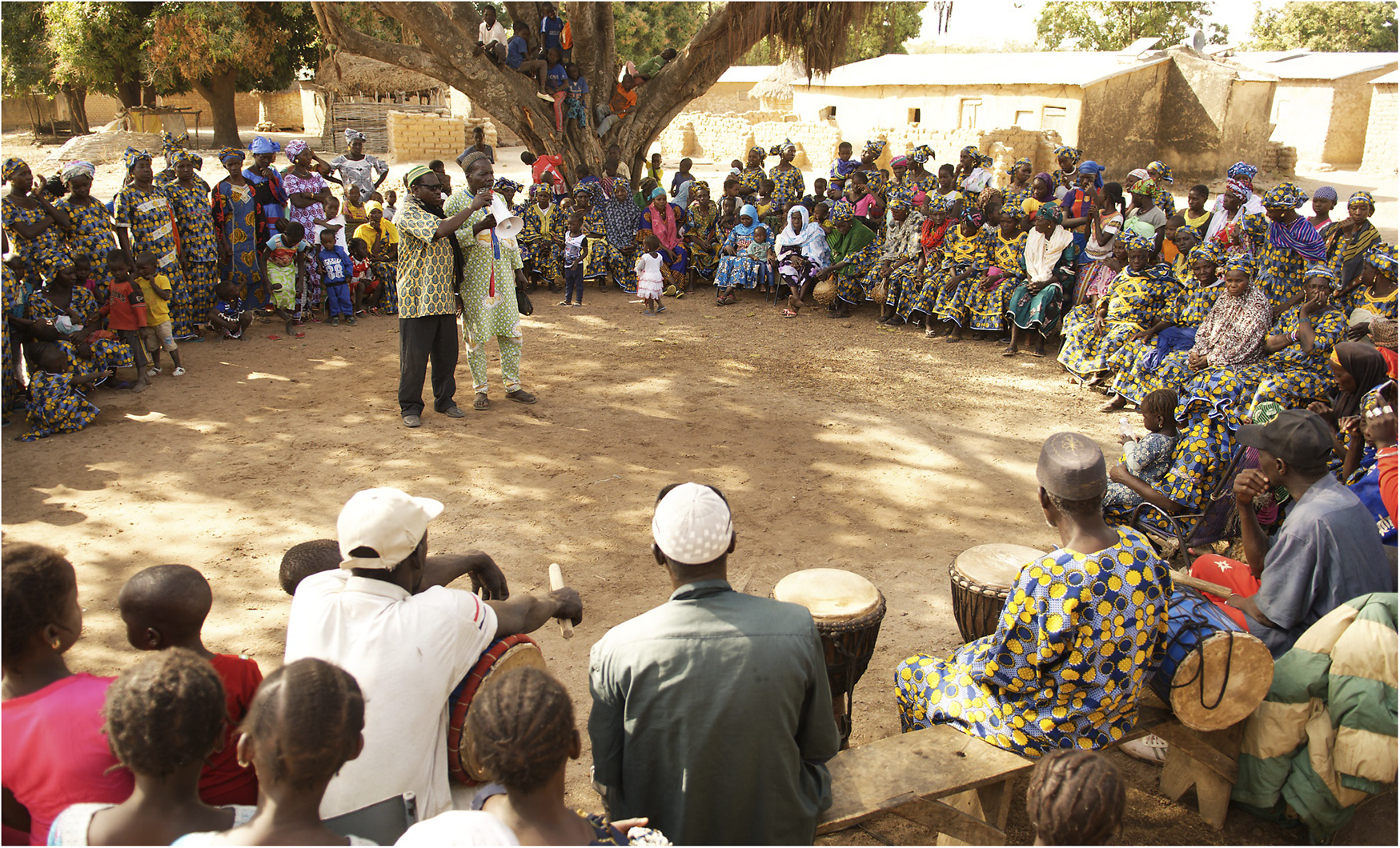
After lunch and the short break that had followed the welcome party in the late morning, the public celebration started as planned at 14:45. It took place in the village square under the shade of a huge strangler fig tree (see Figure 3). Seven male drummers took turns on three djembes and two cylindrical dundun drums, with two substitutes on the bench at any one time. In this regional style of djembe music, two accompanying djembes and the higher-pitched dundun play simple ostinatos that serve to keep time and flesh out the groove; the lower-pitched dundun produces a characteristic timeline pattern that specifies each piece in the repertoire; finally, one djembe plays the lead part, which includes variable and sometimes virtuosic melo-rhythmic patterns and coordinates the interaction of the drum ensemble with the singing and the dancing. The drum ensemble was accompanied by the same collective clapping and rattling that had been performed on its own at the morning party. About half a dozen female singers from Saguele and Dogoro took turns as lead singers, using a battery-powered megaphone that had very little amplification power. As in the morning, the response singing was performed jointly by community members, most of whom also took turns dancing.
Djalabatigui association spokesman Dauda Ly (with megaphone, assisted by an aide holding an audio recorder) delivering a speech during the celebration in Dogoro’s village square. Photograph: Rainer Polak.

Figure 3. Long description
A wide-angle photo captures a large outdoor assembly in a dirt square.
* At the center of the square, Dauda Ly stands holding a white megaphone to his mouth. He is wearing a patterned green and white tunic. Beside him, an aide in a similar patterned shirt holds a small audio recorder toward the megaphone.
* Surrounding the central speakers is a large audience seated in a wide semi-circle. Most of the women are dressed in vibrant, matching blue and yellow patterned traditional garments and headwraps.
* In the background, a large, sprawling tree provides shade, with several children perched in its branches. Behind the crowd are low-slung, light-colored mud or concrete buildings under a bright, clear sky.
* In the foreground, viewed from behind, several men sit on wooden benches. One man wears a blue and yellow patterned robe and plays a djembe drum. Other drums are visible nearby, including one being held by a man in a white cap. Several children are also seated in the immediate foreground, looking toward the center of the square.
After half an hour, a male member of the Saguele branch interrupted the music and dance performance to give a speech explaining the occasion and circumstances of the event (see Figure 3). He welcomed the local dignitaries and pointed out that playful, enjoyable music and dance performances can promote a sense of belonging and cohesion among community members. He also emphasized that the claim that such celebratory performance is incompatible with good customs of the Islamic faith is false, although widespread. He went on to announce that our research team would document the event on film, a plan to which the congregation gave its consent through collective applause. In this situation, the spatial arrangement of performance in the round was used to grant the speaker a central role and focus of attention, similar to the dancers’ role in the performance event. The speech performance was combined with applause as a form of audiencing for social recognition and validation.
At 15:30, the assembly resumed the music and dance performance, which now went on for a good hour and a half with consistently high intensity and an electrifying atmosphere. At 17:10, the celebration was interrupted once again for another, albeit very short, speech, followed by a further music and dance phase starting at 17:15. This, however, only had the character of a fade-out, with some participants already on their way home. At 17:45, the djembe ensemble stopped working, whereupon some participants continued the performance without the help of the drummers — another little handclapping celebration, like the one described in Study 1. At 18:00, the event was finally over, and everyone remaining immediately headed home because following sunset, just after 18:00, it gets dark very quickly in these latitudes and the roads are neither paved nor lit.
The event lasted just over three hours, of which two hours and ten minutes were devoted to music and dance performances. The gathering numbered about 150 youth and adult participants, while a few dozen children filled the ranks. Most adult participants were female, but about twenty were male. Seven of the latter acted as djembe and dundun players in the drum ensemble, and about ten performed as dancers. The programme consisted of a sequence of twenty-five distinct pieces, most of which were between four and eight minutes in duration; the six-minute performance documented in the ethnographic video ‘Kisa’ was the eleventh of these pieces.Footnote 16 It occurred about an hour and a half after the start of the event, during the main phase of the djembe performance between the two speeches. The song is about the joy of life:
Live your life, live your life, we all die and return to the earth forever; Live your life, for death spares no one; Live your life, because no matter how famous (celebrated) you are, we will all return to the earth one day forever.
The djembe performance in ‘Kisa’ shows some fundamental similarities with the performance of ‘Fura’ in the handclapping event described in Study 1, most importantly the interaction system of singing, playing percussion instruments, dancing, and spectating. First of all, while the performance is still critically dependent on the mutual recognition of and interaction between all four activity modes, the dancing is again central in terms of spatial organization and focus of attention, and it often leads the interaction. This will become particularly clear in examples of individual drum/dance encounter that I will describe below, where the lead drummer is largely responsible for following and marking a solo dancer, who is mostly leading.
At the same time, however, differences between the clapping and the djembe performance contexts are discernible; I highlight three that are relevant to my theoretical interest. Firstly, percussion is now dominated by the djembe-centred drum ensemble, whose activity is highly skilled and physically demanding. Drumming is considered labour in southern Mali, including in rural Maninkaland, and is performed almost exclusively by male specialists who have undergone many years of apprenticeship.Footnote 17 The polyrhythms of the multi-part drum ensemble are more complex than the monophonic rhythm of the rattles in the clapping game.Footnote 18 Moreover, the systematic tempo acceleration that is typical of Mande drumming in general turns out to be much stronger in the djembe context than in the clapping one.Footnote 19 On the other hand, usually only some of the drummers also dance, and even then only very sporadically. For example, in the three-hour performance event studied here, only two of the seven performing drummers danced at all, and each of them only for a few minutes.
Secondly, the djembe celebration is on a different scale from the small clapping celebration in several respects: the number of participants, the size of the site, the duration and number of the pieces performed, and thus the duration of the whole event are each many times greater than those described in Study 1. In everyday conversations and open interviews, I repeatedly asked the members of the Djalabatigui association why they value drumming so much that they are willing to spend money on it — money they have very little of. Most answers highlighted the beautiful and loud sound of the djembe, which can attract many more participants than clapping and rattling, thus making the gathering larger. They also often emphasize that a proper celebration can only succeed if the assembly has a certain size, a critical mass that helps the music–dance performance develop the energetic collective atmosphere it needs to sustain for several hours. Without this, the inviting host, for example in a wedding celebration, would be publicly embarrassed.
A third difference seen in ‘Kisa’ is that, in contrast to in the handclapping celebration, some participants sitting or standing at the very back of the outer circle now merely observe and do not also sing, clap, or groove along with the music and the dancers. In summary, the key activities — percussion music, song, dance, and spectatorship — were more role-differentiated from each other in the djembe performance than in the clapping celebration. While in the latter all participants contributed to each of the activities, in the former they tended to specialize, such as the male drummers focusing on the percussion music but not dancing or singing, and a subset of the mostly female participants being mainly busy with observing but not also dancing, singing, or playing percussion. In addition to these differences observable in the video, the djembe event but not the handclapping performance was announced to the village authorities in the morning and explained in a public speech during it (see Figure 3). This marked out the djembe music–dance event as more officially public and socially representative in character.
Surprisingly, perhaps, the increase in role differentiation that characterizes djembe performance compared to handclapping performance leaves the interaction system largely unchanged in terms of the distribution of performance and audiency functions across action roles. In particular, the mostly leading role of the dancers may appear unlikely considering that the djembe drum ensemble is made up of highly skilled and partly professional experts, while it is ordinary club members and guests at the celebration who perform the dancing. However, the sustained centrality and leading role of dancing is evident from various observations. For instance, the spatial arrangement is the same as in the handclapping celebration, and this reserves the inner performance arena for dance, while the position of the drum ensemble is in the outer circle. Another indication is that it is still only the dancers, not the drummers, who receive attention and recognition in the form of applause, cheers, and encouragement. For example, consider these two interactions in ‘Kisa’, each of which lasts for about twenty seconds:Footnote 20
(3:05) From the right side, two solo dancers move in front of the drummers. From the left side, a male dancer, Dauda Ly, joins; the solo dancer to his side is his wife, Fatoumata Kante.
(3:10) From the back left, a participant, who is a daughter of Fatoumata, with an infant on her back, detaches herself from the outer circle, approaches her dancing mother, takes off her own headscarf and throws it over the dancer’s shoulder; such tossing of headscarves for solo dancers is a frequently observed gesture of personal affection and public recognition.Footnote 21 Standing behind her performing mother, the daughter begins to clap her hands and cheer her on.
(3:13) The lead drummer plays a signal phrase and the dancers respond by promptly finishing their solo and clearing the floor. Dauda Ly, who has been cheering on his wife rather than giving a solo dance himself, shouts ‘Bravo!’, as does the daughter.
(3:44) Three individual dancers line up in front of the drummers.
(3:50) At the back right of the outer circle, a participant borrows a rattle from her neighbour, crosses the arena to approach the dance performers, and percussively cheers on one of the three dancers.
Both sequences of interaction above involve explicit audiencing activity in the form of specific gestures and utterances intended to encourage and cheer on performers: the tossing of the scarf, shouts of bravo, and cheerleading through clapping and rattling. Each of these expressions of audiency is directed at an individual dancer; nothing comparable is directed at a drummer or singer, either in ‘Kisa’ or at any other time during the event.
A second aspect of correspondence between the two genres featured in Study 1 and Study 2 is that the dance performance depends on musical audiency. This is evident in the individual drum/dance encounters that characterize the second part of most djembe performance pieces; these serve as my exclusive focus for the remainder of this case study. Djembe drum/dance encounters are energetic since both the loud drumming with bare hands and the dance style, which combines much vertical bouncing of body mass with fast footwork, require a great deal of concentration and physical effort. Understandably, they are brief, lasting no longer than ten to twenty seconds each, and they gain experiential intensity not least from their participants engaging with each other face to face — that is, close up and with mutually mirroring bodily presence. The spatial closeness affords an extreme perceptual directness and salience: As a drummer, you sense how the dancers’ stamping makes the ground vibrate, you are aware of their sweating and heavy breathing, and you inhale the dust raised by their feet; as a dancer, you feel the drumming at a mind-blowing level of loudness, comparable to listening to a rock music performance while standing next to the drum kit or in front of a tower of amplifiers. In each of these intensely energetic encounters, the lead drummer mostly follows and offers musical audiency to the dancers, thus contributing to the dance appearing central and often leading the interaction.
In the following subsections, I will elaborate on this form of embedded audiency. Let me prepare this with a rough sketch of encounters in ‘Kisa’:
(2:15) The group dance circle begins to break up, and one by one most participants leave the dance floor and resume their respective starting positions in the outer circle.
(2:45) However, two senior dancers do not leave but position themselves directly opposite the drummers and continue dancing there on the spot, more energetically now. The lead djembe player looks at them and ‘takes them over’, as the drummers call it, meaning that from now on, he has the responsibility to respond to their dancing and ideally to bring the dance performance to a good conclusion.
(2:50) From the right rear of the arena, a third individual dancer comes in front of the drummers. The three dancers are now in a musical spotlight constituted by the lead drummer.
(2:59) The djembe soloist plays a type of short and pithy signal phrase known in the Maninka language as tigèli, which means ‘cutting off’.Footnote 22 In response, the dancers stop their solo contributions and return to their respective default positions.
(3:05) From the right side, two other solo dancers move in front of the solo drummer, who now stands half a step in front of his ensemble towards the dance floor, in order to more directly receive and respond to the solo dancers.
(3:13) Another break by the lead djembe, and the two dancers finish their solo and clear the floor.
(3:20) Two more dance soloists, including Nakanaba Keita (the lead singer), get into position face to face with the lead drummer.
(3:33) Two further dance soloists join them from the left, but they cannot take the central position opposite the drummers because the first two are still active there.
(3:37) The lead djembe drummer plays another break and all four dancers leave.
(3:44) The next three soloists line up in front of the drummers. In the remaining two minutes or so of the piece, about twenty more solo dancers appear, each seeking out and sometimes competing for position vis-à-vis the lead drummer before going into their solo.
The description above highlights two decisive moments in the complex interaction that each drum/dance encounter represents. Firstly, at the beginning of each encounter, the entrance of the dancers constitutes an act of floor-taking. Beyond the physical and spatial dimension of moving onto the dance floor, this act has an implication on the level of intentional social interaction, where it means deliberately assuming the ratified lead role in a public situation according to established norms of conduct. My use of the term ‘floor-taking’ emphasizes the functional similarity between djembe dancers seeking the dance floor at the centre of the circle and, for instance, a musician entering the stage at a concert hall. Through such floor-taking, I maintain, djembe dancers ascribe an audiency function to their respective addressees, the djembe players. Secondly, at the end of each encounter, the lead drummer’s signal to cut off the current dancers creates a moment in which the drummer assumes the leading performance role. In these moments, the dancer responding to the lead drummer’s signal provides audiency, contributing to the social recognition and meaning of the drummer’s performance. In the ensuing subsections, I will give detailed descriptions of both the floor-taking of the dancers and the lead drumming of the djembe player, and I will supplement this with a close look at how the lead drummer actively provides musical audiency for the performing dancers.
The solo dancers’ floor-taking
‘Kisa’ shows that, before the beginning of a dance solo, an upcoming dancer needs to seek and find a free spot in the arena directly in front of and face to face with the drummers.Footnote 23 Usually, this involves leaving the outer circle and crossing the arena, a move which makes the participant’s aspirations visible to everybody else in the circle, including, importantly, other hopefuls who then need to coordinate their rival attempts; such negotiations around the politics of floor-taking will become evident in later examples. I propose at this point that the spatial aspects of floor-taking —close-up positioning and face-to-face orientation with the drummers — are directly linked to the key intention underlying the act of floor-taking, which is that the dancers aim to address and present themselves to the drummers.Footnote 24 This addressivity marks the dancing as a performance display meant for audiency, framing the drummers’ attention and musical responses to the dancing as a form of musical audiency.Footnote 25 When the dancers approach the drummers, they seek to gain their audiency.
In support of this interpretation, I offer two more short observations about ‘Kisa’ to highlight some peripheral but relevant actions:
(4:01) Two dancers have just left and three others take the floor facing the solo drummer. The drummer takes one step onto the dance floor, actively approaching the solo dancers, albeit only by a matter of centimetres. At this moment, a fourth participant starts to step towards the dance floor from the right side of the outer ring, but she is kept back by her neighbour (who is masked by the dundun player with the green cap). The neighbour taps on the aspiring fourth dancer’s shoulder, gesturally and verbally explaining that the floor has been taken and is already full. The thwarted aspirant nods her head in acquiescence, in conjunction with giving a slightly embarrassed smile.
(4:03) Someone (to the right side, outside of the camera’s view) has noticed the interaction and, in an effort to reinforce public awareness of the politics of floor-taking, shouts out quite loudly, as is audible in the video: ‘Mind the arena!’ Probably mainly intending to remind aspiring dancers of the spatial order, the lead drummer also responds by turning his head to the right side where the shout came from. He too gives an embarrassed smile and steps away from the arena again, back into the drum ensemble formation. Thus he merges again with the outer circle of participants.
(4:07) A further participant joins the three solo dancers currently present. She does not find a proper space facing the lead drummer but takes a position immediately behind one of the existing dancers.
(4:08) The woman from the right side who, a couple of seconds ago, had aspired but was forced to withdraw from performing notices this; she points at the fourth dancer in protest.
(4:10) The frustrated aspirant then walks across the arena behind the dancers and approaches the fourth one with the intention of chasing her off.
(4:12) The latter recognizes this and flees, clearing the place.
(4:16) The drummer plays a break, and the three remaining dancers leave.
(4:18) The former aspirant, now ready to walk back across the arena after having chased off the other aspiring dancer, capitalizes on being very close to the drummers, taking the floor herself.
This last instance of floor-taking was a lucky shot. The next example describes a more standard way that participants proceed when unable to realize an attempt to take the floor:
(4:18) In the very moment the interaction described above ends, the situation becomes extremely fluid and dynamic as the floor is approached from three directions at the same time:
1. As noted, one dancer involved in the previous interaction is already close to the dance ground in front of the drummers and can easily take the floor.
2. From the right side, two aspirants enter the arena looking quite committed; within the next second, they will indeed make it onto the floor.
3. From the left rear, three other aspirants advance into the arena, one of them a step ahead of the others. The latter two are aware of the one ahead of them and at the same time look to their left (the right side in the video), where they also see the two committed aspirants approaching. They realize that they won’t make it, so withdraw; rather than confusing the situation by continuing an approach that is unlikely to succeed (at least without being overly rude to someone else), they choose to stop.
All the above happens during the space of one second (still 4:18).
(4:20) One of the two withdrawing aspirants immediately steps back into her default position in the outer circle. The other spends a few seconds carrying out for herself a constrained version of the dance move she had had in mind to perform before also stepping back (4:24). Of the four dancers who made it to the arena, two perform a solo face to face with the drummers, while the other two groove along several steps behind them in the arena, in a status of approved waiting for their own turns, which eventually come ten seconds later (4:35).
Note that the dance arena is considerably larger than the hot spot in front of the drummers, which means that while one certainly needs to find room to dance, mere space alone was not the issue in the examples above. Both the chased and the withdrawing dancers would have had enough space to dance. Thus what they lacked, and what kept them from presenting a performance, was the lead drummer’s musical attention and customized response. This indicates the fundamental importance of the musical audiency provided by the lead drummer; without it, it does not make full sense for the participants to present a solo dance, and etiquette and the politics of floor-taking tend to prevent dancers from going for a solo anywhere but in the lead drummer’s focus. In the next subsection, I will provide additional argument and evidence for the interpretation that what the solo dancers are seeking from the lead drummer can be understood as musical audiency.
The lead drummer’s audiencing
During drum/dance encounters, the core characteristic of the lead drummer’s role is to constantly observe the dancers and to flexibly adjust and musically respond to what the dancers present. In conversations and interviews, drummers and dance experts agree that it is a key task of the lead drummer to ‘mark’ the dancer’s performance by improvising drum patterns that are appropriate to the dancer’s steps. This attunement of the djembe player to the dancers can go quite far; for instance, I have observed performers presenting dance moves belonging to repertoires different from what was currently being performed. Each piece of repertoire consists of a collection of dance moves and drumming patterns that can be exchanged, to a degree, across some closely related and partly overlapping pieces, but not others. The lead drummer’s musical response in such situations has always been to change the drumming rhythm accordingly, rather than to insist on what, from a music-dominated perspective, could be justified as the ‘correct’ repertoire. I have also observed instances where the lead drummer immediately and drastically decreased the tempo by dozens of beats per minute when an aged and relatively immobile dancer took to the floor, raising the tempo back to normal again when a younger and more athletic person followed.
In ‘Kisa’, no such extreme changes occur, and this makes it more difficult to make out who is following and adjusting to whom.Footnote 26 In Bamako, where the djembe dancing style is strongly influenced by professional dance performers, solo contributions often consist of sequences of two, or sometimes three or more, different dance moves. The lead drummers there ideally try to elaborate explicitly upon the moves they see by changing their drum patterns to correspond. Among Bamako professionals, both drummers and dancers are unanimous in conversations and interviews that it is the drummers’ responsibility to follow and adjust to the dancers rather than pushing on in their own directions.Footnote 27 In Saguele, however, such explicit pattern changes rarely occur, as the ideal for a dancer in the local style is to present just one single move per solo contribution.
However, there are other indications to support the view that it is mainly the lead drummer following the moves of the solo dancers rather than, conversely, the dancers choreographically adjusting to any template established by the music. This concerns a simple but not trivial question: at which moments does the lead drummer play at all, and when is he silent? Each time a group of solo dancers clears the floor following a drumming signal, the first thing the drummer does is stretch his back and pause for a few seconds while waiting for the next dancers to come in (see ‘Kisa’, at 3:00, 3:15, 3:38, 3:58, and 4:16). He does not use this ‘free’ time to present solo drum phrases for the sake of aesthetic interest or to show off his virtuosity. By contrast, the lead drummer virtually never stops playing for a dancer whenever one is present, an act which would run fully against the local understanding of what a djembe drummer is in charge of: to constantly monitor and musically accompany any dancer that takes the floor.
In a focus group interview, an experienced Djalabatigui association member and dancer, Minata Keita, put it this way: ‘When you go out into the arena [taking the floor as a solo dancer], it is as if the djembe sound is added onto you.’Footnote 28 Stopping playing while a dancer is performing would mean stripping this individual’s staged persona of an important part of their costume and exposing this ‘nakedness’ to the public eye, something that would make the dancer feel embarrassed and would presumably make them stop dancing and leave the arena. While this virtually never happens, other than in extraordinary situations where, for instance, an experienced drummer has a blackout or a novice player fails to perform properly, the dancers, by contrast, can and often do push back against the rules of the game, counting on the drummer’s flexibility and willingness to adjust accordingly. One such situation occurs in ‘Kisa’:
(4:26) A signal phrase by the lead djembe player is unexpectedly ignored by the present dancers, who simply continue with their solo.
(4:28) In contrast to earlier instances of drumming signals, the lead drummer does not stop playing after this one. Rather, he adapts to the situation by continuing to accompany the dancers for another couple of seconds.
(4:32) The drummer sets off another signal phrase; this time, the dancers respond and leave.
The above general observations and little sketches from ‘Kisa’ confirm that providing the dancers with musical audiency — attending, responding, and co-constructing the meaning of dance performance — is a key element of the lead djembe drummer’s role. This idea has also repeatedly emerged from my conversations and interviews with drummers and dancers from Saguele. As an example, let me quote from an interview with the drummer Namakan Keita, who plays the accompaniment djembe part in ‘Kisa’ (sitting to the right side, with black baseball cap) but is a very experienced lead drummer himself:
As a proper djembe player, whether you like it or not, you are required to observe the dancers’ legs. While drumming, you follow their legs. If you focus on the step of one [dancer], then you play the corresponding drum pattern. If you take the other [dancer’s] step, then it’s their rhythm. If you don’t watch their legs, will you be able to do this? No. You don’t focus on the [dancers’] arms, you don’t focus on the head, what you focus on is the legs. A skilled djembe player keeps an eye on the legs. Whatever step they take, you play the corresponding rhythm. If the step changes, you change the djembe [pattern], too. However, if you don’t constantly follow their legs, and they pick up a certain step without you noticing, then you’re going to spoil their thing. In that case, you will have played according to your own intuition, but you and the dancer will not have walked the same path together. It is in this context that one can also understand why it is not good if too many people crowd the dance floor at the same time […] Because then you are not able to watch the steps of all these people to adjust your rhythm to fit everyone at the same time. If it’s just watching one person, then you see the legs and play the appropriate rhythm. But if the dance floor is full of people, and everyone is enjoying a dance on the floor at the same time, you will often hear protesting voices: Clear the dance floor, get off the floor! Always in pairs, only in groups of two! The reason is that only then can the djembe player watch their legs and play in a way that fits the dances. […] This applies to the lead djembe player. It doesn’t matter much for the accompaniment djembe player, because he always goes straight, playing only one and the same pattern.Footnote 29
In summary, I have argued that djembe drum/dance encounters are constituted by the lead drummer’s musical audiency complementing the dance performances. Seen from the perspective of an economy of attention and recognition, a key aspect of the role of the djembe drummers is to produce and amplify rather than consume audiency and to fuel the dancers’ presentations by providing them with the surplus of musical audiency they have created.
Discussion and Conclusions
Drawing on a broad notion of performance informed by interaction and communication research in the social sciences, this article adopts an understanding of audiency as the forms of explicit attention and engagement that co-construct a performance’s social recognition and meanings. Intending to recognize acts of audiencing even when carried out not by an audience in the narrow sense but as part of activities that count as performance, I have proposed the theoretical notions of embedded audiency and musical audiency. Two case studies were dedicated to exploring those notions’ analytical and interpretive values.
Study 1 concerned a small music and dance event in rural southern Mali. It revealed that musicians and spectators form an outer circle of participants who mark the dance circle in their interior as a performance arena, thus establishing the dancing as the central mode of performance. In this context, spectatorship behaviours such as observational gaze and cheering overlap so much with the musical activities of singing, clapping, and rattling that they can hardly be separated. Virtually all the audiency here is embedded in the musicking. This example shows that the theoretical assumption that audiency is fundamental for the constitution of performance is not dependent on the contribution of a role-separated group of audience members but holds equally for the minimally role-separated, maximally embedded type of audiency studied here.
Study 2 was dedicated to a larger, more representative and role-separated music–dance event that featured an ensemble of highly specialized djembe drumming experts alongside the collective clapping and rattling. It found that the spatial and social coordination of performance and audiency functions essentially maintained the structural relationships already found in the smaller event, realizing them on a larger scale. One characteristic feature of djembe performance is the individually tailored encounters between solo dancers and the lead drummer. Here the dancers address and present themselves to the drummers, whose musical response amplifies the public attention to the solo dance as if with a sonic spotlight, further contributing to the constitution of dancing as the main focus of performance. As with the singing, clapping, and rattling, the djembe drumming, too, represents a form of musical audiencing: its attentional focus on, engagement with, and response to the dance co-constructs the latter’s meaning and socially validates its central role.
The musical activities at Malian dancing circles do more than just provide dancers with audiency: the singing calls upon people to dance in the first place; the clapping and rattling provide a beat that the periodicities of the singers’ melody and the dundun’s timeline cast into a metric cycle, which in turn affords the rhythmic entrainment of the different modes of expression. The accompanying drums complete the polyrhythmic ensemble groove that creates an atmosphere of joyful enthusiasm and motivates people to move together to the beat; the sound of the percussion music signals to the wider community the participants’ understanding of the event as falling under the cultural frame of playful celebration, which exempts the participants from norms of conduct that in everyday life would constrain their partly exuberant behaviour. All these functions of music are indispensable for the overall interaction to succeed. However, unlike the other aspects (psychological motivation, multimodal rhythmic coordination, energized collective atmosphere, cultural framing), the function of music as audiency is a relatively novel but not an outright intuitive idea. In this article, therefore, I have elaborated upon the notion of embedded audiency, specifically musical audiency, a concept that is meant to complement or extend the field of audience studies in music research. Beyond that, however, it can be productive in other research contexts.
Finally, I would like to suggest two possible directions for such applicability. Firstly, the concept of musical audiency dedicated to dance performance can stimulate research into the interplay between these two forms of expression. It complements the widespread notion of dance as a response to music by highlighting that music also can function as a response to dance. Moreover, in the emerging field of integrated music–dance studies or ‘choreomusicology’, one aim is to move beyond binary typologies of static structural relationships between the two modes, e.g. congruence versus opposition or parallelism versus counterpoint, and focus on the dynamic interaction of their mutual implications.Footnote 30 Analysis of the individual djembe drum/dance encounters in Study 2 provided such a dynamic account in which audiency embedded in music is fundamental to constituting dance as the central performance mode and focus of attention, while alternating with brief moments in which the music appears as the leading performance mode. This suggests that djembe music and dance interaction is dynamic to the degree that influence and response go both ways, complicating simplistic notions of dance music being music played for dance and dance being a response to music.
Secondly, embedded audiency offers an alternative to the ‘participatory performance’ model, widely used in dance studies and musicology for performance contexts beyond the concert hall. Classical formulations of participatory performance assume a narrow understanding of participation that recognizes only personal and direct contributions to the central mode of performance, but not other roles such as spectatorship.Footnote 31 This establishes a theoretical binary at the core of the model — its self-definition in opposition to so-called ‘presentational’ performance: From a participatory perspective, a performance is presentational and thus non-participatory if only one subset of those present perform (the performers), while another group does not (the audience); inversely, a performance under this concept is fully participatory only when it is non-presentational. Consequently, Thomas Turino considers ‘sequential participation’, where participants take turns performing lead roles and enjoying the audiency provided by other participants, as a performance format that is not fully participatory, as it is compromised by the inclusion of presentational aspects.Footnote 32
In contrast, embedded audiency may be seen to apply equally in performing and audiencing activities; this notion accepts all attendees as participants, recognizing spectatorship as a form of participation. Its usage emphasizes that both participation and presentation/audiency are aspects of all collaborative interaction and communication. Consequently, it would compromise the term to classify different performances, genres, or contexts as more or less participatory (or more or less presentational) based on the degree of role differentiation alone. Embedded audiency rather suggests a sceptical view of the assumption that presentation and audiency are antagonistic to truly participatory performance. If anything, the present study of music–dance events in Mali shows that the presentational nature of the ‘sequentially participatory’ dancing, and the musical audiency granted to it, enhance rather than diminish the participants’ opportunities for and experiences of participation.

 Open access

