Introduction
Residential complexes, purpose-built exclusively for older people, are now a familiar part of south-east Queensland's urban fabric. Such developments are also seen in other parts of Australia (Blundell Reference Blundell2009: 47–8) and mirror similar models in the United States of America (USA) (seeRosenberg and Everitt Reference Rosenberg and Everitt2001) and the United Kingdom (Evans Reference Evans2009; Hanson Reference Hanson, Peace and Holland2001; Phillips et al. Reference Phillips, Bernard, Biggs, Kingston, Peace and Holland2001). The provision of residential complexes in Australia is framed by policy makers and developers as a response to the increasing number of older people and a management strategy for meeting their expected care and support needs. This paper reports an exploratory study of these large residential complexes that are now numerous on the fringes of Queensland's main cities and on its coastal strips. They often look like small towns, segregated by high fences and security systems, and are occupied entirely by older people living in scaled-down houses. Often on the same site are large buildings housing those with low or high care needs. These complexes, termed residential complexes in this paper, are big business in Australia. Despite the overwhelming evidence that people prefer to age at home, increasingly large complexes are being built by Australian developers from both the for-profit and not-for-profit sectors (Robinson Reference Robinson2008).Footnote 1 Incorporating low and high care facilities, as well as retirement villages, they are built to accommodate the change in Australia's age distribution. And they soon sell, with retirement villas often purchased off the plan, and waiting lists growing for nursing home places. The number of retirement villages has effectively doubled since 1990, with growth now accelerating and expected to double within the next 17 years (Robinson Reference Robinson2008).
As well as being big business for developers, these complexes attract significant Australian government attention through regulation and legislation at local, state and Commonwealth levels. The Commonwealth Government has legislated responsibility for the funding and standards of care. Developers provide the housing, often in a form called villas, for older people to ‘downsize’ from their suburban home, with maintenance and grounds managed for them. Some developers, particularly from the not-for-profit sector, provide rental and affordable accommodation as a form of social housing. State governments have consumer legislation in place to protect the rights of residents and accredit villages. Both Commonwealth and state governments thus have a major stake in the development and operation of residential complexes. It has been argued, however, that the growth of residential complexes does not constitute a coherent policy for older people's housing in Australia (Kendig Reference Kendig2008).
Within these complexes, and partly as a result of historical funding arrangements and divisions between both the Commonwealth and state governments, and between the not-for-profit and for-profit sectors, the component care facilities and retirement villages have become attached to different discourses. This might be appropriate when retirement villages and nursing homes are stand-alone spaces, but the separate discourses mask the fact that in many parts of Australia over the past two decades it has become increasingly common for these two forms of accommodation to occupy the same space, albeit often with separate entrances and marketed with different names. Despite the selective marketing of retirement villages, providers perceive there is market and development approval advantage to having both on the one site, their version of ‘ageing in place’.
Research in gerontology has generally considered villages and care facilities independently. Thus, for example, in discussing ageing policy, publications present retirement villages in chapters on housing, while nursing homes and hostels are discussed in chapters on care (seeBorowski, Encel and Ozanne Reference Borowski, Encel and Ozanne2007; Kendig and McCallum Reference Kendig and McCallum1990; Minichiello and Coulson Reference Minichiello and Coulson2005). Conversely the literature on housing for older people tends to omit facilities for providing care (seeAlcock Reference Alcock2005; Faulkner Reference Faulkner2007). Whilst there are accounts of the strong links between inappropriate housing and having to enter care accommodation (Bridge and Kendig Reference Bridge, Kendig, Minichiello and Coulson2005), and the separation in policy and service systems of accommodation and aged care has been noted (Jones Reference Jones2004), systematic integration is rare.
The size and growth of residential complexes has clearly affected the urban landscape of south-east Queensland and other parts of Australia. Yet as Glenda Laws (Reference Laws1993) asked, what do they tell us about our social attitudes towards older people and our approach to ageing? Attention to different policy priorities such as social inclusion or positive ageing, as well as growing calls for community for all ages, suggests an uneasy fit with such large separate complexes. It is thus proposed that gerontology is not considering residential complexes in a holistic way and there is a need for research to consider structural and cultural impacts on the design of older people's living environments as one large space. This is the intent of the present article.
Further, understanding the impact of acres of separate accommodation for older people on our urban and social fabric is assisted by the call for urban studies to be integrated with gerontology (e.g. Scharf, Phillipson and Smith Reference Scharf, Phillipson, Smith, Wahl, Tesch-Romer and Hoff2007). The utilisation of theory from urban studies, in particular a spatial framework, facilitates linking practice with gerontology research. The spatial framework, social space, conceptualised by Henri Lefebvre (Reference Lefebvre1991) provides a means to explore the geographies of residential complexes. Thus the aim of this exploratory study is to draw on Lefebvre's theoretical concept of representations of space, one dimension of the theory of social space. This is undertaken by considering the working knowledge of policy makers, architects, planners and developers in terms of their view of the everyday reality of older people's lives and to explore how this is linked to the design and nature of residential complexes in south-east Queensland (Petersen Reference Petersen2009). The importance of this study is underscored by the identifiable lack of research, both nationally and internationally, on the role of professional knowledge in informing the design, form and location of these residential spaces for older people.
The theoretical and conceptual framework
Whilst spatial perspectives have been utilised to great effect in gerontology (seeAndrews et al. Reference Andrews, Cutchin, McCracken, Phillips and Wiles2007; Andrews and Phillips Reference Andrews and Phillips2005), the spatial framework of social space (Lefebvre Reference Lefebvre1991), which is at once humanistic and critical, has not been employed in gerontology or indeed in the context of residential complexes. This robust theoretical perspective is holistic and innovative as it recognises space not only as a location but also as a metaphorical and social phenomenon. Social space establishes links between physical space (the specialised built environment for older people), mental space (the views of older people and those responsible for provision of these environments) and social space (the place of older people within society), and thereby provides a framework to understand the factors responsible for the predominance of residential complexes as older people's accommodation. A unitary theory, social space is the manifestation of three dimensions, spaces of representation, spatial practice and representations of space. Lefebvre asserted that it is the interplay of these three dimensions that make up social space and insists they are not separate spaces (1991: 40–3). However, to permit a discussion of the knowledge that informs the provision of residential complexes, the triad has been artificially separated in this paper by presenting findings related to the representations of space. This is defined as the forms of abstract knowledge connected to the formal and institutional apparatuses that are responsible for organising space, or the ways in which professions represent space. Representations of space are seen to be the logic and forms of knowledge, the ideological content of codes, theories, and the conceptual depictions of space linked to production relations (Shields Reference Shields1999: 163). Lefebvre refers to ‘the space of … planners, urbanists, technocratic subdividers and social engineers … all of whom identify what is lived and what is perceived with what is conceived’ (1991: 38). This perspective directly informs the research question driving this paper, ‘how are specialised spaces for older people conceived by policy makers, developers and providers?’
Research design
The research was conducted in south-east Queensland and drew on a broad range of data sources to represent the working knowledge of professionals responsible for designing and planning residential complexes for older people. The texts consulted for this study include interviews with key professionals across the broad mix of relevant stakeholders, field notes from conversations and presentations, and extracts of relevant published documents. These documents were chosen for their relevance in answering the research question, and were pre-analysed to identify and situate data into a smaller corpus relevant to the built environment in this specific geographical area. In addition, interviews were conducted with professional stakeholders such as architects, town planners, developers and providers, with the latter comprising both the for-profit and not-for-profit sectors. Interviews and relevant documents were also gathered from several government agencies involved in the planning and development of residential complexes. It should be noted here that although older people and their families are also clearly stakeholders in this process, they were not included in this phase of the research because it focuses on the working knowledge of professionals (seePetersen Reference Petersen2009). Furthermore, documents relevant to development and planning were included in the corpus, whereas policy documents concerned with support and care services for older people were not.
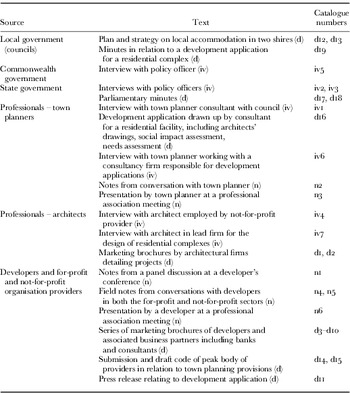
As noted earlier, Australia has a complex mix of policy, funding and regulation surrounding older people's accommodation. All levels of government in Australia have explicit policies and distinctive responsibilities alongside shared responsibilities. The Commonwealth Government is responsible for ageing policy that includes care and support, health and active ageing. As such, the Commonwealth funds nursing home places and manages quality and compliance in the residential care sector. Retirement villages are subject to state government legislation including that relating to fair trading. Local government (council) is responsible for town planning regulations and ensuring that complexes adhere to the Australian Building Codes. As such, care facilities and retirement villages are subject to local planning regulations. However, local government planning sits within the jurisdiction of state government with adherence required to legislation such as the South East Queensland Regional Plan. Under the Integrated Planning Act 1997, the Queensland Government Minister for Local Government and Planning can call-in and reassess development applications that are being considered by a local council.Footnote 2 The minister's decision is final and not subject to appeal. Texts in the form of policy documents or interview data were included from across this complex mix of policy stakeholders. Altogether the corpus has 32 text items that represent the broad range of relevant sectors. Table 1 itemises and describes the sources of data using a series of catalogue numbers, which are then cited in the findings section.
Data sources

Notes: d: document. iv: interview. n: note.
Gaining visual evidence of the geography also provided a valuable supplement to the data, as it provided a clear indication of the physical spatial attribute being studied. This methodological choice respects the centrality of the visual to the construction of our social life, as well as Lefebvre's epistemology. Visual material in the form of maps, pedestrian and windshield surveys,Footnote 3 and photographs of residential complexes, were also collected. These forms of data have been used to good effect by geographers (May Reference May1996) and planners (Grant Reference Grant2005), and are increasingly employed by cultural studies scholars (Rose Reference Rose2003, Reference Rose2007).
Participants for the interviews were purposively sampled to represent the major agencies and professionals involved in the planning, development and provision of residential complexes within south-east Queensland. As such, these roles are an operationalisation of Lefebvre's ‘experts’ who conceive the living environment of older people. The interviews were semi-structured, guided by a similar set of questions that varied slightly according to the interviewee's profession. The questions centred on understanding their role in the development and planning of complexes, and specifically: (1) what policies, regulations, and influences affect their role; (2) what informs their role; (3) how do they conceptualise how the complex will look and function; (4) who else is involved in planning and development; and (5) what is the place of consumer involvement and feedback?
Data analysis
The documents were analysed with the aim of exploring the working ‘knowledge’ of the professional stakeholders. This exploratory framework respects Lefebvre's observation that ‘only non-directive interviewing can give a proper account of habitation. The people concerned must be allowed to speak, and the interview is orientated towards the specific activity the researcher is studying (in this case, habitation), leaving scope for free expression’ (Lefebvre Reference Lefebvre, Elden, Lebas and Kofman2003: 127–8). All the texts were analysed using discourse analysis. The analysis looked at how development professionals use specific terminology either in a written or spoken form, alongside an integration of wider social and political contextual material. The use of discourse analysis respected the methodological pointers outlined by Lefebvre and was tailored to fit the project's aims (Jaworski and Coupland Reference Jaworski and Coupland2006; van Dijk Reference van Dijk1997; Wood and Kroger Reference Wood and Kroger2000).
The main approaches considered useful for this study reflect a number of perspectives and disciplines, including ethno-methodology, conversation analysis, pragmatics, critical discourse analysis, as well as visual methodologies for the images in documents (Rose Reference Rose2007). Thus, for example, the tailored analysis includes the key terms: social acts, drawn from Austin's speech act theory, that by talking we perform one or more social acts (Gomm Reference Gomm2004); ambiguity, where it is not possible to clearly assign sense to words except by recourse to the context, as well as where ambiguity may be purposively used to suggest a desired scenario (Locastro Reference Locastro2003: 46); presuppositions, concerned with the implicit meaning of language, and which are often part of the background and can be seen as unstated assumptions (Slembrouck Reference Slembrouck2006); lexical choice, the choice of words pinpointing opinions and attitudes, and showing local meanings (van Dijk Reference van Dijk, Wodak and Meyer2001); paradigm analysis, which considers the range of alternative language possibilities and the choices that are made among them in texts (Wetherell, Taylor and Yates Reference Wetherell, Taylor and Yates2001); and semiotic analysis, which offers tools to interpret images through the use of signs and codes, and assists in ‘seeing’ the persuasive talk of advertising (Beasley and Danesi Reference Beasley and Danesi2002; Rose Reference Rose2007). Furthermore, discourse analysis requires a particular orientation to texts (whether they be transcriptions, advertising material or documents) accounting for what is there and what is not there whilst being open minded. Paying attention to absence is integral to this process. All tools are identified by italics in this article's findings, and are included in order to convey the integrity of the theoretical approach.
The strategy for interpreting the data closely followed the recommendations of Wood and Kroger (Reference Wood and Kroger2000) and involved the adoption of a disciplined and systematic procedure. A number of templates were developed that incorporated the varieties of discourse analysis tools and prompts appropriate for the specific task. Analysis was approached in a cyclical manner by the first author, with the overall goal of explaining the structure and organisation of the discourse and how it can assist understanding particular functions, effects or consequences. What is being done in the discourse and how is this accomplished? The pathway taken with this study's analysis commenced with an initial reading and listening (if an interview) to the discourse, and making decisions on which parts to analyse, as well as the size of the unit to analyse. In transcription form this was usually half a page of dialogue, or a paragraph in a document. Not all sections of text were included in the analysis. This was guided by the research question and by referring to the theoretical dimension representations of space iteratively throughout the data analysis. It was necessary to listen to interview tapes and to read texts multiple times to achieve the analysis. This material was then broken up into smaller parts, identifying subjects, verbs and clauses. From this detailed work interpretations could be determined; these sections of transcription were then copied to that part of the template, such as membership category or lexical choice, with analysis notes added beside it. This provided a traceable path for the analysis. Therefore, this stage of the analysis essentially consists of a detailed and repeated reading of manageable sections of the discourse, usually sentences, against the background of the different discourse analysis perspectives.
The second stage of the analysis required identifying a pattern both within a text and across different texts. The claims, such as the presupposition of ‘dependency’, were checked and refined within the singular document before all claims were checked and refined across multiple documents. All the segments relevant to a particular concern were then assembled as the starting point for presenting evidence in the discourse. A critical part of this process is searching for exceptions or counter-arguments to the claim. Identifying ageism as one theoretical perspective and pattern in the data, for example, permitted the exploration of more positive representations of older people as an exception to include in the analysis. At this stage, context is also an important consideration, and it includes the micro elements that may have a bearing on the interview such as the setting, sourcing the document, the document's intended audience, and news reports of a development. Overall, the systematic and cyclical nature of this process assisted with issues of trustworthiness, as findings are checked in regard to its use in further analysis. All sections were revised after other sections were analysed. Analysis was continued until it was felt that the research question had been addressed and that a reasonable reading of the discourse can be offered. This process is in line with the recommendations of Potter and Wetherell (Reference Potter and Wetherell1987, Reference Potter, Wetherell, Bryman and Burgess1994) and with discursive analysis in social psychology (Hutchby and Wooffitt Reference Hutchby and Wooffitt1998), conversation analysis (Pomerantz and Fehr Reference Pomerantz, Fehr and van Dijk1997), and critical discourse analysis (Fairclough Reference Fairclough1995). Rigour was assisted by the systematic approach to data reporting, demonstration of the process of analysis, inclusion of negative case examples and systematically questioning and reflecting during all phases of analysis of the data (Fook Reference Fook1996; Padgett Reference Padgett1998). Furthermore, for ease of reading, data are presented in a standard manner in this paper, not according to linguistic guidelines (seePetersen Reference Petersen2009 for use of Jefferson's transcript notation).
Findings
This paper focuses on how professional stakeholders provide representations of space; how they conceive the space of residential complexes. These findings explore the working knowledge of professionals involved in the planning and development of these complexes and illustrate the way older people are represented in the professional discourse. The headings all represent assumptions evident within the texts, beginning with the prevailing assumption of a crisis of ageing and that, within this context, older people inevitably need care.
Older people are dependent and need care
Professional stakeholders were found to hold presuppositions linked to common stereotypes of increasing dependency with older people as they age. The statement in a development application, ‘the old sites will be rebuilt to meet the ever increasing needs of our elderly’ (d16) rests on the assumption that the reader will ‘know’ as people age they become needier. The statement is conditional on a widespread tacit acceptance of this ‘common knowledge’. The ambiguity of the word ‘needs’ can be linked to a number of spheres, the demographic changes with increasing numbers of older people and/or the assumed increasing need for older people to have support and care. Within this document, a development application for a residential complex, this assumption was expressed clearly, ‘as Australians get older, their dependence on outside care increases and people's ability to remain in their own home decreases’.
Whilst this is the case for some people, statements such as this form truth claims whereby all older people are treated the same and equated as dependent. This truth claim is also seen with the statement within the same development application, ‘it is a well known fact that as people age their health weakens and the need for care is increased’ (d16). This statement appears credible given that it is made by a well-known provider of aged care who has expert knowledge. Presuppositions are also seen in the statement: ‘[developer's name] is desperately trying to stretch out to care for the growing aged population in Queensland expected to rise by more than 270 per cent to one million people within the next four decades’ (d16). A number of images are evoked with this statement. The lexical choice of ‘desperately trying’ evokes the existence of crisis with the ageing population as well as a humanitarian role of the developer. Also inherent is the presupposition that all of the population will require care.
The need for residential complexes is repeatedly linked to a crisis in the lack of care facilities for older people by professional stakeholders. Parliamentary addresses by one state government minister noted that ‘there is a clear and pressing need for aged care facilities in the community’ (d18) and ‘it will be used by [provider's name] for sorely needed aged care beds’ (d17). Both statements are truth claims supported by the status and power of the minister. The lexical choice of ‘aged care beds’ is a common expression for older people's rooms in high-care facilities and rests on the perception they are a scarce resource. As a result, residential complex development is piggybacking on the common perception of a shortfall in nursing home places, which is in itself a contested notion.
Professional stakeholders make assumptions relating to a pathway for older people. As highlighted by one Commonwealth government policy professional, there is a ‘flawed assumption … just because someone goes into a retirement village doesn't automatically mean that they will go into an aged care service’ (iv5). This presupposition of a progression was seen in one council policy strategy: ‘a qualitative survey of aged persons’ accommodation highlights the disparity in the number of higher care facilities compared to lower care or independent living units, such as retirement villages' (d12), which associates all older people with a need for care at some stage of their life. This presupposition brings with it planning issues, as noted by a town planner when discussing an aged care facility:
[there is] … generally obviously a progression but also … making the observation the transition from retirement sort of living to a residential aged care is also you know … that I guess some issues raised about siting those facilities together is actually in some ways … maybe some reluctance to do that in that people staying in the retirement part of don't want to know what's ahead of them … that next stage so to speak (laughter). (iv1)
This material highlights a connection between framing older people as frail, dependent and needing care, to the development application process of a residential complex. McCann (Reference McCann2002) made the point that strategies that link a development's economic outcomes to a set of humanitarian values, in this case ‘caring for the elderly’, are generally seen to be above reproach. To consider further McCann's linkage of development with humanitarian values, it is important to examine both the wider discourse that attaches dependency and care with residential complexes and the claims about the economic outcomes of residential complexes for older people. In terms of the wider discourse, Australian policy at all levels of government (Commonwealth, State and Local) and particularly the funding arrangements, certification standards and planning laws reinforce the connections. This is not to suggest that regulation is misguided or inappropriate, but demonstrates how the policy discourse frames older people as dependent and thereby contributes to ageist assumptions such as their dependency and the need for care.
According to one council's strategy, residential complex developers require at least 120–140 units to be viable (d12), which necessitates very large sites. In addition, situating retirement villas with care facilities is a planned initiative by developers. As related by one developer, ‘we actually need to turn out a lot of independent living villages, they make the money, and as part of social responsibility we need to deliver some high level care’ (n1). These texts also reveal the awareness that community and council support is more likely if a development is framed as care. Thus, as another developer stated, ‘the option of having a low care high care facility definitely would be appealing to the council … it helps to sell it, no question about it’ (n1). The not-for-profit sector, the traditional providers of care facilities, are able to generate surpluses from developing retirement villages, a vital source of revenue given that Commonwealth funding is focused on care not infrastructure. In this context, it can be seen how lexical choices such as ‘aged care’ used in relation to the development of residential complexes is in part a justification to both the council and the community for support. A developer's press release on winning a planning appeal made the statement ‘the decision meant older people in [suburb] will get the aged services they needed’ (d11).
Linking the economics of development to humanitarian values requires understanding developer's economic priorities and the profit motive evident across all parts of the sector as well as the role of speculators, finance companies and banks in the industry. The social act of business acumen is evident in the following statement from a developer, ‘my motives are less altruistic than others here; I am purely driven by profit’ (n6). One developer from the not-for-profit sector related that his agency developed and managed retirement villages to fund their core business of providing free welfare services to children (n5). According to one town planner, ‘the for-profit sector saw a dollar in it and started entering the market’ (iv6). This is in line with Stimson's (Reference Stimson2002) view that the interest from the for-profit sector grew from an awareness of both the growing number of older people and the financial success of the not-for-profit sector's retirement villages. This was evident in a developer's brief for an architecture firm ‘to design a product that is marketable, saleable … good … operational … ensure good functionality and efficiency … maximises yield … at the end of the day we are here to make money’ (n1).
It is thus proposed that presenting older people as dependent is tied to the need for development applications to be approved and for profits to be made. The industry, both for-profit and not-for-profit organisations, focuses on creating revenue and surpluses from developing residential complexes. As one developer summed up, ‘just because they are not-for-profit doesn't mean they don't make a profit; they usually don't use the word profit like a developer might, they talk about surpluses and so they may still produce a surplus’ (n6).
Exceptions to the dependent discourse were evident in the working knowledge of some professionals. Healthy ageing policies were exceptions to the crisis discourse, and were integral to the working knowledge of policy actors at the Commonwealth and state government levels (iv5, iv2, iv3). Local government policies were however peppered with assumptions. Truth claims such as ‘like others, many older people struggle to keep pace with change’; ‘many are forced to leave home’; ‘decreased mobility for all as they age’; ‘home increased importance to older people’; ‘inevitability of older people moving to nursing homes’ were present in one key policy document (d12). Such truth claims are concurrent with a strong dependency and care discourse. With lexical choices such as ‘forced’ and ‘inevitably’, a lack of agency is reinforced. Presuppositions that older people cannot continue to live and age at home weakens the notion that this council recognises the diverse needs and capacities of older people, and hence their support of the strategy of healthy ageing.
The absence of older people in the development process
The analysis identified not only a focus on dependency but also revealed that older people were absent from a considerable number of the texts, even though the central concern was the living environments of older people. This manifested in a number of ways. First, the places in which older people live are presented as synonymous with ‘aged care beds’ or ‘bed’ in interviews with some professionals and in a development application (iv4, iv7, d16). Further, the references to demographic factors in council reports used the phrase ‘inventory of beds’ (d12, d13), and success in receiving funding was termed ‘taking bed licenses’ (iv4, n1). These word choices are long-standing and commonplace in the Australian health and welfare sectors. A paradigm analysis provides awareness that the word ‘beds’ is chosen in preference to the words older person, place or home. The repeated use of the lexical choice ‘bed’ substitutes the individual by a single object. It also acts to redefine a person's home as a single attribute, a bed or perhaps a (shared) room and, as such, dissociates the space from the intended occupiers, older people.
The absence of older people is most apparent in the advertising and promotional material produced by architectural firms and financial institutions. Architectural firms promote their buildings and design features by ‘redefining lifestyle through architecture’ (d1). However, who this lifestyle is for is not mentioned; the only clue in the four-page brochure is the use of the word ‘retirement’ (d1). Moreover, there are few references to the everyday lives of older people. In one architecture firm's brochure, the only representation of an older person was a caricature, signifying wealth, leisure and choice. Lexical choices of ‘upmarket resorts’, ‘recreational’, ‘draw on lavish residential facilities in US’, ‘exclusivity’, ‘limousine service’, ‘5 star’, ‘salubrious’, ‘most desirable and prominent senior's projects’ reinforce the pitch for status and luxury (d2). Whilst it is acknowledged that the purpose of the brochure is to promote architecture and design to developers, and to encourage investors, the brochure makes no reference to who will live there, how they will live, and how the design will add to their life. This demonstrates the restricted knowledge and awareness of professionals and their separation from older people, and particularly with the implied intentionality that people are secondary to buildings, to design, and to property development. This commercial and investment focus is reinforced by this statement in an architecture firm's brochure:
with three developments currently under way … and a further three projects in the pipeline … [firm's name] has recognised that the recent revitalisation of the retirement property sector offers a unique opportunity to create large scale, high-end projects that cater for retirees seeking the very best in accommodation for their twilight years. (d2)
It is interesting that businesses refer to ‘the retirement village industry’ even though it is evident in their brochures that the sites are complexes, with ‘elaborate care facilities such as assisted living, skilled care services and memory support facilities with a hotel/resort-style environment’ (d2). Whilst the focus on property is totally acceptable within the industry, the absence of older people is paradoxical, particularly as the marketing material is pitched at having older people's quality of life as central. The contrasting evidence outlined in this section asserts that the intention, or the core interest, is property development.
Older people are marketable and ageless
A large portion of the marketing material used by professional stakeholders disguises ageing, as it constructs an image and lifestyle that belies its realities and is unattainable to many. Seemingly representing ‘successful ageing’, these images in effect perpetuate a myth of agelessness. The employment of a basic semiotic analysis to this printed material provides evidence of the persuasive techniques (Mulholland Reference Mulholland1994) employed by the professional stakeholders.
Images within advertisements targeting the retirement village market commonly utilise models that appear to be much younger than the average age of residents (which is 72 years at entry). Indeed the images are often similar to the chic and relaxed visitor evoked by tourism advertising material, with text that signifies problem-free choices. Images such as this can be criticised for masking ageing, given the model's age does not match that of a residential complex resident. Conversely, it could be argued the images represent the ideals of successful ageing. This reinforces Holdsworth and Law's (1994) point that frailer older people are largely excluded from the construction of the lifecourse. A developer's statement, ‘we don't want young ones in there, we want our money back’ (n1) reinforces that the construction of agelessness is a marketing tool of promise.
This evidence is strongly reinforced by the writings of Glenda Laws (Reference Laws1995, Reference Laws, Jamieson, Harper and Victor1997). She asserted that the marketing of a lifestyle to be consumed is purposively conducted to attract a niche of the ‘third age’; a market perceived to be interested in continual leisure, where the frail body is excluded. This is reinforced in the present study, where the lexical choices in marketing brochures describe these complexes as ‘upmarket resort’, ‘golf course resorts’, ‘5 star’, alongside an absence of frailer people though they too live in these complexes (d3–d10). In summary, this first section of findings has explored how professionals represent older people in order to promote the development and marketability of residential complexes. The following section will focus on the ways that older people's spaces are represented as being separate and segregated from others, and as distinct from ‘home’.
Older people inhabit large separate spaces
The size of residential complexes is treated as a ‘matter of fact’ by the industry, as seen in the truth claim of an architect, ‘we have massive buildings; that is what they are and that is what they need to be’ (iv4). This statement is not explained further; no evidence is given as to why they need to be like this. Certainly these complexes are big; the complex under construction outlined in the provider's development application is ‘256 beds, 72 serviced apartments, 180 Independent Living Units with 402 parking spaces … and gated’ (d16). Council reports on older people's accommodation note that developers prefer large sites ranging from a site area of five hectares to ten hectares with a ‘yield of more than 200 units’ (d12, d13). A council report and interview with a Commonwealth policy officer both note the footprint for a care facility is smaller, relating 60 places are needed to ensure financial viability (d13, iv5). With both ‘models’ on one site, the combined footprint is very large, with some developments the size of small towns.
In line with the marketing trends discussed earlier, the size and design of residential complexes draws on trends in the USA for large-scale ‘retirement living’. Australian architectural firms travel to the sun belt of Phoenix, San Diego and Las Vegas to view models of design and management for a burgeoning senior's living market (d2). ‘Lavish recreational and residential facilities are seen to be what is required over the next two decades to accommodate a doubling of the number of Australians aged 65 and over’ (d2). Care facilities are included within the ‘hotel/resort style environment’. They are marketed as a solution to demographic change, as noted by one developer, ‘what drove me is the demographics’ (n6).
Not-for-profit providers note that they are unable to compete with residential and commercial developers for land and are often restricted to the urban fringe. This was noted by one town planner, who suggested that they are ‘pushed to the margins’ (iv6), and an architect who said that ‘they are always on the back of somewhere … with politicians wanting you to do it somewhere else, and land developers only want to sell you land at the back of somewhere’ (iv4). The same sentiment was expressed in council minutes, ‘Members of Parliament steer you to outer areas’ (d19).
It is important to note that there is evidence to suggest the acceptance of the large sites, particularly in regard to the location, is disputed. Some neighbourhoods contested development, and some professional stakeholders demonstrated a lack of engagement with the size and location of complexes. This is illustrated in the statements made by a state government policy officer and town planner relating to the size and location of complexes, and in particular their distance from transport and services. The discourse tool of ambiguity highlights this lack of engagement, with the statement by the government policy officer: ‘[It is] a grey area in terms of planning because they are private businesses you know’ (iv2); and the town planner's statement ‘[they are] pretty big blocks raises issues but be that as it may’ (iv6).
As well as accessibility, the use of restrictive gates and large fences are other points of contention. In a planning submission, it is suggested that
gated communities [are] tapping into a perceived need for security by older people. Security is one of the major reasons that residents choose to move to a retirement complex. … Greater permeability can only come after councils can demonstrate reductions in traffic and crime and antisocial behaviour through physical design in their areas. (d14)
Here, discourse analysis tools of justification, euphemisms and truth claims are used to position developers as advocates of security for older people, which is difficult to argue against. However, other potential outcomes such as segregation or social isolation are not mentioned or discussed. Further, providing physical barriers, such as gates or large fences, also contradicts the claims of advertising material aimed at older people who are considering moving to a residential complex. Here, speech acts of promise highlight that developments promise ‘friendship and social opportunities’ and will ‘rekindle the sense of community spirit’ (d5). Euphemisms such as ‘community spirit is often lost in modern neighbourhoods’ presuppose that life outside a complex does not provide this and could be linked to the common perception of isolation in Australian suburban life. However, the potential for isolation from the broader community is not addressed in these documents.
Residential complexes are segregated within
As well as being located away from communities, complexes are often internally divided. Developers view spatial modifications as necessary if a complex incorporates both a nursing home and a retirement village. A number of sources highlighted the need to divide (hide) the nursing home from the retirement village. These views were expressed openly by professional stakeholders, who have established a membership category, one which can be linked to the marketing of residential complexes. Older people within nursing homes are attached to the category representing mortality. According to a town planner, nursing homes are a ‘last resort’ and, as noted above, are linked to ‘a progression from retirement living to residential care’ (iv1).
The assumption relayed by a town planner is that ‘people staying in the retirement part don't want to know what lies ahead of them’ (iv1). This perception is ‘very strong’ among developers, as noted by a town planner, of the importance of separating active from frailer older people:
they don't want to be reminded and therefore often in our brief, and the architect's brief is a requirement to have separate entries, separate addresses, you know different streets … certainly in terms of entry and exits they would be very divorced. (iv6)
Active older people presumed to be living in the retirement village thus form a different membership category, one that is the face of marketing campaigns for residential complexes, and quite separate from the frail aged. Thus, the comment by one developer that ‘you don't want to look at them … don't want to see it every day’ (n7) suggests segregation within a segregated space; a manifestation of spatial ageism.
Residential complexes are of one type
Furthermore, professional stakeholders rarely discuss alternatives to separate spaces for older people. On the whole, recognition of other accommodation options were absent in the documents analysed. A council-commissioned report to consider the provision of residential aged care and retirement housing limited its focus largely to residential complexes (d13). By considering absence, we note that integrated models of supported accommodation, cohousing, and retro-fitting houses for universal design were not considered. In discussing with a number of professional stakeholders what informed their role in planning and design for older people, hesitation and silence characterised a number of responses (iv7, iv1), as well as ‘not thought about it’ (iv1, iv6).
Furthermore, strong and effective advocacy by a peak body representing providers also has the consequence of restricting consideration of alternatives. Through evoking bias or lack of support for aged care, the text positions the reader to agree with the report's recommendations. The peak body's submission contains strong assertions of ‘unwarranted intrusion into assessment procedures’ and ‘bias against proposals involving an aged care component’ linking it to the ‘detriment of the end user, the older person who typically is financially vulnerable’ (d14). It asserts that in relation to the community consultation process, ‘this type of requirement appears to assume that aged residents represent an alien life form living in our midst’ (d14). This is reinforced by one town planner, who said that ‘treating housing for the aged as some sort of leper community … that may not come out quite right but, you know, not some aliens with two heads’ (iv6). The lexical choices in these quotes effectively mobilise support for their submission. The reader is challenged not to be prejudiced against older people by not supporting aged care. Further, the overall effect is to repress discussion of alternative options for accommodation of older people.
Residential complexes are not home
A body of assumptions about older people's preferences in terms of living environment is a manifestation of the professional's planning and logic. Representative or truth claims present these assumptions as an architect's professional skill, ‘now if I understand how the residents want to live in there which is the first priority and I think I do have a feeling for that because everyone knows how they would like to live in that facility’ (iv4). The working knowledge of another architect also consists of justifications about the design of aged care facilities:
from a resident's point of view an aged care facility wants to be as much like home as you can possibly make it … it is never going to be home some people pretend it will be it's never going to be home because at home most of us don't live with people not related to a dozen people and most of us do not have a lot of aids around to enable mobility. (iv7)
Implicit within these statements is a recognition of the need for facilities to be home-like, and justification is presented to account for the architect's working knowledge; ‘You know it was more like designing a hospital or a surveillance place or not someone's home and I am now looking at it as a marriage of the two and that is purely what it is’ (iv4). Justification is needed to move from the humanist knowledge of older people's preferences to professional knowledge. The professional knowledge of the architect is concerned with ‘the most efficient layout in respect of design’ and starting with what's viable you know how many beds do you put together in a cluster' (iv7). This is observed by Regnier (Reference Regnier2002) as the single largest challenge architects face in designing facilities. He notes the difficulty of creating an attractive residential setting that is large enough to meet economy-of-scale requirements for efficient, functional service production. Constructing a sense of place is also part of design professional's working knowledge. Whilst the meaning of sense of place varies across disciplines, participants viewed it as a sense of compatibility with the built environment, something that can be rectified. Town planners see there is ‘always a design solution’ (iv6), such as the ‘cute is beaut’ cottage-style residential facilities that were built in small numbers in Australia in the 1980s (iv7). This gives the impression that sense of place can be manufactured.
The place of humanism is evident with recognition of the needs of the frail, ill and disadvantaged. State government policy professionals saw their role as ‘supporting vulnerable seniors’ (iv2, iv3). One professional, an architect, talked of ‘being personally touched’ by seeing first-hand life in a nursing home, speaking with partners of people in care culminating in the resolve, ‘convinced you need to do your best’ (iv7). The interplay of humanism and economics was clearly evident, and in the minds of a number of professionals, residential facilities are ‘the last resort’ (iv1, d13). Their concern is focused on the end of life rather than about living, and aimed at giving a ‘typical honourable ending’ (n1) and to ‘do your best’ (iv7). Despite this evidence of humanism and concern, it is clear within these texts that business motives dominate. The final section now discusses how professional stakeholders develop and utilise a sophisticated marketing and lobbying exercise to promote large-scale development, and how they respond to some of the issues relating to the promotion of large residential complexes.
Professional stakeholders utilise lobbying
The contested nature of large residential complexes necessitates the use of advocacy by development professionals if they are to secure support for the development. This is because there is often potential for significant community and local government opposition. As summed up by an architect interviewee, ‘when you're dealing with putting up a submission for quite a large facility it becomes political’ (iv4). Evidence from this study shows that advocacy by developers includes that undertaken by their peak body, as well as consultation with powerful stakeholders, and targeted and highly purposive networking in the community.
Providers, both not-for-profit and for-profit, lobby members of parliament and councillors in relation to proposed developments. In minutes of council meetings, one councillor related that a not-for-profit provider received support from a member of parliament for a controversial development (d19). This councillor asserted that providers subject community and neighbourhoods to ‘very great pressure’ by seeking to construct residential care facilities (d19). Within this address the councillor tempered these points with expressive speech acts praising the developer numerous times including ‘great work [name of provider] does’, and ‘people in [name of provider] motivated by good … provide worthwhile facility’ (d19). Implied within these comments is the public standing and power of the developer.
In turn, one development professional with this provider categorised councils either as negative, by describing them as ‘they make it difficult’, ‘aggressive council’ or ‘political’, or as more positive, as in ‘happy with that type of council environment’. This binary was linked to the former council rejecting a development application, the latter embracing a development. Both sectors – the developers and the government – imply that power is held by the other. Developers establish their credibility and experience with development applications by positioning themselves as a reliable knowledgeable provider, and thereby legitimise their role in the development. This is a form of marketing, as is evident in one report commissioned to explore a proposed new development. This contained no references or statistics, instead blanket statements such as there are ‘no disadvantages to the complex’ (d16). Town planners see their role of assisting in this process, and use lexicons such as ‘advocate’, ‘represent’ and ‘facilitate’ (iv1). ‘[We] need to make it happen’ (iv1). It is a ‘small p political exercise … denied by the planning industry … the goal is to get the project through the system’ (iv6). They are aware, however, that developers are keen to ‘push their own barrow’ (iv1). These forms of marketing suggest an integrated and sophisticated mechanism aiming to promote residential complexes as housing for older people. The sophistication of the advocacy and lobbying undertaken by the professional stakeholders, and their horizontal integration, provides evidence of their influence.
Overall, the evidence considered in this study outlines the features of the template utilised by professional stakeholders to construct the spaces of older people as a separate space. The segregated nature of this space is a long-standing feature of older people's accommodation in Australia. The legacy of government policy, with its reactive features, has resulted in a default policy of segregated spaces for older people.
Discussion
The extent and means by which professional stakeholders construct the spaces of older people as separate in south-east Queensland is clearly evident in the data that we have examined. Given the power and prominence of the development professions, this results in not only setting older people aside physically in specialised spaces, but also socially and metaphorically. Stereotypes and assumptions about older people characterise the practice of development professionals, resulting in a lack of consideration of other accommodation options for older people despite the strong evidence in support of older people's preference to remain at home in the community. Although many professional stakeholders show respect for older people, their working knowledge is made up of assumptions, generalisations and commonplace euphemisms. Older people are represented as simultaneously dependent and ageless. These findings extend the writings of McHugh (Reference McHugh2003) and Blaikie (Reference Blaikie, Andrews and Phillips2004) on the myth of agelessness in the American and English context, respectively, and how this myth is employed by retirement communities to hide the reality of ageing. These generalisations are commonly a part of business acumen both in terms of gaining approval for development from local government authorities, and the need within both the commercial and the voluntary sectors to create profits. By asserting the commonsense reality of these assumptions and generalisations, professional stakeholders frame residential complexes as a solution to meet the crisis of the ageing population, and thereby gain community and council support. The marketing of older people as ageless for business purposes has the consequence of belying ageing and constructing ideals that are unattainable to many. It is proposed that these views result in the ‘othering’ and ‘essentialising’ of older people (Minichiello et al. Reference Minichiello and Coulson2005), and thereby constitute ageism.
Furthermore, it is clear from this study that the professional stakeholders' views of older people's lives has led to large separated spaces as the dominant purpose-built accommodation model for older people. The legitimisation, indeed promotion, of separate spaces for older people is a prerequisite for the survival and growth of a large number of businesses, not-for-profit organisations, and consultancies in the region. It is important to note this is linked to the regulated capping of public funding that limits monies available for developing care facilities (Access Economics 2009). The business model employed by these professionals is akin to that of the commercial property sector. It includes strong advocacy and lobbying, often paradoxically linking humanitarian values with economic outcomes. These models of development alongside the need for economies of scale, contribute to the custom of locating sites on the outer urban fringe of Queensland cities. Further, it can be argued that this combination of factors has shaped a specialised space of ageing, the residential complex, which in turn shapes conceptions of what are considered appropriate living environments for older people.
Within the current context of ageing in Australia, and given the advocacy that older people remain at home in the community, it is interesting that our findings show that the notion of creating ‘home’ is not part of the working knowledge of professionals. The practice of building complexes is also muddied by the custom of separating care accommodation from villas on the one site, a view that fits with the common societal perception that they are different spaces for business purposes. However, as asserted here, they occupy one site, the one space. Alternatives to this one large space as specialised accommodation for older people are rarely part of the working plans of professional stakeholders.
The aims of this study were exploratory and the findings are limited to a small sample of professionals in one Australian region. However, these results highlight the importance of adopting a spatial approach within gerontology. The operationalisation of representations of space, one dimension of Lefebvre's triad, raises the issue of how space is conceived and thereby provides a theoretical approach to looking at how professional knowledge informs design, form, and location of older people's living environments. The implications of this study for theory will be discussed in a further paper, but here it is noted that this theoretical framework is important in focusing attention on the professional practice of three key groups of professional stakeholders with responsibility for the development of spaces for ageing in this region of Australia. Findings suggest that there are links between their practice, the standing and growth of large residential complexes, and ageism. This supports and extends the thesis of Glenda Laws (Reference Laws1994) written over 15 years ago, of the links between the built environment and ageism. The industry practice of separating older people geographically has consequences for how society perceives older people, how they live and how they are viewed in society. Clearly more research is now needed to establish the relevance of these findings in other geographical contexts. However, these findings point to a need for gerontology to critically examine the response of providers and developers to develop large separate spaces as accommodation for older people, and policy's indirect support of this with the funding focus on care. It is asserted such an omission results in social gerontology being restrained from considering ageism, arguably its central tenet.
Acknowledgements
We would like thank the previous editor of Ageing & Society, Tony Warnes, for his careful consideration and support during the review process. Thanks are also due to our colleague John Minnery, who was involved in the overall design of the study. We owe a special debt to all the people who participated in this study, who graciously answered questions, and indeed showed such an interest in the overall project.