One of the most significant figures in the social and intellectual history of America was the Cherokee scholar, artist, and inventor Sequoyah. Sequoyah was born in the heart of the Cherokee homeland in East Tennessee in the eighteenth century. Sometime in the first quarter of the nineteenth century, after moving to what is today Alabama, Sequoyah developed an entirely new writing system for the Cherokee language, one that employed a syllabary structure that was easy for Cherokee speakers to learn. Sequoyah's writing system comprised 85 syllables in its final form, expressing all the sounds needed to reproduce the language. Because it linked written symbols to the spoken syllables used to communicate in Cherokee, the Cherokee Syllabary had no formal or structural relationship to the English writing system used by the encroaching white society. It was a Cherokee writing system intelligible only to Cherokee speakers. Once introduced, the Cherokee Syllabary spread quickly among the Cherokee people, and literacy became widespread (Perdue Reference Perdue and Kwachka1994:120). Known to even his own people as a creative but reticent enigmatic person, Sequoyah invented his writing system over an unknown period. In 1825, however, the Cherokee Nation adopted the syllabary as the official tribal writing system; literature, tribal records, religious materials, and a newspaper were soon available to the increasingly literate Cherokee public. Coming as the people were facing forced physical removal from their ancestral homelands by the United States government, the Cherokee Syllabary was immediately a source of pride and cohesiveness (Bender Reference Bender2002; Perdue Reference Perdue and Kwachka1994). For Cherokees, Sequoyah became a symbol of their unity and perseverance as they faced the Trail of Tears and the suffering and indignities that followed. From that time until the present day, Sequoyah has been revered as a giant of Cherokee innovation, intellectual achievement, and cultural identity.
In 2011, the prestigious international archaeological journal Antiquity published a paper by Rex Weeks and Ken Tankersley entitled “Talking Leaves and Rocks That Teach: The Archaeological Discovery of Sequoyah's Oldest Written Record.” In that paper, the authors argued that they had identified the earliest known examples of the writing system invented by Sequoyah, who was also known by the English name George Guess or Gist (Davis Reference Davis1930; Goodpasture Reference Goodpasture1921; Hoig Reference Hoig1995; Mooney Reference Mooney1900:108). Surprisingly, in contrast to all other known examples of early Cherokee Syllabary writings, these inscriptions were archaeological rather than textual, produced as petroglyphs in a small rockshelter/cave in Clay County, Kentucky, known as the Red Bird River Shelter site (15CY52). Moreover, based on characteristics of the inscriptions, along with supporting historical materials invoked in formulating interpretations, Weeks and Tankersley suggested that the Red Bird River Shelter inscriptions were not only the earliest known examples of Cherokee Syllabary writing but also were likely prototypes of Sequoyah's early syllabary development. The historical importance of these conclusions is obvious, and the announcement of these findings generated worldwide interest and commentary (Powell Reference Powell2009; Wilford Reference Wilford2009).
In recent years, as part of our ongoing study of Native American rock art sites on the Cumberland Plateau, we have visited and revisited many known rock art localities in Alabama, Tennessee, and Kentucky (Simek et al. Reference Simek, Cressler, Henson, Diaz-Granados, Simek, Sabo and Wagner2018). We have also documented caves in the region containing Cherokee Syllabary inscriptions (Carroll et al. Reference Carroll, Cressler, Belt, Reed and Simek2019), so we were particularly keen to visit the Red Bird River Shelter site. We did so for the first time in 2015 and have now been to the site on several occasions. Our research team includes an Anglo-American archaeologist (Simek), a Cherokee archaeologist (Carroll), a Cherokee scholar of tribal history (Reed), and a Cherokee language specialist (Belt). We have worked extensively with United States Forest Service archaeologists who manage the property (Adams and White). Even using Weeks and Tankersley's illustrations as guides, however, we have never been able to see the syllabary elements they argue are in the shelter. Instead, we see nineteenth- and twentieth-century Euro-American signatures overlying an important but very damaged set of much older precontact Native American line-and-groove petroglyphs. Furthermore, investigations of the documentary record concerning Sequoyah's life and his supposed travels to Kentucky during and after his invention of the syllabary do not provide the historical warrant argued by Weeks and Tankersley for Sequoyah's personal presence at the site.
In this article, we articulate the salient portions of Weeks and Tankersley's presentation and interpretation of Red Bird River Shelter. Next, we present the site, which has never been completely described in print. We then evaluate Weeks and Tankersley's claims for the content and history of the Red Bird River Shelter, focusing on two aspects of their argument: 1) evidence for early Cherokee Syllabary symbols in the site and 2) the historical evidence for Sequoyah's presence in Clay County, Kentucky, at the time the syllabary was being developed. This latter evidence is required if the thesis that Sequoyah authored any of the inscriptions is to be validated. Finally, we present a different interpretation of the Red Bird River Shelter petroglyphs based on our study of the site and what is historically documented about Sequoyah's life and his invention of the syllabary.
The Red Bird River Shelter Site According to Weeks and Tankersley
Weeks and Tankersley begin their study of the Red Bird River Shelter (15CY52) by very briefly describing the site, a small rockshelter/cave in Clay County, Kentucky. They then identify the site as the “grave site of Dotsuwa [ᏙᏧᏩ in the Cherokee Syllabary], or ‘Red Bird’, a Cherokee man who purportedly was murdered nearby by two American fur traders in 1796” (Reference Weeks and Tankersley2011:980). This association between the site and Red Bird, however, remains unconfirmed by historical evidence.Footnote 1 They go on to posit four chronological periods of petroglyph production at the site: “1) prehistoric; 2) late eighteenth century attributed to Dotsuwa; 3) early nineteenth century, most probably made by Sequoyah; and 4) recent” (Weeks and Tankersley Reference Weeks and Tankersley2011:980). The only reference they provide for these historical and archaeological assertions is an earlier paper by Tankersley (Reference Tankersley2006) that references little historic documentation.
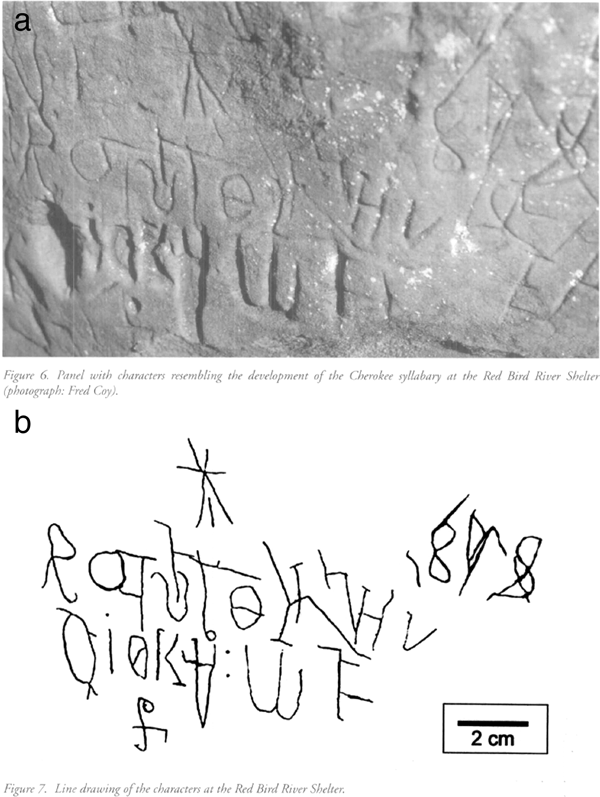
Weeks and Tankersley's argument focuses on one specific area of engravings located on the eastern interior wall just inside the shelter entrance, the only area of the cave where they see syllabary elements. The rest of the engravings in the shelter fall into their chronological periods 1, 2, and 4, although they do not distinguish which glyphs fall into which period. Our Figure 1 shows Weeks and Tankersley's view of this area, including a photograph of the panel by Dr. Fred Coy (Weeks and Tankersley Reference Weeks and Tankersley2011: Figure 6) and their interpretive line drawing of Coy's photograph (Reference Weeks and Tankersley2011: Figure 7). Based on their drawing, they argue that the lower right portion of the panel comprises prototypic Cherokee Syllabary symbols (Weeks and Tankersley Reference Weeks and Tankersley2011:985). In all, they suggest “19 characters can be plausibly identified” (Reference Weeks and Tankersley2011:983), and they undertake an epigraphic analysis of these inscriptions. Then, in their Figure 8 (Reference Weeks and Tankersley2011:986), they offer a tabular correlation of the Red Bird petroglyphic symbols with syllabary elements handwritten by Sequoyah himself and from the print press version of the syllabary developed between 1825 and 1828 to mass produce printed materials for consumption by the newly literate Cherokee people (these two forms of syllabary do not entirely correspond). Despite proposing that the Cherokee Syllabary correlates for all their identified Red Bird River Shelter elements and even arguing that some were “developing” out of more ancient pictographic symbols (i.e., were developmental prototypes), Weeks and Tankersley do not provide any translation for the inscriptions. Eventually they admit that some of the characters on the shelter wall do not look much like syllabary, but they suggest that is because carving them into sandstone would have been much more difficult than writing them on paper (Weeks and Tankersley Reference Weeks and Tankersley2011:986). They ultimately assert that “the Cherokee Syllabary at Red Bird River Shelter do not appear to consist of any recognizable words. Rather, the work seems to be experimental” (Weeks and Tankersley Reference Weeks and Tankersley2011:981). Again, no documentation is cited to support this view.
Weeks and Tankersley's interpretation of petroglyph inscriptions from the Red Bird River Shelter (15CY52) as Cherokee syllabary writing (Weeks and Tankersley Reference Weeks and Tankersley2011:985): (a) their Figure 6, showing Fred Coy's photograph of the panel where they see syllabary elements and (b) their Figure 7, showing a line rendering of the inscription. Used by permission from Cambridge University Press.

In addition to the syllabary symbols, Weeks and Tankersley argue that there is a date associated with the Cherokee inscription: “a date of ‘1808’ or ‘1818’ is inscribed to the immediate right of the syllabary” (Weeks and Tankersley Reference Weeks and Tankersley2011:984). They acknowledge, however, that the third digit of the inscription is difficult to discern.
In sum, Weeks and Tankersley's interpretation of one panel of petroglyphs at the Red Bird River Shelter is that it contains prototype or experimental elements of the Cherokee Syllabary produced in 1808 or 1818. Because historical documents indicate that the syllabary was in development around this time, they suggest that the Red Bird River Shelter inscriptions were made by Sequoyah himself. According to Weeks and Tankersley, he periodically visited his white father, Nathanial Gist, and other Gist relatives who lived in Kentucky. While on at least one of these visits, Sequoyah stopped at Red Bird River Shelter and tried out a few of his prototypic syllabary symbols as petroglyphs. He apparently intended no message in this exercise, or at least the experimental symbols cannot be read today.
Sequoyah and the Syllabary
In fact, little is known historically about the timing of the Cherokee Syllabary invention, and there is little consensus on its chronology of development (Bender Reference Bender2002; Hoig Reference Hoig1995; Perdue Reference Perdue and Kwachka1994). Moreover, there is uncertainty as to the nature and timing of many of Sequoyah's life events (Hoig Reference Hoig1995). We do know that Sequoyah was born in East Tennessee, where Cherokee people were frequently in contact with Euro-Americans, including government officials, soldiers, and missionaries. Sequoyah moved with his family sometime in the early nineteenth century to the Cherokee community of Willstown in Alabama. At that time, Alabama was outside the United States, but interactions with white merchants and missionaries were common.
We also know that Sequoyah mustered into Andrew Jackson's US Army in 1813, in Alabama, to fight the Red Stick Creeks. According to Hoig (Reference Hoig1995), Sequoyah joined John McLamore's company of Mounted and Foot Cherokees, in which all noncommissioned officers and troops were Cherokees, including Sequoyah's relatives George and John Lowery. He mustered out in 1814 and returned to Willstown after this military experience. There is no mention of Sequoyah's syllabary in any documents dating to before his service with the US Army, but it is certain that his life experiences gave him ample occasion to observe the use of writing as a means of keeping records and communicating over distance. He certainly understood the value of literacy, even if he did not speak or write in English.
Most scholars agree that much of Sequoyah's syllabary development occurred in and around Willstown. Foreman (Reference Foreman1938) suggests that Sequoyah's development process began somewhere around 1809 and lasted 12 years. Thus, the 1808 date proposed by Weeks and Tankersley would be very early in the process indeed, and even their 1818 date would represent the earliest currently known examples of the writing. A contemporary record based on conversations with Cherokees who knew Sequoyah in Willstown, however, suggests that he began developing the syllabary in 1820 and had a working system by 1821 (Payne and Butrick Reference Payne, Butrick, Anderson, Brown and Rogers2010:136–138). McKenney and Hall (Reference McKenney and Hall1848) say Sequoyah was inspired to invent the syllabary in the Cherokee community at Sauta near Willstown in 1820 and completed his invention in 1821. This beginning date may seem late for some (Hoig Reference Hoig1995), but it wasn't until after 1821 that the Cherokee Nation, its representatives, and Sequoyah began working on a printing press design for the syllabary. We know that the Cherokee Nation adopted the syllabary as its official writing system in 1825. A development date beginning in 1808 seems early given most historical narratives, and 1818 might also be too early given many accounts. Based on their interpretations of the third digit in their perceived date, however, Weeks and Tankersley identify the Red Bird River Shelter inscriptions as very early Cherokee Syllabary, “experimental,” and produced by Sequoyah himself.
The Red Bird River Shelter Revisited
Before describing the Red Bird River Shelter and petroglyphs, we make a few general observations about our perspective on the site. We do not argue that Cherokees were not in Clay County, Kentucky, historically; they certainly were. We do not have anything to contribute to debates about the reality of Chief Red Bird, for whom the site and the adjacent river are reportedly named, although there is little historical documentation concerning Dotsuwa. We also want to be clear that we believe the Red Bird River Shelter is a precontact period rock art site containing a variety of petroglyphs including the incised lines and grooves, “bird tracks,” and pit motifs common in the prehistoric rock art of Kentucky and Tennessee. Information about the site was published several times by the late Kentucky rock art expert Dr. Fred Coy (Coy and Fuller Reference Coy and Fuller1969; Coy et al. Reference Coy, Fuller, Meadows and Swauger1997), who believed there were significant Native American components there. Coy and his colleagues were well acquainted with Cherokee history in Kentucky and never mentioned syllabary related to Red Bird River Shelter.
A Description of the Red Bird River Shelter Site
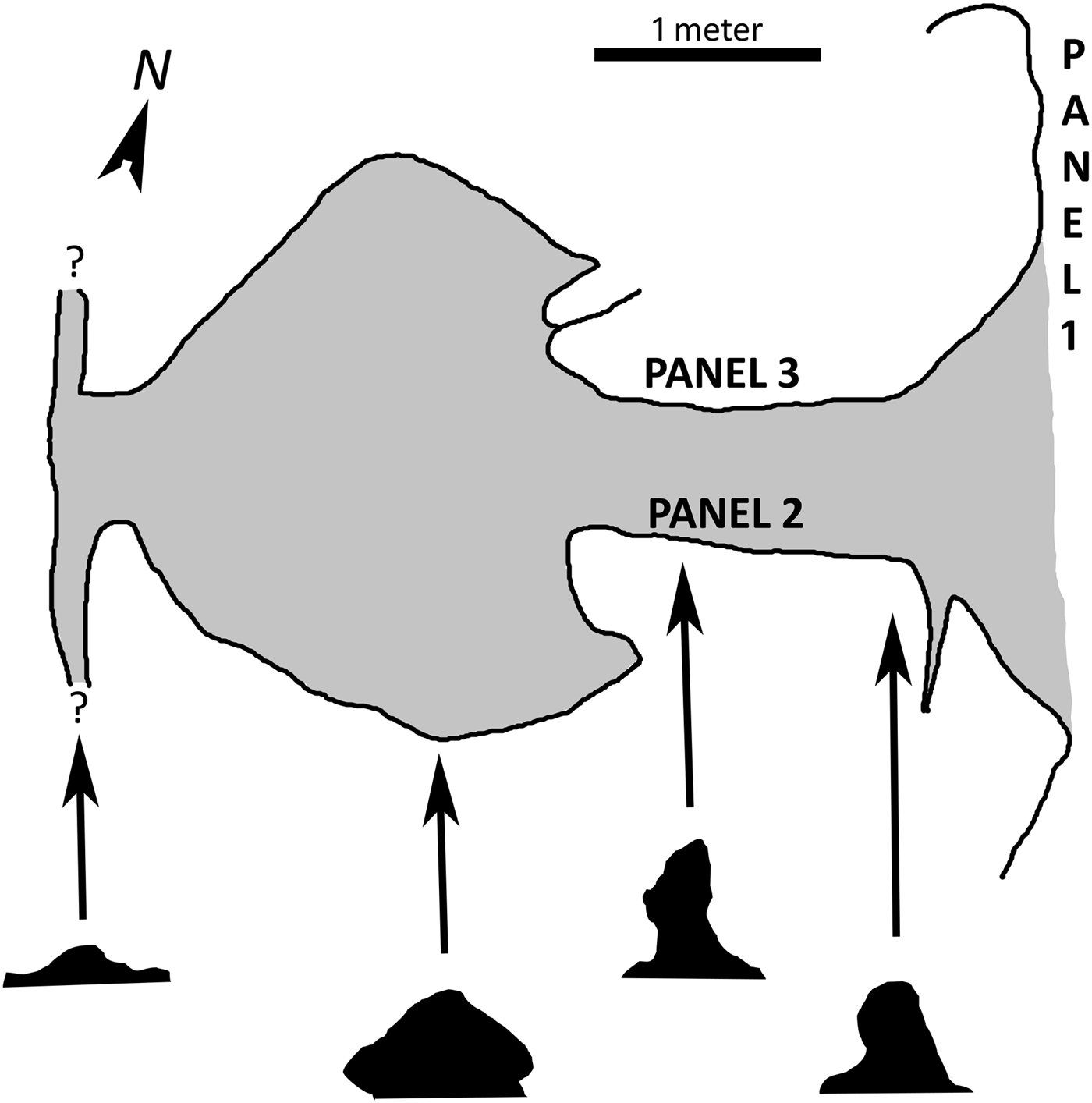
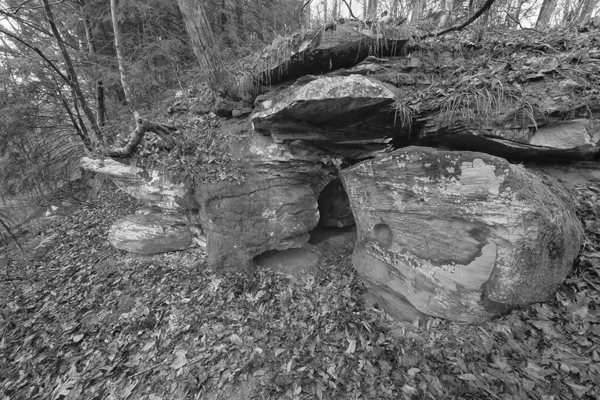
Despite being the subject of at least three publications (Coy and Fuller Reference Coy and Fuller1969; Coy et al. Reference Coy, Fuller, Meadows and Swauger1997:34–37; Weeks and Tankersley Reference Weeks and Tankersley2011), the Red Bird River Shelter petroglyph site has never been completely described, so we will do so here. The shelter was formed in the Pikeville formation, Breathitt group of the Lower and Middle Pennsylvanian period lithostrata of eastern Kentucky. At the shelter, these rocks outcrop as relatively soft, iron-rich sandstones with evidence of crossbedding and mineral precipitation within the rock matrix. Small and with characteristics of a cave (although not formed by solution), the Red Bird River Shelter is about 2 m wide and 1.5 m high at the entrance (Figure 2). Inside, the shelter constricts to less than 1 m wide in the entry passage, then widens into a small interior chamber. Overall, the shelter extends 5 m deep (Coy et al. Reference Coy, Fuller, Meadows and Swauger1997:34). Although loose sediments cover the shelter floor throughout most of the interior, we saw no archaeological materials on the floor, nor do Coy and colleagues (Reference Coy, Fuller, Meadows and Swauger1997) or Weeks and Tankersley (Reference Weeks and Tankersley2011) mention observing artifacts at the site. Thus, we have no chronological data for the Red Bird River Shelter beyond the inscriptions, including some dates, and their stratigraphic relationships. The shelter opening (Figure 3) faces SE (130°) at 24.5 m above and 40 m west of the main channel of the Red Bird River. The slope down to the river has a steep 61.25% gradient. As Coy and colleagues saw (Reference Coy, Fuller, Meadows and Swauger1997:34), the sheltered area is so small and the petroglyphs so near the opening that none of the engravings were ever in complete dark, except perhaps at night.
Plan map of the Red Bird River Shelter, showing locations of the petroglyph panels discussed in the text. The map shows the position of the cave walls some 25 cm above the sediment floor. The gray shows areas under the shelter overhang. The black sketches show the passage vertical form at sections indicated by arrows; these sections are viewed looking into the site from the east.

Exterior photograph of the Red Bird River Shelter. Panel 1 is visible outside and to the right of the shelter opening. Part of Panel 2 can be seen on the left interior wall just inside the shelter. (Photo: Alan Cressler)

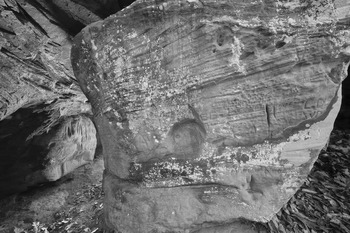
As noted, we have visited the site three times since 2015, and during those trips, we documented the petroglyphs and their context using high-resolution digital photography and on-site drawings. Based on our studies, we have distinguished three separate panels of petroglyphs and graffiti at the site, occupying different vertical rock faces. Panel 1 is outside the shelter facing southeast (Figure 4). It contains mostly recent graffiti, although there are some abraded circular pits, several deep vertical grooves, and perhaps an inverted trident-shaped bird track. The most prominent feature on Panel 1 is a human face or skull sculpted in bas-relief in the center of the panel. This image, however, is recent; Coy and colleagues (Reference Coy, Fuller, Meadows and Swauger1997:36–37) compared photographs of this panel made in 1969, when there was no face on the rock, to photographs made in 1993, when the face was clearly visible. Thus, there have been significant alterations to the site even in the past few decades.
Closeup of Panel 1. The human face effigy at the center was produced after 1969. Note the trident or bird track petroglyph, partially covered by lichen, to the left of the face. This is likely precontact in age. (Photo: Alan Cressler)

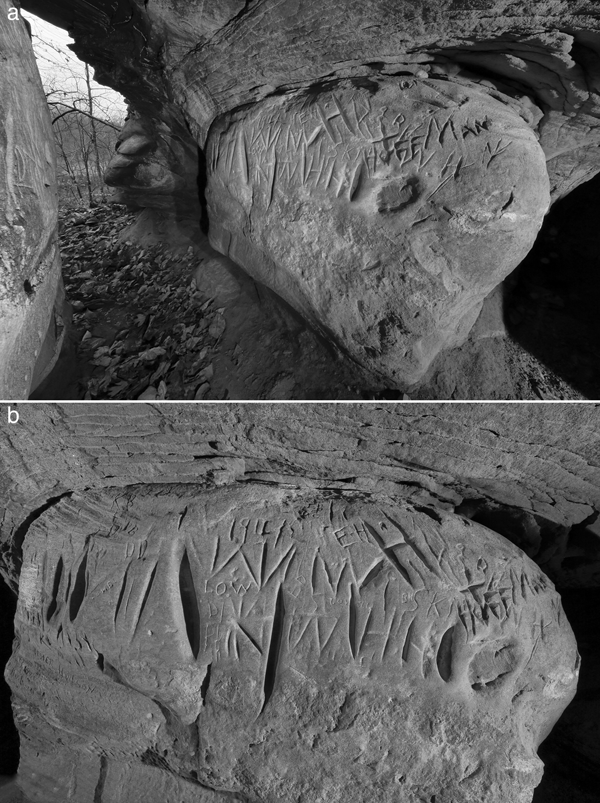
Figure 5 shows Panel 2, inside the shelter on the western interior wall. This panel contains myriad vertically oriented grooves across the rock face, some quite long (up to 25 cm) and deep (up to 2 cm). There are oblique line segments associated with vertical ones, and some may figure bird tracks or the English letter “W.” There are early to mid-twentieth-century dates (1911 or 1914, 1931) and numerous English letters including “N” and especially “H.” Sets of letters (“W. H.,” “E. H.,” “N. H.”) probably are initials of names; many have “H” as the second letter, a fact we return to below. It is very difficult to assign any of the elements on Panel 2 to a specific Native American manufacture; however, the lines and inverted trident figures might well be ancient. There is little stratigraphic overlap to indicate an application sequence, but the obvious “Tee Man” inscription (Figure 5a) clearly came late to the panel.
Panel 2 petroglyphs: (a) the position of the panel on the western interior wall of the shelter (note the proximity to the opening) and (b) a closeup of Panel 2, showing deeply incised vertical grooves and numerous initials, including “H,” “W,” and “N.” A date of 1914 is evident at the top center of the panel. (Photos: Alan Cressler)

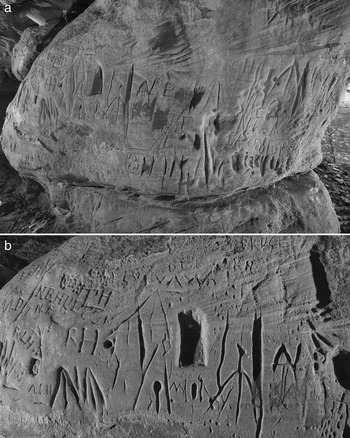
Panel 3, located on the eastern interior wall, comprises two flat vertical surfaces joined at an angle roughly in the center of the wall with a vertical ridge at the junction (Figure 6). The right (exterior or southern) side of this panel is where Weeks and Tankersley believed they saw Cherokee Syllabary. It is immediately evident that this panel is extremely complex. Series of deeply incised vertical grooves extend across the rock face on both sides of the central ridge. A number of these occur in sets of three with the characteristic trident configuration of bird tracks. Most of these bird tracks are inverted with the widest portion pointing downwards. Numerous round pits—some quite small and others up to 3 cm in diameter—are scattered over the panel surface. These may have started as natural depressions in the soft sandstone and were intentionally enlarged and/or regularized by interior abrasion. In and among the lines, grooves, and pits are numerous English letters, many surely initials, again dominated by the second initial “H.” At the left, interior side of Panel 3 (Figure 6b), the initials “N. B.” are followed by a surname, Hudson, with a backwards s. As will be seen, we think the many “H” initials we see in the shelter refer to this surname. We examine the area of supposed syllabary on Panel 3 below.
Panel 3 petroglyphs: (a) the position of the panel on the eastern interior wall of the shelter just inside the opening (the area where Weeks and Tankersley saw syllabary is at the lower right), and. (b) a closeup of Panel 3, showing deeply incised inverted trident or bird tracks, numerous abraded pits and pit-and-groove motifs, and myriad English letters and names, including “N. B. HUDSON” at the upper left on the lower photograph. (Photos: Alan Cressler)

Thus, Red Bird River Shelter contains an array of line and pit petroglyphs, along with names and initials, carved into three vertical rock panels, two inside and one at the mouth of the sandstone shelter. Many of the petroglyphs were produced by abrasion, but some have deep V-shaped cross-sections suggesting sharp-edged implements were used to produce them. We were not able to distinguish with certainty whether chert or metal tools were used in this regard. Overall, we concur with Coy and colleagues that “the Red Bird River Shelter is a genuine Native American petroglyph site extensively overlain by modern graffiti” (Coy et al. Reference Coy, Fuller, Meadows and Swauger1997:37).
Line and pit petroglyphs are a very common form of rock art in the Southeast (Simek et al. Reference Simek, Cressler, Henson, Diaz-Granados, Simek, Sabo and Wagner2018), with at least 18 sites in Kentucky and Tennessee dominated by incised motifs like those at Red Bird River Shelter. There are numerous other instances where a few such motifs are found in association with other, more abundant kinds of petroglyph images. The great majority of these line-and-groove petroglyph sites are in the open air along the Cumberland Plateau, but there are three examples of line-and-groove petroglyphs in dark-zone caves in Tennessee (Simek et al. Reference Simek, Cressler, Henson, Diaz-Granados, Simek, Sabo and Wagner2018). Because these motifs are petroglyphs, there is no possibility of dating them directly, but at some sites, we have associated chronological information suggesting that line and pit motifs were produced perhaps as early as the Late Archaic and persisted into the Mississippian period (Simek et al. Reference Simek, Sherwood, Herrmann, Bow, Cressler and Carmody2013; Simek et al. Reference Simek, Cressler, Henson, Diaz-Granados, Simek, Sabo and Wagner2018). There was another similar site, the Red Bird River Petroglyphs (15CY51), less than 1 km away and across the river, but those petroglyphs were removed to preserve them when road construction activities imperiled their location (Coy et al. Reference Coy, Fuller, Meadows and Swauger1997). Unfortunately, we can say little about the age of the precontact rock art at Red Bird River Shelter.
Is There Cherokee Syllabary at Red Bird River Shelter?
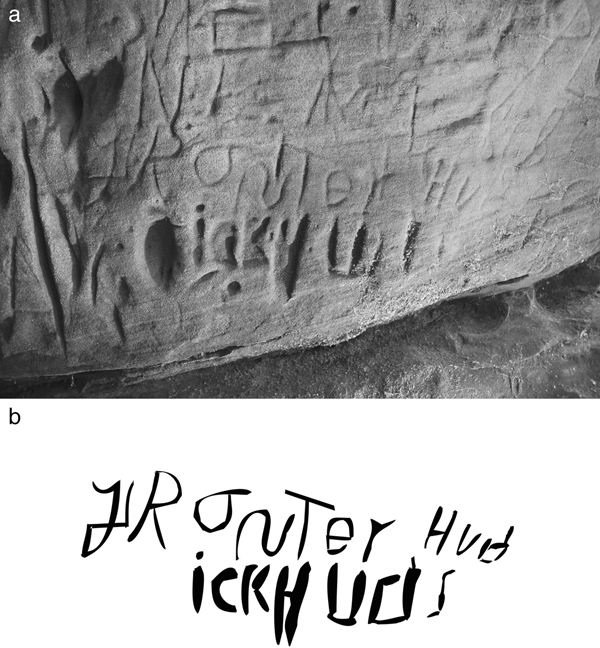
Weeks and Tankersley contend they saw Cherokee Syllabary elements at the southern (exterior) side of Panel 3. We interpret the relevant inscriptions at Red Bird River Shelter very differently. Figure 7 shows our photograph of the panel in question and our line drawings of the carved inscriptions taken from our field notes and from photographs. Where Weeks and Tankersley traced syllabary elements (Reference Weeks and Tankersley2011:985; see Figure 1 above), we identify two Euro-American names. The upper signature is of a “J RONTer” inscribed using English letters. A deep vertical groove, included as part of the “T” by Weeks and Tankersley, clearly underlies the cross line of the “T” in “RONTer” and is much deeper and weathered differently than the other letters in the name. Based on superposition, this groove was surely placed before the name was inscribed and looks more like a precontact vertical line petroglyph and not part of the “RONTer” signature. Similarly, a vertical line passing under the final r in “RONTer” is weathered differently than the rest of that letter and was not part of it. To the right of “RONTer” are three letters, “Hud.” The second name is below the first and is deeply carved into the sandstone surface. The forms of the letters, especially the first one, are evident only deep inside the incisions. They spell out Nick Huds, a shortened version of the name Nick Hudson or N. B. Hudson, which appears several times in different versions elsewhere in the cave (see Figure 6b). Above and to the right of the Nick Huds inscription are engravings that Weeks and Tankersley interpret as a date (recall Figure 1); they suggest reading 1808 or 1818, which would make this date earlier by far than any other date written in the shelter and place it within Sequoyah's lifetime. If this is indeed a date, we believe the third digit would best be interpreted as a 9 based on our viewing and on Week and Tankersley's own rendering (Reference Weeks and Tankersley2011: 985). This makes the date 1898 rather than either of the much earlier versions they favor. Such a late date, six decades after Indian removal, would likely preclude Cherokee authorship, not to mention that of Sequoyah himself, who, by 1898, was 45 years deceased, having passed away in Texas in 1843 (Hoig Reference Hoig1995).
Our interpretation of the area where Weeks and Tankersley saw Cherokee syllabary writing: (a) a photograph of the inscription and (b) a digital line rendering of the inscription. The “N” in “Nick” is traced deep in the abraded depression at the beginning of the name but cannot be seen in the photograph. (Photo and drawing: Jan Simek)
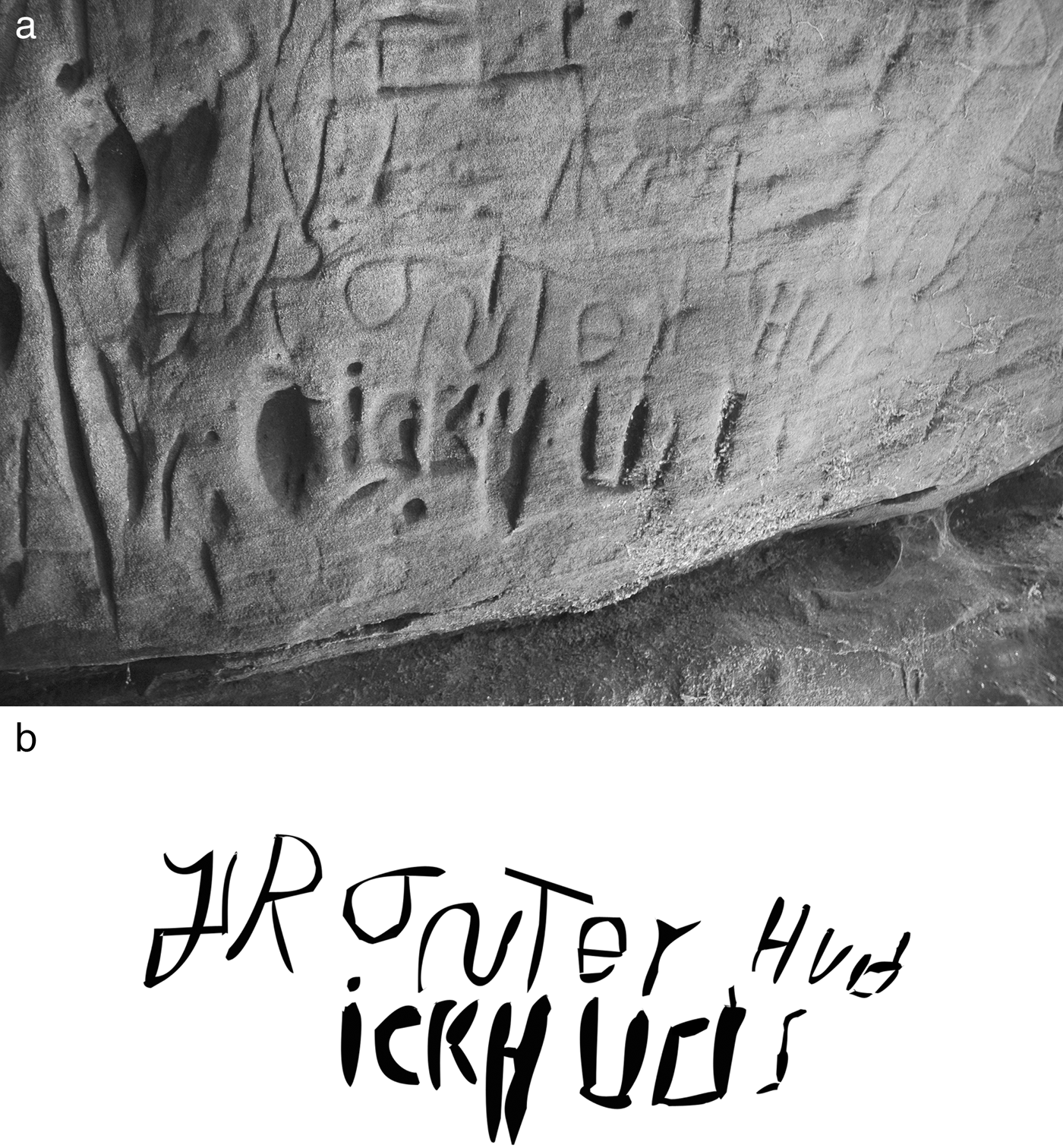
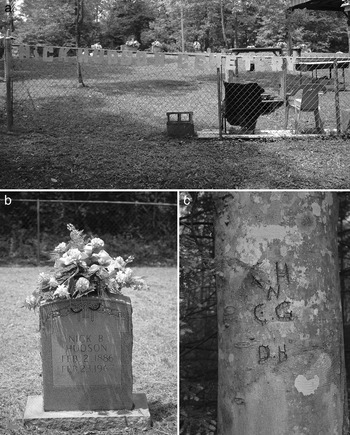
The signatures of a Hudson family generally and of Nick Hudson specifically are not surprising in the Red Bird River Shelter. The Hudson family lived on land around the cave since the nineteenth century. The family cemetery is less than a kilometer away on the plateau just above the shelter (Figure 8a), and it is today named in honor of family patriarch Nick B. Hudson. Mr. Hudson is buried there (Figure 8b) along with many members of his family. Across the rocky hillside between the Hudson Cemetery and the Red Bird River Shelter, numerous trees are marked with Hudson family names and initials (Figure 8c), physically connecting the two sites. Much of the historic graffiti inside the shelter also comprises various Hudson initials and autographs. Born in 1886, young Nick would have been 12 years old in 1898 (if that date is truly the one at issue), a perfect age for an Appalachian child to be roaming through the woods, exploring, and inscribing his name on trees and cave walls with his pocket knife. We do not know who J. Ronter is, although he may be another Hudson family member. Still, in our assessment, the only writing in the site relates to twentieth-century visits by Euro-Americans, especially members of the family who lived on the land. In our view, there is no Cherokee Syllabary, early or late, in Red Bird River Shelter.
Imprints of the Hudson family around the Red Bird River Shelter: (a) the Nick Hudson Cemetery, located approximately 1 km from the shelter on the plateau above. The cemetery is still in use, and the chairs and barbeque indicate that family reunions and decoration events continue to take place; (b) the grave of Nick B. Hudson (1886–1967) in the cemetery named for him; and (c) an example of initials carved into a tree between the cemetery and the Red Bird River Shelter. Such markings occur on many trees in the area. Note that two of the initial sets have “H,” likely Hudson, as the family name. (Photos: Jan Simek)

Sequoyah in Kentucky
If Sequoyah was the author of the Red Bird River Shelter inscriptions, he must, of course, have been in Kentucky at the time the inscriptions were produced (i.e., in the early nineteenth century). Weeks and Tankersley base their belief in his presence on three accounts cited in Samuel Williams's Reference Williams1937 discussion of Sequoyah's paternity. All three accounts depend entirely on the identification of Nathaniel Gist as Sequoyah's father. Nathanial Gist was a white British army officer who fought against the French in the 1750s, remained in America, and moved to Kentucky after the American Revolution. He was supposedly captured and held for several years by the Cherokees after the British defeat at Monongahela under Braddock in 1755. It was during this captivity that he allegedly fathered Sequoyah with a Cherokee mother.
The first Williams reference is to a letter written by John Mason Brown:
… of the Louisville bar, one of the greatest lawyers of Kentucky in his day, [who] was a descendant of Nathaniel Gist; and he in a letter preserved in the Bureau of Ethnology, at Washington, stated that Sequoyah had visited the Gist family in Kentucky and was recognized by the descendants as a natural son of Gist (Williams Reference Williams1937:11).
There are, however, significant problems with the Brown letter. In it, Brown asserts that Sequoyah had converted to Christianity, indeed was a Baptist minister, and that he spoke English well. The historical record does not support any of this (Giemza Reference Giemza2006). Sequoyah was widely regarded as a traditionalist Cherokee (Bender Reference Bender2002:35), and there is no evidence that he could or would speak English (Hoig Reference Hoig1995). James Mooney, who was familiar with and skeptical of this letter, dismissed it in 1900:
Aside from the fact that the Cherokees acted as allies of the English during the war in which Braddock's defeat occurred [making] it unlikely that a British soldier would be held captive after the battle, and that Sequoyah, so far from being a preacher, was not even a Christian, the story contains other elements of improbability and appears to be one of these genealogical myths built upon a chance similarity of name (Mooney Reference Mooney1900:109).
A second Williams reference to Sequoyah in Kentucky is very similar to the first, consisting of what is likely genealogical myth: “Mrs. Mary Cary (Cratz) Morton, a granddaughter of the Gist still living, states that the family tradition is that Sequoyah once visited Lexington looking up his Gist relatives. This visit may have been in 1828, as Sequoyah was going to or returning from Washington as one of the Cherokee delegation” (Williams Reference Williams1937:12–13). This “family tradition” is unsupported beyond its simple assertion in Ms. Morton's testimony. In any case, the syllabary had already been developed and adopted by the tribe by 1828.
The third document cited by Williams is key if Sequoyah is to be placed in Kentucky earlier in the nineteenth century. This is a narrative by General James Taylor referring to a meeting he had with Colonel Nathaniel Gist in 1793. Taylor describes the following at that meeting:
… a good-looking youth, who appeared to me about 16 or 17 years of age, come to the markee and was invited in … the colonel inquired his name. ‘My name is Gist, sir,’ said the young lad. ‘Aye,’ said the colonel, ‘and who is your father?’ ‘Why, sir,’ says he, ‘I am told you are my father.’ ‘Ah, indeed,’ says the colonel, ‘and who is your mother? Betsy—Oh, very likely it may be so then; I was well acquainted with a girl of that name some years ago when I commanded Redstone fort’ (Williams Reference Williams1937:18).
As there is no other possibility in the Williams references, Weeks and Tankersley clearly take this boy to be Sequoyah. From the description itself, however, this cannot be. First, as has been stated, there is no evidence that Sequoyah spoke English. Second, Sequoyah was born in East Tennessee to a Cherokee mother, and he moved with her in the late eighteenth century to the Cherokee Lower Town at Willstown in modern Alabama. There is no evidence that he was born at Redstone Fort (in Pennsylvania) to a mother named Betsy. Clearly, this document does not refer to Sequoyah. There is no other documented evidence for Sequoyah visiting southern Kentucky as he was developing his syllabary writing or afterwards. In addition, on an 1828 visit to Washington, Sequoyah provided the earliest known description of his syllabary development process in a detailed press interview; nowhere in his discussion does he mention having or visiting white family members in Kentucky or describe carving his syllabary into rocks (Knapp Reference Knapp1961).
Finally, we feel compelled to point out that the paternity of Sequoyah has long been a topic of debate, and there is no resolution for the identity of Sequoyah's father. Rumors abound, with Sequoyah's father purportedly a white Dutch trader or Nathanial Gist or a Cherokee with a white father, and so on (Goodpasture Reference Goodpasture1921; Hoig Reference Hoig1995; Williams Reference Williams1937). The best scholarship on the matter stresses the vagueness of Sequoyah's history and the lack of clarity on many aspects of his life, especially the identity of his father (Davis Reference Davis1930; Goodpasture Reference Goodpasture1921; Hoig Reference Hoig1995; Mooney Reference Mooney1900:108; Williams Reference Williams1937). In truth, any supposed paternity is unconfirmed (Giemza Reference Giemza2006). Perhaps most important, however, is that the concern for Sequoyah's paternity is a Euro-American emphasis, pursued by a century and a half of Euro-American scholarship. The Cherokee people, on the other hand, were matrilineal, and it was the mother's lineage that defined family. Sequoyah certainly identified with his mother's clan, and when he moved from East Tennessee, where he was born, to Willstown, he moved to live among his maternal clans-people. He also moved away from white encroachment. It was in and around Willstown that he invented the syllabary, and from there, he moved west around 1824 to join the Old Settlers, Cherokees who had voluntarily removed themselves to Arkansas to avoid contact with the relentless enveloping white culture and government (Hoig Reference Hoig1995; McKenney and Hall Reference McKenney and Hall1848; Mooney Reference Mooney1900). In any case, the notion that Sequoyah traveled to Kentucky at any time to visit with his paternal white Gist family simply has no solid basis in either historical records or Cherokee culture.
Discussion and Conclusions
In their 2011 Antiquity article, Rex Weeks and Ken Tankersley argue that they identified the earliest known example of Cherokee Syllabary writing on a wall in a small sandstone rockshelter site in southern Kentucky today called the Red Bird River Shelter. They suggest that the writings were prototypic and consonant with an age in the first quarter of the nineteenth century. Furthermore, they suggest that the timing of the inscriptions’ production meant that only the great Sequoyah himself, the famous inventor of the syllabary, could have written them. They argued that Sequoyah did this while traveling between his home in modern-day Alabama to visit his white relatives (including his father) in Kentucky. If all this is true, the Red Bird River Shelter is an extremely important site from the point of view of Cherokee and, indeed, American history, as it represents the earliest known examples of Sequoyah's syllabary found anywhere. And if the proposed scenario is accurate, it also tells us something about at least some contexts where Sequoyah worked on syllabary development, such as far away from Cherokee communities in isolated and remote locations.
We disagree with all these interpretations. Cherokee scholars in our research team could not see anything that might represent even prototypical syllabary characters among the Red Bird inscriptions. We have shown that those engravings interpreted as syllabary figures are, in fact, late nineteenth- and early twentieth-century Euro-American signature graffiti, in some cases produced by identifiable local residents. We have also argued that there is no date inscribed on the cave wall that indicates an early nineteenth-century date for any of the inscriptions. We have called into question the historical evidence posited by Weeks and Tankersley to support the notion that Sequoyah was in Kentucky visiting white paternal relatives and thus in place to make the inscriptions in question. By most contemporary historical accounts, Sequoyah did not speak English, much less travel substantial distances from his people to visit white people in their homes. Indeed, he showed a consistent effort throughout his life to maintain distance from whites to the point of leaving his birthplace in East Tennessee for Willstown around the turn of the eighteenth century and then departing Willstown in 1824 to join the Old Settler communities in Arkansas (Hoig Reference Hoig1995; Mooney Reference Mooney1900; Payne and Butrick Reference Payne, Butrick, Anderson, Brown and Rogers2010). We do not believe that historical evidence supports the attribution of any engravings at the site to Sequoyah.
In conclusion, we take no pleasure in objecting so categorically to research findings presented by archaeological colleagues. In fact, over the years, we have always preferred to present our research results in a positive voice without contesting others’ work as we offer our own. The case of the Red Bird River Shelter, however, is different. This is because the life of Sequoyah, a giant in Cherokee, and indeed American, intellectual history is poorly known and shrouded in hearsay, imperfect memories, and the mists of time (Giemza Reference Giemza2006). We are unsure of when he was born, his father's identity, when he moved from Tennessee to Alabama to Arkansas to Oklahoma, and when and how he came to invent his astoundingly simple and brilliant Cherokee Syllabary.
The life of Sequoyah matters to his descendants. How he placed himself in the culture, society, and political lives of his people at the most stressful and difficult time in their history is important. He was a powerful leader among the Cherokees, and an unfounded notion that he spent time with his unconfirmed white family at the moment when the complete removal of his people from the United States loomed cannot go uncontested. The lessons of his life for succeeding generations of Cherokee people, and for those to come, require dependable information on the details of his perspectives and experiences. As modern historical scholars, we believe it is our responsibility to be accurate, critical, and as certain as we can be of what constitutes the historical record concerning such culturally influential people. The impact of Sequoyah's achievements on his people was and is enormous; we must do our very best to be sure the elements we add to his story are accurate.
Acknowledgements
The research reported here was funded in part by the Wenner-Gren Foundation and the Noyes Family Foundation. We acknowledge the generous cooperation of the Daniel Boone National Forest and its staff in helping us with our research. Barbara Heath, Graciela Cabana, and Francisco Di Fabio Rocca helped translate our abstract into Spanish. George Crothers read an earlier draft of the article and made helpful recommendations for its enhancement. We are grateful to the three anonymous reviewers for American Antiquity who made important suggestions for improving our presentation.
Data Availability Statement
Most the historical data used in this article are not original and are available in the referenced sources. Field data collected for the purpose of this article are maintained at the University of Tennessee Department of Anthropology.