Introduction
Natural silk production in Indonesia is usually produced by the silk moth, Bombyx mori Linnaeus, 1958 (Lepidoptera: Bombycidae), a monophagous insect that feeds on fresh mulberry leaves (Zhang et al. Reference Zhang, Zhang, Niu, Ji, Liu and Li2019). Kumaidi and Ekastuti (Reference Kumaidi and Ekastuti2013) stated that 3500 m2 of mulberry plant area could meet the diet needs of only approximately 10 000 eggs of B. mori. This situation indicates the need for more expansive space for mulberry plantations for cultivation activity on a large scale. Although eri silkworm Samia cynthia ricini (Drury, 1773) (Lepidoptera: Saturniidae), which is also known as Attacus cynthia ricini, Philosamia cynthia ricini, and Philosamia ricini (Centre for Agriculture and Bioscience International 2021), has been commercially used for many years in India (Hani and Das Reference Hani and Das2019), it has been developed only recently in Indonesia (Trisnawati and Nurkomar Reference Trisnawati and Nurkomar2020) and Thailand (Tungjitwitayakul and Tatun Reference Tungjitwitayakul and Tatun2017). This caterpillar is easy to rear and can produce beautiful natural silk that is of good quality. Nangia et al. (Reference Nangia, Jagadish and Nageshchandra2000) stated that S. c. ricini is an oligophagous insect that can consume various plants such as castor and cassava. In addition, Subramanianan et al. (Reference Subramanianan, Sakthivel and Qadri2013) noted that S. c. ricini could also eat tropical almond leaves to meet their daily needs. Cassava (Manihot glaziovii) (Euphorbiaceae), castor (Ricinus communis) (Euphorbiaceae), and tropical almond (Terminalia catappa) (Combretaceae) are plants commonly found in and can grow and develop well in the Indonesian climate. Hence, the cultivation of this caterpillar presents a significant economic opportunity in Indonesia.
The most commonly used parts of the cassava plant are the tubers, whereas the leaves are used only as a dish of raw vegetable material and are not used optimally. Likewise, castor leaves and tropical almonds are also not widely used. Castor seeds are used to manufacture biofuels in Indonesia (Syakir Reference Syakir2010), and tropical almond is easy to find and often used as a shade tree or ornamental plant (Marjenah and Ariyanto Reference Marjenah and Ariyanto2018). Thus, these three plant species can be further used as a food source for rearing eri silkworms.
Diet is an essential factor in insect rearing. Several studies have shown that diet can affect several biological characteristics of insects. Silva et al. (Reference da Silva, de Freitas Bueno, Andrade, Stecca, dos, Neves and de Oliveira2017) stated that the larvae of Spodoptera frugiperda J.E. Smith, 1797 (Lepidoptera: Noctuidae) reared on wheat leaf, oats, artificial diet, and corn had a faster larval development time, heavier larval weight, and heavier cocoon weight than larvae fed on cotton and soybean did. Onaolapo et al. (Reference Onaolapo, Olufemi-Salami and Salami2017) also found that although Plodia interpunctella (Hübner, 1813) (Lepidoptera: Pyralidae) larvae could be reared on four different types of diet, the resulting fecundity differed depending on the diet.
Although several studies have looked at S. c. ricini rearing (Kedir et al. Reference Kedir, Emana and Waktole2014; Tungjitwitayakul and Tatun Reference Tungjitwitayakul and Tatun2017; Das and Das Reference Das and Das2018; Narayanamma Reference Narayanamma2018), understanding of how diet impacts survivorship, development, and fecundity remains limited. The effect of diet on fecundity is important because fecundity is a main parameter in silkworm rearing sustainability. The goal of the present study was to document the effect of three different host plants as diet on the survivorship, development, and fecundity of S. c. ricini in order to improve its rearing.
Material and methods
Diet preparation
The plant material used in this study was obtained from several trees growing in the area around Universitas Muhammadiyah Yogyakarta’s campus, Kasihan, Bantul, Yogyakarta, Indonesia. The leaves were first cleaned with tap water to remove dirt and organisms that could cause disease for silkworm larvae and then dried. The leaves were prepared every day in the morning.
Effect of diet on life cycle and survivorship of Samia cynthia ricini
The experiment was conducted by testing three types of food as rearing treatments on S. c. ricini. All treatments were repeated five times, with 30 individual silkworms included per treatment for each replicate. Thus, there were 15 experimental units, and 450 individual silkworms were used in the experiment. All rearing activities were carried out under laboratory conditions (25 ± 1 °C, 80 ± 10% relative humidity, and 16:8 light:dark photoperiod).
The S. c. ricini eggs were obtained from PT. Jantra Mas Sejahtera, a group of silkworm breeders in Kulon Progo, Yogyakarta, Indonesia. The eggs obtained were harvested from several generations of S. c. ricini that had been reared on castor as the food source. Thirty eggs were prepared for each replication of all treatments. This number was determined based on preliminary research that S. c. ricini can survive only under gregarious conditions, and the density of 30 individuals was the minimum number needed for them to survive to adulthood. The eggs for a treatment were placed in a tray that had a transparent lid (30 × 11.5 × 3.5 cm). The eggs were incubated until they hatched. Daily observations were carried out to count the number of eggs that had hatched.
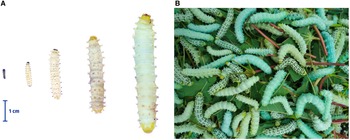
One day before the eggs hatched, the food was prepared according to the treatment by putting it in each container. Samia cynthia ricini larvae develop through five instars over 20–23 days. Each larval instar has special characteristics that need to be nurtured in a different way. The different instars of S. c. ricini larvae can be distinguished from differences in colour, body size, and the remaining larval exuvia (Fig. 1A). First- and second-instar larvae have yellow bodies with black heads, but the bodies of first-instar larvae are pale yellow, whereas the bodies of second-instar larvae are bright yellow. The larvae’s bodies become white, with black heads, for the third-instar larval stage. Fourth-instar larvae have the same characteristics as third-instar larvae, but the head turns yellow. The last-instar larvae have a range of body colours, including blue, turquoise, white, and yellow (Fig. 1B), while the head remains yellow. Larvae of all instars also have black spots on their bodies.
Samia cynthia ricini larvae, A, from first to fifth instar and B, with a diversity of colours and sizes.

After the eggs hatched, the larvae in the first- to third-instar stages were reared in the same containers that were used for the eggs, but the fourth-instar larvae were transferred to larger trays (32 × 25 × 5 cm) to provide more room. These trays were placed in adult cages (37 × 30 × 33 cm) until the cocoons formed. The food was given as follows: (A) first-instar larvae were fed once a day, in the morning; (B) second-instar larvae were fed twice a day, in the morning and evening, and (C), third- to fifth-instar larvae were fed three times a day, in the morning, afternoon, and evening. One to two fresh leaves were provided every day.
Once cocoons formed, the cocoons for each treatment were hung using threads in the upper adult cage for that treatment. The cocoon must be hung with the heads facing up to allow moths to emerge and prevent wing defects. The cocoons were kept until the moths emerged. Each moth was reared in the same cage until it died.
The traits measured during the study consisted of the development time of each phase, including eggs, larva, and pupa, pupal weight (obtained using a portable balance; ACIS AD 300, PT Libra Mas, Indonesia), longevity, and adult total fecundity. Both the development time of each stage and longevity were observed and recorded every day for one generation. Total fecundity was observed by counting the number of eggs laid by an adult every day until the adults died.
Data analysis
Data on the development time, pupal weight, and total adult fecundity of S. c. ricini reared on cassava and castor were analysed using a paired t-test. The data obtained from the tropical almond treatment were not included in the analysis because no S. c. ricini larvae in this treatment survived past the fourth-instar larval stage. The effect of diet on daily adult fecundity data was analysed using an analysis of variance for a completely randomised design with daily observation. The result of the analysis was further tested using the Tukey’s honestly significant difference test (α = 5%). Data analysis was performed using Microsoft Office Excel 2019 and Statistical Analytical Software (SAS), version 9.4.
Results
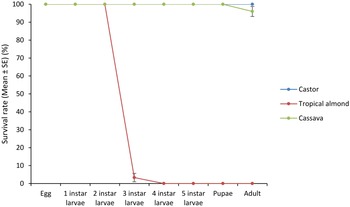
Samia cynthia ricini reared on different diets had different survival rates (Fig. 2). Samia cynthia ricini fed on castor had 100% survival from the egg to the adult stages. However, S. c. ricini fed on cassava had 100% survival from the egg to the pupal stages, and the survival rate decreased to 96% when they moulted to the adult stage. In contrast, the first-instar larvae fed with tropical almond developed well to the second-instar larval stage, but the survival rate decreased to 4% at the third-instar larval stage and to 0% at the fourth-instar larval stage. None of S. c. ricini specimens in this treatment completed its life cycle.
The survival rates of Samia cynthia ricini reared on three types of diet. SE, standard error.

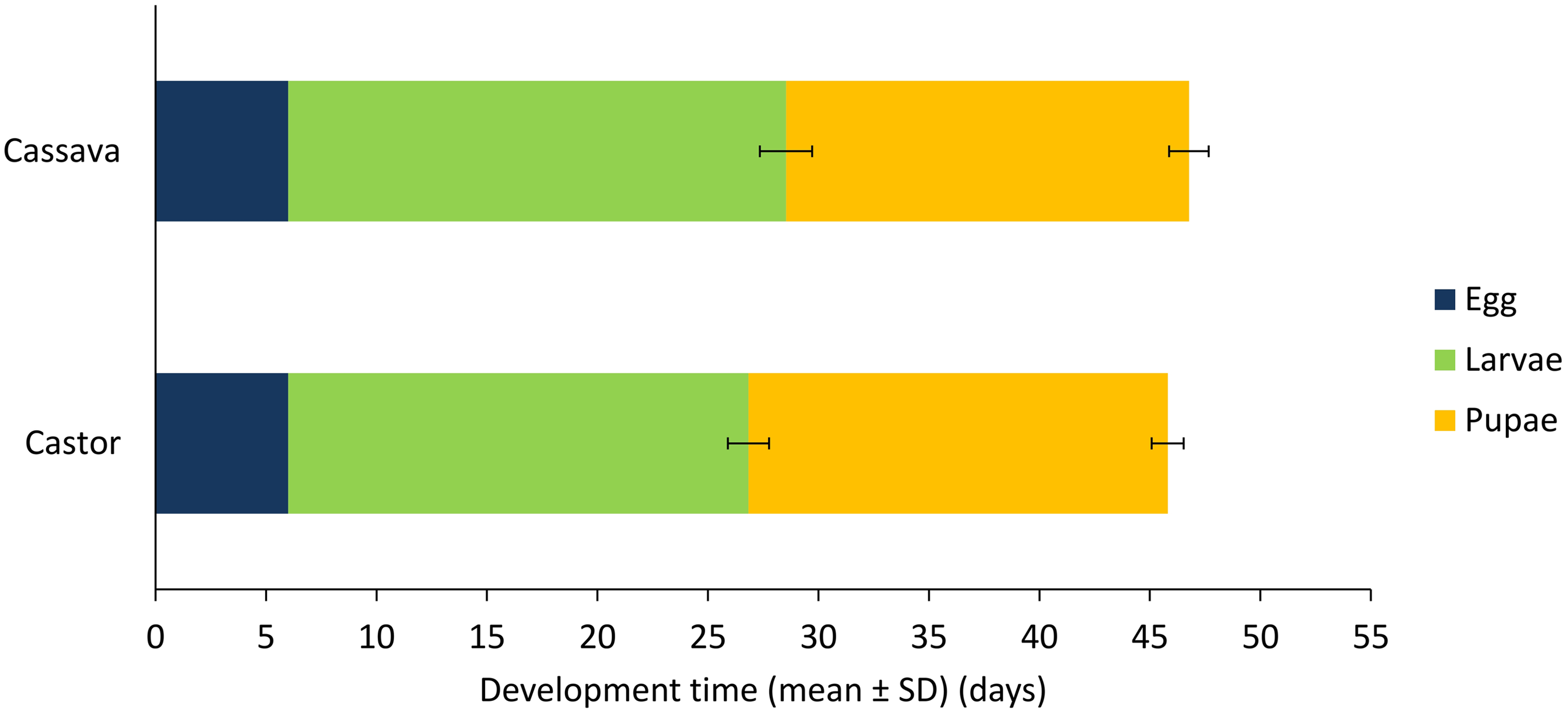
The development time of S. c. ricini reared on the three types of diet differs depending on the life cycle phase (Fig. 3). The development time of eggs obtained from S. c. ricini adults that had been reared as larvae on the different diets lasted for six days both on castor and cassava. Samia cynthia ricini larvae showed slightly different development times when reared on cassava and castor. Samia cynthia ricini larvae developed faster when reared on cassava (20.83 days) than on castor (22.53 days; paired t-test, P = 0.0001, n = 5). The development time of the pupal stage of S. c. ricini obtained from larvae reared on castor (18.23 days) also differs significantly from that of larvae reared on cassava (18.97 days; paired t-test, P = 0.0002, n = 5). Likewise, the cocoon shells (paired t-test, P = 0.028, n = 5) and the pupae (paired t-test, P = 0.049, n = 5) of S. c. ricini reared on castor were significantly heavier than those of larvae fed the cassava diet (Table 1). Lastly, the longevity of S. c. ricini adults also differed between the two treatments tested (paired t-test, P = 0.0059, n = 5), with S. c. ricini adults living longer when, as larvae, they had been fed castor (4.84 days) than those that, as larvae, had been fed cassava (4.09 days). Adult S. c. ricini lived from one to eight days on both diets. The total development time from egg to adult on the two types of diet is significantly different (paired t-test, P = 0.0038, n = 5).
Development times of Samia cynthia ricini reared on either castor or cassava. SD, standard deviation.

Pupal weights of Samia cynthia ricini reared on different diets.

* Mean ± standard error followed by different letters in a column are significantly different based on the t-test at a 5% significance level.
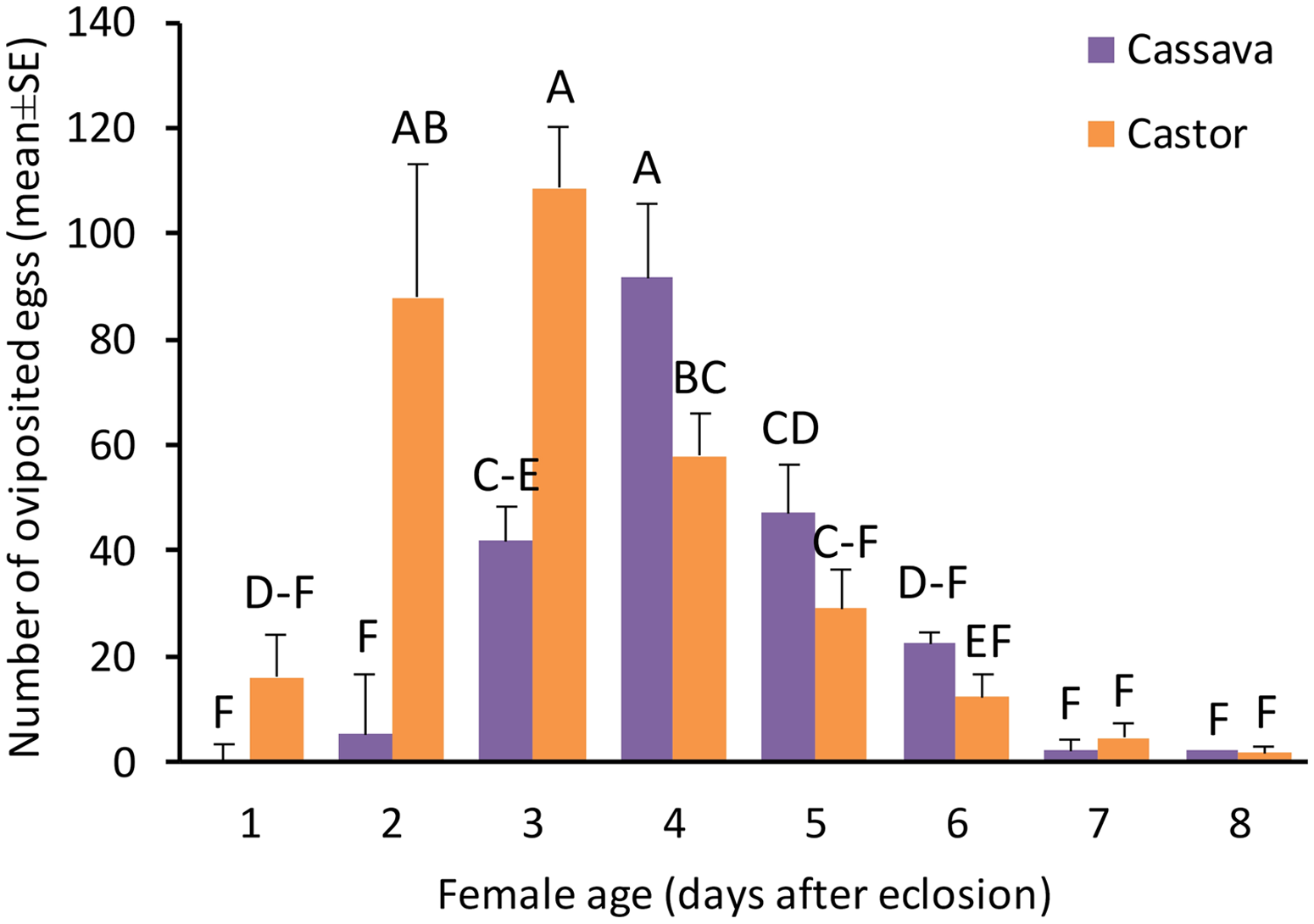
The analysis results showed that type of diet and the age of the adult females affected the numbers of eggs laid daily (F = 7.36, df = 7, P < 0.001). The total fecundity of S. c. ricini adults was significantly higher in adults of castor-raised larvae (23 874 eggs) than in those of cassava-raised larvae (15 925 eggs; paired t-test, P = 0.01, n = 5). Fecundity peaked in adults of castor-fed larvae peaked earlier that it did in adults of cassava-fed larvae (Fig. 4).
Adult female fecundity of Samia cynthia ricini. Means followed by different letters are significantly different (Tukey’s honestly significant difference test, α = 0.05). SE, standard error.

Discussion
Our research shows that larvae fed a castor diet have a higher survival rate than those fed cassava. No larvae survived on tropical almond. This result aligns with the analysis of Ramadhan (Reference Ramadhan2019), who reported that the survival rate of S. c. ricini fed with castor and cassava was 92.4% and 80.8%, respectively. Samia cynthia ricini is an oligophagous insect that can consume various plants from the same family, such as cassava and castor (Nangia et al. Reference Nangia, Jagadish and Nageshchandra2000). Cassava and castor both are euphorbiaceous, while tropical almond comes from the Combretaceae family. The difference in taxonomic family level may cause the suitability of diet source for S. c. ricini. Plant genotype differences also could affect the hatchability, larval duration, and survival rate of S. c. ricini (Kedir et al. Reference Kedir, Emana and Waktole2014). Based on our observations in the present study, S. c. ricini survival on different leaf diets is also shown by their response during feeding activity. Samia cynthia ricini larvae showed an active response to cassava leaves and castor but did not eat much when fed tropical almond. These responses indicate that tropical almond is unsuitable for the cultivation of S. c. ricini. Tropical almond might have an insecticidal effect on S. c. ricini. Hasyim et al. (Reference Hasyim, Setiawati, Marhaeni, Lukman and Hudayya2018) reported that tropical almonds can cause mortality in chili pepper yellow mites, Polyphagotarsonemus latus. Nta et al. (Reference Nta, Mofunanya, Ogar and Azuike2019) reported that tropical almonds can cause mortality in the bean weevil, Acanthoscelides obtectus. However, Kavane (Reference Kavane2014) reported that tropical almond is a potential diet for S. c. ricini under conditions found in Maharashtra, India and may be affected by other environmental conditions. Plants originating from other regions contain different secondary metabolite compounds (Sampaio et al. Reference Sampaio, Edrada-Ebel and Da Costa2016). The effect on herbivorous insects can therefore also differ.
The development time of different larval stages is influenced by the nutrients obtained by the insect. In addition, the amount of diet consumed and rearing environment conditions (temperature and humidity) also affect an insect’s growth (House Reference House1969). A significant difference in the development time of larvae of S. c. ricini reared on cassava and castor has implications for the costs incurred for cultivation. In total, the development time of the first- to fifth-instar larvae lasted for 20.84 days when S. c. ricini was reared on castor, two days faster than S. c. ricini larvae reared on cassava (22.53 days until pupa formation). The longer the development time, the longer the time before silk is produced and, thus, the higher the production costs.
The development time of S. c. ricini pupae reared on the two diets tested differed by one day. The development time of pupa can be influenced by internal factors, such as the larvae’s readiness to develop body structures in the cocoon, and external factors, including temperature and humidity (Al-Saffar et al. Reference Al-Saffar, Grainger and Aldrich1996). The length of pupal development affected the harvest time of cocoons as silk thread material.
However, the pupal and cocoon weight is more important than the length of its development time. Our results thus agree with those of Devaiah et al. (Reference Devaiah, Rajashekhargouda, Suhas and Govindan1985), who reported that a castor leaf diet produced heavier larvae, cocoon shells, and silk glands. Factors that affect a cocoon shell’s weight are the ability of larvae to make fibre, the species of caterpillar, diet quality, temperature, and the humidity when the caterpillar enters the pupal stage (Hartati and Umar Reference Hartati and Umar2012). The total weight of S. c. ricini pupae observed in the present study was the same as that noted by Patil (Reference Patil2004), who reported that the total weight of S. c. ricini pupae fed with castor leaf diet generally was approximately 2.50 g, which is higher than the weight reported for S. c. ricini reared on cassava leaves (Sakthivel Reference Sakthivel2014). Samia cynthia ricini also has a heavier cocoon weight than B. mori, the fresh cocoons of which weigh from 1.15 to 1.49 g, depending on the race (Diba and Tavita Reference Diba and Tavita2019). The heavier the cocoon, the more the silk thread that can be produced.
High fecundity is important for insect rearing. The total number of eggs laid by S. c. ricini females emerging from larvae reared on castor is higher than that of females from larvae reared on cassava, which is comparable to what Das and Das (Reference Das and Das2018) reported. Factors that influenced the number of eggs produced by S. c. ricini adult were the cocoon and pupal weights, as Gowda et al. (Reference Gowda, Narayanaswamy and Munirajappa1989) and Jayaswal et al. (Reference Jayaswal, Singh and Rao1991) found for B. mori. Although the relationship between pupal weight and fecundity was not specifically tested in the present study, the results showed that the pupal weight of S. c. ricini was heavier and that S. c. ricini adults produced more eggs when larvae were reared on castor than the pupal weights and number of eggs produced by cassava-reared S. c. ricini.
Conclusions
Diet affected the development and reproductive capacity of S. c. ricini. Although the total development time of S. c. ricini reared on cassava was similar to that of castor-reared S. c. ricini, the latter larvae had a faster larval development time than those reared on cassava. In addition, the pupal weights and the adult fecundity of S. c. ricini from castor-reared larvae were higher than those of S. c. ricini from cassava-reared larvae. Castor is thus a better diet for rearing S. c. ricini for silk production, with cassava possibly serving as an alternate diet when necessary. Tropical almond is not a suitable diet for S. c. ricini, with no observed survival.
Acknowledgements
The authors thank Pak Anto and the team from PT Jantra Mas Sejahtera for providing the Samia cynthia ricini’s eggs. The authors also thank Teguh Utomo for the help with insect rearing during research. This research was partially funded by Lembaga Riset dan Inovasi, Universitas Muhammadiyah Yogyakarta.
Competing interests
The authors declare no competing interests.