In a recent survey, Portuguese people exhibited a negative perception of their parties’ capacity to fulfil their pledges. When asked whether ‘MPs try keep to keep the promises they have made during the election’, 70 per cent of the respondents expressed some form of disagreement (ISSP Research Group 2008). This is an important pitfall for parties in a democracy. In an age of rampant distrust in political parties and institutions, there are increasing legitimacy problems in the electoral linkage between voters and parties (Dalton et al. Reference Dalton, Farrell and McAllister2011). Classic party government arrangements (Katz Reference Katz1986) are hindered by exogenous constraints; for example, EU institutions blurring the clarity of responsibility (Powell and Whitten Reference Powell and Whitten1993). Minority governments face particular institutional dilemmas in delivering on their promises because they do not control a majority and need opposition parties’ support to fulfil their pledges.
In this article, we explore pledge fulfilment in Portugal, focusing on minority governments by comparing their performance with their majority counterparts. Specifically, we are interested in not only whether minority governments fulfil their pledges, but also how they do so. Existing research has established that minority governments survive and develop their legislative agenda because opposition parties are not only office-seeking. Rather, they have policy-seeking concerns, and they play an ongoing bargaining game with the government in order to extract policy benefits for their constituencies without the inherent costs of office (Strøm Reference Strøm1990).
Our argument is that minority governments fulfil at least as many pledges as their majority counterparts for three main reasons. Firstly, the fact that a given policy is based on the party’s programme is a strong argument at the disposal of a minority government when it is bargaining with the opposition. Opposition parties face potentially negative political costs if they block legislative initiatives that have been sanctioned by voters at the polls. On the other hand, opposition parties themselves might pressure minority governments to fulfil promises that would fulfil the programmes of both actors. Thirdly, minority governments have higher incentives to deliver on their promises because they face greater uncertainty about their survival. Since they can be toppled at any point during the constitutional inter-election period (CIEP), they need to deliver policy benefits to their constituents from the very start of their term in office.
To illustrate our arguments, we focus on pledge fulfilment in Portugal, where majority and minority governments have alternated in power. To be sure, Portuguese political parties are the core organizational units in executive–legislative relations, with high levels of cohesion (Leston-Bandeira Reference Leston-Bandeira2009). The frequent occurrence of majority and minority situations allows parties to anticipate the consequences and to adapt their behaviour accordingly. Further, minority governments in Portugal have traditionally been unstable,Footnote 1 which illustrates the potential legislative gridlock of this type of government arrangement (Ganghof and Brauninger Reference Ganghof and Brauninger2006).
This article uses an original data set containing over 3,000 testable electoral pledges for the five Portuguese parties. It uses an approach developed for the Comparative Party Pledges Group which allows us to test the extent to which parties have fulfilled their pledges (Thomson et al. Reference Thomson2014). Our analysis covers three Socialist governments: one commanding a majority of seats (Sócrates I, 2005–9), and two minority governments (Guterres I, 1995–9, and Sócrates II, 2009–11). By focusing on three single-party Socialist governments operating under similar institutional constellations, we develop a case study approach that helps us understand the patterns of pledge fulfilment in Portugal. In addition to the quantitative data, we use extensive evidence from interviews with former ministers and party leaders that help us understand the micro-level foundations of how and why parties choose to deliver on their promises.
Our evidence suggests that minority governments fulfil at least as many pledges as their majority counterparts. Specifically, pledge fulfilment rates suggest that good economic performance and a cooperative head of state heighten the likelihood that parties will deliver on their promises. We also demonstrate that minority and majority governments are different regarding the way in which they fulfil their pledges. Our data show that opposition parties, even when they do not formally support a government, manage to fulfil a much larger proportion of their pledges in a minority setting. This suggests that minority governments are as perfectly able to fulfil their pledges as their majority counterparts, but they also need to take opposition parties’ programmes on board.
PLEDGE FULFILMENT IN MINORITY GOVERNMENTS
In democratic polities, voters choose to delegate power to their elected agents to take decisions on their behalf (Strøm Reference Strøm2000). By delegating, voters entrust their agents with significant power. Mansbridge’s (Reference Mansbridge2003: 516) influential model of promissory democracy hinges on the conception that ‘by exacting a promise, the voter at Time 1 (the election) exercises power, or tries to exercise power, over the representative at Time 2 (the governing period)’. This perspective entails a normative dimension: the idea that delegation is possible, because there are ‘explicit and implicit promises that the elected representative makes to the electorate’ and that the agent has the ‘normative duty to keep promises made in the authorizing election (Time 1)’ (Mansbridge Reference Mansbridge2003: 516).
There are four reasons that explain why political parties want to fulfil their electoral pledges. Firstly, electoral pledges are crucial signalling instruments for parties to create a distinct and attractive electoral profile, which helps them with their vote-seeking goal (Müller and Strøm Reference Müller and Strøm1999). Secondly, parties are also policy-seeking actors; they have an inherent interest in the policies contained in their party profiles (Adams and Merrill 2009). Thirdly, electoral pledges serve as a written contract binding the party (a principal) to legislators (its agents in the legislature) (Müller Reference Müller2000). For example, this contract serves to limit ministerial leeway by forcing the minister to follow the party line. If ministers are put under direct pressure from bureaucracy, interest groups and international actors, they might have incentives to depart from the preferred position of the party and select their preferred options instead (Andeweg Reference Andeweg2000; Indridason and Kam 2008). Finally, election programmes also serve as a way for the party rank and file to keep tabs on party leadership and to bind party factions together (Rose Reference Rose1984; Thomson et al. Reference Thomson2014).
By and large, parties have incentives to respect their electoral manifesto. However, they might also be tempted – or even obliged, for that matter – to depart from it. Firstly, party officials make pledges in advance that they know are too difficult to fulfil. Ultimately, they expect to garner votes with those promises. For example, a party leader promising to deliver on job creation, knowing in advance that that specific goal does not depend solely on public policy, constitutes a typical illustration of this problem. Secondly, there is an ever-growing difficulty for leaders to fulfil their pledges because of exogenous shocks. International crises are typical examples of such difficulties, mostly because they are impossible to anticipate at the time that parties draft their manifestos.
Comparative empirical work on pledge fulfilment has found that minority governments fulfil as many, if not more, pledges than their majority counterparts. Artés (2013) compares single-party minority and majority governments in Spain and finds that the nature of the government is devoid of political consequences for pledge fulfilment. Similarly, Naurin (Reference Naurin2011) shows that Swedish governments fulfil an overwhelming proportion of their pledges. Mansergh (2004) and Moury (Reference Moury2011) demonstrate that short-lived coalition governments with a minority of seats in Ireland and Italy have a reasonable degree of pledge fulfilment. Thomson et al. (Reference Thomson2014) make a comparative analysis of pledge fulfilment for various government types. They conclude that, all else being equal, pledges made by parties governing in single-party minority governments are no less likely to be fulfilled than pledges made by governing parties in different government types. The evidence from previous research brings us to an important puzzle: how is it possible that minority governments, which do not have a majority to approve their legislation, do not underperform compared with their majority counterparts?
Strøm’s seminal Minority Government and Majority Rule (Reference Strøm1990) convincingly deconstructs the conventional wisdom according to which minority governments lead to political instability and ineffective governance. Starting with the observation that minority governments are a frequent occurrence, Strøm demonstrates not only that minority governments are only slightly less durable than majority coalitions, but also that they are less punished by the electorate than parties governing with a majority. Recently, Field (Reference Field2009) reached similar conclusions for the Spanish governments between 1979 and 2008. Using government duration, legislative success and the governing party’s electoral success in the subsequent election, Field finds only minor differences between majority and minority governments.
But how do minority governments manage to work efficiently? Strøm (Reference Strøm1990) argues that the rationale for the formation of minority governments hinges on parties’ capacity to extract policy benefits without having to bear the costs of office. In addition, Strøm acknowledges that parties themselves are not interested in forming an institutionalized coalition. Instead, it is more efficient for them to have a minority government with ad hoc bargaining. The argument builds on the assumption that parties’ incentives go beyond office-seeking. In fact, parties might find that they are more effective if they stay in opposition and seek policy influence and electoral advantage (Strøm Reference Strøm1990: 69) by forcing the executive to deliver particular policy payoffs. Strøm identifies two necessary conditions to help opposition parties in their goals. Firstly, the legislative committees should offer an institutional constellation to help the opposition extract information and to influence legislation. Secondly, Strøm identifies the decisiveness of elections as a force that drives parties’ calculations of the costs of office.
In his work on Danish governments, Green-Pedersen (Reference Green-Pedersen2001) illustrates Strøm’s argument. He shows that minority governments in that country manage not only to survive, but also to approve major reforms in the Folketing by forming an alliance with the right or the left, depending on the nature of the policy proposal. Parties extract policy benefits exclusively in their preferred dimensions. For all other issues, parties oppose the government. This dual behaviour helps parties cement their reputation and signal to their constituency that they are working on their behalf only to extract benefits. This ties in well with Christiansen and Pedersen’s findings, underlining that ‘formal minority governments are most likely to use the log-rolling strategy, paying its support party off with concessions’ (Christiansen and Pedersen Reference Christiansen and Pedersen2012: 948; see also Christiansen and Damgaard Reference Christiansen and Damgaard2009: 30).
Further, Artés and Bustos (Reference Artés and Bustos2008) illustrate this argument. They show that the Spanish Convergència i Unió (CiU – Convergence and Union)Footnote 2 managed to fulfil close to 60 per cent of its electoral programme during the Partido Popular (PP – Popular Party) and Partido Socialista Obrero Español (PSOE – Spanish Socialist Workers’ Party) minority governments. Under majority governments, in 1989 and 2000, this percentage fell to about 40 per cent, which bodes well for the argument that opposition-support parties extract more policy benefits under minority governments.
Parties cannot risk being too cooperative with the government, but there are incentives for cooperation, which stem from the desire to influence legislation (Moury and De Giorgi Reference Moury and De Giorgi2015). In minority governments, the disjuncture between cooperation and conflict is particularly high, in that the consequences of opposition parties’ behaviour are more dramatic. Failing to support the government at a critical juncture might trigger its resignation and lead to early elections. This entails two risks for opposition parties. Firstly, minority governments are less likely to be electorally punished than their majority counterpart (Powell and Whitten Reference Powell and Whitten1993; Strøm Reference Strøm1990). Secondly, toppling the government might cause the electorate to blame opposition parties. This is, however, a calculated risk. Opposition parties will only defect from the status quo if, and only if, they perceive that a new electoral cycle might have electoral advantages (Lupia and Strøm Reference Lupia and Strøm1995).
ARGUMENT
In this article we approach pledge fulfilment in Portugal by focusing on how three Socialist governments, with heterogeneous power constellations, delivered their electoral pledges. By focusing on different governments from the same party, operating under similar institutional rules, we want to gauge the extent to which their majority or minority status influences their capacity to fulfil their promises.
Our argument is that Portuguese minority governments fulfil at least as many pledges as their majority counterparts. There are numerous reasons behind the capacity for minority governments to deliver on their promises. Firstly, although party manifestos are equally important for both majority and minority governments, the latter have more incentives to deliver on their promises. Manifestos – and their inherent electoral mandate – empower minority governments to propose legislation based on that document. Research has shown that opposition parties, in all contexts, are more adversarial when governmental bills are salient (Christiansen and Pedersen Reference Christiansen and Pedersen2012; Moury and De Giorgi Reference Moury and De Giorgi2015). Indeed, low issue salience suggests a lack of attention from the public, hence more incentive for political parties to cooperate. Bills based on the manifesto are more likely to be salient and hence to trigger attention from opposition parties. However, democratic legitimacy is a bargaining resource (Schimmelfennig Reference Schimmelfennig2001). When minority governments make a legislative proposal based on their manifesto, they can invoke the democratic legitimacy of their proposal and hence ‘shame’ opposition parties for not collaborating. Thus, by and large, if the proposed legislation has been included in the manifesto, it is easier for the government to blame the opposition for legislative gridlock. Otherwise, if the proposal departs from the government’s electoral pledges, the opposition can convincingly argue that its non-cooperation is justified by a lack of electoral legitimacy. We believe this argument to be true for all opposition parties, whether they formally support the government or not. That said, our argument builds on the findings that: (1) supporting parties are more likely to cooperate with the government (Christiansen and Pedersen Reference Christiansen and Pedersen2012); and (2) major opposition parties, with realistic expectations of getting into government, tend to be more cooperative (Moury and De Giorgi Reference Moury and De Giorgi2015).
Secondly, minority governments face high uncertainty regarding their survival (Lupia and Strøm Reference Lupia and Strøm1995). Unlike majority governments, which command enough seats in the legislature to control the timing of the next election, minority governments face a greater likelihood of early termination. Governments have to manage the electoral cycle carefully because an exogenous shock might change the status quo and force them to go to the polls earlier than previously anticipated (Smith Reference Smith2004). This gives them incentives to deliver on their electoral pledges – because they have to be ready to go through the sanction of the voters at any point of the constitutional inter-election period. In addition, as Becher and Christiansen (Reference Becher and Christiansen2015) show, the dissolution threat in parliamentary democracies heightens minority governments’ bargaining capacity, particularly at early stages of the electoral cycle. To be sure, minority governments can use institutional gridlock to their advantage as an electoral argument.
Finally, in semi-presidential systems the president is institutionally vested with the power to dissolve the assembly, paving the way for early elections (Amorim Neto Reference Amorim Neto2003). The head of state constitutes an important veto player, particularly if it is ideologically non-adjacent to the party in power (Tsebelis Reference Tsebelis2002). For example, under cohabitation situations, heads of states may use their power – for instance, by making speeches that have the capacity to shape the public agenda and the menu of legislative choices available to the government (Amorim Neto and Lobo Reference Amorim Neto and Lobo2009). In return, this can hinder the government’s capacity to act. Minority governments have incentives to fulfil their pledges to deter the head of state from using her powers by invoking a government drifting from the electoral manifesto.
THE PORTUGUESE CASE
In this article, we make a contribution to the comparative literature on minority governments and pledge fulfilment using Portugal as a case study. There are several reasons that make Portugal an interesting case study. Firstly, Portugal has a closed-list proportional representation electoral system. Consequently, it has a party-centred legislature, with high levels of party cohesion, which is helped by the highly centralized candidate selection mechanisms (Leston-Bandeira Reference Leston-Bandeira2009). There are no incentives to cultivate a personal vote, which undermines the possibility that minority governments find support in the parliament in exchange for pork-barrel measures (Fernandes Reference Fernandes2016). Secondly, similar electoral statutes have produced alternating minority and majority governments. The most important consequence is that political parties have the opportunity to learn the consequences of each type of government and to adapt their behaviour accordingly to maximize future electoral success.
Our article focuses on three particular governments: Guterres I (1995–9), Sócrates I (2005–9) and Sócrates II (2009–11). These governments share several similarities, which helps our research design by allowing us to control for several institutional and behavioural features. Firstly, they are all single-party Socialist governments, which allows us to control for ideological and/or party-specific heterogeneity. Secondly, those governments operate under similar institutional rules. Specifically, there is no variation in terms of party system or electoral rules.Footnote 3
Similarities notwithstanding, the three governments under analysis also have important differences, particularly in the economic conditions and power constellations. First and foremost, there was an important difference in the performance of the Portuguese economy between 1995 and 2011. During Guterres’s first term in office, economic growth averaged 4.15 per cent a year. Similarly, unemployment hit historic lows, averaging 5.8 per cent during Portugal’s golden decade. Sócrates faced significantly different conditions, particularly during his second term, when Portugal suffered the harsh effects of the recession. In Sócrates’s minority government, between 2009 and 2011, economic growth became negative and unemployment reached 11 per cent. Ultimately, the capacity of a government to deliver benefits and to fulfil its electoral pledges is arguably heightened under an economic boom (Huber and Stephens Reference Huber and Stephens2001).
Secondly, the nature of the Portuguese political system, with a directly elected president coexisting side-by-side with a directly elected legislature (Elgie 1999), imposes constraints on governments. Those constraints, however, are of different natures, depending on power relations between the president and the government, which has important consequences for political instability (Shugart and Carey Reference Shugart and Carey1992). In the Portuguese case, the role of the president has been limited since the Constitutional Reform Act of 1982. However, the president retains significant powers, including referring bills to the Constitutional Court or vetoing bills that require a special majority in the parliament (Amorim Neto Reference Amorim Neto2003). During Guterres’s government, the Socialist Sampaio held the presidency, which guaranteed a higher likelihood of preference-sharing between the president and the government. In contrast, Sócrates governed for most of his term in office in cohabitation with the centre-right’s Cavaco Silva, which caused several institutional conflicts.Footnote 4 For example, Cavaco Silva and Sócrates had profound disagreements over the ‘Azores Act’, which governs the powers of the president concerning that particular administrative region.
Finally, the three governments differ in the number of MPs they controlled in the parliament. Sócrates controlled an absolute majority of 121 out of 230 MPs during his first term in office, which allowed him to govern without veto players in the legislative branch. Subsequently, however, he lost the majority and formed a government supported by only 97 MPs. The third government we analyse here, Guterres I, had 112 MPs. Certainly, it is important to account for how many opposition MPs a government needs to garner to approve bills in the legislature. In his second term, Sócrates needed 19 opposition MPs, while Guterres only needed four.
Contextual differences affect the capacity to fulfil pledges. Guterres enjoyed a constellation of institutional and exogenous conditions that fostered his capacity to deliver on his electoral promises. Not only did he have a cooperative president, but he also enjoyed a booming economy. Conversely, Sócrates’s short-lived minority government operated in cohabitation and suffered an important exogenous shock, the 2008 financial crisis, which curtailed its capacity to fulfil its pledges (Magalhães 2012). In addition, Sócrates’s minority government was further away from the majority threshold than Guterres’s.
RESEARCH DESIGN
Our empirical work focuses on three Portuguese governments. For each of the five political parties represented in the Portuguese Assembleia da República we calculated the fulfilment of electoral pledges. In operational terms, we follow Royed’s definition of a pledge as ‘a statement committing a party to an action or outcome that is testable’ (Royed Reference Royed1996: 79), which has successfully travelled to heterogeneous institutional contexts (Mansergh Reference Mansergh2004; McCluskey Reference McCluskey2008; Naurin 2009; Thomson Reference Thomson2001).
We have retrieved a total of 3,161 electoral pledges made by Portuguese parties in 1995, 2005 and 2009.Footnote 5 Data have been collected in the context of the Comparative Party Pledges Group project (Thomson et al. Reference Thomson2014). To avoid selection bias, we have included pledges from all policy areas.
Pledge fulfilment appraisal is a two-step process. Firstly, we have to identify a testable pledge. Secondly, we need to find evidence to determine the extent of its fulfilment. The first step hinges on the analysis of electoral manifestos, which are assumed to be the best indicators of what parties communicate to voters. To be sure, most voters do not read manifestos, but those documents determine the official discourse of party officials during the electoral campaign (Costello and Thomson Reference Costello and Thomson2008). Parties use manifestos as low-cost signalling devices. In operational terms, a pledge is a statement that includes some sort of commitment for future action. For example, parties make a pledge by saying, ‘we will do this’ or ‘we promise to’. In the Portuguese case, in 2005, José Sócrates made an unequivocal promise that the Socialists would ‘create 150,000 new jobs’ before the end of the mandate or that they would ‘double public investment in R&D, to reach 1 per cent of GDP’. These two examples constitute testable pledges. On the other hand, there are many statements in manifestos that do not qualify as pledges because they offer only vague commitments. For example, in 2005, the Socialists promised to ‘increase the quality of democracy, by strengthening the political system and the state’. The latter arguably does not constitute a testable pledge.
The second step in the analysis of pledge fulfilment is to retrieve data that allow us to determine the extent to which a particular pledge has been fulfilled.Footnote 6 For this, we used the CD-ROMs edited by the Imprensa Casa da Moeda, containing all decisions taken by public institutions since 1975. Those include legislation, as well as ministerial and presidential decrees. Secondary sources were also included, specifically newspapers. All sources allow for a keyword search.Footnote 7 Our categorization of pledge fulfilment is as follows: ‘fully’, ‘partially fulfilled’ and ‘not fulfilled’. We include pledges in the latter category if we cannot find any legislative piece, cabinet decision or newspaper report indicating that the government worked towards that outcome or action.Footnote 8
A pledge is considered to be ‘partially fulfilled’ when actions were taken towards the pledge but without totally fulfilling it. Similarly, in those situations in which an outcome is promised and there is a positive change in that direction, but not total delivery, it counts as a ‘partially fulfilled pledge’. For example, if the Socialist government promised to create 150,000 new jobs and delivered 50,000, this is deemed a partial fulfilment, because there was a change in the status quo towards the proposed outcome but it did not reach the proposed level.
‘Fully fulfilled’ pledges are those in which political action was taken to achieve full fulfilment and results were achieved. A typical illustration is deficit reduction. If the government promised to have a 1 per cent of GDP in public investment in R&D and we found legislation paving the way for subsequently measured outcomes, then we consider the pledge to be fulfilled.
In addition to quantitative empirical evidence, our article also makes use of interviews with former ministers and opposition party leaders.Footnote 9 These interviews allow us to grasp the micro-level foundations of not only why minority governments have particular decision-making paths, but also how opposition members perceive pledge fulfilment and its contribution for office- and policy-seeking.
EMPIRICAL EVIDENCE
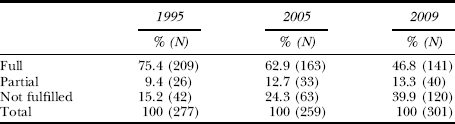
We start our foray into pledge fulfilment in Portugal by looking at the extent to which the three Socialist governments delivered on their promises. Table 1 shows the fulfilment rates for two Socialist minority governments (Guterres I and Sócrates II) and one majority government (Sócrates I). Overall, Portuguese governments have a high fulfilment rate, which contradicts the electorate’s perception. On average, the three governments under analysis fulfil 61.7 per cent of their pledges in full.
Pledge Fulfilment in Portugal – Governing Party (PS)

Evidence supports our argument that minority governments outperform their majority counterparts in delivering on their promises. The first Guterres government fulfilled 75.4 per cent of its promises, which compares to only 62.9 per cent for the first Sócrates government, despite the former having an absolute majority of MPs in the Assembleia da República. Guterres not only had strong incentives to fulfil his electoral promises, but also enjoyed extremely favourable economic conditions and a cooperative president to carry out his electoral mandate.
During his majority government, Sócrates had little incentive to fulfil his electoral pledges. As a former minister notes, majority governments do not have incentives ‘to inform, to negotiate, to try to win people or parties over, to give way because it has a majority’. Another minister sheds light on why governments facing fewer institutional constraints end up fulfilling fewer pledges: by and large, ‘a majority government feels more at ease to do whatever it wants, even when this involves decisions that are not in the programme or contradict it, because they have control over the parliament’. This anecdotal evidence supports Lijphart’s (Reference Lijphart1999) contribution on the normative advantages of consensual democracies as opposed to majoritarian democracies, in which governments are less institutionally constrained.
Table 1 allows us to compare pledge fulfilment for both Sócrates governments. In his second term in office, after having lost the absolute majority, Sócrates delivered only 46.8 per cent of his electoral pledges. However, it is important to underline that this government faced a particularly difficult constellation of exogenous constraints. Firstly, Portugal was severely hit by the 2008 financial and economic meltdown that would ultimately lead the country to accept a financial bailout from the EU in 2011. Secondly, Sócrates was governing in a cohabitation situation with Cavaco Silva, a conservative president. If the prime minister and the president were from the same party there would have been potential for the latter to act as a pivotal actor in helping the government in the bargaining processes with the opposition. As Amorim Neto and Lobo (Reference Amorim Neto and Lobo2009: 250) argue, the Portuguese president has the power to ‘voice opinions that frame the country’s political agenda and prompt governments to act’. Finally, we need to account for the short time-span of Sócrates’s minority government. Unlike the other two governments under analysis in this article, Sócrates resigned 18 months into his mandate, which curtailed the possibility of his delivering on more pledges.
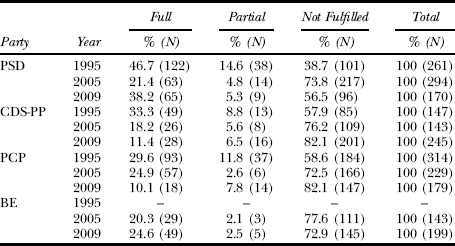
Turning to the opposition parties, our expectation is that they have more opportunities to fulfil their pledges under minority governments. Table 2 presents pledge fulfilment for the four opposition parties during the Socialist governments. Our data confirms, with no exception, that all opposition parties managed to deliver more policy benefits to their constituencies during minority governments than during the majority leadership of the Socialist Party. On average, opposition parties fulfilled 27.7 per cent of their pledges under minority governments and 21.2 per cent under majority arrangements.
Pledge Fulfilment in Portugal – Opposition Parties (PSD, CDS-PP, PCP and BE)

The first Guterres government offered the most opportunities for the opposition to fulfil its pledges. To be sure, after eight years of Cavaco Silva’s single-party majority (1987–95), the government inaugurated in 1995 was a watershed in executive–legislative relations in Portugal. As Leston-Bandeira (Reference Leston-Bandeira2004: 29, 30) puts it, there was ‘a dominance of the government’s will over parliamentary decisions and proceedings’, which led to a ‘notable unwillingness to accept any input from the opposition’. Subsequent Socialist governments offered fewer opportunities for the opposition to deliver on their promises. Despite its efforts for empowering the legislature, Sócrates’s majority government constrained the opposition. For example, the pledge fulfilment of the Partido Social Democrata (PSD – Social Democratic Party) fell to 21.4 per cent from 46.7 per cent. In his second term in office, Sócrates compromised with the PSD, leading to an increase in the pledge fulfilment of the latter.
There is an important difference between the number of pledges fulfilled by the main opposition party (PSD) and smaller parties (Partido Comunista Português (PCP – Communist Party), Centro Democrático e Social–Partido Popular (CDS-PP – Christian Democrats–People’s Party) and Bloco de Esquerda (BE – Left Bloc)). On the one hand, the Social Democrats fulfilled 46.7 per cent of their pledges during Guterres’s minority government, and 38.2 per cent during Sócrates’s second term in office. On the other hand, the Communists fulfilled 29.6 per cent and 10.1 per cent, respectively; the Christian Democrats fulfilled 33.3 per cent and 11.4 per cent, while BE managed to deliver on 24.6 per cent of its electoral promises.
The ideological proximity of the two main Portuguese parties, the Socialists and the Social Democrats, explains the capacity of the latter to extract policy benefits when the former are in a minority situation in government. Jalali (Reference Jalali2007) offers the argument that the main cleavage in the Portuguese party system is between anti- and pro-system parties, which explains why the Socialists form an alliance with the Social Democrats on major issues, particularly in economic and foreign policy areas.Footnote 10 This is in line with Belchior’s (2008) work on left–right positioning of Portuguese parliamentary elites. Belchior’s account shows that the ideological distance between PS and PSD on a 0–10 left–right scale is 1.96, while the distance between PS and BE is 2.06, and 2.54 between PS and CDU.
How do political actors perceive the decision-making process in minority and majority governments? According to a party leader, in Portugal the crucial difference is that ‘there is more supervision of parties that are in the minority [situation], and so the opposition is in a better position to derail proposals coming from the government that do not respect what the electorate would want’. In fact, the same party leader posited that ‘in an absolute majority, there is a greater impunity and those governments are able to impose measures on parliament whether or not they correspond to their electoral programmes’.
Our interviewees stress that electoral promises are an important focal point in the bargaining process in minority governments. A party official told us that the ‘this is in the programme’ argument is commonly used. According to this senior politician, ‘a strong political argument of opposition parties is to call on the government to comply with its electoral programme and the government feels more obliged to do so’. Conversely, in majority situations, governments ‘faced with the reality of governing can correct the course of policies more easily and distance themselves from the initial electoral programme’. To illustrate this problem with a real-world example, a former minister said, ‘the programme serves as a written testimony to deal with corporate interests. For example, I had to say to the trade unions that there could be no negotiation on things that were in the government programme and were already part of the electoral programme because they had already gone to the vote and were non-negotiable.’ Ultimately, as another interviewee put it, ‘when a government does not have a majority, it feels the need [to bargain and accommodate opposition interests]. Generally the outcome is better. Sometimes a majority is a very dangerous thing.’
The opposition adopts a strategic behaviour in changing its position according to the electoral cycle. A former minister recognized that, ‘if the opposition sees that the life expectancy of the government is long, then it will let the measures pass’. As soon as the opposition perceives a potential change in the status quo, ‘it will start opposing the government measures’, in order to build an electoral profile by sending signals to the electorate.
CONCLUSIONS
This article makes a contribution to the study of minority governments and pledge fulfilment by looking at the Portuguese case. Our key contribution is that pledge fulfilment does not depend on majority conditions. The Portuguese experience illustrates that what differs between minority and majority conditions is how those pledges are fulfilled. In the latter, governments have more leeway to implement legislation according to their utility calculations. In minority governments, pledges are fulfilled in bargaining with the opposition, which makes for a more consensual democracy, where both government and opposition get to deliver on their promises.
Our study has an important caveat inherent in its case study nature. By and large, it is difficult to identify the independent impact of cohabitation and the economy for pledge fulfilment (but see Thomson et al. Reference Thomson2014 for a study with more cases). There are, however, three important conclusions that can be drawn for the Portuguese case and for comparative literature.
Firstly, we find that on average single-party minority governments fulfil as many pledges as their majority counterparts. Specifically, we show that, working under favourable economic conditions and a cooperative president, the first term of Guterres in office offered the possibility for the Socialist Party to deliver on 75 per cent of its promises. Sócrates’s minority government fulfilled less than 50 per cent of its pledges, despite its short-lived nature.
Secondly, we show that opposition parties are offered more opportunities to deliver on their promises in minority governments. Our evidence suggests that during Sócrates’s majority government, opposition parties had few opportunities to extract policy benefits. Interestingly, the decrease in pledge fulfilment during the majority government was not compensated by an increase in the government’s performance.
Thirdly, we find that the Social Democrats, the major opposition party during the Socialists’ time in government, are the party that is most able to make an alliance with the government and to deliver on its promises. Our evidence reinforces Jalali’s (Reference Jalali2007) argument about the importance of the anti- and pro-system cleavage in the party competition as opposed to a traditional left–right cleavage.
From a normative perspective, our results raise the issue of the quality of democracy under minority government. According to Strøm’s canonical work, minority governments are questionable on this aspect for two reasons. Firstly, ‘they seemed to represent serious threats to domestic stability’. Secondly, ‘they violate the application of the norm of majority rule to executive–legislative relation. Thus, a key link in the representational chain might be broken’ (Strøm Reference Strøm1990: 243). However, Strøm argues that minority governments are perfectly able to meet the terms of their electoral mandate, as our evidence suggests. Ultimately, ‘minority governments form in circumstances in which the anticipation of elections weighs heavily on party leaders. Such governments reflect responsiveness to elections future, rather than to elections past. In this way minority governments represent the workings of prospective, rather than retrospective, orientations among political leaders’ (Strøm Reference Strøm1990: 244). Minority governments offer a more inclusive and consensual democracy by giving the median party the pivotal role for legislation approval (Lijphart Reference Lijphart1999).