Introduction
Julian Le Grand (Reference Le Grand2007) has developed a model of means and ends in service delivery. He claims that service delivery systems contain a mix of four means: trust, targets, voice and choice. There have been a number of applications of Le Grand's model (Taylor-Gooby et al., Reference Taylor-Gooby, Sylvester, Calnan and Manley2000; Forder, Reference Forder, Saltman, Busse and Mossialos2002), adaptations (Kendall, Reference Kendall2001) as well as far-reaching critiques (Martin et al., Reference Martin, Phelps and Katbamna2004). In this article, we extend and apply it in three main ways. First, we apply it to the rather different area of equal opportunities and diversity (EO&D). Second, we use the model to critique existing policy chronologies (Jewson and Mason, Reference Jewson and Mason1994; Bagilhole, Reference Bagilhole1997, Reference Bagilhole2009). Third, while Le Grand (Reference Le Grand2007) focuses largely on the user's point of view, we focus more on the producer, organisation or agency. We find that his model is useful in stressing important issues regarding means and ends, and that it produces a more complex and nuanced policy chronology. In our view, the benefits of extending his model outweigh the problems.
Chronologies of EO&D policy
Several writers have conceptualised equal opportunities using different chronologies. An early framework was constructed by Jewson and Mason (Reference Jewson and Mason1994) who saw the period from the 1940s to the late-1950s as defined by class inequalities and equal opportunities as a means of achieving social mobility. At that point it shifted towards matters of immigration and achieving cultural assimilation via a ‘colour-blind’ notion of equality of opportunity. Bagilhole (Reference Bagilhole1997, Reference Bagilhole2009) provides the most comprehensive attempt, setting out four, subsequently updated into five, ‘distinct eras’. These are:
• the moral era, 1940s and 1950s (emphasis on disability);
• the liberal legislative era, 1960s and 1970s (gender, ‘race’ and gay men's issues); The politically hostile era, 1980s (threats to gender and ‘race’, no hope for disability);
• the public relations and professional era, 1990s (acceptance of EO&D and hopes for disability);
• the fairness tempered with economic efficiency era, 2000s (positive action for ‘race’, disability and gender, broadening the EO&D project).
Bagilhole (Reference Bagilhole2009) provides more details elsewhere in her book (see also Dickens, Reference Dickens2007; Equalities Review, 2007: chapter 2; Thane, Reference Thane2010).
While the chronological era approach provides a useful heuristic device for understanding the development of EO&D, we feel that it has limitations, including a tendency to over-simplify equal opportunities and neglect competing perspectives. For example, Cockburn's (Reference Cockburn1989, Reference Cockburn1991) conceptualisation of ‘short’ and ‘long’ agendas does not fit neatly into these frameworks. It does have a temporal structure, but it is not reflective of defined time periods. The aspect that is relevant is that addressing inequality of opportunity is a long-term, structural mission. The ‘short’ option is to continue to focus exclusively on its individual and cultural dimensions rather than the way in which discrimination is woven into the warp and weft of society. Second, while decades may be useful for presentation, it is not clear what the ‘tipping points’ or ‘path changes’ were. Third, Bagilhole (Reference Bagilhole2009: 58) notes that the major forces can be categorised respectively as morality, liberal legislation, political opposition, economic and professional interests, and a combination of supranational, political will and economic drivers, and that, although there is often a combination of forces in the different eras, ‘on the whole it is possible to speculate about the dominant force’. We aim to develop this point within the context of Le Grand's (2007) focus on means and ends, and argue that development was sometimes more nuanced without a clearly dominant means or end. Moreover, the overlap of ends and means, and interaction between them, provides further complexities.
Le Grand's models
Le Grand (Reference Le Grand2007) discusses the means and ends of public service delivery. He discusses the ends of quality, efficiency, responsiveness and accountability and equity, and their trade-offs. He then presents four models of delivery: trust, targets, voice and choice. Ultimately, he argues that delivery systems that incorporate substantial elements of the ‘invisible hand’ of choice and competition have most promise.
In the trust model, the government sets the overall budget then providers spend it. Public servants are altruistic ‘knights’ rather than self-interested ‘knaves’ (Le Grand, Reference Le Grand2003). In broad terms, this can be related to the ‘public sector ethos’ (Le Grand, Reference Le Grand2007: 18–19). In other words, governments should trust public sector professionals. Le Grand's model of targets, performance management or ‘command-and-control’ assumes less trust. Here, public service workers are part of a rigid management hierarchy. This requires less professional discretion through rigid aims, often formalised in goals and targets. The third model of ‘voice’ is shorthand for the ways users can express their dissatisfaction through communication with providers, whether informal discussion, by indirect means (through parent governors), formal processes (via complaints procedures) or collective action (voting). Le Grand's preferred option is ‘choice’. If we cannot trust professionals, or control them by targets or ‘voice’, then the best means of organising services is to make them respond to the mechanism that drives the private sector: competition expressed through choice.
While others have applied and critiqued Le Grand, two points are relevant to this article. First, Le Grand's main purpose is to present an analytical framework rather than a policy chronology. In an earlier work, Le Grand (Reference Le Grand2003) discussed the move from ‘knights rampant’ (the British welfare state 1945–79) to ‘the triumph of the knaves’ (the British welfare state after 1979). However, it can be argued that a more detailed application to general public service delivery is unclear. Moreover, it should be noted that policy rhetoric is often a poor guide to practical policy; few politicians advocate ‘command and control’, although there were significant elements of this under the Conservatives (1979–97) and New Labour (1997–2010).
Second, Le Grand's main aim is to examine ends with respect to service users. However, the ends in EO&D are less clear: as we discuss below, sometimes the end focuses on the diversity of the workforce or senior management (i.e. an end for producers), while at other times the end is better service provision for all (the business case) or for certain groups (representative bureaucracy). While the framework provided by Le Grand was clearly not designed for the evaluation or exploration of EO&D policies and legislation, and perhaps in attempting to do so we are unable to account fully for the role of user voices at this stage given the space available, we maintain that this simply presupposes its further adaptation and refinement.
Applying Le Grand's framework
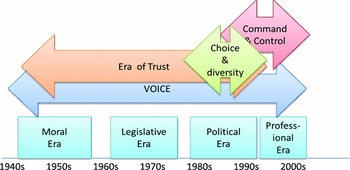
In this section, we take the different models and consider their relevance for EO&D, visually represented in figure 1.
Comparing the frameworks.

The figure shows that there is some degree of overlap in the different means. While it should not be ‘over-interpreted’ (e.g. that voice began in a certain year), it broadly suggests that it is better to portray means as co-existing over time rather than focusing on discrete historical periods. Moreover, ends also change over time, and there are sometimes complex interactions between different means and ends. We now turn to discuss ends and means.
Ends
There are many possible ends in EO&D policies, including an obvious point about whether ‘equality’ reflects a different end to ‘diversity’. Equal opportunities may make assumptions about diversity, but it is not a necessary outcome, as according to its internal logic (referring to the formal and liberal variations, see Forbes, Reference Forbes, Meehan and Sevenhuijsen1991 and Johns, Reference Johns2006) the principal objective is to eradicate unfair barriers to protected group achievement. If for some reason, which might include choice, cultural factors or geographical location, diversity does not materialise that is ultimately, in theory, tolerable. Writers such as Kandola and Fullerton (Reference Kandola and Fullerton1998) advocate diversity as a policy objective, although their outcomes may be seen as questionable. The unpopular and mostly illegal bridge between equal opportunities and diversity is positive discrimination (radical equality of opportunity) that seeks to actively diversify workforces/places/roles/pay and conditions. For the sake of brevity, we focus on workforce diversity or representation in the public sector rather than on wider issues, such as equal pay or harassment etc. (see for example, Bagilhole, Reference Bagilhole2009).
In very broad terms, Conservative governments have tended to favour ‘equality of opportunity’ goals, which are often related to the ‘business case’. For example, Friedman (Reference Friedman1980) argues that the free market will eradicate discrimination because profit seeking firms will not wish to limit their markets, or fail to attract the best employees. Labour governments, at least rhetorically, tend to argue that ‘equality of opportunity’ is insufficient and move towards more radical interpretations such as equality of outcome. Most policy ends tend to relate to proportional equality such as a workforce that broadly reflects the population. However, Dandeker and Mason (Reference Dandeker and Mason2001) point out that the apparently unproblematic concept of representativeness conceals four distinct ideas: the statistical, the delegative, the symbolic and the value. Moreover, some organisations, such as the National Health Service, have had diverse workforces in some respects for many years, but remain ‘snow-capped’, in Trevor Phillips’ penetrating term, in the sense that senior management does not reflect the workforce (see, for example, Iganski and Mason, Reference Iganski and Mason2002). However, there appears to be no clear policy goal about whether senior management should reflect the population or the workforce. Finally, it is not clear whether organisations should reflect the national population (as suggested by the nationally uniform targets for public boards) or the local population.
Means
Trust
It can be argued that ‘trust’ remains a dominant mechanism from the 1940s, with the ‘classic welfare state’ defined by trust in welfare professionals, exemplified in the public service ethos (Deacon, Reference Deacon2002; Le Grand, Reference Le Grand2003). There appears to be a similar picture for EO&D, with the passage of the Disabled Persons (Employment) Act 1944 (which was designed to assist disabled soldiers returning from the Second World War to obtain work, and set out a quota system of 3 per cent for disabled workers in workforces over 20), into at least the 1980s, which essentially blends the moral, legislative and political eras. Once the legislation was passed there appeared to be a kind of laissez-faire approach to its enforcement in the public sector. Aside from government circulars and various forms of guidance, there were only modest attempts to ensure compliance (Iganski et al., Reference Iganski, Mason, Humphreys and Watkins2001). While it might be tempting to account for this in strictly party political terms, the failure of both Labour and Conservative administrations over this period to provide greater impetus suggests the limitations of a purely political analysis.
On the other hand, alternative explanations stress complacency or perhaps wilful ignorance: that governmental sponsors of EO&D thought that simply to pass the 1944 Act and the later Race Relations Acts of 1965 and 1968 would be enough. Bearing in mind of course the motive for the ‘race’ legislation as a counterweight to racist immigration policies (Berkeley et al., Reference Berkeley, Khan and Ambikaipaker2005), it can be argued then that just as poverty was rediscovered (Abel-Smith and Townsend, Reference Abel-Smith and Townsend1975) evidence of continuing discrimination was similarly ‘rediscovered’ (for example, Brown and Gay, Reference Brown, Gay and Burstein1985; Jonsson and Mills, Reference Jonsson and Mills1993; Blackaby et al., Reference Blackaby, Clark, Leslie and Murphy1994). In short, this early albeit implicit stress on ‘trust’, implied because the public sector was in this period regarded as a ‘model employer’ and that this was naturally underpinned by the ‘public service ethos’, did not produce a representative workforce or senior management in terms of ‘race’ and/or disability.
Command and control
Moving forward in time without falling entirely into the chronological schema it is possible to see that the 1970s legislation (1970 Equal Pay Act; 1975 Sex Discrimination Act; 1976 Race Relations Act) reflected command and control, but while the legislation enabled employers to take positive action, the provisions were voluntary and often neglected (Iganski et al., Reference Iganski, Mason, Humphreys and Watkins2001). Although the Thatcher and Major administrations resorted to ‘command and control’ generally in the public sector, as welfare professionals were regarded as selfish knaves rather than knights, there was much less interest in using command and control in terms of equal opportunities provisions (Gillborn, Reference Gillborn2005). One of the few examples in the EO&D field enacted without direct EU pressure (unlike the amendments to existing legislation in the mid-1980s), the Disability Discrimination Act 1995, where disabled candidates had to be short-listed for interview if they were minimally qualified and structural discrimination was at least nominally targeted through the injunction for employers to make ‘reasonable adjustments’ to premises and processes. However, this was implemented because the evidence suggested it would be economically beneficial; removing disabled people from unemployment benefits and making them economic contributors (Riddell, Reference Riddell2003).
Turning to the New Labour government, Blair shared the same distrust for welfare professionals as Thatcher, and continued the broad, though implicit, command and control agenda. Although there was perhaps more inherent sympathy with equal opportunities, the EO&D agenda received a major ‘external shock’ from the public inquiry into the death of Stephen Lawrence (Mclaughlin and Murji, Reference McLaughlin and Murji1999). The final report said that there was evidence of corruption, incompetence and institutional racism. Without hesitation, the government introduced goals and targets for minority ethnic recruitment into the police service with more rigorous reporting mechanisms, and more interest in the outcomes, than had been the case with the 1940s disability legislation (Home Office, 1999), and several new equal opportunities policies.
Ultimately, this had two important outcomes. First, it drove equal opportunities policy down the road of positive action, dovetailing neatly with command and control, where targets for minority ethnic recruitment were established and monitored. Second, the onus fell on the public sector. Whether that will continue with the Conservative-Liberal Democrat coalition is hard to tell. Early pronouncements suggest that it will remain as (at least rhetorically) a policy objective, reinforced by the passage of the Equality Act 2010.
Choice and diversity
Running almost parallel to the command and control period has been ‘choice’, which is interesting because they appear antithetical. Bagilhole (Reference Bagilhole2009: 67) notes that increasingly in the 1990s a business case was argued for EO&D, as voiced by Conservative Ministers and the then chair of the EOC (Iganski and Mason, Reference Iganski and Mason2002; Bagilhole, Reference Bagilhole2009). The ‘business case’ is distinctive on two important grounds. First, it accepts that morality or ‘social justice’ is insufficient, and that EO&D initiatives had to appeal to self-interest, emphasising benefits to organisations and, de facto, middle-class white men. As Dickens (Reference Dickens1999: 9) puts it, business case arguments are inevitably contingent, variable, selective and partial. Perriton (Reference Perriton2009) argues that it works to frame, restrict and depoliticise the discussion of gender in the workplace. Second, it blurs the boundaries between equality of opportunity and diversity. ‘Managing Diversity’ (Kandola and Fullerton, Reference Kandola and Fullerton1998) focuses on the individual rather than groups, and critics argue that it downplays issues of discrimination (Wrench, Reference Wrench2005; Perriton, Reference Perriton2009).
Bagilhole (Reference Bagilhole2009) points out that the ‘fairness tempered with economic efficiency’ era (itself an acknowledgement of the limitations of the chronological approach, mixing as it does, different ends) saw three areas of EO&D develop significantly under New Labour: family-friendly policies; the influence of EU legislation; and positive action by placing a positive duty on the public sector to promote EO&D. ‘Human rights’ became important, but Bagilhole (Reference Bagilhole2009: 76) notes that these were sometimes ‘primarily and predominantly based on economic arguments’. This can also be seen in the Equality Strategy published by the Coalition Government to frame the Equality Act 2010 provisions, where Theresa May, Minister for Women and Equalities, states in the foreword: ‘As we rebuild our economy it is essential that we make sure we benefit from the talents of everyone in the UK’ (HM Government, Reference Government2010). Of course, the legislation and supporting strategy are about enforcement, but the appeal is to choice through the business case: diversity is good for you!
However, there are other issues about the ‘business case’ as it applies to the public sector. For example, some themes, such as attracting the best talent to the workforce (Ross and Schneider, Reference Ross and Schneider1992; Bagilhole, Reference Bagilhole2009), apply to both public and private sectors. However, while private sector firms can lever diversity to attract more customers to enlarge markets and increase sales, public sector organisations that enlarge markets (e.g. sickle cell screening) are likely to achieve organisational goals but also (at least in the short term ways in which public budgets operate) increased costs. Consequently, different alternatives were drafted specifically with the public sector in mind, notably the ‘quality case’ for diversity (Commission for Racial Equality, 1995).
Voice or voices
’Voice’ is perhaps the most problematic of Le Grand's (2007) models. His model refers to ‘the voice’ of users, but there are a number of possible ‘voices’ in relation to EO&D. First, there is the ‘voice’ of social movements. Bagilhole (Reference Bagilhole2009: 59) points out that during the 1960s and 1970s, the struggles of grassroots organisations gained recognition and the voices of long-neglected groups were heard in the political and public arena. These might include the civil rights movement in the USA and feminist, anti-racist and gay movements in the UK. Additionally, there are those areas of policy where welfare users/consumers express preferences for providers from similar backgrounds. At the weaker end of this spectrum we might include the higher uptake for sickle cell and thalassemia clinics run by minority ethnic professionals (Anionwu and Atkin, Reference Anionwu and Atkin2001; Johns, Reference Johns2006) while at the more extreme end there are the segregationist tendencies represented by the establishment of faith schools (Finney and Simpson, Reference Finney and Simpson2009). Other examples of ‘voice’ in relation to EO&D would include those indirect means flagged earlier in the form of parent governors, as well as through complaints procedures and electoral processes (though these may be difficult to interpret with any degree of accuracy). Second, there is the representative notion of ‘voice’ that having more diversity in public sector organisations will lead to better representation for protected groups, which might be the flip side of the preferences for minority ethnic professionals highlighted above. This is an assumption widely expressed in the relevant literature (Kalra et al., Reference Kalra, Abel and Esmail2009), and has been reflected in the importance of diversity for democracy in the adapted notion of representative bureaucracy (Meier et al., Reference Meier, Wrinkle and Polinard1999). New Labour's determination to introduce all-women's shortlists from 1997 onwards, where female candidates were selected in safe Labour seats, might be considered a practical expression of representative bureaucracy (Krook, Reference Krook2003).
Third, there is the voice of individual employees. Unsurprisingly the evidence suggests that those least in support of equal opportunities are white men. Managing diversity advocates such as Kandola (Reference Kandola1995) talk about the need to bring everyone along, though evidence suggests that those with most to gain are not always supportive. For a long time, there have been concerns expressed about positive action identified as ‘the stigma of incompetence’ (Heilman, 1994, cited in Bagilhole, Reference Bagilhole1997); people generally want to believe that they have advanced by their own merits.
Fourth, the collective voice of service providers has been expressed in one of three ways. First there are trades unions. While it would be wrong to say that equality of opportunity was always a central concern for unions (Cook, Reference Cook1993), it has become an important strand of their activities (Dickens, Reference Dickens2000). Another expression of this voice has been the establishment of professional associations; examples include the National Black Police Association, which strives to provide a bulwark against discrimination. Finally, there has been the more recent phenomenon of staff groups and networks. The distinction between these groups reflects differences in their origins and motivations. While unions and associations emerged organically, staff networks have appeared as a result of downward pressure. Unions have been under attack since the 1980s, and attempts have been made to replace this ‘voice’. By suppressing the voice of trades unions and encouraging staff networks management have divided the voices of employees into their respective ‘minority group’ silos. This has set groups against each other. There has thus been a proliferation of staff networks based on ethnic group, ‘racial’ identity, gender and disability. European Directives have compelled the UK government to give employees a vehicle for representation, and they chose to encourage staff groups rather than potentially troublesome trades unions.
Discussion
We have argued that it is possible to develop an alternative policy framework for understanding the development of EO&D in the UK using Le Grand's (2007) focus on means and ends. We argue that means vary over time, resulting in a less linear and more nuanced picture to existing ‘eras’. While there may be dominant means in different periods, seemingly incompatible means such as command and control and choice co-exist within a policy mix (Exworthy et al., Reference Exworthy, Powell and Mohan1999; see also Cunningham, Reference Cunningham2000). For example, does increased command and control or the ‘audit society’ typified by the imposition of goals and targets ‘drive out’ trust? (Johns and Green, Reference Johns, Green, Johns and Barton2009; Seldon, Reference Seldon2010). Do the ‘knavish’ aims associated with the business case conflict with the knightly objectives of the moral case? (Johns et al., Reference Johns, Green and Powell2012) Does choice (suggesting greater local devolution) conflict with the tighter line management of command and control? Can the intersectionality central to the Equality Act 2010, which is an attempt to challenge multiple layers of discrimination in and through the same means (an acknowledgement of the importance of ‘interaction’) achieve positive ends for every protected group (Squires, Reference Squires2008; Bagilhole, Reference Bagilhole2009; Chatoo and Atkin, Reference Chatoo, Atkin, Craig, Atkin, Chatoo and Flynn2012)? Or will it simply create more complicated layers of injustice, as hierarchies of oppression become more pronounced as gender trumps ethnicity and disability outranks sexuality and so on and so on? Similarly, there have been different emphases on ends over time, and there remains considerable confusion over conflicting ends (for example is the priority a representative workforce or senior management team? Should senior management and public boards reflect the workforce or the national or local population?).
Conclusions
We have applied Le Grand's (2007) model of public service delivery to the chronological development of EO&D policy. Our main findings are that this presents a more nuanced picture than an emphasis on discrete eras. Our alternative perspective stresses that ends and means vary over time, and different approaches can overlap and interact, for example the command control of positive action running parallel with the ‘choice’ at the heart of the diversity (diversity is good for business and service provision). Dickens (Reference Dickens1999) points out that legal, social regulation and business strategies are not to be seen as alternatives or as three separate poles, but as a tripod where the three strategies are complementary and mutually reinforcing. However, in our view, this assumption that approaches are mutually reinforcing is far from clear. This can be the case, but it is also possible that different approaches may not mix (like oil and water) or that they can be mutually repulsive (in the sense that command or competition may drive out trust). A model that clearly focuses on means and ends allows us to examine in the future these vital issues in more depth; what we have done here we believe is to take a tentative step along this road.