Liquid milk can be processed into various downstream products such as milk powder, cheese and ingredients, resulting in high wastewater volumes. A typical European dairy processing plant produces approximately 500 m3 of wastewater daily (Demirel et al. Reference Demirel, Yenigun and Onay2005). Such wastewaters represent a potential environmental risk (e.g. eutrophication) due to high nutrient loads, requiring extensive treatment prior to discharge into receiving water bodies. Traditional biological treatments are often applied in dairy processing wastewater remediation but typically require chemical precipitant application and potentially high energy inputs. Intermittently aerated sequencing batch reactor (IASBR) technology has been previously described in the treatment of wastewater (Pan et al. Reference Pan, Henry, Liu, Huang and Zhan2013) as a cost efficient, sustainable wastewater treatment approach. The technology relies on biomass adaptation via multiple, alternating anaerobic/aerobic periods to achieve efficient removal of organic carbon (BOD), nitrogen (N) and phosphorus (P). The advantages of this system include a single operational reactor with reduced energy and chemical precipitant inputs when compared with traditional biological approaches.
In biological wastewater treatment technologies, the performance of the system is dependent on the action of key microorganisms for nutrient remediation. Biological reactor operational parameters play a major role in the selection and stability of such microorganisms. Understanding the relationship between the microbial communities in biological reactors and treatment performance has been found to be critical in the improvement/optimisation of these technologies (Ferrera & Sánchez, Reference Ferrera and Sánchez2016). Research to date into the microbiology underpinning IASBR systems has been limited to investigation of the spatial distribution of nitrite oxidizing and ammonia oxidizing bacteria, respectively (Pan et al. Reference Pan, Henry, Liu, Huang and Zhan2013). The current study applied NGS technology to fully characterize the microbial populations contributing to varying nutrient remediation performances of a laboratory scale IASBR system.
Material and methods
Laboratory-scale IASBR set-up and sample collection
The IASBR reactor was seeded with municipal sludge and operated at 11 °C in 12 h cycles with varying aeration rates (0·6 and 0·4 LPM). The reactor had a 4 d hydraulic retention time (HRT) and 20 d solid retention time (SRT). Physiochemical parameters were tested following standardized analytical procedures (APHA, 2005) and the manufacturer's instructions for a Konelab 20 Nutrient Analyser (Thermo Scientific). Biomass sampling for NGS analyses were chosen during 0·4 and 0·6 LPM aeration periods and reflection variations in reactor nutrient remediation performance. Samples were frozen at −20 °C until further analyses.
Molecular analyses of bacterial community composition and bioinformatics
In order to ensure sufficient biomass for optimal nucleic acid extraction, sludge was centrifuged prior to DNA extraction. Genomic DNA from mixed liquor sludge samples was extracted using PowerSoil Isolation Kit (MOBIO Laboratories) according to the manufacturer's instructions. Each sample was amplified using polymerase chain reactor (PCR) technique in triplicate to ensure representative sampling and sequenced by an external service provider (454 GS FLX + pyrosequencing, MACROGEN, Seoul). Sequences were corrected using Acacia (Bragg et al. Reference Bragg, Stone, Imelfort, Hugenholtz and Tyson2012) and processed using Quantitative Insights Into Microbial Ecology (QIIME) pipeline (Caporaso et al. Reference Caporaso, Kuczynski, Stombaugh, Bittinger, Bushman, Costello, Fierer, Peña, Goodrich, Gordon and Huttley2010). Taxonomy was assigned to each operational taxonomic unit (OTU) at 97% similarity in an open-reference OTU picking process implemented in QIIME. Taxonomy graphs were filtered at 3% cut-off.
Results and discussion
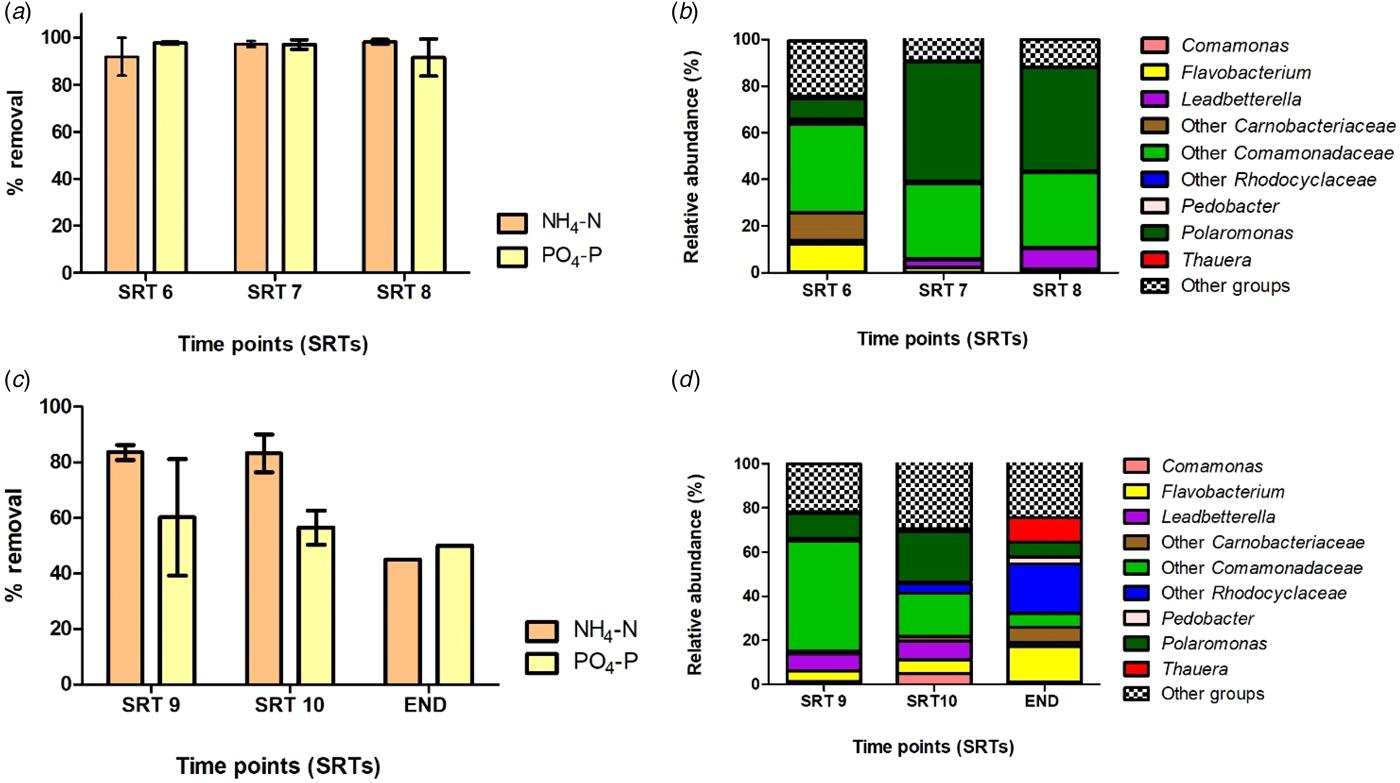
Genus level microbial diversity and percentage removal of ammonia (NH4-N) and orthophosphate (PO4-P) during each of the sampled SRTs are shown in Fig. 1. Under 0·6 LPM aeration conditions (SRTs 6–8) ~92% removal for both NH4-N and PO4-P was observed. This coincided with a clear dominance, up to 51·4% abundance, at genus level by Polaromonas (Fig. 1b). The competitive capacity of this genus appeared to be confined to the specific physicochemical conditions arising under 0·6 LPM aeration. The subsequent shift to 0·4 LPM resulted in a rapid reduction in the abundance of Polaromonas representatives (11% in SRT 9) and an increase of the bacterial diversity from SRT 10 compared with the dominance of a few groups of bacteria under 0·6 LPM aeration. During the 0·4 LPM period lower removal efficiencies were detected with higher impact in PO4-P removal, ≤60% removal efficiency (Fig. 1c). Polaromonas, a member of the family Comamonadaceae, has previously been identified within the microbial community structure of an activated sludge system treating municipal wastewater operated at 5 °C (He et al. Reference He, Ding, Xu, Geng and Ren2016). Evidence from the literature shows a positive correlation between several members of the Comamonadaceae family and biological nutrient removal (BNR) (Willems, Reference Willems, Rosenberg, DeLong, Lory, Stackebrandt and Thompson2014; Ge et al. Reference Ge, Batstone and Keller2015). The strong dominance of Polaromonas during the optimal nutrient removal performance in the IASBR suggests that the genera may contribute significantly to BNR processes. Other microbial groups with established links to BNR, such as Flavobacterium and Thauera, (Weissbrodt et al. Reference Weissbrodt, Shani and Holliger2014) were also observed in this study. However, the dominant ecological shifts were related to Polaromonas and other members of the family Comamonadaceae (‘Other Comamonadaceae’ group). Further work is required to assess the functional contribution of Polaromonas enrichment within the IASBR and, by extension, other biological treatment approaches.
Removal efficiencies (%) of NH4-N and PO4-P and respective solid retention times (SRTs) during 0·6 LPM (a) and 0·4 LPM (c) aerations, respectively. Bacterial composition at genus level during 0·6 LPM (b) and 0·4 LPM (d) and respective solid retention times (SRTs). ‘END’ corresponds to the final day of bioreactor operation at the conclusion of SRT10.

In summary, IASBR application to synthetic dairy processing wastewater appears to be a promising technology capable of efficient remediation of high nutrient loads. Minor alterations in IASBR aeration rates (0·6 vs. 0·4 LPM) had significant impacts on reactor performance. These impacts were reflected in changes within the microbial ecology profiles, which suggest a dependence of IASBR performance on specific bacterial community structures. The analyses suggest the potential importance of the genus Polaromonas in the system under investigation, which has not been previously reported.
Acknowledgments
The authors would like to thank the Department of Agriculture, Food and the Marine (Ref.: 13-F-507) for funding the Dairy Water Project. For additional details: https://www.dairywater.ie. Additionally, the DairyWater research team would like to the members of the Irish dairy sector for their cooperation and contributions throughout the research project.