Whether it was bread-wielding Tunisians, marching Suez workers, or Yemeni protestors chanting against corruption, the 2011 Arab uprisings put political economy issues front and center. Indeed, a critical thread throughout the region's uprisings has been the simple question: “where has the money gone?” And though the field of political economy is multifaceted, the basic refrain “follow the money” unites most of it. Having students engage and debate political economy issues helps counteract much of the popular media's fixation on violence, terrorism, and sectarianism that too often exclusively frames how Americans understand the Middle East. Political economy gets at some of the most important (but certainly not all) factors and dynamics that define social and political life in the Middle East. A political economy approach also reinforces the critical disposition and tools of inquiry to instill in university undergraduates. In particular, the approach stresses to students that the realms of the economy and the political are hardly distinct, and therefore a more complete explanation for the events of 2011, and after, require grasping that interaction (Lindblom Reference Lindblom1982; Polanyi Reference Polanyi2001).
Because many of my students come from rust belt cities like Cleveland, Ohio, Detroit, Michigan, and Youngstown, Ohio, having them make the connection between politics and money is not difficult. Front-cover stories of Americans' disgust at the banking sector or Europeans protesting austerity, also help to place the Arab grievances of 2011 in a broader context. Today, the 99% can be found in many places. That broader context can help expand what constitutes “the economic” so that students appreciate the social, political, and cultural settings in which trucking and bartering takes place. Thus, the millions of Arab citizens who took to the streets in 2011 did so in defiance not only of a history of economic stagnation, inequality, and corruption but did so in the face of consistent political despotism and social divisions. To be sure, however, political economy considerations can be only part of a more complex understanding of 2011.
This article suggests two general political economy themes to sharpen our lens on the paths to 2011 and dynamics after: the politics of economic development/reform and resource politics. Tracing the politics of economic development and the last decades of economic reform in the Middle East challenges students to think beyond an abstract world divided between politics and economics. Exploring resource, or rentier, politics presents students with a parsimonious debate with broad methodological implications. Underlying these issues are concerns about the accuracy of the macro economic data produced by governments in the region and indeed throughout the developing world. Experimenting with ways around uneven and missing macro economic data by exposing students to multiple methods of inquiry broadens classroom engagement with one of the most diverse regions of world.
THE POLITICS OF ECONOMIC DEVELOPMENT AND REFORM
One important point to make sense of what most Egyptians and Tunisians commonly refer to as “the Bread Revolutions” is to recognize these were not singular events. A political history here laid the foundations. Economic historians of the Middle East have long emphasized the politics underpinning economic policies pursued by external powers and their follow-on effects. Ottoman and later European powers were less concerned about the economic and social development of their possessions and more focused on keeping political control to pursue geostrategic aims. Colonial alliances with large land owners in Syria, Egypt, and Iraq deepened rural inequality and further impoverished peasants. Special trade and retail access for urban merchants, likewise, entrenched systems of economic privilege for those with the political connections (Henry and Springborg Reference Henry and Springborg2010; Owen and Pamuk Reference Owen and Pamuk1999).
Similar to other parts of the developing world, formal political independence hardly freed new Arab leaders from these legacies. Plus, new challenges emerged. The necessity to build or adapt state institutions, craft national identities, and build political coalitions overlapped with the challenges of constructing a national economy. Policies in one area could adversely affect pursuit of others. Externally, new Arab states faced a decidedly unequal international economy in which American dominance in the 1950s would give way to Asian competitors in the 1980s. New Arab leaders also competed among themselves for position in the region thereby linking one's domestic performance to pursuit of external goals. Finally, within countries, leaders and centers of power competed to get their own piece of the pie. As the great Arab social historian Ibn Khaldun remarked, no king is powerful by himself; he needs the support of others to rule. Thus, across the Arab world leaders would use economic policies as tools to cement political rule by rewarding allies and punishing rivals. Infrastructural investment was tightly linked to patronage, trade was monopolized for those with the political contacts, and labor union autonomy was curtailed to avert political opposition. Indeed today, the Middle East leads the world in having the lowest levels of labor protection and enforcement (Cammett and Posusney Reference Cammett and Posusney2010). The exigencies of short-term political control trumped development of the kind of longer term investments, institutions, and political arrangements which has led to productive economic development elsewhere (Waldner Reference Waldner1999).
In addition to these political foundations, economic development also intersected with social and moral considerations, which remain a lasting part of the region's economic life. The international consensus of the 1950s and the 1960s on economic development reserved a strong role for state guidance and planning. That Egyptians, Syrians, and Iraqis would be masters of their own economic fate complemented the optimism of independence from foreign rule. As well, Arab and Islamic values of propriety, equality, and justice could not be separated from the economic ones (Tripp Reference Tripp2006). This held true for secular leaders like Egypt's Gamal Abdul Nassar whose populist rhetoric and policies were designed to partly contrast with the economic privileges doled out by the monarchy he helped overthrow in 1952. Similar revolutionary economic promise came with political upheavals in Syria and Iraq; so much so that in Iraq Prime Minister Nuri al-Said's infamous sale of Iraq's oil resources to the British in the 1930s contributed to his grisly death when the monarchy was overthrown in 1958. The social and moral expectations of economic policies were not mere window dressing; they would remain deeply embedded within Arab societies. Perceptions that these norms and expectations were violated contributed to the outpouring of socioeconomic discontent which led to 2011. Whereas the experiences of individual countries differed to some extent, policies encouraging the growth of the public sector, creating state-owned enterprises (SOEs), implementing price and trade controls, nationalizing leading economic enterprises, and attempting rural land reform were built on comparable political and social foundations.
Looking down the road, the coming clash is clear to a generation of American students versed in the civil rights movement. Because just as “all men are created equal” was bound to clash with a Jim Crow South in the 1950s and 1960s, the promises and expectations of economic prosperity and equality in much of the Middle East would come to crash against the stagnation, inequality, and corruption which the politics of economic development ultimately fostered. Here reinforcing more general issues of political economy with students is crucial. All too often public discourse in North America portrays politics in the market as always detrimental, but the critical classroom consideration here is not that politics can or should be divorced from the economy; rather, the question is who benefits from the economic policies? Are policies broadening the capacity and the participation of groups and individuals in the market? Or are policies centralizing economic resources and cutting off alternatives?
Although long-term answers to these questions were mostly negative, students must understand there were positive achievements. Collectively by the 1970s, the region expanded urban infrastructure, broadened education, and achieved respectable income equality (more on measuring later) in comparison to other developing regions. But problems developed because much of this investment and building was of the fire-and-forget variety, not followed up with sustained investments in worker skills, deeper education, or pursuit of more value-added, competitive manufacturing. Moreover, the short-term political rationales on which many economic policies were built continued to present obstacles for future chances to shift investments, respond to changes in the global market, upgrade labor skills, or meet the needs of a growing middle class.
Beginning in the mid-1980s and lasting through the 1990s, the region entered into what is termed the bust decades whereby growth slowed, oil prices declined, debt mounted, and job prospects narrowed. States and societies reacted differently, but generally, as early as the late the 1970s, we began to see mounting protest. Protests in Egypt over price increases prompted deployment of the military; the second occurrence of military deployment would come in 2011. Similar unrest subsequently unfolded in Morocco, Jordan, Algeria, and Tunisia. Political leaders reacted with various measures promising economic reform, limited political opening, and eventually turned to international lending institutions. The resulting economic reform policies hewed closely to core elements of the Washington Consensus, even for countries where formal structural adjustment agreements were not in place (Algeria, Iraq, and Kuwait). And in nearly every case, the principle goal was revival of the private sector through new laws liberalizing investment, trade reform, and privatization. Across the region, private business—shunned for decades as predatory or tied to the colonial past—returned.
By the late 1990s, it was apparent that economic reform was failing to generate more productive growth. Those short-term rationales of the past proved tenacious. Thus, unemployment, export competitiveness, and labor skills upgrading all remained problems. For most of the non-oil exporting states, two options were available. One option was to continue with neoliberal reforms to ensure access to international lending. And here students can begin to see the specific effects of the political legacies of previous economic policies. Because those policies were designed to secure support for centralized rule, any policy shifts that would decentralize those investments were only rhetorically followed, abandoned at implementation, or simply dragged out. What ruler wants to pursue economic policies that might threaten political control? For example, allowing greater labor rights as a means to upgrade labor skills and flexibility could enhance the political power of organized labor, not coincidently one of the important actors in 2011. Where reform went the farthest was the opening to greater private-sector consultation and policies favoring investment. The problem, however, was that these openings remained restricted to private-sector elites in most cases, not encompassing labor, consumers, or broader discussion of socioeconomic priorities. Just as policies of the 1950s and 1960s were designed to cement political control, new reform policies were often geared toward bringing business into a tighter network with regime leaders. But the problem was that business as a social actor tends not to reform the institutions around it; rather it uses resident arrangements to pursue particular advantage (Moore and Schrank Reference Moore and Schrank2003). The private sector as harbinger of change failed.
A second option open to states of geostrategic importance to global powers was to strengthen international alliances guaranteeing access to external funding. For example, both Jordan and Egypt's peace treaties with Israel and their subsequent support for US policies in Iraq earned each regime more external funding but at the cost of aggravating populations at odds with those policies. Shutting down opposition voice on economic reform and foreign policy meant that promises of political reform faded. Economic reform in the Middle East, therefore, became synonymous with increased centralization and not liberalization (Heydemann Reference Heydemann2004). Clearly, although the sustained protests of 2011 came as surprise, the issues of socio-grievance did not.
RESOURCE AND RENTIER POLITICS
A second teaching focus in the political economy of the Middle East is debate about the resource curse or what is termed rentier state theory. In contrast to the previous section, here the emphasis is on how an economic factor (in this case resources and commodities more generally) can shape political outcomes. Exploring this debate in class has two benefits. First, the theories are accessible for undergraduates, and it allows students to put abstract methodological concerns into a real world setting. Second, since outcomes from 2011, so far, suggest that most of the oil-rich countries have resisted the popular forces of change, investigating what might make oil exporters different, or not, makes sense.
Prior to the 1980s, it was a common assertion among scholars that lack of democracy or monarchical rule in the Middle East was due to cultural or religious factors. One of the first serious blows to those ideas came with the advent of rentier state theory. In its most basic form rentier theory subscribed to a kind of fiscal sociology in which it was argued that how a state collects its revenue shapes its basic politics (Moore Reference Moore, Brynen, Moore, Salloukh and Zahar2012). The distinction was made between states that collect revenue through domestic extraction versus states that derive revenue externally. In the Middle East and other parts of the developing world, external revenue comes often from oil profits but can also include other mining revenues, aid, and debt forgiveness. Together, these external forms of state revenue are considered rents in so far as the state has monopoly control and the funds are less earned and more reward (Gulf oil production, in particular, has very low per-barrel costs). For states where external revenue comprises a majority of public budgets or dominates the domestic economy (a rentier state), the political implications are straightforward. States that do not need to extract domestically are unburdened by reciprocal demands for political participation; thus the well-known twist, no taxation, no representation. States can distribute that easy money to buy off rivals and reward allies. Or, states can use that money to enhance capacities for domestic repression. Hence, democracy is thwarted and authoritarianism is strengthened through possession of an economic asset.
In the last decade, popular journalists have cribbed from this scholarship to “discover” iron laws of oil politics; oil rents go up, freedom goes down; oil rents go down, freedom breaks out. Getting students to critically assess such simple formulas is a start. There are debates about how oil dependency is measured and the sets of cases that result (Herb Reference Herb2005; Ross Reference Ross2001). Does the size of a country matter? For example, oil-rich Nigeria has to spread its money over a larger population than the small city-states of the United Arab Emirates. Empirical complications emerge as well. What happened when most of the oil exporters experienced rent declines in the 1980s and 1990s as oil prices fell? While forms of protest and demands for greater political participation and consultation did take place to varying degrees among the oil exporters (Gause Reference Gause1994, 78–119), the iron law turned out to be neither iron nor a law. There are also critiques of the causal model itself. For example, because oil does not spend itself, students can consider whether all resource exporting states are doomed to similarly undemocratic politics? What about historically resource dependent cases like Canada, Norway, or Mexico?
Pursuing these questions can also persuade students to think methodologically. What came before oil exports might be important for what comes after. Norway and Mexico, at least, built their states and institutions prior to the arrival of significant oil money, whereas all of the Middle East's resource exporters started building their states at the same time oil money and the international oil companies began to arrive. Timing matters and asking students to compare across time and space brings this point home (Jones Reference Jones2011; Munif Reference Munif1989; Vitalis Reference Vitalis2009). Finally, exploration of resource politics, similar to the focus on efforts at economic reform, shows that the division between the domestic and the international is hardly set. Whereas natural resources may not come with their own political properties, the international structure of resource production and politics matters. For example, some of the previous critiques of rentier models fault its ecological determinism by contrasting the failures of Middle Eastern and African resource exporters with the success of earlier Western resource exporters. However, with respect to my Canadian colleagues, seventeenth century Canadian beaver pelts were hardly geostrategic commodities; whereas oil in the twentieth century was a different matter altogether. The domestic uses of resource wealth may be politically and socially dependent but the international politics and sociotechnical aspects of oil also may impart pressures and opportunities on rulers to spend the profits in certain ways (Mitchell Reference Mitchell2011).
To summarize, oil resources do seem to matter for nondemocratic regimes wanting to maintain power, but oil alone cannot account for the origins of these regimes. Like politics and economy, oil and rule go together, but it is not a neat, one-way relationship.
THE SOCIO-ECONOMIC ROAD TO 2011
In this final section, we bring both teaching foci together to illuminate the political economies of the 2011 uprisings. Among the explanations scholars have offered for understanding the 2011 uprisings, socioeconomic ones have been prominent. Some scholars argue that the uprisings' start in Tunisia and Egypt was because of economic modernization, increased literacy, and urbanization, which propelled a growing middle class to rise up. Another explanation blames the region's rampant corruption and lack of genuine reform for the uprisings. Others blame neoliberal policies and the reduction of state welfare provisions for the increases in corruption and inequality that informed many of the protestors' grievances. Finally, the way the uprisings spread, generally landing more lightly on the more oil-rich countries, suggested to some scholars that oil wealth has played a role in limiting the uprisings. To be clear in the classroom, these are all structural arguments for fast moving and highly contingent political events and thus can only be one part of a complete explanation. It is useful for students to debate these explanations to understand 2011, link the analysis back to the literatures on economic development and the resource curse, and to explore ways to understand the macroeconomic data produced by developing world governments.
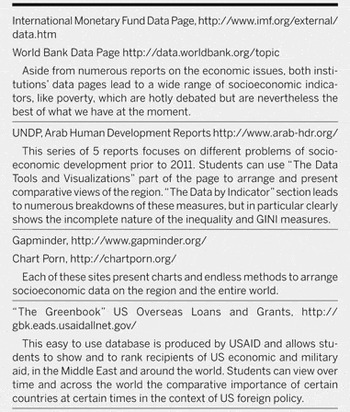
The primary difficulty of adjudicating the first three economic explanations rests with the incomplete and uneven nature of economic data on the region. With the exception of Turkey, Israel, and to some extent Egypt and Iran, reliable time series data is rare, and many of the region's recent socioeconomic achievements are contested. Data pages at the World Bank and International Monetary Fund websites (see table 1) are good starting points for research. Students can find comparisons of the region's development that put it ahead of Sub-Saharan Africa and Latin America in terms of inequality and poverty. Likewise, literacy gains, particularly in Egypt during the last decades, are impressive; all support the modernization theory of 2011. But by taking a closer look, it turns out much of this data needs interpretation or is contested by other measures. The most common measures of inequality, the GINI coefficient or index, rely on either household income data or household consumption data. In the Middle East, as with much of the developing world the source is household consumption, which likely under-measures inequality because poor households consume more as a percentage of their income than do the rich (Milanovic Reference Milanovic2010). Static poverty measures like $1.25 or $2.00 a day, in which the Middle East does well, might also misrepresent: citizens in developing countries with stronger public welfare and public good provisions can stretch that money further than weaker providers, therefore, contrast public good provisions in South Africa with Egypt (Broad and Cavanagh Reference Broad and Cavanagh2012). Also, the comparatively positive measures of inequality contrast with the very high unemployment in the region, particularly youth unemployment (Campante and Chor Reference Campante and Chor2012). Regardless of precise measurement and recalling those strongly held moral considerations and expectations about the economy, students should be able to appreciate the importance of how a gap between economic performance and expectations played in 2011. Because issues of inequality were at the forefront of many of the protests and recalling the historical failures of economic development, it is helpful for students to construct short research projects to explore the general issues around inequality (“New Approaches to Inequality in the Developing World”) and their expressions in the Middle East. As a means to use and interpret the macro data in a way that makes better sense to the lives of the people who went to the streets in 2011, several measurement and interpretive tasks are available. The Arab Barometer project has public opinion data that canvass the concerns of Arabs over time. How do socioeconomic concerns rank in terms of what people felt was most important in the years before 2011? What is the variation among countries and overtime? In contrast, aggregate surveys and the kind of macro perspective political scientists rely on can miss some of the importance of everyday politics and acts of resistance (Bayat Reference Bayat, Sowers and Toensing2012; Benin Reference Benin, Sowers and Toensing2012). For a second investigative direction, students engage and present novels and films to broaden their perspective. Focusing on Egypt, for example, students can be assigned two books that provide different locations and temporal perspectives on inequality. Yusuf Al-Qa'id's War in the Land of Egypt, published in 1978, portrays the failed promises and injustice of rural Egyptian life in the context of the 1973 War. Students can appreciate that what was expressed in 2011 has a tangible history. Fast forward about three decades and Khaled Khamissi's Taxi yields an urban view of corruption and inequality in Mubarak's Egypt. Together, these books give students not only a diachronic measure of the political economy issues that drove 2011, but they get biting narratives of Egyptian humor in the face of chronic injustice. Moreover, these accounts match nicely the 2011 on-the-ground perspectives from scholars at Middle East Report (El-Ghobashy Reference El-Ghobashy2011) and illuminating interviews with activists found at Jadaliyya.
Online Resources: Political and Social Economies

Another route to contextualizing the macro data I call the Arab mall crawl. Students are assigned to research national per capita income measures and then select the corresponding national capital. Today in every Arab capital, there are luxury enclaves with five-star hotels, health clubs, chic eateries, and retail malls, most well out of reach for the average citizen. Assign students to find the now ubiquitous websites of the newest shopping malls in Amman, Cairo, and Beirut, scout prices at retail and food establishments (or derive them from their Western outlets), convert the currency, and with average monthly incomes in hand, have the students determine what can be purchased by the average person.
Returning to the oil exporters, observers tend to discount, mistakenly, the 2011 uprisings in these countries because the kind of sustained political mobilization witnessed in Egypt only came to Bahrain, not a significant oil exporter. Large-scale protests did break out in Libya, but the ultimate demise of the regime there had a lot to do with NATO intervention. But in fact, historically significant and loud protests did take place in Saudi Arabia, Kuwait, Oman, and even the UAE (Jones Reference Jones2011). On the one hand, oil wealth alone cannot account for these divergent experiences. For example, what about the international position of Libya (where the regime fell) and Bahrain (where the regime endured) influenced the contrasting outcomes? On the other hand, in reaction to the region's protests, the major oil exporters did deploy their oil wealth in similar ways, either implementing large scale spending to buy off unrest or enhancing repression when people hit the streets. Again, the politics and the economy are entwined.
In the classroom, abstracting from the political and the economic helps students grasp the critical tools and concepts we use to orient analysis of change in other societies. The challenge comes with moving students back to a point where the political and the economic are not sealed off; rather their interactions can be appreciated as part of the struggles which shape states, regimes, and their citizens' voice. Teaching the 2011 Arab uprisings, not as a bolt out the blue but as part of a longer history of resistance, provides this opportunity and hopefully breaks ground in building new perspectives on an important region of the world.