According to the Food and Agriculture Organization of the United Nations (FAO 2015), Brazil is the largest orange producer (17.5 million tons), the fourth-largest producer of tangerines and tangors (0.9 million tons), and the fifth-largest producer of lemons and limes (1.7 million tons) worldwide. The state of São Paulo produces 0.85 million tons of lemons and limes, primarily Tahiti acid limes (IBGE 2013). Brazil’s citrus orchards are mostly located in small farming operations and are particularly appealing from economic, environmental, and social perspectives.
Although Brazil is an important citrus producer, its yield lags behind that of many other citrus-producing countries, with a ranking of 13th in terms of production per hectare for the group of oranges (24.9 tons ha-1), 22nd for the group of tangors and tangerines (18.5 tons ha−1) and 6th for the group of lemons and limes (25.6 tons ha−1) (FAO 2015), likely owing to management practices. Until the mid-1990s, plows and harrows were used to till the areas between rows in orchards, which resulted in soil erosion and compaction and exposed the soil to high temperatures. These methods also cut tree roots, harming the trees’ development and nutritional status and exposing them to Phytophthora spp. and other opportunistic fungi (Carvalho et al. Reference Carvalho, Paes, Neves, Menegucci and Silva2005). There is significant interest in developing and using more sustainable orchard management practices such as conservation agriculture (CA). CA is defined by the Food and Agriculture Organization of the United Nations (FAO 2016) as an approach to managing agro-ecosystems in which minimal soil tillage is used, organic mulch is applied, and diverse species are cultivated in sequence (crop rotation) and/or in combination (intercrop/cover crop).
In orchards, a common approach to CA is to use zero or minimum tillage (tillage only during orchard installation) and to sow an intercrop/cover crop in the inter-row area. CA practices can increase the soil organic matter and improve nutrient availability (Reicosky and Forcella Reference Reicosky and Forcella1998), and provide other benefits such as reduced erosion, improved physical properties and greater water-holding capacity (Carpenedo and Mielniczuck Reference Carpenedo and Mielniczuk1990).
Furthermore, one of the major benefits of intercropping or using cover crops is weed control, but because these cropping systems involve spatial diversification, a high degree of interaction is expected between plant species (Liebman and Dyck Reference Liebman and Dyck1993; Willey Reference Willey1979). Any improper choice can cause the cover crops to behave as weeds and compete with the primary crop.
In general, weed competition in citrus orchards may result in yield losses of up to 33% (Singh and Sharma Reference Singh and Sharma2008). Weeds may directly interfere with citrus growth because they compete for essential resources and may release allelopathic substances (Blanco and Oliveira Reference Blanco and Oliveira1978). Weeds also act as intermediate hosts of pests and pathogens (Chiavegato Reference Chiavegato1986) and hinder operations such as harvesting. Globally, weeds represent the most limiting biotic factor during crop growth (FAO 2009).
Although other types of weed control are available, citrus growers primarily depend on chemical weed control. Glyphosate is the herbicide most widely used by Brazilian citrus growers, and in many cases it is the only herbicide in use. In addition, this herbicide is used frequently (up to four times per year) and at high dosages (up to 2,800 g ae ha−1). However, in perennial cropping systems that rely heavily on the use of one or a limited number of herbicides, reduced weed control has been observed due to the development of herbicide resistance, which has made the control of certain weed species more difficult (Singh et al. Reference Singh, Ramirez, Jhala and Malik2012).
Therefore, the maintenance of cover crops in orchards and cover crop residue management are very important. Mowing and herbicide application in the intra-row area (between citrus trees) are the most widely used weed-control practices in citrus orchards. With respect to mowing, there are two primary types of mowers used in citrus orchards, as shown by Azevedo et al. (Reference Azevedo, Rosseto, Schinor, Martelli and Pacheco2012). These include the conventional mower, which cuts the biomass and allows the residue to remain in the inter-row area; and the ecological mower, which cuts in the inter-row area and launches the resulting biomass into the intra-row area. This ecological mower is intended to promote a mulching effect, which can be an important component of integrated weed management in orchards.
Recent citrus orchard cover crop studies in Brazil have focused on grasses (the Poaceae family), legumes (the Fabaceae family) and Brassica vegetables (the Brassicaceae family) (Azevedo et al. Reference Azevedo, Rosseto, Schinor, Martelli and Pacheco2012; Bremer Neto et al. Reference Bremer Neto, Victoria Filho, Mourão Filho, Menezes and Canali2008). However, little information is available on perennial grasses used as orchard cover crops. Among the options, two perennial species of the genus Urochloa (syn. Brachiaria) stand out: signal grass (Urochloa decumbens) and ruzi grass (Urochloa ruziziensis). Signal grass is the most common grass species in Brazil, and it has been reported to have an allelopathic effect on the initial growth of the Rangpur lime (Citrus limonia Osbeck) (Souza et al. Reference Souza, Velini, Martins and Rosolem1997). An alternative to this species is ruzi grass, which is believed to be a less aggressive species and has not been reported to have allelopathic effects on citrus. These species inhabit areas ranging from wetlands to semi-desert regions, and have adapted to low-fertility and poorly drained soils by generating root systems that help restructure soil and increase soil porosity (Bogdan Reference Bogdan1977).
It is important to understand the effects of using different cover crops, as well as cover crop management practices and herbicide programs, when establishing sustainable weed control systems in citrus orchards. Therefore, the aim of this study was to evaluate the combined effects of two cover crop species, two different types of mowers, and glyphosate usage on weed control and Tahiti acid lime vegetative growth and yield, as a conservation agriculture method in a Brazilian orchard cropping system.
Materials and Methods
This experiment was conducted over three growing seasons (2011/2012, 2012/2013, and 2013/2014), from September to August, in Mogi Mirim, São Paulo State, Brazil. The study site is located at a latitude of 22°25′ south and a longitude of 47°09′ west, with an average elevation of 611 m above sea level. The climate at the site is classified as Cwa subtropical with dry winters (temperatures below 18 C) and hot summers (temperatures above 22 C) according to the Köppen-Geiger climatic classification system (Alvares et al. Reference Alvares, Stape, Sentelhas, de Moraes, Leonardo and Sparovek2013).
The experiment was designed as a split-split-plot in a randomized complete block design, with four replications. The (A) primary plot was planted with cover crop species, either a) ruzi grass or b) signal grass. The (B) subplots were maintained with the two types of inter-row mowers, namely a) an ecological mower (EM) (Kamaq® Ninja Eco 230 model, with six blades and a 2.60-m cutting width, that launches the mowed biomass into the intra-row area) or b) a conventional mower (CM) (Kamaq® Ninja 230 model, with four blades and a 2.60-m cutting width, that leaves the mowed biomass in the inter-row area). The (C) sub-subplots were subjected to either a) no glyphosate application (NO GLY) or b) repeated glyphosate application in the intra-row areas (GLY). According to the structure of this design, the factors were nested, with the C factor nested in B and the B factor nested in A. The factors and the blocks were considered fixed effects.
Each whole plot covered an area of 10,752 m² and consisted of 384 Tahiti acid lime plants arranged in six rows of 64 trees each. The subplots consisted of 192 Tahiti acid lime plants arranged in three rows of 64 plants, covering a total area of 5,376 m². The sub-subplots were made up of three rows of 32 plants, and covered 2,688 m².
The area was prepared using a minimum tillage system, and only the planting rows were subsoiled prior to planting the citrus trees. The cover crops were hand-sown over the whole area at 10 kg ha−1, in January of 2010. After its establishment, the Tahiti acid lime orchard was planted with a 4 m (within row) by 7 m (between row) spacing in March of 2010. The Tahiti acid lime trees were Citrus latifolia (Yu. Tanaka) Tanaka grafted on Swingle citrumelo [Citrus paradisi Macf. × Poncirus trifoliata (L.) Raf.].
Glyphosate was applied (1,440 g ae ha−1) three times during each growing season, between September and April, and was sprayed into the intra-row area using a knapsack sprayer (20 L) with a spray volume of 200 L ha−1. The width of the glyphosate-treated area was increased each year, from 1.3, to 2.1 and 3.0 m for the 2011/2012, 2012/2013 and 2013/2014 growing seasons, respectively.
One day after each glyphosate application, two cover crop evaluations were made. The biomass yield of each cover crop species was quantified by sampling the aboveground biomass of the cover crops in the inter-row area. The second evaluation quantified the biomass deposition in the intra-row area after the mowing operations by the two types of mowers. In each evaluation, four quadrats (0.25 m²) were randomly sampled and aggregated, for a total sampling area of 1.0 m² in each plot. After the fresh weights were obtained using an electronic balance (which was accurate to 5.0 g), the samples were dried at 60 C for 48 h to obtain the dry matter values of the samples.
To evaluate the weed infestation, the weed density was determined along the Tahiti acid lime intra-row area. Weeds in each plot were counted in 10 randomly placed 0.25 m² subplots, for a total sample area of 2.5 m². This evaluation was conducted three times during each growing season, 30 days after management treatments (mowing and glyphosate application), in the months from October to May; this is the critical period for weed control in São Paulo State citrus orchards (Blanco and Oliveira Reference Blanco and Oliveira1978). For each growing season, the three weed density evaluations of this seven-month period were pooled into one by their average values.
The vegetative growth and yield of Tahiti acid lime trees were measured in May during each growing season. The heights and canopy diameters of the four central trees of each plot were measured using a graduated scale, and the canopy volume was calculated using the following formula (Mendel Reference Mendel1956):
 $$V{\,\equals\,}2/3\,\,{\rm \pi }\,R^{2} H$$
where V is the canopy volume (m3), R is the tree radius (m), and H is the tree height (m). The citrus fruits were hand-harvested and sorted into marketable and non-marketable fruit and weighed.
For the statistical analysis, all data were subjected to a three-way ANOVA to test for the primary effects and interactions. The data were analyzed separately for the three growing seasons. When the effects were significant, differences among treatments were determined using Tukey’s multiple comparison test at significance levels of 1% and 5%. Because three-way significant interactions were not observed, two-way interactions are presented when significant.
Results and Discussion
Inter-row Cover Crop Biomass Yields and Intra-row Cover Crop Biomass Deposition
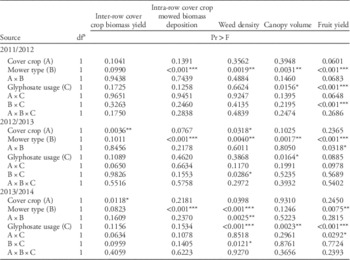
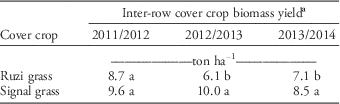
When considering the cumulative dry biomass production over the growing season, only the primary effect of cover crop species was significant during the 2012/2013 and 2013/2014 growing seasons (Table 1). Signal grass produced 64% and 24% more biomass in the inter-row area of the orchard than did ruzi grass in the 2012/2013 and 2013/2014 growing seasons, respectively (Table 2). These values were similar to those observed by Arruda et al. (Reference Arruda, Cantarutti and Moreira1987), who observed signal grass biomass yields ranging from 2.4 to 8.0 ton ha−1 after two mowings. Bauer et al. (Reference Bauer, Pacheco, Chichorro, Vasconcelos and Pereira2011) obtained similar biomass yield with these two species (approximately 3.5 ton ha−1).
Degrees of freedom (df) and P-values (Pr>F) of the three-way ANOVA on the primary effects and all possible interactions of cover crop, mower type, and glyphosate usage on the inter-row cover crop biomass yield, intra-row cover crop mowed biomass deposition, weed density, canopy volume, and fruit yield, over three growing seasons (Mogi Mirim, São Paulo State, Brazil, 2011 to 2014).

ª df: degrees of freedom; *: P<0.05; **: P<0.01; ***: P<0.001.
Primary effects of cover crop on the biomass yield (ton ha−1) in the inter-row area of a Tahiti lime orchard. Data are averaged over two mower types and two glyphosate treatments, and represent the sum of three mowing events for each growing season (Mogi Mirim, São Paulo State, Brazil, 2011 to 2014).

ª Means followed by the same letter within each growing season do not differ (Tukey – 1%).
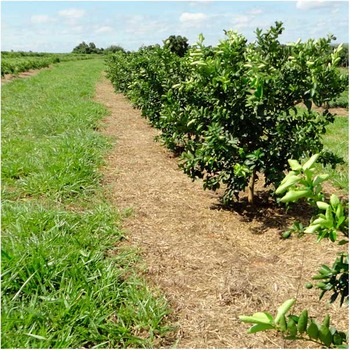
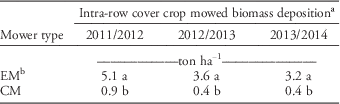
The mowed biomass deposition in the intra-row area was influenced only by the mower type (Table 1). The EM resulted in higher biomass values in the intra-row area than did the CM (up to 9.0 times) throughout the growing seasons, with values ranging from 3.2 to 5.1 ton ha−1 (Table 3). As previously described, the EM launches the mowed biomass towards the intra-row area, resulting in a mulch layer formation (Figure 1). As expected, the opposite result occurred when using the CM because the CM largely leaves residue within the cutting site, i.e., the inter-row area. Azevedo et al. (Reference Azevedo, Rosseto, Schinor, Martelli and Pacheco2012), who studied the same mowers that were used in this study in three different cover crops and spontaneous vegetation, reported results similar to those seen in this study, with values ranging from 0.5 to 7.8 ton ha−1 for the EM treatments (up to 8.8 times greater than that of CM).
Mulch layer formed in the intra-row area of a Tahiti acid lime orchard, 30 days after management (mowing and glyphosate application) with the ecological mower (Mogi Mirim, São Paulo State, Brazil, 2012).

Primary effect of mower type on cover crop biomass deposition (ton ha−1) in the intra-row area of an orchard. Data are averaged over two cover crop species and two glyphosate treatments, and represent the sum of three mowing events for each growing season (Mogi Mirim, São Paulo State, Brazil, 2011 to 2014).

ª Means followed by the same letter within each growing season do not differ (Tukey – 1%).
b EM: ecological mower; CM: conventional mower.
Weed Infestation
During the 2011/2012 growing season, weed density in the intra-row area of the orchard was influenced only by the effect of mower type (Table 1). In this case, the weed density was lower in the EM treatments (10.9 weeds m−2) than it was in the CM treatments (32.1 weeds m−2). The lower density of weeds in the EM plots was caused by the mulching effect that resulted from moving cover crop biomass from the inter-row area to the intra-row area of the Tahiti lime orchard (Figure 1). Therefore, weed control in this case was a consequence of the physical barrier of the mulch layer, which decreased weed density and suppressed weed emergence and growth (Teasdale et al. Reference Teasdale, Beste and Potts1991, Teasdale and Mohler Reference Teasdale and Mohler2000).
In the 2012/2013 growing season, weed density in the intra-row area was influenced by the primary effect of cover crop species and by an interaction between mower type and glyphosate usage, which was also observed in the 2013/2014 growing season (Table 1). Between cover crop species, the weed density was lower in the signal grass treatments (59.1 weeds m−2) than it was in the ruzi grass treatments (111.6 weeds m−2). These data show that signal grass has a greater ability to suppress weeds than does ruzi grass. Signal grass is an aggressive cover crop species: it produced 64% more biomass than did ruzi grass during this growing season (Table 2).
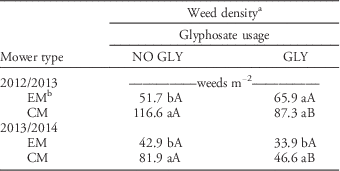
Analysis of the mower type and glyphosate usage interactions showed that GLY decreased the weed density in the intra-row area relative to the NO GLY treatment, but only for the CM treatments, by 25% and 43% during the 2012/2013 and 2013/2014 growing seasons, respectively (Table 4). These results show that EM can reduce glyphosate dependence, since the weed density levels for EM were lower than those for CM in both growing seasons. The decrease caused by GLY in the CM treatments was expected because glyphosate was the only weed control component in these cases; there was no mulching effect in the intra-row area of the orchard as a result of using this type of mower.
Two-way interactions between mower type and intra-row glyphosate usage on weed density (weeds m−2) in the intra-row area of a Tahiti acid lime orchard, during the 2012/2013 and 2013/2014 growing seasons. Three evaluations were made for each growing season 30 days after the management treatments (herbicide application and mowing), from October to May. Data are averaged over two cover crop species treatments and three evaluations for each growing season (Mogi Mirim, São Paulo State, Brazil, 2012 to 2014).

ª Means followed by the same letter within each interaction do not differ (Tukey – 5%); lowercase letters: between mower type (column); uppercase letters: between glyphosate usage (row).
b EM: ecological mower; CM: conventional mower; NO GLY: without intra-row glyphosate application; GLY: with intra-row glyphosate application (1,440 g ae ha−1).
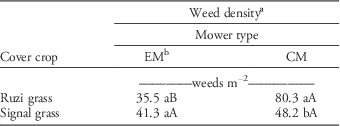
During the 2013/2014 growing season, an interaction was observed between cover crop species and mower type (Table 1). In the ruzi grass plots, weed density in the intra-row area was 56% lower in the EM treatments than it was in the CM treatments; there were no differences in intra-row weed density between the mower types in signal grass treatments (Table 5). This result highlights the importance of EM in weed management. It is clear that signal grass is a very aggressive cover crop, because the weed density levels in signal grass treatments did not decrease even when EM provided mulch in the intra-row area of the orchard.
Two-way interactions between cover crop species and mower type on weed density (weeds m−2) in the intra-row area of a Tahiti acid lime orchard during the 2013/2014 growing season. Three evaluations were made 30 days after the management treatments (herbicide application and mowing), from October to May. Data are averaged over two glyphosate treatments and three evaluations for each growing season (Mogi Mirim, São Paulo State, Brazil, 2014).

ª Means followed by the same letter within each interaction do not differ (Tukey – 1%); lowercase letters: between cover crop species (column); uppercase letters: between mower type (row).
b EM: ecological mower; CM: conventional mower.
Several studies have shown improved weed suppression when using an intercrop or cover crop, relative to crops that are grown alone (Liebman and Dyck Reference Liebman and Dyck1993). In this study, results using the signal grass cover crop showed that differences in the weed control ability could occur, even among cover crop species from the same genus. Another possible explanation for this lower weed density could be an allelopathic effect by signal grass in weeds, which could have enhanced the weed control. The presence or absence of an allelopathic effect was not directly tested in this study. Previous research indicated that signal grass extracts reduced germination of two standard target species (canarygrass, Phalaris canariensis L. and lettuce, Lactuca sativa L.) and an invasive weed species (molassesgrass, Melinis minutiflora Beauv.) (Barbosa et al. Reference Barbosa, Pivello and Meirelles2008).
Relatively few studies have evaluated the effects of mulching methods on weed control in citrus orchards. One such study was conducted in Spain by Verdú and Mas (Reference Verdú and Mas2007), who reported decreased weed coverage with the use of organic mulch relative to synthetic mulch and glyphosate application in the intra-row areas of a tangerine orchard. Abouziena et al. (Reference Abouziena, Hafez, El-Metwally, Sharma and Singh2008) studied tangerine orchards in Egypt, and reported an increase in weed control when using synthetic and organic mulch compared to other weed management programs, such as glyphosate application. However, in both of these studies the mulch was imported into the orchards, a practice that may not be feasible to use on a large scale.
Tahiti Acid Lime Vegetative Growth and Yield
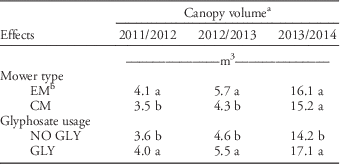
The canopy volume of the Tahiti acid lime orchard was influenced by the mower type primary effect during the 2011/2012 and 2012/2013 growing seasons and by the glyphosate usage primary effect during all three growing seasons (Table 1). Between the mower types, the canopy volume was 4% and 33% greater when EM was used compared to when CM was used, in the 2011/2012 and 2012/2013 growing seasons respectively (Table 6). For the glyphosate usage, when GLY was applied, the canopy volume was 12% to 20% higher than it was under NO GLY treatments (Table 6).
Primary effects of mower type used for inter-row cover crop management and intra-row glyphosate usage on canopy volume (m3) of Tahiti acid lime trees over three consecutive growing seasons. Data are averaged over two mower types and two glyphosate treatments for the mower type primary effect, and over two cover crop species and two mower type treatments for the glyphosate usage primary effect (Mogi Mirim, São Paulo State, Brazil, 2011 to 2014).

a Means followed by the same letter within each growing season do not differ (Tukey – 5%).
b EM: ecological mower; CM: conventional mower; NO GLY: without intra-row glyphosate application; GLY: with intra-row glyphosate application (1,440 g ae ha−1).
The results for EM in terms of the canopy volume are explained by the mulching effect, which promotes a number of benefits, such as enhanced soil fertility and conservation (Campbell et al. Reference Campbell, McConkey, Zentner, Selles and Curtin1996; Freebairn and Boughton Reference Freebairn and Boughton1985) and good weed control, as described before. The GLY results were due to better weed control than that in NO GLY treatments, even though weed density levels were not decreased by the primary effect of the glyphosate usage in this growing season.
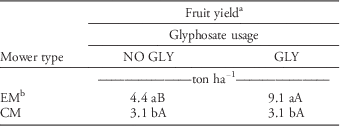
Interactions between fruit yields and other factors were observed during all growing seasons (Table 1). In the 2011/2012 growing season, the interaction shows that the difference between the fruit yield in mower type treatments was dependent on glyphosate usage (Table 1). For GLY treatments, the differences were significantly higher only in association with EM (107% higher fruit yield than NO GLY treatments) (Table 7). The EM and GLY association was beneficial to the orchard, and its effects were complemented by better weed control and all the other benefits of mulching, as already mentioned.
Two-way interactions between mower type and intra-row glyphosate usage on the fruit yields (ton ha−1) of a Tahiti acid lime orchard, during the 2011/2012 growing season. Data are averaged over two cover crop species treatments (Mogi Mirim, São Paulo State, Brazil, 2012).

ª Means followed by the same letter within each interaction do not differ (Tukey – 5%); lowercase letters: between mower type (column); uppercase letters: between glyphosate usage (row).
b EM: ecological mower; CM: conventional mower; NO GLY: without intra-row glyphosate application; GLY: with intra-row glyphosate application (1,440 g ae ha−1).
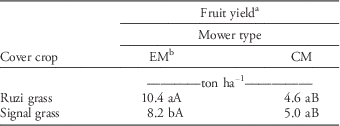
During the 2012/2013 growing season, an interaction shows that the differences between fruit yields in the cover crop treatments were dependent on the mower type (Table 1). With ruzi grass, the fruit yield was significantly higher (126%) in EM relative to CM treatments, while with signal grass there was a smaller (64%) increase in fruit yield with EM treatments compared to that seen with CM treatments (Table 8). This yield difference was due to lower competition between the ruzi grass and the Tahiti acid lime, as signal grass produced higher biomass yield and lower weed density values than did ruzi grass in this growing season. The possibility of an allelopathic effect of signal grass on citrus trees has been suggested by Souza et al. (Reference Souza, Velini, Martins and Rosolem1997), who also reported a reduction in the height of lemon [Citrus × limon (L.) Burm. f. (pro sp.) (medica aurantifolia)] seedlings that were planted in old signal grass pastures. In addition, Souza et al. (Reference Souza, Velini, Martins and Rosolem2006) reported growth reductions in corn (Zea mays L.), rice (Oryza sativa L.), wheat (Triticum aestivum L.), soybeans [Glycine max (L.) Merr.], beans (Phaseolus vulgaris L.), and cotton (Gossypium hirsutum L.) grown in soil in which signal grass dry matter was incorporated.
Two-way interactions between cover crop species and mower type on the fruit yields (ton ha−1) of a Tahiti acid lime orchard, during the 2012/2013 growing season. Data are averaged over two glyphosate treatments (Mogi Mirim, São Paulo State, Brazil, 2013).

ª Means followed by the same letter within each interaction do not differ (Tukey – 1%); lowercase letters: between cover crop species (column); uppercase letters: between mower type (row).
b EM: ecological mower; CM: conventional mower.
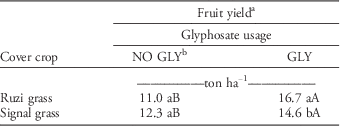
For the 2013/2014 growing season, fruit yield was influenced by the primary effect of mower type and by an interaction between cover crop species and glyphosate usage (Table 1). Between the mower types, the fruit yields were 43% higher for EM treatments (16.0 ton ha−1) than they were for CM treatments (11.2 ton ha−1). The interaction shows that the differences between fruit yields in cover crop treatments were dependent on glyphosate usage (Table 1). With ruzi grass, the difference in yield between the GLY and NO GLY treatments was significantly greater (52% higher in GLY relative to NO GLY) than it was with signal grass (19% higher in GLY relative to NO GLY) (Table 9). In this case, when a weed control method was used (GLY), signal grass competed with the citrus trees.
Two-way interactions between cover crop species and intra-row glyphosate usage on fruit yields (ton ha−1) of a Tahiti acid lime orchard during the 2013/2014 growing season. Data are averaged over two mower types (Mogi Mirim, São Paulo State, Brazil, 2014).

ª Means followed by the same letter within each interaction do not differ (Tukey – 5%); lowercase letters: between cover crop species (column); uppercase letters: between glyphosate usage (row).
b NO GLY: without intra-row glyphosate application; GLY: with intra-row glyphosate application (1,440 g ae ha−1).
The results of this 3-yr study indicate that Urochloa as a cover crop, combined with intra-row glyphosate and the ecological mower, is a good option for sustainable and integrated weed management. The mulch is generated in situ (in the inter-row of the orchard), and mowers are standard equipment for any citrus producer. This strategy enhances fruit yields and weed control, primarily for young citrus orchards. As Singh and Sharma (Reference Singh and Sharma2008) reported, the most critical time to control weeds in citrus orchards is from planting to early establishment (up to 6 yr), when the young citrus trees produce very little shade to suppress weeds.
Thus, for the conditions encountered in study, it was concluded that the use of ecological mowers provides a mulch layer that is effective for weed control and promotes greater canopy volume and yield in Tahiti acid lime. These effects are enhanced by the use of ruzi grass and the application of glyphosate. Further studies must be conducted to confirm the allelopathy of signal grass in citrus trees and the weed community (more effective herbicides options, herbicide mixtures, possibility of reducing the number of applications per year) within integrated weed management strategies.
Acknowledgments
We thank the State of São Paulo Foundation for Research Support (FAPESP; process: 2014/21349-4) for financially supporting this project; the Coordination for the Improvement of Higher Education Personnel (CAPES) and the National Council for Scientific and Technological Development (CNPq) for granting scholarships to R Martinelli and FA Azevedo, respectively; and the associate editor and the anonymous reviewers for their helpful suggestions toward improving this manuscript.