Introduction
Pietro Ingrao, one of the most influential Italian Communist leaders of the past century, dubbed the year 1956 as ‘unforgettable’.Footnote 1 The XX Congress of the Communist Party of the Soviet Union (CPSU) in February, followed by the uprisings in Poland and then Hungary, had strong repercussions among communists in Europe, causing the first international crisis of the communist movement in the post-war era. The PCI (Partito Comunista Italiano), the largest Communist Party in the Western world, could not be left unscathed. Between 1956 and 1957, 200,000 people left the PCI.Footnote 2 They were mostly working-class members, as data on the composition of the party show. Giuseppe Galasso analysed membership flows between 1956 and 1959 and found that 120,660 workers (−14.8%) and 45,962 housewives (−16.1%) had abandoned the PCI, whereas the number of ‘intellectuals’ had remained virtually constant.Footnote 3
One of the standard explanations for these heavy losses is the reaction of Italian communist militants to the events of 1956. Shocked by the revelations about Stalin contained in Nikita Khrushchev's ‘secret speech’ and by Soviet repression in Eastern Europe, Italian militants decided to abandon the Party and abjure communism. This was the explanation favoured by some journalistic accounts at the time of the events and later in some of the academic literature, both tinged with anti-communism.Footnote 4 The split between the party and its militants was worsened by the fact that the PCI leadership officially supported the Soviet invasion of Hungary, despite protests from the Confederazione Generale Italiana del Lavoro (CGIL), the communist trade union, and from within party ranks. The CGIL published a statement condemning the Soviet intervention in Hungary, but was later forced by the party leadership to withdraw it. Another statement criticising Soviet actions in Hungary, the so-called Manifesto dei 101, was published by a group of intellectuals connected with the PCI. Both documents created a great stir in the PCI, and eventually led to the expulsion of some members from the party and to the voluntary resignation of others. Finally, the PSI (Partito Socialista Italiano) strongly condemned the USSR following the intervention in Hungary and broke the alliance with the PCI, ending the ‘popular front strategy’ in Italy. Such was the trauma caused by 1956 to the Italian left that the year's events and the decisions of the PCI leadership are still discussed today.Footnote 5
However, the accounts of dissent within the PCI focused on its ‘intellectual’ component, leaving out almost entirely the reaction of working-class members. A Doxa survey conducted in March–April 1957 found that 71% of the Italian Communists interviewed considered the use of Soviet troops in Hungary justifiable, and 80% of them believed the revolt to have been a ‘fascist conspiracy’ or ‘the work of foreign agents’.Footnote 6 The US Embassy in Rome, which closely observed the PCI, maintained that the Italian communist movement had experienced serious difficulties during 1956, but reported in early 1957 that the PCI leadership ‘has thus far managed to keep the party a strong cohesive political force.’Footnote 7
Most of the existing literature on the PCI confirms that the party grass roots largely accepted the official Soviet account of the upheavals in Poland and Hungary, and a significant part of it even regarded Khrushchev's denunciation of Stalin with suspicion.Footnote 8 Miriam Mafai, referring to life within party sections, wrote that
comrade Stalin, the great leader of the USSR and of all the communists in the world, the most brilliant Marxist (even though after Marx and Lenin), the winner of the second world war, the firmest combatant for peace, watched over, placid and affable, every one of our meetings, assemblies and gatherings. Perhaps, over our life itself. The myth of the USSR grew, grew, grew.Footnote 9
Renato Sandri, who was the Secretary of the PCI Federation of Mantua whose central committee had expressed a strong condemnation of the Soviet invasion of Hungary, remembers that
We realised how the position of the Party leaders [in Mantua] did not reflect the stance of the majority of Party members: on the Hungarian events, our militants’ stance was influenced by the very strong bond to the Soviet Union.Footnote 10
Vittorio Foa argued that indifference towards the events in Eastern Europe and admiration for Stalin after 1956 was the prevalent reaction also for some of the working-class members of the PSI. Foa remembers ‘the discussion in some Socialist sections where they criticised the Soviets for having stopped in Hungary, for not having arrived here’.Footnote 11 According to historian Paolo Spriano, 1956 marked a rift between PCI ‘intellectuals’ who criticised the party leadership and the PCI rank and file, who refused to follow them and supported the choices made by the leadership.Footnote 12 Giuseppe Mammarella wrote that dissent in 1956 remained confined to intellectuals, ‘an important element, but, all in all, external and auxiliary to the mass organisation’.Footnote 13 In his more recent work on the Hungarian revolution, Federigo Argentieri confirmed that the PCI rank and file did not share the critical attitude of the party intellectuals towards their leadership.Footnote 14 British historian Donald Sassoon went so far as to argue that ‘there was no doubt that the prevalent relation within the party was one of faith on the part of the rank and file’.Footnote 15 Giovanni Gozzini and Renzo Martinelli compared this ‘faith’ to a real sense of religious belonging, where the USSR – regarded as an ideal society – acted as the Promised Land for Italian communists.Footnote 16
This leaves historians with a puzzle: if the grass roots essentially agreed with the line assumed by the Direzione (the party leadership) on the international events of 1956, why did they leave the PCI? Sassoon identified the root of the problems for the PCI in doppiezza, that is to say a ‘dichotomy between a political strategy elaborated at the top and its distorted reception at the base’. Part of the issue was due to the fact that a large number of Italian communists had never fully accepted the PCI's shift to parliamentary rather than revolutionary means to conduct the class struggle. In general, ‘the party's official line may be at odds with the thinking of its militants who, however, follow it out of a sense of duty and party unity’.Footnote 17 Lack of internal debate and lack of understanding of the party strategy on the part of its grass-roots militants therefore caused dwindling membership in the 1950s.
Structural factors also contributed. Sassoon noticed that ‘Italian capitalism was showing its ability to deal with a strong but divided labour movement and revealing itself not to be Malthusian and paleo-capitalistic as everyone thought it was.’Footnote 18 Gozzini and Martinelli argued that the PCI loss of working-class members in 1956 was the consequence of a crisis ‘that precedes and transcends the events of this year’.Footnote 19 Following the lead provided by Sassoon, and Gozzini and Martinelli, this article argues that the membership decrease which hit the PCI after 1956 was part of a longer trend, which depended more on domestic than international issues. In particular, the primary – although not unique – factor that led thousands of PCI members to leave the party was the impact of economic growth and better living standards, and the inability of the party to deal with the new social and economic context of Italy in the second half of the 1950s.
The Italian ‘economic boom’ and the PCI
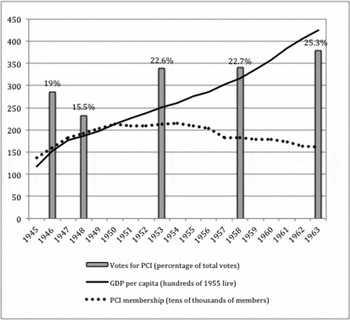
Italy in 1956 was not the country it used to be. The impact of the Italian ‘economic miracle’ on communist militants was especially powerful. Even if the official start of the boom is usually identified as 1959, when the annual GDP growth rate reached 6%, a long-term growth cycle had already begun in 1951, with a remarkable average yearly increase of 5.3% in the gross domestic product.Footnote 20 In the mid 1950s, in particular, something very important was happening from an economic point of view: following the deflationary policies previously carried out by the Banca d'Italia could finally implement a real long-term development programme, the ‘Vanoni plan’, named after the Minister of the State Budget. Designed in 1954 and launched during the following year, the plan was based on significant state intervention in the Italian economy. Productivity was to be boosted through investment, mainly sustained by the public sector, in order to create jobs, to try to reduce the gap between north and south and to help consolidate industrial competitiveness. Italy's performance during the 1950s was successful. In 1956, Italian GDP was 165% of its pre-war level,Footnote 22 while industrial production had more than doubled since 1938,Footnote 23 with an inflation rate of only 2%.Footnote 24 Standards of living were also improving. In the period between 1950 and 1958, the average annual increase in wages was 6.1% for the industrial sector and 4.7% for agricultural workers.Footnote 25 Growth was undoubtedly radically changing the life of millions of Italians, including communist militants. Plotting GDP per capita against the number of PCI members and electoral support for the party, two key trends become evident.
PCI membership (hundreds of thousands) and votes for PCI (%) versus GDP per capita (1955 lire), 1945–63.Footnote 21
Source: Derived from Greene, “Comparative Communism” and Galli and Prandi, Patterns.

As GDP per capita grew in the two decades after the war, party membership declined until stabilising at around 1.5 million, where it would remain more or less constantly until the early 1970s. However, the share of votes that the PCI received in national parliamentary elections increased significantly during the same period. In the first post-war elections in 1946, the PCI received 19% of total votes; at the 1963 elections its share rose to 25.3%. In fact, votes for the PCI kept increasing until the early 1980s. The data would seem to suggest that increased prosperity weakened Italian communists’ willingness to participate in party life, but not their voting habits – although a causal link is impossible to establish without a more refined statistical analysis. Simple descriptive statistics suggest that, although the PCI went through a period of crisis in the second half of the 1950s, it managed to overcome this successfully, consolidating its position as a major political force in Italy.
The crisis of communism in Italy
The main argument of this article is that the difficulties which the PCI encountered in the 1950s stemmed from its unpreparedness to deal with economic development. The traditional view of capitalism as a backwards phenomenon destined to pass through increasingly harsh crises until its final destruction was being refuted by facts. The traditional economic programme of the PCI was based on strong state intervention in the economy and on redistribution from the most well-to-do Italians to the working class. According to Elena Aga Rossi and Victor Zaslavsky, however, this represented a weakness for the party, for many middle-class Italians feared the policies proposed by the Communists would hit them, and consequently did not vote for the PCI. Moreover, the party's official view that economic autarky was possible and indeed desirable contrasted with the belief of a significant portion of the population that loans and aid from abroad were crucial for Italy's recovery and future development.Footnote 26
The inability of the Communist leadership to cope with development became evident in the spring of 1955, when the CGIL, the communist trade union, was crushed in the elections for the commissioni interneFootnote 27 in several factories. The communist trade union's share of the vote dropped from 65% to only 36% at the FIAT plants in Turin, a communist stronghold since 1921.Footnote 28 The reasons for this defeat were found in a new economic policy and in new methods of management. The new attitude of the Christian-Democratic government towards industry and capitalism was rapidly changing the Italian economy. Policies designed to pursue development, together with American funding, were directed towards ‘monopolistic concentrations’, fuelling the dream of an industrial structure based on large enterprises. From the already existing giants, such as FIAT and Pirelli, to the new rising star of Enrico Mattei's ENI, many benefited from this stream of money, generating employment and income. In addition, in the mid 1950s something else reached Italian industries from the United States: new techniques for dealing with ‘human resources’. Productivity and effort awards were introduced in Italy, and controlling the workforce became easier for plant managers. They could simply leave out of the productivity-prize schemes the most seditious workers, usually the communists, thereby weakening the influence of trade unions and workers’ organisations. Moreover, through OSP (offshore procurement), the US government made sure that overseas orders were placed only with firms that did not employ communists. In a review of Washington's policy towards Italy, the State Department reported that these policies ‘were effectively carried out by the US Ambassador’.Footnote 29
The effects of the newly acquired prosperity and the new organisational methods were devastating for communist organisations. The CGIL persisted with the centrally designed Communist Party strategy of total warfare against ‘monopolistic capitalism’, refusing any possibility of accommodation with the capitalists. By contrast, the CISL and the UIL (the Christian Democratic and Socialist trade unions) compromised with the owners, reaped the rewards, and became suddenly more attractive to the workers. The final result for the Communists was the sound defeat of March 1955.Footnote 30
The CGIL leadership thus understood that it needed to detach itself from the PCI if it wanted to regain the support it had lost. When it published a statement ‘deploring’ the use of Soviet troops in Hungary,Footnote 31 the CGIL Secretariat was in fact making clear its willingness to assume a more autonomous line. It was necessary, in order to prevent isolation, to reassure Socialist and Catholic trade unionists about the CGIL's ‘democratic’ credentials, and Hungary offered the best occasion to do so. The CGIL General Secretary Giuseppe Di Vittorio, who was shocked by the Soviet intervention, did not contradict this interpretation at a meeting with the PCI leadership on 30 October, when the Direzione put him under enormous pressure to retract the CGIL's stance on Hungary.Footnote 32 The Italian ‘boom’ was cutting Lenin's ‘transmission belt’ between the party and the trade union.
The PCI executive organs, both at local and national level, were already losing touch with the communist grass-roots militants well before 1956. The Communist Party was not ready to provide enough assistance for the new needs of its militants, born out of Italy's growing prosperity. The Christian-Democrats, by contrast, could rely on the pre-existent network of collateral Catholic organisations, such as parish clubs and Azione Cattolica. Furthermore, after Amintore Fanfani's ‘leftist stream’ triumphed at the Party Congress in 1954, the DC (Democrazia Cristiana), through the CISL, ACLI (Associazioni Cristiane dei Lavoratori Italiani) and Coldiretti (the Catholic confederation of agricultural workers), was sneaking directly into the communists’ favourite terrain. In 1956, the Italian Communist Party was still lagging behind Christian Democracy in regard to sport, cinema, childcare, and the political organisation of free time, all activities the Catholics had practised for longer – in some cases since the Rerum Novarum encyclical (1891). Moreover, the state-controlled radio and television offered the DC another platform from which to influence Italians. In Italy, 1956 was not only the year of the revolts in Hungary and Poland, but also of Lascia o Raddoppia?, a hugely popular quiz show, and of the first mass holidays at the seaside. US Ambassador Clare Booth Luce noticed in 1956 that
Italy is still a poor country in comparison to most Western European countries, but today the fact of prosperity is more imposing than that of poverty. During the last four years Italy has made the greatest economic strides in her entire history. I may add that in the center and north of Italy prosperity is visible not only in the higher standard of living of the rich and well-to-do; it is even more vividly apparent in the greater enjoyment of life among millions in the middle income group and factory workers. Concrete evidences of this better economic life for millions of Italians are the small cars and motorcycles that swarm the roads of Italy, taking their owners not only to work but also to the beaches, to the lakes, and the mountains and the hundreds of camping sites which have sprung up in the last two or three years. Among the many details in this over-all fact of prosperity, I may cite the continued building of houses and apartment buildings; bulging shipyards; surplus production of wheat and other agricultural commodities; and 8 million tourists this last year straining all facilities of the country.Footnote 33
Luce also wrote that initially Washington could not understand why such a large number of Italians still supported the PCI and PSI, despite a considerable increase in living standards since 1945. However, she underlined that better results in fighting the communists had been obtained by directly co-operating with domestic anti-communists and by influencing Italy's managerial practices through OSP – a policy the US Embassy in Rome strongly advocated.Footnote 34 The communists suddenly discovered they had to compete against the Catholics in areas such as entertainment and popular culture – something the traditionally austere PCI seemed not particularly well equipped to do – and against the combined effort of the US government and local entrepreneurs to prevent the labour movement from fragmenting even more.
Sassoon notices that ‘it was precisely at this unfavourable conjuncture that the most important event in the post-war history of the international communist movement took place: the Twentieth Congress of the CPSU’.Footnote 35 The dissent towards the party leadership that emerged amongst the ‘intellectuals’ in the PCI following Khrushchev's revelations, and especially following the Polish and Hungarian uprisings, has been well documented by the existing literature. However, the reaction of the PCI rank and file to the traumatic events of 1956 still needs to be studied in the broader context of a period of unprecedented economic growth and changing industrial relations. The aim of this article is therefore to analyse what the communist militants thought, felt and hoped in 1956, and to show how economic development and new needs played an important role in driving working-class members away from the Communist Party.
In order to provide such a study, the PCI Provincial Federations of Turin, Milan, Bologna and Florence have been chosen as case studies to illustrate the feelings and aspirations of the PCI grass roots. Since the national PCI congress was due to begin in late 1956, all provincial federations in Italy held their own congresses earlier in the year, in order to discuss the issues to be raised at the national level. The documents produced before and during the provincial congresses – from preliminary notes to the minutes of the meetings – thus offer a unique window into the daily life of the PCI precisely at the time when Italian communists were going through the events of 1956. The choice of the cities was quite straightforward: Turin and Milan were, and still are, the industrial hub of Italy. The presence of the biggest concentrations of ‘monopolistic firms’ makes them an ideal sample of northern Italy. Bologna has always been a stronghold for the Italian left. Administered by the PCI since 1952, the area of Bologna combined the memory of the Resistance against Fascism with the newly achieved prosperity after the war, largely due to the work of local communist administrators. The PCI also enjoyed significant popular support in Florence. Moreover, the width and intensity of the debate about the events of 1956 makes Florence a particularly interesting case to study.Footnote 36
Turin
The PCI in Turin counted 63,287 members in 1950, one of the largest memberships in northern Italy. The number fell to 50,301 in 1955 and kept shrinking, reaching 44,235 by 1956. In the provincial elections of the same year, the leftist forces (the PCI together with the Italian Socialist Party and the Radicals) obtained 278,994 votes; a net increase with respect to the general elections of 1953, but a rise which owed more to the contribution of the Socialists than that of the Communists.Footnote 37 Therefore, the traumatic defeat of the CGIL at the FIAT internal elections of the year before was nothing but the most dramatic consequence of a state of general disarray in the communist movement in Piedmont.
In June 1956, in a letter to Giorgio Amendola (head of the Organisation Commission of the PCI), Ugo Pecchioli, former secretary of the Federation of Turin and a leading PCI activist at the local level, highlighted some ‘positions and attitudes not always adequate for the development of things’Footnote 38 as the main problem for the Communist Party in the city:
Changes have happened and are still happening in big industry. They are relevant phenomena: technical innovations, automations of plants, new organisation of productive cycles, modifications in the living standards of workers, in the markets, etc., the kinds of facts that have also created some economic advantages for certain strata of workers: in the face of which . . . have we been able to keep abreast of the times? My impression is that . . . instead of fixing new goals . . . we too often indulge in the temptation of old propaganda that always wants to depict the situation in a catastrophic way.Footnote 39
Well before the start of the international crises of 1956, there was already a gap between the overall strategy of the PCI and the reality of working-class life. Pecchioli was referring to a long-term general trend in which the numerical losses could be understood. In the main industrial centre of Italy, economic growth was starting to improve the workers’ living standards, slowly eroding support for the communist agenda and also transforming priorities. Pecchioli sadly concluded, ‘as long as we had to fight directly for clear targets against brutal situations and adversaries, everything turned out for the best, but since . . . in some sectors some things have improved, a certain embarrassment is perceivable on our side’.Footnote 40 Predictably, moderate social-democratic forces were the main beneficiaries of the general difficulties experienced by the PCI.
When the international crisis finally erupted, the situation reached boiling point. On 26 October the ‘Giaime Pintor’ cell of the Einaudi publishing house unanimously approved a resolution that harshly criticised official party statements on the upheaval in Hungary in particular, and the other crises of 1956 in general.Footnote 41 They accused the Direzione of providing a ‘slanderous interpretations of the facts of Poznan’ and an ‘ambiguous and deformed’ one on Hungary. This ‘unacceptable falsification of reality’ prevented the ‘brave denunciation of past crimes and mistakes’ the cell deemed necessary. A few days later, two very similar declarations drafted by the ‘Communist Doctors’ and ‘Communist Schoolteachers’ of Turin, reached the PCI headquarters in Rome.Footnote 42
However, as Federation Secretary Antonio Roasio pointed out, dissent in Turin was ‘elitist’, and therefore marginal.Footnote 43 The authors of these documents were separated from manual workers and peasants by a wide socio-cultural gap: Einaudi was the centre of Italian literary life, not an industrial plant. The dissenters from Turin were ‘people fairly secure in their jobs and not dependent upon the party for economic, social or moral support’,Footnote 44 contrary to their working-class comrades. As a consequence, the intellectuals’ initiatives within the party failed to attract the support, and probably even the attention, of the mass of PCI members. Indeed, the alienation that the working masses apparently felt for the Communist Party was identified as the worst problem affecting the PCI in the capoluogo of Piedmont. Guido Mazzoni, a cadre designated to observe and report on cell meetings throughout Turin shortly before the Federation Congress, wrote to Roasio that ‘cells do not conduct any political or organisational life; comrades are not politically linked to each other and are detached from workers and citizens’.Footnote 45 Mazzoni's remarks were very similar to what Pecchioli had written to Amendola only a few months before: the PCI was progressively losing its appeal for the working masses in Turin. ‘Nonetheless,’ Mazzoni concluded, referring to the aftermath of the Soviet invasion of Hungary, ‘the workers reacted well to the anti-communist campaign and to the physical and moral pressure sparked off by the press and the bosses against the communists.’Footnote 46 It was not the international crisis that was damaging people's trust in the party, but its inability to tackle effectively the everyday problems of its members at a local level.
The speeches by section representatives at the 9th Provincial Congress held in November 1956 show that confusion was the first reaction to the international events among PCI members. Several speakers reported that at the beginning nobody knew exactly which position to assume, and official statements from the Direzione were thought slow to appear and ambiguous. For example, many seemed to have disagreed with the first Soviet intervention in Hungary, but instead did agree with the successive, decisive invasion. The words of Besciamelli, a working-class member from the peripheral 18th Section, are a perfect synthesis of how the PCI grass roots felt during those months:
I perfectly agree with them [the Soviet leaders]. At this point, as a worker, I cannot help praising the Soviet Union for having intervened to avoid the rebirth of fascism in Hungary . . . [However,] I am convinced that many of the repercussions in Italy are our, your fault, meaning that you [the PCI leaders] did not tell us anything about what was really happening in those countries, you did not tell us about how socialism was developing in those countries. This is the bitterest sensation I have ever felt towards you, as I loved you and I learned from you some things I regard as fundamental for my life, I considered you colours [sic] that through our action of yesterday managed to really educate the new generation. I cannot understand how you could not mention these faults that came from other leaders with whom you had nothing to do and it would have been right for you to inform our party and the workers who together form a single body.Footnote 47
What militants were looking for was a single, clear, simple answer to the crisis. They blamed the party leadership for not having informed them about the real situation in the USSR and its satellites. However, they were ready to accept the official version that came from Moscow, and their attachment to the communist movement and to the PCI remained unaltered. Harsh words were directed at the ‘dissenting intellectuals’. Ernestina Bertolè, a partisan during the war now working for the Olivetti plant in Ivrea, commented ironically:
We need the intellectual comrades, and feel this need. And it is painful for us workers, we who are the majority of the PCI (and the intellectuals should always remember this), to observe that the mistake of these comrades . . . is that they never come to speak to us. I have a great esteem for the intellectual comrades, but . . . we were born with clogs on our feet and we removed them . . . while they were born with shoes.Footnote 48
Those who had criticised the Direzione enjoyed little credibility among the rank and file, because working-class militants felt that the ‘intellectuals’ did not normally mix with them. Bertolè and others resented being scoffed at by some of their comrades, who then expected their support in criticising the party.
The attitude of anti-communist forces played a crucial role in the perception of the crisis by the communist grass roots: the verbal, and on several occasions physical, violence helped convince them about the rightness of the party position and of the presence of well-organised reactionary forces. The anti-PCI rallies organised in the heat of the Hungarian revolt by the management of the ‘Mirafiori’ FIAT plant with the support of the CISL failed to attract a significant number of PCI members and sympathisers because the aggressiveness of the demonstrators was so strong that it persuaded communist employees to stick to the party line and ignore what was then judged ‘a provocation’.Footnote 49 The communist workers’ instinct was to stay with the USSR. When exposed to the ‘errors’ of some Communist leaders, the grass roots blamed the PCI local apparatus for not having kept them informed, but they did not question the nature of the Soviet system as a whole.
Nonetheless, the PCI in Turin was still in the midst of a crisis, although it had little to do with the Hungarian crisis. Thanks to the biggest concentration of industrial firms in Italy, Turin was one of the nerve centres of the dramatic improvements caused by economic growth. Many industrial workers started to lose interest in mass ideologies and projected their hopes and aspirations towards more prosaic ideas. Their priorities had changed. During the Congress, working-class delegates pleaded for more support from the party for their day-to-day activities, from representation on the shop floor to the refurbishment of cinema screens in the Case del Popolo (recreational and cultural centres managed by the PCI). Complaints and worries from a distant and rarefied world, from people who did not participate in party life and ‘came only to the congresses’ could not reach the workers. Most of the issues raised by working-class members could be improved by simply sending a party representative to a factory cell, or by spending a few thousand lire from the Federation funds. The fact that several comrades laughed at the relatively simple requests of Besciamelli and others annoyed them deeply. ‘Do not confuse intelligence with education’, Besciamelli concluded, addressing the party intellectuals, ‘you could regret it sooner or later.’Footnote 50 The working-class PCI members in Turin felt alienated and distant from their ‘intellectual’ comrades, who seemed not to understand their preoccupations and who were concerned instead with issues the working class did not consider important. Therefore, the PCI rank and file in Turin remained largely unscathed by the international crisis, but very much affected by a local, if widespread, emergency.
Milan
In the municipal elections on 27 May 1956, the leftist coalition obtained 40% of the total votes in Milan. As Giuseppe Alberganti, the PCI Federal Secretary, wrote to the Federal Comitato Direttivo (June 1956), ‘The DC has lost its political monopoly.’Footnote 51 Nevertheless, the PCI in Milan was in no better position than in Turin. The 1956 elections were a triumph for the PSI and for the Social Democrats (PSDI), whereas the Communists had received 19,810 fewer votes than in 1953 and more than 20,000 fewer than in 1950. Data on membership was not encouraging either: from roughly 70,000 in 1950, the PCI's strength in Milan was reduced to 63,000 in 1956.Footnote 52
Since the beginning of the summer, the Federal Committee had been searching for answers. They did not have to look far: analysing the electoral losses at a neighbourhood level, it became evident that they were concentrated in working-class districts. ‘The mothers, the wives of the workers voted more socialist than communist’, as Alberganti put it.53 The homogeneous notion of a working class composed of factory workers and their families ceased to make sense, as the harsh needs of the war had ended, and traditional forces were quickly regaining their grip, as the PCI saw it, on some PCI women. Ilde Pizzoli, an exponent of the UDI (Unione delle Donne), identified RAI (Radiotelevisione Italiana), the Italian state television operative since 1954, as the new main ‘channel of propaganda’ for the ‘politico-ideological pressure’ of factory owners and the Church on the workers and their spouses. The PCI was defenceless against this new offensive.Footnote 53
As the Hungarian crisis unfolded, the problems increased. On 29 October, a group of influential communist intellectuals sent a letter to Botteghe Oscure (the HQ of the PCI in Rome, colloquially named after the street it was located on) expressing solidarity with the Hungarian revolt and a strong invitation to rediscuss the events and redefine the party line.Footnote 54 Shortly thereafter, a few sections in Milan declared their approval of the CGIL statement that criticised Moscow's policy.Footnote 55 Right before the Provincial Congress, the Milan Federation was forced by these major manifestations of dissent to look at what was happening among militants through an internal investigation. A party cadre, Nella Marcellino, optimistically concluded that
the reaction of the Party to the Hungarian events is on the whole good. The Party shares the position assumed by the Direction of the Party and approves the Soviet intervention, often warmly even if there were here and there phenomena (mostly isolated) of disagreement and defeatism. Those who assumed critical positions about the judgment of the Direction of the Party and Soviet intervention do not have support in the sections.Footnote 56
The tone did not change during the IX Provincial Congress. In his final report Alberganti praised Milan's Communists, who ‘closed ranks with the party and passionately supported its positions’.Footnote 57
However, as in Turin, the rank and file lamented a lack of clarity on the part of the Direzione. Libero Morandotti, from Tecnomasia, an engineering factory, accused l’Unità, the PCI daily newspaper, of having provided too little explanation about what was happening in Moscow, Poznan and Budapest, creating uncertainty and doubts amongst the rank and file.Footnote 58 Just as was happening at the same time in Turin, the working-class militants asked for clear statements from the PCI leadership that could more easily be understood by the party grass roots.
The problem of understanding had deep roots. Since the 1944 svolta of Salerno, when PCI General Secretary Palmiro Togliatti had officially abandoned any revolutionary ambition, the PCI rank and file had not been able to metabolise fully the new democratic strategy. Direzione statements and articles in l’Unità were considered too abstract and difficult for the workers, who put a brave face on it rather than truly sharing Botteghe Oscure's programmes. The socio-cultural gap inside the PCI was widening in the mid 1950s: while intellectuals like Davide Lajolo, the director of l’Unità in Milan, were ‘tired of being beaten up’ and hoped to be able to enter government, as Lajolo explained at the party congress, working-class comrades were used to waiting and struggling for the dream of a better world to come. Even Luigi Longo, the second most important PCI leader after Togliatti, who was sent by the Central Committee to observe the Congress in Milan, had to acknowledge the growing tension between intellectuals and workers.Footnote 59
In fact, there was much more than a ‘difference in sensibility’ between workers and intellectuals, as Longo dubbed it. These words by a working-class delegate show the growing rift between the PCI components very clearly:
We must say that some statements of intellectual elements adhering to our party, which also appeared in the bourgeois press, hurt us, as workers, because, you see, we workers are people a bit made in our own way. We have to pull the trolley for several hours and unfortunately – I say unfortunately – we do not have the chance of studying more, of learning more . . . And we, in our simplicity, are convinced that, exactly because they are intellectuals . . . they ignored all the other considerations, in the end making statements that were substantially useful for the class adversary to try to break us up, to try to present us to public opinion in a different manner from what we really are; this really hurt us.Footnote 60
Despite these arguments, trust in the party and its parallel organisations was undiminished, as demonstrated in November 1956 by the sound victory of the CGIL at the elections for the commissioni interne of two of the largest factories in Milan, Breda and Braggi.Footnote 61 However, Breda and Braggi, although fairly large factories, could not be compared to Turin's FIAT with its new American-style techniques of managing human resources. Compared to Turin, in Milan the struggle between workers and owners followed a more traditional pattern and was therefore easier to manage for the PCI.
Nonetheless, similar concerns to those expressed in Turin about the PCI's ability to improve the daily life of workers were expressed at the congress in Milan. Delegates from the ring of communist-dominated industrial towns surrounding Milan spoke at the Congress about broken roofs and leaky sewage systems, about schools to be built and streets to be paved, and about more funds for the Case del Popolo. Several delegates at the Provincial Congress of Milan stated that the PCI was not doing enough in these fields, and lamented that it left everything in the hands of rival forces, mentioning Catholic schools, parish recreation centres (oratori), and municipal libraries and cinemas.Footnote 62
Moreover, as the workforce itself was changing, traditional strategies were progressively losing effectiveness. The memory of the resistance against fascism was not enough to guarantee the loyalty of the new generations. Sante Cappelletti, a PCI delegate from a Siemens-controlled plant, explained to his comrades that
we must take into account that new forces have replaced a large part of those workers [who fought in the Resistance] in the factories, here comrades our propaganda must follow a different course, must take into account that we are facing young female workers who have come from schools in the last few years and that they did not learn there the history of the Resistance, what the communists did, what the people did, what the workers did in the struggle against fascism.Footnote 63
In northern Italy the number of ex-partisan communist supporters was shrinking and the PCI struggled to find recruits to renew its ranks. Those who did join tended to have different ideas and ambitions from their older comrades. A decade after the end of the war, they had grown accustomed to a different political climate. Younger members expected the PCI to take full part in the running of the country and its regions, defending the interests of the weakest part of Italian society. Waiting for a revolutionary breakthrough, supported by the Soviet bloc, made increasingly less sense for them. If it wanted to retain their support, the Direzione had to take into account their aspirations.
In the end, in Milan as in Turin the mass of working-class militants remained largely deaf to the dissenters’ call: the social and cultural gap was too wide and mutual mistrust too strong to permit a deeper understanding. The idea that the Soviet system could be wrong, and that the PCI needed to break free from it, was far from the minds of the working-class comrades in Milan. Even Stalin was still a hero. Equated with Caesar and Napoleon, whose ‘greatness was not obfuscated by their crimes’, Stalin too was greeted with applause at the Milanese congress.Footnote 64
Bologna
Bologna was the beating heart of Italian communism. The PCI could count on no fewer than 130,000 active members, a figure that had been continuously on the rise since 1950. An uninterrupted series of Communist administrations had governed the city since the liberation from Nazi-Fascism in April 1945. The city and province of Bologna were among the most prosperous in Italy, not least thanks to the work of Communist administrators. The elections of May 1956 confirmed the trend of PCI success. The Christian Democrats, desperate to break the Communists’ grip on power, persuaded Giuseppe DossettiFootnote 65 to stand as candidate for mayor, but he was defeated and the PCI easily won a second mandate. The total number of votes for the Communists even increased by 5%.Footnote 66
Given these premises, the story of 1956 in Bologna could not have been the same as in the industrial north. In Bologna, the XX Congress of the CPSU was not regarded as a moment of confusion and doubt, but instead as a way to increase the popularity of the party. Giuseppe Dozza, the long-term mayor and one of the most celebrated Communist administrators in Emilia Romagna, specifically said ‘I have the sensation that after the Congress people do not look at us with fear, with concern any more, but some look at us with more trust, others with less suspicion.’Footnote 67 Later on in June, at a meeting of the Provincial Administrative Commission, Bologna was defined as an ‘oasis’ of communism, and the atmosphere among PCI members in the city was judged ‘enthusiastic’.Footnote 68 This was surprising given that Fabrizio Onofri, then director of the PCI party school of Bologna, had published a polemical article about Togliatti's management of the revelations contained in Khrushchev's secret speech only a couple of days before. Onofri accused Togliatti and the PCI leadership of trying to hide Stalin's crimes. Onofri was subsequently accused by the Direzione of weakening the party by publishing his accusations in the ‘bourgeois press’, and eventually expelled from the PCI in 1957.Footnote 69
The ‘Onofri case’, while certainly one of the most important episodes of dissent within the PCI in 1956, was felt more deeply at the party offices in Rome than in Emilia Romagna. At the beginning of October, the Provincial Commissione di Organizzazione reported some cases of ‘sympathy’ for Onofri and his ideas amongst party members in Bologna, but no disciplinary actions were deemed necessary.Footnote 70 The overall balance of the PCI work in the city was judged very positively.Footnote 71
Not even the Hungarian upheaval broke the serene relationship between the Communist Party and its members in Bologna. Between 30 October and 11 November, no fewer than twenty-four letters and telegrams from sections in and around Bologna reached Botteghe Oscure, expressing unanimous consent over the party line and complete trust in the Direzione.Footnote 72 The comrades of the ‘Remigio Venturoli’ section significantly wrote that they were
happy to learn that the Revolutionary Government of Hungarian workers and peasants, led by Janos Kadar, backed by workers, Hungarian peasants and the Soviet army, has defeated the fascist counter-revolutionaries, ended the white terror . . . and the bloodshed, creating favourable conditions to keep peace in the world.Footnote 73
The few anti-Soviet initiatives were not successful. The members of the PCI cell of Ducati, a motorcycle manufacturer, wrote to Togliatti in person to announce that a strike called by the CISL against the Soviet intervention in Budapest had failed and that in the plant even socialist workers supported the PCI line.Footnote 74
At the VIII Provincial Congress of the Federation of Bologna, declarations of support for the party line were simply repeated. Opening the congress, Secretary Enrico Bonazzi exclaimed that
As early as 2 and 3 November, while the Italian reactionaries and the disoriented were singing victory, from the factories and from the fields the comrades and workers were asking the Soviet Union not to abandon Hungary to the hands of reaction: this is reality!Footnote 75
Even the CGIL Regional Secretary declared his personal agreement with the Direzione, expressly contradicting the position assumed by his trade union less than a month before.Footnote 76
However, imagining Bologna as a haunt of unrepentant Stalinists could not be farther from the truth. Communism in Emilia Romagna was not only a matter of political allegiance; it was seen as the best possible system of life for the majority of citizens. The PCI in Emilia Romagna was largely credited with having brought economic prosperity to the region. The creation and successful management of the cooperative, co-operative farms and small enterprises, had produced significant gains after the war for a largely agricultural-based economy. Local peasants and workers were better off than most of their counterparts in other areas of Italy, and they were thankful to the Communist Party for their relative prosperity. Furthermore, the ‘upper-class’ stratum of the population had little to complain about the Communists. The local government functioned smoothly and efficiently, and Dozza was considered more business-friendly than his ascetic Catholic rival Dossetti – something that local small entrepreneurs obviously appreciated.Footnote 77 Finally, the PCI in Bologna was firmly in control of the local government, meaning that the intellectual comrades could actively take part in and contribute to the administration of the city. The impossibility of doing the same in other regions of Italy greatly frustrated party intellectuals – as Lajolo explained at the congress in Milan – and alienated them from the PCI, contributing to their unhappiness about the party line on the events of 1956. This was a problem the PCI Federation of Bologna did not have.
Rather than a Stalinist paradise, Bologna's recipe was more like ‘welfare communism’. The PCI cared for its members from the cradle to the grave: co-operatives created employment and economic development, local city and town councils offered the necessary administrative support, Camere del Lavoro defended workers and peasants’ rights, and the Case del Popolo – better funded than in Milan or Turin – entertained them. Togliatti himself, who observed the Provincial Congress as an envoy from the PCI Central Committee, was perfectly aware of the exceptionality of Bologna.
a situation like the one that exists today in the city and province of Bologna, has never existed in other periods and does not exist in other places . . . What is more striking is the existence of an ample sphere of agreement and collaboration between social groups, and therefore also between economic and political groups of different natures. The existence of this sphere . . . creates a particular atmosphere of civil harmony and the tight unity of the majority of the population in the city, and in the largest part of the province, around the advanced nucleus, represented by the vanguard parties of the working class and the people.Footnote 78
The special situation of Bologna, however, made its communist citizens more demanding towards the central party apparatus. At the time of the PCI VIII National Congress, in December 1956, several representatives from party cells and sections in Bologna expressed their expectations of a much greater degree of openness inside the PCI, and also for a significant renewal of the party leadership. The outcome of the national congress was disappointing for them, and the Direzione came under fierce criticism in Bologna too, including criticism over its past stance on Stalin and Eastern Europe.Footnote 79 The PCI, however, did address some these complaints, and the alarm in Bologna was soon over. In January 1957, party membership even slightly increased.
Florence
Whereas dissent remained largely unexpressed in Bologna, in Florence, another traditional Communist stronghold, it assumed a completely different dimension. The intellectual liveliness of the PCI in Tuscany was already evident in March 1956. Immediately after Togliatti's return from the XX CPSU Congress in Moscow, a letter from the section of Borgo San Lorenzo reached him in Rome. Section Secretary Cocchi carefully expressed a few perplexities about the way ‘Stalin's errors’ had been presented, and deemed it necessary to encourage more ‘self-criticism’, since the PCI agreed in principle with the Soviet path to socialism. ‘Many comrades’, Cocchi wrote, ‘are inclined to say that “all the dirty water is thrown at Stalin, because he's dead”’,Footnote 80 thus saving other Communist leaders, including Togliatti, from taking responsibility for those same ‘errors’. The complete text of Khrushchev's ‘secret speech’ had not even been published yet.
When it was published, the problems for the PCI in Florence predictably increased. The section of Certaldo, a small town on the outskirts of Florence, lamented the fact that the militants learned of the speech from the ‘bourgeois’ press rather than l’Unità, which was accused of fostering disinformation. Indeed, sales of l’Unità in the province of Florence had been dropping since 1951 and the limited circulation of the Communist press was already on the agenda of the Federation. Quality was considered to be too poor: the average socio-economic level among PCI members in Florence was relatively high, and members expected more from their party newspaper.Footnote 81
After the outbreak of the Polish and Hungarian crises, the atmosphere worsened still further. On 30 October, the section of Campi Bisenzio, in the hinterland of Florence, made its disappointment known to Botteghe Oscure:
For years we have been accustomed to exalting those regimes, which even having a popular and socialist character, had lost the most elementary forms of democracy, and every sort of violation of legality was committed. Our press has a particular responsibility and particularly l’Unità, which did not carry out the task of informing the comrades and public opinion with objectivity, reporting instead news that today has been revealed as false and wrong.Footnote 82
Other sections from provincial towns, such as Gambassi Terme and Montaione, instead wrote to the Direzione in Rome to express their appreciation for the party line, and their support for Soviet actions in Hungary.Footnote 83
The PCI in Florence was strong and influential (membership had remained stable at more than 100,000 since 1954), but the IX Provincial Congress was not an easy moment. Mario Fabiani, president of the Provincia and one of the most charismatic Communist politicians in Tuscany, immediately acknowledged the difficulties. Referring to the international crisis, he said that ‘the consequences of this entire situation have made themselves heard loudly and profoundly in our Federation’. Moreover, ‘the comrades who had accepted Party policies for many years without discussion and followed almost blindly the directives of the leadership, found themselves disorientated’.Footnote 84
Delegate D’Este, from the central ‘Madonnone’ section, explained that
The comrades asked themselves why it is possible that the events in Hungary happened, in a country with a Communist leadership; how it is possible to arrive at such a situation? This is the explanation we found. In Hungary it happened because the leading comrades did not listen to what the grass-roots comrades were saying and, instead of listening to them, arrested them and sent them to jail.Footnote 85
The statements released by Botteghe Oscure as an explanation for the Polish and Hungarian crises were deemed unsatisfactory. Even the late, lamented Stalin was the object of criticism and reassessment. ‘We considered Stalin above everyone, the superman, the infallible master, the oracle that could not be contradicted’, while the various communist and workers’ parties were in fact in a condition of subordination. ‘Underneath this lurked the bitterest dissents and the largest lacerations’, concluded the delegate of the city section ‘Santi’.Footnote 86
Such a degree of widespread grass-roots disagreement and mistrust towards the Direzione was unmatched in the rest of Italy. Certainly, the PCI rank and file in and around Florence seemed more disturbed by the events of 1956, and more conscious of the lack of internal debate within the party. Why in Florence? Giving an unequivocal answer is not possible, since this was most probably the result of a set of factors. However, some useful observations can be made about the city of Florence and the nature of communist militancy in Tuscany that help to provide at least a partial answer. The socio-economic conditions of the city and the composition of the PCI membership, differed from those of other regions previously examined. Tuscany, like Emilia Romagna, was not an industrial region in the same way as Piedmont and Lombardy. Even though its province remained largely rural, Florence's economy had an ancient tradition of crafts and commerce. Hence, the local PCI grass roots had a remarkably higher percentage of artisans, shopkeepers, and clerks. The PCI's own figures reported that roughly 40% of members in Florence were considered to be ‘middle class’, compared to a national average of 17%.Footnote 87 A significant proportion of PCI members in Florence were hence reasonably well educated and independent, and therefore much less prone to accept everything that came from Botteghe Oscure than farmers from Emilia Romagna, or blue-collar workers from Turin and Milan. Indeed, the available evidence suggests that most of the manifestations of dissent came from sections within the city, and therefore presumably less purely working class, rather than from provincial ones.
Other factors contribute to set Florence apart from other cities with strong Communist influence. In particular, the record of the PCI in Florence was not comparable to that of Bologna. In 1951, the Christian Democratic candidate Giorgio La Pira had won the mayoral elections, wresting Florence from the hands of Fabiani. The new mayor was part of the ‘leftist’ group of the DC, which, under Fanfani's leadership, had won the party congress in 1954, strengthening the DC's commitment to tackle social issues. La Pira had been very cunning in understanding the city's demands and turning them to his advantage. He based his campaign and successive mandate on the construction of new housing estates and schools, the restructuring of war-damaged bridges and roads, and the defence of employment. For example, in 1954 La Pira had successfully lobbied Enrico Mattei to avoid the permanent shutdown of Pignone, a crisis-ridden industrial plant. As a result, 30,000 voters switched from the leftist parties to the DC between 1951 and 1956.Footnote 88
Those who remained loyal to the PCI felt abandoned and unheard. At the Congress, a few delegates lamented the lack of a consistent party policy towards public-sector clerical workers, a large component of Florence's communists, while ‘tourism and the export of artisan products have been almost completely ignored’, according to Gianpaolo Paoli from the central ‘Cecchi’ section.Footnote 89 Some of the PCI members’ criticism towards their party was particularly trenchant. Using the international situation as an extreme example, party members in Florence demanded to be more involved in the elaboration of the political strategy of the party.
This unfortunately difficult situation of Hungary must teach us that it is absolutely necessary that comrades are listened to, that their opinions are taken into account, that criticism and interventions are rightly evaluated, because only in this way is it possible to strengthen the party.Footnote 90
In the end, the PCI Federal Committee could do nothing but acknowledge its mistakes, and promise to improve its work in the future, taking into account the specific peculiarities of Florence.
We strove to find and highlight all the areas of misery, all the symptoms of economic depression, all the ratios of exploitation, without ever making a minimal attempt at seeing what was new in the situation.Footnote 91
An overall evaluation of the losses suffered in 1956 was carried out only in the summer of 1957. The PCI's strength in the province of Florence was reduced to 93,638 members, with severe losses in several key districts in the city.Footnote 92 However, despite all the upset the international crises of 1956 caused among militants, the devastating impact that the Christian Democrats’ good administration had on the support for the PCI in Florence must not be underestimated. All the good intentions of the Federal Committee notwithstanding, the PCI had to wait until 1975 to win the local elections again.
Conclusion
In May 1957, the PCI suffered an unexpected setback in the regional elections in Sardinia. The Communists’ share of the vote decreased from a promising 22.3% in 1953 to a disappointing 17.6%. The great winner of those elections was Achille Lauro, a former sea captain from Naples who had become a rich ship owner and launched himself into politics. He was a sort of Silvio Berlusconi ante litteram, whose populist methods and big promises managed to capture the hearts of many in southern Italy. Lauro's party was a political comet of the 1950s. Although he remained popular in his native Naples, where he was elected mayor in 1952 and again in 1961, his newly founded party quickly disappeared from the national political scene. Nevertheless, in 1957 he took more votes from the PCI than from the Socialists and Christian-Democrats, as the Direzione sadly had to recognise on 12 July 1957.Footnote 93 The Communists were losing appeal amongst their traditional supporters because of their inability to deal with the new problems and achievements of Italy during the ‘economic miracle’. While the CISL was growing in the north of Italy thanks to a much softer line towards factory owners, and Lauro was giving out boxes of pasta to the people who came to his street speeches in the south,Footnote 94 Communist cadres and intellectuals risked losing contact with the grass roots.
The party, however, was able to change course, contain the damage, and establish the bases for future success. Beginning with the VIII Congress in December 1956, the PCI had to restyle itself. In his intervention at the congress, Togliatti reinstated his view about an ‘Italian road to socialism’, different from the ‘slavish imitation’ of the USSR.Footnote 95 Gozzini and Martinelli, who actually played down the component of renewal and reform in the VIII Congress, highlighted the structural reforms that followed the report by Longo at the congress. PCI federal committees now reported directly to the Direzione, without the need for intermediate regional committees, which were abolished. The same federal committees were now required to meet at least once a month, and neighbourhood and district committees were created to assist the federal committee in the larger cities.Footnote 96 Moreover, a new generation of party leaders were admitted into the Central Committee and the Direzione. People like Luciano Barca, Emanuele Macaluso and Giorgio Napolitano – all destined for long and successful political careers within and without the PCI – were ‘promoted’ to the party central organs in 1956. As a consequence, the share of Central Committee members who had joined the PCI in the 1920s dropped to less than a third.Footnote 97 These were significant changes. The PCI responded to the growing rift between its base and its top, which had become particularly evident in 1956, by streamlining its organisation and by modernising itself.
This modernisation process eventually led to a diminished role for the Soviet Union. New members grew up in the midst of the economic ‘boom’, they had not participated in the resistance, and had no memory of Stalin. Therefore, the PCI could condemn the Soviet invasion of Prague in the summer of 1968 with the certainty of being understood and supported by the majority of its members. This was not possible in 1956. The party working-class rank and file were still attached to the idea of the USSR as an ideal society. Moreover, they felt too disconnected from their ‘intellectual’ comrades to take their criticism seriously. Aga Rossi and Zaslavsky have argued that the PCI leadership's support of Moscow's foreign policy, including the most controversial decisions in 1956, stemmed from its complete identification with the USSR, which turned the party into a mere tool of Soviet foreign policy.Footnote 98 The evidence presented here suggests a different story. The majority of PCI members, despite significant but limited dissent existing also amongst working-class activists, were firmly supportive of the Soviet Union. Condemning the USSR or distancing the PCI too abruptly from Stalin would probably have alienated a large component of the party rank and file.
In the second half of the 1950s, the problems for the Italian Communist Party lay elsewhere. The PCI grass roots in the great industrial hubs in the north, largely made up of factory workers, thought that the party's higher echelons remained deaf to their calls for more help and support in their daily life. In particular, the PCI seemed unable to adapt itself to the new realities of labour in the plants, and to compete effectively with the DC for the political organisation of free time. The PCI did comparatively much better in Bologna, where the party grass roots were happier thanks to their relative prosperity, and where the ‘intellectual’ component of the party could contribute to local government. In Florence, where working-class membership was relatively smaller, the party faced the most difficult situation. The ‘intellectuals’ were cut out from government by the success of the DC, and they did not fear voicing their discontent with the way in which the PCI managed both international and local politics.
To conclude, the idea of 1956 as a year of upheaval inside the Italian left, as an ‘unforgettable’ year, is fundamentally wrong. It is true that a significant number of high-profile public intellectuals – from novelist Italo Calvino to some of the signatories of the Manifesto dei 101 – left the PCI following the events of that year. However, the Communist rank and file's loyalty towards the PCI was not affected. As shown by the contrasts in the provincial congresses, a large part of working-class PCI members regarded their ‘intellectual’ comrades with suspicion, if not open hostility, and found their ideas difficult to accept. In fact, for some of the ‘intellectuals’ themselves the events of 1956 offered an occasion to break free from the rigid structures of the Communist Party, which could not fulfil their ambitions. If the aim was to contribute directly to the government of Italy, then there was no point in staying in the PCI, since the Communist Party still had no realistic chance of winning the elections or of participating in a coalition government at the national level. The same is true of the PSI. The Italian socialists had grown tired with the idea of permanent opposition to successive DC governments. In 1956 they could break with the ‘undemocratic’ and pro-Soviet PCI and start building contacts with the DC, now dominated by the ‘leftist stream’. The PSI would eventually take part in centre-left coalition governments from the early 1960s onwards.
The revelations of Stalin's crimes and Soviet repression in Poland and Hungary certainly shook the Italian Communist Party, and also contributed to starting a process of renewal and relative internal democratisation. However, several significant issues that the PCI faced in 1956, from internal dissent to relations with other political parties, were part of longer-term trends connected to economic development and political changes in post-war Italy. Therefore, the evidence presented contradicts the view of 1956 as an ‘unforgettable’, extraordinary year.