INTRODUCTION
The statistical data from the ABS (2012) show that China-born is the third largest foreign-born group, comprising 12% of immigrants in Australia. More than half of permanent arrivals from China are in the skilled category (Hugo, Reference Hugo2007). They are strongly concentrated in the top occupational groups, with 54.6% working as professionals Footnote 1 (ABS, 2006), representing an important constituent of Australia’s diversified workforce (ABS, 2007; Department of Immigration and Citizenship (DIAC), 2008). Those professional Chinese immigrants (PCIs) are expected to substantially contribute to the relief of skills shortage and the bolstering of Australia’s economic and social development (Rudd, Swan, Smith, & Wong, Reference Rudd, Swan, Smith and Wong2007; Lundy, Reference Lundy2008). These facts have stimulated the focus of this study on PCIs.
As this group becomes a significant part of the Australian society, there is an urgent need to understand how its members adapt to the wider society and the problems they encounter during the process of adaptation (Cooke, Zhang, & Wang, Reference Cooke, Zhang and Wang2013). It is most unlikely that each individual experiences the same adaptation process even in the same environment due to uniqueness of individual perceptions and attitudes. It is, in fact, argued that acculturation attitude is an important factor in understanding individual differences about how they adapt to the host country (Berry, Reference Berry1997) and largely determines how immigrants interact with mainstream society (Berry, Kim, Power, Young, & Bujaki, Reference Berry, Kim, Power, Young and Bujaki1989).
Acculturation attitudes have been emphasized in empirical studies, as this kind of research has influenced and continues to enormously influence theory development in acculturation (Navas, Rojas, García, & Pumares, Reference Navas, Rojas, García and Pumares2007). However, very few studies on acculturation have been conducted in the Australian workplace context (Lu, Samaratunge, & Härtel, Reference Lu, Samaratunge and Härtel2011c). For example, the attention is given to investigate the acculturation stress of Sudanese refugees Milner and Khawaja (Reference Milner and Khawaja2010). Germain (Reference Germain2005) examined ethnic Australian adolescents’ acculturation attitudes and national identity, whereas another study focused on acculturation of Asian international students in Australia Tran (Reference Tran2009); none of them assessed the acculturation attitudes of immigrants and related issues in the workplace and studies on the predictors of PCIs’ acculturation attitudes remain limited. This gap in the literature not only restricts professional immigrants from ‘reaching their full potential, but also prevent the employing organizations from deploying talents effectively to raise their productivity and competitiveness’ (Cooke, Zhang, & Wang, Reference Cooke, Zhang and Wang2013). Without a systematic study, it is difficult to make informed suggestions as to what good experience can be shared and improvement made.
Few research studies conducted in countries other than Australia reveal that immigrants in a multicultural society have a clear preference for integration (Berry et al., Reference Berry, Kim, Power, Young and Bujaki1989; Zheng & Berry, Reference Zheng and Berry1991; Bakker, van der Zee, & Van Qudenhoven, Reference Bakker, van der Zee and Van Qudenhoven2006; Choi & Thomas, Reference Choi and Thomas2009). However, whether this is also the case for PCIs, who have been migrating to Australia in large numbers, yet to be identified. This paper fills part of this important research gap by investigating the PCIs’ acculturation preference in their new homeland.
There are various predictors of acculturation attitudes, for example, demographic characteristics (e.g., age at migration, gender and education), perceived social support at work, self-construal and perceived workgroup diversity climate (Berry, Reference Berry1997; Zakaria, Reference Zakaria2000; Padilla & Perez, Reference Padilla and Perez2003; Luijters, van der Zee, & Otten, Reference Luijters, van der Zee and Otten2006). Currently, however, little is known about the interrelationships between these predictors and the acculturation attitudes for PCIs. This paper also explores the predictors of each acculturation attitude, which can provide information for organizations developing effective acculturation programs to assist immigrant employees with adaptation to a new workplace.
The paper is organized as follows. We start the paper with a discussion on theoretical background and hypotheses development. Then we discuss the research design, including sampling and measurement. In the third section, we present the key findings and their implications for both governments and Australian employers. The paper concludes with a brief discussion of limitations and future research agenda.
Acculturation attitudes
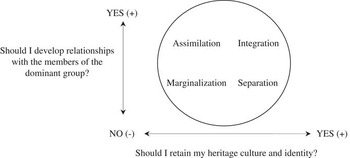
Berry et al. (Reference Berry, Kim, Power, Young and Bujaki1989) developed a two-dimensional model of acculturation, which provides a theoretical framework for the study of acculturation attitudes (Neto, Barros, & Schmitz, Reference Neto, Barros and Schmitz2005) and many researchers have tested this model in different countries (Lu, Samaratunge, & Härtel, Reference Lu, Samaratunge and Härtel2011c, Reference Lu, Samaratunge and Härtel2012, Reference Lu, Samaratunge and Härtel2013). The model proposes that, in multicultural societies, ethnic groups and their individual members must deal with the issue of how to acculturate by working out two issues: cultural maintenance (to what extent the cultural identity should be maintained) and contact and participation (to what extent good relationships with members of the dominant groups should be developed) (Berry et al., Reference Berry, Kim, Power, Young and Bujaki1989; Berry, Reference Berry1997). When the two questions are considered simultaneously, an integrated model is generated to posit four acculturation attitudes (Figure 1).
Acculturation attitudes of immigrants Source. adapted from Berry (Reference Berry1997); copied from Lu, Samaratunge, and Härtel (Reference Lu, Samaratunge and Härtel2012)

When individuals do not want to maintain their heritage culture and aim at complete absorption into the host culture, they are adopting assimilation (Berry, Reference Berry1997, Reference Berry2003). In contrast, if individuals strongly retain their cultural identity and consider the relationships with the host cultures as unimportant, they are using separation. When people are interested in maintaining their heritage cultures during daily interactions with the host cultural groups, integration is utilized. Finally, when individuals lose their heritage culture without establishing ties with the new culture, marginalization is the option (Berry, Reference Berry2003).
Hypotheses development
There are various predictors for the choice of acculturation attitudes, including an individual’s demographic and social characteristics (Berry, Reference Berry1997; Zakaria, Reference Zakaria2000; Padilla & Perez, Reference Padilla and Perez2003; Luijters, van der Zee, & Otten, Reference Luijters, van der Zee and Otten2006). However, little is currently known about these relationships for the PCI population in Australia. For this reason, in the present study the predictors of acculturation attitudes for PCIs are proposed and tested. The four predictors identified and discussed in detail in the subsequent sections are: length of residence in the host country, perceived mainstream language proficiency, perceived social support at work and self-construal.
Length of residence in the host country
Length of residence in the host country is broadly reported to influence the acculturation process. Studies of Korean immigrants showed that the longer the individual resided in the United States, the higher their level of acculturation (Oh, Koeske, & Sales, Reference Oh, Koeske and Sales2002; Shim & Schwartz, Reference Shim and Schwartz2007). Similar results are reported for Asian immigrants in the United States (van Oudenhoven, Prins, & Buunk, Reference van Oudenhoven, Prins and Buunk1998; Choi & Thomas, Reference Choi and Thomas2009). Filipino Americans who resided in the United States for a longer period gradually lost their sense of ethnic identity and became less concerned with Filipino culture, were less likely to identify themselves as Filipinos and were less actively involved in Filipino communities (Gong, Takeuchi, Agbayani-Siewert, & Tacata, Reference Gong, Takeuchi, Agbayani-Siewert and Tacata2003). Trueba (Reference Trueba2004) suggested that immigrants who had resided in the United States for a long period, but remained in contact with their homeland and their people, tended to be oriented toward the host culture while maintaining their original culture. In contrast, short tenure in residency within the adopted country could contribute to stress along with the acculturation process, which negatively impacts on an individual’s successful adjustment, mental health and well-being (Miranda & Matheny, Reference Miranda and Matheny2000). Time of exposure to a non-native culture could lead to more knowledge about and appreciation of the culture (Miranda & Matheny, Reference Miranda and Matheny2000), promoting the will to participate in the larger society (Oh, Koeske, & Sales, Reference Oh, Koeske and Sales2002; Shim & Schwartz, Reference Shim and Schwartz2007). From this, it is hypothesized that:
Hypothesis 1a: Longer length of residence in the host country will predict usage of the assimilation attitude among PCIs.
Hypothesis 1b: Longer length of residence in the host country will predict usage of the integration attitude among PCIs.
Hypothesis 1c: Shorter length of residence in the host country will predict usage of the separation attitude among PCIs.
Hypothesis 1d: Shorter length of residence in the host country will predict usage of the marginalization attitude among PCIs.
Perceived mainstream language proficiency
Language is a tool for people to communicate and socialize, which is important for building up social networks. Numerous studies identify the importance of fluency in the host country’s language for acculturation and social and economic settlement outcomes (e.g., Padilla & Perez, Reference Padilla and Perez2003; Remennick, Reference Remennick2003; Choi & Thomas, Reference Choi and Thomas2009). Mainstream language proficiency can facilitate immigrants’ contact with natives and broaden their social networks and resources. As such, it is also reported that language proficiency is a critical factor for immigrants’ success in the labor market in Western countries, particularly for those from non-English speaking countries (Mahmud, Alam, & Härtel, Reference Mahmud, Alam and Härtel2008).
It is reported that immigrants who are or feel inadequate in their use of the mainstream language often yearn for their ethnic group, in which they can continue to speak their mother language and function appropriately both culturally and linguistically (Winning, Reference Winning1991, cited in Zhang, Reference Ng2008). Nonetheless, immigrants balance the pros and cons when deciding whether to adhere to their traditional patterns of social interaction, as they also desire the opportunities provided in their external environment, especially those that improve social mobility (Govindasamy & Nambiar, Reference Govindasamy and Nambiar2003).
English is the dominant language in Australia, spoken as the only language at home for around 84% of the population (ABS, 2006). A strong command of English increases the ability of immigrants to acquire cultural knowledge of the host country and workplace, which facilitates their cross-cultural interactions with members of the host society and further helps them to avoid potential intercultural misunderstandings and conflicts (Kuo & Roysircar, Reference Kuo and Roysircar2004). It is even recognized by non-English speaking countries’ immigrants themselves as a key element of integration (see Ip & Wu, Reference Ip, Wu and Inglis1998; Lidgard, Reference Lidgard1996). In contrast, people with lower communicative competence and confidence may feel isolated and upset because of a sense of malfunctioning and inferiority in the host society (Wang, Reference Wang2009).
Proficiency in the mainstream language of the migrant-receiving country provides a means of learning about the host country and engenders a feeling of belonging, which facilitate individuals’ accommodation into the large society (McIntyre, Reference McIntyre2008). As well as the direct impact on social interaction, language problems spill over into other aspects of social adaptation such as confidence in accessing government and other formal and informal services and labor force participation.
Perceived language competence may be a more vital predictor of acculturative outcomes than actual linguistic competence (Noels & Clément, Reference Noels and Clément1996). Studies have been undertaken to test the relationship between perceived language proficiency and acculturation strategy. The majority of these studies, which are based in the United States and focused on immigrants from non-English speaking countries, highlight that fluency in speaking English can facilitate immigrants’ adaptation into the American culture (e.g., Oh, Koeske, & Sales, Reference Oh, Koeske and Sales2002; Yeh, Reference Yeh2003; Choi & Thomas, Reference Choi and Thomas2009). Berry et al. (Reference Berry, Kim, Power, Young and Bujaki1989) conducted a similar line of research in Canada and found that low fluency in English was a predictor of separation. Lu, Samaratunge, and Härtel (Reference Lu, Samaratunge and Härtel2011c) found higher levels of perceived English proficiency could predict higher levels of acculturation strategies among the PCIs in Australia. In this research, perceived mainstream language proficiency (in this case, English proficiency) is included as a potential predictor of acculturation attitudes with the expectation that:
Hypothesis 2a: High level of language proficiency (English) will predict usage of the assimilation attitude among PCIs.
Hypothesis 2b: High level of language proficiency (English) will predict usage of the integration attitude among PCIs.
Hypothesis 2c: Low level of language proficiency (English) will predict usage of the separation attitude among PCIs.
Hypothesis 2d: Low level of language proficiency (English) will predict usage of the marginalization attitude among PCIs.
Social support at work
Social support is the physical and emotional comfort given to us by numerous sources, including support in the workplace (e.g., co-workers, supervisors and managers) and support from sources other than the workplace (e.g., family, friends and ethnic communities) (Noh & Kaspar, Reference Noh and Kaspar2003; Wang & Sangalang, Reference Wang and Sangalang2005). This study mainly focuses on social support in the workplace.
Several studies have examined the influence of social support on the acculturation and adjustment of immigrants. According to Choi and Thomas (Reference Choi and Thomas2009), social support can have a significant influence on the acculturation attitudes of immigrants. Wang and Sangalang (Reference Wang and Sangalang2005) point out that those immigrant employees who get more support from co-workers and management in the workplace adjust better to their working environment and are more likely to feel satisfied with their jobs. The reason for this relationship is that social support from these sources enables immigrant employees to better understand their jobs and get more information about the organization and therefore they more readily acculturate into the workplace and further improve their job performance. Also, people who receive more social support at work may have a sense of being accepted by their colleagues and perceive more inclusiveness in the workplace (Ayoko, Härtel, & Callan, Reference Ayoko, Härtel and Callan2002; Härtel & Panipucci, Reference Härtel and Panipucci2005). Hence this study hypothesizes that:
Hypothesis 3a: High level of perceived social support at work will predict usage of the assimilation attitude among PCIs.
Hypothesis 3b: High level of perceived social support at work will predict usage of the integration attitude among PCIs.
Hypothesis 3c: Low level of perceived social support at work will predict usage of the separation attitude among PCIs.
Hypothesis 3d: Low level of perceived social support at work will predict usage of the marginalization attitude among PCIs.
Self-construal: independent and interdependent
The basic concept of self-construal was originally introduced by Markus and Kitayama (Reference Markus and Kitayama1991) to refer to the degree to which people conceive themselves as separated from (i.e., Independent) or connected with (i.e., Interdependent) others. Markus and Kitayama (Reference Markus and Kitayama1991) suggested there are two types of self-construal: independent and interdependent. Individuals with a dominant independent self-construal view themselves as a whole, unique and autonomous entity that is distinct and separated from others, emphasize individual abilities, thoughts, feelings and self-interest, and value autonomy and personal achievement. On the other hand, individuals with a dominant interdependent self-construal, see the self as a part of an encompassing social relationship and focus on connectedness and relatedness of individuals to each other. People who experience a dominant interdependent self-construal tend to find a way to fit in with others, to fulfill and create obligation, value harmony and cooperation and to become a part of various interpersonal relationships (Markus & Kitayama, Reference Markus and Kitayama1991).
Singelis (Reference Singelis1994) proposed a relationship between acculturation and the adjustment of one’s self-construal: (a) assimilation required an individual to replace their former self-construal with the type that is most common in the host country; (b) separation occurs when individuals choose to retain their traditional self-construal and refuse to incorporate the new construal; (c) integration involves developing the host country’s dominant form of self-construal, while maintaining one’s former self-construal, thus forming a bicultural self-construal; and (d) marginalization refers to the degradation of the former self-construal without the replacement of a new construal. Most of the empirical studies investigating the relationship between self-construal and acculturation were carried out in Asian American samples (e.g., Tata & Leong, Reference Tata and Leong1994; Abe-Kim, Okazaki, & Goto, Reference Abe-Kim, Okazaki and Goto2001). For instance, in a sample of East Asian immigrants in the United States, Barry (Reference Barry2000) found a weaker independent self-construal among those who adopted the separation option and who held a stronger heritage ethnic identity. Stronger interdependent self-construal, on the other hand, was found among those identified strongly with the heritage culture. Liem, Lim, and Liem (Reference Liem, Lim and Liem2002) found greater interdependence, as reflected in endorsing more other-focused emotions, among Asian Americans who chose the separation option. A higher level of independence, as reflected in endorsing more ego-focused emotions, was revealed among Asian Americans who chose the assimilation option. Mak, Law, and Teng (Reference Mak, Law and Teng2011) found that Asian Americans were higher on interdependent self-construal and lower on acculturation than were European Americans. Similarly, Kateri and Karademas (Reference Kateri and Karademas2009) investigated 74 Indian and Albanian immigrants in Greece and found that a strong interdependent self could predict the use of the separation strategy.
There is a paucity of research investigating the relationships between acculturation and self-construals using ethnic immigrant samples in the Australian context. In view of the results of past studies and the fact that Australia belongs to the highly individualistic culture group, in which individuals are more likely to have independent self-construal (Singelis & Brown, Reference Singelis and Brown1995), PCIs with high level of independent self could be a signal for adopting the host culture aspects, whereas those with high level of interdependent self could be a signal for retaining the heritage culture aspect (Singelis, Reference Singelis1994). Therefore, it is hypothesized that:
Hypothesis 4a: Low interdependent self-construal and high independent self-construal will predict usage of the assimilation attitude among PCIs.
Hypothesis 4b: High interdependent self-construal and high independent self-construal will predict usage of the integration attitude among PCIs.
Hypothesis 4c: High interdependent self-construal and low independent self-construal will predict usage of the separation attitude among PCIs.
Hypothesis 4d: Low interdependent self-construal and low independent self-construal will predict usage of the marginalization attitude among PCIs.
METHODOLOGY
Sample
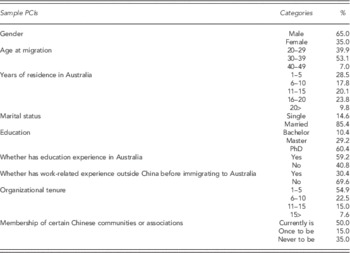
A thousand and fifty PCIs residing in Australia were invited to complete a questionnaire survey. A total of 220 usable questionnaires were obtained, resulting in a response rate of 21%. All participants were first-generation immigrants who were born and raised in mainland China. Most participants (88.5%) came from Melbourne and Sydney where the Chinese immigrants to Australia increasingly congregate (DIAC, 2009). Sixty-four per cent of questionnaires were completed in English, whereas 36% were completed in Chinese. The average age of the respondents was 43 years old with 72.8% falling in the 31–50 years age group. The majority of participants immigrated to Australia before 35 years of age. Table 1 provides the detailed demographic information of the sample.
The structure of sample PCIs

Note. PCI=professional Chinese immigrants.
N=220.
Procedures and data collection
Data were collected from October 2009 to February 2010. A non-probability sampling method was adopted. Individual participants were selected via the respondent-driven sampling method among PCIs who live and work in Australia. Respondent-driven sampling is a de facto variation of snowball sampling, selecting participants from the friendship network of existing participates (Salganik & Heckathorn, Reference Salganik and Heckathorn2004). The sampling process ‘begins when the researchers select a small number of seeds who are the first people to participate in the study,’ and then these seeds recruit others to participate in the study (Salganik & Heckathorn, Reference Salganik and Heckathorn2004: 196). Recruiting future sample members through existing sample members continues until the desired sample size is achieved (Heckathorn, Reference Heckathorn1997; Salganik & Heckathorn, Reference Salganik and Heckathorn2004).
Standard statistical methods are impractical for the research because of the problems of obtaining a random sample of ethnic minority populations. There is no specific list of these PCIs or any detailed statistics on their professions, and a probability random sampling technique would be too expensive and not feasible for the study. Respondent-driven sampling can be done more cheaply, quickly and easily than other methods in use and also can provide an asymptotically unbiased estimate about these minority groups (Heckathorn, Reference Heckathorn1997).
The seed participants in this study were mainly recruited via friendship groups of the researchers and accessible Chinese associations in Australia. Individual PCIs were initially approached by email with a brief explanation of the research. Once they expressed an interest in participation, survey packets including a survey statement, an English-version questionnaire and a Chinese-version questionnaire, were sent to them.
The original questionnaire was written in English. The questionnaires were translated into Chinese by the researcher, enabling participants to choose whether to complete the survey in English or Chinese. To ensure accurate translation, the Chinese versions were then back-translated twice into English by two competent and knowledgeable translators accredited by the National Accreditation Authority for Translators and Interpreters. Once translated into English, these two versions were compared against each other in order to resolve any discrepancies. Minor discrepancies were found because of stylistic differences in wording. The main points of the questions were conveyed by both versions.
Measures
In assessing the variables involved in the hypotheses, existing measures were employed wherever possible. Minor modifications were made to ensure the measures were applicable to both the Australian and the workgroup context. As several measures of a construct were often identified in the literature, the measures that were viewed as the most appropriate for this study context were selected.
Demographic information questionnaire
Factual information was gathered about participants’ demographic characteristics, including specific questions relating to participants’ age, sex, current marital status, level of education completed in China and Australia, respectively, level of education completed in other countries, past working experience, total years lived in Australia and primary language spoken at home.
Perceived mainstream language proficiency: English proficiency
The participants’ perceived mainstream language (English) proficiency was measured using a 7-item scale developed by the researcher. The questions were on a 5-point Likert scale ranging from ‘strongly disagree’ to ‘strongly agree’ to test participants’ proficiency in understanding, reading and writing English, and the extent to which their English can be understood by others. Sample items include ‘I speak English very well’ and ‘My English can be easily understood by others.’ Coefficient (Cronbach) α was calculated to be 0.89 for this measure.
Social support at work
Social support at work was measured using the 36-item scale adapted from Wang’s (2001) social support at work questionnaire, which was used to measure social support for three sources: immigrant co-workers, native-born co-workers and supervisor/management. The Cronbach’s α coefficients was 0.96 for this measure.
Self-Construal
The measurement of self-construal in this study was adapted from the Self-Construal Scale, developed by Singelis (Reference Singelis1994). The Self-Construal Scale comprises 24 items, divided evenly into two subscales (Hardin & Leong, Reference Hardin and Leong2004). Each item is rated on a 7-point scale, with answers ranging from 1=‘strongly disagree’ to 7=‘strongly agree.’ A sample item assessing interdependent self-construal is ‘I will sacrifice my self-interest for the benefit of the group I am in,’ and a sample item assessing independent self-construal is ‘I’d rather say “No” directly, than risk being misunderstood.’ Coefficient (Cronbach) α was calculated to be 0.79 and 0.67 for the sample, respectively, for measures of Interdependent Self-Construal and Independent Self-Construal.
Acculturation attitude
The measure of acculturation attitude employed in this study was adapted from the Acculturation Attitude Scale developed by Kim (1988). The original scale consisted of two sets of subscales (16 items per subscale), one assessing attitude toward the American culture and society, and the other assessing attitudes toward the Korean culture. For this study, the word ‘American’ in the original measure was changed to ‘Australian’ and the word ‘Korean’ was changed to ‘Chinese.’ Examples assessing PCIs’ attitude to maintain Chinese culture (cultural maintenance) were ‘I would socialize children to learn Chinese values of hard-work, cooperation and harmony’ and ‘I prefer Chinese friends with whom I can share my inner thoughts and feeling.’ Examples assessing PCIs’ attitude toward developing relationships with the Australians (relationship development) included ‘To be successful, it is important to know how to work well with Australians’ and ‘In Australia, it is important to work with Australians and help each other.’ Participants were asked to rate these questions by using a Likert-type scale ranging from 1=‘strongly disagree’ to 5=‘strongly agree.’ The α coefficients for relationship development and cultural maintenance were 0.78 and 0.83, respectively.
RESULTS
Classification of acculturation attitudes among PCIs
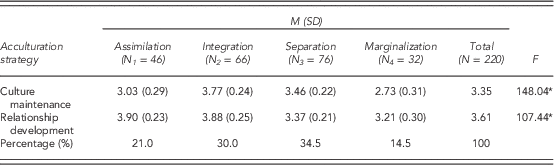
A cluster analysis was conducted linking strategies toward Chinese culture with strategies toward Australian culture. In line with previous studies conducted by Lu, Samaratunge, and Härtel (Reference Lu, Samaratunge and Härtel2012) and Kim, Helgesen, and Ahn (Reference Kim2002), the K-means method was employed as the algorithm. The produced clusters were divided in advance into four in line with our theoretical assumptions. The cluster analysis for individuals’ acculturation attitudes is presented in Table 2 Footnote 2 . These results indicate that 30.0% of the PCIs preferred to maintain their traditional culture without developing relationships with the members of the host group, identifying separation as the most popular acculturation attitude among PCIs, followed by integration (30.0%) and assimilation (21.0%).
General acculturation attitudes among PCIs
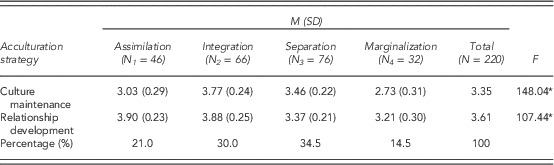
Note. PCI=professional Chinese immigrants. *p < 0.05.
Predictors of acculturation attitudes
Direct logistic regression analyses were performed that aimed to predict PCIs’ acculturation attitudes of 217 cases on the variable acculturation attitude, after deleting three cases with missing values. Five independent variables were used as predictors: length of residence in Australia, perceived English proficiency, perceived social support at work, interdependent self-construal and independent self-construal. For the purpose of making comparisons between the predictors of different units of measure, all the variables were standardized to produce z scores.
A test for multivariate outliers was conducted before running the logistic regression. Using data from the set of five variables, the Mahalanobis distance was calculated for each case. Tabachnick and Fidell (Reference Tabachnick and Fidell2007) state that the Mahalanobis distance should be interpreted as a χ2 statistic with the degrees of freedom equal to the number of IVs. The authors recommend that a criterion of p<.001 be used to evaluate whether a case is judged to be a multivariate outlier (Tabachnick & Fidell, Reference Tabachnick and Fidell2007), and so a critical value of χ5 2=20.52 was used. No case was identified with a Mahalanobis score in excess of this value and so no multivariate outliers were identified.
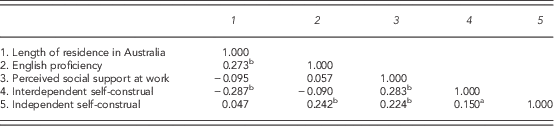
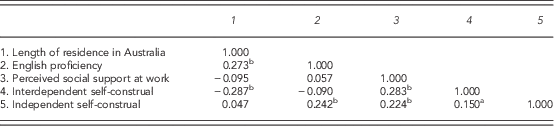
As logistic regression is also sensitive to high correlations among the predictor variables, multicollinearity was checked using Spearman’s ρ correlation coefficients. From the correlation matrix shown in Table 3 it is evident that the correlation values among predictor variables did not threaten the assumption of absence of multicollinearity, since the highest correlation value was 0.39 and was far below the critical value of 0.70 (see Tabachnick & Fidell, Reference Tabachnick and Fidell2007). Therefore, the assumptions for conducting logistic regression were not violated.
Correlation matrix for testing absence of multicollinearity
Note.
a Correlation is significant at the 0.05 level (two-tailed).
b Correlation is significant at the 0.01 level (two-tailed).
Predictors of assimilation
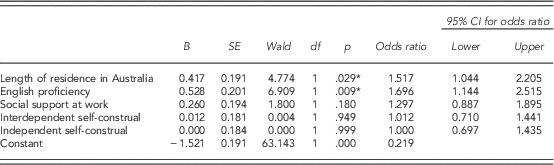
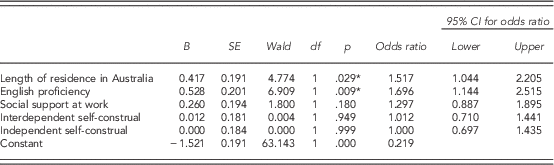
First, a direct logistic regression analysis was performed to assess the impact of the 12 variables on the likelihood that respondents would hold the assimilation attitude. A test of the full model with all the predictors against a constant-only-model was statistically significant, χ2 (5, 217)=19.32, p<.05, indicating that the predictors, as a set, reliably distinguished between respondents who adopted and did not adopt assimilation. The Hosmer and Lemeshow test also supported the model as being worthwhile, with χ2=5.13, df=8, p>.05. The model as a whole explained between 8.4% (Cox and Snell R 2) and 13.2% (Nagelkerke’s R 2) of variance in assimilation attitude. The model was able to classify correctly 8.9% of those who adopted assimilation and 99.4% of those who did not, for an overall success rate of 80.8%.
Table 4 shows the logistic regression coefficient, Wald test and odds ratio for each of the predictors when predicting assimilation. Employing a 0.05 criterion of statistical significance, only length of residence in Australia and English proficiency had significant partial effects. The other variables were not found to provide any significant contribution to the model. The length of residence in Australia had an odds ratio of 1.52, indicating that, when holding all other variables constant, the participants were 1.52 times more likely to hold the assimilation attitude, with a 1 year increase on the length of residence in Australia. The English proficiency had an odds ratio of 1.70, indicating that, when holding all other variables constant, with a one point increase on the 5-point language proficiency scale, the participants were 1.70 times more likely to hold the assimilation attitude. Therefore, Hypothesis 1a and Hypothesis 2a, stating that longer length of residence in Australia and high level of English proficiency would predict the usage of assimilation attitude, were supported, whereas Hypothesis 3a and Hypothesis 4a were rejected.
Logistic regression predicting likelihood of adopting assimilation attitude
*p < 0.05.
Predictors of integration
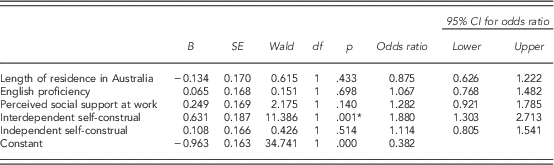
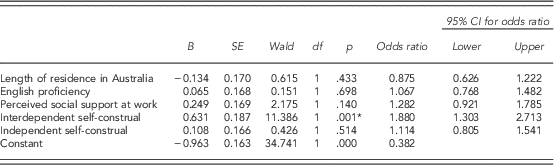
A direct logistic regression analysis was employed to predict the probability that a participant would adopt Integration. A test of the full model with all the predictors versus a model with intercept only was statistically significant, χ2(5, 217)=24.83, p<.05, indicating that the predictors, as a set, reliably distinguished between respondents who adopted and did not adopt integration. The Hosmer and Lemeshow test also supported the model as being worthwhile, with χ2=12.50, df=8, p>.05. The model as a whole explained between 10.7% (Cox and Snell R 2) and 15.2% (Nagelkerke’s R 2) of variance in the integration attitude, and correctly classified 24.2% of those who adopted integration and 91.5% of those who did not, for an overall success rate of 71.2%.
According to the Wald criterion, as shown in Table 5, employing a 0.05 criterion of statistical significance, only interdependent self-construal made a significant contribution to prediction. The other variables were not found to have significant partial effects. The odds ratio for interdependent self-construal was 1.88, indicating that holding all other variables constant in the model, with a one point increase on the 7-point interdependent Self-Construal Scale, there was about twice the possibility that the participants employed the integration attitude. Therefore, Hypothesis 1b, Hypothesis 2b and Hypothesis 3b were not supported, whereas Hypothesis 4b was partially supported.
Logistic regression predicting likelihood of adopting integration attitude
*p < 0.05.
Predictors of separation
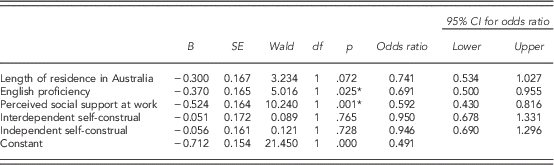
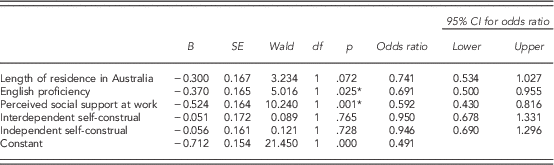
A direct logistic regression analysis was employed to predict the probability that a participant would adopt separation. A test of the full model with all the predictors versus a model with intercept only was statistically significant, χ2(5, 217)=24.80, p<.05, indicating that the predictors, as a set, reliably distinguished between respondents who adopted and did not adopt marginalization. The Hosmer and Lemeshow test also supported the model as being worthwhile, with χ2=9.06, df=8, p>.05. The model as a whole explained between 10.7% (Cox and Snell R 2) and 14.8% (Nagelkerke’s R 2) of variance in the separation attitude, and correctly classified 28.9% of those who adopted separation and 88.1% of those who did not, for an overall success rate of 67.6%.
According to the Wald criterion, as shown in Table 6, employing a 0.05 criterion of statistical significance, only English proficiency and perceived social support at work made a significant contribution to prediction. The other variables were not found to have significant partial effects. The odds ratio for English proficiency was 0.69, indicating that holding all other variables constant in the model, with a one point increase on the 5-point English proficiency scale the participants were 0.69 times less likely to hold the integration attitude. The odds ratio of 0.59 for perceived social support at work was <1, indicating that holding all other variables constant in the model, with a one point increase on the 7-point social support at work scale, the participants were 0.59 times less likely to employ the separation attitude. Therefore, Hypotheses Hypothesis 2c and Hypothesis 3c, stating that low level of English proficiency and low level of perceived social support at work would predict the usage of separation attitude, were supported, whereas Hypothesis 1c and Hypothesis 4c were rejected.
Logistic regression predicting likelihood of adopting separation attitude
*p < 0.05.
Predictors of marginalization
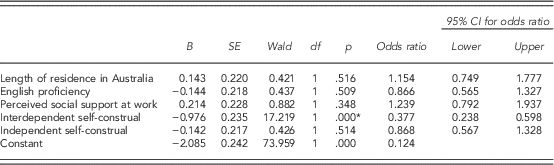
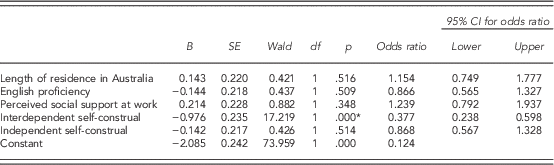
A direct logistic regression analysis was employed to predict the probability that a participant would adopt marginalization. A test of the full model with all the predictors versus a model with intercept only was statistically significant, χ2(5, 2175)=24.70, p<.05, indicating that the predictors, as a set, reliably distinguished between respondents who adopted and did not adopt marginalization. The Hosmer and Lemeshow test also supported the model as being worthwhile, with χ2=12.94, df=8, p>.05. The model as a whole explained between 10.7% (Cox and Snell R 2) and 18.9% (Nagelkerke’s R 2) of variance in the marginalization attitude, and correctly classified 12.5% of those who adopted marginalization and 98.9% of those who did not, for an overall success rate of 86.3%.
According to the Wald criterion, as shown in Table 7, employing a 0.05 criterion of statistical significance, only Interdependent self-construal made a significant contribution to prediction. The other variables were not found to have significant partial effects. The odds ratio of 0.38 for Interdependent self-construal was <1, indicating that holding all other variables constant in the model, with a one-point increase on the 7-point interdependent Self-Construal Scale, the participants were 0.38 times less likely to employ the marginalization attitude. According to these results, Hypothesis 4d was partially supported while Hypothesis 1d, Hypothesis 2d and Hypothesis 3d were not supported.
Logistic regression predicting likelihood of adopting marginalization attitude
*p < 0.05.
Discussion And Implications
Results revealed that PCIs in Australia collectively choose to retain their traditional culture, with most individuals holding the attitudes of separation and integration. Separation, not integration, was surprisingly the most popular choice among PCIs. This finding infuses the acculturation theory with new insights, since previous studies conducted in countries other than Australia demonstrated that immigrants have a clear preference for the integration attitude (e.g., Berry et al., Reference Berry, Kim, Power, Young and Bujaki1989; Zheng & Berry, Reference Zheng and Berry1991; Bakker, van der Zee, & Van Qudenhoven, Reference Bakker, van der Zee and Van Qudenhoven2006; Choi & Thomas, Reference Choi and Thomas2009), which differs from the current finding that separation is the most preferred attitude.
One possible explanation for PCIs’ preference of the separation attitude is that Chinese immigrants feel proud of their Chinese culture, which is believed to be a representative example of world culture and has a great impact on the world (Wu, Reference Wu2000). Therefore, they may want to maintain their traditional culture, which a multicultural society such as Australia allows them to do so. Another possible reason is that the participants in this study take an active part in different Chinese communities in Australia, which advocate retaining and promoting Chinese culture. Members of these communities have ample opportunities to function appropriately according to their heritage culture and use their ethnic language. As a result, PCIs collectively choose to maintain their heritage culture and the Chinese culture can be sustained in Australia (Lu, Samaratunge, & Härtel, Reference Lu, Samaratunge and Härtel2011). A third possible explanation is that those participants might be interested in participating in cultural activities of the host country and build up relationships with Australians, but could not find a way to do so. This possibility threatens Australia’s espoused value of a multicultural society, which warrants further research preferably with a larger sample of PCIs through in-depth interviews.
Results of logistic regression analysis identified that a high level of English proficiency predicted the preference of assimilation, a high level of interdependent self-construal predicted the desire of integration and avoidance of marginalization, and a higher level of perceived social support at work predicted a preference for separation. The longer the immigrants have lived in the host country, the more possible it is for them to have the assimilation attitude, and the less likely they are to maintain their Chinese identity and culture. Along with increased length of residence in Australia, PCIs can learn and know more about the host society and their workplace, via which they can adjust themselves to fit into the context. Also, they have the time to gain the experience and support needed to adjust to living in Australia, promoting their willingness to have greater contact with Australians and taking part in the mainstream society, which in turn help to improve their English proficiency.
Consistent with many previous studies (Yeh, Reference Yeh2003; Choi & Thomas, Reference Choi and Thomas2009), participants with better proficiency in English were more likely to adopt the assimilation attitude. A strong command of English increases the ability of immigrants to acquire cultural knowledge of the host country and workplace, which facilitates their cross-cultural interactions with members of the host society and further helps them to avoid potential intercultural misunderstandings and conflicts (Kuo & Roysircar, Reference Kuo and Roysircar2004). Moreover, better English proficiency provides individuals with the opportunity to mingle with people from cultural backgrounds other than their own and thus learn and know more about the host society. Such a finding underscores the importance of the ability to master English for the development of a positive acculturation strategy in English-speaking countries. On this evidence, policy-makers and program developers in organizations would do well to focus their attention on designing effective and accessible training programs for improving PCIs’ English proficiency to promote positive attitudes among PCIs toward the acculturation process.
Interdependent self-construal is found to predict integration and less usage of marginalization. Marginalization involves rejection by or refusal to build connections with the dominant society, combined with own-culture loss. In contrast, integration involves the desire to build a relationship with members of the host group, combined with maintenance of one’s own heritage culture and participation in one’s own ethnic activities (Berry, Reference Berry1997). In this sense, individuals with a high level of interdependent self-construal see themselves as an integral part of an encompassing social relationship and closely connected with others, and thus are less likely to adopt marginalization and more likely to adopt integration. This finding suggests a way that organizations can intervene in employees’ acculturation attitudes through encouraging a collective workplace culture and strengthening relationships among colleagues. A culture value of collectivism and cooperation between colleagues facilitates PCIs to develop more relationships with their colleagues as they value connectedness with others; this in turn reduces the likeliness of adopting marginalization and increasing the likelihood of using integration. This is necessary because studies by Lu, Samaratunge, and Härtel (Reference Lu, Samaratunge and Härtel2010, Reference Lu, Samaratunge and Härtel2011a, Reference Lu, Samaratunge and Härtel2011b indicate that PCIs using the marginalization attitude and separation attitude have a significantly lower level of job satisfaction, affective workgroup commitment and work engagement than those with the assimilation attitude.
Findings also revealed that respondents who received higher levels of social support from their co-workers, supervisors and managers were less likely to adopt the separation attitude, which is related with lower job satisfaction, affective workgroup commitment and work engagement. It is possible that people who receive more social support at work may have a sense of belonging and perceive more inclusiveness in the workplace (cf. Ayoko et al., Reference Ayoko, Härtel and Callan2002; Härtel & Panipucci, Reference Härtel and Panipucci2005). Social help from these three sources can provide immigrant employees with more information regarding the local managerial system, which assists them in understanding the system and solving problems caused by system or cultural differences. Furthermore, employees often interpret support from co-workers and supervisors as a signal of being accepted and perceive more fairness in the workplace, promoting attachment with their workplace (Ng, Reference Ng2008). Availability of social support at work serves as a tool to become involved in the host culture, which, according to this study, is a facilitating factor for positive acculturation strategies. Training supervisors in providing support, managing interpersonal relationships and enhancing mutual communication between supervisors and employees would be one important step organizations could take to improve commitment (Ng, Reference Ng2008; Stewart & Johnson, Reference Stewart and Johnson2009).
However, having an acculturation attitude does not necessarily guarantee the use of a corresponding strategy in the real world. A person who has an assimilation attitude may put separation into practice if the host group and mainstream society do not provide them with the opportunity to do so, such as access to the broader society. Therefore, it is valuable to investigate the real experience in daily life of these PCIs and explore how they deal with issues of maintaining heritage culture and developing relationships with members of the host group.
CONCLUSIONS, LIMITATIONS AND FUTURE STUDIES
As an important phenomenon associated with immigration, acculturation means having to learn to deal with two different cultures. One is the individual’s heritage culture and the other is the host culture one has migrated to. A better understanding of immigrant employees’ acculturation experience is an indispensable precondition for effectively managing them, since an extensive review of the literature reveals a critical link between acculturation and work-related outcomes, including employee’s performance, job satisfaction, commitment, interpersonal communication and level of conflict (Lu, Samaratunge, & Härtel, Reference Lu, Samaratunge and Härtel2011c; Oerlemans, Peeters, & Schaufeli, Reference Oerlemans, Peeters and Schaufeli2008). To provide recommendations for governments about how to embrace immigrants and organizations about how to manage a culturally diverse workforce, we examined PCIs’ acculturation attitudes and identified factors contributing to individuals’ acculturation options.
The research revealed that most PCIs adopt separation as their acculturation strategy across life domains. Better English proficiency, a higher level of interdependent self-construal, support from colleagues, supervisors and managers, and a culture encouraging connectedness, cooperation and inclusiveness are found to promote the development of a positive acculturation strategy toward the acculturation process. It is hoped that through effective acculturation-related policies at the societal level the government can help immigrants be better accommodated into the larger society. Also, through effective acculturation-related programs at the organizational level, practitioners can better utilize the human capital of immigrant employees and gain a competitive advantage by keeping the diverse skills and experience within the organization rather than outside it.
Although findings of this study contribute new knowledge to the existing literature, there are several limitations that need to be addressed. One of the main limitations is the generalizability of the results, because this study is not a comparative study between different ethnic groups or PCIs across national contexts. It only focuses on the Chinese group in the Australian context. Therefore, the research outcomes cannot explain the case of immigrants from other countries, nor can it reveal the circumstances of Chinese immigrants in countries other than Australia. The research findings cannot necessarily be applied to immigrants from other ethnic backgrounds such as other Asian population groups (e.g., Korean, Japanese and Indian immigrants), let alone immigrants from other continents like Europe. Similarly, the research findings may be unable to explain the case of immigrants who have settled into their lives in countries other than Australia. Each country has its own ideology toward immigration, formatting its specific acculturation climate and context for immigrants’ adjustment that impact on immigrants’ acculturation (Kosic, Mannetti, & Sam, Reference Kosic, Mannetti and Sam2005). Using methods and research design similar to the current study, several comparative studies could be conducted in the future. For example, future studies could address the acculturation experience of immigrants from different ethnic backgrounds living in Australia and other countries, and the acculturation experience of Chinese immigrants living in different countries. Comparisons between acculturation of the first-generation and second-generation immigrants could also be conducted.
Another limitation related to generalization is the focus in the current research on PCIs. Future research would also benefit from examining the acculturation experience of Chinese immigrants who belong to occupations other than professions and its influence across life domains. Other occupational groups (e.g., laborers, traders, etc.) may have different acculturation experiences in the workplace; this deserves further exploration. The low response rate can be regarded as another weakness related to generalization. Only 21.0% of the respondents who were approached participated in the research. This is a common problem in research among ethnic minorities (Dinsbach, Reference Dinsbach2005). Nonetheless, future studies should aim to increase the sample size to improve the genaralizability of the results through adopting a mix of sampling methods.
The research is confined to self-report. Future studies could consider data sources other than self-report instruments (e.g., interviews with respective managers and employees) to assess acculturation strategies (Chirkov, Reference Chirkov2009) and cause-and-effect relationships between acculturation strategies and job outcomes.
As a final point, there is a need for research incorporating the host society members’ attitudes toward immigrants’ acculturation choices. In that way, insights into how the majority group shapes the acculturation strategies of immigrant groups can be gleaned (Navas et al., Reference Navas, García, Sánchez, Rojas, Pumares and Fernández2005). Such information would facilitate the development of more efficient acculturation programs for organizations and can open a road for governments to make policies that support a harmonious life among different cultural contact groups.
Acknowledgements
We sincerely thank Prof. Uichol Kim for helping to contextualize the Acculturation Attitudes Scale. Special thanks go to Dr. Mingqiong Zhang for his comments and suggestions. We also thank Prof. John W. Berry for helping to clarify the theoretical models of acculturation. Our gratitude is extended to Dr. Brian Cooper for his invaluable assistance with data analysis
Financial Support
None.
Conflicts of Interest
None.