Background
Early life experiences shape how adults relate to others, respond to stress, and perceive the world (Bowlby Reference Bowlby1969 [1984]; Bowlby Reference Bowlby2017; Sullivan Reference Sullivan2017). Childhood trauma has lifelong effects on health-harming behaviours including early substance use and addictive patterns (Sullivan Reference Sullivan2017)., and is associated with mental disorders such as depression, anxiety, and psychosis (McKay et al. Reference McKay, Cannon, Chambers, Conroy, Coughlan, Dodd, Healy, O’Donnell and Clarke2021), physical illness including cardiovascular disease, obesity, and cancer (Noteboom et al. Reference Noteboom, Ten Have, de Graaf, Beekman, Penninx and Lamers2021), and impaired relational functioning (Haslam and Taylor Reference Haslam and Taylor2022). Through neurodevelopmental disruption, epigenetic changes, and dysregulation of stress systems, trauma exposure increases the risk of cognitive challenges, lifelong disease, and psychopathology (Madigan et al. Reference Madigan, Deneault, Racine, Park, Thiemann, Zhu, Dimitropoulos, Williamson, Fearon and Cénat2023).
Population-based studies confirm a dose-response relationship between childhood trauma and illicit drug use: the greater the number of traumatic experiences, the higher the risk across the life course (Carliner et al. Reference Carliner, Keyes, McLaughlin, Meyers, Dunn and Martins2016; Scheidell et al. Reference Scheidell, Quinn, McGorray, Frueh, Beharie, Cottler and Khan2018). Rates of abuse and neglect among those with substance use disorders far exceed those in the general population (Zhang et al. Reference Zhang, Lin, Liu, Pan, Zeng, Chen and Wu2020), with neurobiological evidence linking trauma to limbic brain alterations and neuroimmune pathway disruption, mediating addiction vulnerability and relapse risk (Chang et al. Reference Chang, Chen, Lu, Jou, Santos and Goh2024; Iacono et al. Reference Iacono, Catale, Martini, Valzania, Viscomi, Chiurchiù, Guatteo, Bussone, Perrone and Di Sabato2018; Van Dam et al. Reference Van Dam, Rando, Potenza, Tuit and Sinha2014). Impulsivity and irritability have also been identified as mediators between childhood abuse and addictive behaviours (Liu et al. Reference Liu, Xiao, Ye, Li, He, Peng and Zhou2025).
The financial costs of childhood trauma are considerable, estimated at an average of 3% of annual GDP (Hughes et al. Reference Hughes, Ford, Bellis, Glendinning, Harrison and Passmore2021). Globally, alcohol use disorders account for an estimated 100 million cases (Degenhardt et al. Reference Degenhardt, Charlson, Ferrari, Santomauro, Erskine, Mantilla-Herrara, Whiteford, Leung, Naghavi and Griswold2018); in Ireland, 8,163 cases were treated for problem alcohol use in 2023 – the highest in over a decade – with the proportion classified as ‘harmful’ rising from 16% in 2017 to 22% in 2023 (O’Neill et al. Reference O’Neill, Ní Luasa, Lyons and Carew2024). Problem gambling affects approximately 1.5% of adults globally (Gowing et al. Reference Gowing, Ali, Allsop, Marsden, Turf, West and Witton2015). These trends are reflected in the expansion of the ICD-11, including the addition of ‘Gaming disorder’ and ‘Substance induced anxiety disorder’ (Organization Reference Organization2024; Reed et al. Reference Reed, First, Billieux, Cloitre, Briken, Achab, Brewin, King, Kraus and Bryant2022).
The Childhood Trauma Questionnaire (CTQ), developed by Bernstein et al. (Reference Bernstein, Fink, Handelsman and Foote1998), is a retrospective self-report instrument assessing emotional abuse, physical abuse, sexual abuse, emotional neglect, and physical neglect (Bernstein et al. Reference Bernstein, Fink, Handelsman and Foote1998). A short form (CTQ-SF) was published in 2003 (Bernstein et al. Reference Bernstein, Stein, Newcomb, Walker, Pogge, Ahluvalia, Stokes, Handelsman, Medrano and Desmond2003) and has been translated into more than a dozen languages, demonstrating reasonable validity and reliability (Fu and Yao Reference Fu and Yao2005).
Given the individual, social, and economic burden of childhood trauma and addiction, we performed a systematic review examining their association, including comorbid mental and physical illness. We also explored mediating and moderating mechanisms.
Methods
This systematic review was registered on PROSPERO (CRD420251009673) and conducted in accordance with PRISMA guidelines (Moher et al. Reference Moher, Shamseer, Clarke, Ghersi, Liberati, Petticrew, Shekelle and Stewart2015).
Eligibility criteria
Population
Studies involving adults (aged 18 or over) with a diagnosed substance use disorder (alcohol, opioids, cannabis, or other illicit drugs) or recognised behavioural addiction (gambling or gaming disorder) were included. Studies focused exclusively on adolescent or paediatric populations were excluded unless adult data were reported separately.
Exposure
Studies must have assessed childhood trauma (before age 18) using the CTQ or CTQ-SF, covering at least one of: emotional abuse, physical abuse, sexual abuse, emotional neglect, or physical neglect. The CTQ is a validated retrospective self-report instrument comprising 28 items assessing five subtypes of maltreatment: emotional abuse, physical abuse, sexual abuse, emotional neglect, and physical neglect (Bernstein et al. Reference Bernstein, Fink, Handelsman and Foote1998). The short form (CTQ-SF) comprises 25 items across the same five subscales, each containing five items rated on a five-point Likert scale (1 = never true to 5 = very often true), with higher scores indicating greater severity of maltreatment (Bernstein et al. Reference Bernstein, Stein, Newcomb, Walker, Pogge, Ahluvalia, Stokes, Handelsman, Medrano and Desmond2003). A minimisation/denial subscale is also included to identify potential underreporting. Its use as an eligibility criterion in this review ensured measurement consistency across a heterogeneous international literature, facilitating meaningful comparison of trauma prevalence and severity across addiction types and study designs.
Comparator
Both studies with and without a control group were included in the review; control groups were considered to be those without an addiction.
Outcomes
Included studies reported on at least one of the following: prevalence or severity of childhood trauma among individuals with addiction; the association between childhood trauma and addiction; comorbid mental health conditions (e.g. depression, anxiety, psychosis); or comorbid physical health conditions (e.g. cardiovascular disease, obesity).
Study design
A systematic search was conducted across PsycINFO, EMBASE, Web of Science, PubMed/MEDLINE, and Cochrane. Cross-sectional, cohort, case-control, and RCT designs were included. Qualitative studies, case reports, editorials, letters, opinion pieces, systematic reviews, and meta-analyses were excluded, though the reference lists of reviews were screened for eligible primary studies.
Language and date
English-language studies published between 2006 and 2025 were eligible; an updated search was conducted in March 2026. See Appendix A for the full search strategy.
Selection of studies
Two reviewers independently conducted primary searches; disagreements during full-text screening were resolved by a third reviewer. Reference lists of prior reviews were also screened.
Data extraction and management
Data were extracted using a pre-designed template per MECIR standards (Chandler et al. Reference Chandler, Churchill, Higgins, Lasserson and Tovey2013). Primary outcomes were addiction type and prevalence, and childhood trauma type, prevalence, and/or mean CTQ scores. Each CTQ subscale comprises five items rated on a five-point Likert scale (1 = never true to 5 = very often true) (Bernstein et al. Reference Bernstein, Stein, Newcomb, Walker, Pogge, Ahluvalia, Stokes, Handelsman, Medrano and Desmond2003). Secondary outcomes included sociodemographic data, comorbidities, and clinical information.
Risk of bias assessment
The Newcastle-Ottawa Scale was used to assess internal validity, reliability, comparability, and bias in observational studies, with age, gender, and setting as potential confounders. See online Supplemental Material for full quality assessment.
Results
Search results
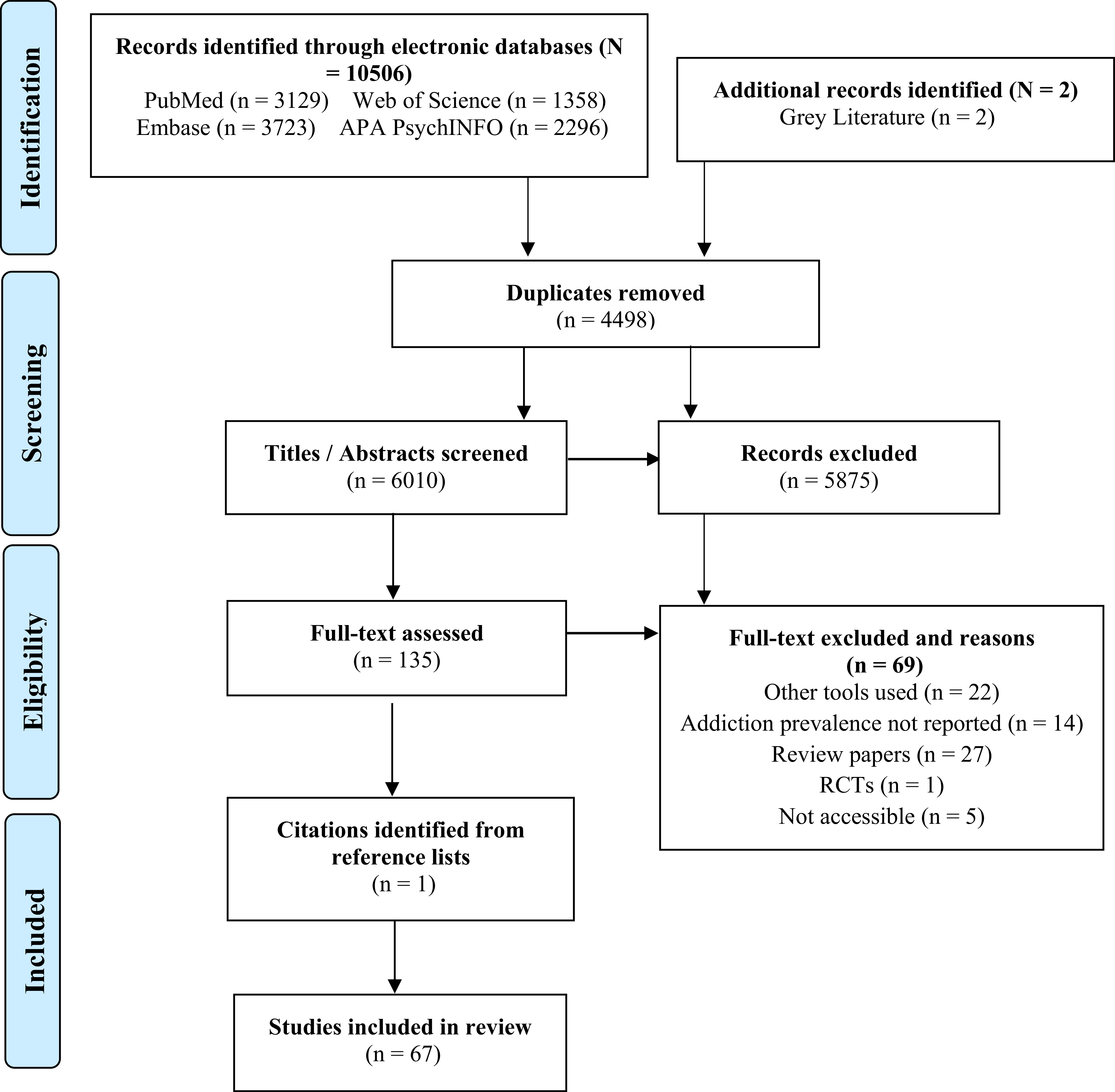
The search yielded 12,506 citations; 8,010 remained after duplicate removal. Of 135 studies assessed at full-text, 66 met inclusion criteria; one additional study was identified through citation searching, giving a total of 67 included studies. See Figure 1.
PRISMA flow chart and search results.

Figure 1. Long description
The flowchart begins with the identification of records through electronic databases and additional records identified. Records identified through electronic databases total 10506, with contributions from PubMed (3129), Web of Science (1358), Embase (3723), and APA PsychINFO (2296). Additional records identified from Grey Literature total 2. Duplicates are removed, resulting in 4498 records. Titles and abstracts of these records are screened, with 6010 titles/abstracts screened and 5875 records excluded. Full-text assessment is conducted on 135 records, with 69 full-texts excluded for various reasons including the use of other tools (22), addiction prevalence not reported (14), review papers (27), RCTs (1), and not accessible (5). One citation is identified from reference lists. Finally, 67 studies are included in the review.
Characteristics of included studies
The 67 studies included 44,429 participants in total; 19 studies included a comparison group (6,133 controls). Sample sizes ranged from 11 to 2,193 for addiction groups and 11 to 4,122 for controls. Studies were published between 2009 and 2026, predominantly from China and the USA. Designs comprised 30 cross-sectional, 29 cohort, and 8 case-control studies. Twenty-six were based in treatment centres, 21 in specific populations (criminal-justice settings, military bases, hospitals, or homeless centres), and 20 in the general population. Table 1 provides a summary.
Summary of studies included

Table 1. Long description
Panel A: Table listing studies with columns for study, country, setting, design, sample size, and addiction type. Panel B: Detailed information on each study including specific countries, settings, and designs. Panel C: Summary statistics on sample sizes and study designs.
Addictions and trauma
All participants were assessed using the CTQ (Bernstein et al. Reference Bernstein, Stein, Newcomb, Walker, Pogge, Ahluvalia, Stokes, Handelsman, Medrano and Desmond2003). Emotional neglect and abuse were the most frequently reported trauma types, followed by physical abuse.
Eight studies reported exclusively on behavioural addictions (Chen et al. Reference Chen, Zhang, Zhang, Luo, Xu, Huang, Yang and Zhang2021; Evren et al. Reference Evren, Evren, Dalbudak, Topcu, Kutlu and Elhai2019; Jin et al. Reference Jin, Wang, Huang, Luo, Gao and Shen2024; Ma et al. Reference Ma, Huang and Ma2020; Nazligül et al. Reference Nazligül, Yilmaz and Griffiths2023; Reis et al. Reference Reis, Park, Dionne, Kim and Scanavino2023; Wang et al. Reference Wang, Luo, Huang, Xiang, Chen, Lin, Chen, Zhang, Huang and Wang2023; Zhou and Li Reference Zhou and Li2024), one on both behavioural and substance addictions (Schwaninger et al. Reference Schwaninger, Mueller, Dittmann, Poespodihardjo, Vogel, Wiesbeck, Walter and Petitjean2017), and 57 on substance addictions. Alcohol was the most common primary addiction overall (30 studies), followed by methamphetamine (8 studies). Among treatment-based studies, alcohol was most prevalent (11 studies), followed by methamphetamine (9 studies). In general population studies, alcohol was again most common, followed by behavioural addictions. For cross-sectional studies reporting alcohol prevalence (14 studies), rates ranged from 9 to 80% (mean 46.7%, SD = 21.1%). Twenty-seven studies reported polysubstance use; cannabinoids and cocaine were the most common secondary substances. Internet addiction was the most frequently reported behavioural addiction, followed by mobile phone addiction. See Appendix B.
Comorbidities – mental or physical illness and trauma
Thirty-two studies reported a primary mental illness. Depression was most common (18 studies), followed by PTSD (7 studies); other conditions included anxiety, personality disorders, psychosis, and bipolar affective disorder. Mean mental illness prevalence across the 20 reporting studies was 51.1% (SD = 23.1%). See Appendix C.
Several studies examined additive effects of childhood trauma and addiction, identifying: reduced resilience (Aldemir et al. Reference Aldemir, Akyel and Havaceligi Atlam2022), increased impulsivity and aggression (Brents et al. Reference Brents, Tripathi, Young, James and Kilts2015; Ergelen et al. Reference Ergelen, Yalçın and Bilici2018; Lanesman et al. Reference Lanesman, Gouse, Bantjes, Stein and Lochner2019; Liu et al. Reference Liu, Pu, Liu, Zhang, Shen, Deng, Wang, Li, Fu and Yang2022), poor emotional regulation (Mohammadzadeh et al. Reference Mohammadzadeh, Ganji, Khosravani, Ardakan and Amirinezhad2019), poor executive function (Narvaez et al. Reference Narvaez, Magalhães, Trindade, Vieira, Kauer-Sant’Anna, Gama, von Diemen, Kapczinski and Kapczinski2012), insecure attachment (Cheng et al. Reference Cheng, Cui, Zhang, Zhang, Wang, Yuan, Huang, Zhang and Zhou2020), dissociative behaviours (Evren et al. Reference Evren, Cınar, Evren, Ulku, Karabulut and Umut2013; Evren et al. Reference Evren, Evren, Dalbudak, Topcu, Kutlu and Elhai2019; Schäfer et al. Reference Schäfer, Reininghaus, Langeland, Voss, Zieger, Haasen and Karow2007), low self-esteem (Lu et al. Reference Lu, Wen, Deng and Tang2017; Zhou and Li Reference Zhou and Li2024), sexual health risks (Jewkes et al. Reference Jewkes, Dunkle, Nduna, Jama and Puren2010; Lee et al. Reference Lee, Ti, Marshall, Dong, Wood and Kerr2015), and pro-inflammatory disease (Kascakova et al. Reference Kascakova, Petrikova, Furstova, Hasto, Geckova and Tavel2022; Levandowski et al. Reference Levandowski, Viola, Wearick-Silva, Wieck, Tractenberg, Brietzke, Bauer, Teixeira and Grassi-Oliveira2014). Neurobiological effects were also documented: lower oxytocin levels in methamphetamine-dependent individuals (Chang et al. Reference Chang, Chen, Lu, Jou, Santos and Goh2024); a role for GABRA2 gene variation (Enoch et al. Reference Enoch, Hodgkinson, Yuan, Shen, Goldman and Roy2010); prefrontal cortex functional alterations (Martins et al. Reference Martins, Cáceda, Cisler, Kilts and James2018); HPA axis dysregulation in cocaine addiction (Rovaris et al. Reference Rovaris, Mota, Bertuzzi, Aroche, Callegari-Jacques, Guimarães, Pezzi, Viola, Bau and Grassi-Oliveira2015); and reductions in brain volume, cortical thickness, and limbic grey matter (Türkmen et al. Reference Türkmen, Tan, Gerhardt, Bougelet, Bernardo, Machunze, Grauduszus, Sicorello, Demirakca and Kiefer2024; Van Dam et al. Reference Van Dam, Rando, Potenza, Tuit and Sinha2014).
Quality and risk of bias results
Overall quality was moderate across study designs. Cohort studies (n = 29) scored between 4 and 7, with the majority achieving scores of 5–6, indicating fair to good quality. The most common limitations were absence of a clearly described non-exposed cohort and inadequate follow-up reporting, with most studies relying on self-report rather than objective outcome assessment. Case-control studies (n = 8) scored between 4 and 5, reflecting fair quality overall; key limitations included non-blinded exposure ascertainment and inconsistent methods of ascertainment between cases and controls. Non-response rates were poorly described across all case-control studies. Cross-sectional studies (n = 30) ranged from 3 to 7; while all studies applied appropriate statistical tests and controlled for at least some confounders, selection bias was a consistent concern, with the majority drawing from convenience or clinical samples and few studies providing justification for sample size. Non-respondent data were rarely reported.
Across all designs, exposure ascertainment via the CTQ was a methodological strength. Age, gender, and setting were considered as potential confounders throughout. These limitations should be considered when interpreting findings. See online Supplemental Material.
Emergent themes
Theme 1: psychological and psychosocial mediators between childhood trauma and addiction
Across the included studies, psychological and psychosocial factors consistently emerged as intermediary mechanisms through which early maltreatment shapes addiction vulnerability, rather than evidence of a direct causal pathway.
Impulsivity was the most frequently identified mediator: Chang et al. found that oxytocin levels and impulsivity mediated the relationship between childhood trauma and age of first methamphetamine use (Chang et al. Reference Chang, Chen, Lu, Jou, Santos and Goh2024); Narvaez et al. demonstrated associations between trauma, executive dysfunction and impulsivity in crack cocaine users after controlling for confounders (Narvaez et al. Reference Narvaez, Magalhães, Trindade, Vieira, Kauer-Sant’Anna, Gama, von Diemen, Kapczinski and Kapczinski2012); and Arwood and Nooner found that impulsivity and PTSD symptoms together amplified the association between adverse childhood experiences and adolescent binge drinking (Arwood and Nooner Reference Arwood and Nooner2023).
Emotional dysregulation was a further key mechanism. Mohammadzadeh et al. found that childhood trauma had no direct relationship with suicidal ideation in heroin users, but was indirectly linked via difficulties in emotional regulation – suggesting that disruption of affect regulation, rather than trauma exposure alone, elevates risk (Mohammadzadeh et al. Reference Mohammadzadeh, Ganji, Khosravani, Ardakan and Amirinezhad2019). Evren et al. extended this to internet addiction, showing that dissociative experiences and emotion dysregulation mediated the trauma-internet addiction relationship in young adults (Evren et al. Reference Evren, Evren, Dalbudak, Topcu, Kutlu and Elhai2019).
Self-concept and self-esteem also operated as mediators. Lu et al. found that self-concept mediated the relationship between childhood maltreatment and both abstinence motivation and self-efficacy in drug-dependent individuals; this, in effect, having implications for treatment engagement (Lu et al. Reference Lu, Wen, Deng and Tang2017). Zhou and Li found that social support and self-esteem partially mediated the maltreatment–internet addiction pathway (Zhou and Li Reference Zhou and Li2024); Ma, Huang and Ma identified loneliness and self-control as further mediating and moderating variables in mobile phone addiction (Ma et al. Reference Ma, Huang and Ma2020).
Methodologically, the body of evidence has limitations. Several studies employed cross-sectional designs, precluding causal inference. Samples were frequently narrow, treatment-seeking, and geographically concentrated, limiting generalisability. There was considerable heterogeneity in how key constructs such as impulsivity and emotion dysregulation were operationalised, complicating direct comparisons. However, these findings indicate that specific psychological vulnerabilities – impulsivity, emotional dysregulation, negative self-concept, and dissociation – are key mechanisms through which early adversity translates into addictive behaviour across the life course.
Theme 2: neurobiological correlates of childhood trauma in addiction
A substantial body of evidence from the included studies identifies structural and biochemical changes linked to childhood trauma that may mediate addiction vulnerability and severity.
At a structural level, Van Dam et al. found that childhood maltreatment was independently associated with reduced grey matter volume in limbic regions – specifically the hippocampus, parahippocampus, and fusiform gyrus – and that these reductions prospectively predicted greater relapse severity over 90 days (Van Dam et al. Reference Van Dam, Rando, Potenza, Tuit and Sinha2014). Turkmen et al. similarly found that adverse childhood experiences were associated with reduced cortical thickness in frontal and insular regions involved in inhibitory control, with early adolescent abuse showing the strongest associations (Türkmen et al. Reference Türkmen, Tan, Gerhardt, Bougelet, Bernardo, Machunze, Grauduszus, Sicorello, Demirakca and Kiefer2024).
At a functional connectivity level, Wei et al. found childhood trauma negatively associated with within-default-mode-network connectivity in methamphetamine-dependent individuals, with cross-network connectivity potentially serving a compensatory function (Wei et al. Reference Wei, Tsai, Tsai, Chen, Tseng, Yang, Zhai, Yang and Wang2023). Martins et al. identified sex-dependent alterations in anterior cingulate cortex-temporoparietal junction connectivity in comorbid drug use disorder and childhood maltreatment (Martins et al. Reference Martins, Cáceda, Cisler, Kilts and James2018).
At a molecular level, Chang et al. found lower plasma oxytocin in methamphetamine-dependent individuals with childhood trauma, implicating disruption of social bonding and stress regulation (Chang et al. Reference Chang, Chen, Lu, Jou, Santos and Goh2024). Rovaris et al. identified a gene-environment interaction between physical neglect and mineralocorticoid receptor gene variation, altering cocaine addiction susceptibility and withdrawal severity, and consistent with HPA axis dysregulation (Rovaris et al. Reference Rovaris, Mota, Bertuzzi, Aroche, Callegari-Jacques, Guimarães, Pezzi, Viola, Bau and Grassi-Oliveira2015). Enoch et al. found that GABRA2 genetic variation interacted with childhood trauma to influence risk for alcohol, heroin, and cocaine dependence (Enoch et al. Reference Enoch, Hodgkinson, Yuan, Shen, Goldman and Roy2010).
Collectively, these findings support a model in which childhood trauma produces lasting alterations to brain structure, function, and molecular signalling that directly influence addiction vulnerability, severity, and treatment response.
Theme 3: gender as a moderating variable in the trauma-addiction relationship
Several studies highlighted gender as a significant moderator of the trauma-addiction relationship, though findings were not always consistent.
Benda found that childhood sexual and physical abuse were stronger predictors of rehospitalisation for substance abuse in women veterans, whereas substance use severity, cognitive disorders, and peer associations were more predictive in men (Benda Reference Benda2004). Heffner, Blom and Anthenelli found that trauma-related symptoms predicted relapse to alcohol and drug use in women but not men (Heffner et al. Reference Heffner, Blom and Anthenelli2011), and Nia et al. found that the association between cannabis use and childhood trauma was significant in women only, suggesting sex-specific neurobiological stress pathways (Nia et al. Reference Nia, Weleff, Fogelman, Nourbakhsh and Sinha2023). Rasmussen et al. and Chen and Gueta both found that women with substance use disorders reported more severe and varied childhood maltreatment than men, with the latter study also finding higher rates of intergenerational transmission of substance-related problems among female inmates (Chen and Gueta Reference Chen and Gueta2016; Rasmussen et al. Reference Rasmussen, Arefjord, Winje and Dovran2018).
In a large Brazilian birth cohort, Valerio et al. found that maltreatment-substance use associations were generally stronger in females, particularly for physical abuse and adolescent smoking (Valério et al. Reference Valério, Soares, Menezes, Wehrmeister and Gonçalves2022). Karabulut and Genc found that women with comorbid PTSD and substance use disorder presented with significantly higher childhood trauma severity and more complex clinical profiles, reinforcing the case for routine trauma and PTSD screening in women accessing addiction services (Karabulut and Genç Reference Karabulut and Genç2023).
Rasmussen et al. and Valerio et al. represent the stronger methodological contributions, while Heffner et al. and Chen & Gueta should be interpreted more cautiously given their preliminary, exploratory nature and significant sample size constraints. While childhood trauma is a risk factor for addiction across genders, the overall findings indicate that its nature, expression, and pathways differ meaningfully between men and women – with important implications for trauma-informed, gender-responsive treatment approaches.
Discussion
This systematic review of 67 studies, encompassing 44,429 participants across multiple continents, demonstrates a consistent and robust association between childhood trauma and addiction. These findings are broadly consistent with the wider Adverse Childhood Experiences (ACE) literature (Felitti et al. Reference Felitti, Anda, Nordenberg, Williamson, Spitz, Edwards and Marks1998; Madigan et al. Reference Madigan, Deneault, Racine, Park, Thiemann, Zhu, Dimitropoulos, Williamson, Fearon and Cénat2023) and extend it by providing CTQ-derived data specifically within addicted populations. It corroborates meta-analytic evidence of markedly elevated childhood trauma prevalence among individuals with substance use disorders globally (Zhang et al. Reference Zhang, Lin, Liu, Pan, Zeng, Chen and Wu2020).
Three overarching themes emerged. Firstly, the pathway from childhood trauma to addiction was substantially mediated by psychological and psychosocial factors, rather than reflecting a direct causal mechanism. Oxytocin levels and impulsivity sequentially mediated the relationship between trauma and age of methamphetamine use (Chang et al. Reference Chang, Chen, Lu, Jou, Santos and Goh2024), while impulsivity and PTSD symptoms together amplified the link between adverse childhood experiences and adolescent binge drinking (Arwood and Nooner Reference Arwood and Nooner2023). Emotional dysregulation similarly linked trauma to suicidal ideation in heroin users (Mohammadzadeh et al. Reference Mohammadzadeh, Ganji, Khosravani, Ardakan and Amirinezhad2019) and to internet addiction (Evren et al. Reference Evren, Evren, Dalbudak, Topcu, Kutlu and Elhai2019). Self-concept also mediated the relationship between maltreatment and both abstinence motivation and self-efficacy (Lu et al. Reference Lu, Wen, Deng and Tang2017). These findings align with Kober and Bolling’s emotional dysregulation model of substance use (Kober and Bolling Reference Kober and Bolling2014) and Khantzian’s self-medication hypothesis, whereby substances serve to ‘medicate’ emotional suffering (Khantzian Reference Khantzian1997).
Secondly, neurobiological evidence converged on a model of lasting structural, functional, and molecular brain alterations following early trauma. Childhood maltreatment was independently associated with reduced limbic grey matter volume, prospectively predicting relapse severity (Van Dam et al. Reference Van Dam, Rando, Potenza, Tuit and Sinha2014), and with reduced cortical thickness in regions involved in inhibitory control (Türkmen et al. Reference Türkmen, Tan, Gerhardt, Bougelet, Bernardo, Machunze, Grauduszus, Sicorello, Demirakca and Kiefer2024), while disrupted default-mode network connectivity was reported in methamphetamine-dependent individuals with a trauma history (Wei et al. Reference Wei, Tsai, Tsai, Chen, Tseng, Yang, Zhai, Yang and Wang2023). A gene-environment interaction between physical neglect and receptor gene variation influenced cocaine withdrawal severity (Rovaris et al. Reference Rovaris, Mota, Bertuzzi, Aroche, Callegari-Jacques, Guimarães, Pezzi, Viola, Bau and Grassi-Oliveira2015), and GABRA2 variation interacted with trauma to increase risk across alcohol, heroin, and cocaine dependence (Enoch et al. Reference Enoch, Hodgkinson, Yuan, Shen, Goldman and Roy2010). Collectively, these findings support an allostatic load model in which cumulative trauma produces lasting dysregulation of stress-response systems that influences addiction vulnerability (Koob and Volkow Reference Koob and Volkow2016).
Thirdly, gender emerged as a significant moderator of trauma-addiction relationships, although findings were not entirely consistent. Trauma-related symptoms predicted relapse in women but not men (Heffner et al. Reference Heffner, Blom and Anthenelli2011), while cannabis use was linked to childhood trauma in women only, suggesting sex-specific activation of stress pathways (Nia et al. Reference Nia, Weleff, Fogelman, Nourbakhsh and Sinha2023). Stronger associations between maltreatment and addiction in women were also observed, particularly regarding physical abuse (Rasmussen et al. Reference Rasmussen, Arefjord, Winje and Dovran2018; Valério et al. Reference Valério, Soares, Menezes, Wehrmeister and Gonçalves2022), and women with comorbid PTSD and substance use disorder reported significantly greater trauma severity, reinforcing the case for routine trauma screening in women accessing addiction services (Karabulut and Genç Reference Karabulut and Genç2023). Collectively, these findings align with broader evidence of sex differences in the neurobiological response to early-life stress (Bangasser and Valentino Reference Bangasser and Valentino2014).
Clinical implications
The findings of this review carry several practical implications. Given the high prevalence of childhood trauma among individuals with addiction, routine trauma screening using validated instruments such as the CTQ or ACE questionnaire should be embedded in addiction treatment settings (Jordan-Cox Reference Jordan-Cox2018). The strong comorbidity with depression, present in over half of reporting studies, highlights the need for integrated rather than sequential mental health and addiction care (Torrens et al. Reference Torrens, Rossi, Martinez-Riera, Martinez-Sanvisens and Bulbena2012). Treatment approaches with an evidence base spanning trauma and addiction, including Seeking Safety (Najavits Reference Najavits2002), trauma-focused cognitive behavioural therapy, and eye movement desensitisation and reprocessing (van der Vleugel et al. Reference van der Vleugel, van den Berg, de Bont, Staring, de Jongh and Luber2015), warrant implementation and evaluation in this population. Trauma-focused psychotherapies, particularly those based on cognitive-behavioural principles and exposure-based components, demonstrate greater efficacy in reducing post-traumatic stress symptoms compared to non-trauma-focused or substance use-only interventions (Hien et al. Reference Hien, Papini, Saavedra, Bauer, Ruglass, Ebrahimi, Fitzpatrick, López-Castro, Norman and Killeen2024; Roberts et al. Reference Roberts, Roberts, Jones and Bisson2016). Targeting identified mediators (impulsivity, emotion dysregulation) through dialectical behaviour therapy or mindfulness-based relapse prevention may offer additional benefit (Bowen et al. Reference Bowen, Witkiewitz, Clifasefi, Grow, Chawla, Hsu, Carroll, Harrop, Collins and Lustyk2014). The neurobiological findings support further investigation of pharmacological adjuncts targeting HPA axis function or oxytocin pathways, though clinical trial evidence in this specific population remains limited. At a population level, the estimated economic burden of childhood trauma at approximately 3% of annual GDP reinforces the urgent case for upstream prevention strategies targeting adverse childhood experiences (Hughes et al. Reference Hughes, Ford, Bellis, Glendinning, Harrison and Passmore2021).
Limitations
Several limitations should be considered when interpreting these findings. The reliance on the CTQ as an inclusion criterion, while ensuring measurement consistency, means findings cannot be generalised to populations assessed with other trauma instruments. The CTQ’s retrospective self-report format introduces recall bias and potential minimisation, particularly where participants have a history of emotional neglect (Hardt and Rutter Reference Hardt and Rutter2004). The instrument does not capture contextual or relational dimensions of trauma, which may be relevant to addiction pathways. It remains, however, the most widely used and psychometrically robust standardised instrument for retrospective childhood trauma assessment in adult populations, and its breadth of subscales permits examination of differential effects across maltreatment subtypes.
The predominance of cross-sectional designs (n = 30) limits causal inference. Cohort study quality was variable, with most scoring in the ‘fair to good’ range on the Newcastle-Ottawa Scale, and follow-up periods were often inadequately described. Case-control studies were limited by non-blinded exposure ascertainment and inconsistency in ascertainment methods between cases and controls. Reliance on self-reported rather than objectively assessed outcomes was a consistent concern across all designs.
Significant heterogeneity across studies in terms of addiction type, setting, population, and outcome measures precluded meta-analysis and limits the synthesis of quantitative estimates (Higgins et al. Reference Higgins, Thomas, Chandler, Cumpston, Li, Page and Welch2019). Sample sizes varied considerably (n = 11 to 6,315), and many studies drew from clinical or convenience samples, raising concerns about selection bias and generalisability to community populations.
The geographical concentration of studies in China, the USA, Turkey, and Brazil limits cross-cultural generalisability, and few studies explicitly reported or adjusted for socioeconomic confounders. Inclusion criteria here were that studies be in English and published between 2006 and 2025, to ensure contemporaneity and accessibility. However, future studies might consider using search terms in non-English-language search engines – particularly Spanish and Chinese.
Finally, behavioural addictions were represented by only nine studies, the majority of which focused on internet and mobile phone use, and findings in this domain should be interpreted with caution given evolving diagnostic criteria and the relative immaturity of the field (Reed et al. Reference Reed, First, Billieux, Cloitre, Briken, Achab, Brewin, King, Kraus and Bryant2022). This scarcity is itself informative, underscoring a comparative gap in CTQ-based research on behavioural addictions relative to substance use disorders and reinforcing the value of their inclusion, as originally specified in our search strategy.
Conclusion
This systematic review provides robust evidence that childhood trauma, as measured by the CTQ, is consistently associated with substance use and behavioural addictions across diverse populations, settings, and study designs. The relationship is not direct but is substantially mediated by impulsivity, emotional dysregulation, and negative self-concept, and moderated by gender – with women demonstrating more severe trauma profiles and stronger associations between trauma symptoms and relapse. Structural, functional, and molecular neurobiological alterations provide a plausible biological substrate for these associations. Clinically, these findings support the routine integration of trauma screening and trauma-informed, gender-responsive care within addiction services, and the evaluation of established trauma-focused therapies in addicted populations. Future research should prioritise longitudinal designs, underrepresented populations and addiction types, and the development of targeted interventions addressing the psychological mediators identified here.
Supplementary material
The supplementary material for this article can be found at https://doi.org/10.1017/ipm.2026.10229
Funding statement
Thus review received no specific grant from any funding agency, commercial or not-for-profit sectors.
Competing interests
The authors declare none.
Ethical standards
The authors assert that all procedures contributing to this work comply with the ethical standards of the relevant national and institutional committee on human experimentation and with the Helsinki Declaration of 1975, as revised in 2008.
Appendix A: Search strategy
-
1. (‘addiction’ OR ‘addiction disorder’ OR ‘drug addiction’ OR ‘alcohol addiction’ OR ‘opioid addiction’ OR ‘internet addiction’ OR ‘mobile phone addiction’/OR ‘substance’ OR ‘substance use’ OR ‘substance misuse’ OR ‘polysubstance use’ OR ‘polysubstance misuse’/OR ‘behavioural addiction’).
-
2. (‘childhood trauma’ OR ‘early life trauma’ OR ‘adverse childhood’/OR ‘childhood abuse’ OR ‘childhood neglect’/OR ‘childhood emotional abuse’ OR ‘childhood emotional neglect’/OR ‘childhood physical abuse’/OR ‘childhood sexual abuse’).
-
3. Searches 1 and 2 were then be combined (1 ‘OR’ 2).
-
4. (‘childhood trauma questionnaire’ OR ‘childhood trauma questionnaire short form’ OR childhood trauma questionnaire long form’).
-
5. Searches 3 and 4 were then be combined (3 ‘AND’ 4).
The search strategy will be adapted for PsycINFO, EMBASE, Web of Science and Cochrane. Further search terms will be identified via descriptive terms under MeSH terms.
Appendix B. Summary of addictions

Appendix C. Summary of mental illnesses