There is a growing movement of parent groups and youth sporting organisations promoting cardiac screening programmes for children who participate in organised athletics. Many of these screening programmes use advanced testing including physician-reviewed electrocardiograms and, in some cases, echocardiograms. Although well intentioned, there is little consensus on what testing should occur, what normative values should be used, or who should be evaluating the results. Complicating matters, the medical community has been divided on the issue of athletic screening, particularly as it applies to electrocardiographic evaluation for screening athletes for the risk of sudden cardiac arrest/sudden cardiac death.Reference Corrado, Basso and Schiavon 1 – Reference Maron, Friedman and Kligfield 4
Recognising that a major function of paediatric electrophysiologists is to evaluate young patients and families who are at possible or definite risk of sudden cardiac arrest/sudden cardiac death, in October, 2014, the Executive Committee of the Pediatric and Congenital Electrophysiology Society formed the Task Force for Prevention of Sudden Death in the Young. There was a conscious effort to specifically avoid the word “athlete” in the name of the task force, because athletes are not the only young people at risk. Furthermore, special attention to risk in athletes shows a bias against those who choose not to participate in athletics.
The first meeting of the Task Force was in conjunction with the “Sports Cardiology and Sudden Cardiac Arrest in the Young” meeting held on 23–24 January, 2015 in Anaheim, California. The consensus was to identify areas where gaps existed in the current literature but also to publish a paper aimed at the primary-care physician on the proper evaluation of children, adolescents, and young adults for risk of sudden cardiac arrest, including those with congenital heart disease.
The second Task Force meeting was held on 18 February, 2016, the day before the meeting, “Wolff–Parkinson–White syndrome and Other Causes of Sudden Death in the Young: The Fouad Mobassaleh Memorial Symposium”, for which the proceedings are published in this issue of Cardiology in the Young. The meeting had 19 Pediatric and Congenital Electrophysiology Society members in attendance, either in person or via video link. There was considerable discussion on issues of mission and immediate goals. At present, the emphasis of the Task Force is to concentrate on areas outside of the ECG screening controversy, as this is being studied by multiple groups. Instead, the Task Force recognises that prevention of sudden death in the young is a much broader problem with multiple facets that need to be addressed. These include disease-based risk identification, appropriate use of genetic testing, under-/over-testing and under-/over-treatment, unified health evaluations for athletes and non-athletes alike, and cardiopulmonary resuscitation and automatic external defibrillator training in all high schools.
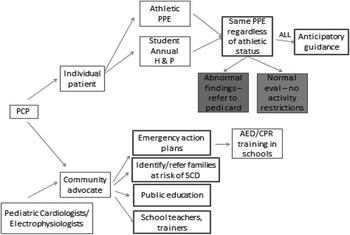
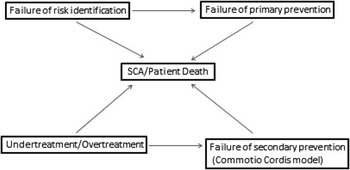
During this meeting, preparation of a primary-care manuscript was initiated with goals of addressing not only primary prevention strategies such as pre-event cardiac screening but also secondary prevention strategies. Figures 1 is a model demonstrating how the primary-care physician together with paediatric cardiologists/electrophysiologists and others involved with youth can have an impact at several levels in sudden cardiac arrest/sudden cardiac death prevention. Figure 2 demonstrates opportunities for study and improvement to prevent sudden cardiac arrest/sudden cardiac death in the young. This includes failure of secondary prevention or the Commotio Cordis Model where even children with no heart disease at all can suffer sudden cardiac arrest/sudden cardiac death. While the manuscript is being prepared, other opportunities of study will be prioritised.
In this model, both the cardiovascular subspecialist and the primary-care provider will work together as community advocates with the specific intention of increasing awareness of sudden cardiac death. Individual patients would undergo an annual evaluation that would be identical regardless of athletic status with the intent of identifying risk factors for sudden death. All patients would receive anticipatory guidance with a focus on warning signs of sudden death as well as a recommendation for AED/CPR training. AED/CPR=automatic external defibrillator/cardiopulmonary resuscitation; H & P=history and physical examination; PCP=primary-care provider; PPE=pre-participation exam; SCD=sudden cardiac death.

This diagram demonstrates the multiple avenues for systems failure that could lead to sudden cardiac arrest or sudden cardiac death. This includes the Commotio Cordis Model where even a child with no heart disease can have a sudden cardiac arrest/death if adequate resuscitation resources are not available. These avenues are also opportunities for study and advocacy for the Task Force. SCA=sudden cardiac arrest.