Antimicrobial resistance (AMR) is a major public health threat at the intersection of healthcare quality and global health security.1, 2 In the United States in 2013, AMR contributed to 23,000 deaths, with an estimated $20 billion in direct healthcare costs and $35 billion in overall societal costs.2 Misuse and overuse of antimicrobials are major causes of AMR, such as methicillin-resistant Staphylococcus aureus bacteremia (MRSA). An important opportunity exists to reduce the incidence and impact of AMR because up to 50% of all antimicrobials prescribed in US acute-care hospitals are unnecessary or inappropriate.Reference Dellit, Owens and Mcgowan3–Reference Levin, Idrees and Sprung5 Beyond resistance, incorrect antibiotic prescribing can increase adverse events (sometimes severe) and leads to ~250,000 Clostridioides difficile infections (CDIs) in hospitalized patients every year,2 with no therapeutic benefit.Reference Fridkin, Baggs and Fagan4, Reference Alshammari, Larrat, Morrill, Caffrey, Quilliam and LaPlante6
Antimicrobial stewardship programs (ASPs) can help ensure that antimicrobials are only prescribed when needed and that the right antimicrobial, dose, and duration of treatment are being prescribed.7 Although ASPs can take different approaches (eg, antibiotic time outs, prior authorization, and prospective audit and feedback), all involve stricter assessment and monitoring of antimicrobial use, sometimes restricting the use of broad-spectrum agents.7, Reference Karanika, Paudel, Grigoras, Kalbasi and Mylonakis8 A growing body of evidence has shown that ASPs can optimize antimicrobial use,Reference Morrill, Caffrey, Gaitanis and Laplante9, Reference Khdour, Hallak and Aldeyab10 reduce adverse eventsReference Morrill, Caffrey, Gaitanis and Laplante9 and resistance rates,Reference DiazGranados11 all of which improve quality of care and patient safety. Reduced antimicrobial use has not been shown to negatively affect, and may improve, patient outcomes.Reference Schuts, Hulscher and Mouton12 Most ASP literature focuses on prescribing practices or antimicrobial useReference Karanika, Paudel, Grigoras, Kalbasi and Mylonakis8, Reference Khdour, Hallak and Aldeyab10, Reference Kelly, Jones and Echevarria13 rather than resistance rates. Moreover, most studies in which the impact of ASP on infection rates was assessed were conducted in a single and/or international setting, so external generalizability was compromised.Reference Mijović, Dubravac-Tanasković, Račić, Bojanić, Stanić and Lazarević14
In 2014, the CDC launched the Core Elements for Hospital Antimicrobial Stewardship Programs (hereafter, Core Elements), specific guidelines for ASPs in acute-care hospitals and other healthcare settings7 that added to previous work of the Society for Healthcare Epidemiology of America, Infectious Disease Society of America, and The Joint Commission.7, 15 The CDC guidelines set a minimum standard for hospitals with 7 core elements for ASPs: leadership commitment, accountability, drug expertise, action, tracking, reporting, and education.7
Despite the CDC guidelines for a minimum standard ASP and its assessment in hospitals, the effect of the Core Elements on resistance rates and CDI remains unclear. Furthermore, the impact of ASPs on actual AMR rates in hospitals is uncertain or has not been explored. The objective of this study was to examine reported compliance with the Core Elements between 2014 and 2016, as well as the association between statewide adoption of the Core Elements and hospital MRSA and CDI rates in all US states. We formulated the following hypotheses: (1) that reported compliance with the Core Elements would increase between 2014 and 2016 and (2) that states with higher percentages of reported compliance to the Core Elements would have significantly lower MRSA and CDI rates.
Methods
Data sources
We merged 2014–2017 hospital-level data from the Centers for Medicare & Medicaid Services’ (CMS) Hospital Compare data, Provider of Service files, Medicare cost reports, and 2014–2016 state-level data from the CDC’s Patient Safety Atlas website. Hospital Compare compiles quality of care information from >4,000 Medicare-certified hospitals; Provider of Service files contain data on hospital characteristics and type of services provided; and Medicare cost reports include utilization and cost data in addition to facility characteristics regarding all Medicare-certified providers. The CDC’s Patient Safety Atlas website provides access to state-level data on hospital-acquired infections, antimicrobial resistance, and ASPs from acute-care hospitals nationwide, collected through the CDC National Healthcare Safety Network (NHSN) Patient Safety Component Annual Hospital Survey. The ASP data are used to assess whether facilities (reportedly) meet the criteria for each of the 7 recommended core elements.
Participants
The study population included all 50 US states plus the District of Columbia from 2014 to 2016. Medicare and Hospital Compare data were originally compiled at the hospital level and were collapsed at the state level using hospital size weights (ie, number of beds). These data included all Medicare-certified acute-care hospitals in the United States for which MRSA and CDI standardized infection ratio (SIR) data were available for 2014–2016 (ie, a large proportion of the total acute-care hospitals in the United States). Veterans’ Affairs (VA), children’s, and critical-access hospitals were excluded because of different data collection periods, different case mixes and different hospital epidemiology, and lack of reporting requirements for infection data, respectively.
Similarly, for ASP data, 4,173 to 4,764 acute-care facilities completed the NHSN survey from 2014 to 2016, respectively,16 although critical-access hospitals may be underrepresented due to reporting requirements. The total number of acute-care hospitals in the United States is 5,262,17 and the percentage of facilities that reported ASP data to NHSN was ~79.3%–90.5% during the study years, which should largely overlap with hospitals in the Medicare/Hospital Compare data set.
Measures
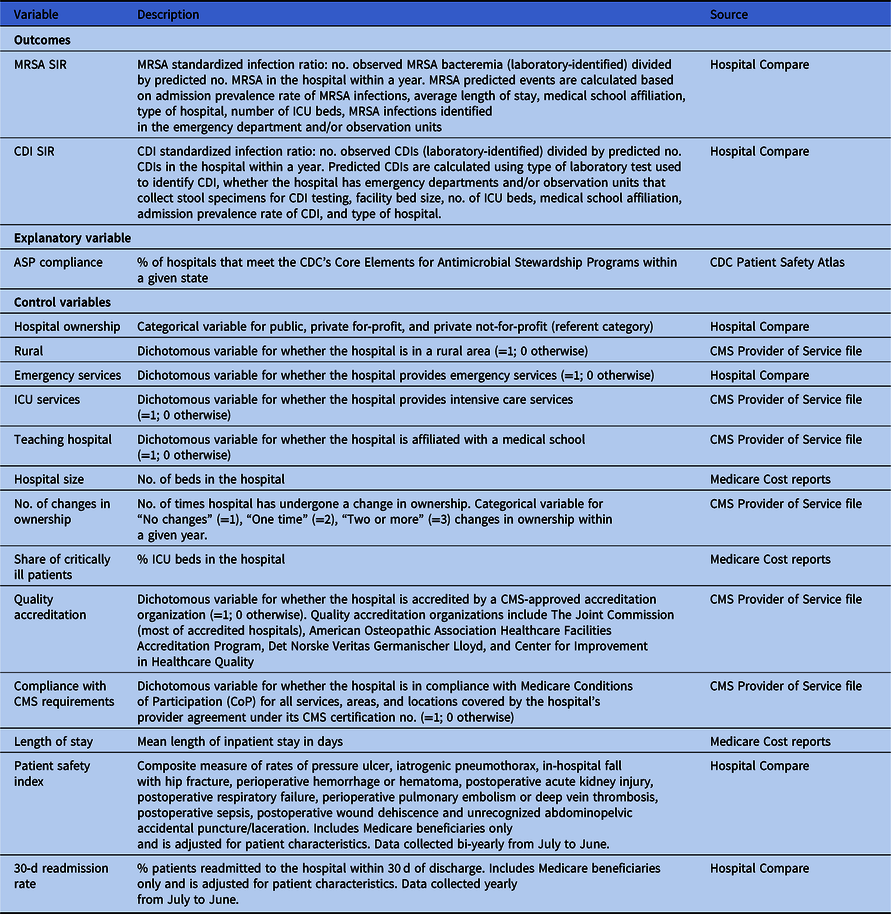
Table 1 contains operational definitions for each variable. We defined our 2 outcomes as follows: the MRSA SIR is the ratio of MRSA bacteremia laboratory-identified events to the predicted number of MRSA bacteremia events, and the CDI SIR is the ratio of CDI laboratory-identified events to the predicted number of CDI events. SIRs are calculated for each hospital by the NHSN and are made available through the Hospital Compare data system. MRSA and CDI predicted events are calculated by the NHSN based on several predictors, which are described in Table 1. Notably, MRSA and CDI SIRs are calculated only for hospitals with at least 1 predicted event.18
Data Sources and Variables, 2014–2017

Note. MRSA, methicillin-resistant Staphylococcus aureus; SIR, standardized infection ratio; CDI, Clostridioides difficile infection; ASP, antimicrobial stewardship program; CMS, Centers for Medicare & Medicaid Services; ICU, intensive care unit.
Our main regressor is the percentage of hospitals that reported complying with the Core Elements in a given state over time (2014–2016). The CDC’s Patient Safety Atlas website shows a substantial increase in the percentage of reported compliance in every state nationwide from 2014 to 2016.16 Time-variant independent variables in the models included the following: type of ownership, emergency services, intensive care unit (ICU) services, medical school affiliation, bed count, quality accreditation, number of changes in ownership, compliance with CMS requirements, % ICU beds, average length of stay, patient safety index, and 30-day readmission rate.
Analysis
First, we used descriptive statistics to measure state-level variation in the percentage of hospitals meeting the Core Elements between 2014 and 2016. Then, for each outcome, we estimated a set of different models using state fixed effects.
We chose state fixed effects because several time-invariant unmeasured confounders affect the relationship between ASP and resistance and/or CDI rates: location (state, rural, vs urban), hospital ownership, teaching status, specialty hospital, patient case mix and structural factors. Because most of these variables had not been observed, we were not able to verify whether they were truly time invariant, but we assumed that they had very little variation, if any.
We used state-level analyses due to the availability of ASP data only at the state level; thus, hospital data were aggregated at the state level and were weighted using hospital size (ie, number of beds). The analyses were also weighted by number of hospitals in each state, and we controlled for the time-variant characteristics listed in Table 1. In terms of model specification, the results of a Hausman test indicated a preference for the fixed-effects model over a random-effects model.
We also tested our model using a lagged explanatory variable (2014–2016 ASP data and 2015–2017 outcomes) to address a possible reverse causation in states that improved the ASP because they already had high rates of AMR, and an interaction between ASP and time (years) to test whether there could be differential treatment effects at each specific year. Moreover, we re-estimated the models using hospital-level data, even though ASP variation occurred only at the state level.
Results
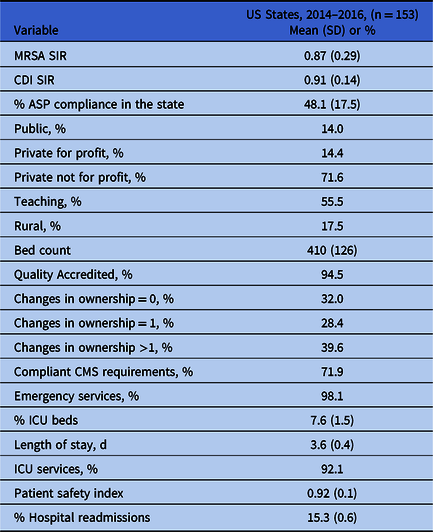
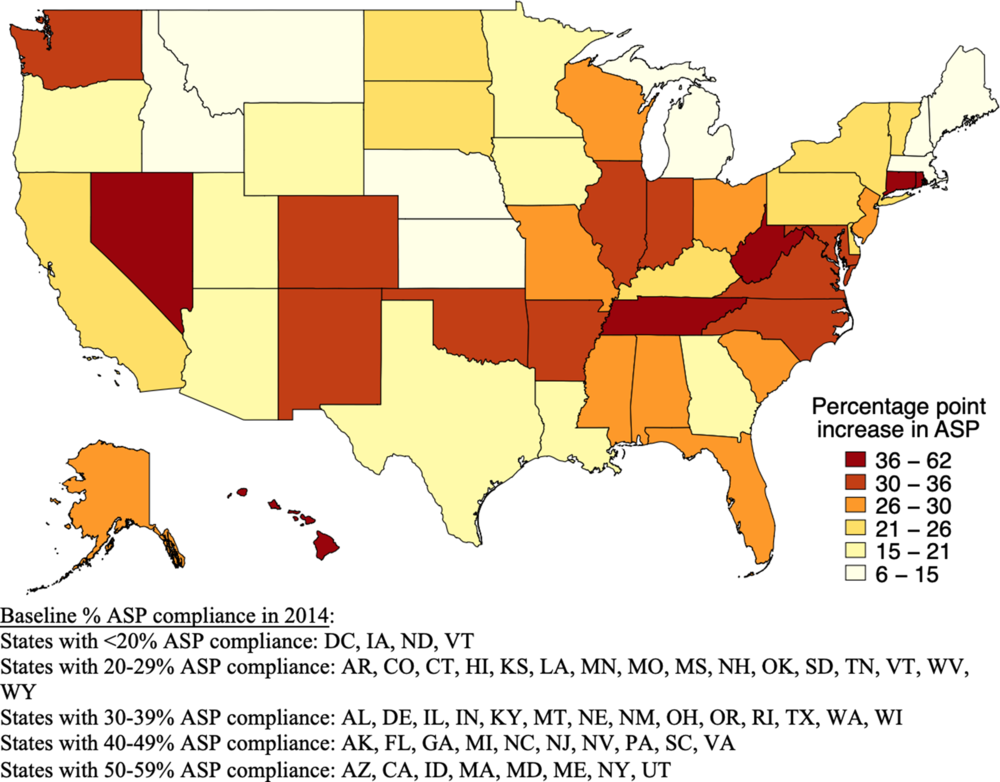
The average reported ASP compliance across states from 2014 to 2016 was 48.1% (Table 2). Increases in the percentage of hospitals that reported complying with the Core Elements guidelines between 2014 and 2016 ranged from 6% to 62% (Fig. 1). States with a smaller absolute increase usually had a higher percentage in 2014. For example, states that reported ≥50% compliance in 2014 (eg, Arizona, California, Idaho, Massachusetts, Maine, and Utah) had only 6%–26% increases in ASP compliance by 2016. Similarly, states that reported only ≤29% compliance in 2014 (eg, Connecticut, District of Columbia, Hawaii, Tennessee, and West Virginia) had the highest absolute increases in percentage of hospitals meeting the 7 core elements (36%–62%).
Descriptive Statistics for MRSA and CDI Models, 2014–2016

Note, MRSA, methicillin-resistant Staphylococcus aureus; CDI, Clostridioides difficile infection; SIR, standardized infection ratio; CMS, Centers for Medicare & Medicaid Services; ICU, intensive care unit.
Increase in antimicrobial stewardship programs (ASPs) meeting the CDC’s Core Elements for Hospital Antimicrobial Stewardship in US states, 2014–2016.

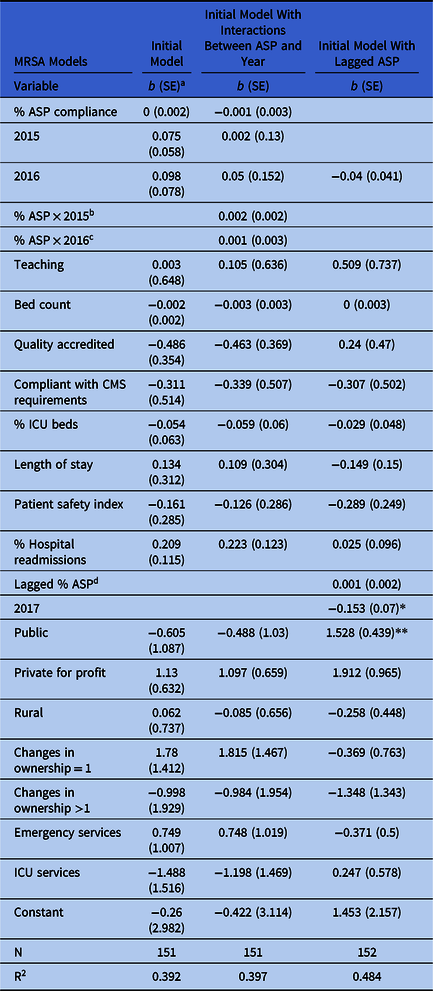
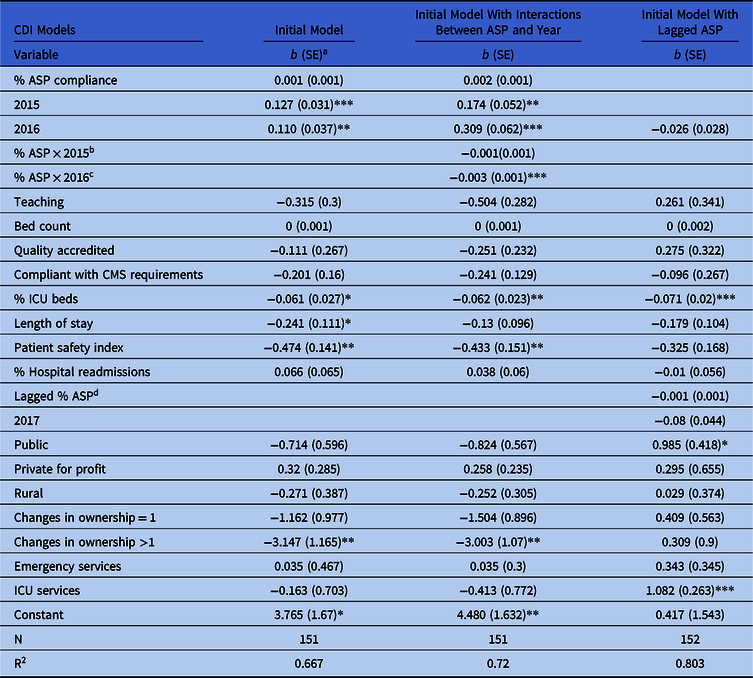
We hypothesized that states with a higher percentage of reported compliance with the Core Elements guidelines would have significantly lower MRSA and CDI rates. Our findings do not support our hypothesis for MRSA (Table 3). However, we found support for our hypothesis in the CDI model in which reported ASP compliance was interacted with year. A 1% increase in reported ASP compliance was associated with a 0.3% decrease (P < .01) in CDI in 2016 relative to 2014 (Table 4). This result suggests a differential treatment effect of increasing ASP compliance at the state level across years.
Regression-Adjusted Estimates for the Association Between % ASPs Meeting the CDC’s Core Elements of Hospital Antimicrobial Stewardship and MRSA SIRs, 2014–2017

Note. ASP, antimicrobial stewardship program; MRSA, methicillin-resistant Staphylococcus aureus; SIR, standardized infection ratio; CMS, Centers for Medicare and Medicaid Services; ICU, intensive care unit; SE, standard error.
*P < .05; **P < .01.
a b = regression coefficient, the effect of a 1-unit increase in the independent variable on MRSA SIR.
b Effect of ASP in 2015, relative to 2014.
c Effect of ASP in 2016, relative to 2014.
d Effect of ASP on MRSA in the following year.
Regression-Adjusted Estimates for the Association Between % ASPs Meeting the CDC’s Core Elements of Hospital Antimicrobial Stewardship and CDI SIRs, 2014–2017

Note. ASP, Antimicrobial Stewardship Program; CDI, Clostridioides difficile infection; SIR, standardized infection ratio; CMS, Centers for Medicare and Medicaid Services; ICU, intensive care unit; SE, standard error.
*P < .05; **P < .01; ***P < .001.
a b = regression coefficient, the effect of a 1-unit increase in the independent variable on CDI SIR.
b Effect of ASP in 2015, relative to 2014.
c Effect of ASP in 2016, relative to 2014.
d Effect of ASP on CDI in the following year
We did not find evidence of a lagged effect (or reverse causation) of reported ASP compliance in any of the models. Our results in the MRSA and CDI models were consistent in both state-level and hospital-level analyses.
Discussion
ASPs that encourage compliance with the 7 Core Elements have the potential to reduce AMR. In our study of all US states, we tested 2 hypotheses: (1) reported compliance with the Core Elements would increase between 2014 and 2016 and (2) states with a higher percentage of reported compliance with the Core Elements guidelines would have significantly lower MRSA and CDI rates. Our results show that reported compliance with the Core Elements increased nationwide and was associated with a decrease in CDIs. However, we did not find this association for MRSA infections.
Increased reported compliance with the Core Elements
As hypothesized, reported compliance with the Core Elements increased in every US state from 2014 to 2016. Nationally, the proportion of hospitals that met the 7 core components increased from 39% in 2014Reference Pollack, Santen, Weiner, Dudeck, Edwards and Srinivasan19 to 48% in 201520 and 64% in 2016.16 Not surprisingly, increases in reported compliance were greater in states with lower compliance in the initial study period. Increases may have resulted from recent national policies that encourage ASPs to be implemented in all healthcare facilities, such as the National Action Plan for combating Antibiotic Resistance,21 the ASP Guidelines by the Society for Healthcare Epidemiology of America (SHEA),Reference Barlam, Cosgrove and Abbo22 and The Joint Commission Standards for Antimicrobial Stewardship.15, 23
Despite nationwide increases in reported ASP adoption, we observed regional differences in reported compliance. States with a higher percentage of compliance were closer to the west or east coast compared to states in the center of the country.20 Studies that had access to more granular data were able to identify that larger hospitals (ie, >200 beds) and teaching hospitals were more likely to report that all 7 core elements were implemented,20, Reference Pogorzelska-Maziarz, Herzig, Larson, Furuya, Perencevich and Stone24, Reference O’Leary, Van Santen, Webb, Pollock, Edwards and Srinivasan25 which may also explain the underrepresentation of smaller facilities (eg, critical-access hospitals) in hospital-reported surveys. The core element “action” was the most commonly implemented, although that could encompass a range of different facility-specific activities. The “leadership commitment” element (eg, written support from administrators and ASP-related compensation) was the strongest predictor for a hospital meeting the 7 core elements.20, Reference O’Leary, Van Santen, Webb, Pollock, Edwards and Srinivasan25
Implementing all 7 of the core elements has been associated with a decrease in antimicrobial use up to 10% in a large healthcare system,Reference Logan, Williamson, Reinke, Jarrett, Boger and Davidson26 but an ideal level of antimicrobial use in hospitals is not known. However, the decrease in antimicrobial use can certainly improve antimicrobial-related adverse events. With national support and local implementation of stewardship activities, the judicious use of antimicrobials can be achieved, and emergence of resistance can be contained.
ASP association with decreased CDIs
As hypothesized, reported ASP compliance with the Core Elements guidelines was associated with a significant decrease in CDI SIR in 2016 relative to 2014. This significant association in 2016 may be related to the recent increase in ASP compliance; reported ASP compliance increased in every state from 2014 onward.
This finding is consistent with previous studies conducted in single hospital settings.Reference Mijović, Dubravac-Tanasković, Račić, Bojanić, Stanić and Lazarević14, Reference Talpaert, Rao, Cooper and Wade27, Reference Christensen, Barr and Martin28 The VA system also reported declining CDI rates after implementing national stewardship activities.Reference Kelly, Jones and Echevarria13 A reduction in CDI has been associated with decreased antibiotic prescribing in outpatient settings as well.Reference Dantes, Mu and Hicks29, Reference Sarma, Marshall, Cleeve, Tate, Oswald and Woolfrey30 Restrictive and persuasive (eg, audit and feedback) stewardship strategies were found to be more effective in decreasing CDI rates.Reference Mijović, Dubravac-Tanasković, Račić, Bojanić, Stanić and Lazarević14, Reference Sarma, Marshall, Cleeve, Tate, Oswald and Woolfrey30, Reference Elligsen, Walker and Pinto31
Moreover, ASPs may sometimes include disease-specific policies, such as guidelines for treatment of CDI, which recommend stopping unnecessary antimicrobials for any patient with CDI.7, Reference Cohen, Gerding and Johnson32 Better clinical response and reduced risk of recurrence follow as a resultReference Cohen, Gerding and Johnson32 and may also explain the association between ASP and reduced CDI rates in this study. In summary, our study results are consistent with evidence from single settings and other healthcare venues.
No effect on MRSA infections
Our hypothesis was not supported for MRSA infections. Our study did not find evidence of an association between reported ASP and MRSA. There are several possible explanations for this difference. First, ASP efforts may not equally impact hospital-acquired pathogens. MRSA rates, for example, are also driven by person-to-person transmission; therefore, screening and infection control efforts (eg, hand hygiene) may be confounding the results.
Second, resistant strains may also take longer and may require higher levels of ASP compliance or specific restriction policies to impact their infection rates in hospitals. Large, nationwide studies reporting an effect of ASP on rates of MRSA or other resistant bacteria were 7–16 years long and were conducted outside the United States.Reference Boel, Andreasen and Jarløv33, Reference Lawes, Lopez-Lozano and Nebot34 A systematic literature review found large variance in resistant microbe outcomes when assessing the impact of interventions to improve antibiotic prescribing.Reference Davey, Marwick and Scott35 Mixed results are likely explained by the prevalence density of MRSA and the intensity of the intervention in different studies.Reference Lawes, Lopez-Lozano and Nebot34
As an example of varying ASP interventions, 2 international studies combined antimicrobial stewardship with hand hygiene interventions and detected a decline in several strains of MRSA.Reference Lawes, López-Lozano and Nebot36, Reference Kim, Kim and Song37 Our general measure for ASP did not capture that level of granularity or the those infection control efforts included in stewardship activities; thus, we were unable to determine or analyze the effective components of those programs.
This study has several limitations. First, we were able to obtain only 3 years of state-level ASP data, which may have decreased our statistical power in the state-level analyses. Second, we only had access to the percentage of hospitals that reported compliance with all 7 Core Elements, rather than the distribution of each specific element hospitals adopted and specific stewardship activities at the hospital level. Therefore, we could not assess the association of specific core elements with CDI and MRSA rates. Moreover, because we lacked data on stewardship strategies, we had to use a more general measure for ASP, which may not have had enough granularity to reveal its relationship with resistant infections. Additionally, no study has assessed the validity of the NHSN’s ASP survey instrument.
Finally, we were not be able to estimate causal relationships because unmeasured residual confounders may have affected the analyses. For example, patient safety and infection control programs in hospitals could have some overlap with the Core Elements guidelines and could impact resistant infections (especially MRSA) and CDI rates as well, although we somewhat controlled for this factor by using fixed-effects estimation. Furthermore, a small share of the hospitals reporting ASP data to NHSN may not be the same across the years included in this study.
Policy implications
In this study, we have demonstrated a novel approach to estimating the effect of hospital ASP on infection outcomes nationwide and, therefore, important evidence to the incipient body of literature in the field. Perhaps most importantly, our findings suggest that increasing documentation of the 7 core elements may be associated with decreases in CDI SIR in acute-care hospitals. However, even though reported compliance with the Core Elements guidelines has increased in all states nationwide, we did not find evidence of an association with MRSA SIR.
Policy makers can use insights from this study to advocate for comprehensive hospital ASPs. Payers may also use evidence from this study to incorporate ASP-related financial incentives in payment models. In the healthcare setting, administrators can use our results to leverage momentum for the local implementation of all components of hospital ASPs and education of healthcare personnel. Providers may use it for continued education and to increase awareness of the importance of complying with hospital policies to promote the judicious use of antibiotics.
Research on hospital ASPs would greatly benefit from more granular data on the components of ASP and types of stewardship activities, especially if they become available at the hospital level. Researchers should seek mechanisms to make possible or facilitate obtaining such data from governmental health agencies. Because ASP data are available from 2014 onward, future research will also benefit from longer follow-up periods and, possibly, from using other relevant microorganisms in addition to those in this study.
Acknowledgments
We would like to acknowledge Jason Rotter for his assistance with data management in this research article.
Financial support
No financial support was provided relevant to this article.
Conflicts of interest
All authors report no conflicts of interest relevant to this article.