If we have a look at visual culture today, for the longest time it felt like it was barely evolving. There was always a sense of reluctance or lack of action when it came to representation, diversity, and inclusion; whether that is in the media industries, academia, or both. Gatekeeping is, and always has been, the reason we've created certain barriers to entry. Those barriers were often in the shape of lack of recruitment, and a lack of diversity in references and within student bodies. This would thereby create unequal hierarchies. When something is socially and culturally devalued within the group one belongs to, the most natural reaction amongst that group is to differentiate oneself from the devalued object or subject. Under which agreement do we have the right to claim what is good graphic design and what isn't, for example, or what reference should be included in a curriculum and which ones shouldn't? Who gets to be a tastemaker in this industry and who doesn't? Should there even be such a thing as a tastemaker? Only recently, it seems, that some of these hindrances are a bit more recognized and steps are being made to move forward. This change is not just within visual culture but also within media outlets from Instagram to Pinterest boards and YouTube channels; visual culture has started to get quite a bit of backlash from different groups that feel misrepresented and/or excluded. Words such as decolonization, queering, inclusivity, and representation are popping up everywhere and are starting an evolution that questions history and the ways in which we used to do things. This emergence, we think, is a great step forward.
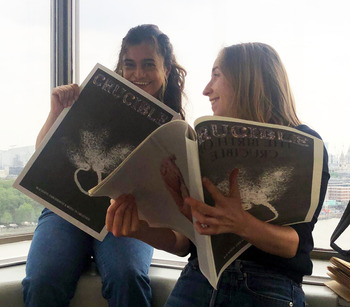
Co-founders of Sold Out Publishing and Co-authors of Not a Reference Yet from left to right: Bakhtawer Haider, Betty Brunfaut. Photo by the authors.

We — Bakhtawer Haider and Betty Brunfaut — met in 2018 at the Royal College of Art where we started the Master's program in Visual Communication. At the end of our first year, after a full year of collaboration on several projects, we started to discuss opening a graphic design studio after graduation and to take our second year as a testing period and space for our new studio practice. In our first year, we had already started exploring topics such as cultural appropriation, a topic that resonated with us given how much of a common occurrence it is in our industry. We found that the line can often be very thin between cultural appropriation and appreciation. Some designers see the concept of cultural appropriation as something that only limits their creative expression. However, if you aren't crediting or referencing your sources and are profiting/capitalizing on it, in our opinion, this clearly counts as cultural appropriation. We found that referencing in the correct manner was a crucial point here. Even though there is a lot of traction around the blurry line between cultural appropriation and appreciation (as it is hard to unilaterally agree on what counts as either one or the other), it is essential that as graphic designers and educators we reference artists and designers from the West as well as the non-West in the correct way. It is the lack of correct and complete referencing that results in some references being deemed ‘right’ and others not, and some references taking precedence over others.
During the second year, we continued discussions around the lack of awareness of other cultures — the misrepresentation, but also the continued gap of certain references within the curriculum. This mixed with an unnerving sense of a clear hierarchy of how references were cited. Not only was this our motivation to investigate the mechanisms around referencing in our curriculum, but we had also reached a point where the same names would be dropped and references brought up over and over again. Marshall McLuhan being one of them. At this point, when we started expanding our references within graphic design, we faced a nearly blank page. We couldn't find the type of work, artists, designers, and representation we were looking for. So, we decided to create Sold Out Publishing.
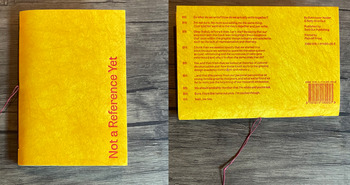
Not a Reference Yet, Sold Out Publishing, 2020. Cover and back cover. Photo by the authors.

Sold Out Publishing aims to publish under-represented references within graphic design and visual culture. The starting point with Sold Out was to not just abstractly address the act of referencing and the problems with referencing in our education system, but to actually attempt to tackle some of the topics such as decolonizing the curriculum, unlearning tastes, and diversifying references. Thanks to the help of librarians and tutors, we managed to unpack some of the thoughts that we developed further in our book Not a Reference Yest, which presents the initial research and background of the creation of Sold Out Publishing. We specifically looked at the value system of referencing, and how often the same references were used over and over again. One aspect that particularly interested us was how an academic (often Western) reference is often prioritized over personal narrative, or first-hand experience. Often, an overused academic reference has the ability to take precedence over the personal experience. The lived experience seems to have to fight to be deemed relevant. This devaluation of the personal experience as a basis for research and creation comes directly from the under-representation of those same experiences. Often the argument behind this depreciation is that the personal experience lacks theory to back it up. Academia has its own gatekeepers to keep certain things in and others out – such as personal narratives. When the personal narrative is used as a source for a research or design project, it is often questioned and labelled in a negative way as identity politics.
There is also this constant feedback loop – where the good intentions of librarians or tutors of colour in trying to diversify the reading list would fail against the curriculum that hadn't been properly diversified or decolonized. Discussions with librarians revealed that the publishing industry itself is very white male dominated, and so are the references that they end up publishing. Even with the best intentions of finding the right references one wouldn't always be successful simply because the right references didn't yet exist. We came across a very enlightening project by Leonardo Vasconcelos, a Brazilian designer based in London, that only further reinforced our gut feeling. Leonardo does an excellent job of visualizing and contextualizing the missing gaps in references and representation in the publishing industry. His project, Judging by the Cover, is a data visualization that highlights race bias in design book publishing. He looked at various design book publishers, and the percentage of design books published with an author that is either black, another racialized ethnicity or white. It's really astonishing to see how big the gap is between the groups and how race influences the material published. He makes a very poignant and moving point by stating: ‘When you are Black and come from a working-class family, the struggle to not fit turns into an uninvited company in diverse moments of your life. I'm using my knowledge and skills to continue the work made by other Black people before me.’Footnote 2 With this context in mind, the intention of Sold Out Publishing boiled down to: if we couldn't see the references we wanted to see and we didn't see voices being represented we would just start our own publishing house. One major objective was to question and break the hierarchies between academics and non-academics, theoretical and lived-experiences, core (western) and periphery (‘developing countries’) knowledge, male and female and non-binary identities. With Sold Out Publishing, we are attempting to create a democratic system of authors, participants and people who are interested in what we do — to collectively build an array of references that questions what a medium of a reference can be, who it can be represented by, and how to dissect the politics of referencing within academia and much more.
Titles published by Sold Out Publishing (left to right): Open Eye Open Heart by Margherita Sabbioneda, Grey Stuff by Clem Rousset, The Dot - Kalakarm Curriculum by Siddhi Gupta, Broken English by Ravista Mehra, The Coloring Book by Morgan Markey. Photo by the authors.

We organized a Kickstarter campaign that raised £6000 and enabled us to publish our first six books. Through the different publications and objects, we investigate expanding the meaning of graphic design – but also the canons, tastes and aesthetics within the practice. Our ambition of expanding graphic design and its references is enhanced through the inclusion of juxtapositions and intersections such as these. We need to start expanding the roster of who a graphic designer is, what graphic design can be, and who should also take part in this conversation. As bell hooks said, ‘Those of us who have been militant anti-racist advocates continue to insist that there will not be an end to white supremacy and racism until there is a fundamental shift in all spheres of culture, especially in the world of image making’.Footnote 3
Within Sold Out we have shown what expanding tastes, exploring postcolonial identities, and expanding references would look like through different published titles. For example, Open Eyes Open Heart is a design exercise book that was created to push graphic designers to question their aesthetics and their own embedded value systems. Another toolkit or exercise book developed by one of our authors, The Kalakarm Curriculum, is more on a pedagogical level and looks at how design and communication play roles in educating about art and design. Graphic design is also about communication and narration, so we produced publications such as Broken English which looks at the personal stories that are often overlooked in the postcolonial experience/identities. As mentioned previously, we decided to write our own book Not a Reference Yet and to create links between visual culture and visual communication. We see Not a Reference Yet as an in-depth reference list in which we keep adding to our own stories and expanding on personal narratives. We wanted to make it as accessible as possible and even though we're not academics ourselves we really wanted to highlight how embedded colonialism is in our curriculum and the graphic design industry. Within the book itself, we questioned how we cite the references in it. For example, we decided to put footnotes as top notes and the bibliography in front of the book instead of at the back to highlight all the people who shared their thoughts, research, and experiences before us and who served as our inspiration. We also created a clear trajectory to how we found each reference. Making a comment on how we found references is a process in itself, and they are not always found where you would expect to find them. Unpacking not only how the referencing system affects academia, but even writing and transferring information within a written piece turned out to be a great learning experience.
One chapter of the book that we want to look closely at is a case study. The chapter is called ‘Cultural Decolonization’, and it's a term coined by Abdellatif Laâbi: a Moroccan artist who created the Magazine Souffles (1966-1972). He explains how at first decolonization was geographical and political; the decolonization of the land and power and how they later started to investigate cultural decolonization in Morocco. When many African countries finally achieved their independence from their colonizers, the generation that had fought for independence focused more on political and economic emancipation and didn't consider all the implications of colonization and the various levels on which it was affecting the rebuilding of their countries. One of the first things Laâbi started to question was what happened culturally. What was the colonial enterprise within the framework of culture? What was the impact of colonial politics on the sociology of Moroccans? He explains that it was only the subsequent generation that later started to ask these questions: ‘What happened culturally? What was the colonial enterprise in the framework of culture? What was the impact of colonial politics on the being, on the psychology of Moroccans, on their identity, on the relationship they have with their past, present, and future?’Footnote 4 That was the original intention of his publication; and along the way he started to face different challenges, for example, language. The publication is in French and Arabic, and Laâbi mentions that French was the language of the colonizer and though using it may seem like a paradox, it, in fact, isn't. French was a language that was imposed on them, a language they never chose, but at the same time they made it their own. All the ‘in-betweens’ that started emerging posed something truly intriguing and interesting. Along similar lines of thought, we'd like to mention the book by Ravista Mehra: Broken English. She asked different individuals, from vastly different perspectives, to write their personal experiences in the postcolonial world. Mehra asked them to write in their native language and then translated the texts into English, for every English speaker to be able to read it. The interesting twist is that she didn't touch or edit the text in her translation, she left them as they were written because she didn't want to correct the mistakes, or proofread it, or meddle with it in any way. We think that is a very compelling statement to make, in and of itself.
Another challenge the magazine Souffles faced was the intersectionality of identities. Once you aim to decolonize a culture (in the case of Moroccans you have Muslims, Jews, Saharans, Mediterranean, etc.), you must acknowledge certain issues. Looking at the multiplicity of these identities was one of the challenges that Souffles was first to grapple with. How do you reject the universal canon, and then once you have rejected the canon (though the canon is part of your identity), how do you localize that? Furthermore, how do you contextualize your own knowledge to yourself and to your environment and your surroundings and how, from that point onwards, do you create fluid categories, rejecting the boxes that have been made for you by the colonial gaze? How do you create these fluid categories in library systems, curriculums, and classrooms? How do you make it relevant to all these identities? Even though we have been looking at it from a visual/graphic design perspective, there are many other areas such as library languages and systems. We ask ourselves: how do libraries stop using the Dewey Decimal System and instead use a local and contextualized system? As a potential response to this, a Royal College of Art librarian mentioned the system of INIVA, a sort of tagging system, where people can tag their own books with different labels and categories, giving the power to the readers. In opposition to these questions arises the question of how to ensure a diverse array of perspectives to include without categorizing them?
Lastly, Souffle also found the fact that popular Moroccan culture and art was labelled by the colonizer as ‘tribal’ or ‘craft’. This re-emphasizes the point of why certain groups dictate what graphic design is and use categories such as ‘craft’ or ‘print’ or (too) ‘commercial’. These are all inherent parts of the same graphic design history, so why is there a need to push them away instead of bringing them in? One of our Authors, Siddhi Gupta, wrote her dissertation on this very topic: ‘It is interesting how over time through pre and post colonization, folk communities are still considered “tribal” around the world. They are not only “other-ed” from what is considered conventional theory but also within the larger community they belong to i.e., “their country”.’Footnote 5 So, it's quite interesting what are considered valid references and what that means. It is also worth questioning why we don't include alternative formats of references and resources in libraries such as zines, sound, magazines, publications, and/or artefacts in library collections?
This was the chain of thoughts brought up by the ‘Cultural Decolonization’ chapter in Not a Reference Yet. All these decolonial discourses are interlinked in many ways and although a lot of the questions are rather open-ended, they supply a framework that we believe universities, tutors, and practitioners should start including in their pedagogical framework and within their teaching models. When providing a reference, context holds a much stronger and valuable meaning and a reference, we believe, should no longer be about name dropping or supposed knowledge sharing. It should be a lot more intentional and relevant.