Introduction
Bottlenose dolphins Tursiops truncatus (Montagu, 1821) were once common in the North Sea, but during the last century numbers have declined (Evans, Reference Evans1980) and they are now rarely observed here (Reid et al., Reference Reid, Evans and Northridge2006). The exception is a small population of ~195 animals on the east coast of Scotland (Wilson et al., Reference Wilson, Thompson and Hammond1997; Cheney et al., Reference Cheney, Thompson, Ingram, Hammond, Stevick, Durban, Culloch, Elwen, Mandleberg, Janik, Quick, Islas-Villanueva, Robinson, Costa, Eisfeld, Walters, Philips, Weir, Evans, Anderwald, Reid, Reid and Wilson2013). Many historical reports of free-ranging animals, stranded individuals and catches show that bottlenose dolphins also used to inhabit Dutch waters (van Bree, Reference van Bree1977; Kompanje, Reference Kompanje2001, Reference Kompanje2005; Camphuysen & Peet, Reference Camphuysen and Peet2006). In the first half of the 20th century, groups of bottlenose dolphins were observed yearly in spring in the Marsdiep, a tidal inlet connecting the North Sea and the Dutch Wadden Sea, between Den Helder and the island of Texel. Here they foraged on herring migrating to the Zuiderzee to spawn. After the completion of the dam ‘Afsluitdijk’ in 1932, the Zuiderzee was closed off from the Wadden Sea and the local herring stock collapsed, with the dolphins disappearing soon after. Since 1965 the sightings of dolphins have also decreased in other parts of the Netherlands and bottlenose dolphins are now considered rare visitors (ter Pelkwijk, Reference ter Pelkwijk1937; Verwey, Reference Verwey1975; van Bree, Reference van Bree1977; Verwey & Wolff, Reference Verwey, Wolff, Reijnders and Wolff1981; Kompanje, Reference Kompanje2001, Reference Kompanje2005; Camphuysen & Peet, Reference Camphuysen and Peet2006). Most reports since then have been of solitary individuals (Addink & Smeenk, Reference Addink and Smeenk1990; Addink, Reference Addink1991; van der Ham et al., Reference van der Ham, Platteeuw and Camphuysen1992; Camphuysen & Peet, Reference Camphuysen and Peet2006). Most notably is a male identified as ‘Dony’ (also occasionally named ‘Randy’), that stayed in the Netherlands for multiple weeks in November/December 2002. This individual yielded the first photo-identification match of a ‘foreign’ bottlenose dolphin in the Netherlands (Camphuysen & Peet, Reference Camphuysen and Peet2006). He was first observed in Ireland (April 2001), and later in England and Belgium, before entering Dutch waters. Currently (April 2021) he is residing off Brittany, France (Nunny & Simmonds, Reference Nunny and Simmonds2019; Facebook page Dony, 2021). It is suggested that these solitary individuals came as a direct consequence of the decimation of bottlenose dolphins in European waters (Müller & Bossley, Reference Müller and Bossley2002), as a dispersing dolphin might not be able to find neighbouring populations and might socialize with people instead (Nunny & Simmonds, Reference Nunny and Simmonds2019).
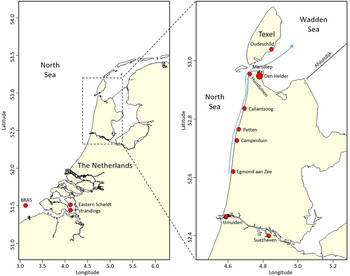
In contrast, a group of 50–100 bottlenose dolphins was observed in the morning of 12 August 2004, swimming off Huisduinen (Figure 1), along the north-western coastline of the Dutch mainland, until they entered the Marsdiep (Supplementary Figure S1), all the way to the Afsluitdijk (Leopold, Reference Leopold2004; Zeezoogdieren.org, 2004; Camphuysen & Peet, Reference Camphuysen and Peet2006). The animals returned to the North Sea in several smaller groups in the afternoon and evening and disappeared from view. One month later, on 9 September, a group of ~60 animals was seen in the same area (Supplementary Figure S1). Again, the dolphins were first observed in the morning, at 9:30 a.m. further south, off the Dutch mainland coast (Camperduin), by an experienced seawatcher (pers. comm. Nick van der Ham). The animals moved north and were picked up by other seawatchers at Callantsoog and Huisduinen before they entered the Marsdiep at approximately 12:30 p.m. Here they swam eastwards up to the Den Helder-Texel ferry track line, where they turned north and returned to the North Sea, following the coastline of Texel (Camphuysen & Peet, Reference Camphuysen and Peet2006; van Bemmelen, Reference van Bemmelen2009). Unfortunately, none of the photographs taken during these two occasions were suitable for photo-identification.
Maps of the Netherlands showing the locations mentioned in the main text. Left panel: The locations of the two stranded bottlenose dolphins (2007 top and 2013 bottom) in the Eastern Scheldt and the sightings from fishing vessel BRA5 (2014). Right panel: Map of the province North-Holland. The arrow depicts the estimated route of the bottlenose dolphins, sighted on 19 July 2019.

A similarly large group was seen offshore, on 3 October 2014 near the Dutch/Belgium border (51°30′00″N 03°07′48″E, Figure 1), from the fishing vessel BRA5 (Natuurpunt, 2014). Animals accompanying the ship were videoed, but the image quality did not allow matching.
In this study we report on new sightings and photo-identification matches of bottlenose dolphins in Dutch waters (i.e. the Marsdiep and Amsterdam). Additionally, we present images of two bottlenose dolphins that were stranded in the Netherlands that could not be matched with previously known individuals.
Materials and methods
Photographs and videos of bottlenose dolphins in Dutch waters were opportunistically collected, both of stranded (dead) and free ranging individuals. We compared these images manually (i.e. by eye) with photo-identification catalogues and pictures taken by the public, available on the internet, to examine the origins of these Dutch sightings.
Results
Bottlenose dolphins in the Marsdiep
On 19 July 2019, at 5:30 a.m., a group of bottlenose dolphins was spotted off Egmond aan Zee (Dutch mainland coast) (Figure 1) (pers. comm. Jasper Rautenberg). The group travelled north and was observed off Camperduin (pers. comm. Bert de Haan and Nick van der Ham) and then photographed off Petten (pers.comm. Nils van Duivendijk) later that morning. At 10:32 a.m. the group swam past Huisduinen (pers. obs. JH), 30 km north of the first sighting location. At this point two groups were observed. Within each group, the animals were swimming closely together and both adults and juveniles were present. The first group swam northwards parallel to shore at 500–1000 m and consisted of ~10 individuals. The second group was swimming in the same direction, but closer to shore (50–100 m) and consisted of nine individuals. Whenever a boat passed close by, the animals dived longer and appeared to increase their swimming speed. Occasionally the dolphins were lobtailing. The first group continued to move northwards towards Texel, crossing the Marsdiep, and soon disappeared from sight, while the second group followed the coastline eastwards, deeper into the Marsdiep towards the Wadden Sea, where the animals were continuously seen until noon by multiple observers (pers. obs. ML). The last sighting was made from the vessel TX 10 at 15:27 p.m. in the Wadden Sea east of Texel, close to Oudeschild (Figure 1).
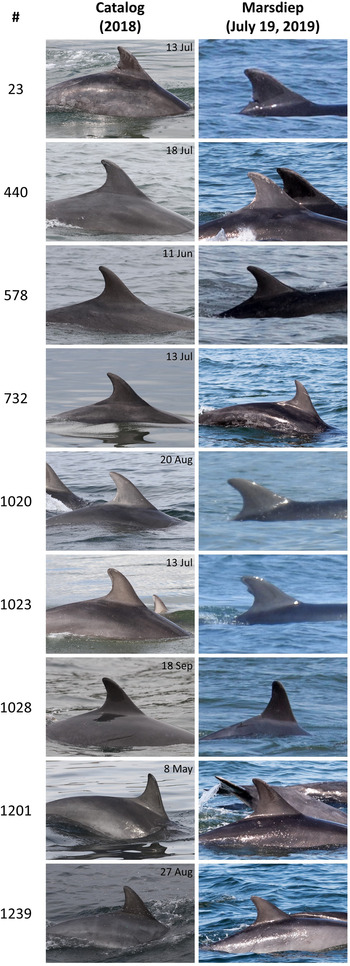
The first group was too far from shore to collect any images that could be used for photo-identification. The second group, however, swam closer to shore and photos (Figure 2, Supplementary Figure S2) and video recordings (Supplementary Video S3) were made, both from shore and from seal watching boat ‘Het Sop’. These images were compared with the East Coast Scotland Bottlenose Dolphin Photo-Identification Catalogue (Cheney et al., Reference Cheney, Corkrey, Durban, Grellier, Hammond, Islas-Villanueva, Janik, Lusseau, Parsons, Quick, Wilson and Thompson2014), curated by the University of Aberdeen and the University of St Andrews. Eight individuals were positively identified, while one other individual was highly likely a match to the same population (Figure 2, Supplementary Figure S2, Table 1). Matches were made using multiple photographs from the Netherlands (see Supplementary information) to individuals observed almost annually by the University of Aberdeen since at least 2006. The adult dolphins were matched using nicks (three dolphins) and/or tooth rakes and skin lesions (six dolphins), and the two juveniles were matched on observed association with their mothers and dorsal fin shape (Table 1). The group consisted of an adult and a juvenile male, six adult females and one juvenile of unknown sex (Table 1). None of these dolphins was observed by the University of Aberdeen in the Moray Firth Special Area of Conservation during their approximately weekly photo-identification surveys between May and September 2019, although all the adults had previously been photographed in this area every year since at least 2009.
Photo identification of the Dutch bottlenose dolphins, sighted on 19 July 2019. Pictures on the left are from the East Coast Scotland Bottlenose Dolphin Photo-ID Catalogue, pictures on the right are taken in the Marsdiep (by Tobias Brügging, JH and ML). High resolution versions and additional photos and video that were used to identify individuals can be found in Supplementary Figure S2 and Supplementary Video S3.

Overview of bottlenose dolphins photographed in the Marsdiep (the Netherlands) that are matched with the East Coast Scotland Bottlenose Dolphin Photo-ID Catalogue

In June 2020, two of these individuals (#1028 and #440) were observed and photographed in the Moray Firth, providing proof of the animals' return to their normal range after their excursion across the North Sea. However, three other individuals (#23, #578 and #732) were photographed in autumn 2020 on the west coast of Denmark (pers. comm. Carl Kinze). Whether this means that these three individuals stayed in the eastern part of North Sea, or returned to Scotland before traveling to Denmark remains unclear. However, in January 2020 one of these dolphins (#23) was sighted in the Moray Firth by a regular seawatcher familiar with this individual (pers. comm. Alan Airey). Unfortunately, this animal was not photographed, and the identification could not be confirmed.
Solitary bottlenose dolphin in Amsterdam
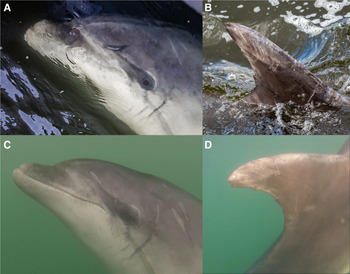
A solitary bottlenose dolphin was observed on 2 May 2020, swimming with the sailing vessel ‘Tres Hombres’. The crew first observed the dolphin off France 3 days earlier. The animal followed the ship to the Netherlands, into the Noordzeekanaal (North Sea Canal), passing the sluices in IJmuiden (Figure 1), up to the Suezhaven in Amsterdam where the ship docked. The dolphin appeared to be healthy, and was observed defecating. The dolphin stayed with the ship, and detailed photographs could be made. Comparison of the dorsal fin and facial features (Genov et al., Reference Genov, Centrih, Wright and Wu2018) with images of known individuals from the French coast showed that this individual is known as ‘Zafar’ (Figure 3, Supplementary Figure S2), a male solitary-sociable dolphin that shows atypical behaviour in seeking out human company (Nunny & Simmonds, Reference Nunny and Simmonds2019). This individual might have been observed as early as 2002, but the first confirmed sighting dates back to 2017, when he was seen off Lomener, Brittany, France (Zafar le dauphin blogspot, 2018). Since then, he was repeatedly observed off Brittany, mostly off Brest, until mid-February 2020. On 3 May the dolphin was escorted back through the sluices, after which he resided in the Seaport of IJmuiden for two days. Here he interacted with various small boats, buoys and people, but was also observed foraging. The last confirmed sighting was from a fishing vessel off Callantsoog on 5 May, which he followed for multiple hours (Observation.org, 2020). Unfortunately, the dolphin was found dead with its tail amputated on 12 May, probably after a ship strike (IJsseldijk et al., Reference IJsseldijk, van Schalkwijk, van den Berg, ten Doeschate, Everaarts, Keijl, Kuijpers, Bravo Rebolledo, Veraa, Kik and Leopold2020).
Photo identification of the Amsterdam bottlenose dolphin. The top images (A and B) were taken in Amsterdam (2 May 2020, by JH), the bottom images (C and D) were taken in France (Facebook page Zafar, 2019).

Recent strandings
Bottlenose dolphin strandings in the Netherlands over the last two decades were examined to look for other potential matches with the east coast of Scotland. An extensive overview of strandings and catches of bottlenose dolphins in the North Sea between 1534 and 2000 can be found in Kompanje (Reference Kompanje2001, Reference Kompanje2005), but these do not show photographs of recent cases that might be matched with dolphins from other regions. Since 2000, 10 new strandings have been reported (Table 2). These records mostly concerned single bones, but there were two individuals found dead and photographed in the Eastern Scheldt, both of which were first observed alive in the same area.
Summary of stranded bottlenose dolphins in the Netherlands since 2000 (Walvisstrandingen, 2020)

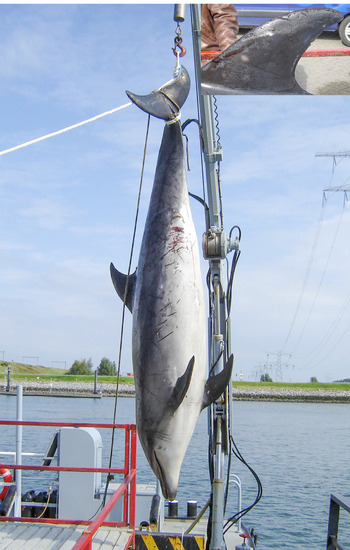
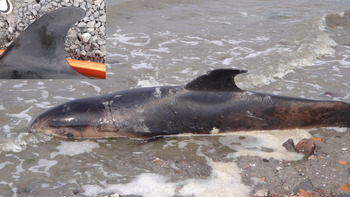
The first of these two dolphins was a female (262 cm, 221 kg), found on 12 September 2007 (Figure 4), floating in the Eastern Scheldt, between buoys LG10 and LG12 (Figure 1). This animal had been observed alive days before stranding in this semi-enclosed tidal bay. A necropsy, performed by Dr Thierry Jauniaux, indicated the cause of death was an infectious disease, specifically lung oedema associated with pyaemia/septicaemia. Stomach content analysis found remains of (amongst others) 12 Atlantic cod Gadus morhua, six saithes Pollachius virens and two black gobies Gobius niger, a locally abundant goby species, indicating that the animal had been feeding locally, until shortly before her death.
Bottlenose dolphin, retrieved from the Eastern Scheldt, south-west Netherlands, 12 September 2007. Photo by Alfons Wijdeveld, provided by EHBZ Zuidwest (Walvisstrandingen, 2020).

A second female (266 cm, 196.5 kg) was found dead in the Eastern Scheldt near Krabbendijke (Figure 1) on 27 June 2013 (Figure 5), after she had been observed alive in the area since 18 June 2013. The stranded animal had died very recently (the body was still warm) and was necropsied the same day at Utrecht University. The stomach was empty, except for some tiny fish eye lenses and jaws of marine worms, both probably from small secondary prey, suggesting this dolphin had not eaten recently. Parasitic nematodes Anisakis simplex found in the fore stomach were still alive. All these findings suggest the animal live stranded following starvation and subsequently died (van Beurden et al., Reference van Beurden, IJsseldijk, Cremers, Gröne, Verheije and Begeman2015).
Bottlenose dolphin stranded near Krabbendijke, Eastern Scheldt, south-west Netherlands, 27 June 2013. Photos by Liliane Solé (Walvisstrandingen, 2020).

Neither of these dolphins from the Eastern Scheldt could be matched to the NE Scotland population, nor with solitary individuals documented online.
Discussion
The photo-identification matches presented here show that bottlenose dolphins in the Netherlands originate from different locations. The Marsdiep group of 2019 comprised the first photo-identification match of bottlenose dolphins in the Netherlands with the NE Scotland population. Furthermore, this sighting provided the first matches of bottlenose dolphins from the east coast of Scotland population outside the UK and Ireland. The sightings of two individuals (#1028 and #440) from this group in 2020 back in the Moray Firth show that these dolphins made a round trip. Individual #23 may have returned to the Moray Firth before he was re-sighted in Danish waters, although without photographs or video footage this could not be confirmed. It is unknown whether individuals #578 and #732 also returned to the Moray Firth or stayed in eastern parts of the North Sea, before they were re-sighted with #23 in Danish waters. The fate of the other identified individuals is not presently known. Unfortunately, there is no high-resolution imagery available of the bottlenose dolphins sighted in 2004 in the Marsdiep, so their origin remains unknown.
In contrast to the group of dolphins photographed in the Marsdiep in 2019, two solitary bottlenose dolphins may have entered the North Sea from the south. The Amsterdam dolphin of 2020 (‘Zafar’) was matched with previous sightings off Brittany, which is close to a nearby population residing off Normandy, France, consisting of ~420 individuals (Louis et al., Reference Louis, Gally, Barbraud, Béesau, Tixier, Simon-Bouhet, Le Rest and Guinet2015). The behaviour of ‘Zafar’ allowed for confirmation that this dolphin entered the North Sea from the south via the English Channel, as he was seen by the crew of the ‘Tres Hombres’ for three consecutive days as they sailed through the Channel. The dolphin that resided in the south-west of the Netherlands in 2002 (‘Dony’) was first observed in Ireland (Camphuysen & Peet, Reference Camphuysen and Peet2006), close to a genetically distinct population residing in the Shannon Estuary (Mirimin et al., Reference Mirimin, Miller, Dillane, Berrow, Ingram, Cross and Rogan2011). It is likely that ‘Dony’ entered the North Sea via the English Channel as well. The two other solitary dolphins, observed and later found dead in the south-west of the Netherlands in 2007 and 2013, did not match with any individuals from the east coast of Scotland population. Comparisons were also made with pictures of solitary individuals and groups sighted along the Belgium coast (Haelters & Kerckhof, Reference Haelters and Kerckhof2010; Haelters et al., Reference Haelters, Kerckhof, Moreau, Rumes, Potin, Jauniaux and Vercayie2018), but no match could be established.
Based on the genetic population structure, the North-East Atlantic coastal bottlenose dolphin ecotype can be divided into two populations, a ‘Coastal South’ (comprising the English Channel, Arcachon Estuary and South Galicia resident groups) and a ‘Coastal North’ population (comprising the UK and Ireland resident or mobile coastal groups) (Louis et al., Reference Louis, Viricel, Lucas, Peltier, Alfonsi, Berrow, Brownlow, Covelo, Dabin, Deaville, de Stephanis, Gally, Gauffier, Penrose, Silva, Guinet and Simon-Bouhet2014). It is currently unclear to which populations ‘Zafar’, ‘Dony’ and the two stranded individuals belong, but this can potentially be resolved by future genetic analysis.
The results presented here could only be collected due to the (opportunistic) collaboration between land-based ‘seawatchers’, observers at sea and marine scientists, augmented by public outreach in (social) media. This is indicative of the importance of long-term research and photo-identification catalogues such as the East Coast Scotland Bottlenose Dolphin Photo-Identification Catalogue, and also of publicly available platforms such as Observation.org (2020).
Small coastal populations that are relatively isolated are vulnerable to extinction (Louis et al., Reference Louis, Viricel, Lucas, Peltier, Alfonsi, Berrow, Brownlow, Covelo, Dabin, Deaville, de Stephanis, Gally, Gauffier, Penrose, Silva, Guinet and Simon-Bouhet2014). Already a population of North Sea bottlenose dolphins became extinct, namely the genetically distinct population in the Humber Estuary, East England (Nichols et al., Reference Nichols, Herman, Gaggiotti, Dobney, Parson and Hoelzel2007). The bottlenose dolphins that visited the Marsdiep/Zuiderzee seasonally have disappeared from that area as well. As it remains unclear whether these animals were genetically differentiated from neighbouring populations, it is unknown whether they changed their distribution or that this population became extinct as well.
In Europe there are two key conservation measures for bottlenose dolphins. Firstly, the designation of Special Areas of Conservation (SAC) under Annex II of the EU Habitats Directive (92/43/EEC), although the use of these static protection measures for mobile species has been debated (Hooker et al., Reference Hooker, Cañadas, Hyrenbach, Corrigan, Polovina and Reeves2011; Wilson, Reference Wilson2016). Secondly, bottlenose dolphins are European Protected Species under Annex IV which is dynamic and protects bottlenose dolphins ‘across their entire natural range’ within the EU, although unlike Annex II, this does not provide habitat protection. In Scotland, following the EU exit, the Conservation (Natural Habitats, &c.) Regulations 1994 (as amended) continues to deliver these two conservation measures for territorial waters and provides that the population of bottlenose dolphins that uses the Moray Firth SAC are protected across their known Scottish range. However, whether this same level of protection extends internationally is debatable, especially in areas this population was not known to frequent. The dolphins in Normandy live in an ‘Area of Special Interest’ that is being upgraded into a marine protected area, under the IUCN (category V: ‘protected seascape’) (Louis et al., Reference Louis, Gally, Barbraud, Béesau, Tixier, Simon-Bouhet, Le Rest and Guinet2015) and is being listed under Annex II of the Habitats Directive.
While movements of individual or groups of bottlenose dolphins outside their known range may facilitate gene flow between isolated populations, there is also the risk that individuals from these already small, vulnerable populations (Louis et al., Reference Louis, Viricel, Lucas, Peltier, Alfonsi, Berrow, Brownlow, Covelo, Dabin, Deaville, de Stephanis, Gally, Gauffier, Penrose, Silva, Guinet and Simon-Bouhet2014) move into areas with different levels of protection. Evidence of long-range movements and/or confirmed presence in an area is required to ensure the correct implementation of existing EU conservation and management initiatives by member states to protect both individuals and their habitats. This previously unobserved connectivity of bottlenose dolphins between territorial waters exposes these individuals to widespread and persistent threats such as bycatch and anthropogenic noise (Nelms et al., Reference Nelms, Alfaro-Shigueto, Arnould, Avila, Bengtson Nash, Campbell, Carter, Collins, Currey, Domit, Franco-Trecu, Fuentes, Gilman, Harcourt, Hines, Hoelzel, Hooker, Johnston, Kelkar, Kiszka, Laidre, Mangel, Marsh, Maxwell, Onoufriou, Palacios, Pierce, Ponnampalam, Porter, Russell, Stockin, Sutaria, Wambiji, Weir, Wilson and Godley2021), highlighting the need for adaptive and integrated conservation and management of these mobile cetaceans.
Supplementary material
The supplementary material for this article can be found at https://doi.org/10.1017/S0025315421000679.
Acknowledgements
Many thanks to Jasper Rautenberg, Bert de Haan, Nick van der Ham and Nils van Duivendijk for sharing the initial 2019 sightings through Observation.org, to Steve Truluck (WDC), Charlie Philips (WDC), Wouter Jan Strietman and SOS Dolfijn for rapidly sharing this information, to Tobias Brügging and Het Sop for providing additional images of these sightings, to Rogier Kruger, Bram Fey and Sophie Brasseur for providing additional images of the 2004 sightings, to Guido Keijl (Walvisstrandingen.nl) for his help summarizing the recent strandings, to Lonneke IJsseldijk for providing additional information on the necropsies, to Hans Verdaat (Observation.org), to Geert Aarts for the map of North Holland and to Pauline Gauffier for her help with matching ‘Zafar’. Finally, we thank the editor and two anonymous reviewers for their many constructive and insightful comments and suggestions.
Financial support
This research received no specific grant from any funding agency, commercial or not-for-profit sectors. JH was funded by NWO (project ALWPP.2017.003).