Introduction
Epistaxis is the commonest ENT emergency, affecting 60 per cent of the population, of whom 6 per cent seek medical attention.Reference Viehwag, Robertson and Hudson1 It has a bimodal distribution, with peaks in childhood and in the sixth decade.Reference McGarry and Gleeson2 Most epistaxis episodes are minor and do not require hospital admission.Reference McGarry and Gleeson2 A significant proportion of epistaxis cases presenting to UK hospitals are managed in the accident and emergency department; only a limited number require ENT referral.
The key to effective management of these patients lies in identification of the bleeding point and subsequent cauterisation. Epistaxis has traditionally been divided into anterior and posterior, based on the site of bleeding. Unfortunately, there is no universally accepted landmark for this division. Traditionally, posterior epistaxis has been defined as a bleeding point not identified by anterior rhinoscopy.Reference Pearson3 However, it has been suggested that this can be variable and dependent on the examiner's experience.Reference McGarry and Gleeson2, Reference McGarry and Chiu4 Therefore, a new definition has been advocated based on anatomical landmarks, defining the piriform fossa or aperture as the dividing landmark.Reference McGarry and Gleeson2, Reference McGarry and Chiu4 This ambiguity in site definition has made meta-analysis of different studies difficult. In addition, there appears to be significant controversy surrounding the commonest site of epistaxis, with UK authors highlighting the septum but North American authors favouring the lateral wall.Reference McGarry and Chiu4, Reference Thornton, Mahesh and Lang5
A review of the literature indicates a surprising lack of information regarding the association of relevant medical and demographic factors with site of epistaxis. In addition, there are no prospective studies that evaluate the impact of bleeding site on treatment and patient outcome.
This study was therefore undertaken to evaluate whether patient factors influence the site of epistaxis, and whether the bleeding site influences patient management. This is the first study to systematically and prospectively identify patient outcome in relation to the site of epistaxis.
Materials and methods
A prospective study was conducted on 100 consecutive and eligible patients with epistaxis who were seen at the department of otolaryngology and head and neck surgery of the Aberdeen Royal Infirmary over a six month period from February 2007 to July 2007.
We excluded from the study patients younger than 16 years and those with a history of trauma, recent sinonasal surgery or bleeding diathesis. We also excluded patients with hereditary haemorrhagic telangiectasia or septal perforation, and those presenting within 24 hours of an earlier attendance due to epistaxis from the same site.
Relevant patient details, co-morbidity and medication were recorded on a proforma.
During the study period, all cases were evaluated by otolaryngology trainees with formal training in the use of the rigid nasal endoscope for the management of epistaxis. Nasal examination was performed with a rigid nasal endoscope (4 mm, 0° and/or 30°; Karl Storz, Tuttlengin, Germany) after application of 5 per cent lidocaine hydrochloride plus 0.5 per cent phenylephrine nasal spray (Aurum Pharmaceuticals, Romford, Essex, UK), or cotton wool soaked in the same solution. Patients referred after Merocel packing of the nose were evaluated after removal of the pack, within 24 hours.
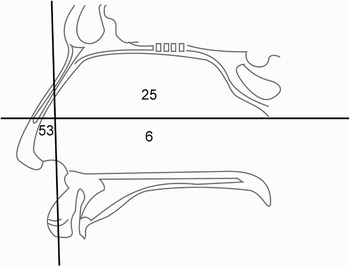
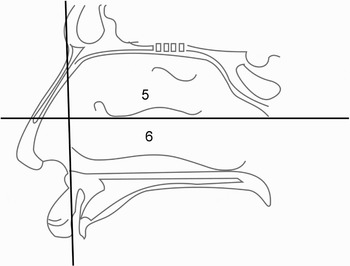
Examination findings were recorded on a schematic diagram of the nasal septum and lateral wall (Figures 1 and 2). Bleeding from sources posterior to the piriform fossa or aperture was classified as posterior epistaxis. This was identified by noting the anterior end of the inferior turbinate inferiorly and the junction of the upper lateral cartilages and the nasal bones superiorly, and the corresponding area on the septum. The lower border of the middle turbinate was used as a landmark to divide the lateral wall and septum into upper and lower parts.
Diagram used to record site of bleeding from the septum. Numbers indicate the total number of bleeding points encountered in each area.

Diagram used to record site of bleeding from the lateral nasal wall. Numbers indicate the total number of bleeding points encountered in each area.

Control of bleeding was first attempted by cauterisation using a silver nitrate stick or bipolar diathermy, if the bleeding source was identified. If this failed, a nasal pack was used. Anterior epistaxis was controlled using eight centimetre Merocel pack (Doyle nasal dressing, Medtronic Xomed, Mystic, CT, USA). For controlling posterior epistaxis 10 centimetre Merocel pack (Doyle nasal dressing, Medtronic Xomed, Mystic, CT, USA) or B.I.P.P. pack was used with or without balloon catheters. Subsequent management – in the form of repeat cauterisation, nasal packing or surgery – was recorded. As part of this study, it was agreed as departmental policy that patients with ongoing epistaxis after two episodes of nasal packing should be counselled to undergo surgical intervention under general anaesthesia. The need for admission and blood transfusion, and the duration of hospital stay, were also noted.
Results and analysis
Site of epistaxis
Of the study group of 100 patients, 40 bled from the right nostril, 48 from the left and 12 from both nostrils.
Fifty-three patients had anterior bleeding and 47 had posterior bleeding. The bleeding site was identified in 91 per cent of patients.
Site of Epistaxis – All the 53 patients with anterior bleeding had identifiable sites on the septum.
Of the 47 patients with posterior bleeding, 38 (81 per cent) had an identifiable bleeding source: 34 had one source and four had two, giving a total of 42 identifiable sites. In this group, 31 of the 42 identified sites (74 per cent) were on the septum (six of 31 on the lower part and 25 of 31 (81 per cent) on the upper part). The remaining 11 sites were on the lateral nasal wall (six below and five above the inferior edge of the middle turbinate) (Figures 1 and 2).
In total, we identified 95 bleeding sites in 91 patients, out of a study population of 100. Eighty-four bleeding sites were on the septum while 11 were on the lateral nasal wall.
Epistaxis site and patient demographics
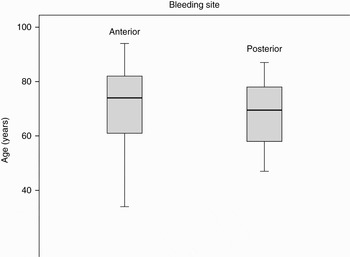
Our study population comprised 53 men and 47 women. All were Caucasian. The overall mean age of our study population was 68.5 years, being 70.5 years for anterior epistaxis patients (Range – 27 years to 94 years) and 67 years for posterior epistaxis patients(Range – 47 years to 87 years) (Figure 3). This difference was statistically insignificant (p = 0.174).
Age distribution of patients with anterior and posterior epistaxis.

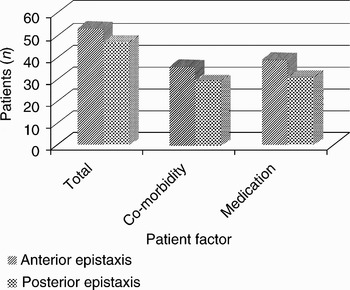
Sixty-five patients had known co-morbidity: 58 were treated hypertensives, seven had some degree of chronic renal failure, and a further eight had haematological conditions (but without a bleeding diathesis). Medical problems were present in 67.9 percent of patients with anterior epistaxis and 61.7 percent of patients with posterior epistaxis. (Figure 4). This difference was found to be statistically insignificant (Pearson chi-square test, p = 0.515).
Incidence of co-morbidity and medication in patients with anterior and posterior epistaxis.

The incidence of regular alcohol intake (more than once a week) was similar in the two groups, being 46 per cent in anterior bleeding patients and 45 per cent in posterior bleeding patients.
Epistaxis site and relevant medication
Seventy patients were taking relevant, ongoing medication: 45 were taking aspirin, 20 warfarin, seven clopidogrel, two heparin, seven steroid nasal spray, and seven regular nonsteroidal anti-inflammatory drugs. One or more of these drugs were being taken by 73.6 per cent of anterior epistaxis patients, compared with 66 per cent of posterior epistaxis patients (Figure 4). Again, this difference was not statistically significant (Pearson chi-square test, p = 0.406).
Epistaxis site and management
Anterior epistaxis
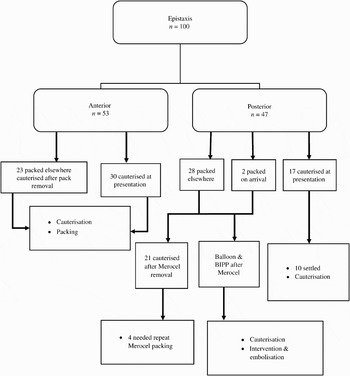
All 53 anterior epistaxis patients were managed by simple procedures. Twenty-three of these patients presented having already received Merocel packing elsewhere; all of these patients responded to silver nitrate and/or bipolar cauterisation after pack removal. The remaining 30 patients were also managed by cauterisation. This was repeated in three patients. No patient required repeat packing (Figure 5).
Flowchart showing patient management. BIPP = Gauze impregnated with Bismuth Subnitrate 20%, Iodoform paste 40%, Liquid Paraffin 40%

Posterior epistaxis
Of the 47 posterior epistaxis patients, 28 were already packed at presentation, 17 were managed with initial cauterisation, and two required packing on arrival as the site of epistaxis was not clearly identified. Of the 17 patients initially managed with cauterisation, four required subsequent nasal packing to control bleeding (Figure 5). Of the 30 packed patients, 21 underwent cautery after pack removal. In the remaining nine patients, initial cauterisation (after pack removal) was not possible due to significant ongoing bleeding which made precise identification of the bleeding site impossible. These patients were managed by posterior balloon catheter and anterior BIPP (Gauze impregnated with Bismuth Subnitrate 20%, Iodoform paste 40%, Liquid Paraffin 40%) pack. One patient in this group had a complicated course, with significant ongoing bleeding after pack removal, initially managed by sphenopalatine artery ligation and septoplasty, but finally controlled, after continued post-operative bleeding, by maxillary artery embolisation (Figure 5).
Admission and hospital stay
Of the 100 patients, 67 required hospital admission, 55 per cent of whom had posterior bleeding. The admission rate was 76.6 per cent (36/47) for posterior epistaxis patients and 58.5 per cent (31/53) for anterior epistaxis patients; this difference was statistically significant (Pearson chi-square, p = 0.05).
The mean duration of hospitalisation was three days for posterior epistaxis patients and 1.6 days for anterior epistaxis patients. There was no mortality. Blood transfusion was needed for three patients with posterior epistaxis.
Discussion
The advent of the rigid nasal endoscope has revolutionised the management of epistaxis. This instrument was initially employed for this purpose by Wurman et al., with success in 12 out of 18 patients.Reference Philip and Milton6 Quick, effective control not only mitigates patient's suffering and anxiety but also prevents unnecessary use of hospital resources. Studies have highlighted the potential financial saving represented by reduced admission rates in appropriately managed epistaxis cases.Reference Ahmed and Woolford7
Most of our epistaxis patients were elderly, with an almost equal distribution of sexes and epistaxis sides. Our findings suggest that patients presenting to ENT services have an almost equal incidence of anterior and posterior epistaxis, in keeping with other recent papers.Reference Philip and Milton6, Reference Almedia, Diogenes and Pinheiro8 This contrasts with data from cases managed in the accident and emergency department, where posterior bleeding is seen in only 5 to 10 per cent of all epistaxis patients treated.Reference Viducich, Blanda and Gerson9, Reference Peretta, Denslow and Brown10
There appears to be no relation between age and the site of primary epistaxis. This is contrary to traditional teaching that posterior epistaxis is encountered more often in the elderly.Reference Watkinson and Kerr11
We found idiopathic epistaxis in adults to be commonly associated with medical co-morbidity (in 65 per cent) and relevant medication (in 70 per cent). Furthermore their management may require the use of a balloon catheter along with anterior packs.Reference Watkinson and Kerr11
Encouragingly, we found that patients with anterior epistaxis were relatively straightforward to manage using cauterisation with silver nitrate sticks or bipolar diathermy, and that most did not need nasal packing. In addition, almost all the patients in this group (more than 94 per cent) responded to a single episode of nasal cauterisation.
In contrast, patients with posterior epistaxis were more likely to need nasal packing (40 per cent) and repeated cauterisation (10 per cent). Furthermore, these patients' management may require the use of a balloon catheter along with anterior packs. Nasal packing was received by 23 of our 53 anterior epistaxis patients (43 per cent) and 45 of our 47 posterior epistaxis patients (96 per cent) (including packing received in the accident and emergency department). As mentioned above, none of our anterior epistaxis patients needed nasal packing in our department, while 19 of our posterior epistaxis patients needed to be packed. Compared with patients with anterior bleeding, our patients with posterior bleeding were more likely to need hospital admission. Furthermore, once admitted, they stayed twice as long. This is not surprising, given that most patients with anterior epistaxis are relatively easy to manage with nasal cauterisation. Furthermore, some posterior epistaxis patients may require blood transfusion (three in our study).
This is the first prospective study to systematically identify significantly different patient outcomes dependent on the site of epistaxis. There have been many studies on epistaxis; however most have suffered from serious flaws. Most studies have been retrospective, with the inclusion of heterogeneous patient groups and an arbitrary definition of posterior epistaxis. In addition, the examination techniques used have been inconsistent with imprecise bleeding site identification. Although in practice patients with epistaxis are usually managed by junior doctors, almost all published studies have reported the outcomes of treatment by senior clinicians.Reference Kotecha, Fowler, Harkness, Walmsley, Brown and Topham12 No previous studies have assessed the association between patient factors and epistaxis site, or between epistaxis site and patient management.
In order to prevent such problems, we used a standardised definition of posterior epistaxis, and prospectively examined a well defined patient group. All patients had similar nasal preparation, were examined with rigid nasal endoscopes, and had their identified bleeding site recorded precisely on a diagram.
• Almost all cases of anterior epistaxis can be managed by silver nitrate or bipolar diathermy cautery; nasal packing in this group should be the exception
• A significant number of patients with posterior epistaxis need effective nasal packing, which may require the use of posterior balloon catheters along with an anterior pack
• Patients with posterior epistaxis are more likely to need hospital admission and to have a more prolonged stay, compared with anterior epistaxis patients
• In adult patients with idiopathic epistaxis, the site of bleeding is not influenced by age, gender, co-morbidity or medication
Managing epistaxis forms a significant proportion of the routine ENT departmental workload. This is very evident in Scotland, 33 per cent of all ENT admissions are for acute epistaxis, accounting for an average of six admissions per day, although this has been declining since 2001.Reference Walker, Macfarlane and McGarry13 The overwhelming majority of patients have idiopathic epistaxis.Reference McGarry and Gleeson2, Reference Walker, Macfarlane and McGarry13 Most patients with idiopathic epistaxis are elderly, and their management can be further complicated by co-morbidity and anticoagulant medication.Reference McGarry and Gleeson2, Reference Walker, Macfarlane and McGarry13
As in other studies, we were able to identify the bleeding point in the majority of our patients (91 per cent). In addition, our study also shows that, with adequate training, otolaryngology trainees can achieve identification rates similar to those quoted for experienced clinicians. Unfortunately, surveys have highlighted a lack of sufficient training, equipment and departmental protocols regarding epistaxis, which could have serious implications for patient care and treatment costs.Reference Duvvi, Khattab, Khalil and Nunez14 This is reflected in the finding that only 20 per cent of epistaxis patients admitted to UK ENT services receive management based on direct identification of the bleeding point.Reference Kotecha, Fowler, Harkness, Walmsley, Brown and Topham12
In our study, most of the identified bleeding sources (84/95) were on the septum for both anterior and posterior epistaxis cases, in keeping with the majority of other reports. The remaining 11, lateral wall bleeding sources all occurred in posterior epistaxis cases, with a roughly equal division between upper and lower sources. However none of our patients had bleeding from the classic Woodruff plexus. Therefore, when trying to identify the site of epistaxis, it would appear logical to concentrate initial efforts on the septum.
Our findings suggest that, compared with anterior epistaxis cases, patients with posterior bleeding represent a management challenge. Junior ENT trainees must be given adequate training in posterior nasal packing and balloon catheterisation, in order to adequately control bleeding. However, it is important to appreciate that the majority of these patients will probably respond to these measures, without the need for surgery.
Further studies are needed to evaluate the impact of the increased admission rates and prolonged hospitalisation of patients with posterior epistaxis.