Introduction
The prevalence and incidence of dementia increases with age, with some studies showing a subsequent leveling off at ages around 90 or 95 (Ferri et al., Reference Ferri2005; Treves and Korczyn, Reference Treves and Korczyn2012; Akushevich et al., Reference Akushevich, Kravchenko, Ukraintseva, Arbeev and Yashin2012). In contrast, the increase in death with or from dementia continues through very old age (Brayne et al., Reference Brayne, Gao, Dewey and Matthews2006). In our aging societies, an increasing number of people will die with or from dementia. One reason for palliative care to apply to dementia is that curative treatments for dementia probably will not be available in the near future. Further, definitions of palliative care emphasize quality of life and person-centeredness, which involves including the family in a holistic approach (WHO, 2002; EAPC, 2009; National Consensus Project for Quality Palliative Care, 2013; NPCRC). As such, palliative care fits with the principles of dementia care (WHO, 2012). Many experts believe that palliative care may be applied not only in the last stage of the disease, but also early in the disease trajectory (WHO, 2002, EAPC 2009; National Consensus Project for Quality Palliative Care, 2013; van der Steen et al., Reference van der Steen2014a).
Dementia patients may derive most benefit from palliative care when it addresses their specific needs and those of their families. This would entail taking into account, for example, the uncertain course of dementia, inevitable cognitive decline, the development of behavioral and psychological symptoms of dementia (BPSD) and the salient need to involve and support family. To define palliative care better in older people with dementia, the European Association for Palliative Care (EAPC) recently performed a Delphi study that comprised five rounds, which resulted in the definition of 11 domains of dementia palliative care (van der Steen et al., Reference van der Steen2014a). For each domain, we provided recommendations for optimal palliative care: 57 recommendations in total, 2–8 per domain. An international panel (23 countries) of 64 experts in dementia care, palliative care or both, achieved consensus on almost all domains and recommendations. Nevertheless, controversies remained about two issues: providing nutrition and hydration which has been highlighted as a sensitive topic in the literature before (e.g. van der Steen et al., Reference van der Steen, Hertogh, de Graas, Nakanishi, Toscani and Arcand2013a), and concerns about the applicability of palliative care in the dementia trajectory.
This paper will focus on the second controversy and provides a detailed analysis of the concerns the Delphi panelists expressed. We examine whether and how the selection of the panelists (an unresolved methodological issue; Meijering et al., Reference Meijering, Kampen and Tobi2013) may have affected consensus, analysing non-response. We further examine which experts found palliative care in dementia less important and less applicable. For this, we analysed associations with demographics (for example, residing in a Western or Northern European country versus other countries), expertise and profession (for example, expertise predominantly in dementia care versus palliative or other care), and possible indicators of interest in the study (for example, speed of the response).
Methods
White paper
To develop a white paper on palliative care in dementia on behalf of the EAPC (van der Steen et al., Reference van der Steen2014a), we conducted a Delphi study with a goal “to define palliative care for dementia patients as distinct from palliative care for other patient groups, to describe core issues, and to provide future directions for palliative care in dementia.” We focused on older people with dementia, and our target group was professionals working in clinical practice providing palliative care to dementia patients – whether occasionally or on a more regular basis – as well as policy makers, and researchers.
The Delphi study process
Considering the goal, we developed domains, recommendations, and a research agenda (van der Steen et al., Reference van der Steen2014a). We adopted the Delphi study design as suitable to provide guidance, to develop standards in an area of relative uncertainty, to build consensus, and to show remaining controversial areas (Box S1).
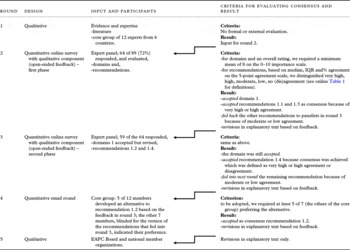
We performed a Delphi study with five rounds (van der Steen et al., Reference van der Steen2014a), as summarized in Table 1 a more detailed version of which is included in the online Supplement. First, based on literature, a core group of 12 experts from six countries drafted a set of core domains with salient recommendations for each domain along with explanatory text. In a two-round online survey with feedback (rounds 2 and 3), we invited 89 experts from 27 countries to evaluate the domains and recommendations, of whom 64 (72%) responded. The fourth round involved decisions by the core team, and the fifth, input from the EAPC Board and collective member associations. In this paper, we focus on the online survey and feedback (referred to as rounds 2 and 3 of the Delphi study).
Delphi study methods and the process of achieving of consensus on the domain of applicability of palliative care

IQR = interquartile range. EAPC = European Association for Palliative Care.
Recruitment of experts for the Delphi panel
We recruited experts via the networks of the 12 core group members, which included EAPC task forces and work groups, colleague clinicians, and patient advocacy groups. For the panel to represent experts from different groups of end-users (in line with key requirements for Delphi studies, Box S1), we sought balance in terms of those with specific expertise regarding care for dementia patients but not necessarily at the end of life, and those with specific expertise regarding end-of-life care mainly to people with cancer, and further, experts on end-of-life care in dementia. We invited clinicians as well as researchers who were or were not also working in clinical practice. We also ensured that different disciplines relevant to palliative care were represented, for example by including spiritual counselors. In addition to the representation of Western and Northern European countries, residence of most of the core team members, we invited panelists from Southern and Eastern as well as non-European countries.
Formats and criteria for consensus
We used rather conservative, pre-defined criteria (Table S1) to determine consensus on the importance of a domain (requiring a mean of at least 8 on a 0–10 scale) and consensus on the content of the recommendation or statement (with 5-point agreement scales), defining high or very high (dis)agreement based on measures of centrality and dispersion. The panelists were also provided with an open-ended question inviting comments on each domain (round 2) or on selected recommendations (round 3). Up to 4,000 characters were allowed and responses regarding the first domain comprised up to 2,539 characters. The panel, in round 2, immediately accepted 10 of 11 domains (all except the domain on prognostication) and 51 of 57 recommendations. We fed back to the panel the recommendations that did not immediately achieve consensus, along with a proposed revised recommendation, a summary of the panelists’ comments to the previous version, the distribution of the panelists’ agreement ratings, and the panellist's personal rating (as shown in Box 1).
Feedback to and from the panelists and revisions of the recommendations within the domain of applicability of palliative care*
Recommendation 1.2 – when palliative care applies – rounds 2–4 of the delphi study†
Original statement [Round 2]:
1.2 Palliative care – with its goals of improving quality of life, maintaining function and maximizing comfort – applies to dementia throughout the full disease trajectory, from diagnosis until after death.
Summary of comments [of the panel] to original statement (from overall comments to domain 1):
-
• Care goals in mild dementia may differ from more severe dementia; care goals shift over time.
-
• Indeed, focusing on dementia as a serious, life-altering condition for which palliative care provides important benefits is a more fruitful strategy than focusing on recognition of dementia as a terminal disease.
-
• Concern that palliative care at diagnosis is interpreted as “giving up” the patient.
-
• At diagnosis, palliative care is still far off; patients try to live a normal life.
-
• Palliative care applies to the end of life only.
-
• Triggering palliative care in dementia, unlike in cancer, cannot be time-specific.
-
• The goals of improving quality of life, maintaining function and maximizing comfort apply to all chronic disease.
The rating of agreement [of the panel] with original statement:
-
• strongly disagree: 6.3%
-
• moderately disagree: 10.9%
-
• neither agree nor disagree: 3.1%
-
• moderately agree: 23.4%
-
• strongly agree: 56.3%
Your level of agreement [the panelist] with original statement: please refer to your email.
Revised statement (revisions highlighted) [Round 3]:
1.2 Improving quality of life, maintaining function and maximizing comfort, which are goals of palliative care, can be considered appropriate in dementia throughout the full disease trajectory, with emphasis on particular goals shifting over time from diagnosis until after death.
Summary of (new) comments of the panel to the revised statement
-
• These goals are not specific to palliative care alone.
-
• Formulation is more ambiguous, is saying less.
-
• Statement is too long.
-
• Suggestions for improved wording.
The rating of agreement [of the panel] with the revised statement:
-
• strongly disagree: 8.8%
-
• moderately disagree: 10.5%
-
• neither agree nor disagree: 1.8%
-
• moderately agree: 15.8%
-
• strongly agree: 63.2%
Second revision of the statement, accepted by core team (same as 1.2 in Table 3, but with revisions highlighted): [after Round 3]
1.2 Improving quality of life, maintaining function and maximizing comfort, which are also goals of palliative care, can be considered appropriate in dementia throughout the disease trajectory, with the emphasis on particular goals changing over time.
Recommendation 1.4 – what palliative care covers – rounds 2–3 of the delphi study
Original statement: [Round 2]
1.4 A palliative care approach refers to all treatment and care in dementia, including treatment of comorbid diseases and (inter- or concurrent) health problems, including also challenging behavior.
Summary of comments [of the panel] to original statement (from overall comments to domain 1):
-
• Challenging behavior is an inappropriate term, because it may be related to mistreatment.
-
• Concern that palliative approach is misinterpreted as poor treatment of comorbid and concurrent conditions.
The rating of agreement [of the panel] with original statement:
-
• strongly disagree: 4.7%
-
• moderately disagree: 9.4%
-
• neither agree nor disagree: 10.9%
-
• moderately agree: 29.7%
-
• strongly agree: 45.3%
Your level of agreement [the panelist] with original statement: please refer to your email.
Revised statement (revisions highlighted) [Round 3]:
1.4 A palliative care approach refers to all treatment and care in dementia, including adequate treatment of behavioral and psychological symptoms of dementia, comorbid diseases, and (inter- or concurrent) health problems.
Summary of (new) comments of the panel to the revised statement:
-
• Concerns about relabeling dementia care into palliative care.
-
• Concerns about being blind to dementia or psychiatric expertise.
-
• Concerns about diluting of contributions of psychiatrists and palliativists when conflating all under one title which does not help collaboration.
The rating of agreement [of the panel] with the revised statement:
-
• strongly disagree: 8.5%
-
• moderately disagree: 6.8%
-
• neither agree nor disagree: 3.4%
-
• moderately agree: 20.3%
-
• strongly agree: 61.0%
No further revision of the statement (the criterion for consensus was met).
*Feedback in bullet points was literally provided to the panelist as represented here [except for parts between square brackets].
†The Figure on care goals was being evaluated separately at the end of the survey so that panelists were not aware of it when evaluating recommendation 1.2.
Analyses and variables
We present the summaries of the panelists’ feedback to the recommendations about the applicability of palliative care to dementia which we also fed back to the panelists, and we include exemplary citations. These summaries were composed within the core group who had received all the comments provided by the panelists.
We analysed differences in characteristics between respondents and non-respondents using χ2 tests and t-tests or a gamma correlation test for hierarchical variables where appropriate. We assessed associations of the panelists’ characteristics with the overall importance rating of the domain of applicability of palliative care in dementia. We used the ratings of the second round for reason of power (greater variability and more respondents). Because of the skewed distribution (over a third scored the maximum of 10), we combined the responses into three categories, with those below the cut-off of 8 for accepting a domain (van der Steen et al., Reference van der Steen2014a) in the first category, ratings of 8 or 9 in the second, and the maximum of 10 in the third category. In addition to the importance rating as an outcome, we summed the agreement ratings for the four items in the applicability domain. We categorized the results of the sum score both on a conceptual basis and by distributing the outcome variables into three levels. We combined ratings 4–15 (i.e. at least one recommendation was lower than “agree moderately” or “strongly”), 16–19, and the maximum of 20 (strong agreement with all recommendations).
The independent variables were the panelists’ characteristics, which were demographics (gender, age, and country), profession and expertise, and possible indicators of interest in the study. Response options for profession included physician, nurse, social worker, psychologist, spiritual counselor, ethicist, epidemiologist, researcher, policy/administration, and other, with multiple answers allowed.
For possible indicators of interest, we calculated speed of the response in Round 2 in days (slow responders may be more similar to non-responders; Johnson and Wislar, Reference Johnson and Wislar2012); and categorized responders as responding before the first general reminder which was shortly before the deadline we had announced initially (Speed 1), before the first personal reminder (Speed 2), and later but before the closing of the round (Speed 3). To this end, we also rated proximity to the core group defined as (1) the lead author not knowing the panelist personally or (2) knowing superficially (been in touch), or (3) knowing her well. We determined if dementia care expertise dominated over palliative care expertise and vice versa, by evaluating if panelists had identified as relevant to themselves more items (clinical practice, research, and policy/administration) for dementia care expertise than for palliative care. If the number of identified items was equal in both areas, in deciding which expertise dominated, the current affiliation was decisive, or we rated as “no dominance.”
Because of the limited sample size, and to avoid “empty cells” in regression analyses with variables describing multiple subgroups, we combined subgroups based on distributions of the responses and relevance. For example, subgroups of professions other than physicians and nurses would be too small. We dichotomized areas of residence as Western and Northern European versus all other regions (according the definition by the United Nations Statistics Division, 2013) to evaluate any possible bias because 11 of the 12 core group members were from the first region. For the same reason, we combined palliative expertise with no dominant expertise either of which applied to most of the core group members versus dominance of dementia expertise. We entered in multivariable analyses the variables associated at a 0.15 level in univariable analyses with any of the two outcomes, along with gender and age, which we wished to adjust for irrespective of significance, with a pre-defined limit of six variables (according to the rule of thumb that 10–15 cases per independent variable are needed). We entered these variables into stepwise backward regression until all variables were significant at a 0.05 level (retained age and gender regardless).
Further, we calculated Pearson's correlation of the two full and the two collapsed outcomes scales, and of the full scale scores in Rounds 2 and 3. We provided the options “unable to evaluate” for the importance score, and “don't know” for agreement with recommendations and considered them missing values. These options were used infrequently, resulting in very few missing responses. Analyses were performed with SPSS 20.0.0.2 (IBM, 2011).
Results
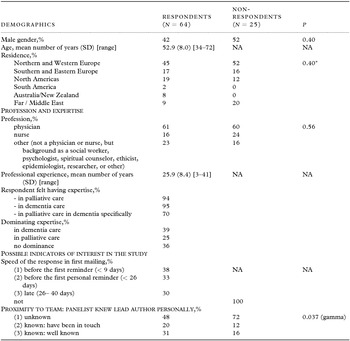
Over 90% of the panelists felt that they had expertise in palliative care, and in dementia care, and 70% reported expertise in palliative care in dementia specifically (Table 2). However, if any expertise dominated, it was more frequently dementia care (39% of total) than palliative care (25%). There was no statistical difference between respondents (panelists) and non-respondents regarding gender, place of residence and profession, but respondents were more likely to know the lead author personally.
Characteristics of respondents (the Delphi panelists) and non-respondents

NA = data not available.
* Tested combined groups of North Americas with Australia/New Zealand, and South America with Far/Middle East.
Achieving consensus through incorporating of feedback and remaining issues
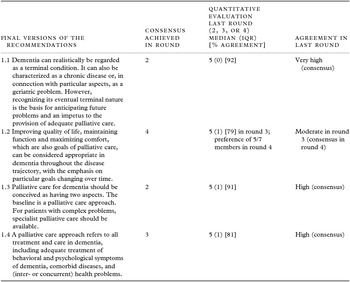
Table 1 shows the process of achieving consensus. Two of four of the recommendations of the first domain on applicability of palliative care (the final versions of which are reported in Table 3) were not accepted immediately, but were accepted after revisions. The panel agreed immediately on the first recommendation (Table 3, 1.1), which represents a rationale for providing palliative care based on the terminal nature of the disease. It is prudently formulated in the sense that it recognizes other conceptualizations including dementia as a chronic disease. Distinguishing between a palliative care approach and specialist palliative care (recommendation 1.3) was also agreed upon immediately. The other two recommendations were not. These recommendations defined the scope of palliative care in dementia in terms of when it applies (in relation to care goals; 1.2) and what treatment and symptoms palliative care may cover (1.4). Box 1 summarizes the process of achieving consensus on the two recommendations that needed revisions in response to the panelists’ comments – the bullet points showing feedback as literally provided to the panelists.
Recommendations and the achieving of consensus on the domain of applicability of palliative care

* Rounds 2 and 3 of the Delphi study refer to the two phases of the expert panel evaluation.
when palliative care applies (recommendation 1.2)
The original recommendation 1.2 stated that palliative care and its goals applied throughout the disease trajectory (Box 1). We replaced “applies” with “can be considered appropriate” and we added the changing of goals over time. These changes were in response to concerns about the early use of a palliative care model, and to panelists who felt that there was no one goal that equally applies from the time of diagnosis. The changing of care goals was addressed by panelists, for example, thus: “you need to recognize that in early dementias the palliative approach will be accompanied by a curative approach;” and it was suggested we needed to “make a distinction between different stages of dementia” because “maybe palliation increases its importance in the global therapeutic approach as the patient advances through the disease.” A broadening of palliative care to the full disease trajectory was also considered outright as “too ambitious.”
In the next round, the revised recommendation 1.2 was still criticized for inclusive applicability, i.e. through stages, and the more nuanced phrasing was not appreciated by all as it was felt there was a risk for it to become “meaningless” or too long (Box 1). For example, “The formulation is more ambiguous, while still promoting a palliative approach which, in my opinion, is appropriate only in the advanced phase of the disease,” and “I much prefer the old statement, which even if one does not agree with it at least says something!” More specifically, a new comment expressed in different ways, essentially focused on the three goals (Improving quality of life, maintaining function, and maximizing comfort) not being specific to palliative care alone. One expert wrote these “are goals of many (if not most) therapeutic interventions.” To avoid “stigma”, another expert recommended adding that the goals apply “as in any other chronic disease.” Moreover, yet another expert wrote: “…aren't only goals for palliative care in dementia—it is quite insulting to our colleagues who specialize in dementia care to suggest it is.” This expert concludes with “I think you are being too concerned here with the debate inside palliative care on whether it has a role just at the end of life or throughout the disease trajectory to see that we could really harm our relationships within dementia by implying that we're the only ones concerned with quality of life, maintaining function etc.” Based on these comments, we suggested a couple of minor, yet important changes in wording (e.g. “goals” to become “also goals”), and shortening while emphasizing the changing goals through omitting of the last part “diagnosis until after death.” In Round 4, this was preferred by five of the seven core group members blinded to the revisions, with two preferring the previous version because it more explicitly included bereavement or “diagnosis until after death.” We accordingly adapted the explanatory text with this recommendation.
what palliative care covers (recommendation 1.4)
Recommendation 1.4 was about an inclusive approach to which treatments could be part of palliative care, and was revised only once (Box 1). “Challenging behavior” was replaced by the more neutral expression of BPSD, and we addressed a concern of suboptimal treatment of comorbid disease or health problems by the adjective “adequate” to precede “treatment.” For example (Round 2), “In q1.4 the palliative approach needed includes really good psychiatric care, which has been a real deficiency of existing palliative care services, which struggle hugely to meet the needs of people with complex dementia.”
In Round 3, some did not like the new term “adequate:” “you don't qualify other sorts of treatment in this way. It may keep one person happy but confuses the question,” and “I do not like the word ‘adequate’ which conveys the sense of ‘good enough’ rather than optimal.” Further, important concerns were expressed on potential adverse effects of “relabeling” treatment of physical, and even more so, psychiatric problems as palliative care. That is, there were concerns about being “blind to all the other expertise in dementia care that already exists,” and “palliative carers are not the specialists for the treatment of BPSD. We have to be careful not to transfer the deficits of psychiatric care into palliative care.” Another expert elaborated and the main points were: “Psychiatrists recognized behavioral management of BPSD before anyone else and can teach us in palliative care a lot about this. We risk diluting both their contribution […] if we conflate all under one title. If we do this, we kill off the early shoots of cooperative work before they start to grow.” In response to these comments to recommendation 1.4, we added reference to a recommendation on the promoting of collaboration between dementia and palliative care (11.3) in the domain of societal and ethical issues.
Panelists’ evaluations of importance and agreement
The mean importance rating for the applicability domain in the first round was 8.3 (SD 1.9) (van der Steen et al., Reference van der Steen2014a), and ranged 3–10 (n = 61, 3 missing). About one-third (31%) provided an importance rating below 8, or rated it 8 or 9 (31%), and 38% of the panelists scored 10. In the Round 3, with two of the four recommendations revised because of moderate agreement in Round 2, the mean importance rating was 8.4 (SD 1.9; n = 59 with four unable to rate). The importance ratings in the two rounds correlated (r = 0.49, p < 0.001).
The mean of the summed agreement ratings of the four recommendations within the domain was 17.3 (SD 2.8; n = 64, so typically just above “moderately agree”), and ranged 10–20. The correlation between the two full scales (importance and agreement) was 0.56 (p < 0.001). In 20% of cases, the agreement rating was 15 or lower, in 55% of cases it was 16–19, and 25% rated the maximum of 20. The correlation between the two combined (three-level) outcomes was 0.53 (p < 0.001).
Characteristics of panelists related to their evaluations
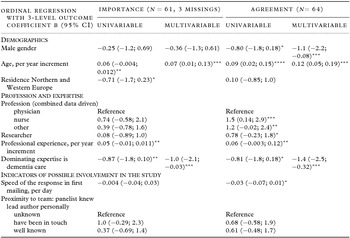
Table 4 shows associations of the panelists’ characteristics with the two outcomes on applicability of palliative care in dementia. At a marginally significant p = 0.10 level, in univariable analyses, a lower importance rating was provided by experts who were younger, less experienced, and those with dementia expertise dominating. Further, agreement was lower for younger or less experienced experts. Finally, in the univariable analyses, physicians were less likely to agree than experts with other professions.
Associations with rating of importance with the overall domain and agreement with the recommendations regarding applicability of palliative care in dementia

* p < 0.15 **p < 0.10, ***p < 0.05, ****p < 0.01.
The correlation between age and experience was +0.71 (p < 0.001). In the multivariable analyses, we retained age only. Whether the panelist knew the lead author personally was not associated with any of the two outcomes at a p = 0.15 level and therefore did not enter the multivariable analyses. Higher age and dementia expertise not dominating were independently related to a greater importance rating. These characteristics were also independently associated, and more strongly than with importance (Table 4), with the agreement rating, in addition to gender, with female experts more likely to agree while there was no gender difference in the rating of importance.
With a maximum of six variables entered in multivariable analyses, we separately performed backward regression models with either being a researcher (p = 0.13 with agreement) or speed of response (p = 0.14 with agreement), but these resulted in the same model. Furthermore, the multivariable models with age replaced by experience were similar for both outcomes, but the coefficient for male gender in the model with agreement as the dependent variable was smaller with experience included (changed from −1.1 [Table 4] to −0.89 which rendered gender insignificant (CI −1.9; 0.01; p = 0.08)).
To illustrate the strongest associations with agreement, the experts providing the highest agreement ratings were 58 years on average (SD 7.8) and the lowest averaged 50 (SD 5.6). Further, almost half (46%; 11/24) of the experts with dementia expertise dominating provided the lowest importance ratings (compared to 22%, 8/37 of the others). Of note, these are unadjusted means and adjusted differences in the multivariable analyses were larger.
Discussion
Main findings and reflections
Experts worldwide acknowledge the benefits of palliative care in dementia, and we achieved a consensus in a Delphi panel on the applicability of palliative care to dementia. However, some controversies were evident when examining feedback of the panelists in detail. The main concerns included the applicability of palliative care early in the course of the disease and a concern regarding expertise: panelists had concerns about whether a palliative care approach would take enough account of the existing expertise in dementia care, for instance regarding the treatment of BPSD. Younger or less experienced experts and those with predominantly dementia expertise were the most critical regarding applicability of palliative care to dementia in terms of importance and agreement, while females were more likely to agree.
Younger experts and those with predominantly dementia expertise (either in the context of mental health or of care for people with chronic disease) are likely to have accompanied fewer people until the last phase of life compared with the other panelists. Perhaps exposure helps practitioners to recognize the benefits of early integration of palliative care principles in the care for these patients. Also, different levels of interest in low-tech solutions with different age may play a role, as older physicians were found to be more interested in chronic disease management (Lee and Begley, Reference Lee and Begley2012). Further, in case scenario studies on decisions at the end of life or in older people, in multiple countries, there was either no association with physician's age (Molloy et al., Reference Molloy1991) or older physicians were more likely to choose less aggressive treatment (Alemayehu et al., Reference Alemayehu1991) or to withdraw treatment (Hinkka et al. Reference Hinkka, Kosunen, Metsänoja, Lammi and Kellokumpu-Lehtinen2002). Another possible explanation is that the experts working in different care settings have a variable focus on biomedical aspects, or on living with dementia, as opposed to anticipation of the end of life. Moreover, research on end-of-life care for patients with dementia has traditionally been compared with care for cancer patients (Davies et al., Reference Davies2014). While seemingly obvious, much less is known about how palliative care differs from, and overlaps with, traditional dementia care (Nakanishi et al., Reference Nakanishi2015), such as a pro-active approach, anticipating the end of life, being key with palliative care while less so in traditional dementia care. In some places, dementia care practice may be holistic, person-centered and multidisciplinary already.
Our analyses provided depth to the earlier finding that there was no consensus among the experts on the applicability of palliative care through all stages of dementia (van der Steen et al., Reference van der Steen2014a), although there was a tendency to disagree that it is important only for severe dementia, and a tendency to agree that it was more important in more severe stages. While research on palliative care in dementia has focused mostly on advanced dementia (van der Steen, Reference van der Steen2010), there is little evidence on the benefits of palliative care earlier in the disease, even though about half of dementia patients may die before reaching the advanced stage of dementia (van der Steen et al., Reference van der Steen, Ribbe, Deliens, Gutschow and Onwuteaka-Philipsen2014b). Advance care planning interventions are increasingly being developed and may help because recognizing dementia as a terminal disease might be important for a comfortable death (van der Steen et al., Reference van der Steen, Onwuteaka-Philipsen, Knol, Ribbe and Deliens2013b). However, we should take seriously the variety of views which we identified among experts: sensitivity to concerns about labeling palliative care as care solely for dying people is required, and fear of under-treatment or being abandoned when palliative care is applied early on, and resistance of professionals, families and patients must be recognized (van der Steen et al., Reference van der Steen2014c).
There was a recognition among experts from the field of palliative care that psychiatrists and other specialists in dementia care may contribute their expertise to improve care. This touches upon an important conceptual and practical issue: should the most helpful model reconcile all expertise under a label of palliative care, or should we acknowledge differences in expertise between palliative and dementia care professionals and promote collaboration? It has been suggested that the general (baseline) palliative approach, or primary palliative care principles, should be applied by generalists, and specialists consulted for treating complex or refractory symptoms and complex decision making (Procter, Reference Procter2012; Quill et al., Reference Quill and Abernethy2013; van der Steen et al., Reference van der Steen2014a). While palliative care is multidisciplinary care and favors continuity of care, in dementia too, there is a poignant question as to who (in addition to the family) is responsible for the dementia patient, given the expertise of dementia services.
Strengths and limitations of the study
The general principles of the guidance provided in the EAPC white paper apply to Western cultures, and although we did not find that perceptions of the applicability of palliative care to dementia differed elsewhere, it may be examined for applicability locally, especially in cultures more distant to Western Europe and in specific healthcare systems that provide palliative or comfort care based on prognosis. Our study was limited through a small sample size. Although sufficient for regression analyses, which provided clear patterns, we could not examine rating of applicability in, for example, the subgroup of nurses. However, we found no evidence for response bias or for hiding controversies through socially desirable rating of experts closer to the team. The open-ended feedback of experts in the Delphi study was very helpful in systematically identifying controversies and improving the guidance, even though Delphi procedures may lack the richness and depth found in “live” groups (Iqbal and Pipon-Young, Reference Iqbal and Pipon-Young2009). The criteria for consensus we used were highly conservative; for example, when applying the Interpercentile Range Adjusted for Symmetry criteria (IPRAS, based on RAND/UCLA criteria) to the 0–10 rating of importance of the applicability domain (Froud et al., Reference Froud2011), it would have been accepted with no revision. This indicates controversies are easily overlooked. The convergence of opinions was slight, as usual (Powell, Reference Powell2003), but resulted in essential rephrasing of the recommendations that covered sensitive topics.
Recommendations
There should be an ongoing dialogue between palliative care and dementia care specialists on conceptualizations of dementia and dementia care, particularly because the field of dementia research is evolving rapidly and definitions of (different types of) dementia also change. Future work on giving shape to palliative care in dementia may not be limited to older people with dementia, but may include people with young-onset dementia. Policies may favor people staying at home longer and dying at home. Home healthcare teams should therefore be educated in applying the principles of palliative care in dementia, and the benefits and drawbacks of applying palliative care early on should be monitored.
Conclusion
Although experts worldwide acknowledge benefits of palliative care in dementia, there is some controversy around its early application and coverage. Further studies should examine the benefits of palliative care specifically in the earlier stages of dementia and how to integrate palliative expertise with other expertise, reasons for possible local resistance regarding implementation of palliative care, and should weigh concerns expressed around receiving a “palliative label” versus the benefits of applying palliative care early, such as when advance care planning of end-of-life issues is started early. We will need to find innovative solutions for practice and maintain an approach that allows patients and caregivers to communicate openly about the disease, prognosis, and needs. For this, dementia care, mental health specialists and palliative care specialists will need to collaborate and find a practical model to provide optimal palliative care to people with dementia.
Conflict of interest
None.
Description of authors’ roles
JTS, LR, MEB, and SJ formulated the research questions and designed the study. MEB collected the data and JTS and LR supervised the collection of the data. JTS was responsible for the statistical analyses and drafted the paper. All authors were involved in design of the Delphi study more generally, and all were involved in data analysis and interpretation and contributed to the writing of the paper.
Access to the qualitative data: all.
Access to the quantitative data: JTS and MEB.
Financial support
The Delphi study was supported by the Dutch Ministry of Health, Welfare and Sport (VWS; grant number 316686) and a career award for JTS of the Netherlands Organisation for Scientific Research (NWO; Innovational Research Incentives Scheme), Veni grant number 916.66.073. The analyses presented in this paper were supported by a career award to for JTS of the Netherlands Organisation for Scientific Research (NWO; Innovational Research Incentives Scheme) Vidi and Aspasia grant number 91711339.
Acknowledgment
We are grateful to the experts who contributed in the Delphi study sharing their wisdom and providing valuable feedback.
Supplementary Material
To view supplementary material for this paper, please visit http://dx.doi.org/10.1017/S1041610215000824.