Why do autocracies choose to hold multiparty elections? Why would dictators legalize their challengers and risk electoral loss? Electoral authoritarian (EA) regimes – defined as autocracies with legal multiparty competition for the legislature – make up two-thirds of post-Cold War autocracies, including Russia, Venezuela, Jordan and Malaysia. Yet despite outpacing the spread of democracy over the last three decades, we know little about what predicts transitions to EA. Scholars have proposed various ways that elections bolster autocratic survival, but have not translated these theories into testable predictions for EA transition.Footnote 1 This is a surprising oversight, given the extensive literature on democratization and the recognition that many EA regimes are highly durable and politically significant.Footnote 2
This article sources transitions to EA to a combination of international pressure, socio-economic structure and elite choice. I argue that autocratic leaders adopt multiparty politics strategically, in two respects. First, autocrats recognize that a range of international benefits (including increased aid, trade and military alliances) that are nominally targeted at ‘democracy’ promotion can be secured with merely contested elections. As a result, they strategically adopt flawed elections and reap the rewards. Secondly, since even heavily manipulated elections present a genuine threat, autocrats are more likely to adopt contested elections if they anticipate that they can reliably win them. In particular, winning under EA is less risky when there is a large mass of poor voters who can be co-opted through clientelism and state assistance. Thus autocratic elites hold elections to gain international benefits, but only if socio-economic conditions favor their ability to dominate the elections.
I use multinomial logit to simultaneously predict transitions to EA and democracy from a sample of closed (non-electoral) autocracies from 1946–2010. Whereas scholars have shown that democratic transition and survival have distinct predictors,Footnote 3 this study instead contrasts different types of liberalization. A natural expectation is that these transitions will be predicted by similar factors, given that they involve the adoption of the same formal institutions. However, I find virtually no overlap in what predicts EA and democratic transition. This can be explained by a simple contrast: Democratization entails a loss of power for autocratic leaders, while transition to EA does not. Since EA allows autocrats to cling to power provided they can control the electoral arena, it is adopted based on a cost–benefit calculation that weighs the incentives to hold elections against their costs and risks. In contrast, autocrats democratize when unable to maintain power within their dictatorship.
In predicting EA transition, I find a major role for pro-democratic international leverage. The more that closed autocracies are dependent on external democracies – through trade ties, military alliances, international governmental organizations (IGOs) and aid – the more likely they are to transition to EA, but not democracy. I also find a parallel regional contagion effect whereby democratic neighbors predict democratization and EA neighbors predict EA transition. To my knowledge, these are the first empirical findings that international variables influence institutional choice within autocracies. Contrary to an extensive literature, socio-economic factors are generally unrelated to democratization, but strongly predict EA transition. However, the effects are in the opposite direction to what one would expect from the democracy literature: autocracies are more likely to adopt multiparty elections at low economic development and high inequality. The strongest predictor of democratization is regime weakness, as proxied by the recent occurrence of a coup.
This article presents instructive contrasts with democratization theory. Whereas theories on democratization have long been divided between structural and actor-based accounts, this article focuses on their interaction to explain EA transitions. Several democratization theories revolve around a similar strategic logic, in which autocrats accept or resist democracy based on their expectations about redistribution,Footnote 4 the supply of public goodsFootnote 5 or general policy radicalism.Footnote 6 This article differs by focusing on expectations about power rather than policy, and by applying this anticipatory logic to transitions within autocracy.
The findings on EA transition are significant for several reasons. First, EA regimes are distinctive and worth understanding.Footnote 7 There is growing evidence that autocratic elections matter for policy, democratic development and conflict behavior.Footnote 8 Even absent leadership change, the adoption of multiparty politics can fundamentally transform a country’s politics and long-term development.Footnote 9 Further, EA regimes can be highly durable and represent an increasing fraction of the world’s regime types. Secondly, most major political transitions are from one autocratic regime to another, yet we know little about what underlies these changes. Thirdly, the results shed light on how international dynamics unintentionally promote liberalized autocracy, which has implications for democracy promotion and foreign policy.Footnote 10
Lastly, the results present a methodological challenge to numerous studies that aim to investigate democratic change, but fail to distinguish democratization and shifts within autocracy. This problem is particularly acute for studies using shifts in Polity democracy scores.Footnote 11 A positive Polity shift from closed autocracy is nearly three times as likely to end up at EA than democracy, yet these transition types are predicted by entirely different factors. Thus studies of Polity shifts may get null results when conflicting effects wash out, or even worse, may mistake predictors of EA transition as predictors of democratization. This article demonstrates the need to clearly distinguish the types of transitions being tested.
BACKGROUND ON ELECTORAL AUTHORITARIANISM
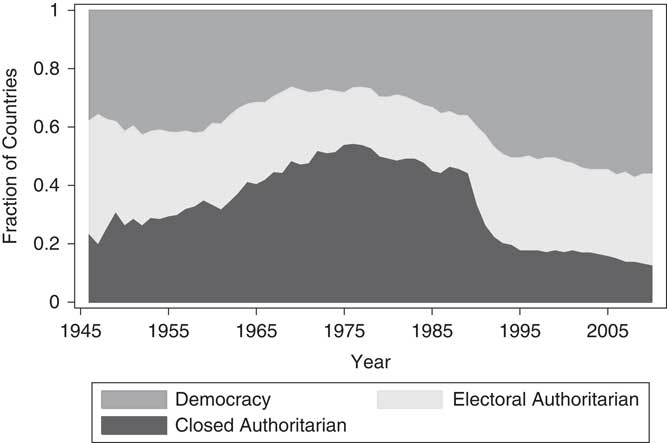
While not entirely new to history, electoral authoritarianism has become the dominant form of dictatorship: 113 countries have held a multiparty election under autocracy since 1946.Footnote 12 Figure 1 shows the global prevalence of closed autocracy, EA and democracy from 1946–2010.Footnote 13 Again, EA regimes are defined as autocracies with legal multiparty competition for the legislature (for example, Russia, Cameroon and Singapore). What distinguishes them from democracies is that this electoral competition is rendered unfair or insufficiently free due to regime control and manipulation.Footnote 14 Closed autocracies either lack electoral institutions (Saudi Arabia, Eritrea) or hold single- or no-party elections (Laos, Swaziland), which are generally ceremonial in nature. This diffusion of autocratic elections, parties and legislatures has stimulated a burgeoning literature on the functions of autocratic institutions.Footnote 15
Regime types over time Note: the figure shows the distribution of three regime types by year from 1946–2010. Electoral authoritarian (EA) regimes allow legal multiparty competition for the legislature (from Cheibub, Gandhi, and Vreeland Reference Cheibub, Gandhi and Vreeland2010). Democracy is measured from Boix, Miller, and Rosato (Reference Boix, Miller and Rosato2013). Note the large fraction of EA regimes as far back as 1946 and the sharp rise in EA around the end of the Cold War.

Why do autocrats allow contested elections? Although numerous theories have been presented, most fall into two categories.Footnote 16 First, elections may be motivated by international pressure and domestic legitimacy.Footnote 17 In this view, the elections satisfy a normative or prescriptive demand by observers. However, it remains unclear how autocratic elections can serve this function given the near-universal emphasis on democratic competition. Further, there has been a lack of empirical work showing that international pressure explains EA adoption.
Secondly, elections may promote regime survival through domestic political advantages, either by co-opting elites into the party hierarchyFootnote 18 or extending control over citizens.Footnote 19 Elections can communicate regime dominance through overwhelming victories, cultivating a ‘public image of invincibility […] [to] discourage potential divisions within the ruling party’.Footnote 20 Autocratic elections can also reveal information and help monitor local leaders.Footnote 21 Thus autocratic elections can be seen as a technique for bolstering power.
Despite the abundance of theories on autocratic motivations for elections, there have been few attempts to translate them into clear predictions of when elections will be adopted. In part, this is because many of the claimed benefits of elections apply generally across autocracies. Thus they have limited value in predicting which autocracies adopt elections. Further, there is a recognized need to avoid functionalism. As Gandhi and Lust-Okar put it, ‘It may be tempting to “read backward” from the roles that elections seem to play to understand the reasons for their existence, but to do so would be a mistake’.Footnote 22 Therefore a theory on election adoption with regime-specific variation is needed.
In turn, a satisfactory theory on the adoption of elections must take into account their costs to autocrats in addition to their potential advantages. Contested elections can invigorate the opposition and threaten survival if regimes fail to adequately control the electoral sphere.Footnote 23 About one in five national elections under EA have led to the incumbent executive leaving office.Footnote 24 Many ruling parties eventually lose to rivals and accede to democratization, as in Malawi in 1994 and Mexico in 2000.Footnote 25 An implication of this threat is that the net advantage of elections for autocrats is contingent on their likelihood of maintaining electoral control.
Perhaps because of these theoretical challenges, to my knowledge no prior quantitative work has specifically predicted transition to EA. A few studies predict shifts to multipartyism, but in limited samples and without distinguishing between EA and democracy.Footnote 26 For instance, Marinov and Goemans find that competitive elections follow coups more often after the Cold War and in more aid-dependent countries, but these elections fall under both EA and democracy.Footnote 27 This research design is problematic, since autocrats typically make a deliberate choice to adopt controlled, non-democratic elections. As a result, I show that EA and democratic transitions have highly distinct predictors. The same concern applies to studies predicting movements on Polity, which conflate shifts to democracy with shifts between autocratic regime types.Footnote 28
A final focus of the literature concerns how EA regimes maintain control of elections despite giving citizens freedom to vote and the opposition room to organize. The legitimacy fiction that EA regimes struggle to maintain requires shifting from coercion to more subtle techniques of dominance. Although not all succeed, autocrats have developed a wide array of tricks to manipulate the electoral process, including gerrymandering, control of the media and campaign funding, the harassment or arrest of opposition members, and sometimes outright fraud.Footnote 29
In particular, nearly all EA systems rely on a ‘punishment regime’, in which opposition is allowed, but comes at a cost to dissenting voters, businesses and politicians. An infamous example is the Venezuelan Government’s publication of the Maisanta, a list of more than twelve million petition signers. Voters who favored Hugo Chavez’s recall faced an average 5 per cent drop in income, with many state workers and doctors dismissed.Footnote 30 Voters favoring the recall of opposition figures were more than twice as likely to enter into a government cash transfer program as Chavez opponents.Footnote 31 Similarly, across EA regimes, local areas that vote for the ruling party are rewarded with spending, whereas opposition strongholds are starved of government funds.Footnote 32 Many authors see this clientelism as the central dynamic underlying autocratic elections.Footnote 33 As I argue below, however, this strategy’s effectiveness depends on the country’s socio-economic structure.
PREDICTORS OF ELECTORAL AUTHORITARIANISM AND DEMOCRACY
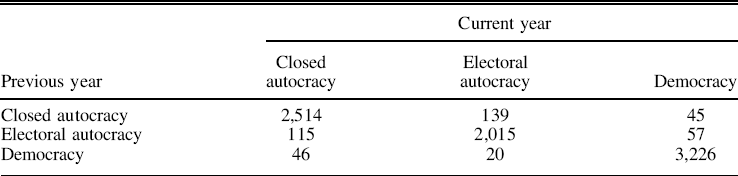
This article examines transitions from closed autocracy to EA and democracy. Table 1 displays the number of transitions between the three regime types. As seen, transitions from closed to electoral autocracy are the most common, with 139 cases (or 5.2 per cent of country-years under closed autocracy).Footnote 34 Transitions directly to democracy are one-third as common. What are the domestic and international factors that predict these transitions?
Transitions between Three Regime Types

Note: the table shows all transitions between the three regime types from 1946–2010. Note that shifts from closed to electoral autocracy are the most common type of transition.
General Theory
Although EA and democracy include a similar set of formal institutions, we should expect very different predictors for each regime type. The key distinction is that autocrats typically retain power when they adopt EA, but lose power after democratization. For all forty-five democratic transitions in this article’s sample, the final autocratic executive lost power within five years (and all but three instantaneously).Footnote 35 In contrast, the majority of executives and more than three in four ruling parties remained in power five years after an EA transition.Footnote 36 Further, in an average five-year period, 75 per cent of democratic executives lose power, compared to 37 per cent of EA leaders and 40 per cent of closed authoritarian rulers.Footnote 37 Whereas democratization is a virtual guarantee to lose power, EA transition may improve security if elections can be controlled. As a result, EA transitions follow from a strategic calculation that balances the benefits of adopting contested elections against the costs and risks.
What are these benefits and costs? On the positive side for EA, regime leaders receive international benefits for allowing contested elections, such as increased foreign aid, reduced trade and military sanctions, and closer engagement with democratic powers.Footnote 38 Thus the anticipated size of international rewards and the leverage held by external democratic actors should encourage EA transition.Footnote 39
On the negative side, contested elections present real risks, as autocrats frequently lose power in even heavily manipulated elections. According to Hyde and Marinov, EA ruling parties have lost fifty-one elections since 1946, often resulting in democratization.Footnote 40 Further, even entrenched parties can face electoral surprises that induce political flux and invigorate the opposition, as occurred in Mexico in 1988, Morocco in 2007, Russia in 2011 and Malaysia in 2013. Simply stealing the election is no panacea, as this can quickly lead to mass protests and elite defections, as in the Philippines in 1986 and Georgia in 2003.
Given these risks, EA adoption should be more likely when autocrats anticipate that they can control the electoral arena. Yet this can be very difficult to predict in the low-information environment of closed autocracy. In some cases, autocrats have rethought legalizing the opposition when initial electoral results were unfavorable.Footnote 41 Absent such signals, regimes must calculate whether they can reliably control the population before allowing open contestation. I argue that a chief factor predicting the ease of electoral control is the population’s socio-economic status, particularly whether there is a large mass of poor voters that the regime can co-opt through clientelism and targeted public goods.
Democratization works very differently, as closed autocratic leaders rarely retain power under democracy. Assuming power is their primary concern, any rewards stemming from democratization will carry little weight. Not only will the rewards fail to match the sacrifice of power, autocrats will no longer be in a position to gain from benefits accruing to the country. As a result, democratization is driven less by an anticipatory cost–benefit calculation and more by whether the regime has the power to survive as a closed autocracy.Footnote 42
In sum, EA transition should be more likely when the direct benefits of EA are high and the autocrat’s risk of turnover within EA is low. The remainder of this section expands on how these benefits and risks vary across regimes, focusing on the leverage of external democracies and socio-economic structure.
International Pressure and Contagion
International pressure for ‘democracy’
Over the last two decades, scholars have increasingly turned to the role of international factors in democratization.Footnote 43 Numerous political benefits, including foreign aid and trade, are designed to be contingent on democracy.Footnote 44 The US Foreign Assistance Act of 1975 and Millennium Challenge Act of 2003 condition aid on democratic and human rights criteria. Diplomatic pressure is also exercised through the State Department’s Bureau of Democracy, Human Rights and Labor. The EU’s European Neighborhood Policy and Cotonou Agreement apply democratic requirements for aid. Democratic conditions are also enshrined in the African Union’s charter and Latin America’s 2001 Inter-American Democratic Charter. Further, studies show that democracies prefer to trade and ally with similar regimes, presenting an implicit reward for recognition as a democracy.Footnote 45
As many scholars have observed, however, the bulk of rewards cast as encouraging ‘democracy’ are in practice given for even critically flawed elections.Footnote 46 Diamond argues that ‘democracy promotion policies have been dominated by a highly minimalist, electoral conception of democracy’.Footnote 47 In African countries, ‘semi-democracy is probably sufficient to deflect international system pressures for more complete political opening’.Footnote 48 As a consequence, the end result of democratic pressure is often transition to EA, since many autocrats will happily adopt partial reforms if they can gain the benefits without sacrificing power.Footnote 49 Failing to distinguish between different types of liberalization may therefore explain why studies so often conflict as to whether foreign aid and pressure effectively spread democracy.Footnote 50
In a recent example, in 2010, Burma’s long-lived military regime began a liberalizing project of expanded civil liberties, political amnesty and multiparty elections. Despite remaining autocratic, Burma’s opening has been met with widespread international acclaim, leading to reduced economic sanctions by the United States, Japan and the EU, increased development aid, and the first-ever visit by an American president in November 2012.
Another illustrative example comes from the Africa Growth Opportunity Act, a 2000 US program that gives duty-free access to 6,400 products from African countries that meet democratic requirements, including ‘the rule of law and political pluralism’. Six countries have had their eligibility revoked and later restored.Footnote 51 In each case, the punishment stemmed from political violence that suspended electoral politics (mainly coups). Eligibility was restored following the resumption of contested elections, but in each case these elections were deemed ‘not free’ or ‘partly free’ by Freedom House.Footnote 52
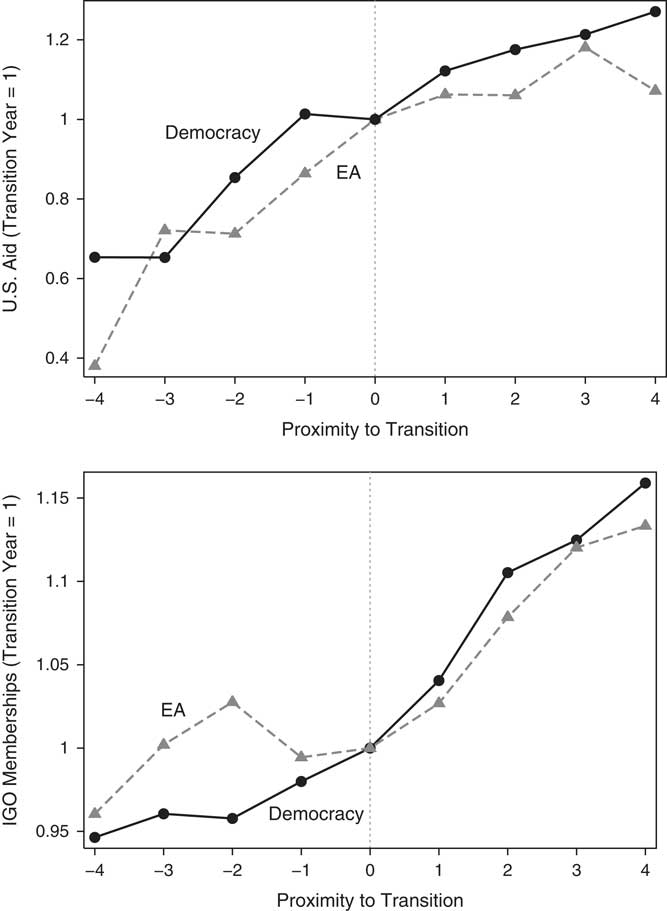
In general, the rewards given for adopting democratic versus merely contested elections are remarkably similar. Figure 2 shows country averages of US economic and military aid (top) and IGO memberships (bottom),Footnote 53 based on proximity to either EA or democratic transition. Transition years for each are normalized to 1 in the figure. In the four years before democratization, the average closed autocracy receives $10.01 per capita in US aid. In the four years following, it receives $15.80. For EA transitions, the shift is from $8.43 to $12.18, an almost identical proportional increase. For IGO memberships, the corresponding increase for democratic transitions is from 44.7 to 51.2; for EA transitions it is from 42.4 to 46.0. Thus EA transition and democratization result in nearly identical benefits.
US economic and military aid and IGO memberships Note: the figures show the average provision of US aid and average memberships in IGOs by proximity to two types of political transitions (democratization and EA transition). A proximity of 0 indicates the year of transition, with the averages normalized so that transition years equal 1. Negative proximity values are closed autocracies in years prior to transitions, and positive values are democracies or EA regimes in years following transitions. The figures show that US aid and international engagement follow very similar patterns after each transition type.

In addition to encouraging EA, international actors’ approval of flawed elections has often worked (sometimes intentionally) to prevent a full democratic opening. In Kenya in 1991, the threatened suspension of aid led Daniel arap Moi to concede to multiparty elections. However, fears of instability led the United States and United Kingdom to endorse highly flawed elections in 1992 and 1997, even restricting fraud reports by their own observation teams.Footnote 54 As Brown writes, ‘This electoral legitimation allowed Moi to […] indefinitely postpone reforms that would have allowed a full transition to democracy’.Footnote 55 Similarly, US pressure has been central to the adoption and maintenance of EA in Egypt, Kuwait, Jordan, Indonesia, Togo and Pakistan.
Why do international actors reward EA adoption under the guise of democracy promotion? In some cases, observers may be genuinely unable to distinguish EA from democracy, or at least unwilling to apply subjective evaluations of the competitiveness and fairness of electoral politics. In contrast, the presence of multiparty elections is concrete and easily observable. But there are deeper reasons for these lax standards: international actors often exaggerate political progress to make democracy promotion look successful, to maintain access, or to reward regimes for economic reforms and partial liberalization.Footnote 56
Regardless of the cause, many autocrats find that they can profit by adopting the formal institutions of democracy without the substance. Since EA does not require sacrificing power, these international incentives provide a strong stimulus to embrace autocratic elections. As Joseph explains, autocrats ‘learned that they did not have to democratize in order to retain [inflows of aid and loans]. What they had to accept, however, was the […] adoption of varying degrees of political liberalization, however effectively constrained in practice’.Footnote 57
Testing international pressure
It follows that the magnitude of international pressure favoring liberalization should predict EA adoption. Testing this presents two primary difficulties. First, we must identify measurable variation in the leverage of external democracies. Secondly, we need to guard against mistaking foreign aid (and other rewards) delivered prior to liberalization as a causal factor when it was given for promises of reform. I therefore show that the results are robust to lagging the international variables by up to five years.
To capture international leverage, I focus on four sources of external dependence on democracies: trade ties, military alliances, IGO co-memberships and foreign aid. When an autocracy is more economically and politically dependent on democracies, economic sanctions and political marginalization become much more costly.Footnote 58 Democracies thereby have greater leverage to incentivize political reforms, either for normative reasons or to improve the legitimacy of the alliance. However, to the extent that piecemeal reforms satisfy these democratic observers, the likely end result is autocratic liberalization rather than democracy. For instance, Egyptian President Anwar Sadat’s unexpected decision to allow multiparty elections in 1976 coincided with a turn from Soviet to US alliance. Egypt scholars generally agree that Sadat was guided by a desire for foreign investment and military co-operation with the West.Footnote 59
Previous work has demonstrated the significance of trade partners’ political characteristics. Hadenius shows that US trade promotes democracy, and Cao et al. find that trade with rights-respecting countries promotes human rights diffusion.Footnote 60 Conversely, other studies show that greater trade with China influences foreign policy and autocratic survival.Footnote 61 Trade dependence on democracies can vary enormously, with major political consequences. In the 1980s, 95 per cent of South Africa’s bilateral trade was with democracies, compared to 60 per cent of Burma’s trade (which subsequently fell as low as 25 per cent). In turn, South Africa liberalized in the early 1990s under intense and costly international pressure from democracies, whereas Burma violently retreated from electoral politics following an unfavorable election in 1991.Footnote 62
Related work examines the influence of democratic military alliances,Footnote 63 co-members of IGOsFootnote 64 and other network interactions.Footnote 65 However, this work either ignores within-autocracy changesFootnote 66 or, by using Polity, implicitly assumes that autocratic liberalization and genuine democratization follow the same logic.Footnote 67 In line with qualitative scholars, I argue that this overlooks the strategic incentives generated by external dependence on democracies, which should more strongly influence institutional adaptation within autocracy.
I compute the fraction of each autocracies’ trade, military alliances, IGO co-memberships and aid represented by democracies, and then show that each predicts transition to EA, but not democracy. I also compare the effects of political, social and economic globalization, none of which predicts democratization. Predictions can be summed up in the following hypotheses:
Hypothesis 1A: Transition to EA is more likely when states are more dependent on external democracies through trade ties, military alliances, IGOs or foreign aid.
Hypothesis 1B: Transition to democracy is unrelated to dependence on external democracies through trade ties, military alliances, IGOs or foreign aid.
Regime contagion
A related international effect is regional contagion. Countries are more likely to democratize and sustain democracy if higher proportions of their regions and neighbors are democratic.Footnote 68 I argue that a parallel effect holds for EA regimes. Most centrally, neighboring regime types proxy for region-specific international pressures. As Levitsky and Way argue, regions vary in their levels of Western cultural and economic linkage, with Latin America and Eastern Europe at the high end.Footnote 69 In their study, this linkage predicts democratic transitions from EA, but it should also explain EA adoption.
In addition, EA neighbors (and to a lesser extent, democratic neighbors) can directly influence EA adoption for four reasons. First, this follows from a policy diffusion logic in which political choices spread through learning and emulation.Footnote 70 If elections and parties function well in nearby countries, autocrats are likely to copy these strategies. Secondly, popular pressure for elections increases when citizens witness them in neighboring countries.Footnote 71 This effect was particularly pronounced during the wave of liberalizations in sub-Saharan Africa from 1990–94.Footnote 72 Thirdly, autocrats want to avoid looking like illiberal outliers in their region.Footnote 73 Fourthly, powerful closed autocracies often provide support for similar neighboring regimes to secure alliances and block future regime diffusion.Footnote 74 For instance, China has been a crucial stabilizing force for North Korea and Laos.Footnote 75 An absence of these hegemonic ‘black knights’ should promote regional liberalization.
Hypothesis 2: Transition to EA is more likely with a higher share of regional EA regimes.
Socio-economic Structure
Closed autocracies primarily rule by force and fear. As Francisco Franco memorably put it, ‘Our regime is based on bayonets and blood, not on hypocritical elections.’ EA regimes, by contrast, require active consent from the masses and the continuous control of a genuine opposition. Leaders will be wary of adopting elections if they believe that controlling them will be too difficult or costly. I focus on how socio-economic characteristics of the population influence the threat of contested elections. Specifically, I argue that wealthier citizens are especially difficult to co-opt and thus discourage EA adoption.
How is EA dominance maintained, and how does this depend on the population? Although electoral manipulation takes many forms, a near-universal characteristic is the use of clientelism to co-opt citizens and elites. This can take the form of individual vote buying, state patronage (where the reward is a state job or service), or targeted local public goods.Footnote 76 Conversely, opposition elements are denied public goods and economic opportunities. The punishment of individuals and local districts for electoral opposition has been observed in Mexico, Jordan, Singapore, Taiwan and many other countries.Footnote 77 In Egypt under the National Democratic Party, for instance, districts supportive of the opposition Muslim Brotherhood were less likely to subsequently receive connections to public sewer and water lines.Footnote 78
The feasibility of this electoral strategy greatly depends on the country’s socio-economic structure. EA regimes typically construct their electoral coalitions around poor voters, who are more cheaply co-opted. Reversing the democratic pattern, the poor are often the most likely to vote in autocratic elections and tend to support the ruling party.Footnote 79 As a result, higher incomes reduce the grip and cost effectiveness of clientelism.Footnote 80 Survey evidence from Ghana shows that both personal wealth and local development reduce an individual’s willingness to sell his or her vote.Footnote 81 Stokes finds the same pattern in Argentina, showing that clientelistic machines focus on poor citizens in small villages, where traditional social networks make them easier to monitor and control.Footnote 82 Further, higher levels of remittances increase local electoral competitiveness in Mexico by reducing voter dependence on state patronage.Footnote 83
In addition to the reduced ability to buy votes, several other mechanisms make wealthier voters more difficult to control within EA. First, they tend to be more mobile, undermining the traditional party-based networks of monitoring and control.Footnote 84 Secondly, wealthier voters are typically better educated, and therefore more discerning and critically evaluative of regime propaganda.Footnote 85 Thirdly, they tend to value political rights over material needs, and will thus push for civil liberties and fairer electoral competition.Footnote 86 Lastly, wealthier citizens have independent resources that can be used to support opposition movements, engage in collective action, and report regime abuses to domestic and international audiences.
It follows that autocratic elections are easier to control with a larger mass of poor voters. Empirical testing confirms that higher average income makes leader turnover more likely in EA regimes, but less likely in closed regimes.Footnote 87 Thus EA is less threatening, and therefore more likely to be adopted, when average income is low and inequality is high. Collier points to several extensions of suffrage in nineteenth century Europe based on ‘confidence in the operation of clientelism and ‘deferential communities’. Similarly, Hugo Banzer allowed 1978 elections in Bolivia because ‘he was confident of winning’ in the poor environment.Footnote 88 Portugal’s Republican Party allowed contested elections in 1911 for the same reason: ‘The meager resources local bosses traded for votes had value precisely because the population was so poor.’Footnote 89
To illustrate the logic further, consider the divergent paths of four Latin American military governments. After the 1964 military coup, Brazil legalized multiple parties and slowly liberalized, finally democratizing in the 1980s. Inspired by Brazil’s concurrent economic success, right-wing military governments in 1970s Chile, Argentina and Uruguay imitated a developmental approach that O’Donnell termed ‘bureaucratic authoritarianism’.Footnote 90 Yet despite copying many aspects of Brazil’s politics, all three states banned multiparty competition. Why did Brazil adopt EA when the other three did not? Critically, Brazil was by far the poorest and most unequal of the four countries. At the time of democratic breakdown, Brazil’s average income was half the next poorest, with its Gini measure of inequality 43 per cent higher than the others’ average. The large mass of poor, rural voters allowed Brazil’s military to dominate the electoral arena and engage in controlled liberalization. In contrast, the others’ development made elections more difficult to control. Despite widespread repression, military regimes in Uruguay and Chile lost key plebiscites in 1980 and 1988, respectively, due to surprisingly sophisticated opposition campaigns. In Argentina, the ‘highly mobilized and organized labor movement’ produced by industrialization made EA competition unworkable for the military.Footnote 91 The predictions can be summed up as follows:
Hypothesis 3: Transition to EA is more likely when average income is lower.
Hypothesis 4: Transition to EA is more likely when economic inequality is higher.
Note that both predictions are opposite in sign to what is most commonly predicted for democracy.Footnote 92 A related factor is the extent of funds available to the regime for electoral control.Footnote 93 Greene argues that natural resource revenues are a critical source of capital for clientelism, leading EA ruling parties to democratize when resource revenues decline.Footnote 94 By extension, resource dependence could predict EA transition if rulers anticipate having these funds for electoral control. However, resources also help consolidate power in closed autocracy and blunt international pressure for liberalization.Footnote 95 Expectations are therefore unclear.
EMPIRICAL ANALYSIS AND DATA
Empirical Design
I estimate a multinomial logit model that simultaneously predicts transitions to EA and democracy from a sample of closed autocracies, covering 1946–2010. I remove cases of state failure (3.9 per cent of country-years in closed autocracy) since they are generally incapable of adopting electoral politics, although the results are unchanged when including them.Footnote 96 The multinomial logit’s reference category is remaining a closed autocracy. To account for heteroskedasticity and the panel structure, I use robust standard errors clustered by country.
This empirical set-up allows for a close comparison of the factors that predict each type of transition. Further, it provides a more accurate test of EA transition, as a binary logit would lump together stable closed autocracies and democratizing countries in the reference category.
Multinomial logit relies on an assumption of independence of irrelevant alternatives (IIA), which states that excluding specific outcomes does not affect the relative odds of the remaining outcomes. For instance, the relative likelihood of transition to EA versus democracy should not depend on the inclusion of closed autocratic stability as a category. For this article’s main models (Table 2), the Hausman χ 2 test fails to reject the IIA assumption for all three regime categories, thus validating the use of multinomial logit.Footnote 97
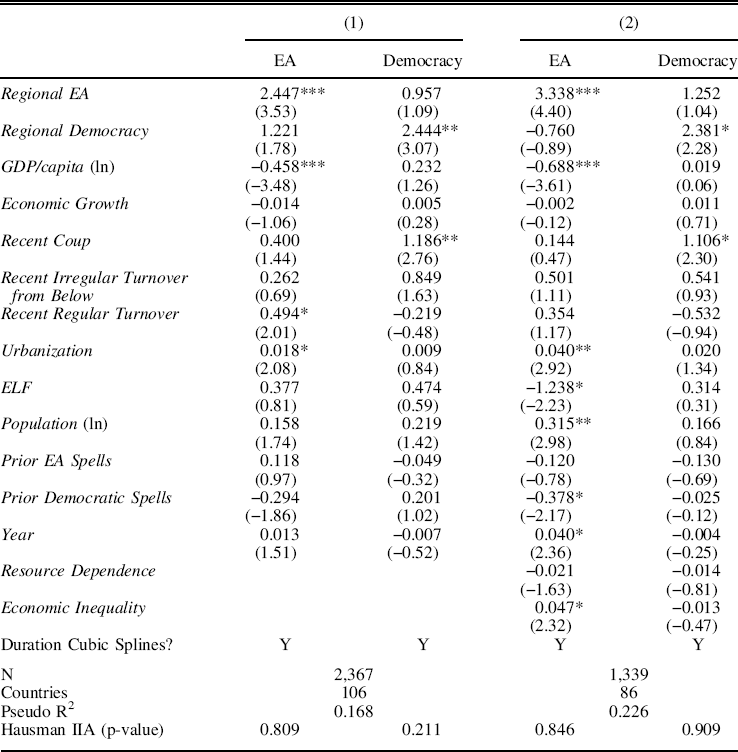
Multinomial Logits Predicting Transitions to EA and Democracy

Note: the table displays two multinomial logit models separately predicting transitions to electoral authoritarianism (EA) and democracy from a sample of closed autocracies. Years are 1946–2010. t statistics (based on robust standard errors clustered by country) are shown in parentheses. *p<0.05, **p<0.01, ***p<0.01
Establishing Regime Choice
This article’s central claim is that autocratic rulers strategically adopt EA. There are two alternative possibilities that require exploration. First, some transitions may be unintended by autocrats. Although the adoption of multiple parties cannot be accidental, it may be that some countries democratize when the ruler intends an EA transition but loses control. To address this possibility, a robustness check recodes the cases of democratization that may have been attempted, but failed, EA transitions. The main results are unchanged.
Secondly, perhaps EA transitions are not strategically chosen by autocrats but forced upon them by domestic actors. For instance, election adoption might occur in the face of overwhelming popular protests. To address this potential explanation, I test several factors related to regime vulnerability and domestic pressure: coercive capacity, state capacity, protests, irregular leader change and civil conflict. None of these variables predicts EA transition.
Measures of Regime Types
Democracy is measured using Boix et al.’s dichotomous coding (updated through 2010), which requires free and fair elections and a minimal level of suffrage.Footnote 98 While highly correlated with other democracy measures, this coding is advantageous as it explicitly differentiates democracies from EA regimes based on the freedom and fairness of elections.
EA regimes are defined as autocracies in which multiple political parties exist and legally compete in legislative elections.Footnote 99 About 88 per cent of these regimes featured full legislative elections within the previous five years.Footnote 100 This definition has two main advantages. First, it is highly concrete, as it is based on a formal legal requirement and not a subjective evaluation of contestation. Secondly, transitions to EA must involve deliberate state action, as legalizing opposition parties is a significant political change.
For twelve countries, Cheibub et al. code the adoption of multiparty politics as occurring one year prior to a democratic transition. Such cases should not be counted as EA transitions, as they simply result from a disagreement between the two sources about the timing of democratization. As such, these cases are recoded as democratizing from closed autocracy in the year assigned by Boix et al.Footnote 101
Independent Variables
I now overview the main independent variables and controls included in each model. All variables predict transitions to both EA and democracy. They are lagged by one year in the main models and by five years in a robustness check to ease endogeneity concerns. Summary statistics are shown in Appendix Table A1. Additional variables, including measures of international leverage, are described in the results section.
Regional EA and Regional Democracy are defined as the fraction of EA regimes and democracies in each country’s region (excluding the country itself).Footnote 102 Similar measures capture the regimes types of trade partners, allies, IGO co-members and donors. Although simple in design, these measures are equivalent to modern spatial dependence models in which the spatial-lag weighting matrix W is defined by region, dyadic trade, military alliances, IGO co-memberships and aid.Footnote 103
Economic development is proxied by logged GDP/capita (in real 2000 dollars).Footnote 104 Economic Inequality is measured by the Gini index of income.Footnote 105 I test five other socio-economic indicators: Economic Growth (the percentage change in GDP/capita), Population (logged),Footnote 106 Urbanization (the percentage living in cities of 100,000+),Footnote 107 ELF (ethnolinguistic fractionalization)Footnote 108 and Resource Dependence (fuel and metal revenues as a percentage of GDP).Footnote 109 Due to missing data, I first run a model omitting Economic Inequality and Resource Dependence.
For three types of executive turnover, I test a dummy variable for whether each has occurred in the past five years.Footnote 110 I distinguish regular turnovers (which occur legally), coups and irregular turnovers from below (primarily rebels and protest movements).Footnote 111 Turnovers in autocracy have been linked to transitions as they weaken autocratic regimes and force new leaders to seek out sources of legitimacy.Footnote 112
Because global regime types have fluctuated over time, I control for the year as a linear term.Footnote 113 To capture regime history, I control for the country’s number of prior spells of EA and democracy. Finally, I account for regime longevity using the Polity dataset’s Durable variable.Footnote 114 I add cubic splines of duration with three knots (at the 25th, 50th and 75th percentiles of Durable). This represents a highly flexible duration model that allows the transition propensity to vary with regime age.
EMPIRICAL RESULTS
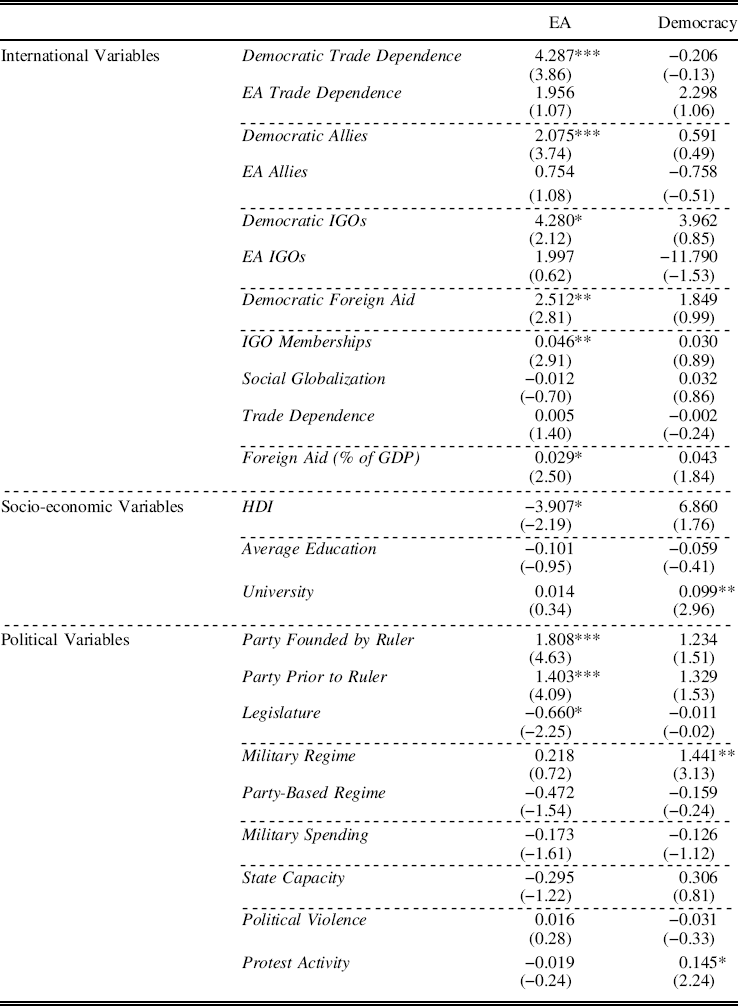
Table 2 displays the initial multinomial logit results. Due to missing data concerns, I first consider a base model (Model 1) that includes most of the key variables yet retains 92 per cent of all observations. Model 2 adds controls for Resource Dependence and Economic Inequality. Table 3 summarizes thirteen additional models separated by dashed lines. For each, a set of variables is added to the base model, and the results for these additional variables are shown. I discuss in turn the findings for international factors, socio-economic structure and other predictors.
Additional Predictors of Transitions to EA and Democracy

Note: the table displays additional predictors of transitions to EA and democracy. Each set of variables between the dashed lines is separately added to Model 1 in Table 2. Thirteen multinomial logit models are shown. t statistics (based on robust standard errors clustered by country) are shown in parentheses. *p<0.05, **p<0.01, ***p<0.01
International Factors
Table 3 displays tests of how international leverage and engagement influence regime change. The first model calculates the effect of trade dependence. The two variables measure the fraction of dyadic trade represented by democracies and EA regimes,Footnote 115 respectively, to test whether economic reliance on these regime types predicts political diffusion. The interesting finding is that economic engagement with democracies strongly encourages transition to EA, but the effect on democratization is slightly negative. In contrast, trade with EA regimes is unrelated to either transition.Footnote 116
The second model in Table 3 tests a different source of international leverage: dependence on military allies. The two variables measure the fraction of each regime type among a country’s formal military allies.Footnote 117 The third model instead looks at regime types among co-members of IGOs.Footnote 118 Lastly, the fourth model tests the fraction of foreign bilateral aid commitments represented by democracies.Footnote 119
In each case, the democratic fraction strongly and significantly influences EA adoption, but not democratization, strongly supporting Hypotheses 1A and 1B. In contrast, the EA fraction has no effect. Autocrats routinely adapt their institutions to mollify the democracies on which they are economically or politically dependent. Thus international leverage by democracies secures the adoption of formal electoral institutions, but not full democratization. These findings are unlikely to stem from democracies engaging with autocracies that promise liberalization, as the results hold after lagging international leverage (see below).
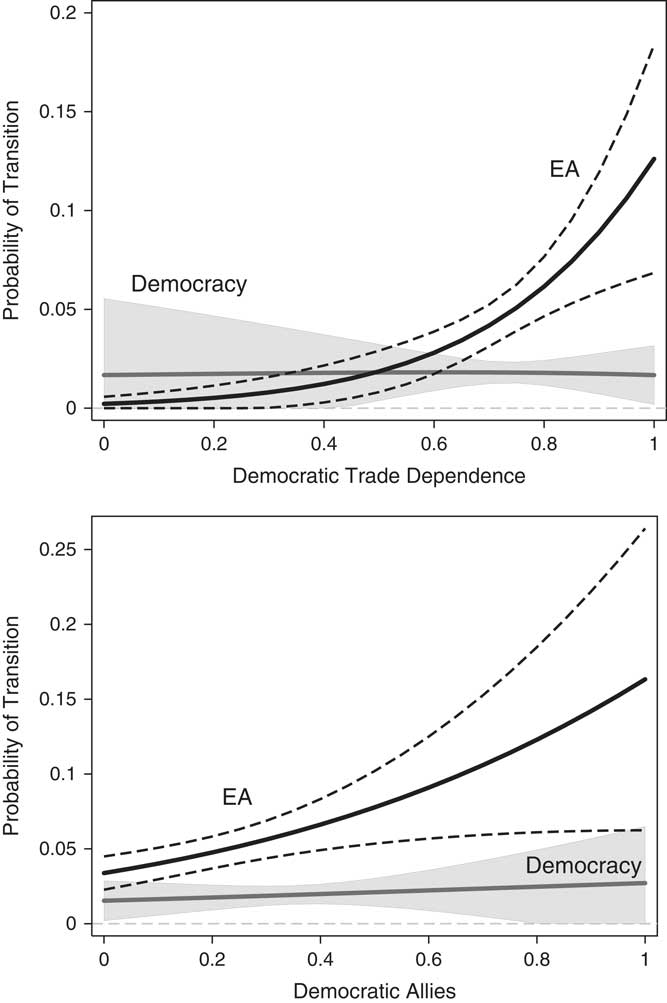
Figure 3 shows the predicted probability of each transition from the first two models, alternatively varying Democratic Trade Dependence and Democratic Allies. Other variables are held at their means. In both cases, there is a large substantive effect on EA transition. Shifting democratic trade dependence up its full range shifts EA transition’s likelihood from roughly 0 per cent to 13 per cent. For democratic military allies, the shift is from 4 per cent to 16 per cent.
Transitions by democratic trade dependence and democratic allies Note: the figure shows estimated probabilities (with 95 per cent confidence intervals) of transition to EA and democracy, based on the first two models in Table 3. The top panel varies Democratic Trade Dependence along the horizontal axis. The bottom panel varies Democratic Allies. Other variables are held at their means. As clearly seen, external leverage by democracies predicts EA transition, but not democratization.

The fifth model compares three types of international engagement: political, social and economic. Following Pevehouse and Torfason and Ingram,Footnote 120 political engagement is measured by the country’s IGO Memberships.Footnote 121 Social Globalization is the KOF index of personal contacts, information flows and cultural diffusion from abroad.Footnote 122 Lastly, economic engagement is proxied by Trade Dependence (imports and exports as a percentage of GDP).Footnote 123 Only IGO Memberships predicts EA transition, whereas none of the variables predicts democratization.
The sixth model tests total Foreign Aid (official development assistance as a percentage of gross national income).Footnote 124 Previous research disagrees as to whether foreign aid (and democracy assistance) encourages moves towards democracy.Footnote 125 The results here are similarly mixed: Foreign Aid significantly predicts EA transition, but is insignificantly positive for democratization. This adds nuance to studies connecting foreign aid to multiparty adoption without distinguishing between EA and democracy.Footnote 126 The fifth and sixth models further support the idea that international leverage encourages piecemeal political reforms, but the results are generally stronger if this leverage is held by democracies.
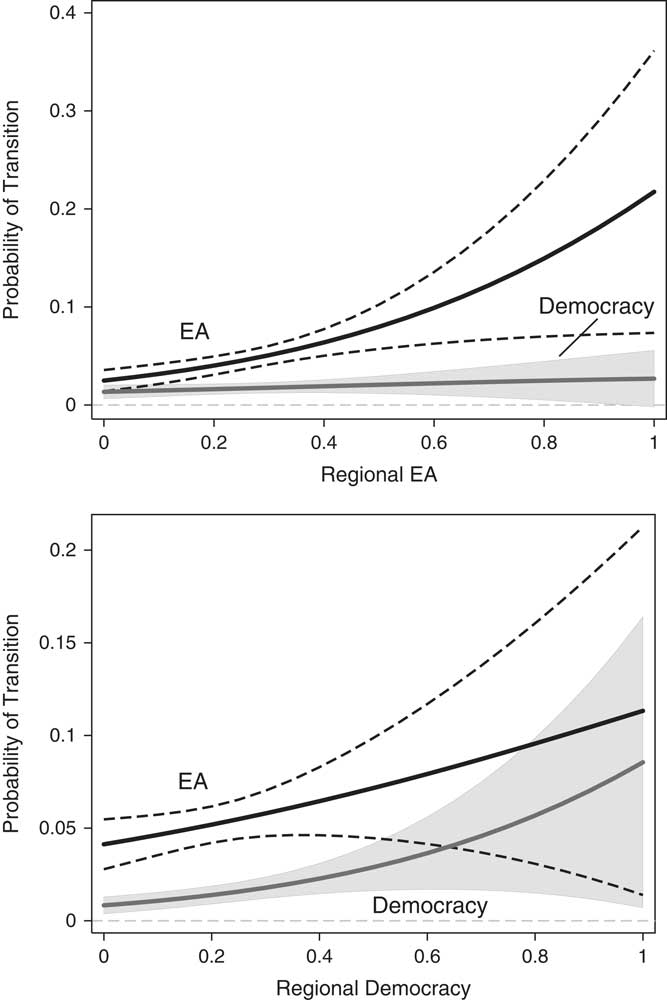
Finally, the two models in Table 2 display clear evidence of regional diffusion: being surrounded by EA regimes predicts transition to EA, whereas being surrounded by democracies predicts democratization. This extends previous findings on regional democratic contagion to a parallel effect for EA, confirming Hypothesis 2. Regional Democracy is also positive for EA transition in Model 1, but narrowly misses significance.Footnote 127 Figure 4 shows the predicted probabilities of transition to EA and democracy from Model 1. In the top panel, Regional EA is varied along the horizontal axis, holding other variables at their means. The estimated likelihood of EA transition ranges from about 2 per cent to nearly 20 per cent each year. The bottom panel instead varies Regional Democracy, showing a similarly strong effect on both transitions. In total, EA transition is more sensitive to regime contagion than democratization.
Transitions by regional EA and regional democracy Note: the figures show estimated probabilities (with 95 per cent confidence intervals) of transition to EA and democracy, based on Model 1 in Table 2. The top panel varies Regional EA along the horizontal axis. The bottom panel varies Regional Democracy. Other variables are held at their means. The results show a corresponding contagion effect of regional EA regimes on EA adoption and regional democracy on democratization.

Socio-economic Structure
I now turn to socio-economic factors. Both models in Table 2 support Hypothesis 3: GDP per capita is significantly negative for EA transition. Using Model 1 and holding other variables at their means, shifting average income from the 10th to the 90th percentile of closed autocracies decreases the annual likelihood of EA transition from 8.5 per cent to 2.3 per cent.Footnote 128 This reflects the difficulty of controlling autocratic elections in wealthier countries, encouraging regimes to retain closed autocracy. In comparison, the likelihood of democratizing increases from 1.2 per cent to 2.6 per cent, although the effect is not significant.
Similarly, in Model 2, Economic Inequality is positive for EA transition and non-predictive of democratization, supporting Hypothesis 4. A 10th to 90th percentile shift on inequality raises the chances of EA transition from 4.0 per cent to 9.0 per cent.Footnote 129 Further, infant mortality and under-five mortality,Footnote 130 common measures of a population’s material deprivation and inequality, both significantly predict EA transition when tested in place of GDP per capita. Unequal countries have more poor citizens who can be cheaply co-opted by state assistance, which makes electoral control easier. These socio-economic effects are counterintuitive, but help to explain the concentration of EA in the most poverty-ridden parts of Africa and Southeast Asia.
Urbanization is significantly positive for EA transition, which may reflect the greater ease of building patron–client networks in urban environments.Footnote 131 Economic Growth, ELF and Resource Dependence are insignificant for both transitions. Surprisingly, Resource Dependence is slightly negative for EA transition, suggesting that it helps to strengthen closed autocracy.Footnote 132
The seventh model in Table 3 tests the Human Development Index (HDI), an aggregate index of income, education and health,Footnote 133 which should match the logic for average income. Indeed, even controlling for GDP per capita, HDI is significantly negative for EA transition. The next model tests two measures of education: Average Education (schooling years among adults)Footnote 134 and University (percentage enrolled at university).Footnote 135 The unexpected finding is that overall education does not predict either transition, but University strongly predicts democratization. Besides the critical role often played by current university students, this may indicate the democratizing influence of norms spread through advanced education and exposure to modern ideas.Footnote 136
Other Predictors
Models 1 and 2 in Table 2 compare three types of leader turnover, using dummy variables for an occurrence within the previous five years. Recent coups strongly predict democratization, as they indicate key periods of instability and regime weakness.Footnote 137 Using Model 1, a closed autocracy has a 1.1 per cent annual chance of democratizing without a recent coup, compared to a 2.9 per cent chance with one. Other irregular turnovers are insignificant for both transition types. Regular turnovers are predictive of EA transition, but only in Model 1.
Table 3 covers five further models. First, I control for the presence of a regime party founded by the current ruler, a party existing prior to the ruler, and a legislature.Footnote 138 Wright and Escribà-Folch argue that parties should be positive for democratization and legislatures negative because parties help regimes retain power post-democratization, whereas legislatures merely bolster regime control.Footnote 139 In fact, that pattern fits the results for EA transitions. Parties are positive for democratization, but not significantly so.
A second institutional model controls for whether the autocracy is a military or party-based regime.Footnote 140 As Geddes observes, military regimes are highly prone to democratization.Footnote 141 However, this effect does not extend to EA transitions. Surprisingly, party-based regimes are slightly less likely to transition from closed autocracy.Footnote 142
The next two models test whether coercive capacity and state strength predict transition. Military Spending (as a percentage of GDP)Footnote 143 is insignificantly negative for each transition. State Capacity (a combination of 24 variables capturing administrative and coercive capacity)Footnote 144 is also unpredictive. In the final model, I test the effects of Political Violence (a ten-point rating of domestic civil and ethnic violence),Footnote 145 which may encourage transition by destabilizing the country’s politics, and peaceful Protest Activity (the number of protests and strikes).Footnote 146 The latter is significantly positive for democratization, but neither predicts EA transition.Footnote 147
These final three models dispute the alternative theory that closed regimes adopt EA out of weakness, either due to low coercive capacity or strong opposition. In fact, except for the existence of a party, domestic political variables are surprisingly weak predictors of EA transition. Rather, international leverage and favorable socio-economic conditions are the pivotal factors, supporting this article’s theory on strategic EA adoption.
Robustness Checks
Appendix Table A2 displays four robustness checks based on recoding EA transitions. All controls in Model 1 of Table 2 are included. The same checks for the models in Table 3 are summarized in Table A3. Model 1 recodes as EA transitions eight cases of democratization that may have been failed attempts to establish EA.Footnote 148 Model 2 recodes EA to additionally require a national legislative election within the past five years.Footnote 149 Model 3 only counts transitions that retain the new regime type for five years.Footnote 150 Finally, Model 4 requires opposition parties outside the regime party front to qualify as EA, raising the bar for multiparty competition.Footnote 151
Two further robustness checks are shown in Table A4. The first includes cases of state failure in the sample.Footnote 152 The second successively lags each variable of interest by five years to minimize endogeneity and reverse causation.
The main results for EA transition are highly robust across these checks. For the 24 total coefficients on democratic leverage (four variables, with six checks each), 22 remain significant.Footnote 153 Foreign Aid (% of GDP) is less stable, but remains consistently signed and significant at the 0.1 level in four of six checks. Regional contagion holds in all but the lagged model. GDP per capita remains significant at the 0.05 level in all models and at the 0.001 level in four of six models. Despite data limitations, Economic Inequality is fairly robust, remaining significant at the 0.1 level across all checks. Urbanization significantly predicts EA transition in all but the state failure model.
Table A5 displays how the main variables’ effects differ during and after the Cold War (1946–89). Many authors claim that geopolitical changes following the Cold War shifted regime change dynamics, particularly as Western democracies became more willing to push for liberalization.Footnote 154 The results show interesting variation between periods. Although there is no significant difference across periods for democratic leverage from trade dependence or foreign aid, the effects of democratic allies and IGOs are stronger during the Cold War. The positive effect of Foreign Aid and the negative effect of GDP per capita are both stronger post-Cold War.Footnote 155
Lastly, Figure A1 presents a cross-validation analysis, showing the out-of-sample predictive power of several variables. Multinomial logits are run on randomly chosen sub-samples of the data, and predictions from this model are then compared to transitions in the remaining data. This is repeated 2,000 times. The results show that the main variables add considerable predictive power for EA transition, with the strongest contribution from trade and IGO dependence. The added predictive power for democratization is relatively modest.
CONCLUSION
This article presents a strategic theory of autocratic regime change. Autocratic leaders hold contested elections to gain international benefits, but only if socio-economic conditions favor their ability to dominate the elections. Thus EA transitions are predicted by external dependence on democracies (through trade, military alliances, IGOs and aid) and by low average income and high inequality. I also find evidence of regional contagion of both EA and democracy. Despite few predictors of democratization, this study sheds light on modern pathways to democracy since 90 per cent of recent democratic transitions occur from EA.
The results empirically support claims that international pressure and aid aimed at ‘democracy’ promotion in fact encourage liberalized autocracy.Footnote 156 Compared to sustaining closed autocracy, this encouragement of EA is not necessarily a bad thing, as there is evidence that EA promotes human development and later democratic survival.Footnote 157 However, the effect of democratic leverage should be acknowledged, as it can help spur adaptation that leads to genuinely pro-democratic effects.
Future work should analyze specific cases of EA adoption to further support this article’s causal logic and develop new theory. These transitions are politically significant, but have not attracted a fraction of the attention directed at democratic transitions. Once regarded as inherently transitional and unstable, electoral autocracies are now widely recognized as distinct and durable regime types.Footnote 158 Future research should avoid lumping them in with democracies or assuming that all forms of liberalization follow the same logic. A better understanding of the origins of electoral autocracies can provide insight into how these regimes function and how international actors can promote democracy, in both form and substance.