Implications
In recent years, after the ban on the use of antibiotics as growth promoters, phyto-additives have been proposed to improve rabbit health and reduce post-weaning mortality. The present study describes the effects of dietary supplementation with Echinacea pallida (EPAL) (known to possess immune-enhancement and antioxidative properties) on the reproductive performance and immunity parameters of rabbit does. In the present study, an EPAL dietary supplementation has been shown not to influence the reproductive or haematological parameters of rabbit does.
Introduction
Animal health is a critical issue in animal production and it has an important effect on the income generated from husbandry activities. Moreover, since the European Union has banned the use of antibiotics as feed additives, many researches in the animal nutrition area have focused on gauging alternative feeding strategies to prevent digestive diseases, while enabling the achievement of a satisfactory growth performance. Given the advances in modern biotechnology, the application of naturally occurring antimicrobial and antioxidant compounds has preferably been employed in animal nutrition, due to their potential health benefits on the host physiology (Chrastinová et al., Reference Chrastinová, Chrenkova, Laukova, Poláčiková, Simonová, Szabóová, Strompfová, Ondruška, Chlebec, Parkányi, Rafay and Vasilkková2010). The immunomodulatory and antioxidative properties of officinal plants are well known, as is their ability to promote positive outcomes on animal health and performance (Böhmer et al., Reference Böhmer, Salisch, Paulicks and Roth2009; Arafa et al., Reference Arafa, Salem and Farid2010).
Echinacea is a genus of herbaceous flowering plants belonging to the Asteraceae botanical family. It is produced extensively and has great economic importance in the United States of America, Canada and European countries. The use of a mixture of Echinacea purpurea (EPUR), Echinacea angustifolia (EANG) and Echinacea pallida (EPAL) has been reported to have immune-enhancement properties and benefits, such as the prevention and treatment of upper respiratory tract infections (Barnes et al., Reference Barnes, Anderson, Gibbons and Phillipson2005). The chemistry of Echinacea species has been well documented, and several groups of constituents, including alkamides and caffeic acid derivatives, are considered important for health improvement activities (Cheminat et al., Reference Cheminat, Zawatzky, Becker and Brouillard1988). However, there are differences in the constituent profiles of the three species. Active components from Echinacea extracts (mainly alkylamides, polysaccharides and proteoglycans) have been shown to exert immunomodulatory, anti-inflammatory and anti-viral activities (Barnes et al., Reference Barnes, Anderson, Gibbons and Phillipson2005). Extracts of EPAL have been proposed as phyto-immunostimulating agents, and their activities are mainly directed toward the innate immune system. Most studies performed on the immunotropic properties of EPAL have been related to its effect on non-specific immunity (activation of macrophage functions, phagocytosis of granulocytes, natural killer cell cytotoxicity), while other studies have investigated the adaptive immune modulation of EPAL (Egger et al., Reference Egger, Pellett, Nicki, Geiger, Graetz, Seifert, Heilmann and König2008). Most Echinacea studies on rabbit nutrition have focused on the fattening period (Kovitvadhi et al., Reference Kovitvadhi, Gai, Dabbou, Ferrocino, Rotolo, Falzone, Vignolini, Gennero, Bergagna, Dezzutto, Barbero, Nebbia, Rosati, Cocolin, Zoccarato and Gasco2016). Nevertheless, scarce and conflicting evidence is available concerning the use of Echinacea spp. products in rabbit does during pregnancy. On the basis of this evidence, it was decided to conduct a two part study. The first part has been aimed at evaluating the effects of EPAL dietary supplementation on the reproductive performance, blood parameters and immune indices of rabbit does. The second part of this study will evaluate the pre- and postnatal effects on growth performances, bacterial community, blood parameters and immunity in growing rabbits due to the dietary addition of EPAL (Kovitvadhi et al., Reference Kovitvadhi, Gai, Dabbou, Ferrocino, Rotolo, Falzone, Vignolini, Gennero, Bergagna, Dezzutto, Barbero, Nebbia, Rosati, Cocolin, Zoccarato and Gasco2016).
Material and methods
Animals, housing, diets and management of the rabbit does
A total of 100 nulliparous does (14 weeks old) of a strain of Grimaud rabbits, obtained from Grimaud Italy, were housed individually in a closed rabbitry, in flat-deck wire net cages (40×50 cm2, including nest boxes: 41×26 cm2), under a constant photoperiod of 16 h of light per day. The rabbitry temperature was kept within 18°C to 22°C. A relative humidity of 60% to 75% was maintained by means of a forced ventilation system.
The does were randomly assigned to two groups (50 does/group). The first group was fed a commercial pelleted diet ad libitum (control diet, C), while the second one was fed the same diet supplemented with 3 g of EPAL powder/kg diet (Echinacea diet, E).
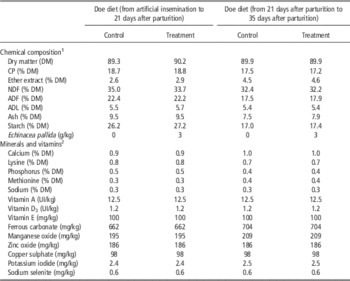
The doe rabbit diets were provided by the Ferrero S.p.A. feed manufacturer (Farigliano, CN, Italy). Dry ground EPAL roots, obtained from Biotrade Snc® (Via Pacinotti 21, Mirandola, MO, Italy), were included in the treated diets during the raw material mixing process. The feeding programme consisted in feeding a diet from insemination to 21 days after parturition and then another diet from 21 days after parturition to kit weaning. The diets contained the following ingredients in decreasing order: alfalfa meal, sunflower meal, barley, wheat bran, dried beet pulp, maize germ, roasted soybean meal, cane molasses, soybean oil, calcium carbonate and sodium chloride. The diets were analysed for dry matter (DM, AOAC 925.40), CP by total nitrogen contents (AOAC 984.13), ether extract (AOAC 945.16), crude fibre (AOAC 962.09) and ash by ignition to 550°C (AOAC 923.03), according to the Association of Official Analytical Chemists (AOAC, 2000). NDF, ADF and ADL were determined according to Van Soest et al. (Reference Van Soest, Robertson and Lewis1991). Starch was determined by means of Ewer’s polarimetric method (European Economic Community, 1972). The chemical composition of the different diets is reported in Table 1. Water was available from nipple drinkers ad libitum. The diets were completely exempt from medication (antibiotics or coccidiostat). All the animals were reared under the same environmental and management conditions throughout the whole experimental period. The rabbit does were first artificially inseminated at 21 weeks of age (mean body weight (BW): 3712±176 g). Then, artificial insemination was applied at 18 days postpartum (49-day reproductive rhythm and single batch system). Cross-fostering was applied within the experimental groups, with a maximum of eight, nine and 10 kits/litter at first, second and following kindling, respectively. The kits were freely nursed by their does and weaned at 35 days of age.
Composition of the rabbit doe diets

1 The experimental diets were analysed in the laboratory of the Department of Agricultural, Forest and Food Sciences, Turin, Italy.
2 These data were provided by the Ferrero Mangimi S.p.A (Farigliano, CN, Italy), which formulated and prepared the experimental diets.
Doe performance
The data pertaining to the first five consecutive reproductive cycles were evaluated. The BW of the does at the first and final kindlings, doe mortality and reproductive performance variables were studied. The following variables were calculated on the basis of the IRRG’s recommendations (International Rabbit Reproduction Group, 2005): total born; born alive; stillborn; litter size at 21 and 35 days of age; litter weight at 21 and 35 days of age; individual BW of kits at 21 and 35 days of age; Kindling rate (%)=number of kindled does per number of inseminated does×100; Prolificacy=number of born kits per number of does kindled; Numerical productivity at birth=number of born alive per inseminated doe; Overall productivity at birth=weight of born alive per inseminated doe; Perinatal mortality (%)=number of stillborn kits per number of total born×100; mortality between 0 to 21 and 0 to 35 days of age.
Haematological, serum biochemistry and serum electrophoresis of the rabbit does
Blood samples were collected from eight rabbits per group at different times during the second gestation period. Considering the day of artificial insemination as the starting day (T0), blood samples were collected at: day 0, day 14 and day 28, respectively. The samples were collected from the lateral saphenous vein with a heparinised syringe to prevent blood clotting. At each sampling time, 1 ml of blood was collected in sterile tubes containing ethylenediaminetetraacetic acid −2K (SB-41; Sysmex Corporation, Hyogo, Japan) for evaluation of the haematological parameters. Meanwhile, serum, obtained by collecting 4 ml blood samples in a sterile serum plain tube after incubation at room temperature (22°C) for 2 h and centrifugation at 2500×g for 10 min, was used for serum biochemistry and serum electrophoresis. The serum was stored at −80°C until analysis. A full blood count was performed using an automated laser cell counter (MS4-S Hematology Analyzer; Melet Schloesing, Osny, France) calibrated for rabbits, to assess the following parameters: red blood cells (RBC, M/mm3), haemoglobin (Hb, g/dl), haematocrit (HCT, %), mean corpuscular volume (MCV, fl), mean corpuscular haemoglobin (MCH, pg), mean corpuscular haemoglobin concentration (MCHC, g/dl), red cell distribution width (RDW, %), platelets (PLT, m/mm3), relative volume of thrombocytes (PCT, %), mean platelet volume (MPV, fl), platelet distribution width (PDW, %), white blood cell count (WBC, m/mm3), lymphocytes (LYM, %), monocytes (MON, %), neutrophils (NEUT,%), eosinophils (EOS, %) and basophils (BAS, %). Concentrations of the total protein (TP, g/dl), glutamate oxaloacetate transaminase (GOT, UI/l), blood urea nitrogen (BUN, mg/dl), albumin (g/dl), urea (mg/dl) and cholesterol (mg/dl) were measured for the serum blood chemistry using an automated system photometer (Screen Master Touch; Hospitex Diagnostics, Sesto Fiorentino, FI, Italy).
Serum electrophoretic patterns were obtained for the immune indices, using a semi-automated agarose gel electrophoresis system (Sebia Hydrasys, Evry, France), to determine the serum protein. Serum lysozyme was measured by means of a lysoplate assay, carried out in a moist incubator at 37°C for 18 min. The method is based on the lyses of Micrococcus lysodeikticus in 1% agarose. The diameter of the lysed zones was measured with a ruler and compared with the lysed zones of a standard lysozyme preparation (Sigma Aldrich, Milan, Italy). The value was expressed as microgram per millilitre (Osserman and Lawlor, Reference Osserman and Lawlor1996). The haemolytic complement assay was carried out in microtitre plates. The complement titre is the reciprocal of the serum dilution causing 50% lysis of the RBCs of rams. Its concentration was expressed as CH50% (Moscati et al., Reference Moscati, Dal Bosco, Battistacci, Cardinali, Mugnai and Castellini2008).
Chromatographic identification of the Echinacea ingredients
Chemicals
The echinacoside (purity 98%), chlorogenic acid (purity ⩾95%), HPLC-MS and analytical grade solvents were purchased from Sigma Aldrich (Milan, Italy).
Extraction procedure
A total of 500 mg of dry ground EPAL roots was sonicated for 10 min with 10 ml of a mixture of MeOH/H2O (70/30) three times. The resulting total extract (30 ml) was filtered and analysed by means of the UHPLC-PDA-MS/MS system (Shimadzu, Duisburg, Germany).
HPLC analysis
EPAL extract analyses were carried out on a Shimadzu Nexera X2 system equipped with an SPD-M20A photodiode detector in series connected to a triple quadrupole Shimadzu LCMS-8040 system provided with an electrospray ionization (ESI) source (Shimadzu, Duisburg, Germany). An Ascentis® Express C18 column (150×2.1 mm i.d., 2.7 μm particle size) (Supelco, Bellefonte, PA, USA), operated at 30°C was used. The mobile phase consisted of 0.1% formic acid in water (A) and 0.1% formic acid in acetonitrile (B) and was fed at a flow rate of 0.4 ml/min. Elution of the polyphenols was achieved using the following linear gradient: starting condition, 95% A, 5% B; 3 min, from 5% to 15% B; 17 min, from 15% to 100% B; 5 min and 100% B for 2 min. The injection volume was 5 μl. The UV spectra were acquired in the 210 to 450 nm wavelength range. The identification of the components was based on the co-injection of pure standards and on their UV spectra as well as on mass spectral information in both positive and negative ionisation modes (ESI+ and ESI−, respectively).
Quantification of echinacoside: a standard stock solution (1 mg/ml) of echinacoside was prepared in methanol and stored at −18°C. Suitable dilutions of the standard stock solution in methanol/water (1/10) were prepared to obtain final concentrations of 10 to 100 mg/ml. A calibration curve was built by analysing the resulting standard dilutions three times by means of HPLC coupled with photodiode array.
Statistical analysis
Statistical analyses were performed using SPSS software package (IBM SPSS, 2012). Data concerning the reproductive parameters from the first to the fifth reproductive cycles were combined and analysed in a single data set. Statistical analyses were performed for significant differences in the reproductive performance between the control and Echinacea groups using a Student’s t test. Mortality, kindling rate and prolificacy were analysed using a χ 2 test. The effect of dietary treatments on the blood indices and immune parameters across three gestational periods (day 0, day 14, day 28) was statistically analysed with a mixed between-within subject model (GLM repeated measures). Duncan’s new multiple range test was used for post hoc comparisons. Significance was declared at P<0.05.
Results
HPLC profile of EPAL
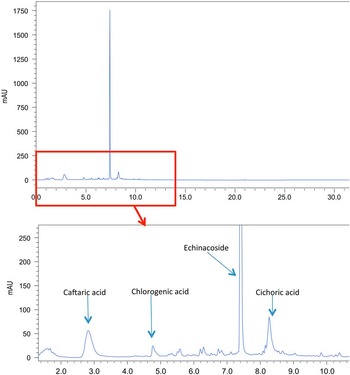
The HPLC profiles of the EPAL root extract are shown in Figure 1. The analysis identified the presence of caftaric acid, cichoric acid, chlorogenic acid and echinacoside, which specifically characterises EPAL species (Hu and Kitts, Reference Hu and Kitts2000; Speroni et al., Reference Speroni, Govoni, Guizzardi, Renzulli and Guerra2002; Barrett, Reference Barcz, Sommer, Nartowska, Bałan, Chorostowska-Wynimko and Skopiñska-Różewska2003). The chromatographic analysis reported 0.37% echinacoside.
Liquid chromatography coupled with photodiode array profile at 325 nm of Echinacea pallida (Nutt.) Nutt root extract at 325 nm.

Echinacoside, which is responsible for the immunostimulatory action of Echinacea extracts (Hu and Kitts, Reference Hu and Kitts2000; Dalby-Brown et al., Reference Dalby-Brown, Barsett, Landbo, Meyer and Molgaard2005; Pellati et al., Reference Pellati, Benvenuti, Magro and Lasseigne2005), was found to be the main caffeic acid derivative in EPAL extract. Echinacoside has frequently been studied for its antioxidant, anti-inflammatory and cicatrising activities (Speroni et al., Reference Speroni, Govoni, Guizzardi, Renzulli and Guerra2002). However, a purified phytochemical does not imitate the immunological effects of whole plant extracts. It appears that the immunopharmacological activities of Echinacea depend on a combination of several active compounds (Randolph et al., Reference Randolph, Gellenbeck, Stonebrook, Brovelli, Qian, Bankaitis-Davis and Cheronis2003).
Reproductive performance
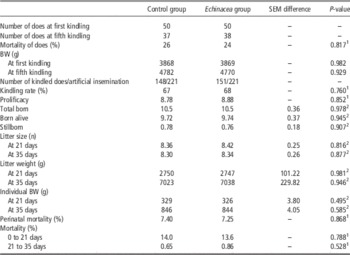
The reproductive performances of the first five reproductive cycles are reported in Table 2. No significant differences between groups were observed for any of the studied parameters. The numerical and overall productivities calculated during the five cycles were: born alive, 1438 and 1471 kits; number of kits at day 35, 1229 and 1260 for the control and E groups, respectively.
Effects of pale purple coneflower (Echinacea pallida) dietary supplementation on the reproductive performance of rabbit does

1 Parameter analysed by means of the χ 2 test.
2 Parameter analysed by means of the Student’s t test.
Haematological findings
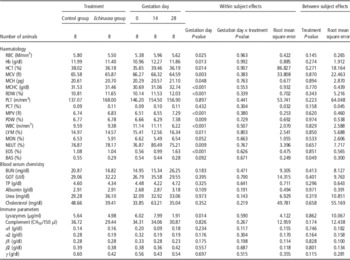
The haematological parameters of the pregnant rabbits are reported in Table 3. The results indicated a significant (P<0.05) effect of treatment and gestation day on some haematological parameters. The EPAL supplementation induced a reduction (−47.3%) in the Bas cell rate (0.55% and 0.29%, for the control and treatment groups, respectively; P=0.049). The gestation day had a significant effect on the RBC, Hb, HCT, MCV, MCH, MCHC, RDW, MPV, PDW, WBC, LYM, NEUT and EOS (P<0.05). The WBC counts declined progressively after day 14. The MCH, MCHC, RDW, MPV and Eos values increased steadily throughout the study, and reached a maximum value on day 28. RBC, Hb, HCT, MCV and NEUT increased slightly up to day 14, and subsequently decreased progressively until day 28. LYM and PDW decreased until day 14, and then increased to a maximum value on day 28.
Effects of pale purple coneflower (Echinacea pallida) dietary supplementation on the blood and immune parameters of pregnant rabbit does (n=8/group)

RBC=red blood cells; Hb=haemoglobin concentration; HCT=haematocrit; MCV=mean corpuscular volume; MCH=mean corpuscular haemoglobin; MCHC=mean corpuscular haemoglobin concentration; RDW=red cell distribution width; PLT=platelets; PCT=relative volume of thrombocytes; MPV=mean platelet volume; PDW=platelet distribution width; WBC=white blood cells; LYM=lymphocytes; MON=monocytes; NEUT=neutrophils; EOS=eosinophils; BAS=basophils; BUN=blood urea nitrogen; GOT=glutamate oxaloacetate transaminase; TP=total protein.
No significant interaction between treatment and gestational period was reported for any of the studied variables. No significant effect of gestation day or treatment was observed on the blood serum chemistry. As far as the immune parameters are concerned, no significant differences were observed between groups, while a significant effect of gestation day was observed for lysozymes (P=0.014). The highest concentration of lysozymes was observed on day 14 of gestation, while it was −32.7% on day 0 and +318.3% on day 28 (6.02 v. 7.99 v. 1.91; for 0, 14 and 28 days, respectively).
Discussion
Reproductive performance
The BW of the does at kindling, the kindling rate and the litter size at birth at days 21st and 35th of age, and the mortality of the kits did not differ between the two groups. This indicates that the Echinacea supplements in the doe diets did not exert a promoting effect on the reproductive function when administered at 3 g EPAL/kg of diet. These results differ from those obtained for mice by Barcz et al. (Reference Barrett2007), who found that two Echinacea drugs (Esberitox and Echinapur) lowered the number of embryos in one litter, even though the results were at the edge of statistical significance. During murine pregnancy, EPUR reduced the number of viable foetuses (Chow et al., Reference Chow, Johns and Miller2006). A prospective study suggested that the use of Echinacea in pregnancy during organogenesis is not associated with an increased risk of major malformations (Gallo et al., Reference Gallo, Sarkar, Au, Pietrzak, Comas, Smith, Jaeger, Einarson and Koren2000). Further theoretical evidence, obtained from an expert panel on botanical medicine, reported that the oral consumption of Echinacea in recommended doses appeared safe and effective to use during pregnancy (Perri et al., Reference Perri, Dugoua, Mills and Koren2006).
Haematological findings
The blood parameters of rabbits are used as an aid for the clinical diagnosis of metabolic, infectious and parasitic diseases and to assess the condition of an animal. A variety of factors can affect the haematological and biochemical parameters of an animal, including breed, gender, diet, age, reproductive status and seasonal variations (Wells et al., Reference Wells, Decobecq, Decouvelaere, Justice and Guttin1999; Ozegbe, Reference Ozegbe2001). The haematological and biochemical parameters obtained in this study were within the normal ranges for rabbit species (Archetti et al., Reference Archetti, Tittarelli, Cerioli, Brivio, Grilli and Lavazza2008; Özkan et al., Reference Özkan, Kaya and Akgül2012). The application of an Echinacea extract should booster immunological reactivity and should contribute toward improving the health status (Böhmer et al., Reference Böhmer, Salisch, Paulicks and Roth2009). In the present trial, EPAL has shown no influence on the haematological and health status of the rabbit does. The change in blood coagulation-related parameters, during the later stages of gestation, is a common physiological response to protect against excessive haemorrhaging or to preserve homoeostasis at parturition (Mizoguchi et al., Reference Mizoguchi, Matsuoka, Mizuguchi, Endoh, Kamata, Fukuda, Ishikawa and Asano2010). In the present study, the modulation of RBC and HCT may be related to physiological anaemia, resulting from haemodilution (Ozegbe, Reference Ozegbe2001). Watery supplementation with EPUR extract has induced higher Hb, PCV and RBC in growing rabbits (Ahmed et al., Reference Ahmed, Kamel, El-Sabeiy and Zeitouny2008). Likewise, a study by Chow et al. (Reference Chow, Johns and Miller2006) found an increase in RBC in pregnant mice fed EPUR. In addition, an increment of erythropoietin level (a glycoprotein hormone that controls erythropoiesis) has been reported in EPUR-treated men. This should support the RBC increment that is derived from the supply of phytoadditives (Whitehead et al., Reference Whitehead, Martin, Scheett and Webster2007). On the other hand, Maass et al. (Reference Maass, Bauer, Paulicks, Böhmer and Roth-Maier2005) did not find any significant difference for these parameters in sows, piglets or grower/finisher pigs that received dried EPUR herbs as a feed additive in their diets. Differences concerning the tested plant species (EPAL v. EPUR), preparation methods (raw material v. extraction), physiological status (pregnant v. non-pregnant) and species (rabbit v. swine, mice or human beings) could explain these contrasting results. It has been shown that WBC parameters increase during the whole period of gestation in pregnant women (Cincotta et al., Reference Cincotta, Balloch, Metz, Layton and Leischke1995), in rabbit does (Haneda et al., Reference Haneda, Mizoguchi, Matsuoka, Miuguchi, Endon, Fukuda and Asano2010) and in rats (DeRijk et al., Reference DeRijk, Esch and Flik2002). Cundell et al. (Reference Cundell, Matrone, Rarjaczak and Pierce2003) found a significant increase in lymphocytes after 1 week in rats fed dried Echinacea preparations. A higher proliferation rate of spleen lymphocytes in EPAL supplemented mice has been reported in an in vitro study, but the haematology indices were not influenced (Zhai et al., Reference Zhai, Liu, Wu, Senchina, Wurtele, Murphy, Kohut and Cunnick2007). An increase in WBC is generally a good indicator of an immunity efficiency increase (Wieslaw et al., Reference Wieslaw, Charon, Winnicka and Gruszczyñska2006). In the present study, the effect of EPAL has only been observed for Bas. According to the results of other studies, this effect may be related to the phytochemically active constituents of EPAL (Hu and Kitts, Reference Hu and Kitts2000; Dalby-Brown et al., Reference Dalby-Brown, Barsett, Landbo, Meyer and Molgaard2005; Pellati et al., Reference Pellati, Benvenuti, Magro and Lasseigne2005).
With respect to the blood serum chemistry, no significant difference was observed in the TP. On the other hand, Wells et al. (Reference Wells, Decobecq, Decouvelaere, Justice and Guttin1999) reported a decrease in TP and albumin in pregnant rabbits, and this is thought to reflect an increased blood volume.
Innate immunity plays an important role in preventing infection as a first-line defence and also contributes antigen-presenting cells that activate the adaptive immune response, which is specific and powerful (Tizard, Reference Tizard2013). Dietary supplementation with Echinacea can stimulate innate immunity by increasing cytokine production (Hwang et al., Reference Hwang, Dasgupta and Actor2004) and phagocyte stimulation (Böhmer et al., Reference Böhmer, Salisch, Paulicks and Roth2009). Lysozymes and the complement system are interesting indicators of how innate immunity functions. In the present experiment, only lysozyme has shown a time related change. It should be highlighted that the present work has been performed in a standard environment without infection, stress or other factors that could influence immune responses. Therefore, it is difficult that experiments conducted in normal conditions could result in a significant effect on immunity, despite supplementation with an immunomodulating agent. In conclusion, there is no evidence that diets supplemented with EPAL can cause any beneficial effects in normal management conditions. Meanwhile, the second part of this study will evaluate the effects on the performances, bacterial community, blood parameters and immunity from EPAL dietary supplementation in fattening rabbits (Kovitvadhi et al., Reference Kovitvadhi, Gai, Dabbou, Ferrocino, Rotolo, Falzone, Vignolini, Gennero, Bergagna, Dezzutto, Barbero, Nebbia, Rosati, Cocolin, Zoccarato and Gasco2016).
Acknowledgements
This research was supported by a ‘University of Torino (ex 60%)’ grant (Es. fin. 2013). The authors would like to thank Dr Claudio Malavasi (Biotrade Snc®, Modena, Italy) for providing the dry ground Echinacea pallida (EPAL) samples, Dr Cerrina (Ferrero S.p.A Cuneo, Italy) for his support with the feed formulation, Dr Luca Operti (Department of Drug Science and Technology, University of Torino) for the EPAL analysis, Mrs Vanda Malfatto for her technical support, Dr Paolo Montersino, Mr Dario Sola and Mr Mario Colombano for the rabbit care.