INTRODUCTION
Now more than ever, scientists agree that the globe is experiencing a significant change in climate (IPCC Reference Pachauri and Reisinger2007). Given that these altered environmental conditions are predicted to reduce the global food supply by 3–11% (Parry et al. Reference Parry, Rosenzweig and Livermore2005; Lobell et al. Reference Lobell, Burke, Tebaldi, Mastrandrea, Falcon and Naylor2008; Tebaldi & Lobell Reference Tebaldi and Lobell2008), agronomists and crop physiologists are grappling with how to adapt agricultural practices (Ceccarelli et al. Reference Ceccarelli, Grando, Maatougui, Michael, Slash, Haghparast, Rahmanian, Taheri, Al-Yassin, Benbelkacem, Labdi, Mimoun and Nachit2010; Eitzinger et al. Reference Eitzinger, Orlandini, Stefanski and Naylor2010). Under the dramatic annual or seasonal climatic shifts, plants have altered their growth and phenology in both natural (Hanson & Weltzin Reference Hanson and Weltzin2000; Parmesan Reference Parmesan2006) and agricultural contexts (Fuhrer Reference Fuhrer2003; Craufurd & Wheeler Reference Craufurd and Wheeler2009). Phenological responses to variation in moisture have been shown to be complex, involving either phenotypic plasticity (Primack Reference Primack1980; Sherry et al. Reference Sherry, Zhou, Gu, Arnone, Schimel, Verburg, Wallace and Luo2007) or rapid evolution (Franks et al. Reference Franks, Sim and Weis2007). Altered precipitation might directly affect physiological processes such as photosynthesis and water use efficiency, which ultimately might limit yield. Alternatively, changes in precipitation could have impacts on growth and flowering phenology – an understudied, yet important, mechanism limiting crop yield. The present paper explores the phenological responses and consequent yield of a common monoecious crop, courgette (Cucurbita pepo), to changes in water availability.
Monoecious plants are frequently self-fertile, with separate male and female flowers such that fruit and seed set depend on vector-mediated pollination (Frankel & Galun Reference Frankel and Galun1977; Maynard Smith Reference Maynard Smith1978). Monoecy is found among some important crops, including maize (Zea mays), all Cucurbits (e.g. cucumber, pumpkin and courgette), spinach (Spinacia oleracea), hemp (Cannabis sativa), many conifers, walnut (Juglans regia), figs (Ficus spp.), oil palm (Elaeis guineensis), coconut (Cocos nucifera), mango (Mangifera indica), bread-fruit and jackfruit (Artocarpus spp.) and papaya (Carica papaya) (Bertin Reference Bertin1993). In the US alone, 86 382 000 acres of field maize were planted in 2008 and worth $48.6 billion USD (NASS 2009). Cucurbit crops are also grown widely and were worth $1.4 billion USD in 2010 (NASS 2011).
For monoecious crops, climate change could affect sex allocation or flowering phenology, or both. Monoecious plants have great flexibility in resource allocation to male and female structures throughout the growing season and across environments (Bawa & Beach Reference Bawa and Beach1981; Willson Reference Willson1983). Previous work regarding environmental effects on the expression of monoecy reveals complex dynamics. To promote successful fruit production and out-crossing, monoecious plants are able to continuously and flexibly adjust the sex of sequentially produced flowers in a variable environment (Freeman et al. Reference Freeman, McArthur, Harper and Blauer1981; Bickel & Freeman Reference Bickel and Freeman1993), and express a singular optimal sex allocation in a constant environment (Bertin Reference Bertin1982; Spalik Reference Spalik1991). Therefore, in agricultural landscapes affected by climate change, plants might produce changed frequencies of male and female flowers and these allocation responses could alter yield. Specifically, stressful conditions (defined as conditions that coincide with smaller plant sizes) often result in higher frequencies of male squash flowers to the detriment of female flower production, so yields could suffer (H. Prenderville, personal communication). Given that phenology is a trait that clearly responds to environmental cues, plants relying on cross-pollination or synchronous flowering of male and female flowers may be at the greatest risk of yield reductions if male and female flower phenologies no longer overlap. In squash, where male and female flowers are often produced sequentially on each plant, pollination requires a significant amount of synchrony within or among plants. If climate change alters the relative investment in male and female flowers or the phenology of either flower type, it may result in floral asynchrony and reduced fruit and seed set. Yet it is not understood if a shift in the timing of flowering or the relative investment in male v. female flowers would have an effect on flowering synchrony and, ultimately, yield or whether this chain of events could be set off by changes in water availability.
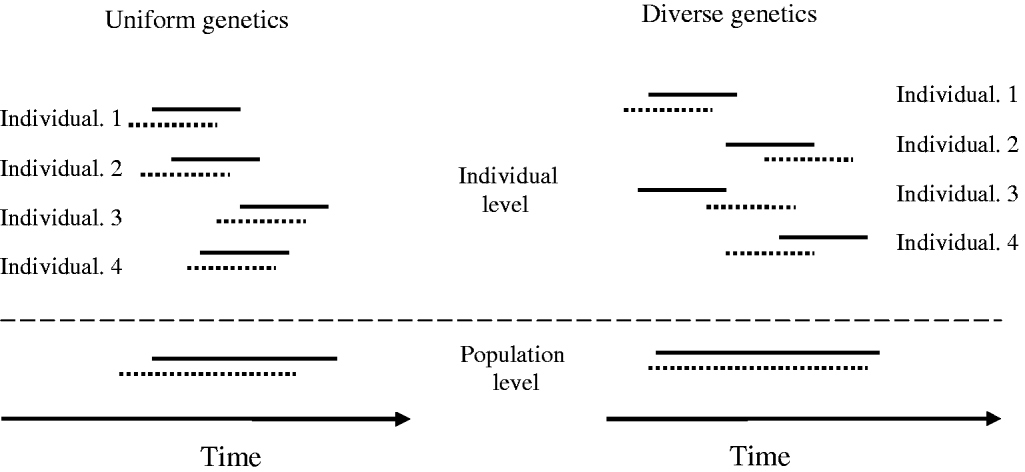
Empirical studies of the individual and combined effects of changes in temperature, precipitation and atmospheric chemistry on crops (monoecious or otherwise) have revealed species- and even variety-specific responses (Herrero & Johnson Reference Herrero and Johnson1980; Wall et al. Reference Wall, Garcia, Kimball, Hunsaker, Pinter, Long, Osborne, Hendrix, Wechsung, Wechsung, Leavitt, LaMorte and Idso2006; Salem et al. Reference Salem, Kakani, Koti and Reddy2007; Nantoumé et al. Reference Nantoumé, Christiansen, Andersen and Jensen2011). For instance, changes in precipitation dramatically influence soy and rice yields, whereas changes in temperature are dominant factors in maize and wheat yields (Lobell & Field Reference Lobell and Field2007). Due to unique evolutionary histories and physiological tolerances, genotype-specific responses might also be observed in altered environmental conditions. More specifically, the quantity and nature of the genetic diversity maintained within crop varieties is expected to play an important role in determining the floral and yield responses to climate change. Varieties containing greater genetic diversity respond differentially to environmental stress (Lillemo et al. Reference Lillemo, van Ginkel, Trethowan, Hernandez and Crossa2005; Salem et al. Reference Salem, Kakani, Koti and Reddy2007; Doi et al. Reference Doi, Takahashi and Katano2010) and some forms of diversity may buffer the impacts of stressful conditions (Mercer & Perales Reference Mercer and Perales2010). Therefore, open-pollinated (OP) varieties, which tend to have higher genetic diversity, may be less susceptible to the effects of stress on flowering than hybrid varieties. Further, OP varieties, with their higher heritable variation in flowering time, could exhibit more overlap in male and female flowering phenology at the population level than hybrid varieties, even if both varieties suffer from asynchrony at the individual level (Fig. 1).
Predicted responses of male–female flowering synchrony for two populations with four individuals with high- and low-genetic diversity. Solid line represents male flowering duration and dotted line represents female flowering duration. Individuals with uniform genetics are expected to have similar male and female flower phenologies; a small increase in synchrony is expected by measuring synchrony at a population level. Populations with high-genetic diversity may have less synchronous male and female flowering phenologies within individuals. However, a greater increase in synchrony at population level is expected.

For a variety of reasons, climate change may have negative effects on crop yield and new genetic material may be required to adapt to changing conditions. Within this context, the present study explored the ways in which abiotic stress and the genetic diversity associated with hybrid v. OP crop varieties affected flowering and crop productivity. A common, monoecious crop, courgette, was used to investigate whether water availability and crop variety:
(1) Alter the relative investment in male and female function?
(2) Affect male and female flowering phenology and fruit production?
(3) Influence the synchrony of male and female flowers within a plant and within a plot? And in cases where synchrony is reduced, how does it affect fruit production?
MATERIALS AND METHODS
Study area
Research was conducted at The Ohio State University's Waterman Farm, a research station in Columbus, Ohio (40°0′N, 83°1′W, 232 m asl) in the Midwest region of the USA. The area has a temperate climate with a mean annual precipitation (1910–2009) of 978 mm and a July mean temperature of 23·9 °C (National Weather Service data for 2009: http://www.weather.gov/). The precipitation totals for 2009 (901 mm) and 2010 (921 mm) were slightly below this average.
Study species
Courgette, also known as zucchini (C. pepo L.), is an important, annual, vegetable crop grown in temperate to sub-tropical conditions worldwide (Robinson & Decker-Walters Reference Robinson and Decker-Walters1997). As a monoecious plant, it has separate male and female flowers produced along lengthening vines, yet maintains a compact growth form. Flowers are insect-pollinated, and often visited by Peponapis pruinosa (squash bee), Apis mellifera (honey bee), Bombus spp. (bumble bees) and Xylocopa virginica (Carpenter bees) (J. Luo, personal observation; Tepedino Reference Tepedino1981; Shuler et al. Reference Shuler, Roulston and Farris2005). During peak production, flowers open early in the morning and last for about half a day. Female flowers can produce an edible fruit that tends to be straight and full. However, abnormal fruit development or abortion (rotten fruit) occurs under incomplete pollination (Winsor et al. Reference Winsor, Davis and Stephenson1987) or diseased conditions (Lisa & Lecoq Reference Lisa and Lecoq1984).
Two varieties with similar phenotypes in terms of fruit colour, growth form and some disease resistance traits were chosen. Both varieties were relatively compact and bushy, mildew resistant and produce dark-coloured fruit. However, one variety was OP (Black beauty from Connecticut Agricultural Experiment Station, Storrs, Connecticut, USA) and the other was an F1 hybrid (Cashflow from Novartis, Basel, Switzerland). Given historical mating patterns in the two varieties, the OP variety was expected to contain higher genetic variation than the F1 hybrid. Neither variety exhibited parthenogenesis, making insect pollination necessary for fruit production.
Field experiment
In both 2009 and 2010, 32 experimental plots measuring 2·5 × 3 m were established. Four moisture treatments were then imposed: irrigation, rain-out, rain-in and control. In 2009, c. 25 mm of water was applied to irrigation plots per week using pressure-compensated drip tubes (Rain Bird Corporation, Azusa, California, USA) to distribute ground water from a local well. If it did not rain within a given week, moisture was applied to the irrigation plots a second time. In 2010, 12·7 mm of water was routinely applied twice per week regardless of the natural precipitation events, which approximates the long-term average rainfall for the area.
To exclude rain, shelters were built with a design similar to that used by Yahdjian & Sala (Reference Yahdjian and Sala2002), with bent plexiglas shingles mounted on a frame that were intended to intercept half of the natural precipitation (hereafter called rain-out shelters). Each shelter covered an area of 2·5 × 3 m, and the height of the shingles was adjusted throughout the growing season to be at least 0·2 m above the foliage. In order to understand the effect of the shelter itself (separate from the effect of rainfall exclusion) on plant growth and fecundity, ‘rain-in’ shelters were constructed that were almost identical to the rain-out shelters except for the inversion of the shingles on the rain-in shelters, which allowed the rain to fall into the plot. Finally, one-quarter of the plots were left untreated as a control. In 2009, a split-plot design was used with four blocks and the four moisture treatments as main plots. Main plots were spaced 4·6 m apart and sub-plots of different courgette varieties were located 2·4 m apart. In 2010, a randomized complete block design with four blocks was used, and plots were 3·6 m away from each other. All plots were fertilized with an N:P:K ratio of 19:19:19 (SureGrow, Comanche, Texas, USA) at a rate of 6·7 g/m2 on 20 May 2009 and on 25 June 2010.
Plots were tilled in late May and courgette seeds were planted on 23–24 June 2009 and 8 June 2010. Seeds were sown at 0·46 m intervals in rows that were spaced 0·91 m apart for a total of 24 positions in each plot. Three seeds were planted at each position and were then thinned to keep one randomly chosen plant in each location at the first true-leaf stage. If no seedling emerged, replanting occurred within 2 weeks of the original planting date to maintain relatively equal plant densities, but these replanted individuals were not included in the data analysis. Plots were manually weeded to simulate a low-competition agricultural scenario, and, additionally, glyphosate (Monsanto, St. Louis, MO, USA) and Strategy (Loveland Products Inc., Greely, Colorado, USA) were applied in 2010. To control powdery mildew, the plots were sprayed with Bravo Weather Stik® (Syngenta, Basel, Switzerland) in 2009 and NOVA (Dow AgroSciences, Calgary, Alberta, Canada) in 2010.
Data collection
Soil moisture levels were monitored in both 2009 and 2010 using a time-domain reflectometer (TDR; Trase System I, 6050X1, Soilmoisture Equipment Co., Santa Barbara, CA, USA) with a 0·20 m wave guide. Measurements were taken in the plot centre of four plots for each moisture treatment on six dates between 24 July and 15 September 2009. In 2010, the method was improved and TDR measurements were taken at four positions along the plot centreline, perpendicular to the shelter shingle direction. Data were recorded in four plots for each moisture treatment on four dates between 7 July and 8 September 2010. During the entire growing season, air temperature was recorded at 15-min intervals within one representative plot for each moisture treatment, using a type T thermocouple located 0·15 m above the canopy and wired to a data logger (Campbell 21X, Campbell Scientific, Inc., Logan, UT, USA). The temperature differences between each treatment and control pair were calculated for each data point, as well as the average and standard deviation of these values over each growing season. In order to evaluate whether the irrigation and shelter structure had any effect on the air temperature, the temperature differences between irrigation and control, rain-in and control, and rain-out and control were calculated using these data. Finally, to determine the effect of shelters on light intensity, the degree of light penetration above and below the shelters was measured using an LI-191 line quantum sensor attached to a LI-COR 1000 data logger (LI-COR Corporation, Lincoln, Nebraska, USA) on a cloudless day at noon on 15 September 2009.
Phenological, flower gender and fruit production data were collected from eight central plants in each plot. For each plant, the date of first male and female flower, and the number of male and female flowers for each day for 5 days per week were measured (flowers opened on Saturday and Sunday were not distinguished and were counted together). Fruits were harvested 5–7 days after flowering in 2009, and as soon as they reached 0·2 m in length in 2010. Fresh fruit weight was measured immediately in the field. In 2010, the fate of each female flower was also tracked and information on whether it produced a harvestable fruit or was aborted/rotten was recorded.
Statistical analysis
All analyses were performed using SAS 9.13 (The SAS Institute, Cary, NC, USA). For each plant, the total number of male and female flowers was estimated throughout the season. Sex ratio was calculated as number of female flowers divided by number of male flowers. The flowering duration of each sex was determined by calculating the number of days between first and last flower of male and female flowers for each plant. Also, the total number of harvested fruits was tallied for each plant and the average fresh fruit weight of each plant calculated.
Flowering synchrony between male and female flowers was calculated using two indices at both individual and plot levels, using methods of Calabrese & Fagan (Reference Calabrese and Fagan2004), slightly modified as described below. Flowering overlap (individual) described the number of days when both male and female flowers were recorded on the same plant, as a proportion of the number of days when there was at least one flower, regardless of gender, open on the plant. Flowering overlap (plot) was calculated in a manner similar to flowering overlap (individual), except that the flowering records of all eight plants within the plot were pooled. Available males (individual) was a season average of the number of males open on days when at least one female flower was open. Again, available males (plot) was calculated in a similar manner except that male and female flowers from the whole plot were included in the calculation. Only the weekday data were used in this calculation because no distinction could be made between flowers opened on Saturday and Sunday. To assess the amount of phenotypic variation within plot, the coefficient of variance (CV) was calculated for all the traits mentioned above (except the flowering overlap (plot) and available males (plot)) among the eight courgette plants within each plot.
To determine the effect of the moisture treatment and crop variety on the investment in male and female function, a series of analysis of variances (ANOVAs) was run on flowering phenology, fruit production, flowering synchrony and phenotypic variation using PROC MIXED with moisture treatment, variety and their interaction as fixed effects. For the 2009 experiment, a split-plot design was employed in which block, block × moisture treatment and block × moisture treatment × variety were included as random effects in the model; the latter two were used as errors in the analysis. For the 2010 experiment, a randomized complete block design was used, so only block and block × moisture treatment × variety were included as random effects. The analysis of the trait variation within plots (i.e. CV analysis) was performed in a similar manner, but the block × moisture treatment × variety effect was not included in the model. Denominator degrees of freedom were estimated using the Satterthwaite method. Variables were either log transformed or square root transformed when necessary to meet the model assumption. Given the number of ANOVAs performed, the Benjamini–Hochberg multi-comparison procedure (Waite & Campbell Reference Waite and Campbell2006) was used to determine whether or not each effect was significant at P < 0·05. If a variety × moisture treatment effect was significant, three a priori contrasts were then performed to determine the moisture treatment effect for each variety: irrigation v. control (water-addition effect), control v. rain-in (shelter effect) and rain-in v. rain-out (water-reduction effect).
To determine the effect of the number of available males (plot) on the fate of fruit production for each female flower, a logistic regression analysis was conducted with PROC LOGISTIC using the 2010 data. The number of male/female flowers in the plot on the day that a female flower opened was the independent variable, and whether or not the female flower produced a harvestable fruit was the dependent variable. Curves were predicted using estimated parameters from the model (block excluded).
To determine the magnitude of the increase in synchrony from the individual to the plot level, the increase in synchrony was calculated as the plot level synchrony index (flowering overlap or available male) divided by the corresponding individual synchrony index averaged across the eight plants within the same plot. An ANOVA was performed on synchrony increase for 2009 and 2010 with variety as fixed effect and block as random effect: data from different moisture treatments were pooled because there was little effect of moisture on synchrony for either year (see Results section).
RESULTS
Growing conditions
In 2009, soil moisture, measured in the centre of irrigation, control, rain-in and rain-out plots, was 0·31 (s.e. = 0·006), 0·24 (s.e. = 0·028), 0·28 (s.e. = 0·02) and 0·17 (s.e. = 0·016), respectively. In 2010, soil moisture, averaged across four positions within each plot, was 0·26 (s.e. = 0·012), 0·23 (s.e. = 0·018), 0·22 (s.e. = 0·011) and 0·19 (s.e. = 0·013), for irrigation, control, rain-in and rain-out plots, respectively. In 2009, the average temperature difference between irrigation and control plots was –0·04 ± 0·63 °C (mean±s.d.). The differences between rain-in and control and between rain-out and control were 0·20 ± 1·18 and 0·30 ± 1·09 °C, respectively. In 2010, the effects of irrigation, rain-in and rain-out were 0·14 ± 0·73, –0·05 ± 0·64 and 0·05 ± 0·40 °C, respectively. Therefore, although irrigation and shelter structures were successful at manipulating moisture, they did not have large effect on the air temperature around the plants.
The effect of moisture and variety
Moisture level had little effect on the flowering phenology and synchrony traits for the two courgette varieties tested in 2009 and 2010. Without adjustment of P-values for multiple comparisons, moisture level significantly affected the number of female flowers, sex ratio and female duration in 2009 (P ⩽ 0·05). Without adjustment, moisture affected phenotypic variability (as measured by CV) of flowering overlap and number of available males in 2009 (P ⩽ 0·05). With adjustments, no traits nor their CVs were significantly affected by moisture.
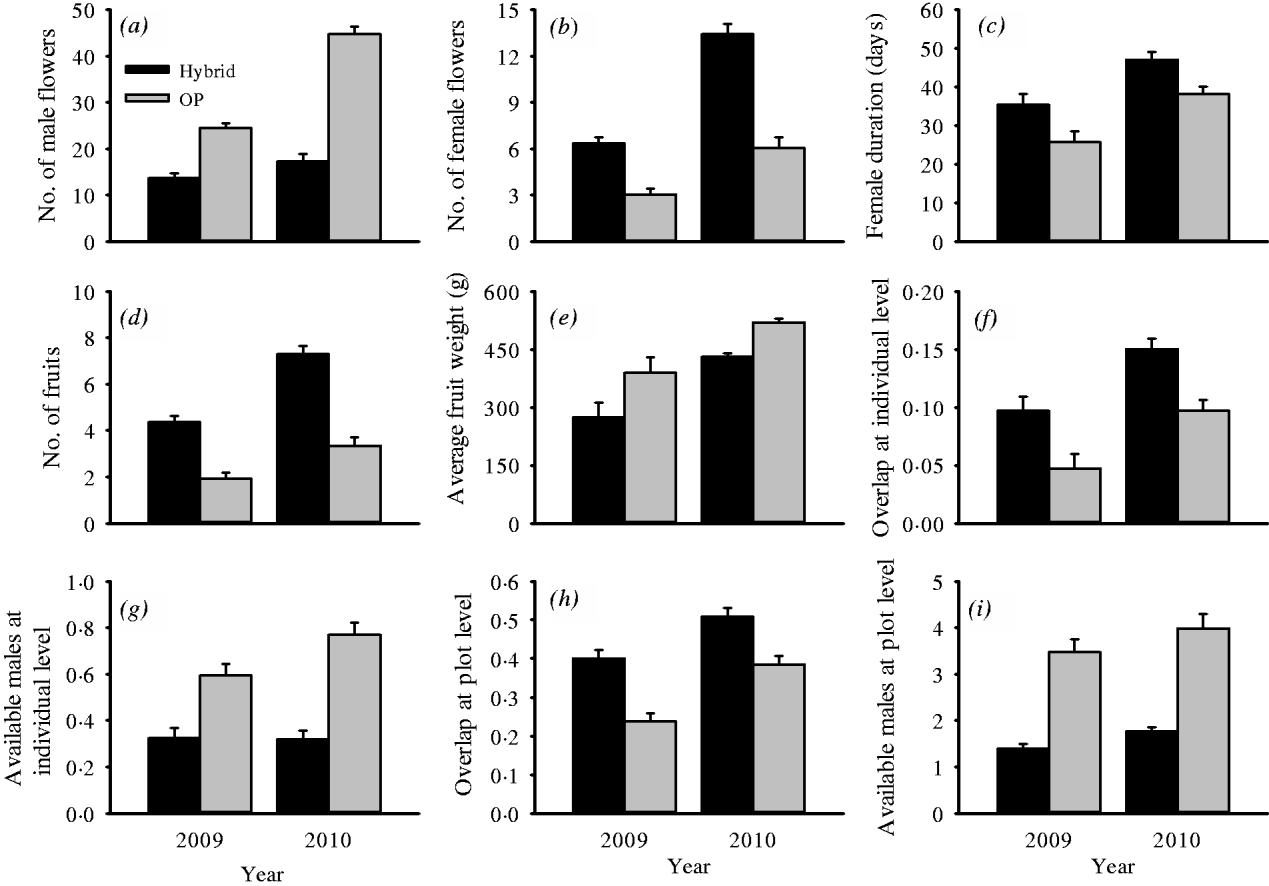
Significant differences were detected between the two courgette varieties in terms of their sex allocation (2009: F 1,12 = 228·48, P < 0·001; 2010: F 1,21 = 91·53, P < 0·001), flowering phenology (2009 male begin: F 1,12 = 6·09, P < 0·05; 2010 female begin: F 1,21 = 5·57, P < 0·05), and the synchrony of flowering between males and females (2009 (individual): F 1,12 = 21·93, P < 0·001; 2010 (individual): F 1,21 = 17·32, P < 0·001; 2009 (plot): F 1,12 = 38·63, P < 0·001; 2010 (plot): F 1,21 = 15·78, P < 0·001). In both 2009 and 2010, the hybrid variety produced fewer male flowers (2009: F 1,12 = 60·93, P < 0·001; 2010: F 1,21 = 224·29, P < 0·001), more female flowers (2009: F 1,12 = 57·70, P < 0·001; 2010: F 1,21 = 57·19, P < 0·001), had a longer female flowering duration (2009 female duration: F 1,12 = 10·29, P < 0·01; 2010 female duration: F 1,21 = 10·06, P < 0·01), and produced more, but smaller, fruits (2009 number of fruits: F 1,12 = 63·24, P < 0·001; 2010 number of fruits: F 1,21 = 59·88, P < 0·001; 2009 fruit weight: F 1,12 = 21·67, P < 0·001; 2010 fruit weight: F 1,21 = 50·40, P < 0·001; Fig. 2). In 2009, for example, a plant from the hybrid variety produced an average of 13·7 male flowers and 6·3 female flowers on each plant, while OP plants produced 24·5 male flowers and 3·0 female flowers. Female flowering duration was c. 10 days longer for the hybrid variety than for the OP variety (35·4 v. 25·7 days). A hybrid plant produced, on average, 4·4 fruits weighing 273 g each, and an OP plant produced c. 1·9 fruits weighing 389 g each. Female and male flowers overlapped phenologically more frequently in the hybrid variety than they did in the OP variety, but female flowers on OP plants had more access to available males at both the individual and the plot levels (2009 available male (individual): F 1,12 = 21·93, P < 0·001; 2010 available male (individual): F 1,21 = 72·66, P < 0·001; 2009 available male (plot): F 1,12 = 87·01, P < 0·001; 2010 available male (plot): F 1,21 = 240·38, P < 0·001; Fig. 2). In 2009, for example, male and female flowers on plants of the hybrid variety overlapped twice as much as those on the OP plants when analysed at the individual level (0·10 v. 0·05). But each female flower on an OP plant had more male flowers opening synchronously than on a hybrid plant (0·60 v. 0·32). These results suggested that the two courgette varieties were very different in their flowering behaviour and reproduction.
Least square means (+s.e.) for nine traits of the two Cucurbita pepo varieties in 2009 and 2010: (a) number of male flower, (b) number of female flower, (c) female duration, (d) number of fruits, (e) average fruit weight, (f) overlap at individual level, (g) available male at individual level, (h) overlap at plot level and (i) available male at plot level.
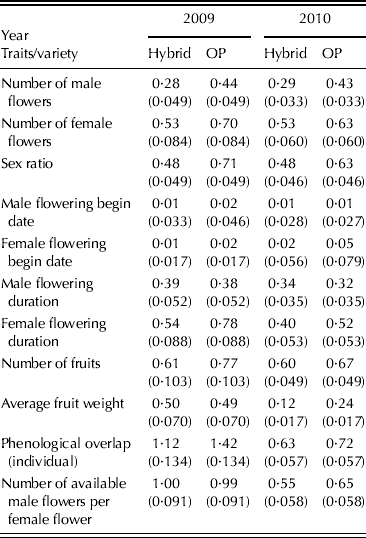
Phenotypic variability within a plot, measured by CV, differed among varieties for sex ratio (year 2009, F 1,12 = 14·20, P < 0·01) and average fruit weight (2010, F 1,21 = 36·26, P < 0·001) when the Benjamini–Hochberg multi-comparison adjustment was used. In both cases, the OP variety had a larger CV than the hybrid variety (Table 1). In 2009, the CVs for sex ratio were 0·48 for the hybrid and 0·71 for the OP variety. In 2010, the CVs for average fruit weight were 0·12 for the hybrid and 0·24 for the OP variety. Without the Benjamini–Hochberg multi-comparison adjustment, many other traits were also significant, such as number of male and female flowers, male and female flowering begin dates and flowering synchrony. The CVs for these traits were mostly larger in the OP variety than the hybrid variety (Table 1). Thus, a clear pattern emerges; the OP variety was more phenotypically diverse than the hybrid variety.
Mean coefficients of variation (±s.e.) for various traits measured in Columbus, Ohio on two Cucurbita pepo varieties, hybrid and OP, in 2009 and 2010
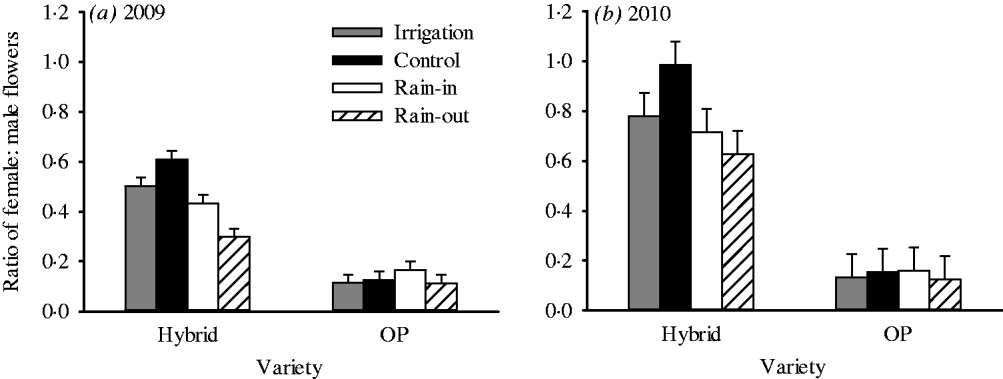
In 2009, there was a significant variety × moisture interaction for the female:male ratio (F 3,12=9·09, P < 0·001). Although pre-planned contrasts revealed that there were no significant differences among the four moisture treatments for the OP variety, significant differences were detected for the hybrid variety between irrigation and control (P < 0·05), between control and rain-in (P < 0·001) and between rain-in and rain-out (P < 0·01; Fig. 3(a)). In particular, the female:male ratio for the hybrid variety was 17% lower than the control under irrigated conditions and was reduced by 31% in the rain-out conditions as compared with the rain-in. Although this interaction was not significant in 2010, the means of the moisture treatments followed the same trend (F 3,21 = 1·18; Fig. 3(b)).
Sex ratio (±s.e.) for the two Cucurbita pepo varieties across an experimental moisture gradient measured in 2 years.
The effect of synchrony on fruit production
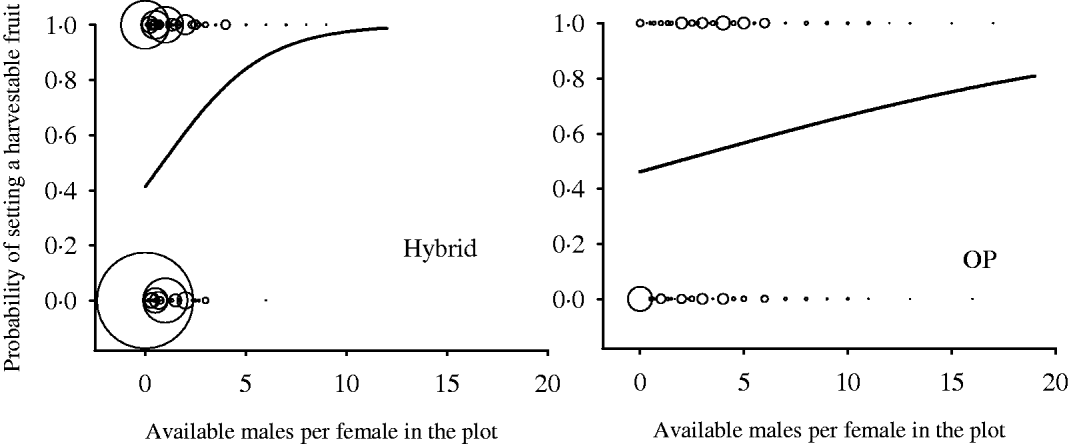
Logistic regression was used to test whether the availability of males at the plot level had a significant effect on the probability of successfully setting fruit. As the number of available males at the plot level increased, so too did successful fruit development (Wald χ2 = 8·01, d.f. = 1, P < 0·01). An interaction among the number of available males/plot and variety (Wald χ2 = 20·62, d.f. = 1, P < 0·001) also influenced fruit development positively. This interaction suggested that the effect of availability of males differed for the two courgette varieties: predicted curves illustrated the relationship between availability of males and fruit set for the hybrid and the OP varieties (Fig. 4). For the hybrid variety, the probability of successful fruit set increased rapidly with the rise of available males in the plot, and reached a plateau when there were c. 10 available males per female, at which point the probability was 0·98. For the OP variety, the curve rose more slowly and steadily, and at the maximum number of available males per female (i.e. 19), the probability was only 0·81. Since the maximum number of available males was 12 males per female for the hybrid variety and 19 males per female for the OP variety, the two curves are truncated at different points.
The effect of available males on each female in the plot on the probability of setting a harvestable fruit for the two Cucurbita pepo varieties in 2010. Observed data are shown as bubbles, the size of which indicates the frequency of that observation. Solid curves show the predicted responses using logistic regression models.
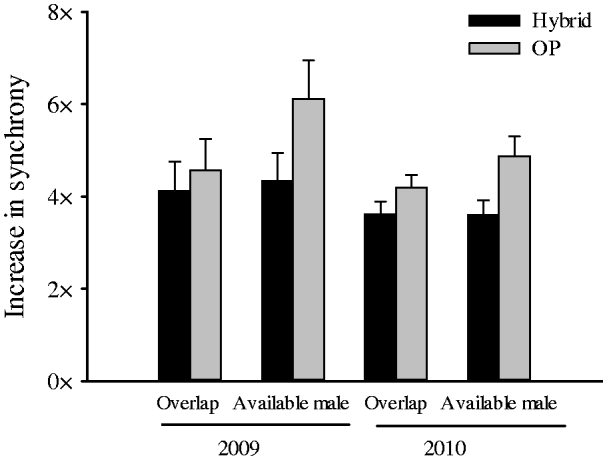
To test the hypothesis that the OP variety, which is more genetically diverse, exhibited greater increases in synchrony than the more genetically uniform hybrid variety, the increase in synchrony was assessed at the plot level as compared with the individual level. Overall, synchrony at the plot level was 4–6-fold greater for both synchrony indices in 2009 and 2010 (Fig. 5). The increase in synchrony, as measured by available males, was greater for the OP variety than for the hybrid variety in both 2009 (P < 0·05) and 2010 (P < 0·05, Fig. 5). The OP variety also exhibited a larger increase in overlap than did the hybrid variety in both years, though it was not statistically significant.
Synchrony enhancement (±s.e.), calculated as the synchrony index at the plot level divided by the same index at individual level, for the two Cucurbita pepo varieties in 2009 and 2010.
DISCUSSION
Climate change and, more generally, any context leading to changes in water availability, may be expected to have significant effects on sex ratios of some courgette varieties. The phenotypically plastic expression of gender in monoecious plants generally depends on resource distribution to male and female function in each reproductive episode (Goldman & Willson Reference Goldman and Willson1986). There can be a higher cost of producing female flowers than male flowers when the number of male flowers is not extremely dominant over the number of female flowers (Silvertown Reference Silvertown1987; Delesalle & Mooreside Reference Delesalle and Mooreside1995). Therefore, more stressful conditions can be expected to lower investment in female function. By experimentally increasing or decreasing water availability, the present study showed a reduction in the relative investment in female v. male flowers in the hybrid, but not OP, variety. The results based on the hybrid variety are consistent with other studies following sex ratios of Cucurbits after the imposition of stressful conditions, including herbivory (Krupnick et al. Reference Krupnick, Avila, Brown and Stephenson2000; Cobb et al. Reference Cobb, Trotter and Whitham2002), and in a variety of other species following experimental limitation of water (Freeman et al. Reference Freeman, McArthur, Harper and Blauer1981; Schlessman Reference Schlessman1982; Solomon Reference Solomon1985; Stromberg & Patten Reference Stromberg and Patten1990). Given that contrasting responses were noted among crop varieties in the present experiment, it is predicted that hybrid varieties may be more sensitive to environmental variation than OP varieties. Furthermore, the increased genetic diversity found in OP v. hybrid varieties could buffer the possible environmental effects on flowering synchrony. However, experiments with multiple OP and multiple hybrid varieties should be conducted to strengthen that claim.
Given that moisture had little effect on flowering phenology, reproduction and flowering synchrony, it can be expected that moderate alterations to rainfall patterns due to climate change would have a small effect on the two courgette varieties in the present study. Within the domesticated cucurbits, phenological and yield responses to changes in soil moisture vary. Oliveira et al. (Reference Oliveira, Andrade and da Silva1997) reported no marked yield changes in watermelon, Citrullus lanatus, under dry conditions. However, several studies noted reductions in fruit size and yield for musk melon, Cucumis melo under water deficits (Long et al. Reference Long, Walsh, Midmore and Rogers2006; Sensoy et al. Reference Sensoy, Ertek, Gedik and Kucukyumuk2007; Cabello et al. Reference Cabello, Castellanos, Romojaro, Martinex-Madrid and Ribas2009). Further, although yield per se was not measured, plant biomass was significantly reduced in cultivated Cucumis sativa, C. pepo and wild Ecballium elaterium grown under artificial lighting conditions in response to an experimentally imposed severe drought (Akinci & Losel Reference Akinci and Losel2009). The present results, with cultivated C. pepo grown under field conditions, reveal that Akinci & Losel's (Reference Akinci and Losel2009) biomass differences may not necessarily translate into yield losses under drought conditions similar to those imposed in the present paper. Perhaps with C. pepo, the temperature changes accompanying global climate change may have greater effects on phenology and yield than were detected here with manipulation of soil moisture. Thus, future research varying both temperature and moisture could provide useful insights. In addition, future studies could include measures of the degree of water stress experienced by each plant to link moisture deficits more precisely to physiological and fitness responses. Nevertheless, the present results suggest that responses to climate change can be species-, trait- and environment-specific.
Hybrid individuals and populations exhibited greater phenological overlap but had, on average, access to fewer available male flowers on any given day than OP individuals and populations. There are several potential agronomic and evolutionary consequences of this result. With greater flowering overlap, reproductive assurance, and therefore fruit production, could potentially be higher in hybrid populations or individuals (Fig. 4; Winsor et al. Reference Winsor, Davis and Stephenson1987). However, due to more male flowers being open on any given day in the OP varieties, stronger pollen competition is expected to lead to more vigorous progeny if gene expression coincides between the gametophytic and sporophytic life cycle stages (hypothesized in Mulcahy Reference Mulcahy1979; demonstrated in Quesada et al. Reference Quesada, Winsor and Stephenson1993). Therefore, farmers producing landraces or breeders developing new lineages may find it easier to maintain vigorous lines by creating environments that promote blooming of male flowers. Finally, larger loads of pollen, as may be associated with increased number of available male flowers, should lead to fruits that are more likely to mature producing the well-formed fruits expected on both large- and small-scale farms (Winsor et al. Reference Winsor, Davis and Stephenson1987).
The process of domestication has reduced the genetic diversity of cultivated varieties (van de Wouw et al. Reference van de Wouw, Kik, van Hintum, van Treuren and Visser2010a, Reference van de Wouw, Kik, van Hintum, van Treuren and Visserb) and OP varieties tend to contain more unique alleles than elite gene pools (Reif et al. Reference Reif, Hamrit, Heckenberger, Schipprack, Maurer, Bohn and Melchinger2005). Fruit yield in the OP variety was much lower than their hybrid counterparts and therefore, the strength of OP varieties is in their phenological resilience, as discussed above, not in overall yield. This result is generally consistent with the published literature. Although hybrid varieties are often higher yielding in high-quality agricultural areas, OP varieties are occasionally more drought-resistant and higher yielding under stressful conditions (sorghum: Blum et al. Reference Blum, Golan, Mayer, Sinmena and Obilana1992; maize: Tollenaar & Lee Reference Tollenaar and Lee2002; canola: Zand & Beckie Reference Zand and Beckie2002). The present results indicate that there was greater genetic variation expressed in the experimental OP crop variety than in the hybrid variety for a number of traits, which could have a few implications. Inter-varietal differences in sex allocation patterns and flowering synchrony could have effects on rates of inbreeding. In squash, highly mobile insects such as bees often conduct pollination, so a female flower of a given plant would be expected to have a similar chance of receiving pollen from a male of the same plant and from a neighbouring male. Further, the number of male flowers available at the time of female flowering in the present study positively affected fruit set for both the OP and hybrid varieties. The OP variety exhibited a greater increase in synchrony from individual to plot level than the hybrid did, suggesting that genetic diversity, and consequent phenotypic diversity expressed by these different crop varieties, may have played an important role in improving flowering synchrony. The synchrony of the OP variety increased more at the plot level (Fig. 5), which could result in higher out-crossing rates and, thereby, reduced inbreeding, which could lower the probability of inbreeding depression. Hayes et al. (Reference Hayes, Winsor and Stephenson2005) reported that a wild species closely related to courgette (C. pepo ssp. texana) showed inbreeding depression in a range of traits such as pistillate flower number and fruit production. Therefore, maintaining higher out-crossing rates could be an important trait for OP to avoid inbreeding depression when seeds were passed from generation to generation.
Despite working with two conventional crop varieties, it is also interesting to consider the related consequences of climate change for both farmer-saved seed crops and non-domestic plant populations. Both OP farmer-saved seed crops and non-domestic plant populations can have relatively high rates of flowering asynchrony. Under altered moisture conditions, stronger selection can be expected for more synchronized monoecious plant populations. Increased synchrony could result in simultaneous flowering and less assortative mating. With more random mating found in populations that are selected to flower more synchronously, a more complete array of genotypes would thus be expected to be produced. With increased diversity, farmer-saved seed may exhibit less consistent phenotypes initially, but provide farmers a greater ability to maintain vigorous crop lineages over the long term.
Despite great interest in the effect of climate change on crop yields and the role of genetic diversity in such a changing environment, this is, to the authors’ knowledge, the first study to investigate the effect of moisture treatments and genetic diversity on the synchrony of male and female flowers in a monoecious crop. These results suggest that a shift in precipitation alone may have little impact on the fruit yield of courgette varieties, but this does not exclude the possibility that yield would be affected when combined with other climate change components, such as elevated CO2 or increased temperature. Finally, the present work demonstrated that synchrony among individuals could be increased in varieties that are more genetically diverse. Thus, future breeding should not discount the adoption of OP varieties as a way to adapt to climate change. Efforts should focus on the introduction of novel genetics and traits into OP varieties, while maintaining their genetic diversity.
The authors thank J. Vent, B. Snow, R. Harrison, E. Park, G. Mills, B. Pace, E. Sanchez, D. Snodgrass, A. Weiss, K. Lewis and B. Willson for amazing logistical assistance. Funds from OARDC SEEDS Research Enhancement Grant 2009-027, The Ohio State University, Rice University and Ryerson University supported this work.