


Introduction
Paranoia has been shown to be common in the general population, using both survey methodology and experimental paradigms (e.g. Ellett and Chadwick, Reference Ellett and Chadwick2007; Freeman et al., Reference Freeman, Pugh, Antley, Slater, Bebbington and Gittins2008; Ellett, Allen-Crooks, Stevens, Wildschut and Chadwick, Reference Ellett, Allen-Crooks, Stevens, Wildschut and Chadwick2013), which is consistent with the idea that experiences such as clinical paranoia lie on continua functions with ordinary behaviour. Although research to date has found evidence of paranoia in the nonclinical population, the vast majority of individuals do not go on to develop any form of clinical psychopathology. Therefore, it is interesting to consider why individuals showing clear paranoid ideation do not go on to develop clinical paranoia. Research suggests that beliefs about nonclinical paranoid experiences might change naturalistically over time. For example, research has examined fluctuations in paranoia using experience sampling methodology (e.g. Thewissen et al., Reference Thewissen, Bentall, Oorschot, Campo, van Lierop and van Os2011) and Ellett, Lopes and Chadwick (Reference Ellett, Lopes and Chadwick2003) found that 37% of their sample reported a change in their beliefs about a specific paranoid experience. However, research is yet to examine naturalistic change in terms of key dimensions of paranoid beliefs, such as conviction, distress, preoccupation and impact, and potential reasons why beliefs about paranoid experiences might change naturalistically are as yet unknown.
Therefore, the aims of the current study were to (1) measure how individuals rate levels of preoccupation, distress, impact and conviction in relation to a single paranoid experience, both retrospectively at the time the paranoid event took place and again at the time of the study and (2) explore reasons participants themselves give for change in beliefs about a single paranoid experience.
Method
Participants and procedure
Sixty students from a British University (mean age 24.4, SD = 7.55, range 18–51) participated; 77% were female. Participants were first asked to describe an experience where they thought someone was deliberately trying to harm them. Participants were screened for the presence or past history of mental health problems, ensuring that the experiences identified were instances of nonclinical paranoia. After participants had described their experience, they were then asked to identify when it occurred, and consistent with previous research (e.g. Chadwick and Lowe, Reference Chadwick and Lowe1994) to rate their experience along four key dimensions: preoccupation, impact, distress and conviction. Two sets of ratings were taken for each participant: retrospective recall at the time when the paranoid event took place, and again at the time of the interview. All ratings were performed on a 5-point Likert scale. All participants reported change in at least one belief dimension, and they were then asked to describe reasons that they themselves gave for change in their paranoid experience. Reasons participants gave for change were analyzed using Thematic Analysis; the coding process comprised six phases, consistent with good practice guidelines (Braun and Clarke, Reference Braun and Clarke2006). Two reliability checks were also performed: first, a consensus review and appraisal of themes was conducted with the researcher and supervisor as an initial reliability check; second, the final list of themes and 40 sample quotations were given to an independent researcher to determine interrater reliability. This revealed a Kappa value of 0.90, indicating an excellent level of agreement.
Results
Content, timeframe and belief ratings of paranoid experiences
Descriptions of paranoid experiences provided by participants were grouped into one of three categories, as used by Ellett et al. (Reference Ellett, Lopes and Chadwick2003), which included: (1) an unexpected event (n = 10), e.g. “this guy at work did something that I was supposed to do, he was having a snipe at me and saying that I wasn't doing my job properly”; (2) victimization and injustice (n = 28), e.g. “she belittled and undermined me, muttering in the background”; and (3) exclusion (n = 22) “there was a group of girls who started to deliberately exclude me from things to upset me”. The amount of time over which paranoid experiences were recalled ranged from 1 day to 25 years (mean = 1978.9 days, SD = 2185.9 days); 29% reported a paranoid experience that occurred within the last year, 49% reported an experience that occurred over 3 years ago, and 19% reported an experience that occurred over 10 years ago. All four belief dimensions (rated 1–5) were rated as significantly lower at the time of the interview compared with retrospective recall at the time when the paranoid event took place (preoccupation, t (60) = 16.46, p = .0001; distress, t (60) = 14.34, p = .0001; impact, t (60) = 11.69, p = .0001; and conviction, t (60) = 4.69, p = .0001), as indicated by mean scores (preoccupation reduced from 3.74 to 1.43; distress reduced from 3.95 to 1.58; impact reduced from 3.25 to 1.31; conviction reduced from 4.07 to 3.36).
To determine mean change across each dimension, retrospective individual ratings at the time of the paranoid experience were subtracted from ratings at the time of the interview. In order to examine if levels of change in belief dimensions about a past paranoid event were associated with the amount of time elapsed since its occurrence, a series of four correlations between change scores in each dimension and amount of time since the event occurred were calculated. No significant relationships between amount of change and time since event were found on any of the four belief dimensions (preoccupation, r = .050, p = .706; distress r = .118, p = .375; impact r = .073, p = .582; conviction r = .144, p = .276), suggesting that reported reductions in dimensions cannot simply be explained by time alone.
Reasons for change
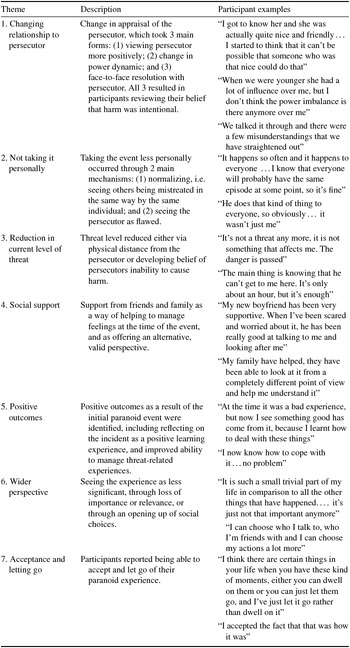
Seven major themes were identified in participants’ explanations for changes in response to a single paranoid experience. Each theme is summarized in Table 1 and grounded in a minimum of two examples to allow assessment of goodness of fit between data and themes extracted.
Summary of themes with participant examples

Discussion
The current study examined specific paranoid experiences in a student sample, and explored subjective accounts of change in key dimensions of this experience. What is striking from the findings is the time period over which nonclinical paranoid experiences were recalled, which in the current sample ranged from 1 day to 25 years, with just under half (n = 29, 49%) reporting an event that occurred over 3 years ago. Importantly in the present study, participants were asked simply to describe an experience where they thought someone was deliberately trying to harm them – it was only after participants had described their experience that they were asked to identify when it occurred. This suggests that paranoid thoughts are not only common in nonclinical groups, but that such experiences can also be persistent.
Replicating the findings of Ellett et al. (Reference Ellett, Lopes and Chadwick2003), results from the present sample suggest that at the time of occurrence the paranoid event was recalled as distressing, preoccupying, impacting on overall well-being, and was accompanied by a strong sense of conviction that harm was intended, features also known to be associated with clinical paranoia. The present study builds on this by assessing perceived change in dimensions over time, showing that all four key belief dimensions were rated as lower at the time of the interview compared with recall at the time when the paranoid event took place. Post hoc analysis suggested that change in dimensions was not associated with time since the event occurred. These findings suggest that responses to a nonclinical paranoid experience change naturalistically, and are consistent with a body of literature demonstrating that most people are able to resolve psychological distress without the assistance of psychological interventions.
An important aim of the current study was to examine reasons participants themselves give for change in response to a single paranoid event. One important finding was that the paranoid event came to be seen by participants as being likely to happen to anyone, as part of everyday normal social interactions. Working to ease a tendency to interpret events as occurring because of something about oneself has long been a key process in cognitive behaviour therapy. Social support also emerged as an important factor associated with change. Participants themselves identified two main mechanisms: (1) social support helped individuals to develop alternative explanations for paranoid experiences, which is already an important part of cognitive-behavioural interventions; (2) participants also described social support as increasing their psychological resources to cope with threat, which is consistent with experimental studies that have shown that boosting psychological resources reduces paranoid ideation (Ellett and Chadwick, Reference Ellett and Chadwick2007). A further reason participants gave for becoming less disturbed by their paranoid experience was coming to accept and thereby let go of the perceived mistreatment, consistent with a growing body of evidence for mindfulness-based approaches for distressing psychosis (e.g. Chadwick, Hughes, Russell, Russell and Dagnan, Reference Chadwick, Hughes, Russell, Russell and Dagnan2009). Future research might usefully determine whether mindfulness-based interventions reduce distress and preoccupation associated with nonclinical paranoid experiences.
The current study identified several novel factors associated with naturalistic change that fit with current psychological interventions. In particular, change in relationship with the persecutor was found to be a key feature of change in nonclinical paranoid experience, similar to a key therapeutic aim in CBT for psychosis of changing an individual's relationship with their voice (Chadwick and Birchwood, Reference Chadwick and Birchwood1994). In addition, findings from the present study suggest that developing beliefs about persecutors’ inability to cause harm may also be beneficial, consistent with examining alternative evidence for beliefs in CBT for psychosis. Future research might usefully determine whether reasons for change differ between non-clinical and clinical groups, and examine whether changes in beliefs about the persecutor have similar effects in clinical groups, which might be beneficial when working therapeutically to reduce levels of distress associated with paranoid experiences.
In interpreting the findings of the current study several methodological constraints need to be considered. First, use of a predominantly female student population limits generalization to other nonclinical groups, although a student sample provides an appropriate test of the questions asked. Second, the paranoid experiences described by participants could have been based in reality. This critical difference between unfounded and founded paranoid beliefs could have clear implications for understanding change, which should be addressed in future research. Third, the exploratory and qualitative design of the current study does not permit causal inferences to be made. However, the main aim of the current study was to provide rich descriptions of reasons for change in nonclinical paranoia. Fourth, the cross-sectional and retrospective assessment of dimensions of paranoid beliefs is a limitation, making it difficult to determine the accuracy of these ratings at the time of the event. Therefore, future longitudinal research is needed to measure change over time as it occurs.
Overall, the study provides further evidence for the presence of paranoia in the general population, and casts light on some of the factors associated with reported naturalistic changes in conviction, distress, preoccupation and impact, data that might be useful in enhancing interventions for clinical and nonclinical paranoia, and in helping to build models to account for why people showing clear paranoid ideation do, or do not, go on to develop clinical paranoia.



Comments
No Comments have been published for this article.