The voice, nuances, and singer's phrasing become embedded in our memories in a way we don't get with poetry that we read to ourselves. … And because of the mutually reinforcing constraints of rhythm, melody, and accent structure – combined with a shot of dopamine or other neurochemicals that are known to accompany music listening – our relationship with a song becomes vivid and long-lasting, activating more regions of the brain than anything else we know of. (Levitin Reference Levitin2009, p. 32)
The semantic meaning is all in the sounds of the words. (Dylan, Reference Dylan2004, pp. 173–4)
Broadly speaking, this study addresses aspects of articulation in performances of vocal melodies in pop songs. The reader may easily imagine how transcriptions of vocal performances could reveal types of articulation such as tenuto, staccato and marcato common to the notation of Western art music, but these types of articulation do not have as significant an impact on the structure of vocal sound as the variations in phonation that shape sounds into words. The words of songs convey either literal meaning or – intentionally or not – an absence of literal meaning, and both modes of communication can have varying degrees of aesthetic impact. On the other hand, phonetic patterns such as rhyme, assonance, and alliteration create pleasing sequences of sound that are aesthetically meaningful in their own ways.Footnote 1 The phonetic structure of a song's lyrics as they are written determines these variations to a certain extent, but the examples below demonstrate how aspects of rhythm as well as habits of phonation also affect the structure of vocal lines. For these reasons, a singer's performance of a set of lyrics is also important.
I am concerned with how recorded vocal melodies from pop songs engage listeners at the level of the phoneme. Undoubtedly, songs in many other musical styles will exhibit – to greater or lesser degrees – the same patterning as those discussed below. Examples in this study are limited to works by major pop artists for a number of reasons. First, I may safely assume that the vast majority of readers will already be eminently familiar with most, if not all, of the examples. Second, limiting repertoire to pop music from the 1960s, 1970s and 1980s shows that certain effects have been factors in commercially successful songs that have endured as favourites beyond their days on the charts. Finally, limiting repertoire to performances by North American/English singers allows readers to contextualise the most important contributions of this study within the dynamic field of scholarship that concerns popular music with English lyrics.
A number of studies have discussed how the recorded voice offers a deep and direct connection with listeners. To name a few, Middleton (Reference Middleton and Potter2000), Lacasse (Reference Lacasse and Bayley2010) and – perhaps most famously – Barthes (Reference Barthes and Heath1977) discuss the paralinguistic aspects of the recorded voice, while Frith (Reference Frith1995), Zak (Reference Zak2001) and Bayley (Reference Bayley2009) discuss how methods of sound production affect the final product. Moore (Reference Moore2001) and Frith (Reference Frith1996) provide ample commentary from both angles. This study investigates another kind of connection between singers and listeners, one that encourages singing along. Stefani (Reference Stefani1987, pp. 23–4) claims that what listeners perceive as melody is that which is ‘singable’, and discusses how a listener's appropriation of a popular melody is structured by physiological and psychological responses. Barthes (Reference Barthes and Heath1977, p. 188) observes ‘if I perceive the “grain” [of the voice] in a piece of music … I am determined to listen to my relation with the body of the man or woman singing.’ Frith (Reference Frith1996, p. 181) writes of how ‘the voice draws our attention to something happening to the body itself’, and further that:
We do hear voices as physically produced: we assign them qualities of throatiness or nasality, and, more specifically, we listen by performing, by reproducing (even if only silently, tentatively) those muscular movements for ourselves, ‘sympathizing’ with a singer by pushing the words up against the top of our mouths when she does. (Frith Reference Frith1996, p. 191)
When listeners sing along with a song, they physically engage in the process of phonation in an attempt to reproduce the performances they admire, and when they do, they experience patterns of vocal articulations and enjoy the way those patterns interact with melodic rhythm, harmonic rhythm and metre. Furthermore, listeners are likely to experience these effects whether they physically participate in singing along or not. The parenthetical clause in the quotation above from Frith (Reference Frith1996) refers to silent singing offhandedly, but Negus (Reference Negus2008, p. 154) reminds us that ‘we should not underestimate how people sing along with songs without opening their mouths’. In other words, listeners can appreciate the interplay of lyrics and music at a level of engagement that involves only their awareness of speech production. Attridge makes the following observation in a discussion of stress timing in spoken English:
In listening to the utterances of another speaker of English, I relate the physical signals I hear to the sequence of muscular actions needed to produce them, a sequence that is rhythmic in character, with its peaks on the bursts of energy that create stressed syllables, and its troughs on the weaker activity that produces weaker syllables. (Attridge Reference Attridge1995, p. 72)
The phenomenon to which Attridge refers is also known as ‘the motor theory of speech perception’, and numerous cognitive scientists and linguists have written about it. According to Gallantucci, Fowler and Turvey (Reference Gallantucci, Fowler and Turvey2006), two of the more tenable ideas behind this theory are that the perception of speech involves the perception of gestures, and that listeners use their motor system to comprehend speech. The ability to physically identify with the production of sound signals, which is presumably universal among speakers of languages that produce those signals, can pay aesthetic dividends when peak ‘bursts of energy’ involve similar (i.e. patterned) sequences of ‘muscular actions’ occurring in correspondence with rhythmic patterns in a metric context. In light of these observations, we should recognise the specific meaning expressed in Frith (Reference Frith1988, p. 123), that ‘the pleasure of pop is that we can “feel” tunes, perform them, in imagination, for ourselves’. The relationship between singer and listener is interactive, personal and intuitively (if not involuntarily) physical.
The analyses below present several ways of considering patterns of vocal articulation, and quite literally demonstrates how well certain lyrics roll off the tongue. I submit to the reader that the interaction of phonetic, rhythmic and metric patterns has something to do with how some pop songs are both pleasing to hear and fun to sing along with. Little previous scholarship engages vocal melody in this way. Bauer (Reference Bauer2001–2002) does address phonetic structure in scat singing, but his analysis is not directly concerned with rhythm and metre, nor does it address singing along. Nevertheless, Bauer demonstrates how the organisation of timbre in vocal performance can be meaningful in a style of vocal melody where there is a notable absence of literal meaning. The interaction of phonetic and rhythmic patterns is especially useful to consider in those pop songs whose lyrics make little or no literal sense.Footnote 2 This study analyses excerpts from a variety of pop songs, some of which have lyrics that are arguably nonsensical. Recent scholarship suggests that, even when a song's lyrics do convey literal meaning, that meaning does not necessarily remain intact when listeners participate. Negus (Reference Negus2007, pp. 78–9) observes how ‘singing along with choruses [of Bob Dylan songs] is also one of the clearest examples of how the words of pop songs become detached from their semantic significance within the song's lyrical narrative or argument’. Bowden (Reference Bowden2001) discusses how certain of Dylan's songs can have widely divergent meanings in different contexts. Levitin (Reference Levitin2009, pp. 30–32) explains the ‘power of the song lyric’ in the way listeners who do not speak English memorised every syllable of the Eagles' ‘Hotel California’. Lacasse (Reference Lacasse and Bayley2010, p. 225) notes a comparable phenomenon within his French family. These observations suggest that whatever prompts a listener to attempt to recreate a singer's performance involves much more than the literal meaning of the lyrics. Lyric recitation – whether it be physical or mental – is a way for listeners to participate in a song's performance, and the way a performance feels (i.e. how it rolls off of the tongue) is important. This study takes as its point of departure the assumption that lyrics are capable of conveying meaning beyond the literal, and shows how some new modes of meaning making are conveyed by phonetic structure. It addresses all of Levitin's ‘mutually reinforcing constraints’, and takes an especially close look at accent patterns and the different articulations that can shape them.
More specifically, the analyses below show how the interaction of accented alliterative patterns with rhythm and metre create engaging music. While rhyme is an important ingredient in the vast majority of pop tunes, it is determined primarily by correspondences of vowel sounds.Footnote 3 As I discuss below, vowel sounds are less phonetically involved than consonants (that is, less physical engagement of the vocal tract is required to produce vowels). In contrast to rhyme, alliteration is primarily concerned with correspondences of the sounds commonly known as consonants.Footnote 4 As I address patterns of articulation that are musically relevant, I investigate sounds at the onsets of stressed syllables in recorded performances of rock lyrics.Footnote 5 I broaden the definition of alliteration using the classifications of consonant production recognised by the International Phonetic Association (IPA 1999). By doing so, I acknowledge similarities in consonant production according to both place and manner of articulation.
This study begins with a short introduction to phonetics. I explain IPA notation for American English, including the locations of vowels as well as the manners and places of articulation for consonants. I then discuss the anatomy of syllables, some differences between written and vocalised English, and relationships between accent, rhythm and metre. The remainder of my study, save for a short conclusion, consists of analytical discussions of musical and phonetic transcriptions of excerpts from popular songs. These analyses demonstrate the significance of strict alliteration in certain pop tunes, and introduce new ways of thinking about alliteration and phonetic structure in music in general.
Consonants, vowels and the human vocal tract
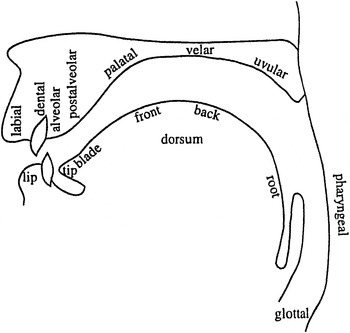
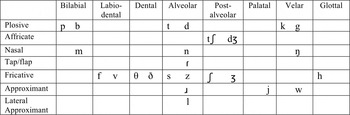
Figure 1 shows the human vocal tract, the region where speakers shape sounds by engaging or disengaging the vocal chords and by directing airflow in some manner. Speakers create different consonants by constricting airflow at different places of articulation such as the glottis, velum, soft palate, alveolar ridge, the front teeth and the lips. Figure 2 is the IPA chart for standard American English.Footnote 6 It provides symbols for all the consonant sounds and arranges them horizontally according to their place of articulation. The vertical axis of Figure 2 differentiates manners of articulation. Plosives involve a complete stoppage of air followed by a short burst; fricatives involve narrowly restricted airflow; affricates begin as plosives but continue as fricatives; nasals involve closing the mouth completely, opening the uvular flap and forcing air through the nasal cavity; a tap, or ‘flap’ involves a quick touch of the tongue to the roof of the mouthFootnote 7; approximants – more like vowels than any other type of consonant – involve the least constriction of airflow.
Mid-sagittal section of the vocal track (IPA 1999), courtesy of Cambridge University Press.

International Phonetic Association's categorization of English consonants.

The reader will notice that a number of blocks within Figure 2 contain more than one phoneme. Pairs of phonemes within the same block differ by a simple contrast of manner. Those on the left are voiceless, and those on the right are voiced. In other words, the only phonetic difference between ‘bill’ and ‘pill’ is that the pronunciation of the former requires speakers to vocalise throughout, while the pronunciation of the latter requires speakers to engage their vocal chords at the vowel of the syllable.
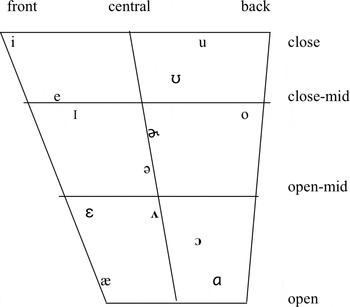
In contrast to most consonants, vowel production involves no obstruction of airflow. While the number of dialects and sub-dialects within American and British English creates a considerable amount of variation in the area of vowel production, Figure 3 shows the IPA chart of those vowels that are relevant to this study. The placement of phonemes within the figure indicates the position of the tongue in the mouth required to produce the vowel sound. For example, the phoneme /i/ requires speakers to place their tongues in the front of the mouth toward the roof. Pronunciation of the phoneme /ɑ/ requires speakers to keep their tongues low and back, creating a relatively open cavity in the mouth.
International Phonetic Association's placement of some vowels in American and British English.

Syllables and accent
Standard linguistics recognises two main parts of syllables. The onset concerns the attack at the beginning of the syllable. The second part is called the rhyme, which is comprised of at least a nucleus (usually a vowel) and possibly a coda (if any consonants follow the nucleus). The part of a syllable most relevant to a study of alliteration is the onset. However, vocalisation often obscures the syllable divisions found in dictionaries. We most often hear vocalised language (either speech or song) as a steady stream of syllables with no obvious interruptions between words. When this happens, sounds blend together in interesting ways. See Example 1, which features a line from the Beatles' ‘Help’, followed by a phonetic transcription of Lennon's performance that provides a more accurate representation of syllable boundaries.
The Beatles ‘Help!’

The sibilant from the end of ‘independence’ actually sounds at the beginning of ‘seems’, and the /ʃ/ sound at the end of ‘vanish’ also sounds on the beginning of beat 3 at the onset of ‘in’. These differences between written and heard syllabic divisions are attributable to a phenomenon that involves movement of a syllable coda to the onset of the syllable that follows it. I call this phenomenon ‘migration’. Within a sequence of syllables, singers generally do not articulate syllable codas until the onset of the syllables that follow.Footnote 8 Singers rarely put the space between syllables that prevents migration, simply because they cannot phrase their lyrics in aesthetically pleasing ways when they do. Migration often occurs when syllable codas with relatively hard consonants such as plosives, affricates or fricatives precede syllable onsets with relatively soft phonemes such as approximants or vowels.
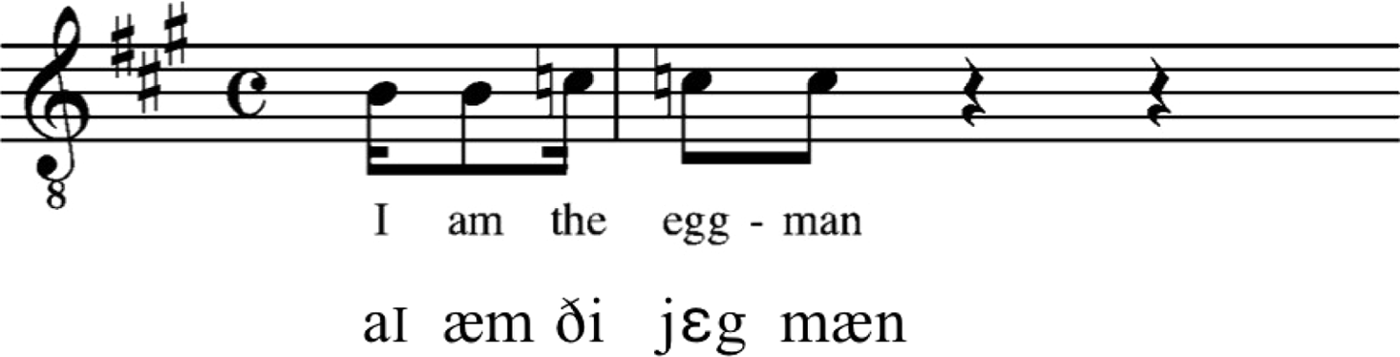
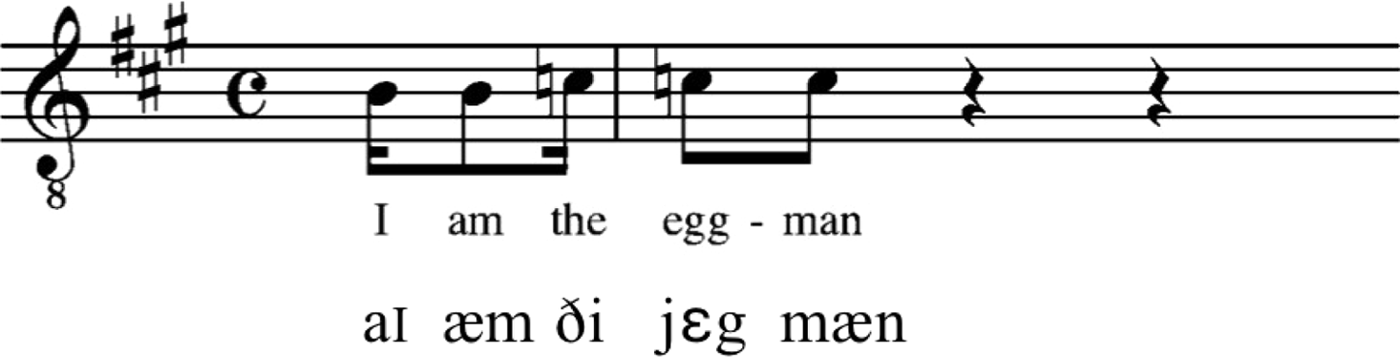
Example 2, a transcription of a familiar line from the Beatles' ‘I am the Walrus’, demonstrates a phenomenon I call ‘insertion’. Although the palatal approximant is not required to produce either ‘the’ or ‘eggman’, it sounds between them in the example. Insertion of the phoneme /j/ helps separate a syllable with a high front final vowel from another vowel sound occurring at the onset of the next syllable, although this reverse diphthong is clearly an unintended result of casual speech. John Lennon, like many speakers and singers, would rather not disengage voicing between syllables whose adjacent endpoints feature different vowel sounds. Instead, he vocalises through the change in syllables. As the tongue moves from high front /i/ to capture the sound of the subsequent vowel, it glides across the palate creating the approximant /j/. While the insertion of the palatal glide does complicate the relationship between written and spoken language, it helps clarify syllable boundaries.
The Beatles ‘I Am the Walrus’
Example 3, an excerpt from Elton John's ‘I Don't Wanna Go On With You Like That’, demonstrates a second type of insertion where the velar approximant /w/ sounds between the vowels /o/ and /ɑ/.Footnote 9 This phenomenon is a byproduct of vocalising through the first syllable – whose vowel already requires a degree of lip rounding – and into the second, which begins with a vowel that sounds closer to the back of the mouth. The rounded lips required for the vowel /o/ influence the transition between vowels, producing the velar approximant /w/. In this example, insertion of the velar approximant alliterates and rhymes with the accented /w/ in ‘wanna’.
Elton John ‘I Don't Wanna Go On with You Like That’

In pop music, the more or less continuous vocalisation that takes place throughout a sung phrase regularly places syllable codas and nuclei up against the onsets of the syllables that follow. While it may be that migration and insertion occur in everyday speech, their effects are more traceable when they occur in rhythmically specific musical settings. Furthermore, since there are often clear differentiations of pitch in a vocalised melody, syllabic parsing can be much clearer in phonetic transcriptions of melodies than it is in phonetic transcriptions of everyday speech. When changes of pitch occur across syllable boundaries, faithful phonetic transcription reveals that the phonemes under scrutiny really do migrate.
Syllabic accent is considerably less restricted than metric accent. While the rhythmic accompaniment of pop tunes in quadruple metre often emphasises beats two and four, such emphasis only creates tension against normatively accented – and therefore ‘metrically strong’ – beats one and three.Footnote 10 In most vocal melodies, syllabic accent reflects the prosody of spoken English. Accented syllables in vocal phrases tend to be the stressed syllables in polysyllabic words. In a phrase of predominantly monosyllabic words, accented syllables tend to be those that would be stressed in a casually spoken sentence. Temperley (Reference Temperley1999, pp. 20–1) discusses melodic syncopation in rock songs, observing relationships of alignment and non-alignment between accented syllables and metrically strong beats. He observes a fundamental difference between the syllabic settings of classical art songs and pop songs, in that accented syllables in the former ‘generally coincide with relatively strong beats’, while those in the latter often fall short, creating syncopations. I recognise that patterns of accented syllables in popular songs frequently fall directly on metrically weak beats. Consider, for example, how declamation in the verses of Aerosmith's ‘Walk this Way’, where such lines as ‘schoolgirl sweetie with her classy, kinda sassy’ and ‘I was a high school loser, never made it with a lady’ feature alliterating accented syllables that fall squarely on beats two and four.Footnote 11 Syllabic accents can even involve both weak and strong beats, as in the verses of Tom Petty's ‘Jammin’ Me', with its litany of ‘take back …’ imperatives falling on beats two and three, or the verses of the Beatles' ‘I Want You (She's so Heavy)’ where emphasis falls on beats four and one (‘I want you, I want you so bad’).
In addition to falling on all beats of the metre, accented syllables often anticipate beats. Temperley's ‘syncopation shift rule’ observes how accented syllables in pop melodies anticipate beats, and conveys the idea that the anticipating accents are metrically shifted variations of a more normative melodic rhythm (pp. 26ff.). Temperley allows that eighths and 16ths that sound in anticipation of quarter note beats can create tension against relatively strong points within metric frameworks and, by so doing, imply simpler and more metrically normative rhythmic patterns. In the analyses below, accent patterns involving anticipations to beats are related to accent patterns that fall squarely on those same beats as long as those anticipations are not longer than half a beat.
A number of factors can give rise to misalignments between metric accent and syllabic accent. A rhythmic pattern in the accompaniment that either emphasises weak beats (i.e. the standard rock and roll backbeat rhythm) or syncopates can create a pattern of accents to which lyrics can adhere. An abrupt change of pitch such as an upward leap can create an accent in a melody. A phonetic scenario such as a striking contrast in the quality of syllable onset could cause a listener to perceive a syllable as accented (e.g. the only plosive in a line of soft syllables). While metric accent and syllabic accent do not correspond tightly in pop music, they do interact with each other in interesting ways. This interaction is important to the analyses below, which show how different alliterative effects arise within patterns of syllabic accent and, in turn, how those patterns relate to what we understand to be normative metric accent. Still, as the focus of my analyses is phonetic structure, the following examples are not organised with regard to rhythmic patterning or deviations from metric norms, but according to different types of alliteration.
Analyses
All the examples below are melodic and phonetic transcriptions from sound recordings. Breaks in phonetic transcriptions occur between spoken syllables, regardless of whether the sound is continuous. In most cases, phonetic transcription is clearly necessary in light of the phenomena discussed above (i.e. insertion, migration), which directly affect the syllable onsets listeners hear. While certain examples do not require this level of description, there are still several reasons for including phonetic transcription in all analyses. First, doing so provides a consistent level of detail at which the reader may engage with the music in all examples and analyses; second, phonetic transcription is a more accurate form of notation than merely writing the lyrics; third, as the written analyses engage alliteration at the phonetic level, it is appropriate that the examples reflect phonetic detail.
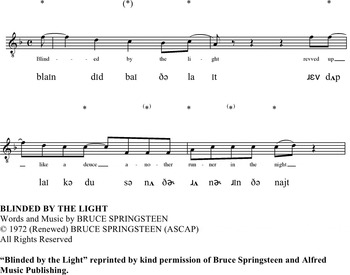
Example 4, a transcription of the refrain to Bruce Springsteen's ‘Blinded by the Light’ as performed by Manfred Mann's Earth Band (1976) demonstrates the importance of alliteration to successful pop songs with nonsense lyrics. Asterisks indicate where alliterative patterns fall on or in anticipation of accented syllables, and asterisks in parentheses indicate secondary accents. The alliteration in this excerpt involves more than simple recurrences of a consonant. Here, a process of fragmentation occurs whereby the consonant cluster /bl/ that sounds at the onset of the first accented syllable ‘blinded’ is followed by accented syllables with onsets of /b/ and /l/ on ‘by’ and ‘light’. Across the first half of line two, the voiced alveolar consonant /d/ migrates from the end of ‘revved’ to the beginning of ‘up’, resulting in ‘revvedup’. This alliterates with the next accented syllable, ‘deuce’. Across the second half, the pair of consonants /n/ and /ɹ/ create a chiasmus, or ‘x y y x’ pattern involving primary and secondary accents. Taking all of Example 4 into consideration, we can hear and feel that all the stressed syllables take part in some alliterative patterning. The majority of these accented syllables sound in anticipation of metrically strong beats at the start of the refrain (the exception being ‘by’), but fall squarely on the beats at the end of the refrain. In this way, accented syllables resolve rhythmic tension against the metre over the course of the passage, and the alliterative patterning highlights this. Finally, we can appreciate how syllables with primary accents always fall on members of the tonic triad F, which is also the harmonic point of arrival in this section.
Bruce Springsteen ‘Blinded by the Light’ (performed by Manfred Mann)

The history of this song reveals the importance of the phonetic structure of this performance. Springsteen's original lyrics are different in this place. Where Earth Band vocalist Chris Thompson sings ‘revved up’, Springsteen sings ‘cut loose’. Although Springsteen's lyrics allow an internal rhyme of ‘loose’ with ‘deuce’, Thompson's lyrics create an alliterative scheme that takes place across the whole refrain, involving every accented syllable. The recording by Manfred Mann's Earth Band was considerably more successful than Springsteen's, even though Thompson's pronunciation of the lyrics is notoriously difficult to understand. I submit that the change of lyrics that produced a greater degree of alliteration made the refrain more fun to sing along with, in spite of the fact that most listeners cannot decipher some of the words, and that a certain amount of the success of the Earth Band's version of this song can be attributed to this change in the phonetic structure of the refrain.Footnote 12
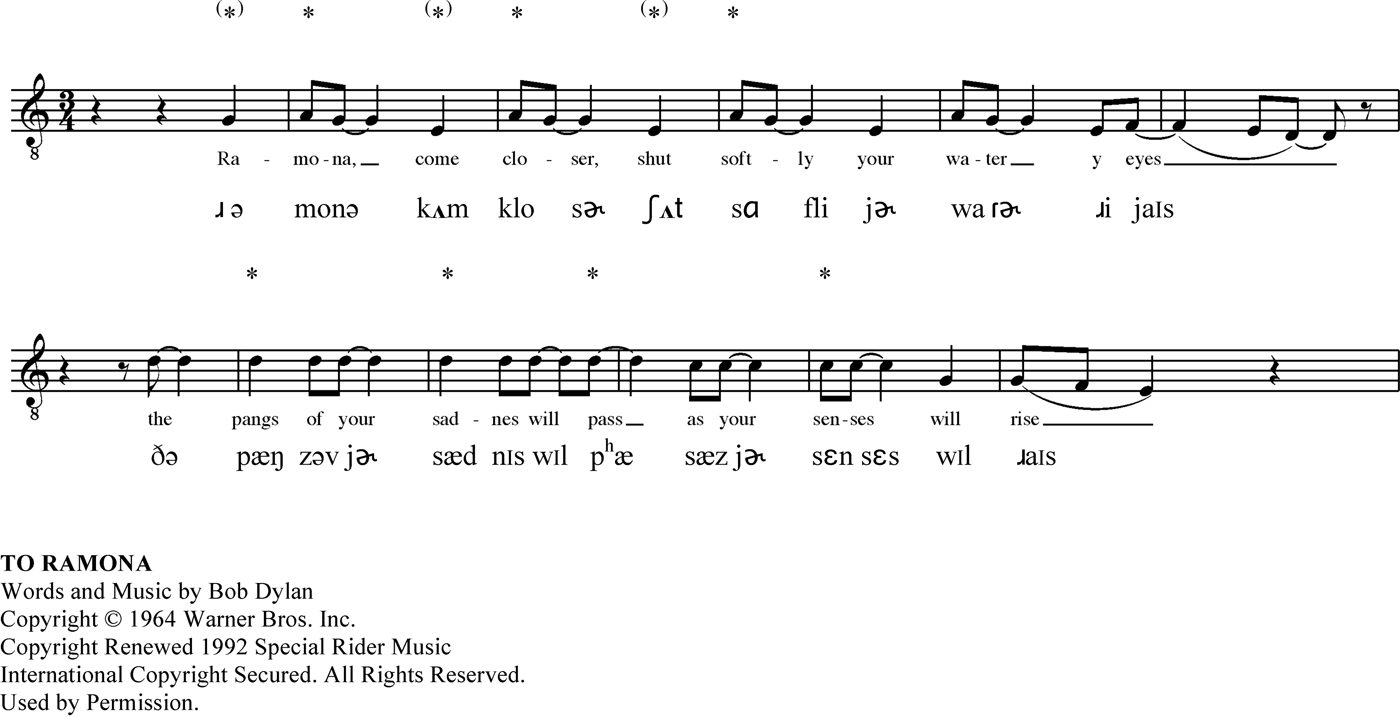
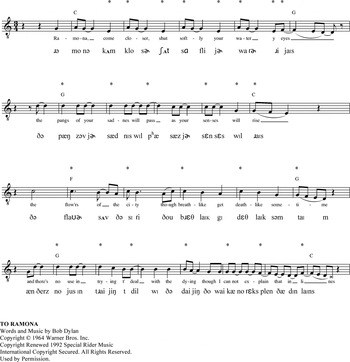
Alliterative patterns occur throughout the first verse of Bob Dylan's ‘To Ramona’, a folk song in triple metre. The reader may already recognise a fair amount of regular alliteration at first glance. Example 5 shows that ‘come quickly’ and ‘shut softly’ alliterate, placing primary accents on downbeats and secondary accents on beat three of virtually every bar of the first line, reflecting the normative hierarchy of beats in simple triple metre. A pattern of alternating consonants /p/ and /s/ sounds across line two (‘the pangs of your sadness will pass as your senses’), further emphasising downbeats.
Bob Dylan ‘To Romana’
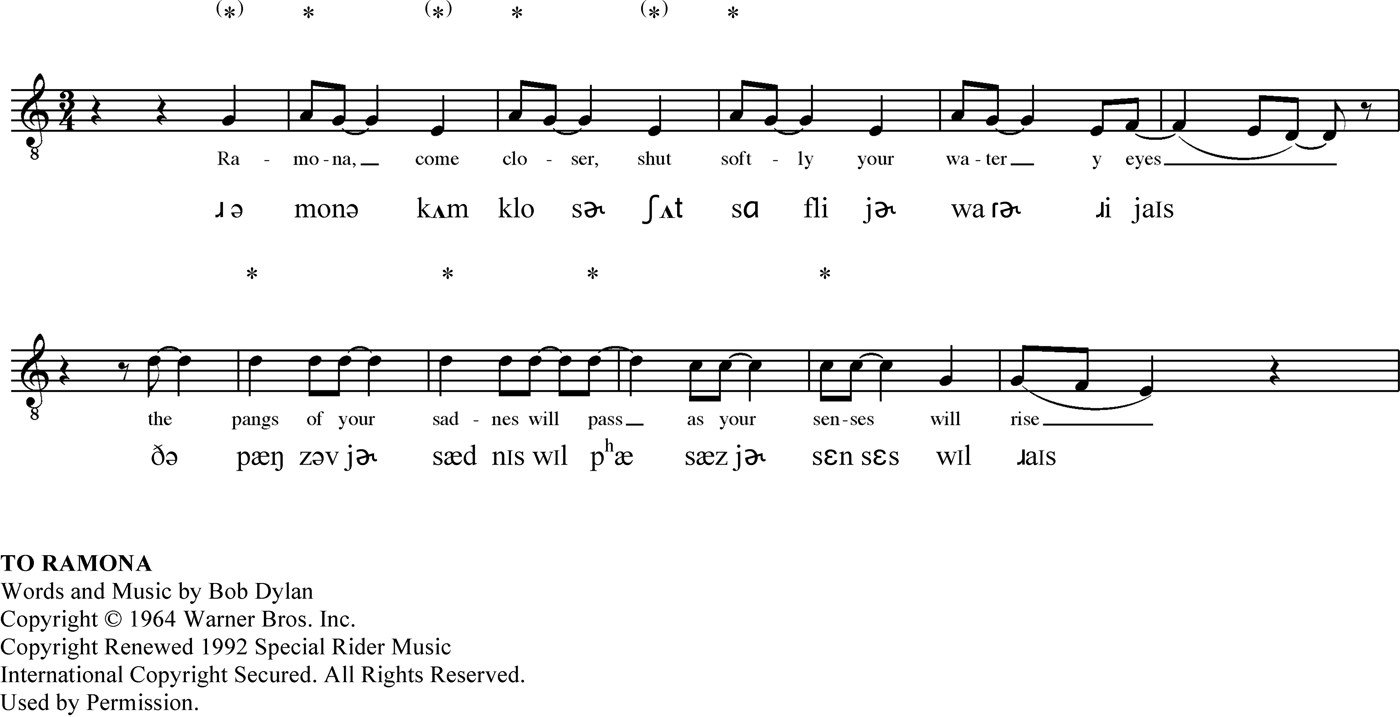
To appreciate the phonetic effects in Example 5, one must have a lenient working conception of alliteration. The post-alveolar fricative at the onset of ‘shut’ actually differs in sound from the alveolar fricative at the onset of ‘softly’. Still, both words begin with sibilants, which involve a fair amount of hissing. Quite a lot of alliteration in popular songs is less than strict. Griffiths (Reference Griffiths and Moore2003, pp. 50–1) discusses rhyme in popular music, introducing such concepts as ‘near rhyme’ and even ‘non-rhyme’.Footnote 13 In the same spirit, I introduce the concept of near alliteration as a generalisation of regular, or strict alliteration. When near alliteration occurs, consonants at syllable onsets involve either a similar (if not the same) manner of articulation, or their production comes from the same general area of the vocal tract. I refer to the former type as manner-preserving and the latter as place-preserving. Manner-preserving alliteration therefore allows contrasting places of articulation, and place-preserving alliteration allows contrasting manners.Footnote 14 The sibilant alliteration between /ʃ/ and /s/ in Example 5 is manner preserving. The places of articulation (post-alveolar and alveolar) contrast, though they are not very far removed from each other. The examples that follow demonstrate different types of near alliteration. In many cases, the examples also involve strict alliteration. I point out these instances when they arise. Although they are not central to the matter at hand, strict alliteration often establishes contexts that make near alliteration more perceivable.
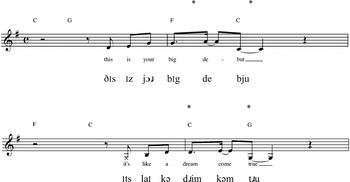
The reader may already see how the pairs of voiced and unvoiced consonants in Figure 2 could give rise to place-preserving near alliteration. In fact, discussions of phonetic similarity at this level of abstraction are not new to poetics.Footnote 15Example 6 shows an excerpt from Steely Dan's ‘Peg’, where accented syllables in the second line fall on ‘dream’ and ‘true’.
Steely Dan ‘Peg’

Two factors strengthen the correspondence between the near-alliterating syllables. The first concerns the fact that both /d/ and /t/ are followed by the lateral approximant /ɹ/. In this way, the near-alliteration involves a pattern of consonant clusters, rather than a simple correspondence of single consonants. The second concerns the rhythmic placement of these syllables on the downbeat and the anticipation of beat three. This not only aligns rhythmically with the harmonic changes in the accompaniment, it also resonates with the strict alliteration that occurs two measures earlier on ‘big’ and ‘debut’.
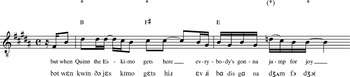
While place-preserving near alliteration is arguably more perceivable when it is somehow involved with strict alliteration, it is also more perceivable when it occurs more than once over the course of a song. Example 7 shows a recurring line from Manfred Mann's ‘Mighty Quinn’ (1968), an arrangement of Bob Dylan's ‘Quinn, the Eskimo’.Footnote 16
Bob Dylan ‘Quinn, The Eskimo’ (performed by Manfred Mann)

A variation of this line occurs at the end of every verse. Only the lyrics of the first half ‘but when Quinn, the Eskimo gets here …’ remain the same each time. The excerpt in Example 7 comes from the first verse (the first reference to the hero Quinn in the song). Unvoiced and voiced velar plosives on ‘Quinn’ and ‘gets’ sound on beats one and three of the first measure, and harmonic changes articulated by the wordless backing vocals accent those syllables. Although ‘jump’ and ‘joy’ relate through strict alliteration, these syllables are not accented by anything else in the arrangement, and ‘jump’ sounds on the relatively weak beat two. As a result of the alignment of near alliteration with the harmonic rhythm and the relatively weak metric placement of ‘jump’, the relationship between the pair of nearly alliterative syllables is arguably as perceivable that which relates the strictly alliterative, but metrically weaker pair.
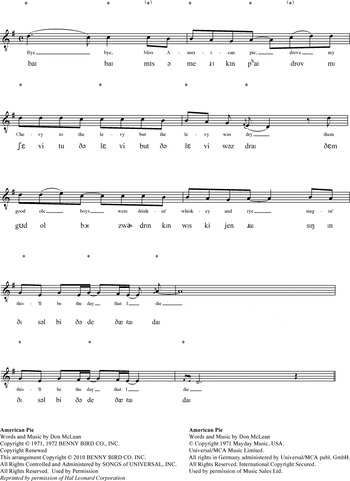
Manners of articulation may vary to greater degrees than simple changes of voicing and still create alliterative patterns as long as the place of articulation is the same or relatively close. See Example 8, the familiar refrain from Don McLean's ‘American Pie’.Footnote 17
Don McLean ‘American Pie’

The first, second and fourth accented syllables of the first line are bilabial plosives, voiced and unvoiced. The third, in ‘American’, is a bilabial nasal. This syllable's engagement in strict alliteration with ‘Miss’ (a secondary accent) encourages participant listeners and singers to hear it as part of the general bilabial alliterative patterning of this line. In this way, a pair of syllables on /m/ answer a pair of syllables on /b/, followed by a single syllable on /p/. As in the examples above, the consistency in the rhythmic placement of each accented syllable brings the near alliteration to the attention of singers and listeners. Each accented syllable in this line falls on beat one or three with the exception of the last, which anticipates beat three. Furthermore, each primarily accented syllable in the passage falls on a different melodic scale degree and delineates a descent from ^5 to ^2.
Admittedly, there are considerable differences in sound between plosive and nasal consonants. For this reason, the alliterative effect across this first line is easier for singers to experience than it is for non-participating listeners. Fortunately, this refrain invites listeners to sing along, and when listeners do become singers, they respond physically to the patterns of sound production in which they are engaged. I submit that the patterns of sound production explained above make this passage fun to sing despite the paucity of any obvious literal meaning in the lyrics.Footnote 18
Initial consonants across line two of Example 8 create near-alliterative effects that preserve a more general sense of place. Accented syllables (falling on beats one, three, or in anticipation of beat three) begin in the post-alveolar area, but come to focus on the alveolar ridge, placing an increasing amount of stress there over the course of the line.Footnote 19 The first accented phoneme, the post-alveolar fricative /ʃ/, requires a place of articulation just behind the alveolar ridge. The subsequent accent of the approximant /l/ on beat three touches lightly on the alveolar ridge, while the final accent sounds in anticipation of a downbeat with the voiced alveolar plosive /d/.Footnote 20 The fourth line begins with an accented dental fricative, but also comes into focus on the alveolar ridge. Accented syllables on ‘this’, ‘day’ and ‘die’ relate by preserving the general place of articulation around the dental/alveolar region. In this way, line four approaches the alveolar ridge from the opposite direction taken by line two.
Although the text of the fifth line is a strict repetition of the fourth, the metric placement of the final syllables differs. Arrival on D at the final syllable of the refrain sets up the initial pitch class of the following verse. The continuity created by this correspondence preserves the song's momentum, which is important in light of the considerable length of the song. The rhythmic difference between lines four and five is significant as well. While the final syllable of line four sounds in anticipation of the downbeat, line five falls squarely on it. This makes the alliterative effect of approaching the alveolar ridge all the more noticeable. In addition, the alignment of ‘die’ with the downbeat creates the kind of resolution of rhythmic tension discussed in Example 4. As the final syllables of all previous lines end in anticipation of strong beats, this resolution returns a degree of metric stability to the performance.
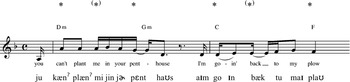
Example 9 presents part of the refrain from Elton John's ‘Goodbye Yellow Brick Road’, where a more complex pattern of alliteration arises.Footnote 21 Unvoiced and voiced velar plosives on ‘can't’ and ‘goin’ sound on subsequent downbeats. Voiceless bilabial consonants sound on the other accented syllables. ‘Penthouse’, which sounds in anticipation of beat three, alliterates strictly with ‘plow’, which falls squarely on beat three. The voiced bilabiol syllables that take secondary accents in each line (‘me’ and ‘back’), fall on or in anticipation to beat two and relate to ‘penthouse’ and ‘plow’ by place-preserving near alliteration. Furthermore, the final accented syllable of this excerpt falls squarely on a relatively strong beat. By doing so, it rectifies the rhythmic tension created by the first syllable of ‘penthouse’, which sounds in anticipation of beat three in the previous measure. As in Examples 4 and 8, alliteration highlights a resolution of melodic accent against metric accent. As in Example 4, this alignment of accents coincides with the harmonic resolution to tonic.
Elton John ‘Goodbye Yellow Brick Road’

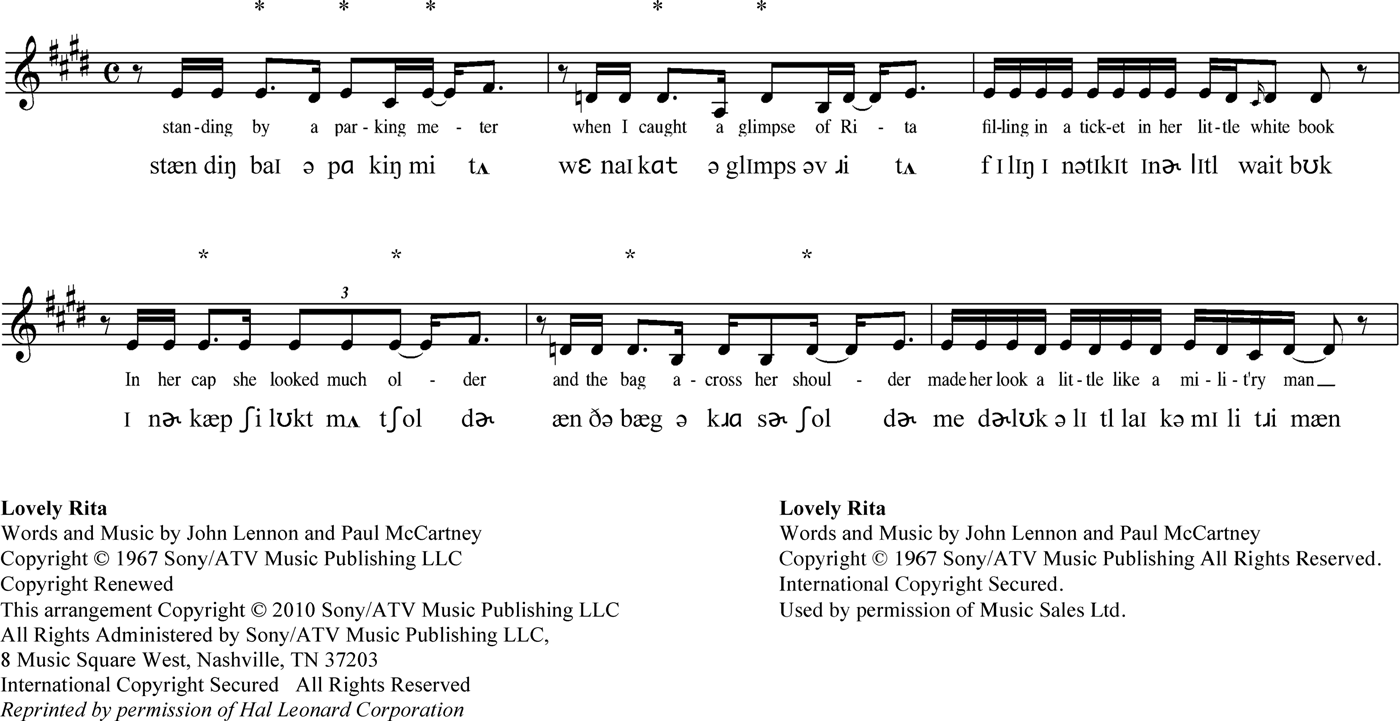
Example 10 is a transcription of an excerpt from ‘Lovely Rita’ by the Beatles. The alliterated syllables in the first two measures are set to the longest-sounding pitches. (The only relatively long syllable not involved in alliteration is the ‘Ri’ of ‘Rita’.) Across the first two measures, accents fall directly on beats two and three, where pairs of voiced and unvoiced plosives occur at similar places of articulation (bilabial ‘by’ with ‘parking’, and velar ‘caught’ with ‘glimpse’). A bilabial nasal of somewhat lesser rhythmic prominence (‘meter’) follows the pair of bilabial plosives placing secondary accent on the anticipation of beat four. The near-alliterative patterning does not follow typical stress patterns for quadruple metres. Rather than stressing alternating beats (one and three or two and four), it emphasises the middle two. This, along with the avoidance of any melodic stress on beat one and only occasional emphasis on beat four contributes to the lighthearted yet plodding feel of the song.
Lennon and McCartney ‘Lovely Rita’
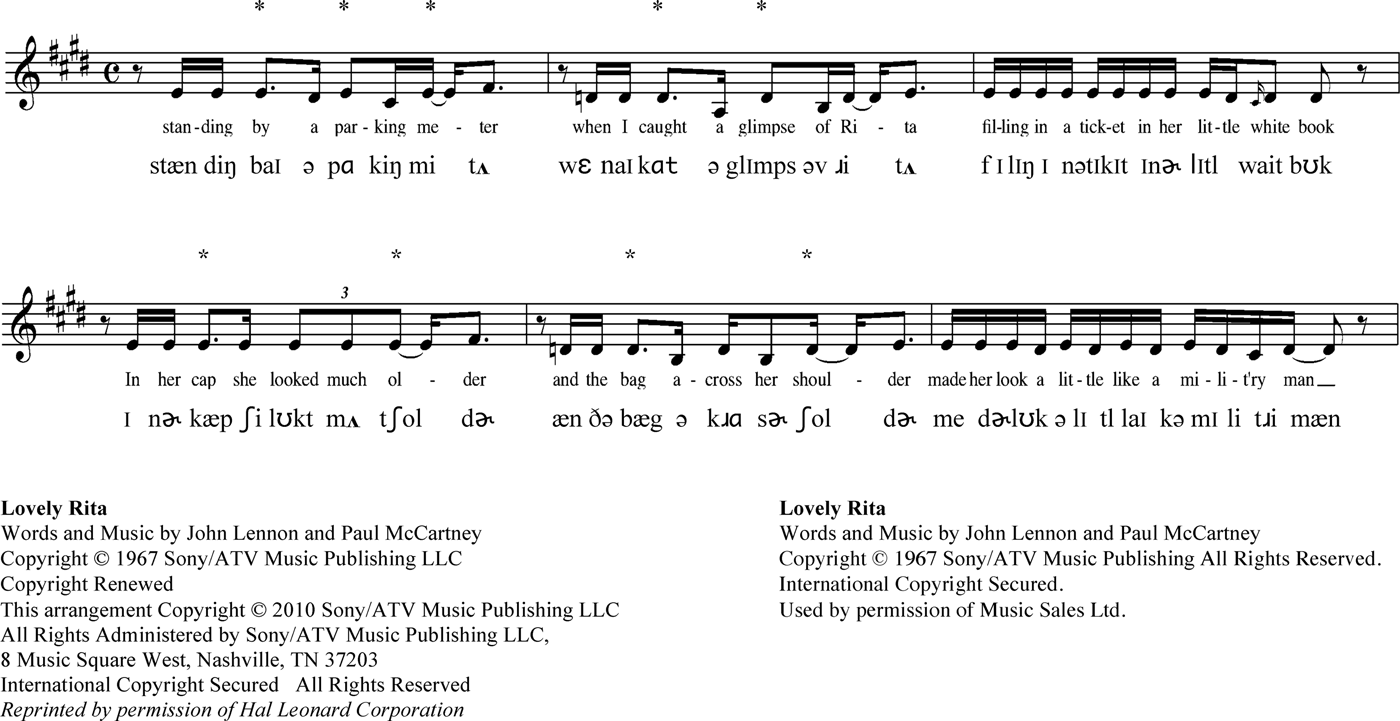
The lyrics in the fourth and fifth measures of Example 10 go well together, but not simply because ‘older’ and ‘shoulder’ rhyme. Migration occurs at the conjunction of ‘much’ and ‘older’, placing the voiceless post-alveolar affricate /tʃ/ immediately before the rhyming syllable. The resultant articulation ‘cholder’ alliterates with the voiceless post-alveolar fricative that begins ‘shoulder’, preserving place of articulation. Alliterative patterning across the last line of the verse is strict, though not consistently reinforced by accent. Here, a fast-paced ‘lookalittlelike’ sounds within a frame of bilabial nasals. Alternation between E and D# in the sixth measure of the example makes the alliteration on /l/ more audible.Footnote 22
Near alliteration may sometimes involve similar manners of articulation with variations in place. Manner-preserving alliteration is arguably less obvious to listeners and singers than the place-preserving kind, but sensitivity to it reveals interesting correspondences within lyric and rhythmic structures. Not all manners of articulation produce phonemes similar enough in sound to create alliterative effects across the board. One could hardly admit that a line with the sequence of accented plosives /p/, /t/ and /g/ produces an alliterative effect. I recognise the three manners of articulation that are capable of producing recognisable alliterative patterns. These are vowels, nasals and approximants. These three manners of articulation constitute a natural class of sounds known to linguists as sonorants, and their common feature is a lack of turbulent airflow.
The most perceptible patterns of manner-preserving near alliteration involve vowels.Footnote 23 Vowel alliteration – sometimes called assonant alliteration – features patterns of accented vowel-initial syllables, with no constraint on the types of vowels that may be involved. Leech (Reference Leech1969, p. 91) discusses the effectiveness of vowel alliteration in modern English poetry, observing that since such accented syllables have a ‘“zero” consonant cluster’ they count ‘as a positive correspondence’. Whether one attributes vowel alliteration to the absence of consonants or to the similarity of all vowel articulations (voiced, with unobstructed airflow), the correspondence is, unarguably, a form of manner-preserving near alliteration.
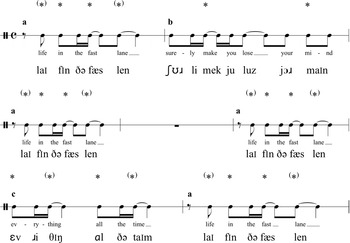
Vowel alliteration occurs along with strict alliteration in Example 11, below, the last line from the first verse of Dylan's ‘Mr Tambourine Man’. In this excerpt, vowel alliteration unites the two modifiers ‘ancient’ and ‘empty’, which precede strict alliteration on ‘dead’ and ‘dreaming’. All accented syllables anticipate metrically strong beats except for the last one, which falls squarely on the last downbeat and, as in Example 4, 8 and 9, resolves a certain degree of tension between melodic rhythm and metre. Example 12, the refrain from the Eagles' ‘Life in the Fast Lane’ shows a familiar occurrence of vowel alliteration within a more established alliterative context. The lyrical form of the refrain is ABA ACA. Segment A, which states the title of the song, features an alliterative chiasmus involving the lateral approximant and the unvoiced labiodental fricative (/l/, /f/, /f/, /l/). Strict alliteration on /m/ in segment B involves metrically weak beats, sounding in anticipation of beat two and squarely on beat four. Vowel alliteration sounds in segment C (‘everything, all the time’), and emphasises the shift of primary syllabic accents to metrically strong beats one and three. Secondary accents on /θ/ and /t/ fall on anticipations to beats two and four in this segment, creating a generally place-preserving near alliteration incorporating the dental/alveolar regions.
Bob Dylan ‘Mr. Tambourine Man’

The Eagles ‘Life in the Fast Lane’

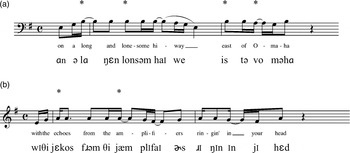
Processes such as migration or insertion can obscure or even obliterate vowel alliteration. Example 13 shows two short excerpts from Bob Seger's ‘Turn the Page’ where vowel alliteration fails to occur.Footnote 24Example 13a shows migration of the phoneme /f/ from the end of ‘of’ to the beginning of ‘Omaha’. The vowel alliteration that could have occurred with ‘east’ and ‘Omaha’ on the first two beats of the measure would have corresponded closely to the accent pattern established in the previous measure by strict alliteration on ‘long’ and ‘lonesome’. In Example 13b, insertion of the palatal glide at the onsets of ‘echoes’ and ‘amplifiers’ prevents vowel alliteration from sounding, but creates strict alliteration of the phoneme /j/ instead.
Bob Seger ‘Turn the Page’

Approximants (/l/, /r/, /j/ and /w/) require the least amount of airflow constriction of all consonants. For this reason, recurrences of accented approximants can give lyrics a liquid quality that only seems half-articulated in comparison to plosives or affricates. The generally liquid quality of approximants is evident in the first verse of Bob Dylan's ‘To Ramona’. Example 5 has already shown how strict alliterative patterns play out across the beginnings of the first two lines. Example 14 shows verse one in its entirety.Footnote 25 The ends of most of these lines involve manner-preserving near alliteration. The end of line 1 features a succession of all four approximants (/j/, /w/, /ɹ/, /j/) on or near accented beats. The fourth approximant arises from insertion of the palatal glide at the onset of ‘eyes’. The accent pattern continues to favour beats three and one as discussed above (Example 5), although the final syllable sounds in anticipation of the downbeat rather than directly on it. This shift of accent accompanies the first harmonic change in the line, a resolution from tonic to dominant. Across this line, syllabic accent begins in alignment with metric accent but ends out of alignment. In this respect, the first line contrasts with Examples 4, 8, 9 and 11. This deviation from the established accent pattern of the line does not detract from our ability to perceive the line's alliterative qualities. In fact, a shift from a pattern of accented articulations that falls squarely on the beat to one that anticipates beats can create an engaging surprise that draws our attention to the sound of the offset syllable.
Bob Dylan ‘To Ramona’

Although accent patterning across most of line two favours downbeats, approximants /w/ and /ɹ/ occur at the end of line two on beats three and one. This reference to the accent pattern of line one strengthens the correspondence between the two lines in a way that enhances both the rhyme scheme and the manner-preserving near alliteration. This alliteration also draws attention to a relationship between melodic rhythm and harmonic motion. As the final accented syllable of line one anticipates the downbeat, creating metric tension as tonic resolves to dominant, the final accented syllable of line two falls squarely on the downbeat as dominant resolves back to tonic.
The end of line three features no approximants. Little in the way of alliteration occurs here at all, though the place-preserving near alliteration involving ‘deathlike’ and ‘times’ on successive downbeats begins a pattern of accented alveolar consonants that continues in line four with /n/, /t/ and /d/. The final accented syllable of this line is the alveolar approximant /l/ on ‘lines’, which resumes the place-preserving alliteration from the first half of the line as well as the manner-preserving alliteration established at the endings of lines one and two.
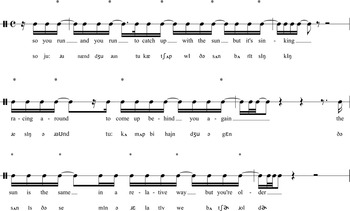
Manner-preserving alliteration also occurs with approximants at the end of line three of the refrain to McLean's ‘American Pie’ (see Example 8), where the setting of the lyrics ‘whiskey and rye’ place approximants on beats 1 and the anticipation of beat three. This continues the alliterative patterning established at analogous places in previous lines with ‘American Pie’ and ‘levy was dry’ and discussed in Example 8. Example 15 shows a more involved case of manner-preserving alliteration in the second verse of Pink Floyd's ‘Time’. The tempo of this song (ca. 66 bpm.) is relatively slow. Sixteenth notes subdivide the majority of quarter notes, and enough time elapses between successive beats to give each quarter note a considerable amount of metric stability. In this excerpt, accented syllables are set to relatively long-sounding notes. Syllabic accents fall on virtually every beat that is set to lyrics, either in direct alignment or in anticipation by a sixteenth note. Manner-preserving alliteration occurs across the second half of line three, where the approximants (/ɹ/, /w/) sound. The rhythmic placement of these approximants corresponds closely to the last three alliterating syllables of line one, where generally place-preserving alliteration involves the unvoiced post-alveolar affricate /tʃ/ and the alveolar fricative /s/ on anticipations of subsequent beats. Also note the parallel relationship among lines one, two and three created by the strictly alliterating pairs of stressed syllables that sound at their beginnings.
Pink Floyd ‘Time’

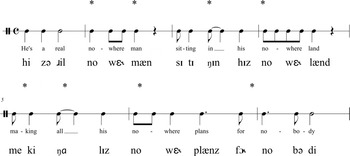
All nasals force air through the nasal cavity and, for this reason, they have a quality of sound shared by no other manner of articulation.Footnote 26Example 16, the opening of the Beatles' ‘Nowhere Man’, presents a somewhat subtle case of manner-preserving near alliteration with nasals.Footnote 27 All three nasals (/m/, /n/ and /ŋ/) occur more than once across seven measures, sounding on downbeats and either squarely on beat three or in anticipation of it. Occurrences of the word ‘nowhere’ place the alveolar nasal on half of the downbeats, and this greatly contributes to the passage's alliterative effect. Migration in ‘sittingin’ and ‘makingall’ places the velar nasal in accented positions, anticipating beat three. Though other types of consonant phonemes sound in this excerpt, the majority of them (/h/, /ɹ/, /s/, /l/) are soft enough to avoid disrupting the passage's general nasality, and those harder consonants that could have such an effect (/p/ and /d/) sound toward the passage's end.
The Beatles ‘Nowhere Man’

Example 17, the beginning of the third verse of Dylan's ‘It Ain't Me Babe’ exhibits patterning of nasals in a well-established alliterative context. Previous verses begin with ‘Go ‘way from my window' and ‘Go lightly from the ledge’. These strict correspondences allow listeners to appreciate the similarity in sound between accented syllables on ‘melt’ and ‘night’, as well as between ‘nothing’ and ‘moving’ at metrically similar places in the next line. This alliterative correspondence sheds some light on Dylan's choice of the verb ‘melt’. After all, other verbs such as ‘fade’, ‘steal’ or ‘run’ (or even the adverb ‘far’) would have sounded more familiar and conveyed the overall meaning of the line more directly.
Bob Dylan ‘It Ain't Me Babe’

Conclusion
The examples above demonstrate how sound patterning at the accented surfaces of many pop vocal melodies involves alliteration. Furthermore, they demonstrate a wide range of alliterative effects from the very obvious (e.g. strict alliteration) to the relatively subtle (e.g. manner-preserving near alliteration). Fortunately, many occurrences of the subtler types of alliterative relationships occur alongside or in rhythmically or formally analogous places to occurrences of more patent forms of alliteration. In some cases, accents delineated by alliterative patterns coincide with harmonic changes. Such coincidences may be perfectly aligned, as in Examples 6 and 7, or not, as in Example 14. Either way, phonetic structure ties directly into deeper aspects of musical structure than simple melodic surfaces. Syllabic accent patterns interact in different ways with normative metric accents, and this is a reflection of the complicated nature of melodic rhythm in pop music. Rather than adhering to strong beat schemas, alliterative patterns flow from the melodic rhythm of popular song which, as demonstrated in Temperley (Reference Temperley1999), is markedly different from melodic rhythm in ‘classical’ or what is conventionally understood to be art music.
The types of alliteration discussed above create patterns that are attractive to listeners, and they can physically engage those who sing along. Furthermore, these alliterative patterns form a direct link between the singer and even the casual, non-singing listener.Footnote 28 This link is particularly relevant when one considers the popularity of those songs whose lyrics make little or no literal sense, as seen in Examples 4, 7, 8 and 11. Future research may reveal how alignments between alliterative patterns and points of metric stability occur in other repertoires, including those that involve languages other than English. Adaptations of the analytical approach used above may even direct our attention to alignments between phonetic structure and other musical parameters – particularly in musical styles that have originated in cultures outside the Western sphere of influence.
The relationship between listener and pop recording invites comparison to the relationship between listener and performer in recitations of ballads and epic poetry.Footnote 29 In both relationships, alliteration facilitates memory and encourages participation. Near-alliterative patterning that involves considerable differences in sound (e.g. manner-preserving) is not easy to hear. However, phonetic relationships do become clearer to those who sing along in time with such passages. Furthermore, several of the examples above demonstrate how near alliteration occurs with strict alliteration, either alongside it or in analogous positions within a song's form, and with the same or similar accent patterns. Such examples suggest the possibility that phonetic patterning influences the decision-making process in lyric writing in many ways not previously discussed. Songwriters may actually sense similarities of manner and articulation among consonant phonemes and write lines that create alliterative (and near-alliterative) patterns because they are more engaging to sing than lines that do not roll off the tongue as well. It is also conceivable that such patterns attract songwriters because they make the words easier to sing and easier to remember.Footnote 30 Certainly, songwriters and scholars have observed how chord choices are determined by the topographies of the instruments on which they write.Footnote 31 It is at least possible that the topography of the human vocal tract influences the composition of lyrics, and it is quite possible that the patterns created within this topography run deeper than strict alliteration and rhyme.