Significant outcomes
∙ The risk for bipolar disorder (BD) and bipolar I disorder (BD-I) was significantly increased for individuals not having completed the exams at term.
∙ Having low exam grades in mathematics was associated with increased risk of both BD and BD-I.
∙ Females with very high exam grades in Danish (percentile group>97.7) had a significantly increased risk of BD-I.
Limitations
∙ The BD diagnoses considered in this study are assigned in relation to normal clinical practice at psychiatric hospitals and are not necessarily based on structured research interviews.
∙ Diagnostic data from general practice and from psychiatrists working in private practices was not available for this study.
∙ Bipolar II disorder (BD-II) could not be included as outcome since this subtype is not readily identifiable in datasets using the 10th revision of the International Classification of Disease (ICD-10) as diagnostic reference.
Introduction
BD is a severe mental disorder characterised by episodic and pathological disturbances in mood, activity, and energy and has a major negative impact on those afflicted, their relatives and society as a whole (Reference Murray, Vos, Lozano, Naghavi, Flaxman and Michaud1,Reference Kessing, Hansen and Andersen2). Despite the predominantly negative consequences of BD, there may also be a more positive aspect of the illness. Many anecdotal reports (Reference Akiskal and Akiskal3–Reference Anderson7) and research studies (Reference Andreasen8–Reference Santosa, Strong, Nowakowska, Wang, Rennicke and Ketter12) have suggested that there is a highly increased rate of bipolar spectrum disorders among individuals with extraordinary creative and academic skills. However, it is not clear whether these suggested extraordinary skills precede the development of BD.
Prior studies have addressed this question by examining the association between premorbid school achievement and later development of BD. A series of recent cohort studies showed that low premorbid school achievement was associated with BD (Reference MacCabe, Lambe, Cnattingius, Sham, David, Reichenberg, Murray and Hultman13–16), but some of these studies also suggested an association between extraordinarily high premorbid school achievement and subsequent development of BD (Reference MacCabe, Lambe, Cnattingius, Sham, David, Reichenberg, Murray and Hultman13,Reference Kendler, Ohlsson, Mezuk, Sundquist and Sundquist14). However, while these studies generally adjusted for parental socio-economic status – none of them adjusted for parental history of mental disorder, which may be an important confounder as it is likely to be associated with both poor school performance and development of BD.
Also, to our knowledge, no cohort studies have assessed the association between school performance and subsequent BD-I. Since the extraordinary skills of individuals with BD have most often been linked to the manic mood pole (Reference Akiskal and Akiskal3–Reference Anderson7), it seems possible that a potential association between scholastic overachievement and BD could be driven by individuals having the potential to develop BD-I. This would be the case if those having the potential to develop BD-I were particularly likely to be in a high-functioning/overachieving/creative state during their school years – prior to developing ‘full blown’ BD-I.
Based on the gaps in the literature mentioned above, the aim of this study was to conduct a nationwide population-based study of the association between school achievement (exam grades) and subsequent development of BD or BD-I, while taking the parental history of mental disorder and other potential confounders into account.
Methods
We conducted a historical prospective cohort study based on data from nationwide Danish registers. The data was obtained by register linkage via the unique personal identification numbers, which are assigned to all Danish residents at the time of birth or with the achievement of residence (Reference Pedersen17). The use of the Danish registers in psychiatric research is well-established (Reference Munk-Jorgensen and Ostergaard18). This study was approved by the Danish Data Protection Agency, the Danish National Board of Health and Statistics Denmark.
Data sources
The Danish Civil Registration System
The Danish Civil Registration System (Reference Pedersen17) contains the unique personal identification numbers and information on sex, date and place of birth, citizenship, identity of parents, vital status, and place of residence, starting in 1968.
The Student Register
In Denmark, final examinations are conducted in the last year of compulsory schooling (9th grade), when the students are typically between the age of 15 and 17 years. Accurate data on compulsory school exam grades has been registered in the Student Register since the school year of 2001/2002 (Reference Jensen and Rasmussen19). Until 2006 the students received grades on a 13-point grading scale ranging from 0 (lowest) to 13, which in 2007 was changed to a seven-point grading scale ranging from −3 (lowest) to 12. The students had incentive to perform well since their results had influence on their future possibilities in the educational system (20).
The Danish Psychiatric Central Research Register
The Danish Psychiatric Central Research Register (DPCRR) contains complete electronic records of all diagnoses assigned following inpatient contacts at psychiatric hospitals in Denmark since 1969 (Reference Mors, Perto and Mortensen21). Data from outpatient clinics were included in the register from 1995. Diagnoses were registered according to the 8th revision of the International Classification of Disease (ICD-8) (22) until 1 January 1994, when the ICD-8 was replaced by the ICD-10 (23). The diagnoses were assigned at discharge by the treating psychiatrist as part of routine clinical practice. The validity of the BD diagnoses in the register is high (Reference Kessing24).
The Danish Education Register
The Danish Education Register contains information on the highest completed level of education for each individual in Denmark, starting in 1981. The validity and coverage of the register is high (Reference Jensen and Rasmussen19). In 2008, 96% of the Danish population aged 15–69 had non-missing information on education in the register.
Participants
The outset of the study population was all individuals born in Denmark in the period between 1987 through 1995 (n=582 011). To prevent confounding by migrant status, individuals were excluded if one or both parents were born outside Denmark (see Supplementary Fig. 1 for a flowchart describing the definition of the final cohort). Furthermore, we required that the cohort members were alive and living in Denmark at the age of 15. Finally, in order to reduce the degree of ‘reverse causality’ (effects of manifest mental disorder on school performance), we excluded individuals who had received an inpatient or outpatient diagnosis of BD (ICD-8: 296.19, 296.39, 298.19/ICD-10: F30-F31, F38.00) or a psychotic disorder (ICD-8: 295.x9, 296.89, 297.x9, 298.29-298.99, 299.04, 299.05, 299.09, 301.83/ICD-10: F20-F29) before the initiation of follow-up.
School exam grades
We used average school exam grades from the period between 2002 and 2012 in the subjects Danish and mathematics (excluding grades for order). We used these two subjects because all students are tested in Danish and mathematics at the final exams regardless of school year and because these tests are the most standardised across the nation. All grades were converted to the seven-point grading scale, which is the currently used scale. If an examination was repeated, we used the results of the first examination.
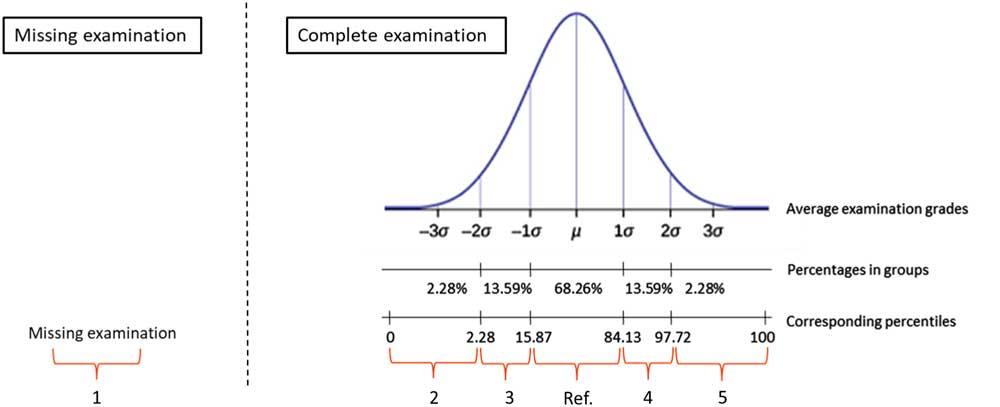
Prior cohort studies on school achievement (Reference MacCabe, Lambe, Cnattingius, Sham, David, Reichenberg, Murray and Hultman13–16) have converted the mean examination results to z-scores (standard deviations from sex-specific population mean) where the mean is 0 and the SD is 1. The study by MacCabe et al. (Reference MacCabe, Lambe, Cnattingius, Sham, David, Reichenberg, Murray and Hultman13) defined four exposure categories: z-score >+2, +1 to +2, −1 to −2, and <−2, with z-score −1 to +1 as the reference category. We were inspired by this categorisation. However, using z-scores for categorisation requires that the exam grades are normally distributed. Of the 443 305 who completed their examination in our study, the mean examination results were almost normally distributed, but slightly negatively skewed (see Supplementary Fig. 2). This was problematic since we were particularly interested in the extreme groups, that is those with very high and very low grades. Thus, if categorising by means of the z-scores, the group with very low examination results would include too many individuals and the group with very high examination results would include too few. To solve this problem we defined six exposure categories in total (see Fig. 1). The first category was ‘incomplete/no exam’ defined as not having completed 9th grade exams in Danish and mathematics when turning 17 years. The additional five exposure categories were defined based on the sex-specific percentiles of the average exam results of the cohort members with complete exams: <2.28, 2.28 to <15.87, 15.87–84.13, >84.13 to 97.72, and >97.72. The sex-specific percentile group from 15.87 to 84.13 was the reference category in all analyses. These percentile groups were calculated both for grades in mathematics and Danish combined and separately.
Definition of the six exposure categories.

Follow-up
The cohort members with a complete exam were followed from July 1st in the year following their year of examination and the incomplete/no exam group was followed from their 17th birthday. For both groups follow-up ended at death, emigration, development of BD or BD-I, or 31 December 2013, whichever came first.
Definition of BD and BD-I
The definition of BD and BD-I was based on diagnoses assigned following in- or outpatient contacts registered in the DPCRR (Reference Mors, Perto and Mortensen21). BD was defined as having received one of the following ICD-10 diagnoses: F30, F31, or F38.00. Since BD-I is not defined specifically in the ICD-10, we defined it based on the suggested operationalisation of BD-I in the upcoming ICD-11 (25), that is having been diagnosed with at least one manic or mixed episode (ICD-10: F30.1, F30.2, F30.8, F30.9, F31.1, F31.2, F31.6, and F38.00). The age of onset of BD/BD-I was defined as the age at the date of the first hospitalisation or the initiation of the first outpatient treatment course, which led to the BD diagnosis.
Assessment of covariates
The age and sex of the cohort members was extracted from the Danish Civil Registration System (Reference Pedersen17). All covariates pertaining to the parents were categorised separately for the mother and father. Parental age at birth of the cohort member (Reference Ostergaard, Waltoft, Mortensen and Mors26) was extracted from the Danish Civil Registration System (Reference Pedersen17) and divided into 6 and 8 levels, respectively. The maternal age groups were as follows: 0 to <20, 20 to <25, 25 to <30, 30 to <35, 35 to <40, and >40. The paternal age groups were as follows: 0 to <20, 20 to <25, 25 to <30, 30 to <35, 35 to <40, 40 to <45, 45 to <50, and >50. Parental education was used as a proxy for socio-economic status (Reference Mathiasen, Hansen, Andersen, Forman and Greisen27) and was assessed when the cohort member was 5 year old using data extracted from the Danish Education Register (Reference Jensen and Rasmussen19) (six categories: lower secondary school, upper secondary school, vocational or short-cycle higher education, medium-cycle higher education including bachelor, long-cycle higher education, and missing). Information on paternal and maternal history of mental disorder (Reference Ostergaard, Waltoft, Mortensen and Mors26) was based on inpatient and outpatient diagnoses from the DPCRR (Reference Mors, Perto and Mortensen21) and categorised as follows: schizophrenia [ICD-8: 295.x9 (excl. 295.79)/ICD-10: F20], BD (ICD-8: 296.19, 296.39, and 298.19/ICD-10: F30, F31, and F38.00), unipolar depression (ICD-8: 296.09, 296.29, 298.09, and 300.49/ICD-10: F32 and F33), and any mental disorder (ICD-8: 290-315/ICD-10: F00-F99). Calendar time was categorised as: 2002–2005, 2006–2008, 2009–2013.
Statistical analyses
Cox proportional hazard regression analyses were performed to calculate hazard rate ratios (HR) for the association between the six categories of the examination results and BD and BD-I, respectively. Age was used as underlying timescale and all analyses were adjusted for the following covariates: sex (separate underlying hazard since age-specific incidences are different in males and females), calendar time, and maternal and paternal: age at birth of the cohort member, education level, schizophrenia, BD, unipolar depression, and any mental disorder. Calendar time and parental mental disorder were handled as time dependent covariates. The analyses were conducted using the total mean grade as exposure, followed by analogue analyses using mean grades in Danish and mathematics separately as exposures. Possible differential effects in males and females were examined in sex-stratified analyses.
The proportional-hazards assumption of the Cox model was tested using Schoenfeld residuals (Reference Schoenfeld28). A few of the exposure groups did not meet the proportional-hazards criterion according to the Schoenfeld residuals. In these cases, we assessed log–log plots visually, which confirmed that the proportional-hazards assumption was not violated.
All statistical analyses were performed with Stata, release 13 (StataCorp, College Station, TX, USA) at Statistics Denmark via remote access.
Results
A total of 505 688 individuals were included in the final cohort (see Supplementary Fig. 1) and their mean follow-up time was 5.2 (SD=2.6) years, yielding a total follow-up time of more than 2.6 million person-years. During follow-up, 900 individuals were diagnosed with BD and 277 (31%) of these diagnoses were BD-I. The incidence rates were 33.9 per 100 000 person-years for BD, and 10.4 per 100 000 person-years for BD-I. The mean age at onset was 21.4 (SD=2.3) for BD and 21.2 (SD=2.4) for BD-I and there were most females among both BD (64%) and BD-I (56%) cases. Of the 62 383 individuals in the incomplete/no exam group, 39 138 (63%) were males and 23 245 (37%) were females.
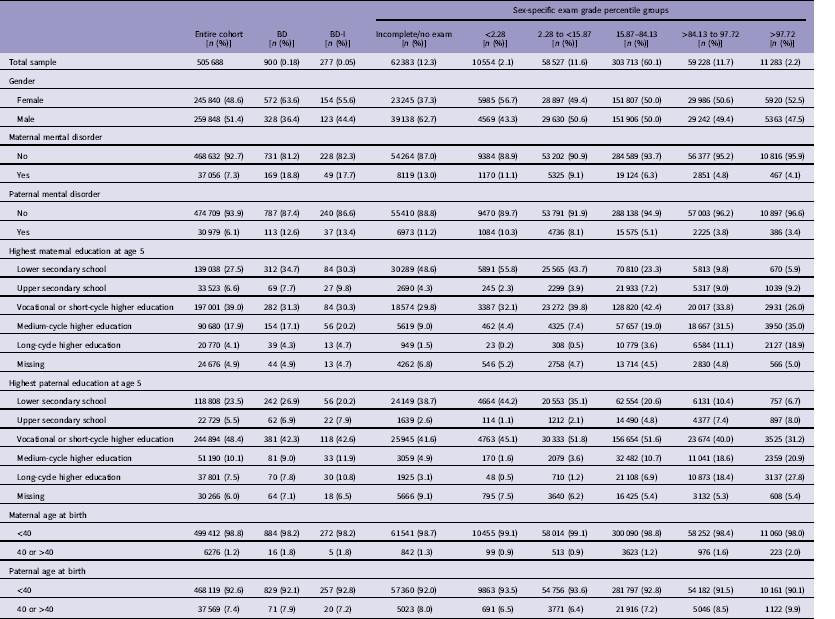
Table 1 shows the distribution of sex and the characteristics of the cohort members’ parents for the members of the overall cohort as well as for the individuals developing BD and BD-I during follow-up. It also shows the same characteristics for the individuals in the incomplete/no exam group as well as for the individuals in each of the sex-specific percentile groups of exam results (Danish and mathematics combined).
Characteristics of the entire cohort, those who develop bipolar disorder (BD) and bipolar I disorder (BD-I), and the individuals in each sex-specific school exam grade percentile group (Danish and mathematics combined)

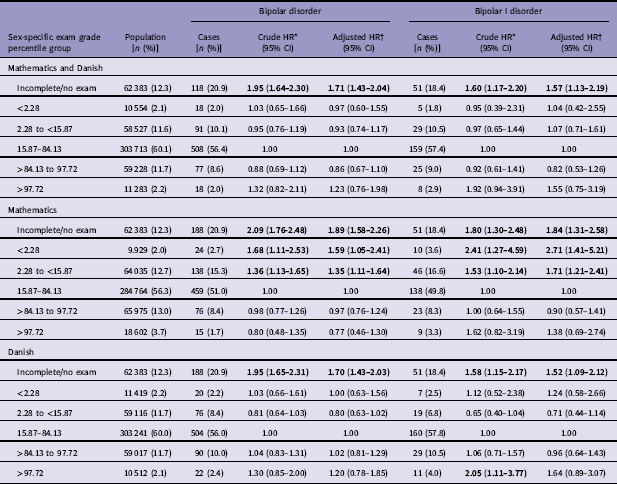
Table 2 shows the association between the exam results (Danish and mathematics combined) and the HR for developing BD or BD-I. The most consistent finding was that having an incomplete/no exam (in Danish, in mathematics, and for Danish and mathematics combined) was associated with a significantly increased risk for both BD and BD-I. Very low (the <2.28 sex-specific percentile group) and low (the 2.28 to <15.87 sex-specific percentile group) grades in mathematics were also associated with significantly increased risk. This was not the case for Danish.
The association between school exam grades and subsequent bipolar disorder and bipolar I disorder

HR, hazard rate ratios.
* Adjusted for calendar time and sex.
† Adjusted for calendar time, sex, maternal age at birth, paternal age at birth, maternal education level, paternal education level, maternal schizophrenia, paternal schizophrenia, maternal bipolar disorder, paternal bipolar disorder, maternal unipolar depression, paternal unipolar depression, any maternal mental disorder, and any paternal mental disorder.HRs in bold represent statistically significant associations (p-values below 0.05).
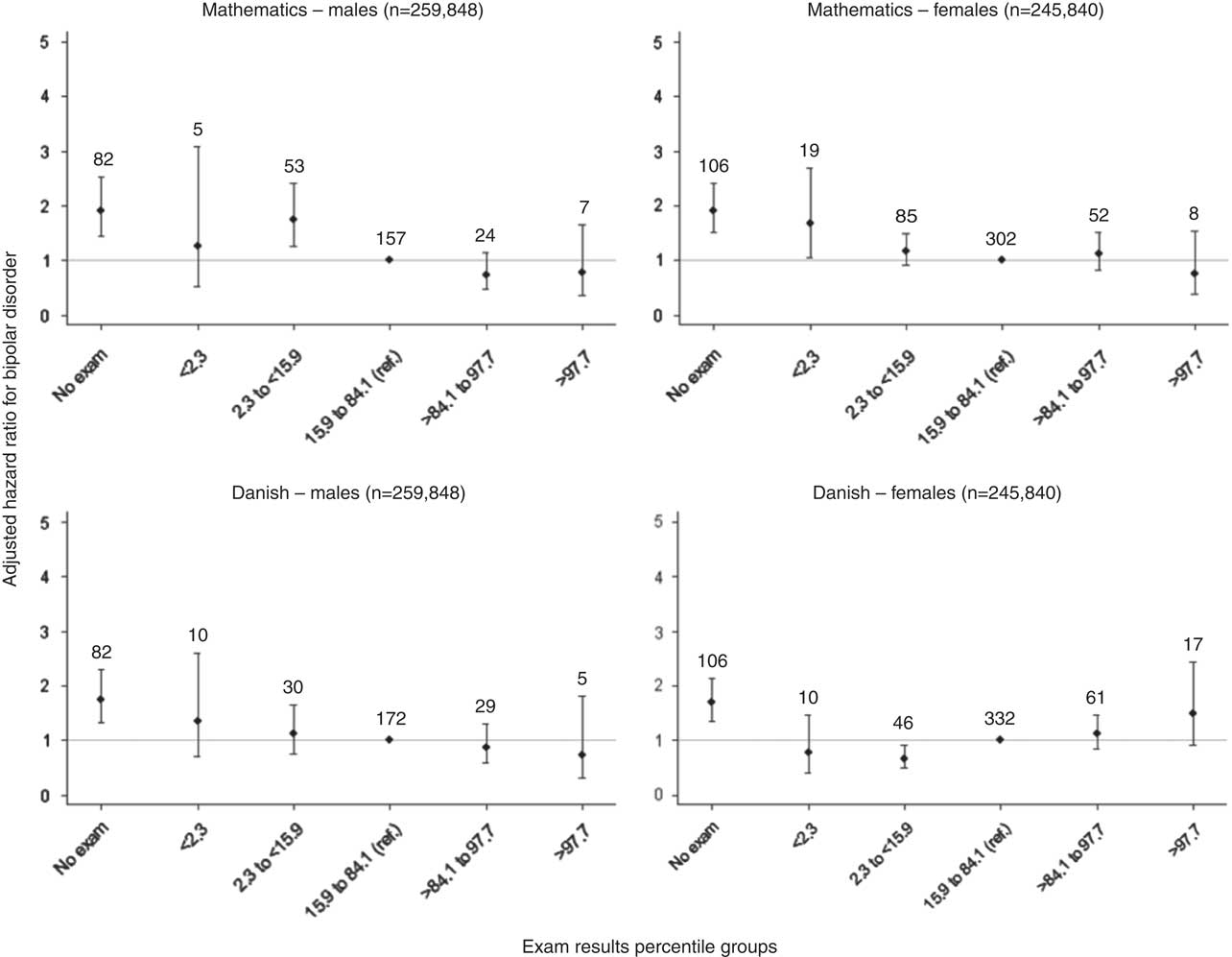
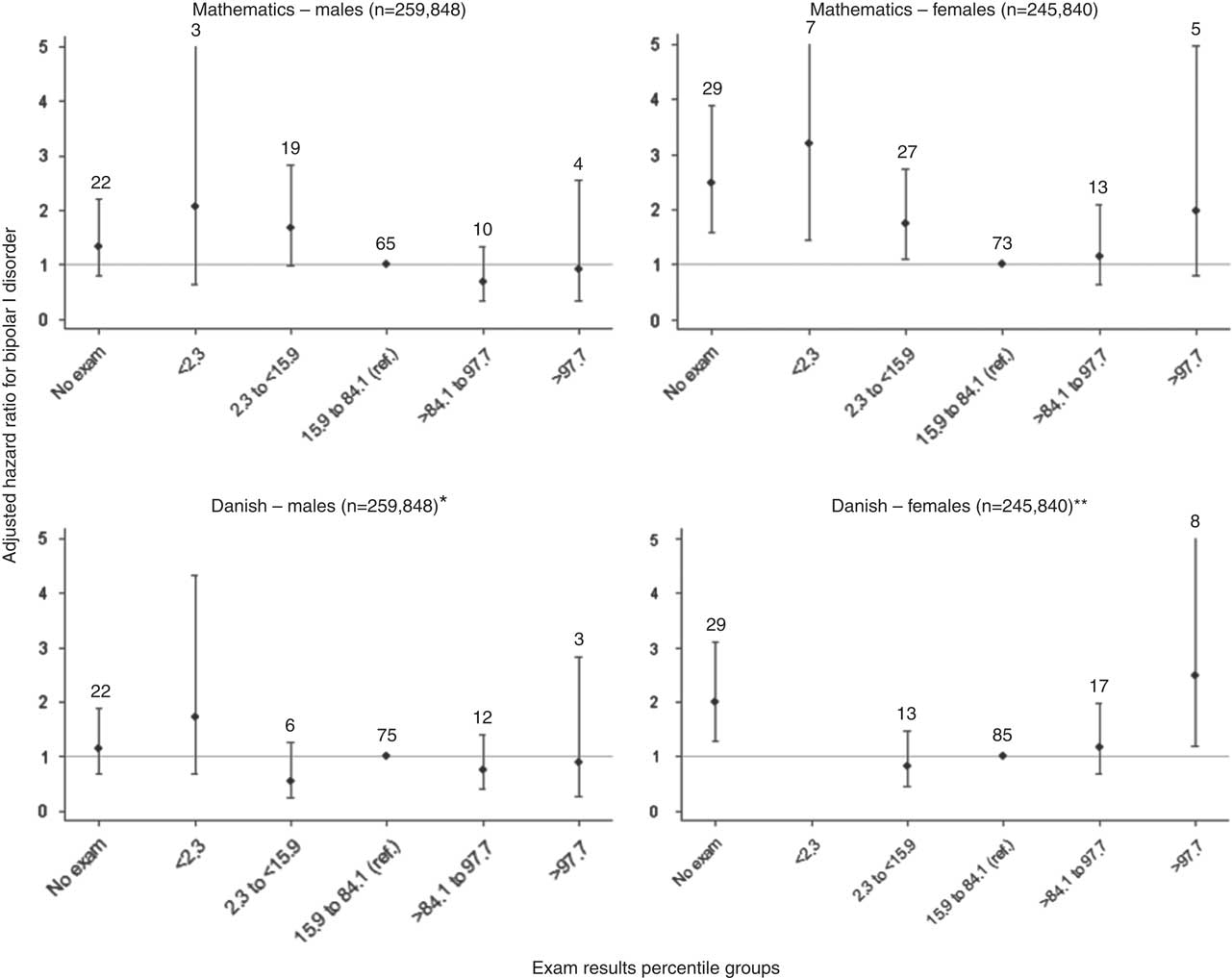
Figures 2 and 3 shows the associations between exam results in Danish and mathematics (separately) and risk of subsequent BD and BD-I, stratified by sex.
The association between school exam grades and bipolar disorder – stratified by sex. The numbers inserted over each estimate in the figure refer to the number of individuals from the respective exam result group that develop bipolar disorder.

The association between school exam grades and bipolar I disorder – stratified by sex. The numbers inserted over each estimate in the figure refer to the number of individuals from the respective exam result group that develop bipolar I disorder. The 95% confidence intervals are truncated at 5.0. *The number of individuals with bipolar I disorder in the <2.3 percentile group are left out because of few individuals in the group (risk of identification). **The results for the <2.3 percentile group are left out because of few individuals in the group (risk of identification).

The sex-stratified results confirmed that the association between very low exam grades and both BD and BD-I was primarily driven by poor performance in mathematics. The only statistically significant association between high exam grades and BD was seen for females with very high exam grades in Danish (percentile group >97.7), who had a significantly increased risk of developing BD-I [adjusted hazard ratio (aHR)=2.49, 95% CI: 1.19–5.23].
Discussion
In this cohort study of 505 688 individuals followed for more than 2.6 million person-years, we found statistically significant associations between grades from the final exams in compulsory schooling (9th grade) and subsequent development of BD and BD-I. Specifically, there were statistically significant associations between (I) having an incomplete/no exam at term (when turning 17) and the risk of subsequent BD and BD-I, (II) having very low exam grades in mathematics and the risk of subsequent BD and BD-I, and (III) having very high exam grades in Danish and the risk of subsequent BD-I (only observed for females).
The association between poor exam grades and subsequent BD observed in the present study are consistent with those from Swedish cohort studies (Reference MacCabe, Lambe, Cnattingius, Sham, David, Reichenberg, Murray and Hultman13–16). As opposed to the present study where we only included exam grades from mathematics and Danish, the Swedish studies used average exam grades from 16 compulsory subjects (Reference MacCabe, Lambe, Cnattingius, Sham, David, Reichenberg, Murray and Hultman13–16). Thus, the results are not directly comparable, but it seems reasonable to assume that those performing well in both mathematics and Danish would also do well in other subjects.
When looking at the school subjects separately, MacCabe et al. (Reference MacCabe, Lambe, Cnattingius, Sham, David, Reichenberg, Murray and Hultman13) found that excellent grades in the humanities were more strongly associated with BD compared with those in science and technology. This is in concordance with our findings showing that females with extraordinary high exam grades in Danish were at significantly increased risk of developing BD-I. From our results, it seems that the association with very high school grades in the humanities and subsequent BD is, at least to some extent, driven by BD-I in females. This could also be the case for other studies, which have found a positive association between school achievement and BD (Reference MacCabe, Lambe, Cnattingius, Sham, David, Reichenberg, Murray and Hultman13,Reference Kendler, Ohlsson, Mezuk, Sundquist and Sundquist14), but have not assessed the association in BD-I separately. This hypothesis is supported by a small cohort study from New Zealand (Reference Koenen, Moffitt, Roberts, Martin, Kubzansky, Harrington, Poulton and Caspi29), in which it was reported that higher childhood IQ was associated with increased risk of adult mania. In addition, in a retrospective study from Canada (Reference Kutcher, Robertson and Bird30), 28 adolescents with BD-I demonstrated good to excellent peer- and academic functioning before the onset of illness. This latter study is however likely to be affected by recall bias.
As expected, the adjustment for potential confounders in our analyses (education level and psychiatric history of the parents), attenuated the association between poor exam grades and subsequent BD and BD-I. However, the associations, which were statistically significant in the crude analyses, remained statistically significant when adjusting for socio-economic status and the psychiatric history of the parents.
From our results, it seems that the association between extraordinary school achievements and BD is the exception rather than the rule, since this association was only seen for the subject Danish and only in females (based on few cases). Instead our results point to a clear positive association between having an incomplete/no exam and later development of both BD and BD-I. This association was consistent across virtually all analyses (see Table 2 and Figs 2 and 3) and is in accordance with the results of Björkenstam et al. (Reference Björkenstam, Dalman, Vinnerljung, Weitoft, Walder and Burstrom31), who found that individuals with an incomplete examination had the highest rates of psychiatric care utilisation compared with individuals with a complete exam.
Thus, from our results it appears that the potential to develop BD seems to predominantly affect the school results of individuals negatively – even before BD is diagnosed. Where does this effect stem from? It is well known that the diagnosis of BD is often preceded by depression (Reference Duffy, Alda, Hajek, Sherry and Grof32–Reference Baldessarini, Tondo and Visioli34) and once BD has been diagnosed, episodes of bipolar depression are both more frequent and burdensome than episodes in the manic spectrum (Reference Goldberg and Harrow35–Reference Kupka, Altshuler, Nolen, Suppes, Luckenbaugh, Leverich, Frye, Keck, McElroy, Grunze and Post38). Thus, it seems reasonable to assume that a fraction of our cohort members who developed BD may have been suffering from depression around the time that they were taking the exams that we used as ‘exposure’ in this study – and that their likelihood of completing/performing well in these exams will have been affected negatively by this depression (Reference Jonsson, Bohman, Hjern, von Knorring, Olsson and von Knorring39,Reference Hysenbegasi, Hass and Rowland40). This hypothesis is indirectly supported by our finding that females doing well in Danish had a significantly increased risk of developing BD-I, since this group is likely to have mania as their predominant polarity (Reference Carvalho, McIntyre, Dimelis, Gonda, Berk, Nunes-Neto, Cha, Hyphantis, Angst and Fountoulakis41) and may therefore have been in a high-functioning/creative hypomanic/manic state (Reference Kim and Kwon42,Reference McCraw, Parker, Fletcher and Friend43) when taking the exams considered in this study.
There are limitations to this study, which should be taken into account by the reader. Most of the limitations are related to the register-based approach. First and foremost, the diagnoses in the DPCRR are assigned in relation to normal clinical practice and are not necessarily based on structured research interviews. However, several studies have shown that the validity of the diagnoses in the DPCRR (including BD) is high (Reference Kessing24,Reference Bock, Bukh, Vinberg, Gether and Kessing44,Reference Uggerby, Ostergaard, Roge, Correll and Nielsen45). A related limitation of the register-based approach is that diagnostic data from general practice and from psychiatrists working in private practices is not available (these services do not report to the DPCRR). It entails that the results reported here are predominantly valid for relatively severe cases of BD. This may have introduced a measurement bias in our study of the exam results – BD association since some high-functioning individuals with BD (and good exam results), who are diagnosed and treated exclusively in general practice or by private practicing psychiatrists, do not figure as BD cases in our data (differential misclassification). Such a bias would result in an underestimation of a potentially positive association between good exam results and BD. In terms of potential information bias, we believe that misclassification of the exam results is of non-differential nature since the teachers and external censors who grade the exams were unaware of the cohort members’ future diagnosis of BD.
In terms of potential selection bias, we did deliberately not include 13.1% of the 582 011 individuals born in Denmark in the period between 1987 through 1995 in our study sample. The vast majority of these individuals were excluded because one or both parents were born outside Denmark (n=60 332) or because the father was not known (n=4966). These individuals were excluded to reduce confounding since both having a parent born outside Denmark and having an unknown father is likely to be associated with both the exposure (exam grades) and the outcome (BD).
Finally, it is a limitation that we were not able to study BD-II as a separate outcome. This is due to the fact that this subtype is not readily identifiable in data sets using the ICD-10 as diagnostic reference (BD-II is not systematically categorised in ICD-10 although it is listed as one of two diagnoses that falls under the code F31.8 along with ‘recurrent manic episodes NOS’) (23). Thus, the BD category used as one of the outcomes in this study, consists of a mix of patients with BD-I and BD-II, whereas the BD-I category consists exclusively of patients with BD-I.
The register-based approach of this study also has several advantages. First and foremost, it allowed us to follow a very large cohort (n=505 688) for a total follow-up time of more than 2.6 million person-years during which 900 cohort members developed BD. Furthermore, essentially no cohort members were lost to follow-up due to the fact that the Danish Civil Registration System contains continuously updated information on vital status and place of residence on all individuals living in Denmark, which allowed us to end the follow-up in case of emigration or death of a cohort member. Also, since all information on both exposure and outcome was retrieved exclusively from register data, recall bias is not an issue.
With regard to generalisability, there is compulsory schooling and free healthcare in Denmark, which makes our data on school exam results and diagnoses of BD very representative for the Danish population. However, our results may not be generalisable to other countries with different school and healthcare systems.
In conclusion, in this population-based study of the association between school exam results and subsequent BD/BD-I, the most consistent finding was that the risk for BD and BD-I was clearly increased for individuals with an incomplete/no exam at term. Also, having low exam grades in mathematics was associated with increased risk of both BD and BD-I. The only statistically significant association between extraordinarily good school achievement and BD was seen for females with very high exam grades in Danish (percentile group>97.7), who had a significantly increased risk of BD-I.
The potential to develop BD seems to predominantly affect the school results of individuals negatively even before the illness is fully developed and diagnosed/treated – with females having the potential to develop BD-I as a possible exception.
Financial Support
This project was supported by grants from the Lundbeck Foundation and Aarhus University Research Foundation.
Conflicts of Interest
The authors declare that there are no conflicts of interest.
Supplementary material
To view supplementary material for this article, please visit https://doi.org/10.1017/neu.2018.3
Acknowledgements
The authors thank Janne T. Larsen (National Centre for Register-based Research, Aarhus University, Denmark) for her assistance with the graphical presentation of the results of the study. Authors’ Contributions: All authors contributed to the design of this study. The analyses were performed by S.D.P. and L.P. The manuscript was drafted by S.D.P., S.D.Ø. and was revised for important intellectual content by L.P. All authors approved the final version of the manuscript before submission.