Bicuspid aortic valve is the most common CHD,Reference Hoffman and Kaplan 1 – Reference Tutar, Ekici, Atalay and Nacar 3 affecting 1.3% of the population.Reference Hoffman and Kaplan 1 Despite advances in our knowledge, since its first descriptions, for five centuries,Reference Braverman, Gϋven, Beardslee, Makan, Kates and Moon 4 there are still knowledge gaps and areas where further research is warranted. The heterogeneous clinical presentation and course, morbid consequences of early valvular dysfunction requiring surgery, and the possibility of life-threatening complications justifies continued efforts to understand this CHD.
The purposes of this retrospective study were to examine disease progression and cardiac outcomes in a group of adults with bicuspid aortic valve followed-up over a prolonged period of observation and to determine predictors of adverse cardiac outcomes.
Material and methods
Study subjects
This retrospective study examined a referral population of consecutive adults with bicuspid aortic valve assessed at the ambulatory adult CHD clinic of the Santa Marta Hospital from 1990 through 2015. Patients were identified using the hospital CHD database. The inclusion criterion was bicuspid aortic valve documented on transthoracic echocardiography. Patients for whom we had no access to baseline echocardiography and those submitted to aortic valve replacement or ascending aortic graft surgery previously were excluded.
Assessments
Baseline data were obtained from the record of the patient’s first visit to the ambulatory clinic. Baseline data included age, sex, reason for referral, coronary risk factors, cardiac medications, associated cardiac diseases, previous cardiac procedures, and echocardiographic parameters. Follow-up data up to September, 2015 were obtained by review of clinical records, which included summaries of ambulatory visits, procedures, and hospital admissions.
Doppler and two-dimensional transthoracic echocardiography examinations performed at baseline and during the follow-up period at the discretion of the attending physician were reviewed by one of the researchers’ echocardiographer in order to standardise the variables evaluated and to ensure uniformity of results. Bicuspid aortic valve was diagnosed when only two cusps were identified in the short-axis parasternal view. The type of bicuspid aortic valve was classified into type 1, from right–left coronary cusp fusion, type 2, from right-non coronary cusp fusion, and type 3, from left-non coronary cusp fusion,Reference Michelena, Prakash and Della Corte 5 in patients who had not undergone previous intervention on the aortic valve and in whom leaflet orientation could be clearly visualised. Valve degeneration was evaluated according to the presence of thickening and calcification. Aortic stenosis was classified as mild (valve area >1.5 cm2, mean Doppler gradient <25 mmHg, maximum jet velocity 2.0–3.0 m/s), moderate (valve area 1–1.5 cm2, mean Doppler gradient 25–40 mmHg, maximum jet velocity 3.0–4.0 m/s), or severe (valve area <1 cm2, mean Doppler gradient >40 mmHg, maximum jet velocity >4.0 m/s).Reference Vahanian and Alfieri 6 In all patients diagnosed before continuous-wave Doppler became available, wide valvular opening ascertained the absence of valve stenosis. Aortic regurgitation was classified as mild, moderate, or severe using an integrated approach taking into consideration the following color and continuous flow Doppler criteria: ratio of the regurgitant jet width to the left ventricular outflow tract width, ratio of the regurgitant jet area to the left ventricular outflow tract area, pressure half-time, effective regurgitant orifice area, regurgitant volume, and presence of holodiastolic retrograde flow in the descending aorta.Reference Vahanian and Alfieri 6 , Reference Zoghbi, Enriquez-Sarano and Foster 7 Other transthoracic echocardiography parameters recorded were left parasternal long-axis M-mode left ventricular end-diastolic diameter, left ventricular end-systolic diameter, end-diastolic posterior wall thickness, end-diastolic interventricular septum thickness, left atrium size, right ventricle size, end-diastolic measurements of the aortic sinus at the sinus of Valsalva level, and proximal ascending aortic dimensions. The presence or absence of left atrial enlargement, left ventricular dilatation, left ventricular hypertrophy, and right ventricular dilatation was also assessed according to criteria defined by Otto et al.Reference Otto 8 Dilated aortic sinus and proximal ascending aorta were defined by dimensions greater than 40 mm irrespective of body surface area.Reference Eleid, Forde and Edwards 9 The spectrum of aortic dilatation phenotypes was classified into type 1, characterised by dilated aortic root, type 2, enlargement involving the tubular portion of the ascending aorta, and type 3, dilatation of the entire ascending aorta with sinotubular junction effacement.Reference Song 10 Left ventricular ejection fraction was also assessed with visual estimationReference Rich, Sheikh, Gallastegui, Kondos, Mason and Lam 11 and two-dimensional echocardiography guidance.Reference Quinones, Waggoner and Reduto 12
Outcome measures
The frequency of progression to thoracic aorta dilatation and to moderate or severe aortic stenosis or regurgitation was determined. Aortic growth rate was defined as the difference between the diameter at the first and the last follow-up echocardiogram – except in patients undergoing ascending aortic graft surgery, in which we took into account the last echocardiogram performed before surgery – divided by the time interval in years for each patient. It was considered that a rapid aortic dilatation was present when the growth rate was above average for the aortic root or the proximal ascending aorta.
Cardiac outcomes were defined as follows: interventional, surgery/percutaneous intervention on the aortic valve or thoracic aorta; medical, death, aortic dissection, aortic valve endocarditis, congestive heart failure, arrhythmias, or ischaemic heart disease requiring hospital admission; and a composite end point of both, total events, during the follow-up period. Mortality was determined, and causes of death were classified as cardiac, non-cardiac, and unknown on the basis of review of clinical records and/or death certificates.
Statistical analysis
Data analysis was performed using SPSS version 20. Continuous data are expressed as mean±one standard deviation, and compared using the unpaired Student t-test or Wilcoxon’s rank test. Categorical data are displayed as frequencies and percentages, and compared using χ2 tests or Fisher’s exact tests wherever appropriate. The two-sided level of significance was 0.05.
Kaplan–Meier curves were generated to determine event rates. Potential predictors of cardiac outcome were evaluated by univariate Cox regression analyses. Candidate variables with a p value of <0.05 on univariate analysis were entered into multivariate Cox regression models. A stepwise, backward-elimination algorithm was used. Multivariate logistic regression models were also developed to predict a rapid growth at the ascending and root level separately.
Results
Baseline characteristics
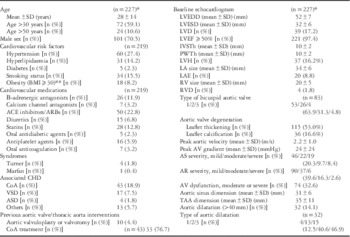
We identified 287 ambulatory patients with bicuspid aortic valve followed-up in the adult CHD clinic of our institution over the past two decades. After application of exclusion criteria, 227 patients were included in the analyses. Baseline characteristics are presented in Table 1. Reasons for referral were aortic valve dysfunction in 72 patients (31.7%), thoracic aorta disease including eight cases of thoracic aorta aneurysm, 3.5%, and nine of aortic coarctation, 4.0%, transition of care from paediatric cardiology to adult cardiology (116 patients, 51.1%), and other reasons in the remaining 22, including five ischaemic heart disease, four arrhythmia, two hypertension, four heart failure, three endocarditis, two atrial septal defect, one family history of bicuspid aortic valve, and one pulmonary stenosis.
Baseline characteristics of study participants.

ACE=angiotensin-converting enzyme; ARB=angiotensin II receptor blockers; AR=aortic valve regurgitation; AS=aortic valve stenosis; ASD=atrial septal defect; AV=aortic valve; BMI=body mass index; CoA=aortic coarctation; IVSTh=interventricular septum thickness; LA=left atrium; LAE=left atrial enlargement; LVD=left ventricular dilatation; LVEDD=left ventricular end-diastolic diameter; LVEF=left ventricular ejection fraction; LVESD=left ventricular end-systolic diameter; LVH=left ventricular hypertrophy; PWTh=posterior wall thickness; RV=right ventricle; RVD=right ventricular dilatation; TAA=tubular ascending aorta; VSD=ventricular septal defect
* Unless otherwise indicated
** Calculated as weight in kilograms divided by height in metres squared
Age at first medical appointment was 28±14 years (median, 21 years; range 15–72; interquartile range 19.5). Patients were predominantly male (70.5%); 27% of patients had hypertension, and 93.5% of them were receiving antihypertensive drugs. Cardiovascular medications included β-adrenergic antagonists (11.9%), calcium channel antagonists (3.2%), angiotensin-converting enzyme inhibitor/angiotensin II receptor antagonist (22.8%), diuretics (6.8%), statins (12.8%), and antiplatelet agents (5.9%).
In all, 67 patients (29.5%) had at least a previous diagnosis of other associated CHD – 18.9% had aortic coarctation, 7.5% ventricular septal defect, 1.8% atrial septal defect, 2.2% patent ductus arteriosus, and 3.5% others valvulopathies excluding aortic valve disease, such as pulmonary stenosis, mitral valve prolapse, or dysplasia. The majority of these associated diseases had successful percutaneous/surgical treatment in childhood, including 77% of the aortic coarctation cases, or had no haemodynamic significance. A total of 10 patients (4.4%) had previous aortic valvuloplasty or valvulotomy in childhood, with two of them having residual moderate aortic stenosis and regurgitation at their baseline echocardiogram.
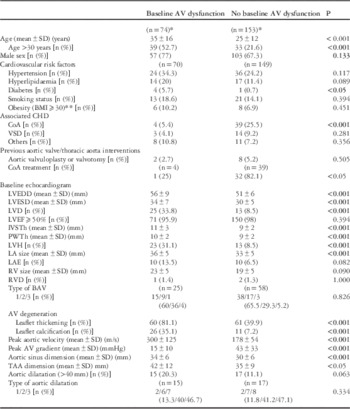
Overall, 74 patients (32.6%) in the study group had significant aortic valve dysfunction – moderate or severe aortic stenosis or regurgitation – at baseline. Table 2 compares baseline characteristics of these patients with those without baseline aortic valve dysfunction.
Baseline characteristics of patients with and without baseline moderate–severe aortic valve dysfunction.

AV=aortic valve; BAV=bicuspid aortic valve; BMI=body mass index; CoA=aortic coarctation; IVSTh=interventricular septum thickness; LA=left atrium; LAE=left atrial enlargement; LVD=left ventricular dilatation; LVEDD=left ventricular end-diastolic diameter; LVEF=left ventricular ejection fraction; LVESD=left ventricular end-systolic diameter; LVH=left ventricular hypertrophy; PWTh=posterior wall thickness; RV=right ventricle; RVD=right ventricular dilatation; TAA=tubular ascending aorta; VSD=ventricular septal defect
* Unless otherwise indicated
** Calculated as weight in kilograms divided by height in metres squared
At baseline, the mean diameter of the sinus of Valsalva and the proximal ascending aorta was 31±6 and 35±11 mm, respectively. In all, 32 patients (14.2%) had dilated thoracic aorta – that is, aortic sinus and/or proximal ascending aortic dimensions greater than 40 mm. The most frequent aortic phenotype was dilatation of the entire ascending aorta (46.9% of cases), followed closely by the isolated dilatation of tubular ascending aorta (40.6%).
Progression of disease
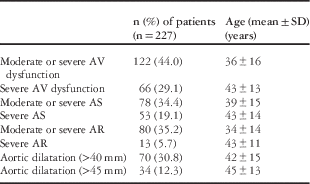
The 227 patients were followed-up for a mean of 13±9 years (median, 11 years; range, 0.2–40.7 years; interquartile range 13.3). The frequency and age at which moderate or severe aortic valve dysfunction and aortic dilatation occurred are listed in Table 3. Overall, 66 patients (29.1%) developed severe aortic valve dysfunction during the follow-up period. The mean age of diagnosis was 43±13 years.
Progression of disease.

AR=aortic regurgitation; AS=aortic stenosis; AV=aortic valve
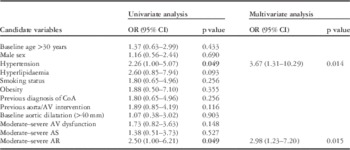
Root or tubular ascending aorta diameters of >40 and >45 mm were observed in 30.8 and 12.3% of patients, respectively. The mean sinus of Valsalva dimension and proximal ascending aorta dimension was 34±10 and 39±9 mm at the end of an aorta mean echocardiographic follow-up of 9±3 years, respectively. Dilatation progressed at faster rates in the proximal ascending aorta: the mean rate of change in aortic sinus dimension was 0.3±0.6 mm/year (95% confidence interval 0.2–0.4), and the mean increase in ascending aorta dimension was 0.5±0.7 mm/year (95% confidence interval 0.3–0.7). In multivariate analysis, the presence of moderate or severe aortic regurgitation and arterial hypertension was strongly associated with rapid aortic dilatation (Table 4).
Predictors of rapidly progressive aortic dilatation.

AR=aortic regurgitation; AS=aortic stenosis; AV=aortic valve; CI=confidence interval; CoA=aortic coarctation; OR=odds ratio
Primary outcomes
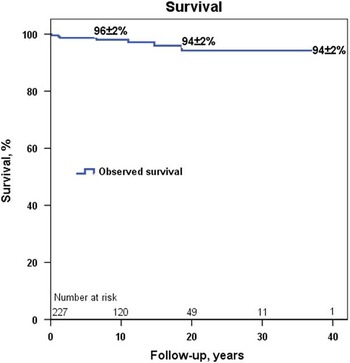
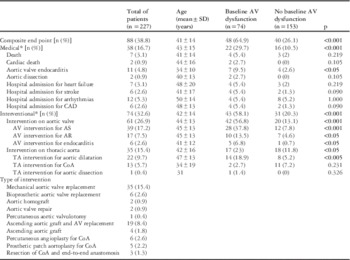
The frequency and nature of outcome events are listed in Table 5. A total of seven deaths occurred (3.1%), of which two were cardiac related, two were not related to a cardiac aetiology, including one case of malignancy and one septic shock, and three were of unknown reasons. Survival was 96±2 and 94±2% at 10 and 20 years, respectively (Fig 1).
Survival during the follow-up of adults with bicuspid aortic valve. Survival (±SD) at 10 years, 20 years, and end of follow-up are indicated.

Cardiac outcomes.

AR=aortic regurgitation; AS=aortic stenosis; AV=aortic valve; CAD=coronary artery disease; CoA=aortic coarctation; pts=patients; TA=thoracic aorta
* Categories are not mutually exclusive
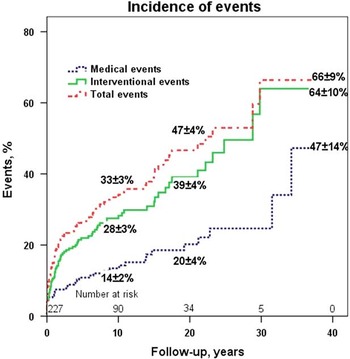
The composite end point – medical or interventional events – occurred in 88 patients (38.8%), with an incidence rate at 20 years of 47±4% (Fig 2); 11 patients (4.8%) were diagnosed with bacterial endocarditis. Aortic dissection and stroke occurred in two (0.9%) and six patients (2.6%), respectively; moreover, seven patients (7.5%) required hospital admission for congestive heart failure (Table 5). The incidence of cardiovascular medical events was 20±4% at 20 years of follow-up (Fig 2).
Incidence of medical (death, aortic dissection, native aortic valve endocarditis, congestive heart failure, arrhythmias, ischaemic heart disease requiring hospital admission; blue dotted line), interventional (aortic valve, thoracic aorta; green solid line), and total events (medical events or interventional events; red dotted and dashed line). The event rates (±SD) at 10, 20 years, and end of follow-up are indicated.

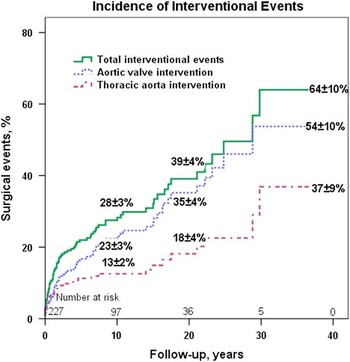
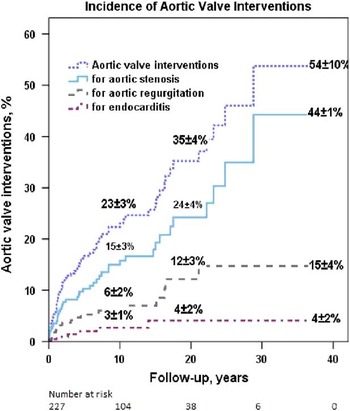
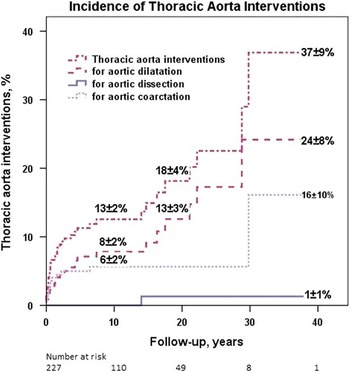
During the follow-up period, aortic valve or thoracic aorta interventions were performed in 74 patients (32.6%), with an incidence rate at 20 years of 39±4% (Fig 3); 61 patients (26.9%) were subjected to at least one aortic valve intervention, at a mean age of 44±13 years. Aortic stenosis was the most common indication for intervention (64% of cases). Only four patients later required aortic valve re-operation – those subjected to aortic valve repair, percutaneous valvulotomy, and one of the aortic homograft required an aortic valve replacement later on during the follow-up. The 20-year aortic valve surgery incidence was 35±4% (Fig 4). In total, 35 patients (15.4%) underwent a thoracic aorta intervention – 60% of cases for aortic dilatation, 37% for aortic coarctation, and only one case for aortic dissection. The indications for surgical intervention for aortic dilatation were aortic diameter ⩾45 mm and need for a concomitant aortic valve surgery (71.4% of cases); aortic diameter ⩾50 mm and presence of other risk factors for aortic dissection (9.5%); and aortic diameter ⩾55 mm in the remaining four patients (19%). There was only one patient who required aortic re-operation, submitted initially for isolated ascending aortic graft and later required a Bentall procedure. The 20-year incidence of surgery for aortic dilatation was 13±3%. A total of 13 patients required surgery for aortic coarctation, with four cases of re-coarctation, leading to a 20-year rate of 6±2% (Fig 5). The peak invasive transcoarctation of the aorta gradient was 60±35 mmHg at the time of the intervention.
Incidence of total interventional events (aortic valve, thoracic aorta; green solid line), aortic valve intervention (blue dotted line), and thoracic aorta intervention (pink dashed and dotted line). The event rates (±SD) at 10 years, 20 years, and the end of follow-up are indicated.

Incidence of total aortic valve intervention (for aortic stenosis, aortic regurgitation, endocarditis; blue dotted line), aortic valve intervention for aortic stenosis (blue solid line), for aortic regurgitation (grey dashed line), and for endocarditis (purple dashed and dotted line). The event rates (±SD) at 10, 20 years, and the end of follow-up are indicated.

Incidence of total thoracic aorta intervention (for aortic dilatation, aortic dissection, aortic coarctation; pink dashed and dotted line), thoracic aorta intervention for aortic dilatation (pink dashed line), for aortic coarctation (purple dashed line), and for aortic dissection (purple solid line). The event rates (±SD) at 10, 20 years, and the end of follow-up are indicated.

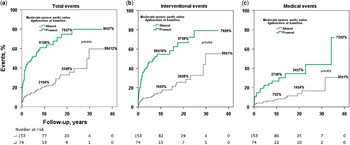
Cardiac events according to presence or absence of baseline moderate–severe aortic valve dysfunction are presented in Fig 6. The incidence rate of the composite end point and of interventional events at 20 years of follow-up in patients with no baseline aortic valve dysfunction was 33±5 and 26±5%, respectively, which was significantly lower (p<0.001) compared with the rates of events in those with baseline moderate–severe aortic valve dysfunction.
Incidence of events during follow-up according to the presence (green solid line) or absence (blue dashed line) of moderate or severe aortic valve dysfunction at baseline (including moderate or severe aortic stenosis or regurgitation). ( a ) Incidence of total events (medical and interventional). ( b ) Incidence of interventional events (aortic valve, thoracic aorta). ( c ) Incidence of medical events (death, aortic dissection, native aortic valve endocarditis, congestive heart failure, arrhythmias, and ischaemic heart disease requiring hospital admission). The event rates (±SD) at 10, 20 years, and the end of follow-up are indicated.

Predictors of primary outcomes
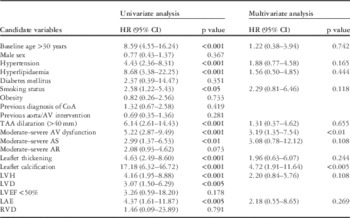
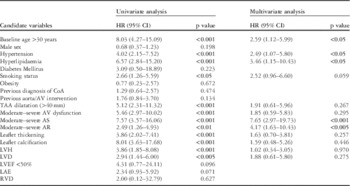
The candidate variables examined by univariate analysis are shown in Tables 6 and 7. None of the variables were highly correlated with each other (r<0.7). On multivariate analysis, the independent predictors of the composite end point were baseline moderate or severe aortic valve dysfunction (hazard ratio, 3.19; 95% confidence interval 1.35–7.54; p<0.01) and aortic valve leaflets calcification (hazard ratio, 4.72; confidence interval, 1.91–11.64; p<0.005). The independent predictors of interventional events – thoracic aorta and aortic valve interventions – were age above 30 years (hazard ratio, 2.59; confidence interval, 1.12–5.99; p<0.05), hypertension (hazard ratio, 2.49; confidence interval, 1.07–5.80; p<0.05), hyperlipidaemia (hazard ratio, 3.46; confidence interval, 1.15–10.43; p<0.05), moderate or severe aortic stenosis (hazard ratio, 7.65; confidence interval, 2.97–19.73; p<0.001), and moderate or severe aortic regurgitation (hazard ratio, 4.17; confidence interval, 1.63–10.43; p<0.005).
Predictors of total events.

AR=aortic regurgitation; AS=aortic stenosis; AV=aortic valve; CI=confidence interval; CoA=aortic coarctation; HR=hazard ratio; LAE=left atrial enlargement; TA=thoracic ascending aorta; LVD=left ventricular dilatation; LVEF=left ventricular ejection fraction; LVH=left ventricular hypertrophy; RVD=right ventricular dilatation
Predictors of Interventional events.

AR=aortic regurgitation; AS=aortic stenosis; AV=aortic valve; CI=confidence interval; CoA=aortic coarctation; HR=hazard ratio; LAE=left atrial enlargement; TA=thoracic ascending aorta; LVD=left ventricular dilatation; LVEF=left ventricular ejection fraction; LVH=left ventricular hypertrophy; RVD=right ventricular dilatation
Discussion
In this study of 227 patients with bicuspid aortic valve followed-up in a tertiary hospital centre, with a mean age of 28±14 years and a male:female ratio of ~2 : 1, 29.1% developed severe aortic valve dysfunction and 12.3% attained thoracic aorta diameters above 45 mm; 39% of patients had at least one primary cardiac event during a mean follow-up of 13 years. The most frequent events were aortic valve surgery for aortic stenosis (17.2% of patients), ascending thoracic aorta surgery for aortic dilatation (9.7% of patients), and aortic valve surgery for aortic regurgitation (7.5% of patients). The fact that aortic stenosis requiring surgery was the principal morbid event is concordant with previous population-based and tertiary-referral-based studies.Reference Michelena, Prakash and Della Corte 5 , Reference Michelena, Desjardins and Avierinos 13 , Reference Tzemos, Therrien and Yip 14 We highlight not only its frequency, with a 20-year incidence of 24±4%, but also the younger age at its occurrence, at a mean age of 45±13 years, lower than the average 5–10 years earlier than that expected for tricuspid aortic stenosis described in the literature.Reference Roberts and Ko 15
Only a few published articles have estimated rates of progressive aortic dilatation in adults with bicuspid aortic valves with a long follow-up period. Thanassoulis et alReference Thanassoulis, James and Filion 16 estimated the annual rate of aortic enlargement in 156 bicuspid aortic valve patients followed-up for 3.8 years, and 68 patients were evaluated during nearly 4 years by Ferencik et al.Reference Ferencik and Pape 17 Our study included 227 patients, with a mean duration of aorta dimensions follow-up of 9 years, both higher than those in previously described studies. Dilatation progressed at faster rates in the proximal ascending aorta, which is consistent with that described in those studies. We also found that the presence of aortic valve dysfunction, especially baseline moderate-to-severe aortic regurgitation, has a repercussion in rate of aortic dilatation, which is consistent with previously published studies.Reference Thanassoulis, James and Filion 16 , Reference Keane, Wiegers, Plappert, Pochettino, Bavaria and Sutton 18 The increased stroke volume imposed by aortic regurgitation enhances proximal ascending aorta wall stress, which can ultimately lead to faster aorta expansion and explain this result.
It is not surprising that baseline aortic valve dysfunction had independently predicted the occurrence of a primary cardiac event, a fact that is consistent with the results of the most recent major studies that addressed this issue.Reference Michelena, Desjardins and Avierinos 13 , Reference Tzemos, Therrien and Yip 14 In these patients, the incidence rate of the composite end point at 20 years of follow-up was as high as 75±7%, which is clearly representative of the significant morbidity associated with bicuspid aortic valve. It should also be noted that even those patients without baseline aortic valve dysfunction are at risk of having events, with a 20-year incidence of 33±5 and 26±5% of total events and interventional events, respectively.
Aortic valve leaflet calcification was also an independent predictor of the occurrence of a cardiac event. Turbulent flow through a bicuspid aortic valve, which has an altered architecture, plays a role in premature valve degeneration and calcification,Reference Robicsek, Thubrikar, Cook and Fowler 19 which ultimately progresses to aortic valve dysfunction. Thus, patients with valve degeneration, even if they had a normally functioning bicuspid valve, need closest follow-up than those without itReference Michelena, Desjardins and Avierinos 13 ; however, other mechanisms rather than turbulent flow could be involved in development of bicuspid aortic valve degeneration. As previously described for tricuspid aortic valves, some cardiovascular risk factors showed significant association with progression of disease.Reference Hughes, Chahound and Mehta 20 – Reference Carabello 22 This probably applies to bicuspid valves as well, and could be a possible explanation for our findings of hyperlipidaemia and hypertension as independent predictors of interventional events.
Incidence of medical events was almost half of interventional events, with a 20-year incidence of 20±4%. In total, 11 patients (5%) had at least an episode of infectious endocarditis during the follow-up, slightly higher than the 2–3% reported in previous population-based and tertiary-referral-based studies.Reference Michelena, Desjardins and Avierinos 13 , Reference Tzemos, Therrien and Yip 14 , Reference Ward 23 Surgical treatment, however, was required in only 54% of these patients, which is similar to rates described for general population endocarditisReference Tornos, Iung and Permanyer-Miralda 24 and far below the 75% reported in a recent multi-centre observational study.Reference Tribouilloy, Rusinaru and Sorel 25 Another encouraging observation was the low rate of dissection, with only two cases in the 227 patients analysed (0.07%/patient-year), similar to that observed by Tzemos et al (0.1%/patient-year)Reference Tzemos, Therrien and Yip 14 and Michela et al (0.03%/patient-year).Reference Michela, Khanna and Mahoney 26 The overall relatively lower dissection incidence in bicuspid aortic valve could be partially explained by prophylactic aortic repair, the larger diameters at which dissection occurs compared with tricuspid aortic valve patients with ascending aortic dissection,Reference Eleid, Forde and Edwards 9 and also by the higher proportion of bicuspid aortic valve patients with no progression of aortic dilatation compared with the aortic root in Marfan syndrome patients.Reference Detaint, Michelena, Nkomo, Vahanian, Jondeau and Sarano 27
Study limitations
First, our study has limitations related to the enrolment of cases from a single tertiary centre. This could have led to overestimation of the severity of valvular lesions, aortic dimensions, and rates of progression as our patients might have had more advanced BAV than those in community-based studies. Another fact that may contribute to this overestimation is our cohort including ~30% patients with associated CHD and 50% patients previously followed-up by paediatric cardiologists. This probably represents a higher morbidity population than adults in community receiving a new diagnosis of bicuspid aortic valve. Therefore, the morbidity associated with bicuspid aortic valve could be overestimated as compared with that in the general population.
Second, we would like to highlight the fact that the studied population included mostly young adults and were relatively free of baseline aortic dilatation. This may have led to a predilection for valve events in follow-up, as age and diameter of the aorta are two of the main predictors of aorta events
Third, we also acknowledge the inability to evaluate other important contributing factors for outcomes as data were retrospectively collected.
To conclude, with major improvements in echocardiography during the study period, with higher reliable measurements of the severity of aortic valve disease since the emergency of continuous-wave Doppler, we consider that adequate techniques were used throughout the study period to rank the severity of aortic valve function, always following the state of art. We are also aware that the transthoracic echocardiography measurements of the thoracic aorta are substantially lower than those measured by more accurate methods such as gate CTReference Ocak, Lacomis, Deible, Pealer, Parag and Knollmann 28 or MRI, and as we did not compare the diameters between these methods in patients analysed by the two techniques we cannot ensure that the rate of thoracic aorta dilatation is underestimated in our study.
Conclusions
In this tertiary referral centre study of adults with bicuspid aortic valve, the long-term survival was excellent but with occurrence of frequent cardiovascular events, mainly aortic valve or thoracic aorta interventions. Patients with aortic valve dysfunction and leaflets calcification at baseline were at higher risk for cardiac events. Not only age and moderate or severe aortic valve stenosis and regurgitation were independent predictors of interventional events but also were cardiovascular risk factors such as hypertension and hyperlipidaemia. Even those with no baseline aortic valve dysfunction had a high 20-year incidence rate of interventional events. Therefore, all patients with bicuspid aortic valve will need serial evaluations of aortic dimensions and aortic valve, with a periodicity dictated by the clinical condition and individual risk factors.
Acknowledgements
The authors thank the staff of the Santa Marta Adult Congenital Heart Disease Clinic and Echocardiographic Laboratory for their assistance with this project.
Financial Support
This research received no specific grant from any funding agency, commercial, or not-for-profit sectors.
Conflicts of Interest
None.
Ethnical Standards
This research does not involve human and/or animal experimentation. All authors have contributed to the study design and data acquisition, analysis, and interpretation. The presented manuscript was reviewed and approved by all authors.