


In reference to its object, this footprint is a perfect icon, although reversed like the image of a person looking at himself in a mirror. But it is at the same time the index of a presence on the island, and not just any presence.... The sign in itself has its own existence, an existence of a non-sign, one might say, just as an ambassador, although representing his country, is what he is in reference to himself....
Gérard Deledalle, Charles S. Peirce’s Philosophy of Signs (2000)
Peirce himself, like Leibniz, gave to the world only fragments of his system, with the result that he has been very thoroughly misunderstood, not least by those who professed to be his admirers. I am—I confess to my shame—an illustration of the undue neglect from which Peirce has suffered in Europe.
Bertrand Russell, foreword to James Feibleman’s
Introduction to Peirce’s Philosophy Interpreted as a System (1946)
Introduction
You and your friend are sitting in a coffee shop when all of a sudden a stranger walks in. ‘Oh my,’ your friend whispers, ‘that man looks just like my father.’ Your friend’s father, whom you never met, died years ago in a fiery blaze that destroyed all photos of him. Given this lack of causal exposure, it would seem you can never know what your friend has in mind when she thinks of her father. Nevertheless, thanks to this look-alike, you now have a sense of what her mental state is like. The two of you have managed this by means of an icon.
Given the privacy that allegedly separates conscious minds, such a promising sign-exchange is certainly worth investigating (perhaps the icon cannot bear the weight of scepticism, but that is something to be argued for, not taken for granted). Unfortunately, glancing at the topics covered by recent books on consciousness, one rarely finds the term ‘icon.’ The term ‘index,’ by contrast, abounds. That is strange, considering that both notions originated in C. S. Peirce’s symbol/index/icon tripartition.
Although iconicity remains poorly understood, indexicality is now a stapleFootnote 1 and has recently been invoked to account for how we refer to qualitative experiences. The neuroscientist, Mary, in Frank Jackson’s knowledge argumentFootnote 2 enjoys an experiential exposure that enriches her mastery of a fabric of symbols. Using a terminology introduced by Bertrand Russell,Footnote 3 we can say that Mary in the cave can muster ‘descriptions,’ but will lack a more intimate ‘acquaintance’ until and unless she undergoes those experiences forbidden to her. By directing one’s attention at a specific time and place, an index can broker acquaintance. The recent suggestion is that, when Mary exits her confines, she will refer to her new experience as ‘this’ feeling.Footnote 4
I agree that “[s]ome kinds of knowledge require distinctive forms of engagement between the knower and the known.”Footnote 5 Judged by that standard, indices indeed bring us closer to their referents than do symbols. However, I think the standard roster of options is too coarse, since according to the sign theory developed by Peirce, there are three ways one can refer to objects: by description, acquaintance, and shared quality. I will argue that knower and known are at their closest when they share a common quality, and that this is what would have to be involved in successful reference to phenomenality.
My argumentative journey will start on familiar soil, methodically venture into semioticFootnote 6 terrain, and then return to the point of departure to see how the new ideas can shed light on recalcitrant issues. I will begin by looking at the phenomenal concept strategy, specifically those versions that appeal to indexicality in order to account for reference to qualia (section 1). I will then look at how philosophy of signs in the Peircean tradition countenances a neglected mode of iconic reference which, unlike the actual exposure required by indexicality, turns on a shared quality (sections 2 and 3). In order to show that there is a need for this notion, I will discuss the work of David Papineau, whose recent views gravitate towards something very close to the icon (section 4). Finally, using the ideas laid down in the earlier sections, I will try to reformulate in a more explicit way Papineau’s claim that, in order to truly refer to phenomenal qualities, those very qualities would have to be ‘included in’ the concept employed (sections 5 and 6).
1. The Indexical Phenomenal Concept Strategy
The ‘phenomenal concept strategy’Footnote 7 is an attempt to preserve physicalist commitments while accounting for why there appears to be a ‘gap’Footnote 8 when it comes to explaining the qualitative dimension of consciousness. The general idea is that, since we have special concepts to pick out conscious states, whatever difficulties we have fitting consciousness into a naturalist picture may owe to the peculiar nature of those concepts.Footnote 9 Although there are several variants of the strategy vying for adoption,Footnote 10 I will focus on those that call upon the notion of an index.
Indexicality is usually taken to be the direct mode of reference whereby language comes into contact with whatever it denotes. Before it got enlisted in debates about consciousness, indexicality was introduced to a wide audience by John Perry, whose original intent was to challenge the view that propositions “have a truth-value in an absolute sense, as opposed to merely being true for a person or at a time.”Footnote 11 Perry looked to indexicality as a means of pinning propositional attitudes down to the world, thereby permitting a better treatment of some difficult cases. The idea of indexing meanings to contextual circumstances is less controversial than the idea of indexing truth-values.Footnote 12 In philosophy of language though, Perry’s proposal has become a common place. We use some words like ‘this’ in specific contexts, and these contexts fix what (in the world) those words point to.Footnote 13
Given Perry’s preoccupation, indices came to be seen as linguistic devices “about where one is, when it is, and who one is.”Footnote 14 According to John O’Dea, this explains the intuitive force of thought-experiments like the inverted spectrum.Footnote 15 O’Dea argues, for instance, that a disagreement between an Earthling and a Martian about what each would mean by ‘I am in pain’ would be “tantamount to a disagreement over whether Earth is here or Mars is here.”Footnote 16 O’Dea surmises that “[t]he irreducibility of sensory terms... may be nothing more than a straightforward consequence of their indexicality.”Footnote 17 Context-specificity is thus invoked to explain (away?) talk of conscious states. “If this is right, then we may not have a straightforward physical explanation of consciousness, but we have the next best thing: a physical explanation of why we find an explanatory gap.”Footnote 18
This indexical account thus strikes a bargain with scepticism: one can successfully refer to, say, the fact that one is now enjoying an experience of green, but the sign one uses to achieve this act of public reference cannot reach all the way to the qualitative feel of the experience.Footnote 19 O’Dea illustrates this as follows:Footnote 20

This depiction seems to recapitulate, rather than solve, the ‘hard’ problem of consciousness.Footnote 21 Since qualia are not captured by causality and since indexicality works precisely by exploiting causalityFootnote 22, qualia are not captured by indexicality. This means that the qualitative dimension of consciousness cannot truly affect or be affected by discourse. On the further assumption—mistaken, as I hope to show—that indexicality is our ultimate means of reference, the privacy of qualia follows.
Tenets in the philosophy of language thereby constrain what can be hoped for in epistemology: if meaning is always anchored to an utterer, then one can at best ‘believe’—not ‘know’—the claims others make about what it’s like to undergo a given conscious experience. Therefore, when prompted to convey how something feels, the convergence of two persons’ verbal reports and/or behavioural responses remains inconclusive. People, of course, remain free to discuss how they feel, but they cannot really discuss how they feel. My goal in this paper is to find a principled way to eradicate this second clause—to genuinely capture the experiential feel of ‘X’ or ‘Y’ in O’Dea’s illustration (I insist on ‘principled’ so as to exclude dismissals that dodge or miss the issue).
When Mary points to, say, a red rose and proclaims, ‘This is red,’ she does not mean that particular flower, then and there. Were this what she meant, one could destroy the colour red once and for all simply by burning the flower. Hence, while appealing to indexicality is relevant, it does not seem to get the reference in question quite right, at least when it comes to qualities. Seeing how “indexicality is now pretty much a given in mainstream analytic philosophy, formal semantics has accreted some epicycles....”Footnote 23 In an attempt to surmount the insufficiency of indices when it comes to consciousness, some have grafted the (much used but incomplete) type/token distinction onto indexicality to yield what Brian Loar calls a ‘type-demonstrative,’ that is, a context-specific gesture and/or utterance by which a subject somehow manages to refer to “That type of sensation.”Footnote 24 Alas, I do not think this finessing succeeds. It makes perfect sense that one should be able to point to tokens, since these supply the presence needed for indices to do their referential business. But types? If ‘type-demonstratives’ were truly possible, one could literally see generality. Surely, one can see instances of a law, kind, or habit—but not the law, kind, or habit itself.
This ability to ‘see’ types is supposedly achieved by ‘thick’ perception.Footnote 25 Of course, once an agent realizes that what she perceived was a token of a type, she can become convinced that she somehow ‘saw’ the type. That, however, would be an embellishment of hindsight. Given that the stream of consciousness flows in a linear fashion, one way to test claims about so-called ‘thickness’ would be to require a subject to ascertain—before any other tokens are experienced—whether there are in fact such other tokens. Clearly, a subject looking at a painting cannot tell, just by looking, whether it has ever been copied or mass produced. Rather than arguing that kind properties are only sometimes represented in experience, it seems more judicious to say that, when perceiving a single token, the most a subject is perceptually (and intellectually) entitled to answer is that a) it exists and b) another token like it could exist. Talk of ‘recognitional dispositions’Footnote 26 captures this, but conflating the modal strength of (b) with the actuality of (a) would constitute a reification. Loar asserts that ‘type-demonstratives’ are ‘recognitional concepts’ which, despite their recognitional status, “need involve no reference to a past instance,” such that “[y]ou can forget particular instances and still judge ‘another one of those.’”Footnote 27 If one can do without past instances, what is the relatum in the judgement “another one of those”? That is a bit like saying that a sibling has no sibling(s).
The standard analysis (from Aristotle to Kant to Frege) breaks ‘this gerbil’ down into three components, insofar as a particular gets identified as a member or instance of a kind or universal by an act of judgement. It was a tangible advance of 20th century philosophy of language to stress that, irrespective of how one glosses the ontological status of universals or the epistemological workings of judgement, context of use would have to be involved in securing reference to a particular.Footnote 28 Capitalizing on the well-deserved reputation of that account, ‘type-demonstratives’ (and ‘thick perceptions’) simply repeat this story to explain reference to (or perception of) universality. This implausibly outstretches the resources of indexicality.
If one wants to refer to ‘gerbilhood’ by means of a situated sign-vehicle like ‘this,’ then, given the generality of the intended target, there should be no reason to prefer one particular gerbil over another. Yet, since, in the end, not all gerbils will be pointed to, we can rightfully ask: why this one? The only sensible answer seems to be because it is in the vicinity of the utterer (needless to say, uttering ‘this’ with no gerbils present would not accomplish much). The claim that demonstratives pick out tokensFootnote 29 is therefore less contentious than the claim that demonstratives can somehow pick out types.
In one of his more cavalier moments, Russell held that “It is obvious… that we are acquainted with such universals as white, red, black, sweet, sour, loud, hard, etc., i.e., with qualities which are exemplified in sense-data.”Footnote 30 Taking Russell at his word, if one is in contact with an ‘exemplification,’ is it not a slide to construe this as contact with a universal? Russell added: “When we see a white patch, we are acquainted, in the first instance, with the particular patch; but by seeing many white patches, we easily learn to abstract the whiteness which they all have in common, and in learning to do this we are learning to be acquainted with whiteness.”Footnote 31 Again, if learning and rational intervention is needed to get at the targeted quality, how can this still count as acquaintance, which is defined as a ‘direct’ mode of knowledge?Footnote 32 If one were truly capable of being acquainted with universals, these should simply present themselves to one, with no intervening particular(s). Needless to say, a subject-to-type access differs greatly from a (more plausible) subject-to-token-to-type access. Russell promises the former but delivers only the latter.Footnote 33 Picking out particular instances is by no means a negligible service. Yet, if on full consideration we must acknowledge that thought, comparison, and other deliberate intellectual interventions are needed, then these interventions need to figure in the official account.
One might reply that it is a matter of coming across the ‘right’ exemplar. After all, if—in keeping with Peirce’s account of abductionFootnote 34—the initial stage of establishing a sign-vehicle’s referent is (and cannot help but be) a surmise, then there is no reason why that surmise could not benefit from beginner’s luck. If so, then the burden would be on the advocate of referential serendipity to explain why, in the vast majority of cases, we do not grasp types via a single token. In any event, confirmation that one indeed guessed a type right from the get-go can be revealed only by further action/experience, so one cannot “forget particular instances and still judge ‘another one of those.’”Footnote 35
Ideally, a story of how one refers to the qualitative dimension of consciousness should be such that whatever post-emergence Mary does or uses to refer to her novel colour experience(s) is not something she could have done or used in her pre-emergence condition, otherwise Mary would not need to emerge. Symbols clearly do not live up to this demand, since prior to seeing red, Mary can competently employ the word ‘red’ she has learned from the descriptions in her textbooks (the adjective ‘competently’ is warranted because Mary can draw more red-based inferences than most lay persons). Therefore, with a twofold menu of symbols and indices, all hope must be placed on the latter option. Interestingly, the indices favoured by many phenomenal concept strategists do not fare any better than symbols. Indeed, if one were to ask pre-emergence Mary what she means by the word ‘red,’ she could very well point to a diagram of the appropriate wavelength and answer ‘this one now.’
Of course, we as outsiders are privy to the fact that Mary has brought the context-sensitive sign-vehicles ‘this’ and ‘now’ in the vicinity of an object ill-suited to truly convey what red ‘is like.’ But—and this is crucial—nothing in the indexical account permits one to regard her gesture as a blunder. This shows that another mode of reference is needed. I thus agree that “in order to be successful, the Phenomenal Concept Strategy needs... to explain how these concepts afford us a rich and substantial grasp of their referents.”Footnote 36
In contrast with indices, icons work only if (and only because) the qualities match. What matters in iconicity is not that the sign-vehicle is near its object but rather that the sign-vehicle is like its object. Hence, if nothing in Mary’s room is coloured, nothing in that room can be used to refer to colours. To be sure, the confines of pre-emergence Mary are filled with other icons. One pencil, for example, might resemble another pencil, and could thus be used to iconically refer to the other (and vice versa). Alas, familiarity with office supplies is not what is at stake, so emergence from the cave is needed for the relevant colour icons to become possible. Mary’s eventual exit is therefore doubly enriching: not only does she get to experience something new, she also gains access to the various sign-vehicles capable of conveying the quality at hand. As we shall see, this is because, in iconicity, sign-vehicle and object are one and the same.
The type/token distinction was originally meant to be threefold and include the neglected notion of tone.Footnote 37 As a first approximation, the referential relation I will champion could be characterized as a ‘tone-demonstrative’: a sign-vehicle that refers to an object by sharing a common quality with that object. Of course, the very fact that a similarity is apprehended attests to the presence of two (or more) tokens brought together by an interpretation. Hence, whenever an icon actualizes its power to resemble something like it, it automatically becomes an index. In this sense, whatever qualitative unity there is can be evinced only artificially (by ‘prescission’). Still, as I hope to show, such an analysis suffices to establish that only icons could refer to qualia.
In order to preview how these ideas can contribute to current debates, let us look briefly at the argument which led Frank JacksonFootnote 38 to abandon the conclusions he once drew from his famous thought-experiment. Howard Robinson renders Jackson’s rationale as follows:Footnote 39
1. Reference to any x involves causal influence from x to the referential act.Footnote 40
2. If x is epiphenomenal then it has no causal influence on anything, so a fortiori, not on any referential act.
Therefore,
3. If x is epiphenomenal then it is something to which we cannot refer.
Therefore,
4. If qualia are epiphenomenal then they cannot be objects of reference.
5. Qualia (if they exist) are what we refer to by using our phenomenal concepts.
Therefore,
6. If qualia exist and are epiphenomenal then they can and cannot be objects of reference.
Therefore,
7. Epiphenomenalism about qualia is incoherent.
Robinson believes the above argument is sound. I disagree; it is valid but unsound. Indeed, I contend that premise (1) is false, since there exists a mode of reference which, though not mind-dependent like symbols, does not rest on causality. Once we incorporate the icon in the overall picture, the terms of the debate shift: working out the logic, (3) and (4) become false, so (6) and (7) no longer follow. The remainder of this article will be concerned with showing why premise (1) is false.
2. Removing Relations
In a survey of debates about consciousness, Paul Livingston identifies Charles Sanders Peirce as the earliest English-speaking philosopher to have used the term ‘qualia.’ Livingston remarks that, “[f]or Peirce, qualia (often used as cognate to ‘qualities’) were already the most basic constituents of the totality of sensory experience, the ground of what he called Firstness or immediacy.”Footnote 41 Peirce was primarily interested in studying how signs workFootnote 42 and all that this action of signs presupposes,Footnote 43 and his analyses shed direct light on the topic of phenomenal qualities. The foundational insight of Peirce’s inquiry (rooted in medieval sign theoryFootnote 44) is that if any sign is truly to act as a sign, it must be a triadic compound of sign-vehicle, object, and interpretation.Footnote 45 Qualia, as escapees of functionalist reduction, are held to be nonrelational. This might seem like it poses a problem. However, there is one sort of sign—the icon—that does not depend on causal interaction or inference.
Some think that “[i]f qualia represent then it is plausible that they represent non-conceptually. That is, they do not have language-like structure but rather are akin to pictures....”Footnote 46 The semiotic class of icon includes images and much else besides. A perfume, for example, is an icon, even though in resembling the smell of, say, lavender, it is in no way pictorial. Still, for better or for worse, the image has become a paradigmatic exemplar of iconicity that continues to inform much theorizing.Footnote 47 The virtue of focusing on the technical notion of icon is that it compels us to bear in mind that these signs are defined in virtue of the sort of referential relation they sustain: to bear an iconic relation is to guide interpretation by exploiting a qualitative bond that would exist regardless of whether another (similar) object or interpretation was present. To give two succinct illustrations, a cough that would sound like the word ‘Attack!’ would still resemble that command, and a morphological ‘homoplasy’ between species lacking a common ancestryFootnote 48 could dupe a predator into attacking the wrong prey.Footnote 49 In both cases, even in the absence of intention and causality, interpretation—which in semiotics is not the sole preserve of humansFootnote 50—could very much capitalize on the shared quality to take one thing to stand for something else.
In a rare pedagogic moment, PeirceFootnote 51 likened the relation involved in the action of signs to ‘giving,’ insofar as the very idea commits one to countenancing not only 1) that which is given, but also 2) that to which it is given and 3) that which gives. This example was later made popular by Russell,Footnote 52 who picked it up from Josiah Royce—that friend and intellectual studentFootnote 53 of Peirce who, “[f]or some reason” Russell could not discern, “always liked triadic relations.”Footnote 54 As we will see, it is unclear whether Russell really understood the Peircean emphasis on triadicity. In any event, like ‘giving,’ the passage at play in a sign cannot be reduced to pairs, so the point is that nothing below three places will do.
Keeping speculation to a minimum, we can thus conclude this much: a universe containing only one or two things could contain neither signs nor gifts.Footnote 55 This can be demonstrated by almost geometric means:Footnote 56
There are three categories, no less and no more. Let us suppose that the world is a unique sheet of assertion.Footnote 57 Let us call it “1.” What can we say of “1”? Nothing—and, of course, as it is “unique,” nobody is there to say anything. So to speak, “1” is not even there. It is not “something,” and it is not “nothing,” unless as non-being, in the Aristotelian sense of sheer “possibility.” To conceive of “1,” “1” has to have a limit and consequently we cannot have “1” without a “2” which delimits “1” on the sheet of assertion:
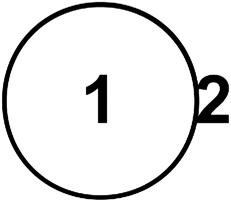
“1” can only exist in a pair. But, as Peirce points out, “it is impossible to form a genuine three by any modification of the pair, without introducing something of a different nature from the unit and the pair.”Footnote 58
In other words, to have a pair (1, 2) one needs a “3” which mediates between “1” and “2”:

To make the most of this diagram, a couple of notational reflexes need to be halted. First, the fact that ‘2’ is in the middle does not mean that it ‘mediates’ between ‘1’ and ‘3.’ Rather, the idea is to place ‘2’ right at the very border delineating ‘1’ so as to mark the delineation as such (irrespective of whether it is interpreted). Likewise, the line before ‘3’ is not to be taken as a ‘minus’ sign. Rather, the idea is to set ‘3’ apart from ‘1’ and ‘2’ in order to emphasize that ‘3’ is whatever would recognize the alterity or contrast for what it is.
When we use these three categories—which Peirce called simply Firstness, Secondness, and Thirdness—to analyse semiosis, we gather that an object referred to occupies the role of ‘2,’ since it must be something which the sign-vehicle (‘1’) is not (actually, at this level of analysis, the two labels are interchangeable, insofar as symmetrical difference is really what matters). Interpretation is what links the two. What this ‘3’ consists in is left unspecified. This third element, which Peirce called the ‘interpretant,’Footnote 59 can of course be glossed as some mental act which apprehends the brute relation between ‘1’ and ‘2.’ The categories themselves are noncommittal.Footnote 60 Yet, since ‘3’ is not nothing,Footnote 61 an interpretant has the potential to figure as a vehicle in a further sign, so the whole machinery can be applied over and over. In this way, triadic relations beget more of themselves, and while “[t]he process as a whole is unlimited,” the same cannot be said of the finite “stages and steps in the process.”Footnote 62
Iconicity exploits the quality of ‘1’ and indexicality exploits the contact in ‘2.’ Peirce stressed that actual reference arises only when things are involved in triadic relations, so icons and indices always need to be interpreted. Yet, he also stressed that, because any relation is complex (having more than one relata), there ought to be no principled impediment to conceivingFootnote 63 whatever simplicity a triad subsumes. ‘Prescission’ is the technical name given to this operation of attending to some elements and deliberately neglecting others.Footnote 64 Unlike the invitation to conceive of ‘zombies,’ prescission does not subtract qualia from a person, but rather a person (and everything else) from a quale.Footnote 65
Since anytime one encounters a sign, one perforce encounters a full relational triad, the isolation of a quality only makes sense if it involves a distinction that is “more than nominal but less than real” (to use the medieval saying). For example, every triangle is trilateral, but while neither sides nor angles can be present without each other, we do distinguish them (and not arbitrarily so). Likewise, an object and an interpretant are always present alongside any sign-vehicle. I thus accept that consciousness cannot be factually separated from functional involvement.Footnote 66 Nevertheless, I believe there are weaker grades of separation one can make. To be sure, this exposes one to the threat of reification. Still, there is no way to understand how iconicity works without employing prescission.Footnote 67
This all bears directly on current discussions of consciousness. Josh Weisberg has recently distinguished between a ‘moderate’ and ‘zealous’ reading of phenomenal consciousness. Those epithets are of course biased, so we might recast the distinction as ‘complex’ and ‘simple’ readings, respectively. On the complex reading, “‘phenomenal consciousness’ just means ‘experience.’ Many people have embraced this sense of the term and use it to roughly pick out conscious experience involving sensory quality.”Footnote 68 We can call this a complex reading because something besides the quality itself is allowed to enter into the notion. By contrast, on the simple reading, the very presence of something besides the quality itself disqualifies the candidate from belonging to phenomenal consciousness. Accordingly, “any explanation of phenomenal consciousness in exclusively cognitive, intentional or functional terms will fail to capture, without remainder, what is really distinctive about phenomenal consciousness.”Footnote 69 Weisberg notes that the simple reading is what Ned Block has in mind when he talks of ‘p-consciousness.’Footnote 70 We can now see that the simple reading is what prescission uncovers, insofar as it reveals ‘what-it’s-likeness’ to be “a monadic property of conscious states. It is something that a state has or lacks independently of its relations to other mental states.”Footnote 71 Indeed, compare this definition with that given by Peirce:
By a feeling, I mean an instance of that kind of consciousness which involves no analysis, comparison or any process whatsoever, nor consists in whole or in part of any act by which one stretch of consciousness is distinguished from another, which has its own positive quality which consists in nothing else, and which is of itself all that it is, however it may have been brought about....Footnote 72
Weisberg is in some sense correct to maintain that “what it is to be in a conscious state is to be aware of oneself as being in that state.”Footnote 73 Yet, anyone committed to two layers of thinking is eo ipso committed to there being one such layer. The point a theorist like Block is trying to make—and which I believe Peircean semiotics succeeds in making—is that the commitment to something simpler (i.e., the first layer) is inescapable, since one can always suppose that second layer absent by prescinding. True, “[i]t is the intentional content of the HO [or higher-order] representation that matters for consciousness, not the presence of the target first-order state the HO representation is normally about.”Footnote 74 Yet, to the extent this is so, the higher-order theorist is bound to countenance a first-order quality stripped of all relational involvement.
As a logician, Peirce was cautious never to make this last claim any stronger than it needs to be. Hence, he never claimed that, as a matter of empirical fact, we encounter nonrelational qualities. Since what we cognize is mediated by signs and since such mediation implies relations, Peirce acknowledged that when we look inside what we see is not ‘phenomenality’ per se but ‘psychology’ in the functionalist sense.Footnote 75 Even so, since the stream of experience (whence we glean all that we know) is complex, the commitment to subsumed simplicity seems logically inescapable. Hence, the (Jamesian) observation that “[o]ur phenomenology has a rich and specific structure” that is “unified, bounded, and differentiated into many different aspects but with an underlying homogeneity to many aspects, and it appears to have a single subject of experience”Footnote 76 does not pose a problem for a semiotic account, so long as we retain the ability to prescind.
Once one grasps all this, important consequences ensue. Loar asserts that “[p]henomenal qualities vary in generality: I can note that a state of mine has what all smells share, or that it is the smell of new mown grass.”Footnote 77 This glosses over several important distinctions. To say that a given quality is shared by other experiences is already to enter into some sort of comparison, and thus to take one quality as the (in this case, iconic) sign of another (or others).Footnote 78 To say that the phenomenal quality in question is the smell of something besides that smell (like new mown grass) is to confess that the quality has already entered into semiosis.Footnote 79 Likewise, the moment a subject notes that a given state has what all such states share, the recognition of similitude falls within the ambit of functionalism. Now, there is nothing wrong or inherently problematic in noting a similitude between qualities, nor is there anything wrong or inherently problematic in the idea of taking a quality as the quality ‘of’ a certain thing. What is wrong and problematic is the assumption that one can do all this whilst handling the simple quality itself, irrespective of its functional role or involvement in relations.Footnote 80
I am discussing phenomenal concepts. In the general literature on concepts, it is common to ask whether concepts are structured or unstructured.Footnote 81 Whether it is appropriate to call it a concept, the simple quality reached by prescissive abstraction is clearly unstructured. If this is so, then there is not much one can say about a quale. Nonetheless, it is worth keeping in mind that “[t]he ineffable is not something mystical or mysterious; it is merely that which evades description. It evades description, but it pervades experience.”Footnote 82 In fact, this indeterminacy of qualitative experience can be seen as a strength, not a liability, of an epistemological account, because it motivates the need for epistemology to begin with. Peirce is well known for showing “How to Make Our Ideas Clear.”Footnote 83 One could say that, by removing relations, philosophy of signs shows ‘why our ideas need to be made clear.’ Inquiry, then, becomes an expression of the fact that “[w]e have only the experimental or hypothetical application of the principle of reason to the fact that we live in a puzzling world.”Footnote 84 Yet, since clarity is not found at the foundations, we confront an interesting question:
[W]hy should such a sign without reference be a sign at all? Husserl and the phenomenological semioticians would consider it as a nonsemiotic phenomenon, but to Peirce, it is nevertheless semiotic, since even if a sign refers only to itself it has the potential of producing an effect in a process of semiosis.Footnote 85
As we are about to see, this ‘potential to refer’ is the very pivot of iconic reference.
3. Referring to Something by ‘Being Like’ that Thing
Frederik Stjernfelt contends that similarity is not a defining feature of iconicity, since “[s]imilarity is generally symmetrical: if a is similar to b, then b is also similar to a; while sign-relations are generally asymmetrical: if a signifies b, it does not follow that b signifies a.”Footnote 86 It is true that similarity is symmetrical. It is also true that, in any triadic sign, interpretation will impose an asymmetrical sense of direction going from sign-vehicle to object. However, it is important to stress that this asymmetry is beholden to interpretation, not to the sign-vehicle or object. Since the overlaying of a means-end order on qualities that are otherwise identical can just as easily be turned the other way around, every object iconically referred to by a sign-vehicle is at the same time a potential sign-vehicle in the opposite direction. This is obscured by the twin facts that there is no reason to ‘prefer’ one quality over the other, yet an interpretant will always privilege one sense of direction in a given instance. To the extent the sign-relation truly latched on to a real similarity between a and b, nothing in principle would have barred the reverse from happening, letting b do the ‘standing for.’
Concretely, this means that, if the stranger in the coffee shop truly looks like your friend’s father, then it is as legitimate to find that your friend’s father looks like the stranger in the coffee shop.Footnote 87
The world is intercrossed by similar qualities, and this adds to causation as a possible channel for the conveyance of meaning. Yet, with a few exceptions, this idea of reference by shared quality is absent in mainstream debates. Some of this neglect is an accident of history, but some of it is concerted.Footnote 88 Looking back, it is distressing to see how early iconicity got discarded, and how thin the grounds of that dismissal really were. Nearest to this paper’s topic, one of the biggest blunders occurred when Arthur Burks—despite editing Peirce’s Collected Papers—reassured the philosophical public that the full type/token/tone distinction was articulated by Peirce “in a way which is too bound up with his system of categories to be of use outside his philosophy, and without adding anything novel to his original trichotomy” of symbol/index/icon.Footnote 89 Given what systematicity means, it is hard to see how being ‘too bound up with a system’ could be seen as a reproach. In any event, let me now rectify this neglect and explain how the type/token/tone distinction constrains the symbol/index/icon distinction.Footnote 90
Although three parts are needed for the sign to do its referential business, those parts hang together in a specific ordinal arrangement, and the question of whether each part is essential or accidental to a given reference is what motivates the symbol/index/icon distinction. For the symbol, if one deletes the interpretation, then the sign-vehicle can no longer signify, since interpretation is all that binds together the sign-vehicle and the object (as explained in section 2, the ‘deletion’ here is simply the prescissive supposition of one thing without another). For the index, if one deletes the interpretation, the sign-vehicle and the object will remain factually connected, so one needs to delete the object as well in order to extinguish the sign-vehicle’s power to signify it. For the icon, the interpretation and the object can both be deleted and still the sign-vehicle retains its power to signify.Footnote 91
Hence, putting one of the opening epigraphs to use, if a footprint leads interpretation to a foot in virtue of its similarity with that foot, then it is the outline (of either the foot or the imprint) that matters. What permits iconicity in this case is the quality of the sign-vehicle ‘1,’ not the object ‘2’ nor the interpretation ‘3.’ Continuing with the example, if a footprint leads interpretation to a foot in virtue of the causal contact it had with that foot, then it is the actual foot that matters. Here, what permits indexicality is the pair ‘1, 2’—not ‘3.’ As for the word or symbol ‘footprint,’ nothing but interpretation (‘3’) holds its reference together. Peirce rightly insisted that these different referential relations “are all indispensable in all reasoning.”Footnote 92
Symbol/index/icon mark out three ways sign-vehicles can be linked to their objects. As we have just seen, this stems from a systematic analysis of which parts of the sign depend on which. In the same way, the nature of the sign-vehicle will affect what sort of relation it can have with its referent. If one is going to assemble a sign, there are essentially three resources one can use: what / happens / again. Obviously, an ontology which, for one reason or another, rejects any of these aspects will have less with which to work. Still, a Peircean semiotician accepts three supports for meaning. These supports have different natures that constrain what sort of referential relation each sign-vehicle affords. This layered interlocking of the two taxonomies is rendered in the grid below:
Conventional imputations must be re-applicable, so only as a type can a sign-vehicle have a symbolic bond to its object. Causation requires particulars, so only as a token can a sign-vehicle have an indexical bond to its object. Similarity requires a shared quality, so only as a tone can a sign-vehicle enjoy an iconic bond to the quality referred to.
Symbols arguably presuppose a whole linguistic community. The icon does not presuppose anything besides itself. Indeed, the referential power of an icon “is not necessarily dependent upon its ever actually determining an Interpretant, nor even upon its actually having an Object.”Footnote 93 Consequently, the only way to eliminate the semiotic potential of a given tone is to eliminate that tone itself. Short of doing so, the ability to be linked to similar things always lies in wait, in germinal form, simply because any quality would resemble whatever would be like it. Of course, the mere talk of ‘another’ tone would entail that we are no longer dealing with tones but with tokens, since juxtaposition or comparison presupposes numerical plurality. Still, when two tokens are related in virtue of their shared quality, it is the underlying tone they share that matters, not those particular tokens. Therefore, in order to truly understand iconicity as a mode of reference, one has to prescind. Doing so reveals the icon to be an idle sign, something that “can only be a fragment of a completer sign.”Footnote 94
When Russell wrote in The Philosophy of Logical Atomism that “[t]he simplest imaginable facts are those which consist in the possession of a quality by some particular thing. Such facts, say, as ‘This is white,’”Footnote 95 he was already several storeys of complexity above the simple ‘1’ in the earlier diagram (section 2). Peirce and Russell were both pioneers in the early florescence of symbolic logic,Footnote 96 and both heeded the (Leibnizian) insight that whatever is complex is composed of simples. Yet, the method of prescissive abstraction employed by Peirce goes beneath ‘This is white’ to reach ‘white.’ The sign-vehicle ‘this’ is not white; in fact, here it is black (and, if spoken, it has no colour at all). Hence, in order to successfully use ‘this’ as a sign of white things, one has to bring a token of ‘this’ near a token white thing so that interpretation can relate the two. Such indexicality is indeed more primitive than description (which in the case of colours seems quite impotent). A white thing, however, can lead interpretation to another white thing. Here it is similarity—not proximity—that underwrites the interpretive passage from one token to another. Therefore, the actual tokens are not what is essential.Footnote 97
As David Pears explains, Russell thought that “when we find that we cannot push the analysis of words any further, we can plant a flag recording the discovery of genuine logical atoms.”Footnote 98 However, if one is engaged in the analysis of signs (not just words), one can plant a flag still further. By analogy with the scale-relativity of the natural sciences, one could say that philosophy of language is akin to chemistry, whereas philosophy of signs is akin to fundamental physics. Indeed, semiotics splits triadic relations and thereby reveals the tone, which does not actually refer to anything, since there is nothing there for it to refer to.Footnote 99 Still, even when considered in such abstract isolation, a qualitative sign-vehicle retains the power to refer. Simply put, ‘1’ could only refer to (or be referred to by) ‘1.’ However, for such a sign-vehicle to act, it must come into contact with something besides itself. The moment a quality does this, it is no longer an icon but an index (that subsumes an icon), since the object with which it is similar must be in the picture.
Prescission not only renders a simple quality visible, it also helps to understand a mode of reference perfectly suited to handle that quality itself. To my knowledge, no one working from Russellian assumptions has come closer to independently reconstructing such an account of iconic reference than David Papineau. Papineau’s project can be seen as an instance of the phenomenal concept strategy, insofar as he hopes to capture an “intuition of mind-brain distinctness.”Footnote 100 Indeed, “[l]ike many physicalists, Papineau diagnoses the apparent threats to physicalism posed by the phenomena of consciousness by locating the source of anti-physicalist intuitions in features of our thinking rather than in non-physical features of reality.”Footnote 101 Papineau champions prescission when he insists that one should be a “conceptual dualist” but an “ontological monist.”Footnote 102 I obviously sympathize with the aspiration of making such a stance tenable. Ultimately though, I think that Papineau’s account is flawed because the basic notions he manipulates are flawed. Still, since there is so much in common, it will be worth looking at what he has to say about phenomenal concepts.
4. Searching for the Icon
As discussed in the first section, the phenomenal concept strategist holds that the apparent distinctness of qualia is an artifact of the special concepts we deploy to refer to such experiential episodes. With that in mind, Papineau developed what he called a “quotational-indexical” account of phenomenal concepts.Footnote 103 However, he eventually came to think that indexicality imposes too strong a constraint on when and where phenomenal concepts can be exercised.
Papineau’s defection is reminiscent of Jackson’s, as both were led to ponder the troublesome intersection of demonstrative reference and epiphenomenalism. Indices turn on physical presence: one has to be near something in order to refer to it by ostention. Likewise, something quoted must be present in order for the mentioning device to do its work. “Linguistic quotation marks, after all, are a species of demonstrative construction: a use of quotation marks will refer to that word, whatever it is, that happens to be made salient by being placed within the quotation marks.”Footnote 104 That will do in most circumstances. Yet, since qualia are not physically present in any straightforward manner, the analogy with quotation seems to bring little aid. Led by these considerations, Papineau has rebuilt his account so that nothing turns on the actual presence of what is referred to. His recent work still retains the core idea that phenomenal concepts involve the very quality referred to. This is the basic thesis I am defending in this paper. However, I believe the standard menu of options—specifically the type/token and description/acquaintance bipartitions—doom Papineau’s effort to failure.
Consider first the type/token bipartition. Papineau asks: “Can phenomenal concepts pick out experiential particulars as well as types?”Footnote 105 Clearly, any concept wedded solely to a particular token is bound to be severally limited in its use, so Papineau rightly concludes that such an hic et nunc concept (if it could indeed be so called) would not allow for crucial “reencounters.”Footnote 106 After all, the taste of the ice cream one ate on the occasion of one’s seventh birthday—if treated as a token—is a taste found in no other ice cream. The Peircean semiotician will of course notice that what is relevant in discussing the taste of ice cream is a tone; but a theorist unable to call on this crucial notion will recoil to her only remaining option when rejecting tokens as inappropriate. Predictably, then, Papineau concludes that what is involved must be “encounters with a type.”Footnote 107 This response brings us back to the unsatisfactory starting point discussed earlier (in section1): how does one encounter a type? Types cannot impact one’s sensory organs, tokens of types do; so any theory which hopes to account for phenomenal consciousness by invoking experiential encounters with types is surely ill-fated.
To be sure, we do say, as PeirceFootnote 108 pointed out, that there is but one word “the” in the English language. But this is no more to be taken au pied de la lettre than is the statement that there is only one poisonous lizard in the continental United States.... There is not one lizard which is the “type-lizard,” and many other lizards which are the token lizards. Likewise, there is not one word which is the type, and many other words which are the tokens.Footnote 109
Investigations into consciousness have progressed on a lot of fronts in the last two decades. Yet if, by analogy, philosophers of mind have recently been led by their discussions of phenomenal concepts to conclude that one can somehow ‘see’ the type-lizard, then something has gone wrong along the way.Footnote 110
To further illustrate how a limited menu of options strong-arms Papineau into adopting unsatisfactory conclusions, consider next the acquaintance/description bipartition. Knowledge by description can be detached from its worldly site of origin and communicated second-hand. Descriptions can therefore work just fine even though the object described is absent. Knowledge by acquaintance, by contrast, requires the actual presence of its object. In order to count as knowledge, (symbolic) reference in absentia must in some way answer to (indexical) reference in praesentia. Indeed, the whole point of the knowledge argument is to show that mere description is insufficient; at least when it comes to conveying the content of experiential feels. Papineau accepts this, since by his lights “[i]t seems clear that the preemergence Mary does lack some concepts of color experiences.”Footnote 111 Thought-experiments notwithstanding, this contribution of lived experience explains why “[o]ne cannot give an informative answer about seeing orange to the congenitally blind.”Footnote 112
The phenomenal concept strategist is thus in a bind. Either she maintains that qualia can be referred to by description—which is what the knowledge argument denies; or she maintains that qualia can be referred to causally—which is difficult to make sense of in the case of qualia. Like Papineau, discussants who rely on Russellian notions bounce between these two options to no avail. I submit that, to dismount this seesaw, one needs the concept of iconic reference.
The employment of one yellow object to signify another yellow object by means of their yellowness (and not, say, their proximity to one another) does not permit one to dissociate questions pertaining to ‘the medium and the message’ (to echo Marshall McLuhan), since these admit of a univocal answer, to wit, ‘yellow.’ As William Seager writes: “What can be called ‘immediate consciousness’ just has the peculiar reflexive property of allowing an appreciation of both the information being conveyed and the mode of conveyance.”Footnote 113 Given this overlap, the very quality which acts as a sign-vehicle cannot be omitted—on pain of omitting the passage that makes that quality play a semiotic role in the first place.Footnote 114 This explains why “[m]any phenomenal kinds can be referred to only through the content shared by experiences of the kind at issue.”Footnote 115
In a statement echoing Peirce’s remark that the icon has the ability of “bringing its interpreter face to face with the very character signified,”Footnote 116 Papineau writes that “phenomenal concepts are too close to their referents for it to seem possible that those same concepts could refer to something else,” since “the referent seems to be part of the concept itself.”Footnote 117 Of course, given that an icon refers to a quality by being that very quality, this suggestion that the referent is ‘part of’ the concept is not at all fanciful. Nonetheless, since Papineau lacks the notional resources needed to properly express this idea, he sometimes frames his conclusions in terms that hinder their reception. Tim Crane, for instance, writes that:
[I]t seems to me entirely incredible that when one thinks about, say, pain, one must, as a necessary part of that very act of thinking, have an experience which in any way resembles pain. When the narrator of E. M. Forster’s Where Angels Fear to Tread says that ‘physical pain is almost too terrible to bear,’ he is clearly intending to talk about pain in the phenomenal sense, pain as a feeling, an event in the stream of consciousness. In any normal sense of ‘phenomenal,’ then—any sense that relates it to its etymology and its traditional philosophical meaning—he is employing the phenomenal concept of pain. But in order to understand this remark, and therefore grasp the concepts which it expresses, I do not think I need to undergo, as a part of that very understanding, an experience which is in any sense painful. Yet this is what Papineau seems to be saying.Footnote 118
Armed with the full symbol/index/icon taxonomy, I wish to come to Papineau’s defence. All parties agree that describing something exclusively by symbols is a non-starter. Russell would be the first to agree. After all, “Russell was as aware as anyone else that not everything can be thought of by description, on pain of the whole system of identification failing to be tied down to a unique set of objects....”Footnote 119 The knowledge argument brings this out in a particularly memorable way. While sequestered in her cave from birth, Mary could have been taught by unscrupulous experimenters to take Dungeons and Dragons seriously and thereby make coherent functional responses about ‘ghouls’ and ‘trolls.’ Hence, given that, on one level, ‘pain’ is a symbol like any other, there is surely something right in Crane’s claim that this lexical concept does not have to be painful. Yet, if one is to truly comprehend what that word refers to, then, in some respect, one must have experienced pain, and whatever quality one will have retained from such token episodes will itself be related to pain states by being able to indexically spot a similar state if and when it presents itself and have an iconic sense of ‘what’ those states ‘are like.’
The second conjunct here is crucial, since it distinguishes the fine-grained appreciation of qualities that iconicity (via prescission) permits. The concept of pain can indexically refer to a past experience(s), but, at some point, that concept will have to share the experiential quality itself, on pain of having no real clue what that feeling is like. In other words, if one asks the narrator of Forster’s book, ‘What is pain?,’ that narrator is free to answer, ‘What I experienced last Friday;’ and when asked what was experienced last Friday, he can in turn answer, ‘What I experienced the Monday before’—and so on. The semiotician has no quarrel with any of this. Yet, if the person really possesses the relevant phenomenal concept, it cannot be anaphora all the way.Footnote 120
As shown in the earlier grid (section 3), semiotics arranges icons, indices, and symbols in an ordinal fashion, such that the more developed grades of reference subsume the lesser ones but not vice versa.Footnote 121 Interestingly, this triadic pecking order is confirmed by empirical data. Consider for example the icon ‘IIIIII’ and the symbol ‘6,’ which have a common referent but relate to it in different ways, the former non-conventionally, the latter conventionally. If symbolic reference could depart completely from iconicity, as Crane’s criticism suggests, then one would expect the interpretation of Arabic numerals like ‘6’ to be untainted by whatever cognitive and mnemonic limits plague its iconic counterpart ‘IIIIII.’ However, studies have shown that subjects asked to pick the largest among pairs of symbols like ‘4 versus 9’ demonstrate a lag in their response times akin to figuring out ‘IIII versus IIIIIIIII.’ “These results strongly suggest that the process used in judgement of differences in magnitude between numerals is the same as, or analogous to, the process involved in judgements of inequality for physical continua.”Footnote 122 Now, if there is evidence that a symbol such as ‘6’—a quantitative concept not exactly known for its poetic connotations—is in some way IIIIII-like, why should it be absurd to agree with Papineau that “[e]ven if imaginings of pains don’t really hurt, they can share some of the phenomenal unpleasantness of real pains”?Footnote 123
The interesting question is not whether concepts need to always resemble the things to which they refer; there is a clear sense in which they do not (to that extent, Crane’s criticism of Papineau is trivially right). The interesting question is whether mastery of symbols and indices alone could ever suffice to secure reference to the ‘feel’ of experiences. After all, from a developmental perspective, iconic competence is often (and perhaps always) the gateway to symbolic competence.Footnote 124 Holistically drawing inferences on an empty symbol-to-symbol axis certainly remains possible (especially by machines that have never known otherwise). It is also possible for one not to feel a hint of pain when one reads or writes the word ‘pain.’ But, if one never does—anywhere, anytime, under any circumstance,—one can hardly lay claim to what the word means.Footnote 125 It may be okay for Mary to refer to whatever her textbooks told her; just as it is okay to answer the question ‘What is pain?’ with ‘What I experienced last Friday.’ But it is not okay for the authors of those textbooks to have never experienced the relevant icon(s).
The point can be put another way. Suppose that a subject were to possess a given colour concept solely in virtue of having been told about its relations to darker and lighter colours in the vicinity. Being told, say, that amethyst is midway between purple and pink could conceivably be informative to someone who has experienced purple and pink. If so, then that person’s concept of amethyst would amount to a rule (involving several relata), and the unfamiliar quality sandwiched between purple and pink would become akin to a conclusion that can be inferred once one knows the relevant premises. Since the rule applies to a spectrum that is ordered, there is a temptation to dismiss the need to experience the midway quality itself.Footnote 126 Yet, that spectrum actually vindicates qualia. The colours sandwiching an unfamiliar shade remain unproblematic only provided that one does not slide the very sandwiching relation to either side. Without an iconic access to qualia though, one must (constantly) make that slide. Therefore, the premises adduced to secure a supposed inference of the quality turn out to be insecure conclusions of their own, leading to a regress or circle.
On a commonsense level, most of us grasp that when a dictionary defines a colour by citing other colours, its accomplishment is partial. The Jacksonian insight—present in Russell and developed by recent phenomenal concept strategists—is that symbols without indices are empty. In keeping with the subsumption illustrated earlier, Peircean semiotics takes this insight further by holding that indices without icons are empty.Footnote 127 Papineau heeds the moral regarding the insufficiency of descriptions, adds to it a novel recognition of acquaintance’s insufficiency with respect to qualities, and then tries to construct a model that could remedy this. The success of his positive suggestions is partial, but his desiderata are on target. In a technicolour world, iconicity trumps indexicality as a more plausible way to explain reference to phenomenal experience(s).
5. ‘Being Like’ a Quality by ‘Being’ that Quality
I have been contrasting two modes of reference. An index “is a sign which would, at once, lose the character which makes it a sign if its object were removed;” whereas an icon “is a sign which would possess the character which renders it significant, even though its object had no existence.”Footnote 128 Now, a sign-vehicle can serve as both an index and an icon. Chalmers is therefore correct to describe Mary as able “to think demonstrative-qualitative thoughts in which both a demonstrative and a qualitative concept are deployed.”Footnote 129 Thankfully, prescissive analysis does not force one to take this double-duty at face value.
Suppose Mary utters, ‘This is what red looks like.’ This involves both indexical and iconic reference. The indexical component captured by ‘this’ is an effective way to track the things in the world that prompt the qualitative experiences one wants to elicit.Footnote 130 Papineau expresses doubts about the ability of an indexical construction like ‘This feeling’ to select a quality in the manifold stream of consciousness with enough specificity.Footnote 131 A lot is going on, so communicators will presumably have to work to pinpoint what they mean. However, once Mary exits her black and white confines, the world provides her both with qualitative experiences and the iconic means needed to convey those experiences. Using symbols (i.e., language) and indices, Mary can invite her interlocutor(s) to prescissively focus on the tone of the tokens to which she points. This is where iconicity does its work. If all goes well, iconicity allows one to glimpse ‘what’ Mary has in mind when she says, ‘My experience is like that.’ A stubborn interlocutor can at any point spoil the sign-exchange. Still, thanks to iconic reference, one can, in principle, convey what a phenomenal quality is like.
Mary could not use her exhaustive neurophysiological premises to make an inference about the qualitative feel of the colour red in advance of any face-to-face experience.Footnote 132 Still, even supposing Mary could do this,Footnote 133 in order to prove her accomplishment to her peers, she would have to engage in some overt act of communication. The ensuing question is whether the red things to which she points can be linked to her experience in a way contentful enough to counter fears that she might be persuading her peers even though “all is dark inside.”Footnote 134
Imagining a qualitatively vacant mind is, it seems, not worthy of much argument these days.Footnote 135 This is unfortunate (and telling). In any event, current debates take it that, “[w]hen you know all of science but don’t know what it is like to see red, then you can name the relevant property and perhaps interact it [sic] from the outside, but you lack the mode of presentation that reveals what the quiddity of the property is.”Footnote 136 Usually, it is assumed that only introspection can secure confidence that the experiential lights are indeed on. Such a ‘viewpoint-relative’Footnote 137 confirmation that one is conscious obviously falls short of third-person verifiability.
SomeFootnote 138 make a big deal of this, while othersFootnote 139 think it is simply a fact philosophers have to live with. Talk of irreconcilable perspectives is arguably less offensive to the contemporary palate than talk of irreconcilable substances. Yet, given that humans must use signs in the world in order to communicate their mental states, what results from either stance is very much sceptical business as usual. Chalmers encapsulates this when he writes that “[m]y qualitative concept ‘R’ plays little direct role in communicative practices. In that way, it resembles Wittgenstein’s ‘beetle in a box.’”Footnote 140
Papineau, despite being aware that “Mary’s concept [of colour] looks like a paradigm of the kind of thing Wittgenstein’s private language argument is designed to discredit,” philosophizes from the assumption that communication of phenomenal qualities is possible.Footnote 141 Truth be told, so do most of us, most of the time. Is there any way to vindicate this commonsensical point of departure—to make it our philosophical point of arrival too? Let us assume for the sake of argument that the signs emitted by people are available to you, but that their minds are hidden. A person may tell you, for instance, when and where she feels green, perhaps locating the objects and events that prompt her experience. On those terms, what sort of reference would be most apt to licence your confidence about their consciousness?
As Edmond Wright points out, mutual trust can quickly seal the divide between numerically-distinct experiences.Footnote 142 From a practical standpoint, that is certainly true; after all, symbolic reference employs that very channel. Seen in this light, indexicality is a way to fine-tune the coupling of two people’s behaviours, thereby ensuring that your inference by analogy about another mind involves as little risk as possible. Yet, no matter how adept, those antics will not amount to a conveyance of what green feels like. This is because, even if a perfect covariation were to hold between what happens ‘on the outside’ and what happens ‘on the inside,’ one cannot use whatever happens on one side to figure out what happens on the other, any more than one can use smoke to ascertain what fire looks like. Indexicality tracks only the covariations, not what covaries. This is certainly more to go on than a stipulated agreement between symbol-users. Nonetheless, since the reach of indexical reference stops where your partner’s skin begins, conversational goodwill—even when reduced to a minimum by a judicious use of indices—pole-vaults from one mind to another by a leap of faith. This yields the isolated conversationalists pictured earlier. All told, most philosophers would prefer a story less dependent on voluntarism, if such a story can be had.
Prescissive abstraction is not mechanical, so I cannot eradicate voluntarism altogether. Still, I believe inference to the best explanation licenses a migration to a semiotic account, since its analysis of resemblance appeals to considerations more impersonal than outright introspection. Papineau quotes approvingly Thomas Nagel’s observation that “[t]o imagine something sympathetically, we put ourselves in a conscious state resembling the thing itself.”Footnote 143 Given that “[i]cons are so completely substituted for their objects as hardly to be distinguished from them,”Footnote 144 if the box that holds the beetle is made into an exact likeness of the beetle, one can gaze at the beetle itself.
6. Transparency and Opacity
Is it grandiose to suggest that icons can allow one to gaze at the beetle itself? To test this claim on a less controversial case, consider ‘IIIIII’ (on this page) as an icon of IIIIII (on this page). Besides the fact that distinct tokens are present, one would be hard-pressed to say that there is any difference between the sign-vehicle and its object. Now, anyone who has ever had his/her attention redirected by an index finger or sudden scream accepts such mundane events as proof that indices are semiotically efficacious. The index cannot bear the full weight of scepticism, but this hardly stops most philosophers from thinking that we are better off with indexicality in the mix. By parity, the manifest similarity between ‘IIIIII’ and IIIIII should suffice to show that icons can work.
Granted, that’s not exactly a naturalist answer, but then again these aren’t exactly naturalist questions. Only sapient creatures wonder how (and worry if) they refer to their own sentience.Footnote 145
Note that the pronounced similarity of the icon holds irrespective of whether one chooses to use or ‘mention’ a sign-vehicle. This is brought out by the much-discussed transparency argument.Footnote 146 Imagine that you are placed before a blue wall so large that it engulfs your entire visual field. The surface of the wall is uniform in hue and smooth in texture, nothing else enters the picture, and your subjective vantage is not allowed to shift.Footnote 147 As we saw (in section 2), “it is conceivable, or supposable, that the quality of blue should usurp the whole mind....”Footnote 148 The task is to note what can and cannot be gleaned from an examination of such a lone quality. Speaking strictly as a logician, Peirce wrote: “To suppose, for example, that there is a flow of time, or any degree of vividness, be it high or low, seems to me quite as uncalled for as to suppose that there is freedom of the press or a magnetic field.”Footnote 149
Peirce took this to vindicate qualia. Strangely, the conclusion nowadays drawn from the transparency argument is that qualia cannot exist. “Since the main reason for believing in nonrepresentational phenomenal character, or qualia, is our alleged direct awareness of it in experience, if there is no such direct awareness, as transparency suggest, then there is little reason to posit qualia.”Footnote 150 The terms of the debate are essentially these: either a vehicle intervenes, in which case it blocks access to the object, or access to the object is achieved, in which case no vehicle intervened.Footnote 151 In my view, what the transparency argument establishes is that one would be impotent to tell whether the qualitative experience one undergoes is ‘internal’ or ‘external.’ Indeed, under the stringent exclusionary conditions just outlined, it would be just as reasonable to interpret a blue expanse as an opaque screen as it is to interpret it as some physical object diaphanously present before one.Footnote 152 What deserves endorsement, then, is not one of these two glosses, but an agnostic mid-way, since both options are equally viable (until and unless further experience is allowed to enter the picture).
Whereas iconicity engulfs the very quality to which it refers, acquaintance always keeps its object at bay. Indeed, it should be remembered that indexicals used to go by the name ‘egocentric particulars.’Footnote 153 Russell designed the notion with the express intent of preserving such a split: “Now I wish to preserve the dualism of subject and object in my terminology, because this dualism seems to me a fundamental fact concerning cognition.”Footnote 154 The possibility of developing an account of iconicity has been hindered by the assumption that such demonstratives are “the mother and father of all information-based thoughts.”Footnote 155 A symptomatic statement can help to appreciate the scope of the missed opportunities. Chalmers matches my negative claim that what is involved in phenomenal knowledge is not an index. He writes: “Mary’s thought involves attributing a certain substantive qualitative nature to an object that is identified demonstratively. The concept R—her qualitative concept of the sort of experience in question—is not a demonstrative concept at all...”Footnote 156 However, Chalmers does not match my positive claim that what is involved is an icon. The closest he comes to reference by shared quality is when he invents a ‘direct phenomenal concept.’Footnote 157 Pausing to take stock of what he has gleaned from his dialectic, Chalmers writes: “All this is to say that there is something intrinsically epistemic about experience. To have an experience is automatically to stand in some sort of intimate epistemic relation to the experience....”Footnote 158 Chalmers is saying that to undergo an experience is eo ispo to know ‘what it is like’ to have that experience (one might rephrase this by saying that whenever there is a token, there is a tone). Yet, Chalmers immediately adds: “...—a relation that we might call ‘acquaintance.’”Footnote 159 By using this Russellian label and speaking of a ‘relation,’ Chalmers inadvertently takes on a host of philosophical assumptions which introduce a gap or hiatus between knower and known.
Chalmers is simply working out a consequence of this dualism of subject and object when he asserts that “experiences are not red in the same sense in which apples are red. Phenomenal redness (a property of experiences or of subjects of experience) is a different property from external redness (a property of external objects).”Footnote 160 Although Chalmers immediately adds that “both are respectable properties in their own right,” his basic assumptions nevertheless leave him with two tokens to juxtapose: one ‘in here,’ the other ‘out there.’ Presumably, one comes to know a token ‘out there’ by means of a token ‘in here.’ Yet, no matter how alike those tokens are, the thin space of numerical distinctness between them is enough to cast doubt that one truly has referred to the quality in question. Chalmers is therefore right that a predicament like absent or inverted qualia is “occasionally found distasteful, but it is a natural consequence of the indexicality of the concept” employed to express phenomenal qualities.Footnote 161
The trichotomy of symbol/index/icon is distinguished from all this by making room for a mode of reference that fuses sign-vehicle and object. Because it is merely potentially similar to something like it, “[a] pure icon can convey no positive or factual information; for it affords no assurance that there is any such thing in nature.”Footnote 162 Although indexicality has its place, Peircean semiotics countenances an ideal case where what is signifying and what is signified are one and the same. In short, careful study of the conditions for the possibility of sign-action reveals a ground level where similarity becomes so pronounced that “[i]t is an affair of suchness only.”Footnote 163 When prescinding all the way to uncorrupted iconicity (without numerically-distinct tokens), we therefore place ourselves at a level incapable of supporting the distinction between veridicality and illusion, given that “[o]n a perceptual level you cannot predicate anything of a Likeness other than the recognition that it is that Likeness.”Footnote 164 This means that, contrary to the view expressed by Chalmers, if one looks solely at a quality, experiences are red in the same sense in which apples are red. Papineau comes to the same conclusion: “What it’s like to focus phenomenally on your visual experience of the bird is no different from what it’s like to see the bird.”Footnote 165 If this is true, then by joint attention subjects can genuinely come to know what it’s like for each other to enjoy a given phenomenal experience.
Now, a standard approach to truth sees it as consisting of truth-bearers on one side, truth-makers on the other side, and a truth-relation between the two. This essentially reprises the triadic model of the sign. Whatever ‘truth’ we get in iconic reference, though, reminds us not to take this model for granted, since in our most proximate experiential dealings with objects, truth-bearer and truth-maker are one.Footnote 166 This means that one should not worry about (much less accuse theorists ofFootnote 167) conflating physical presence and cognitive presence since, at the proper level of analysis, there is simply nothing to ‘conflate.’Footnote 168
All the distinctions in the earlier diagram and grid are prescissive, so I have no wish to deny that, “[w]hen Mary says, ‘So this is what it is like!’, what she refers to will almost certainly be a physical property of a physical event.”Footnote 169 Such physical presence would suddenly matter if, say, Mary were to use a red rose to indicate to her colleagues that she passed by the laboratory while they were gone. Indices, however, do not exhaust the referential repertoire, so I argue that the red rose can fulfil other roles that turn on its quality. Deliberate focus on a quality does not erase the fact that a token is needed to see a tone—the referential resources of philosophy of signs may be richer, but particulars are always needed to impinge upon our senses, just like any sign must have some concrete material support. But if, as I have argued, similarity does not depend on proximity, then it is misleading to claim in an unqualified way that reference to any x involves causal influence from x to the referential act.
To be sure, the pure icon must remain a theoretical ideal—the logical asymptote of a likeness bereft of any alterity (qualitative and numerical). To the extent one reaches this limit, one does so only by means of reason. I thus own up to the fact that, ultimately, “[s]emiosis explains itself by itself.”Footnote 170 The methodological difference is that, unlike using symbols to talk about symbols—which is what linguists do when they employ a metalanguage,—using symbols to talk about icons requires semioticians to subtract, not add, a layer a discourse. Neither strategy is impossible to implement. In either case, one must disregard one’s intervention; otherwise no progress can be made.
Conclusion
The moment an organism acts on the basis of a feeling, this generates a worry that we are studying that feeling’s discernible effects, not the quality of the feeling itself. Properly understood, phenomenal states or qualia are not supposed to enter into any kind of relation with the world or other mental states, otherwise they could in principle be detected (either through their causal efficacy or participation in inferences). Hence, “[o]n the phenomenal concept, mind is characterized by the way it feels; on the psychological concept, mind is characterized by what it does.”Footnote 171 Yet, since ‘doing’ automatically changes the topic away from phenomenality, how could one possibly refer to such qualities? SomeFootnote 172 have taken this to mean that humans have an inherent shortcoming when it comes to understanding consciousness. The phenomenal concept strategist maintains that, on the contrary, our epistemic powers are almost too strong for their own good. We employ a special class of concepts when discussing conscious states, and a better understanding of those concepts will show that “the disturbing effect of the explanatory gap arises from an illusion....”Footnote 173
There is a sense in which I too have endeavoured to disentangle certain intuitions that generate puzzlement about consciousness. Chalmers remarks that “[t]he clearest cases of direct phenomenal concepts arise when a subject attends to the quality of an experience and forms a concept wholly based on attention to the quality.”Footnote 174 Once one enlists the resources of philosophy of signs to articulate this idea of a concept wholly based on attention to a quality, one gathers that only icons could be up to the task of referring to qualia. One can prescind a simple quality amidst any segment of semiosis, but one must ensure that whatever one reports about those impoverished scenarios does not help itself to the very resources supposed absent. Hence, qualia “are the artificial product of a highly sophisticated analysis, and not genuine existents revealed to ordinary, everyday scrutiny.”Footnote 175 Unfortunately, mainstream debates took on selected Peircean ideas without grasping their full semiotic motivation. Present-day advocates of the phenomenal concept strategy represent the culmination of the (mistaken) assumption that indexicals are the simplest form of reference one can muster. By dipping below the level of triadic relations, I have tried to approach phenomenal consciousness from a different—and more promising—angle.
How does the world ‘convey’ information to our minds? The overlooked possibility I have been exploring is: by doing no conveying to begin with. Icons are ideal transducers because they involve no transduction; “[a]nd this means that philosophers do not have the task of explaining how we get from our experience to its external object.”Footnote 176 If we come to the situation armed with the possibility of such ‘split-free’ iconic reference, it is no longer mandatory to countenance the disconnect illustrated by O’Dea. William Seager writes that “[t]he privacy of your qualia does not at all imply that others can’t know what experiences you are having or what they are like. But of course they cannot know this by literally sharing your experiences.”Footnote 177 At the risk of sounding provocative, this essay suggests that they can.
Acknowledgments: This article is in many ways a ‘sequel’ to Champagne Reference Champagne2009a. For helpful comments on earlier drafts, I would like to thank Henry Jackman, Catherine Legg, Paul Livingston, Jacob Beck, Vincent Colapietro, Andrew Parker, Brandon Fenton, Daniel Woolley, Graeme Taylor, David Jopling, Ryan Tonkens, Alberto Richards, Tom Piekarski, anonymous referees, as well as participants who discussed my work at the 2011 CPA meeting. I would also like to acknowledge the Department of Philosophy at York for its continued support. Research for this article was funded in part by an Ontario Graduate Scholarship.


