INTRODUCTION
The importance of informal seed systems in smallholder farming systems in developing countries has attracted much interest. The discussions have largely centred on how the role of the informal system complements that of the formal system (Jones et al., Reference Jones, Audi and Tripp2001; Witcombe, Reference Witcombe2002). For example, in a review of seed systems in three Central American countries, Almekinders et al. (Reference Almekinders, Louwaars and de Bruijn1994) identified (i) varietal use and development, (ii) seed production and storage by farmers under local conditions, and (iii) seed exchange mechanisms as the three principal components. They observed that while formal breeding programmes best address varietal development, informal (local) mechanisms are important in production, storage and exchange. Nonetheless, it is recognized that in many countries formal seed systems work poorly at best, and farmers are often not benefiting from the outputs of modern plant breeding (Tripp et al., Reference Tripp, Walker, Opoku-Apau, Dankyi and Delmini1998). Participatory varietal selection (PVS, Witcombe et al., Reference Witcombe, Joshi, Joshi and Sthapit1996) has been successfully used to identify, introduce and then disseminate varieties of numerous crops using informal seed systems (Almekinders and Elings, Reference Almekinders and Elings2001). Sperling and Cooper (Reference Sperling, Cooper, Sperling, Osborn and Cooper2004), in their review of how seed systems can strengthen seed security, concluded that problems of access to seed permeate constraints related to the functioning of seed systems.
Introduced varieties that meet the preferences of farmers and consumers are likely to spread among farmers. However, studies carried out in East Africa by Sperling and Loevinsohn (Reference Sperling and Loevinsohn1993) report that it cannot be taken for granted that a good variety will spread by itself. Apart from the productivity of the variety, the degree to which farmers appreciate it and how favourable the physical environment is, social factors also affect the geographical distribution. This is because at the initial stage of spread, relatives, friends and neighbours are those who have ready access to the seed. Factors affecting the availability and retention of seed, including the amount of seed initially received, have also been identified as important David et al., (Reference David, Mukandala and Mafuru2002).
Ghana, like many countries in sub-Sahara Africa, has to grapple with the problem of delivering seed of acceptable quality and with desirable characteristics to farmers. The challenge is how to maintain a system that is efficient in supplying seed to small-scale farmers who demand small quantities at a time. The problem is compounded by the fact that the demand for seed is not on a regular basis. While some progress has been made in developing the formal sector for the delivery of maize seed and, to a very limited extent, cowpea, sorghum and soybean, the same cannot be said of other crops. Studies have shown that farmers are more likely to purchase seed from the formal sector only when a new variety has been released (see, for example, Tripp et al., Reference Tripp, Walker, Opoku-Apau, Dankyi and Delmini1998). Thus, even for those crops with a formal system of seed production and delivery, the informal sector is the dominant system operating in Ghana. For example, up to 5% only of cowpea and soybean seed used is from certified sources (GSID-MOFA, 2005). In the case of rice, attempts have been made to deliver seed of improved varieties using the formal sector, and success has been largely limited to irrigation schemes where there is a conscious effort to promote the production of rice varieties that compete with the imported ones.
In Ghana, rain-fed rice production systems accounted for 91% of the total area and 84% of total production in 2002 (MOFA, 2003), and the informal system is the major source of seed for this system of rice production. It was not until 1999 that organized production of seed rice started and the impact is yet to be widely felt. A survey of over 1000 farmers in Ghana in 2000/2001 showed that 25% obtained seed of rice from formal sources (Kranjac-Berisavljevic et al., Reference Kranjac-Berisavljevic, Blench and Chapman2003). However, the use of seed from formal sources varies with the type of ecology. Irrigated rice farmers obtain their seed from formal sources as part of the package, while upland rice farmers do not have access to seed from formal sources. Following a conscious effort by the government to promote rice production in the country as a way of reducing imports, seed production in the formal system for 2004 planting season was expected to cover 12.5% of the total area (MOFA, 2003). Thus, the informal seed system continues to be a vital component of production. Understanding the rice seed uptake pathways of the informal sector should provide insights that could inform interventions.
At the start of a PVS project to introduce new upland rice varieties to farmers in the Western Region of Ghana, a variety-needs assessment exercise was conducted in the Sayerano community in 2001. The most common variety grown by farmers in Sayerano was Agya Amoah, introduced in 1987. The cultivar is named after the farmer who introduced it into the area. The farmer, Agya Amoah, is a relatively well off rice farmer and a member of an active rice farmers group. This farmer requested rice seed from a friend who brought back 0.5 kg of seed from Côte d'Ivoire. This cultivar is an Oryza sativa type. It matures within four months, and this fits in well with farmers' objective of rationalizing labour as the period of peak demand for labour does not coincide with labour demand by other crops cultivated by farmers, especially cocoa, which is the most important cash crop. The cultivar largely replaced a shorter maturing one called Bosome mmiensa (meaning ‘three-month’). Agya Amoah has never been formally released or promoted in Ghana yet appears to have spread widely throughout the Western Region. The objective of this paper is to establish the extent of the spread of Agya Amoah and understand the processes contributing to its spread.
MATERIALS AND METHODS
The study was undertaken in three districts of the Western Region: Juabeso-Bia, where Sayerano is located, Sefwi-Wiawso and Bibiani-Ahwianso-Bekwai. Juabeso-Bia district is the most rural of the locations and has a poor infrastructure. Bibiani-Anhwiaso-Bekwai district is the most urbanized and has a well-patronized market centre. Economic activities here are boosted by active gold mining operations. Sefwi-Wiawso district is less rural than Juabeso-Bia and more rural than Bibiani-Anhwiaso-Bekwai. These districts were purposively selected on the basis that some farmers in these districts had grown the Agya Amoah cultivar in the past.
Rainfall is high, with an annual average of 1400–1500 mm, with a bimodal distribution. There are, therefore, two growing seasons. The first, which is the longer season, is from March to July, and the second is from September to December. Rice is mainly cultivated in the first season as a rain-fed crop. It is produced for both food and cash needs, and it is particularly an important source of cash to younger people (Craufurd et al., Reference Craufurd, Dorward, Marfo, Bam, Ansere-Bioh, Dogbe, Djagbletey, Bimpong and Nutsugah2004). As a cash crop, rice is more important to male than female farmers.
Qualitative and quantitative approaches were used to gather primary data in three phases: preliminary survey, main survey and follow-up survey. The preliminary phase spanned the period April–September 2002. Two activities were included at this stage. They involved qualitative methods, particularly in-depth interviews with key informants in the district where the rice variety was first introduced. Four groups of people were interviewed: farmers, millers, traders and extension staff of the Ministry of Food and Agriculture. The farmers included Mr Agya Amoah, the small-scale farmer who brought the seed to the area, and other farmers who have had long experience in rice cultivation. The second activity was a reconnaissance survey to identify locations where upland rice was grown. The information collected at the preliminary phase, together with insights from the needs assessment carried out in the district in 2000 (which explored farmers' rice growing practices, preferences in varieties and seed systems), was used to select locations to survey and to help design the survey.
The main survey, which involved collection of mainly quantitative data, was carried out in the field during the period November 2002–January 2003. A four-page questionnaire was designed, pre-tested and administered through personal interviews, to elicit information on the socio-economic background of the farmers, farm information, knowledge and cultivation of various varieties and seed management. Six rice-growing villages in each district were purposively selected on the basis that the Agya Amoah cultivar had spread to that location. Within each village, a complete list of all rice farmers was compiled with the assistance of village leaders and agricultural extension staff, and 10 farmers were randomly selected from the list for interview. In all 180 farmers were interviewed. Samples of Agya Amoah seed were collected from each village for identification. Completed structured questionnaires were edited, coded and analysed by computer using SPSS Windows 12.0. Informal follow-up interviews were conducted between 2003 and 2005 to confirm the extent of spread as mentioned by respondents in the survey. The responses on the extent of spread from where the respondents were located were regarded as indicative because those providing these responses on spread were not farming in those locations that the cultivar was thought to have spread to.
RESULTS
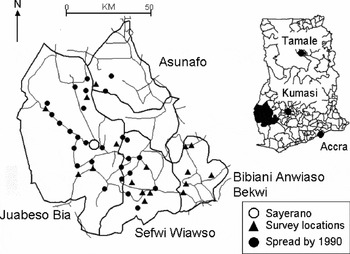
The three Districts of Juabeso-Bia, Sefwi-Wiawso and Bibiani-Ahwianso-Bekwai are the main districts where upland rice is grown in the Western Region. Upland rice is not grown north or east of these districts, although some communities in Asunafo District do grow upland rice (Figure 1). The three main districts cover an area of approximately 7650 km2.
The spread of Agya Amoah in Western Region, Ghana. Maps show: (i) the location of the Districts in Ghana where Agya Amoah was grown; and (ii) the location Agya Amoah was first grown at in 1987, survey locations and locations where Agya Amoah was reported to have been grown by 1990. District boundaries are shown by thick lines and major roads (mostly dirt) by thin lines.

Cropping system
Tree crops, principally cocoa, were estimated to cover 50% of the area under crops. Upland rice and lowland rice each covered 16% and other food crops covered 18%. It should be noted that most farmers relay crop the upland rice fields with other food crops, and usually intercrop rice with immature tree crops. Therefore the area planted to rice is certainly greater than 32%. The mean area per household under rice was 1.8 ha.
Socio-demographic characteristics
Men dominated rice farming in the area, accounting for at least three out of every five farmers. There was no marked difference between the proportion of male and female farmers using Agya Amoah (78.9% and 75.8% respectively). The typical rice farmer was young, with more than half of the farmers being under 36 years old. The age distribution was similar for men and women. The dominance of rice production by men is a reflection of the crop's importance as a commercial crop rather than a food staple among the farmers. More than 70% of the farmers had been growing rice for 10 years or less. About the same proportion have been farming for up to 15 years.
Rice varieties
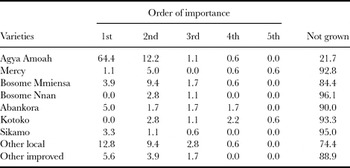
Farmers, both upland and lowland, were growing a range of rice varieties, the most important of which are given in Table 1. However, 61% of the total rice area was planted to a single variety, Agya Amoah, which had largely replaced Bosome mmiensa. Other local varieties (defined as varieties named by farmers but not introduced by extension or research), Bosome Nnan (‘four-month’) and Kotoko (red-seeded O. glaberrima), occupied 31% of the total rice area. Improved varieties (i.e. those known to have been introduced by extension/research) were only planted on 8% of the area. The only improved variety named by farmers was Sikamo, which was released on 23 July 1997. The variety was tested in this region by MOFA.
Importance of rice varieties grown in Western Region of Ghana, percentage of farmers (n = 180).

Agya Amoah was grown by about 80% of all farmers questioned, and 64% of these ranked it as the most important variety (Table 1). In 2002, 90% of farmers in Sefwi-Wiawso, 82% of farmers in Juabeso-Bia and 63% of farmers in Bibiani-Ahwianso-Bekwai were growing Agya Amoah. The proportion of farmers growing and preferring other varieties was small. In 2002 the use of the variety was still rising in all three districts.
In the communities surveyed, farmers were questioned about which year they first planted Agya Amoah and where they either obtained seed from or sent seed to, in order to describe the pattern of spread. Within three years of its introduction in Sayerano, farmers reported growing Agya Amoah throughout the three Districts and in a few communities in Asunafo District. Seed had therefore spread more than 100 km from Sayerano within a few years of being introduced. There was no obvious pattern of spread out from Sayerano, possibly because distances are quite small – albeit most roads are dirt and not tarmac. The main mill for the region is at Sefwi Beckwai, where the tarmac road to Kumasi starts, and more communities grew Agya Amoah by 1990 in this area. In general spread was along the more important and accessible roads (see Figure 1).
Within communities, farmers were still adopting Agya Amoah in 2002 and spread within a community was occurring throughout a 10-year-plus period. On average, farmers reported selling or buying seed from communities about 11 km from their own, through farmers reported distances of up to 90 km.
Mechanism of spread
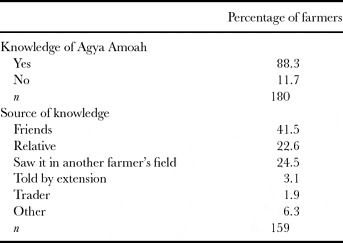
Eighty-eight percent of all farmers knew about Agya Amoah, and had learnt about it from friends or relatives, or by observing it growing in other farmers fields (Table 2). Although this was clearly a good and popular variety, extension was not a source of information.
How farmers first heard of the Agya Amoah cultivar.

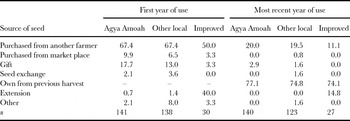
The most important initial source of seed for Agya Amoah, and other local varieties, was purchase from another farmer (Table 3). Sixty-seven percent of farmers reported obtaining seed this way. Other important sources in the first year were gifts and purchase from the market. Seed exchange was unimportant, as was extension. In contrast, 40% of farmers who planted improved varieties reported extension as a source of seed. Once farmers had obtained seed, whether of Agya Amoah, other local or improved varieties, in subsequent years 74–77% of them used seed from the previous harvest for planting. Gifts and purchase from market became negligible. However, extension was still an important source of seed for improved varieties.
Source of seed for planting, percentage of farmers.

Reasons for growing Agya Amoah
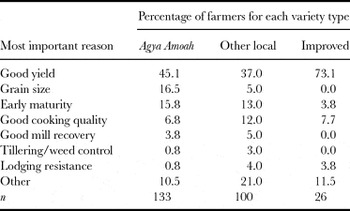
Farmers stated that good yield (45%), grain size (17%) and early maturity (16%) were the most important characteristics of Agya Amoah responsible for its popularity and spread in all districts (Table 4). Grain size, which farmers commonly describe as ‘bold grains’ is an important market characteristic as rice is traditionally sold in bags and not weighed. Therefore ‘bold grain’ varieties are preferred as these grains are perceived to have a larger volume, and hence produce more bags per hectare. Good yield was also important in other local varieties, as was cooking quality. Improved varieties, on the other hand, were apparently only grown for yield.
Most important reason for growing specific varieties in 2002, percentage of farmers.

Seed management
Fifty-five percent of farmers who planted Agya Amoah in 2002 stated that they practised seed selection. However, only 30% of those who said they practised seed selection followed the proper procedure of selecting the seed on the field and harvesting it separately from the grain. This may explain why more than half (53%) of the farmers who planted Agya Amoah reported the incidence of ‘off-types’ on their fields. Most of these, however, reported that only up to one in every 10 plants was an ‘off-type’. The encouraging observation is that even though only 17% of the 75 farmers who observed ‘off-types’ carried out rouging, there was continuous separation of the off-type from the true type after harvest by those who did not rogue, leading to a fall in the incidence of ‘off-types’. Only 27% reported the incidence of ‘off-types’ in fields planted with Agya Amoah in 2002. Less than half (45%) who had ‘off-types’ in their field in the first year the cultivar was planted indicated the problem persisted in 2002.
Expected impact on household income
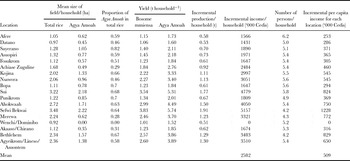
In order to estimate the impact on livelihoods that the spread of Agya Amoah has had, financial returns to households in each location were estimated for a change from Bosome mmiensa (a widely cultivated old variety grown under similar conditions to Agya Amoah except that it matured earlier and which most farmers said had been replaced by Agya Amoah in terms of area cultivated) to Agya Amoah. Estimation of field size and the proportion of households growing Agya Amoah were based on the survey data. Typical values for yield across households and locations based on farmers' estimates were used (1.10 t ha−1 for Bosome mmiensa and 1.65 t ha−1 for Agya Amoah). From these, total and annual incremental production per household were calculated (Table 5). Price of paddy used in the estimation was 2.7 million Cedis t−1. This was the price in September 2005, when rice had just been harvested.
Estimated impact of the uptake of Agya Amoah rice cultivar on households.

Exchange rate: US$1=9,000 Cedis.
Yield of rice paddy as follows: Bosome mmiensa, 1.10 t ha−1; Agya Amoah, 1.65 t ha−1. These were the typical values across households and locations.
Price of paddy used in the estimation: 2.7 million Cedis t−1. This was the price in September 2005, when rice had just been harvested.
Field size and proportion growing Agya Amoah are based on survey data.
There were wide variations in the expected income between the different communities. The highest was obtained for Sefwi Bekwai, where mean farm size was the largest. The high per capita income is explained by smaller household size in addition to the larger field size. The relatively small household size in this urban location is consistent with the results of the Ghana Living Standard Survey (see Ghana Statistical Service, 2000), which shows a smaller household size in urban locations.
The results may be compared to available data on household incomes in the country to provide some indication of the level of the impact. The annual household income for Ghana's rural forest and the country as a whole was estimated to be US$ 983 and US$ 947 respectively in 1999 (Ghana Statistical Service, 2000). The annual incremental household income from replacing the existing rice cultivar with Agya Amoah, with the exception of the location where there was no use of the variety, ranged from 1 431 000 Cedis (US$ 159) to 5 157 000 Cedis (US$ 573), giving an average across locations of 2 582 000 Cedis (US$ 282). The average annual incremental household income is equivalent to 30% of the average annual household income for the rural forest and 29% of the average household income for the country.
The annual per capita income in the same year for rural forest and the country as a whole was estimated to be US$ 218 and US$ 220 respectively. The annual incremental per capita income ranged from 253 000 Cedis (US$ 28) to 1 228 000 Cedis (US$ 136), within an average across all the locations of 509 000 Cedis (US$ 57). This average annual incremental per capita income is equivalent to 26% of the average annual per capita income for the rural forest and 26% of the annual average per capita income for the country.
DISCUSSION
Informal channels of seed distribution are very important in the uptake of new cultivars, as observed in case studies by Cromwell (Reference Cromwell1990) for smallholder agriculture in Africa, Asia and Latin America, and high uptake of varieties introduced to an area have been reported in several studies (e.g. Witcombe et al., Reference Witcombe, Petre, Jones and Joshi1999). Although overall Agya Amoah was grown by approximately 80% of farmers, uptake varied across locations. A study on rice seed use in the eastern part of Ghana (Craufurd et al., Reference Craufurd, Dorward, Marfo, Bam, Ansere-Bioh, Dogbe, Djagbletey, Bimpong and Nutsugah2004) also showed that uptake of seed introduced five years prior to the study varied widely between locations. There, kin was a very important factor in the initial spread and introduction to new communities was almost entirely by relatives. However, the study of Agya Amoah in western Ghana does not show that kin was as important in seed spread and only 23% of farmers growing Agya Amoah had first heard of it from relatives (Table 2). Most farmers obtained seed in their first year of planting Agya Amoah by purchasing it, and relatives are more likely to supply seed as a gift or in seed exchange arrangements. However, spread through kin may have been under-reported in the study as it was conducted approximately 15 years after the initial introduction of the variety. The many young farmers may therefore have first obtained the seed relatively recently, by which time it was readily available. In the early years when the seed was scarce kin may have played a role in its spread. The system of selling seed in small quantities (in 0.5 kg containers) and farmers’ practice of trying these limited quantities appear to have contributed to the rapid distribution of the new variety.
The study by Jones et al. (Reference Jones, Audi and Tripp2001) of the widespread adoption of a pigeonpea variety in Kenya's Eastern Province from a single on-farm demonstration provides a further example of a variety being spread from a single point. However, improving access to seed is expected to increase rates of uptake as reported by David et al. (Reference David, Mukandala and Mafuru2002) in a study of adoption of a new bean variety in Tanzania, and by Malatu et al. (Reference Malatu and Belete2001) for a PVS programme for lowland sorghum.
The finding that other farmers were the primary source of seed is supported by studies elsewhere of informal systems (Jones et al., Reference Jones, Audi and Tripp2001; Witcombe et al., Reference Witcombe, Petre, Jones and Joshi1999). Similarly, the observation that saved seed is the most important source once farmers have access to a variety is common in informal systems and has been reported for many crops, e.g. maize and cowpea in Ghana Tripp et al., (Reference Tripp, Walker, Opoku-Apau, Dankyi and Delmini1998) and vegetable production in Nigeria (Daniel and Adetumbi, Reference Daniel and Adetumbi2004). In the case of improved varieties, which are formally introduced through extension agencies, personnel of these agencies are also important sources of spread, but in this area of Ghana farmers relied on saved seed.
Whilst informal systems of seed management and spread are widely practised in developing countries, they vary with location and need to be understood before designing interventions involving introduction of seed of new varieties (Dorward et al., Reference Dorward, Craufurd, Marfo, Dogbe and Bam2007). Issues to consider include how to make seed available to farmers with different characteristics (e.g. wealth and access to resources, kin, gender) at the outset, and how to ensure sustainable seed supplies after poor seasons or other disasters (Archibald and Richards, Reference Archibald and Richards2002). A further issue evident from a recent study by Bam et al. (Reference Bam, Craufurd, Dorward, Asiedu, Kumaga and Ofori2007) of rice seed storage in central Ghana is the importance of farmers’ local storage practices and the suitability of introduced varieties. The rapid initial spread of Agya Amoah is likely to have been facilitated by Mr Amoah's own characteristics, i.e. a relatively well-off rice farmer who was a member of an active rice farmers group and who readily shared seed of the new variety. Archibald and Richards (Reference Archibald and Richards2002) emphasized problems of inequality and access caused by agencies supplying seed to one body or committee in a village. This is supported by findings from eastern Ghana where, in informal systems, seed of improved varieties was initially spread through kin. Furthermore in eastern Ghana, whilst many farmers produced and passed on small amounts of seed, large amounts were produced by two farmers who then only sold seed in large quantities, and therefore only to other relatively wealthy farmers (Dorward et al., Reference Dorward, Craufurd, Marfo, Dogbe and Bam2007). A further factor that may have facilitated the spread of Agya Amoah is that a high proportion of farmers in the area were young, male, commercially oriented and therefore looking for new opportunities to increase earnings.
So why did this particular cultivar, Agya Amoah, spread so quickly throughout the upland rice growing area of Western Region? Firstly, it clearly had desirable characteristics: it is higher yielding than local cultivars and does not lodge; it meets local preferences for ‘sticky rice’; it is white seeded which is preferred by traders; and it is later maturing, which fits better into the cocoa–rice system. Secondly, a high proportion of the farmers in the area were young men who rented fields and who were therefore looking for opportunities to increase their yield and hence income. Although there was no evidence that Agya Amoah was spread by farmers' groups outside Sayerano, Mr Agya Amoah and other similarly minded men were part of a group when he was interviewed in 2001. Over the longer term this did not affect adoption by women, and Agya Amoah was grown equally by both groups. Thirdly, there clearly was and is an effective informal seed system whereby information about new cultivars spreads rapidly via friends, relatives and personal observation, and wherein seed is supplied farmer-to-farmer.
CONCLUSIONS
This paper demonstrates that informal systems can result in relatively fast spread and extensive uptake from a very small quantity of seed and with no input from the formal sector. For successful uptake, the varieties should take into consideration the farmers' preferred characteristics of the variety in a particular area with respect to the compatibility of the plant type with the cropping system as well as the specific qualities of the grain. Furthermore the switch to the Agya Amoah cultivar has had a major impact on household incomes as a result of large improvements in yields reported by farmers. However, in order to maximize the chances of rapid and equitable spread of new varieties, agencies need to first understand local seed systems to plan appropriate activities. These activities are likely to include both supplying seed to identified individuals and organizations that are likely to multiply and distribute seed, and ensuring that small amounts of seed are given to farmers with a range of characteristics (e.g. kin, wealth) within communities.