Once at the margins of the early modern history of the Americas, indigenous peoples were written in over the course of the twentieth century. This historiographic feat was largely due to the discoveries of an enormous indigenous archive from the colonial period that existed in libraries and collections across the world, like the deep strata of crude oil beneath the earth's crust, previously unrecognized and untapped. The list of bonanzas includes the 1936 publication of Guaman Poma's text, discovered in 1908 in the Danish Royal Library; the 1937 publication of indigenous maps of Mexico City, one of these, the Mapa Uppsala, in the library of a Swedish university; Chimalpahin's treatises, discovered in the Bible Society Collection in Cambridge in 1983; and the 1993 decision to transcribe, translate, and publish the Anales de Juan Bautista in the library of the Basilica of Guadalupe in Mexico City.Footnote 1 These, and other less spectacular texts, like legal documents and wills written in indigenous languages, have fed both the New Philology, based on the study of texts in indigenous languages, and the New Conquest History, which privileges the complex roles of indigenous actors above and beyond Spanish invaders.Footnote 2 Students of the field in the twenty-first century enjoy a transformed historiography of the Americas, one that has granted indigenous peoples agency during and beyond the colonial period. Indigenous communities’ response to such an unrequested grant is the new chapter in this history, one beyond the scope of this essay.
At the end of this list of discoveries, let us recall Edmundo O'Gorman (Mexico, 1906–95), the philosopher-historian whose notable interventions into the historiography of the Americas include his return to the sources that established the “fact” of Columbus's “discovery of America,” revealing the process to have been closer to an invention, one that followed the recognition of the Americas as another part of the established orbis terrarium. The consequences were immense: “Due to this recognition, indigenous civilizations were integrated, no less, into the course of a universal history, but for the same reason were no longer exempted from the consequences of its conceptual hierarchy.”Footnote 3 The “discovery” of the indigenous language archive is no less an “invention” and it too is predicated on a recognition that indigenous actors wielded writing in ways very similar to their colonizers, often with the goal of preserving or expanding the prerogatives of their families or communities. In Mesoamerica in particular, it was alphabetic writing that afforded indigenous communities (particularly indigenous elites) the means to maintain or amplify political power. The validity of this proposition is attested to by the thousands, if not tens of thousands, of documents written in indigenous languages by and for indigenous communities. Historians have used these documents to show how constituent members of those communities refashioned themselves to endure, even thrive, within a new Habsburg political framework.
Alphabetic writing was not entirely new. In fact, the technology of writing was one with deep roots in Mesoamerica.Footnote 4 As part of the larger technological bundle of writing, pictography was widespread before contact, with many of its genres serving state or corporate interests, among them tribute records to keep track of goods owed to the state, maps to reallocate lands among corporate members, and genealogies to trace elite family memberships. Within the well-developed practice of pictographic writing, alphabetic writing, a European introduction, found a comfortable berth.Footnote 5 Around the mid to late 1530s, the earliest known Nahuatl alphabetic texts appear in the form of household censuses from the Cuernavaca region.Footnote 6 These are notable both for their early date and their Nahua authorship, demonstrating that in the decade after the fall of the indigenous empire centered in Tenochtitlan a technological shift was already under way.
That we are able, today, to think about pictography and alphabetic writing as part of the same technological bundle traces back to a very early and fundamental recognition that indigenous actors wielded graphic systems in ways familiar to settler colonizers. Such recognition is found in the earliest accounts of indigenous books. The Franciscan Toribio de Benavente, also known as Motolinía, categorized them by subject matter, dividing them into histories and auguries.Footnote 7 He even compared some to Church breviaries, laying out the framework for recognition, which in turn allowed for the integration of indigenous writing into a global account of writing, much like the integration of America into a precast orbis terrarium.Footnote 8
But when indigenous graphic systems became absorbed into the field of writing, they too were subject to the conceptual hierarchy of European writing systems. And within that hierarchy, alphabetic writing reigned supreme. The newly encountered indigenous archive, described above, seems to bear witness to the consequences of that triumph: almost all indigenous documents preserved in it are alphabetic by 1800. That the technology of writing followed an inevitable course toward alphabetic writing over time has become a kind of historiographic teleology. Certainly, there has been some tinkering with models for the shift: the technological determinism of the 1950s, seen in the work of Isaac Gelb, held that pictography was replaced by alphabetic writing because of some natural, progressive evolution of writing systems, but that view is no longer taken seriously.Footnote 9 In the 1980s, Tzvetan Todorov's argument for the semantic superiority of European communication was a popular success.Footnote 10 But his critics, like Deborah Root, took him to task for ignoring the mechanics of colonialism, rooted in the unequal power relationships between Spaniards and indigenous peoples following the Invasion of Mexico (1519–21). James Lockhart's explanation tacks between Todorov and Root; he posits that the greater precision of alphabetic texts in recording the knowledge needed for the colonial state was the cause for a loss of pictography, a thesis presented with greater nuance by Elizabeth Boone.Footnote 11
Such explanations grow out of sweeping views of the archive by groundbreaking scholars, and their answer to the question of why conforms to a notion of the settler colonial state as a steady and irrevocable force of change on the patterns and practices of indigenous life. These explanations are largely derived, however, from only part of the archive: those documents directed to colonial officials. And the explanations based on an idea of “precision” focus almost exclusively on the semantics of writing—that is, on the information conveyed by the signs set on the page—with an unacknowledged bias toward alphabetic writing, whose “precision” is most easily measured by the modern historian, trained to read alphabetic texts. However, the why of the pictographic-alphabetic shift, happening over the course of centuries, has been met with a satisfying answer. What's missing is an explanation of how the shift happened, and how it was that it seemed to happen so quickly.
The implications are important. As we will see, there are two key players in the scenario, one charged with pictography, the other with alphabetic writing. The former is the indigenous tlahcuiloh (painter-scribe; plural, tlahcuilohqueh), trained to make knowledge visible through accepted graphic codes. The latter is the native-language escribano (notary) who created alphabetic documents following established formulae. Hindsight shows us the importance of the escribanos’ role and its origin, as they would come to play a key role in both the linguistic and cultural translations that occurred at sanctioned interstices where indigenous actors could engage with the state, particularly courts of law.Footnote 12 But indigenous escribanos, like the Americas as a whole, had to be invented.
In this article, I attempt to better understand how alphabetic writing came to eclipse pictography through an account of the invention of the indigenous escribano. Seen at a historical scale of centuries, this account could be a tale of rapid origin and disappearance, but the history I tell is instead one of transition. To tell it, I reduce temporal scale. I slow down the process of observation. I home in on a limited corpus of documents. Within them, alphabetic writing and pictography exist side by side. Within them, the answer to the how lies. Created between the mid 1550s and the 1570s, their early date is key to the story, as these hybrid, pictographic-alphabetic documents allow us to capture a moment where the triumph of the alphabet, that long-accepted historiographic teleology, was neither the desired nor the inevitable trajectory of writing. And rather than looking at documents directed to Spanish colonial officials, where the power dynamic might demand alphabetic writing, I look to documents that were produced and circulated, at least initially, in an indigenous, Nahuatl-speaking ambit. In these documents, Nahuas were writing largely for each other, using a familiar physical form unique to them. And at this moment in the mid sixteenth century, indigenous patrons and indigenous publics were actively engaged in working out the relative authority and veracity of pictography and alphabetic scripts. However, the relative autonomy of these actors in the process is largely unacknowledged.Footnote 13
To best understand the shift, I consider writing not just as a semantic system, where meaning is located in signs set on the page, but as an entire technology, one that involves social actors who act upon and transform available materials to achieve a particular goal. Writing, then, is the product of face-to-face interactions of people. In the period under consideration, 1553 to 1572, separate scripts were produced by two separate people. The minute interactions that the documents show us among patrons and publics, and between tlahcuiloh and escribano, registered by words and gestures, are what allow us to see close up and at high resolution the how of the shift.
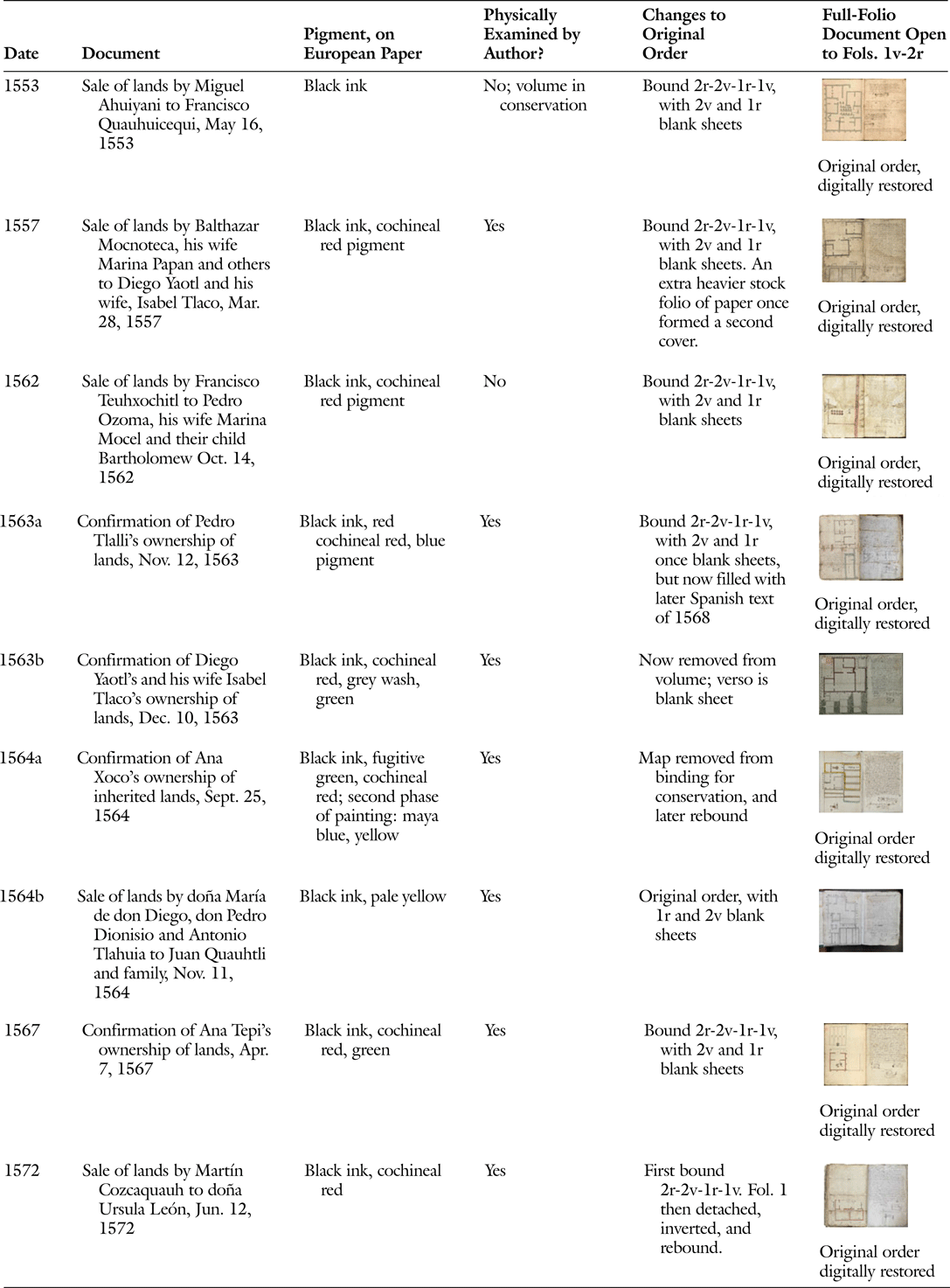
Perhaps such interaction could be demonstrated for any set of hybrid documents, which are common enough. In fact, most early mundane indigenous documents are hybrids; the Cuernavaca corpus is exceptional for the lack of pictography. But the corpus of nine hybrid documents assembled here for the first time (including two newly identified members) is uniquely capable of showing at close quarters how the shift took place: its historical context is well known, its dates are secure, and its creators identifiable (see Tables 1 and 2). These hybrids, then, offer a unique vantage from which to examine the shift over a short, and crucial, period of formation. The methodology I use to analyze the corpus is, like the documents, somewhat of a hybrid, borrowing from history's use of the texts to interpret the agency of people and the functioning of institutions, art history's techniques for parsing the meaning of visual signs, and anthropology's tracking of the object as the material trace and substantiation of social networks.
Reconstruction of the Corpus of Full-Folio Documents with Maps Produced in the Indigenous Cabildo of Mexico-Tenochtitlan, 1553–1572

Sources: For the 1553 document cited in row 1: Archivo General de la Nación, Mexico (hereafter AGNM) Tierras, vol. 38, exp. 2, fols. 138v (map) [ now Mapilu 0561], 137r (text); published in Luis Reyes García et al., Documentos nauas de la ciudad de Mexico del siglo xvi (Mexico City: CIESAS and Archivo General de la Nación, 1996) 144–146, plan 145. For the 1557 document cited in row 2: AGNM Tierras, vol. 45, exp. 3, fols. 361v (map), 358r (text); published in Reyes García et al., Documentos nauas 172–174, plan, 174. For the 1562 document cited in row 3: Lilly Library, Tomatlan, fols. 11v (map), 10r (text); published in Gordon Brotherston, Footprints through Time: Mexican Pictorial Manuscripts at the Lilly Library, Indiana University, Bloomington: A Guide with Color Reproductions (Bloomington, IN: Lilly Library, Indiana University, 1997), plate 1, 35–38; text published in Galen Brokaw, “Nahuatl text pertaining to the Tomatlan Map,” Footprints through Time, 75–76. For the 1563 document cited in Row 4 (1563a): Dumbarton Oaks Library and Collection, “Illustrated file on a land dispute between a ranch owner and his Nahua neighbors,” fols. 42v, 41r; published in Swann Auction Galleries, Printed & Manuscript Americana Sale 2505, lot 391 (New York, 2019). For the 1563 document cited in Row 5 (1563b): AGNM Tierras, vol. 29, exp. 5, fols. 23v-24r [now Mapilu 0555]; published in Reyes García et al., Documentos Nauas 118–127, plan on 126. For the 1564 document cited in Row 6 (1564a): AGNM Tierras, vol. 55, exp. 5, fols. 384r (text), 386r (map); published in Reyes García et al., Documentos Nauas 246–247, plan on 249. For the 1564 document cited in Row 7 (1564b): AGNM Tierras, vol. 22, 1a pte, exp. 5, fols. 122v-123r (map) [now Mapilu 0553]; published in Reyes García et al., Documentos Nauas 110–113, plan on 112. For the 1567 document cited in Row 8: AGNM Tierras, vol. 20, 1a pte, exp. 3, fols. 256v (map) 255r (text) [map now Mapilu 0552]; published in Reyes García et al., Documentos Nauas 89–91, plan on 90. For the 1572 document cited in Row 9: Dumbarton Oaks Library and Collection, “Illustrated file…” fols. 39r (text), 40r (map); Swann, Sale 2505, lot 319. I have used the current foliation provided by the AGNM, which may differ from earlier published sources. Images used with permission of: Archivo General de la Nación, Mexico; Lilly Library, Indiana University, Bloomington, Indiana; Dumbarton Oaks Research Library and Collection, Trustees for Harvard University, Washington, DC. Tables 2 and 3 are also derived from these sources.
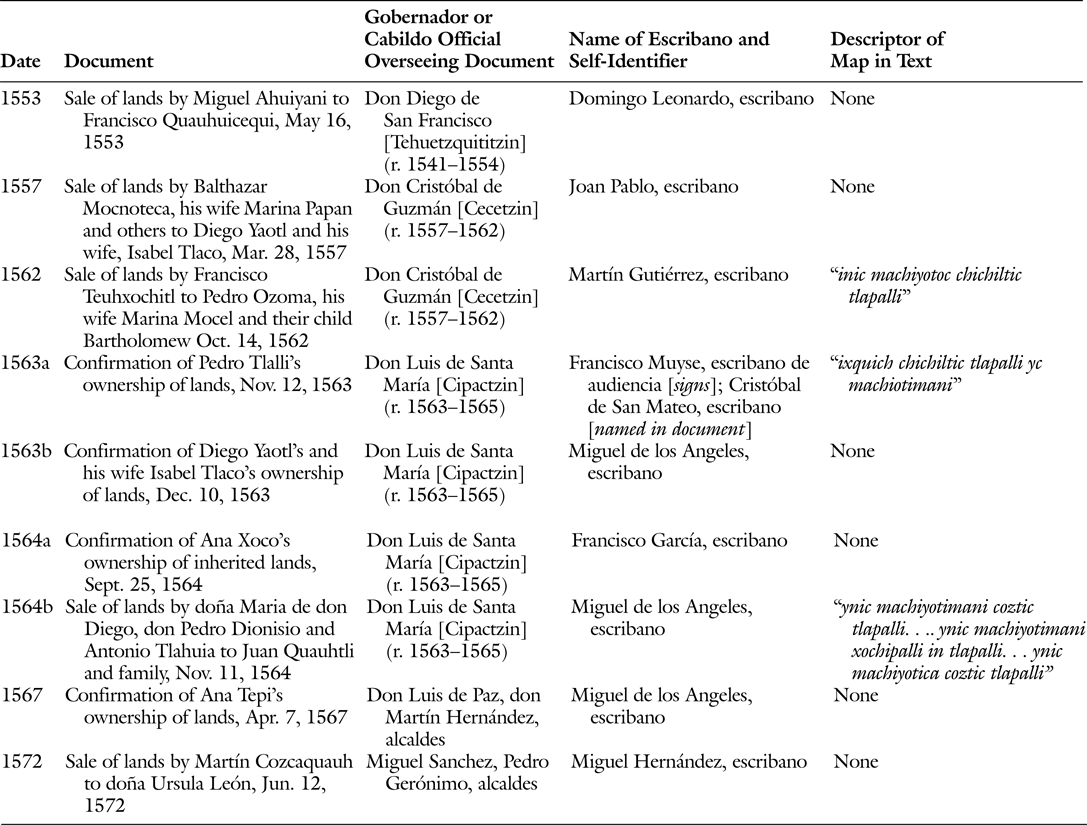
Cabildo Officials, Escribanos and Map Descriptors in the Full-Folio Documents with Maps Produced in the Indigenous Cabildo of Mexico-Tenochtitlan, 1553–1572

Sources: See Table 1
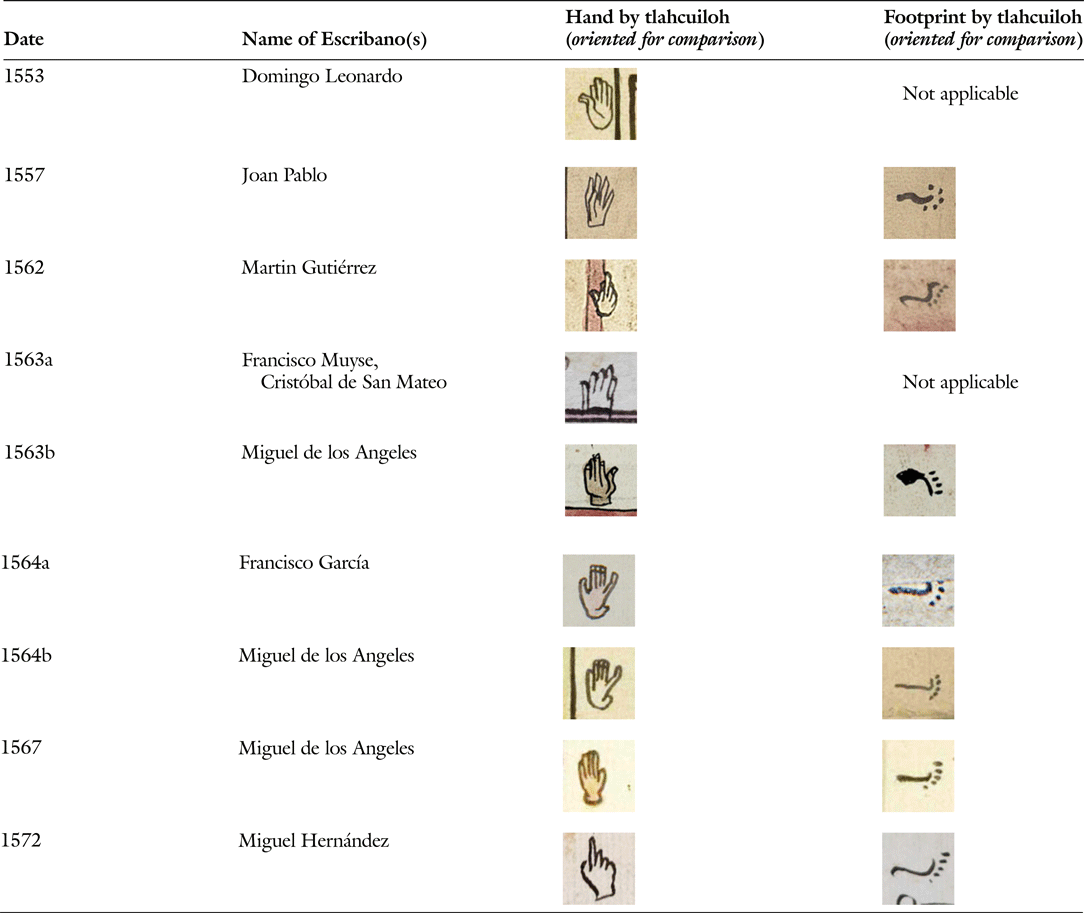
Comparison of the Escribanos of the Corpus with the Distinctive Hands and Footprints Created by the Tlahcuilohqueh, who Created the Adjacent Maps

Sources: Table by author.
Distinguishing Features of the Corpus of Full-Folio Documents
In Table 1, I present the entire known corpus of nine documents, created between 1553 and 1572 within the indigenous cabildo of Mexico-Tenochtitlan.Footnote 14 Originally, each was conceived of as a “full-folio,” that is, created on the front side of a single standard (chancery) size sheet of European paper, 32 cm × 45 cm. On this large sheet, a map was drawn on the left, and the text on the right; the back of the sheet was blank. This large format evokes an indigenous one of long antiquity—the bifold, or two-page spread, with information set down on both left and right sides of the central fold. As with its pre-Hispanic counterpart, the bifold “exerts a unifying influence on the material it contains.”Footnote 15 On these nine documents, alphabetic writing by one creator was set side by side with pictography by another creator.
The relationship of map to text has been obscured by archival practices, and is restored for the first time here. For storage or transport, the large full-folio sheets could be folded down the middle, as if a pamplet, or four-page booklet: the first page (1r) was blank; the second page (1v) was the map; the third page (2r) was the text; and the fourth page (2v) was blank. But only two members of the corpus, 1563b and 1564b in Table 1, were archived thus because archivists, probably in the nineteenth century, misunderstood the format. They may have believed that the text, not the map, was more important. Thus they refolded the documents before binding them, so the text appears as the first page in the reading order. This means that the page that was originally 2r now falls as the first bound page, giving unintended primacy to the text. I first discovered this some twelve years ago, when I noticed anomalous blank pages separating Nahuatl-language texts and their related maps. To confirm my reconstruction of the original order of the documents, I examined most of them in person. When this was impossible, I relied on digital images. I have been able to examine binding structure, and wear and fold marks of paper to find proof to support the digital reconstructions of Table 1. In one case, the document of 1572 in Table 1, the map became detached from the text, and was inverted before being rebound. The original orientation of the map was suggested to me by the arm (cemacolli) glyph on map; stitching punctures on outside edge of map confirmed the rebinding. My reconstruction of the document, 1564a in Table 1, is more conjectural due to modern conservation of the volume.
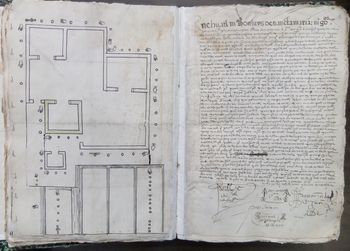
These documents were designed to ratify indigenous landholders’ possession of property by the indigenous cabildo of Mexico-Tenochtitlan, often in the wake of a sale (see Figure 1). The cabildo issued such confirmations using texts and maps until the end of the century, but those we are considering here are set apart by their full folio format, with a map on the left hand side of the open sheet and the text on the right. The use of maps is unique to an indigenous sphere, as land transfers among Spanish parties from the same time and place do not include them.Footnote 16 And the use of an entire folio sheet of paper is notable for its excess—where a half folio sheet of this expensive commodity would have served the same purpose, double that is used, and one entire side left blank.
Full-folio document from the indigenous cabildo of Mexico-Tenochtitlan recording the sale of lands by Doña María de Don Diego, Don Pedro Dionisio, and Antonio Tlahuia to Juan Quauhtli and family, 1564

These works documented established procedures. In the case of a sale, sellers would appear and identify themselves before the indigenous cabildo, present evidence of ownership, and describe the property in question and terms of sale. The buyers would be identified, and witnesses, named in the document and gathered before the cabildo, would give their assent to the terms of the sale. The members of the cabildo would then set down the terms of the transfer and the penalties for a contract breach, and then date and sign the document. Such land transfer documents, and the larger notarial corpus, have been studied by other scholars.Footnote 17 However, their pictography and texts are almost always treated separately. Looking at the two together gives a unique vantage onto this formative moment, when the shift from pictography to writing was under way.
One full-folio document illustrates the essential features of the corpus (see Figure 1, 1564b, in Table 1). On the right-hand of the sheet is the expected text, written in Nahuatl by a Nahuatl-language escribano. Appendix A offers a translation from the Nahuatl text, which registers the 1564 sale of two properties to an indigenous family headed by Juan Quauhtli, into English. One property had been owned by don Pedro Dionisio, a high-ranking Mexica noble and his wife, and the other by Antonio Tlahuia.Footnote 18 The interested parties appeared before the seated gobernador, don Luis de Santa María, and two alcaldes. They described the property and set out the terms of sale. The buyers accepted the terms in front of witnesses.
On the left-hand side of Figure 1 is a map of the property in question. The upper two-thirds of the drawing shows a large enclosed compound, in plan format, its perimeter defined by a double line. Below, in the bottom third, four rectangular chinampas (fields consisting of sedimented lake bed), longer than wide, appear. The compound has two small entrances at its lower left and contains three open rectangles to denote separate structures, each with a gap on one side to indicate the doorway. Below the large compound on the left is a smaller, freestanding structure. The four chinampas are set apart from the property and from each other by parallel, slightly undulating lines to convey the flowing water between these raised-bed fields.
The features shown in the map are arranged according to their position in space, and a precise system of mensuration is signaled with pictographs. The base unit is the cemmatl, (from ce(m), “one” and maitl, “hand”) measuring about one and a half meters; it is shown with the pictograph of a hand, palm up.Footnote 19 Fractions of the cemmatl are represented pictographically by hearts, arms, and arrows. For instance, on the right-most chinampa appears the symbol for cemmatl, a human hand, and below it are 13 counters to show the 14 total cemmatl, corresponding to the text. The perimeter of the house compound is measured with cemmatl and fractions are shown with the cemmitl (from ce(m), “one” and mitl, “arrow”), cenyollotli, (from ce(m), “one” and yollotli, “heart”), and the cemacolli, (from ce(m), “one” and acolli, “shoulder” represented as an arm). One structure at the center left of the map, whose door opens to the top of the map (which the accompanying text will identify as the east) is measured with a cemmatl symbol and three counters along the lower horizontal wall, and another cemmatl symbol and two counters along the vertical wall to convey the 4 x 3 cemmatl dimensions. Although the measurements of individual elements shown in plan are precise, the maps are not entirely to scale, as the length of the chinampas is compressed.
As is typical in indigenous maps, footprints appear as a sign. They are seen along the left-hand edge, where they denote the main road. Footprints have a broad range of meanings; in sacred manuscripts they often are used as they are here, to mark a road. When used in narrative manuscripts in the indigenous tradition, they show a specific character's movement from one place to another, an essential part of a pictographic narrative.
Color was an important component of these maps. This one has only black and yellow (most likely an earth pigment), but in others the tlahcuilohqueh worked with a palette of black (carbon or lampblack) and red (likely derived from cochineal), blue (probably the precious pigment known as Maya blue), and green (perhaps Maya green). These colors were not mixed to create different hues but were used systematically. Most features are outlined with thin, tightly controlled black outlines, and black is also used for footprints. Red, and derived dilutions of dark pink, are most often used for limits or boundaries, be they the boundaries between fields, or the adobe walls of the house. When showing a solid object (like a wall) the red usually appears between black outlines. Blue was used almost exclusively for water, and water also appears in some maps as green. While yellow is rarely used in the corpus, in other contexts it represents earth, often packed earth.
The Context of the Cabildo of Mexico-Tenochtitlan and the Span of Time
The corpus was created within the indigenous cabildo of Mexico-Tenochtitlan. This institution was an import from Iberia, and Spanish settlements were organized around this town council, beginning on the American mainland with the Villa Rica de la Vera Cruz founded by Hernán Cortés in 1519. In the following decades, royal dictates (cédulas) commanded that indigenous local governments also be organized as cabildos, so by the 1540s important indigenous cities were consolidating their own.Footnote 20 Indigenous cabildos in Peru would begin to be consolidated around the 1550s, slightly later than in New Spain.Footnote 21 But the indigenous cabildo was never exactly like its Spanish analog. In their respect for local “usos y costumbres,” Habsburg jurists acknowledged and allowed for continuities in pre-Hispanic law and political organization.Footnote 22 For instance, in the altepetl of Nahuatl-speaking communities in Central Mexico, a tlahtoani was the supreme ruler for life, and he was selected from the ruling line. Under him, the pipiltin (nobility) represented constituent parts of the altepetl. In the early colonial period, men in these roles stepped into offices of the cabildo, meaning that “Spanish-style” governance was also a means for indigenous men to maintain their traditional roles. Like Spanish cabildos, indigenous cabildos were composed of men given the following titles: alcaldes (magistrates) and regidores (aldermen), with alguaciles (constables) who were charged with carrying out the cabildo's decisions. Instead of a corregidor or alcalde mayor, who headed the Spanish cabildo, a gobernador headed the indigenous cabildo, and the office was often occupied by a person with the credentials of the tlahtoani.Footnote 23 In Mexico-Tenochtitlan's cabildo into the seventeenth century, this office of gobernador was often held by indigenous elites who were members of the pre-Hispanic Mexica ruling family, tracing descent from the Aztec ruler Itzcoatl (r. 1428–40).Footnote 24 Recognizing the impossibility for a handful of Spanish jurists to adjudicate cases among hundreds of thousands of newly created subjects, during much of the sixteenth century the crown ceded jurisdiction in civil cases between indigenous plaintiffs to the indigenous cabildos. In addition, the cabildos could (and did) allocate land and oversee land transfers, in effect, exercising both judicial and administrative authority.Footnote 25
Among the indigenous cabildos operating in New Spain by 1550, the most important one as measured by number of tributaries under its jurisdiction was that of Mexico-Tenochtitlan, which shared domain in the island of Mexico City with the smaller cabildo of Tlatelolco, and the Spanish cabildo of the city. In 1562, the cabildo of Mexico-Tenochtitlan oversaw a population of 45,335, almost four times the number of Spanish residents.Footnote 26 To the north of the island, the cabildo of Tlatelolco oversaw a population of maybe a quarter that size, so the two cabildos combined held sway over as many as 60,000 indigenous residents who lived in the city mid-century.
Like their Habsburg analogs, these cabildos produced documents. They recorded actas, summary minutes of their proceedings.Footnote 27 In their judicial capacity, they relied largely on oral testimony, and many of their judgments were likely spoken rather than written. But the assembled corpus is evidence that the indigenous cabildo also created special kinds of records that are akin to the summary judgments issued by the audiencia, or royal court. These seem to have been given to landowners upon the successful settlement of a dispute or the completion of a sale. However, not all land transfers were recorded thus, because of the cost of the document and the trust among buyers and sellers.Footnote 28 The corpus, thus, documents either contentious transfers or high-value properties. In the full-folio document recording the sale of lands by doña María de don Diego, don Pedro Dionisio and Antonio Tlahuia to Juan Quauhtli and family of 1564, presented in Figure 1 and translated in Appendix A, a couple, Simon and María, had built houses on the Dionisio lands, and these had to be removed or torn down for the sale to go through.
The indigenous government of Mexico City was a functioning entity from the time of the refounding of the city by Cortés around 1524. The title of its leader was solidified as ‘gobernador’ with the appointment of don Diego Huanitzin in 1536/38. The indigenous cabildo took definitive shape during the reign of don Diego de San Francisco Tehuetzquititzin (r. 1541–54), who had the second-longest term in office of any early indigenous gobernador (the longest being don Antonio Valeriano, r. 1573–99).Footnote 29 His reign was marked by relative stability, as well as a codification of judicial practices, and it was under Tehuetzquititzin that the form of the corpus emerged, as the earliest identified of its type is dated 1553 (see Table 2). These full-folio documents continued to be made under don Cristóbal de Guzmán Cecetzin (r. 1557–62), don Luis de Santa María Cipactzin (r. 1563–65), and under alcaldes before the seating of Valeriano in 1573. After this period, while maps still are used to document indigenous property, this specially formatted full-folio size document disappears, as far as I have been able to determine.
The Creators of the Corpus
The members of the corpus, hybrids containing alphabetic texts and pictography, were created by two specialists in each kind of writing, an escribano and a tlahcuiloh, each working on his or her half of the full-folio sheet. Clear evidence for two creators comes from comparing details of the maps of the corpus. Table 3 lists the names of the Nahuatl-language escribanos who signed the documents alongside an example of a hand (maitl) and a footprint (when present) on the adjacent map. Each tlahcuiloh had a standard way of painting the hand and the footprint. As can be seen, all the hands are distinct, except those on 1564a, the confirmation of Ana Xoco's ownership of inherited lands, and 1564b, the sale of lands by doña María de don Diego, don Pedro Dionisio and Antonio Tlahuia to Juan Quauhtli and family, where the hands have a distinct convex curve in the pinky finger, and a defined fold line marking the wrist, meaning those maps were created by the same tlahcuiloh (other features on the maps bear out a single creator).
As seen in Table 3, the text of 1564b was created by Miguel de los Angeles, and is written in his distinctive, neat handwriting (reproduced as Figure 1). However, the text of 1564a was created by a different escribano, Francisco García, revealing that the same tlahcuiloh worked alongside two different escribanos. And the three texts by de los Angeles are adjoined to the work of three different tlahcuilohqueh. Table 3 shows that seven escribanos signed their names to the texts, alongside maps by eight distinct tlahcuilohqueh. An additional escribano, Cristóbal de San Mateo, is also named in the confirmation of Pedro Tlalli's ownership of lands of 1563. This suggests a large body of professionals working within the cabildo to create documents.
The Nahuatl Language Escribano in the Cabildo
Escribanos were key figures in the Habsburg imperium. Both the concept and the responsibilities of the escribano had firm outlines in Spanish legal codes and were manifest in well-documented practices.Footnote 30 In both civil and criminal cases, notaries gathered witness testimony, and the notary also set down the summary judgment of the court. In addition, a wide array of transactional documents, ranging from the bill of sale to the deathbed will, was likewise entrusted to the notary's pen. The ubiquity of the notarial document has allowed scholars working on legal and notarial culture to cast escribanos in Spanish America as the foot soldiers in the successful campaign to establish rule by law.Footnote 31 There were scores of different classes of escribanos, all with different domains, but what they shared was training in legal protocols and document production, and certification by the crown before their appointment to an office. One of these offices was the escribano de cabildo, charged with documenting the cabildo's rules and keeping track of its decisions in an archive. Only when set down by an escribano did the actas of cabildos take on legal validity. The escribano de cabildo was thus a key player in the expression of governance, as was his higher-status counterpart, the escribano de audiencia, who worked in the royal court.
Nonexistent before the 1530s, the indigenous escribano had to be invented. While a Spanish category of “escribano” existed, the notion that indigenous men should come to fill that role was not a given, nor were the particular contours of what “escribano” meant within the indigenous cabildo, where men claiming this title first enter the historical record.Footnote 32 Signs of the emergence of the escribano as a self-identified figure are found in a comparison of documents. In 1551, an indigenous man, Gaspar de Aquino, would pen an alphabetic document and identify himself as “tlacuilo.”Footnote 33 In contrast, in 1553, Domingo Leonardo, working for the indigenous cabildo to create the first known document in the full-folio corpus, signed his name “escribano”—one of the few Spanish loan words appearing in an otherwise Nahuatl-language document, and a moniker that was never used lightly. The visible presence of the native-language escribano exists alongside a notable absence: while there is abundant documentation on the confirmation of Spanish scribes by the royal government, I have encountered no sixteenth-century documents wherein the king concedes either the office (escribanía de cabildo) or title (escribano real) to an indigenous scribe. So while the title of escribano real was required of Spanish cabildos and audiencias and granted only at the end of a long training process, this was not true of indigenous notaries.
This absence signals that the crown saw indigenous governance as a local affair. It seems that election of an escribano within the indigenous cabildo itself was sufficient for a candidate to occupy the post and assume the prerogatives of office. A similar custom reigned in provincial regions of the Americas where Spanish-language scribes could be appointed by local crown officials, but these appointments were ad hoc, and did not necessarily convey an enduring post.Footnote 34 That indigenous cabildos were confirming their own escribanos suggests that they were also free to establish the qualifications needed for the office.
Although cabildo members do not seem to have looked far afield for candidates, the other qualifications of the native escribano during this early formative period are poorly understood.Footnote 35 Turning to the work of de los Angeles, who served as escribano in the cabildo of Mexico-Tenochtitlan in the 1560s and 1570s, allows new insight into the training of indigenous notaries, through observation of both their manipulation of standard protocols and their handwriting, an analysis that considers both the formal features and semantic content of writing. De los Angeles wrote exclusively, as far as I know, in Nahuatl, and signed three members of the corpus.Footnote 36 While he may have once kept the minutes of the Mexico-Tenochtitlan cabildo, they are not known to exist today. He was conversant with the protocols of Spanish scribal formats as a comparison of coeval documents produced by him and by the escribano of Mexico City's Spanish cabildo in Appendix B reveals. Appendix B compares the beginning of two documents, one in Spanish, the other in Nahuatl. Both were created in 1563 and both concern land: the Spanish document is a grant of property to Alonso de Peralta, while the Nahuatl document is a confirmation of Diego Yaotl's and his wife Isabel Tlaco's ownership of lands. Column 1 sets out the expected elements of a Spanish notary's document, and column 2 shows their representation in a document by the Spanish cabildo's notary. Column 3 shows the escribano Miguel de los Angeles's representations of the same elements, as they are found in the coeval Nahuatl text.
The notarial formulas used by the notaries to the city's two cabildos in 1563 are markedly similar, and both documents adhere to expectations of the notarial genre.Footnote 37 The introductory texts of both include (often in the same order) an identification of place, date, the government body ruling, and the source of authority. They also include the names of individual cabildo members, the name of the notary, and the name of plaintiff. In the Nahuatl document, the notary signs at the bottom, but does not name himself in the body text.
The Training of the Nahuatl-language Escribano
Such a highly formulaic structuring of information can hardly have been coincidental, and it suggests that de los Angeles (or the person who trained him) had no small measure of expertise. But how would an indigenous man have learned these skills? Beginning after the Invasion, the concentrated urban environment of Mexico City could offer many indigenous people easy contact with the world of writing and notaries. Indigenous men learned reading and writing within the walls of schools run by mendicant friars, some of them emerging trilingual. At the same time, the Spanish escribanos de número (independent notaries who were royally certified) had their own workshops in the city, founded during the 1520s, potentially offering work opportunities for Nahua men.Footnote 38 These scribes had a host of chores easier to farm out than to do themselves, such as the purchase of materials (feathers, materials for ink, paper), the preparation and cutting of quills, the preparation of inks, and the copying and organization of papers, as well as the dispatch of documents to clients across the city. Indigenous labor was cheap and plentiful. Employment by a notary would give indigenous men a firsthand view of practices. They also had opportunities to work more independently. Friars took the lead in translating the expected formula for wills from the Spanish. The first known will in an indigenous language, Nahuatl, was drawn up in the 1540s, and the translation of other kinds of formulas into Nahuatl followed quite quickly.Footnote 39
Beyond this, the similarities in the language of contracts drawn up by de los Angeles and other indigenous notaries point to the use of some kind of pattern, a pattern either written down or memorized, and parallel to the practice of Spanish-language notaries, who relied on template books that could be in manuscript or printed.Footnote 40 By the 1540s, the first full decade in which Mexico City had a printing press, it was churning out Spanish machotes—blank forms to be used by notaries of largely stock formula like the form for a power of attorney.Footnote 41 Spanish-language scribes were paid by the page, and were required to fill pages sufficiently, with 35 lines per page.Footnote 42 Their use of printed machotes may have been cheaper for clients, or perhaps the client kept the handwritten document, and the machote was registered in the scribe's logbook, which is the context in which I have found them.Footnote 43 The term “machote” comes from the Nahuatl machiyotl, meaning a sign or example, discussed at greater length below. I have never found evidence of the existence of printed Nahuatl-language machotes, perhaps because the handwritten native document remained less costly than a printed one.
De los Angeles's mastery of documentary content points to a close association with Spanish notaries and notarial practices in the city, but at the same time, he was not a slave to those formulas. His texts include typically Nahuatl features, like the embedded oratory and shifting points of view that Barry Sell attributes to the “Nahua love of language so often evident even in the notarial corpus.”Footnote 44 In his full-folio document recording the sale of lands by doña María de don Diego, don Pedro Dionisio and Antonio Tlahuia to Juan Quauhtli and family, of 1564 (presented in Figure 1 and translated in Appendix A) one of the sellers, Antonio Tlahuia, speaks in the first person, as do other participants. Such moments of departure offer yet more examples of the “Nahuatilization” of culture described by Sell and others.
The Handwriting of the Nahuatl-language Escribano
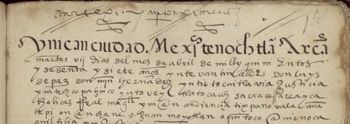
Moving beyond the semantics of the words on the page to de los Angeles's handwriting allows us to discover additional clues to his formation. While historians often overlook the form of the document in favor of its content, the letters can say as much as the words. Calligraphy is not something that a person picks up casually—it is the result of training, often through copying, as one learns the bodily discipline needed for the hand to control the even flow of ink to form standardized shapes set in even registers. For instance, the grant of property by Mexico City's Spanish cabildo of 1563, written by the escribano (presented in Figure 2 and partially transcribed in Appendix B), is in an elegant cortesana script, the handwriting that the crown mandated of its notaries. Over the course of the sixteenth century, the cortesana would degenerate into the procesal, comprised of loosely formed letter shapes and the frequent employment of abbreviations, used by notaries dashing through their work.Footnote 45
Detail of a grant of property by Mexico City's Spanish cabildo to Alonso de Peralta, 1563

De los Angeles's handwriting is not unlike the refined cortesana script used by the Spanish cabildo's scribe (see Figures 1 and 3). At the same time, he employs few of the abbreviations and shortcuts of the procesal used more widely among Mexico City's notaries. His body text also bears relation to the careful letterforms typical of a kind of script described in printed Spanish writing manuals of the period as “letra de provision real”—that is, the handwriting used specifically to convey the dictates of the king.Footnote 46 This clear, crisp, font was closely related to the fonts that were born in Italy's humanist circles, and we find the same calligraphy being taught by Franciscans to indigenous writers educated in their schools. Describing the Nahuatl text of cofradía ordinances, probably created under the direction of the Franciscan Alonso de Molina, Barry Sell identifies it as “the clear Italianate hand used by many friars.”Footnote 47 De los Angeles's calligraphy points to his training in a Spanish notary's workshop, where the procesal was common, and also in a Franciscan ambit, wherein the “Italianate hand” signaled not only training in calligraphy but also affiliation with the world of humanist manuscript culture, distinguished by the same script.
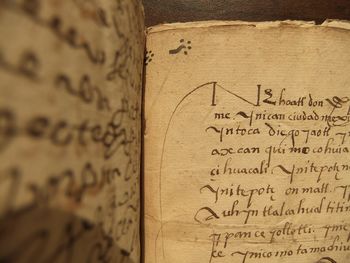
Detail of full-folio document confirming land ownership of Ana Tepi, produced in Mexico City's indigenous cabildo and signed by Miguel de los Angeles, 1567

If de los Angeles's calligraphy links him to Franciscan training and sets up a visual equivalence between the documents created by the indigenous cabildo and its Spanish counterpart, the text shown in Figure 3 does something different. For the introductory line, de los Angeles uses large letterforms not usually seen in the documents created by Spanish language notaries—in fact, play with scale and font is not at all typical of Spanish notarial documents, in which spacing, rubrication, and indentation are standardized. The easy-to-read font de los Angeles employs is identified in writing manuals of the period as “letra redonda” a member of the broader category “letra antigua.” It was called such because of its relation to the letter faces of the ancient Romans (known to Europeans through surviving monumental inscriptions), whose proportions were based on an equal x-height and width, thereby creating letterforms that are square.
Traditional tutelage in Franciscan monasteries was one route for indigenous language scribes to achieve the elegant first line of Figure 3. Exposure to printed books was another, including very popular printed handwriting manuals, mentioned above, in which one would find examples of the letra antigua to be used as guides. Such manuals also would have given Nahua writers access to scribal iconography, like the images of inkwells, pens, and pen cases seen in other indigenous manuscripts. While existing inventories of monastic libraries do not include such manuals, they seem to have circulated in New Spain.Footnote 48 Such manuals were small and cheaply produced; one surviving example from Italy shows that pages were torn or gone missing, and another shows generations of owners using it for penmanship practice.Footnote 49 Most were used to death. So their scarcity in inventories and extant collections can also be read as a measure of their popularity.
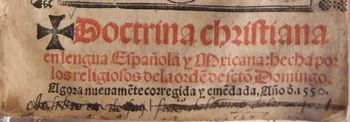
De los Angeles would have also encountered letra redonda on the frontispieces of printed books, including all of the known books printed between 1539 and 1560 in Mexico City (Figure 4).Footnote 50 In the early sixteenth century, printers gradually adopted this type, replacing the older Gothic-style fonts in their typecases. How conscious de los Angeles might have been of the modernity of the type that he chose for the opening line of his document is unclear, but it is highly likely that he knew of its connection to the printed book, given that by the time he penned his document, at least six books in Nahuatl with letra redonda on their frontispieces had been produced on the press of Juan Pablos, whose shop was only blocks from the indigenous cabildo building where de los Angeles worked.
Detail of frontispiece using letra redonda, Doctrina Christiana en lengua española y m[e]xicana: hecha por los religiosos de la orde[n] de S[an]cto Domingo (Mexico City: Juan Pablos, 1550)

So what “escribano” meant when it appeared on an indigenous language document issued by an indigenous cabildo in the 1560s is beginning to take shape. What we can see from de los Angeles's own production is that “escribano” meant someone well versed in Spanish scribal protocols, capable of writing fluently in Nahuatl, and having mastery of the calligraphic codes found in both manuscripts and the typefaces of printed works. These qualities visibly connected the Nahuatl scribe to the transatlantic profession of the escribano as well as to the broader world of humanistic learning.
The Indigenous Tlahcuiloh
While the role of the escribano was in the throes of invention, that of the tlahcuiloh was one of great antiquity. Unlike the escribano, who reproduced Spanish document forms and handwriting, the tlahcuiloh was not adopting and adapting European cartographic practices; instead the maps of the corpus stem from a long indigenous tradition.Footnote 51 Among the earliest extant manuscripts from the Valley of Mexico, probably dating from around 1540, is the Oztoticpac Lands Map, a large document painted and written on native amatl (ficus) paper to document the lands and property pertaining to the ruling family of Texcoco and marked by a highly precise system of mensuration.Footnote 52 From a region close to Mexico City comes the Plano parcial de la Ciudad de México, parts of which may date to the pre-Hispanic period. Although this map lacks the precise measurements found in the documents made for the Mexico City cabildo, it shares many color conventions with them, with blue (likely Maya blue) used to denote canals, yellow for packed earth, and a precise carbon-black line to outline forms. The Plano parcial also uses footprints to distinguish larger roads, another shared convention.
None of the artists of the corpus signed their works with an alphabetic or pictographic name, which points to a different notion of artistic corporate identity than was emerging in coeval Europe.Footnote 53 As we have seen, the word “tlacuilo” was the first term that indigenous alphabetic scribes used to describe themselves, before the loanword of escribano largely replaced it; the Nahuatl verb “ihcuiloa” means “to write” in the sense of putting marks on a surface.Footnote 54 The description of the tlahcuiloh in the Florentine Codex, a Nahuatl-Spanish encyclopedia completed in the 1570s, helps flesh out the indigenous understanding of the role:
The [painter-]scribe: writings, ink, are his special skills. He is a craftsman, an artist, a user of charcoal, a drawer with charcoal; a painter who dissolves colors, grinds pigments, uses colors. The good [painter-]scribe is honest, circumspect, far-sighted, pensive; a judge of colors, an applier of the colors, who makes shadows, forms feet, face, hair. He paints, applies colors, makes shadows, draws gardens, paints flowers, creates works of art.
The bad painter-scribe is dull, detestable, irritating—a fraud, a cheat. He paints without luster, ruins colors, blurs them, paints askew—acts impetuously, hastily, without reflection.Footnote 55
The Florentine Codex gives particular weight to the craft of the tlahcuiloh, emphasizing his or her (the Nahuatl is gender neutral) knowledge and manipulation of ink and pigments. Anyone who has seen one of the pre-Hispanic or early colonial painted books in person can testify to the brilliance and durability of the color, an amazing technological achievement, given the fugitive nature of most color. And recent work by chemists and conservation scientists is revealing the consistency of the Mesoamerican palette (as artists' choices of color are called), indicating the stability of the knowledge base as well as its successful transmission over time.Footnote 56 This tradition of knowledge has left its imprint on the maps of the corpus, in the highly consistent use of color described above. Notably, the chosen colors—red, yellow, and blue—are all applied as flat washes, unmixed with other colors, which is typical in the pre-Hispanic historical and religious manuscripts as well. The corpus leaves little doubt that there was a group of highly trained tlahcuilohqueh working within the Mexico-Tenochtitlan cabildo, producing maps side by side with the escribanos. Instead of a corporate title, the tlahcuiloh made him or herself evident by the visible qualities of his or her work.
But the Florentine Codex also stresses qualities, like the tlahcuiloh's exceptional probity, that had nothing to do with the visible work. Such emphasis suggests that the works of the tlahcuiloh were expected to convey the truth. In the world of native government, the cadastral registers, tribute lists, and genealogies produced by tlahcuilohqueh, then, had an authority by virtue of their authorship. Tlahcuilohqueh enjoyed freedom from paying tribute, another indication of their elite status within native communities.Footnote 57
The Role of the Public and the Authority of the Full-Folio Documents
Up to this point, we've looked largely at two figures, the escribano and the tlahcuiloh, who worked side by side on documents such as that in Figure 1, and we have seen how the former's role was emergent, whereas the latter's was of great antiquity. But we must also consider that both were enmeshed in a social network that included the patrons of the documents, who would pay for their creation, and a public who accepted them as meaningful. No small part of the documents’ authority came from their physical features—their distinctive full-folio format, the ordered and highly codified image on the left, the even and precise handwriting on the right. The Florentine Codex passage suggests that publics directly connected well-drawn images to the technical skills and probity of the tlahcuiloh, and I suggest that the escribano's handwriting resonated no less with these expectations.
Public ratification was also a means of lending authority. In the corpus document of 1562 (see Table 1), the tlahcuiloh included images of eight witnesses of the land transfer, attaching their hieroglyphic names to further underscore their importance. The escribano, following suit, was also attentive to publics. In the document of the sale of lands by doña María de don Diego, don Pedro Dionisio and Antonio Tlahuia to Juan Quauhtli and family (reproduced as Figure 1 and translated in Appendix A), Miguel de los Angeles names 15 indigenous men and women, but their signatures are not appended to the foot of the document. Fifteen witnesses would be an excessive number from a Spanish jurist's point of view, given that once an agreement was recorded by a notary, it was assumed to be valid and binding. The presence of this number suggests that potentially contentious indigenous land transfers were community affairs, and it also shows us (in this and other cases) the presence of women as important witnesses.Footnote 58 Most importantly, the cabildo was asserting and promoting a different standard of juridical truth for the Nahua community, and the tlahcuiloh and then the escribano were following suit in the composition of the document. Within this corpus, then, we see the emergence of what the scholar James Scott has evocatively called the “hidden transcript”: while the formulaic language, titles, and protocols all signal that the indigenous cabildo conformed to standards established under Spanish law, other features in the performative and evidentiary registers reveal the presence of different communal standards.Footnote 59
Internal evidence shows that the maps were crucial to the authority of the document. In the document of the sale of lands by doña María de don Diego, don Pedro Dionisio and Antonio Tlahuia to Juan Quauhtli and family, 1564 (Figure 1 and Appendix A), the couple presented their own map of their property, which they describe thus: “Our one house faces east, its back [wall] measures four maitl and its side wall three maitl, and its three chinampas to the west are each 14 maitl long, flat, and ten maitl wide and the other property measures 11 maitl, all of it is represented [machiyotimani] with yellow ink; the two houses that face west, next to an enclosure of stakes, represented with pink ink” (italics mine). This map clearly adhered to the color conventions standard in indigenous maps, but it is not the map on the full-folio document of Figure 1. This map has exactly the same measurements as that described in the text, and one structure is painted with yellow ink, but it contains none of the pink coloring of the described map. Thus don Pedro Dionosio and his wife first brought a map before the cabildo to initiate their sale, and the map that was set down on the full-folio document as part of the resolution seems to have been a fair copy (minus much of the color) of the initial map.
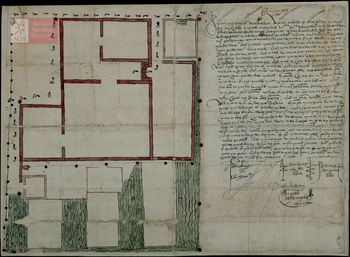
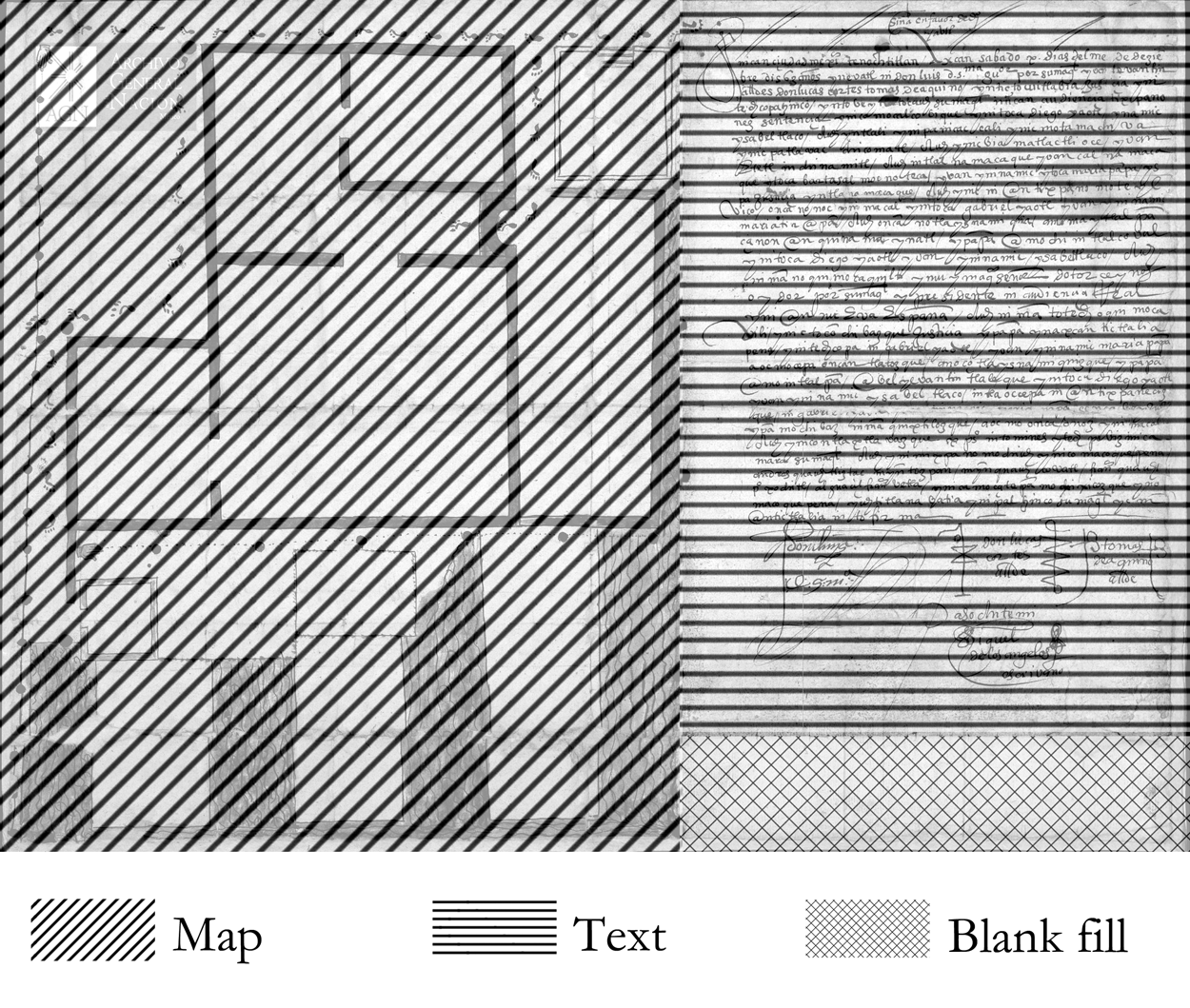
In this case, it was a map, not a text, that owners appealed to as evidence of landholding, suggesting that the authority of the document was located in the part created by the tlahcuiloh, outweighing that of the escribano. Another member of the corpus, the confirmation of Diego Yaotl's and his wife Isabel Tlaco's ownership of lands of 1563 (1563b in Table 1) reveals more: it was the tlahcuiloh, not the escribano, Miguel de los Angeles, who had control of the final document.Footnote 60 This full-folio document has not been subjected to a distorting rebinding and follows the expected format of the corpus, with a map on the left and a text on the right; the verso is blank (Figure 5). However, the text and map were made on two different sheets of paper. The text, penned by de los Angeles, appears to have been created earlier than the facing map, since the paper is slightly darker from surface dirt and looks somewhat more worn. Soon after the map was completed, the sheets were pasted together, with map on left, text on right, with a narrow strip of paper added along the bottom of the text to make the two sheets the same height. Figure 6 offers a diagram to show the joined parts.
Confirmation of Diego Yaotl's and his wife Isabel Tlaco's ownership of lands by Mexico City's indigenous cabildo, Miguel de los Angeles, escribano, 1563

Diagram highlighting composition of the full-folio document, a confirmation of Diego Yaotl's and his wife Isabel Tlaco's ownership of lands, 1563, shown in Figure 5

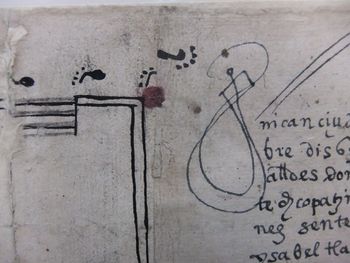
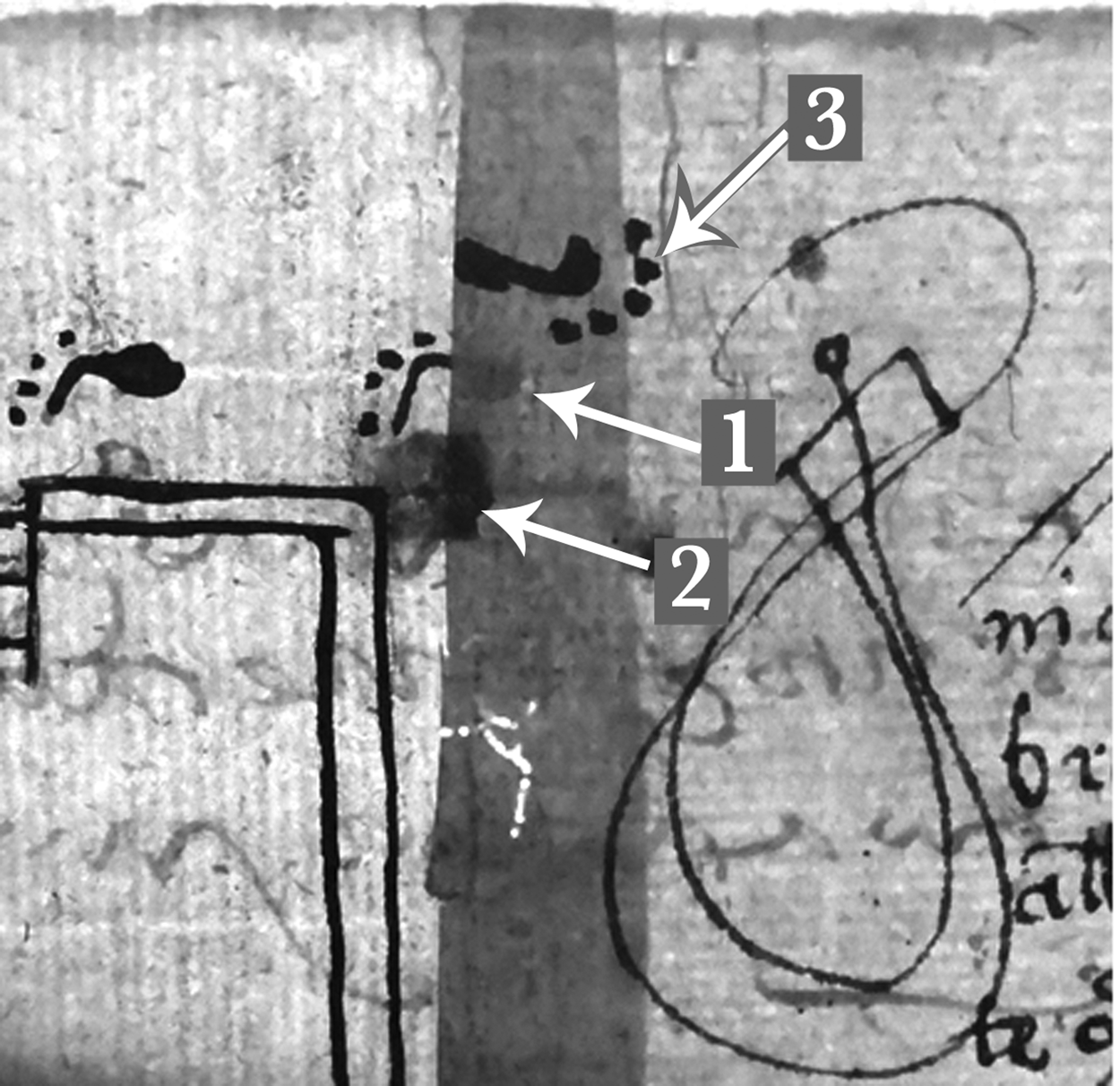
But it was the tlahcuiloh who dictated the final appearance of the full-folio document, as I discovered upon close examination of it. The map has a horizontal line of black footprints, painted with a dense carbon black, running along its top edge from right to left, as seen in Figure 5, and in greater detail in Figure 7. When the text was pasted over the map, the narrow overlap covered one of the footprints. Figure 8 is the same detail as Figure 7, which I was able to photograph under backlighting. In Figure 8, an arrow marked “1” points to the footprint that was covered partially by the overlap of paper, the covered heel now visible when backlit. After the text was joined to the map, the tlahcuiloh continued to work on it, setting bright dots of red pigment along the paper seam, so that they bridge both text and map, marked as number 2 in Figure 8. The tlahcuiloh also added an additional footprint on the sheet containing the text, indicated by number 3 in Figure 8. While identical in style to the other footprints on the map, this lacks the standard cartographic function of the others, that is, to distinguish main roads from minor paths. Instead, it seems to have a narrative or temporal function. In this case, it leads out from the tlahcuiloh's map to the first word of the escribano's text, establishing the primacy of the map over the text.
Detail of the confirmation of Diego Yaotl's and his wife Isabel Tlaco's ownership of lands, 1563, presented in Figure 5, showing text, at right, pasted over map on left, obscuring the footprint at center

Detail of the confirmation of Diego Yaotl's and his wife Isabel Tlaco's ownership of lands, 1563, presented in Figure 5, photographed with backlighting to show overlap of joined paper, appearing as the darker vertical band at center, with the heel of the obscured footprint visible at center

In a member of the corpus from 1557, a sale of lands by Balthazar Mocnoteca, his wife Marina Papan and others to Diego Yaotl and his wife, Isabel Tlaco, a footprint also establishes the map's primacy (see Table 1). Created by the escribano Juan Pablo and an unnamed tlahcuiloh, the full-folio document features a tiny set of footprints leading from the top of the map to the first line of the text.Footnote 61 I was able to determine that the full-folio sheet was refolded before being bound, and as a result the footprints that once led from map to text now are now trapped in the binding of the archived volume, as Figure 9 shows. In both maps, then, the tlahcuilohqueh set their work as the starting point, with the text following.
Footprints leading from map to text, now caught in the binding of the archived volume as a result of the folding of the full-folio sheet

Sign and Symbol: Machiyotl
If the role of the escribano was in flux, so too was the nature of the map, as captured by vocabulary. Within the corpus, the map is usually not mentioned in the Nahuatl text. However, in a few cases, it is described, yet it is not via the vocabulary of other painted things, including terms like tlahcuilolli, “painting or writing.”Footnote 62 These descriptors are listed in Table 2. Characteristically for Nahuatl, the escribanos writing the documents do not use an individual noun to denote the adjacent maps but instead employ various constructions derived from the term ‘machiyotl,’ often connected to the pigment used in the representation.Footnote 63 Machiyotl derives from the verb mati, “to know,” and is translated in the Nahuatl-Spanish dictionary by the Franciscan Molina as ‘señal, cõ[m]paracion, exe˜[m]plo, o dechado.’Footnote 64 In the document of the sale of lands by doña María de don Diego, don Pedro Dionisio and Antonio Tlahuia to Juan Quauhtli and family (Figure 1 and Appendix A), the parts of the adjacent map represented in yellow ink (coztic tlapalli) are described in the text as ynic machiyotimani coztic tlapalli, and those represented in pink ink (xochipalli in tlapalli), are described as ynic machiyotimani xochipalli in tlapalli. In the context of the corpus, machiyo is often affixed to the ligature –ti- and the verb, mani, “to spread out” or oc, “to be lying, to stretch out.” As I understand these passages, the term machiyotimani (which I have translated as “represented”) means more exactly “extends out through a sign/representation.” Mani may convey the planar extension of the lands represented, as the word is typically used in the description of lands, or it may refer to the extension of the flat image on the paper sheet.Footnote 65
Like its English cognate “trace,” the Nahuatl machiyotl carries the sense of “imprint,” the physical impression left behind by something now absent.Footnote 66Tlamachiotilli was the word developed to describe cattle marked with the scar left by a heated brand.Footnote 67 Nahuatl speakers would have identified the footprint with which the tlahcuiloh marked his or her map as icximachiyotl, “footprint,” a mark left by a body on the substrate of softer earth.Footnote 68 Indeed, the entire map could also be considered the tlahcuiloh's machiyotl, the trace being made by his or her (now absent) brush, the extension of the action of his or her (now absent) hand onto the surface of the still present paper.Footnote 69 Machiyotl, in other words, reveals to us a Nahua concept of the painting: it is the result and aftermath of a physical imprint left by the tlahcuiloh on the flat surface, often through the use of color.
In other contexts, beyond the cabildo of Mexico-Tenochtitlan, and in documents produced in the 1570s onward within it, machiyotl was often linked to the loanword of pintura or “painting,” a Spanish term used for maps and plans, a word with its own distinct semantic profile. A document of a 1572 land transfer in Texcoco, which includes a map, sets up “pintura” as part of a couplet, the other half being “machiyo.” It reads “auh yn tlalli yhui inin yn mani yniuh nican pinturatica machiyotica,” or “the land extends in this way as it is here painted, as it is here represented.”Footnote 70 Some coeval translations of Nahuatl documents done by court translators simply use “pintura.”Footnote 71 Translating “machiyotl” into “pintura” allowed the map recognition within a colonial Spanish legal framework wherein “pinturas” were welcomed as evidence, but it also severed the intimate connection between the tlahcuiloh and his or her trace.Footnote 72
Acceptance, Change, and the Enduring Documents
The corpus shows just how local actors accepted the protocols of Spanish notarial practices within the established indigenous ecosystem of governance, within which the visual codes of pictography flourished. This ecosystem was also host to performances unique to the indigenous sphere, like the registering of numerous witnesses, women among them. The indigenous-language notary was a new species in 1540, emerging from the social role of the tlahcuiloh, much as alphabetic writing was emerging from the larger field of writing. Attending closely to the hybrid document has allowed us to see technological change at close range, and also suggests the way that alphabetic writing, and its creator, the escribano, came to flourish in that ecosystem. The cartographic map and its creator, the tlahcuiloh, were key actors, and it was their established codes, both social and visual, that supplied meaning and public authority to the work of the escribano. Notably, one of the very first instances of native scribes recording indigenous testimony for a court case comes from another cartographic work, the Oztoticpac Lands Map (ca. 1540–45), wherein the alphabetic text is set in the middle of the map; witnesses, whose testimony is recorded in the first person, seem to be speaking from within the space created by the map. Two members of the corpus also visually comment on the emergence of alphabetic writing from the anterior and adjacent map, by including a footprint, icximachiyotl, that walks from the space of the map into the opening line of the text. The map preceded the text and underwrote its authority.
The escribano, like the well-trained understudy, was poised to assume a principal role in document creation, and unforeseen historical circumstances unfolding outside of the walls of the cabildo made this happen. The great plague of 1576 thinned the ranks of all indigenous peoples, intellectuals among them, so necessary knowledge transmission of the tlahcuilohqueh was short-circuited. An important patron group for sophisticated pictographic works, in addition to indigenous elites, were the mendicant orders, and they were being starved of resources beginning in the 1570s. The material needed by tlahcuilohqueh, those special pigments through which knowledge was made manifest, became more difficult to acquire as indigenous markets were edged out by transatlantic commerce.Footnote 73 By the end of the 1570s, there may have been few trained tlahcuilohqueh available to serve within the cabildo, had there been a place for them. In addition, the hospitable ecosystem that the cabildo of Mexico-Tenochtitlan provided for “usos y costumbres,” including the work of the tlahcuilohqueh in exercising judicial authority, may have desiccated by 1592. In this year, the viceroy formalized the General Indian Court (Juzgado General de Indios), and allowed Spanish officials (corregidores and alcaldes mayores) to resolve indigenous civil cases.Footnote 74 This court, following the appointment of a corregidor in Mexico City in 1574, cut into the judicial functions of Mexico-Tenochtitlan's cabildo.Footnote 75
The corpus registers these forces. In the 1570s, during the administration of Valeriano, the full-folio format grows scarcer, and then disappears.Footnote 76 When maps appear, they shift, from being an important part of the activities presented to native officials gathered in the cabildo building preceding the grant, to become instead part of the post-grant performances of posesión, a ritual of Spanish origin that was documented as a textual narrative, adapted to an indigenous context. Beginning in the 1570s, the gobernador and the alcaldes customarily dispatched the alguacil to take the new owner to walk the boundaries of the acquired property, to throw stones and pull up grass in a typical performance of possession. It was at this later point of the process that the property in question was measured and mapped, and native witnesses called in. While once native mapmakers had marked the corners of the property with trees, as in the Oztoticpac Lands Map of the 1540s, now it was the small images of stakes, identified with the Spanish loanword “estaca.”Footnote 77 And with increasing frequency over the 1570s and even more in the 1580s, it was the escribano who made the map.
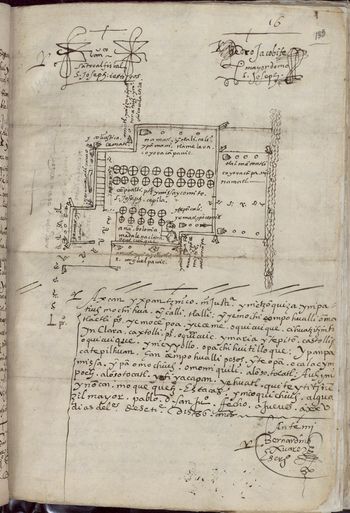
Figure 10 shows one such map, a standard sized half-folio (32 cm x 22.5 cm) document produced by the cabildo recording a post-mortem breakup of property; here the spaces are jammed with round markers standing for the pesos they fetched in sale, as well as texts writing out what the measurements mean.
Sale of property upon the death of Alonso Tocatl, 1586

But the full-folio documents, with maps by the tlahcuilohqueh, continued to carry authority well after the eclipse of their makers. All members of the corpus are found in secondary contexts—introduced after the fact as evidence in later lawsuits. Their survival points to a great archival irony: the hybrid corpus of indigenous people writing for each other is small, since most indigenous documents survive because they were directed to judges, priests or other Spanish officials. The particular full-folio ones that are the subject of this essay are known because they were entered into later lawsuits. In this secondary context, written texts were frequently valued over their maps, as their refolding reveals. But their original full-folio format, with its excessive use of paper, and their preservation over time, suggest that these were keepsake titles, whose carefully elaborated form allowed them to be showpieces of a personal, or familial, archive. When Diego Yaotl and his wife Isabel Tlaco bought lands in 1557, they seem to have preserved the full-folio document of that sale because its map is the model for the one issued by the cabildo in 1563 to confirm their ownership of the same lands (Figure 5; compare 1557 and 1563b in Table 1). They remained keepsakes long beyond their original contexts. Two corpus members, the confirmation of Pedro Tlalli's ownership of lands, of 1563, and the sale of lands by Martín Cozcaquauh to doña Ursula León, of 1572, recently sold at auction as part of a collection of papers from an eighteenth-century lawsuit about unrelated properties, suggesting that in later periods these hybrid documents had a symbolic value above and beyond their semantic one.
A wider view of the documents created by the cabildo of Mexico-Tenochtitlan underscores the enduring value of the work of the tlahcuilohqueh. Careful examination of the Beinecke map and the Plano parcial de la ciudad de México has revealed extensive use over time, including countless refoldings and evidence of public display, as well as patching and repainting.Footnote 78 These are part of a solid body of physical evidence that pictographic documents continued to be used in indigenous ambits in Central Mexico, following the pattern well established in Oaxaca. By slowing down to look at documents created during the moment of the “appearance” of alphabetic writing, and the “disappearance” of pictography, we can see the mechanics of the transition at close quarters, offering a more satisfying explanation of the how of that shift, as within the larger technological bundle of writing, one form, pictography, evolved into another, the alphabetic text, with the text depending on the authority of the map. En route, we have seen instances where pictography endured, both as heirloom and living document, well beyond its expected expiration date. Such second lives merit an examination of their own.
Appendix A: Full-Folio Document from the Indigenous Cabildo of Mexico-Tenochtitlan Recording the Sale of Lands by Doña María de Don Diego, Don Pedro Dionisio and Antonio Tlahuia to Juan Quauhtli and Family, Written by Miguel de los Angeles, escribano, 1564.
The text explicated below appears as Figure 1 of the article, which is a document produced by the indigenous cabildo of Mexico-Tenochtitlan recording the sale of lands and is listed as 1564b in Table 1. Loan words from Spanish appear in italics in the English translation.

Appendix B: Notarial Formulas [Elements of the Introduction] Used by the Spanish Cabildo and the Indigenous Cabildo of Mexico City in 1563
This appendix is derived from Figures 2 and 5 in the article, the Spanish cabildo's notarial document from 1563 and the indigenous cabildo's notarial document of the same year, respectively. Column 1 shows the formulaic notarial elements expected in the introduction to a Spanish cabildo document. In column 2, the italicized text shows how a Spanish notary represented those elements in one 1563 document. Column 3 shows representations (translated and in italic) of the same elements by the Nahuatl-speaking notary Miguel de los Angeles in a coeval text.