Terrestrial amphibians have developed various strategies to survive the dry periods of the year. Many anurans burrow into humid soil layers, several taxa have developed keratin cocoons or mucous coating, and others are ‘crevice creepers’ (Channing Reference CHANNING2001, Loveridge Reference LOVERIDGE1976). Many amphibians were also found associated with the burrows of other vertebrates, such as the tortoise Gopherus polyphemus (Kinlaw Reference KINLAW2006), and fossorial rodents of the families Geomyidae (Franz et al. Reference FRANZ, ASHTON and TIMMERMAN1995, Vaughan Reference VAUGHAN1961) and Ctenomyidae (Altuna Reference ALTUNA1991, Rumbo & Cacciali Reference RUMBO and CACCIALI2008). However, as a whole, information on the relationships between amphibians and burrowing vertebrates is rare and confined to anecdotal reports.
Among primary burrow excavators, especially noteworthy are rodents with a strictly subterranean lifestyle. As they usually feed on widely spaced geophytes, they need to burrow constantly, which leads to dynamic burrow systems where the soil tailing is partly pushed into older burrows and partly deposited above ground (Nevo Reference NEVO1999). In sub-Saharan Africa, the most specialized subterranean herbivores are the African mole-rats (Bathyergidae, Rodentia). Some species of the family live in groups occupying vast, complicated burrow systems (Šklíba et al. Reference ŠKLÍBA, MAZOCH, PATZENHAUEROVÁ, HROUZKOVÁ, LÖVY, KOTT and ŠUMBERA2012, Šumbera et al. Reference ŠUMBERA, MAZOCH, PATZENHAUEROVÁ, LÖVY, ŠKLÍBA, BRYJA and BURDA2012). The burrow systems of solitary species are shorter but subject to constant reconstruction by their inhabitants (Šklíba et al. Reference ŠKLÍBA, ŠUMBERA, CHITAUKALI and BURDA2009). Little information is available on amphibians utilizing mole-rat burrow systems: Kassina senegalensis and Breviceps adspersus were reported from the burrows of Cryptomys hottentotus in South Africa (Eloff Reference ELOFF1952, Hickman Reference HICKMAN1979, Kingdon Reference KINGDON1984), Leptopelis cf. bocagii was found in the unused burrows of Heliophobius argenteocinereus in Malawi (Šumbera et al. Reference ŠUMBERA, KUBOVÁ, CHITAUKALI and BURDA2004) and Tomopterna delalandii in the burrows of Heterocephalus glaber in Kenya (Jarvis & Sale Reference JARVIS and SALE1971). Although the anuran utilization of mole-rat burrows seems common, no attempt to review or further study this phenomenon has been made thus far. Here we assemble our observations of frogs in burrow systems and in/under the molehills of three species of African mole-rat made during our research on mole-rat behaviour and ecology. The aim of the study is to identify the frog species, gather information on their relative abundances and forms of utilization of the burrows in relation to ecology of the frogs, and architecture of the burrow systems.
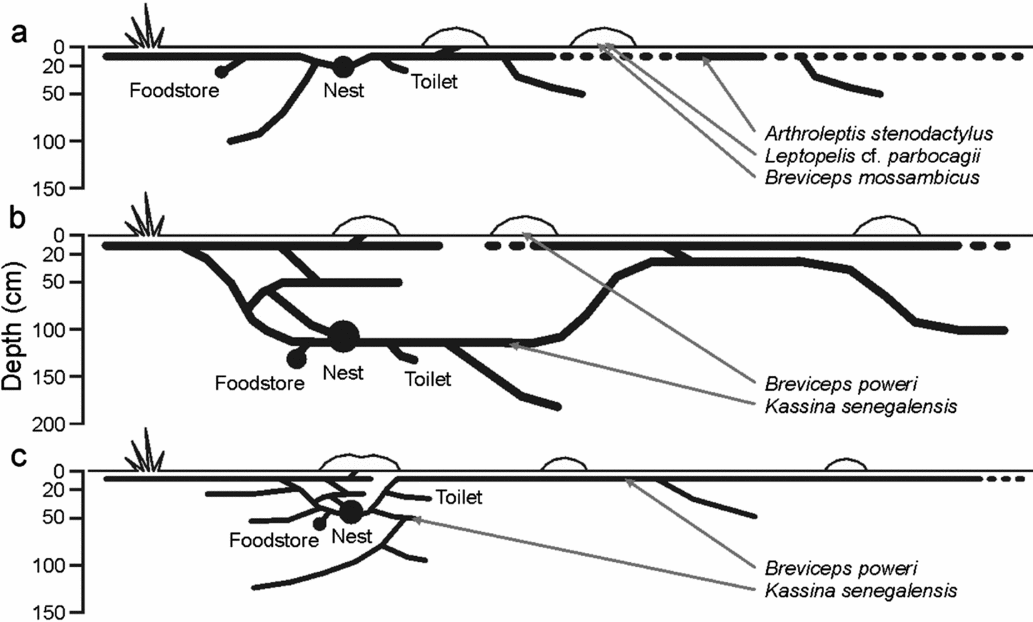
Data were collected while mapping mole-rat burrow systems at three localities in Malawi and Zambia. Ten complete burrows and parts of an additional 20 burrow systems of the solitary silvery mole-rat H. argenteocinereus were excavated in Mpalanganga estate, Malawi (15°27′S, 35°16´E, 1070 m asl) in May–October 2005 and September–November 2008 (mean ± SD = 202 ± 87 m of tunnels per burrow system, Šumbera et al. Reference ŠUMBERA, ŠKLÍBA, ELICHOVÁ, CHITAUKALI and BURDA2008). Two complete burrow systems of the social giant mole-rat Fukomys mechowii were excavated in Ndola Hill forest, Zambia (12°58′S, 28°35′E, 1288 m asl) in April–June 2009 (743 and 2245 m of tunnels, respectively, Šumbera et al. Reference ŠUMBERA, MAZOCH, PATZENHAUEROVÁ, LÖVY, ŠKLÍBA, BRYJA and BURDA2012). Sixteen complete burrow systems of the social Ansell's mole-rat F. anselli were uncovered in Lusaka East forest, Zambia (15°27′S, 28°25′E, 1320 m asl) in April–July 2010 (1241 ± 618 m of tunnels per burrow system, Šklíba et al. Reference ŠKLÍBA, MAZOCH, PATZENHAUEROVÁ, HROUZKOVÁ, LÖVY, KOTT and ŠUMBERA2012). All the localities are in Miombo woodland that is partially burned during the dry season (April–November). The burrow systems of the three mole-rat species differed in their architecture (Figure 1). In H. argenteocinereus they were characterized by a high proportion of backfilled tunnels and a small proportion of deep tunnels, which occurred mostly close to the nests (Šklíba et al. Reference ŠKLÍBA, ŠUMBERA, CHITAUKALI and BURDA2009, Šumbera et al. Reference ŠUMBERA, ŠKLÍBA, ELICHOVÁ, CHITAUKALI and BURDA2008). The burrow systems of F. mechowii were more stratified, with deep connecting tunnels beside shallow foraging tunnels (Šumbera et al. Reference ŠUMBERA, MAZOCH, PATZENHAUEROVÁ, LÖVY, ŠKLÍBA, BRYJA and BURDA2012). The burrow systems of F. anselli were generally shallow except for deep tunnels occurring mainly as a part of extremely complicated mazes surrounding the communal nests (Šklíba et al. Reference ŠKLÍBA, MAZOCH, PATZENHAUEROVÁ, HROUZKOVÁ, LÖVY, KOTT and ŠUMBERA2012).
Architecture of burrow systems of three species of African mole-rat: Heliophobius argenteocinereus (a), Fukomys mechowii (b), F. anselli (c). Dashed lines represent backfilled tunnels. Compiled from Šumbera et al. (Reference ŠUMBERA, KUBOVÁ, CHITAUKALI and BURDA2004, Reference ŠUMBERA, ŠKLÍBA, ELICHOVÁ, CHITAUKALI and BURDA2008, Reference ŠUMBERA, MAZOCH, PATZENHAUEROVÁ, LÖVY, ŠKLÍBA, BRYJA and BURDA2012), Šklíba et al. (Reference ŠKLÍBA, MAZOCH, PATZENHAUEROVÁ, HROUZKOVÁ, LÖVY, KOTT and ŠUMBERA2012) and unpubl. data. Arrows show places where the most common species of frogs were typically encountered.

Frogs were encountered within/under molehills and inside burrows. Representatives of individual frog species were photographed and released in sites similar to the sites of capture. One to three voucher specimens of each species per locality were sedated in a 5% ethanol bath and then stored in 70% ethanol for further identification using the keys by Schiøtz (Reference SCHIØTZ1999) and Channing (Reference CHANNING2001) and the examination of stomach contents. The vouchers are deposited in the herpetological collection of the National Museum in Prague, Czech Republic; collection numbers: NMP6d 41–43/2015 and NMP6v 75149–75159. For each frog species and locality we arbitrarily set the frequency of its encounter on a three-point ordinal scale as follows: rare: up to 1 individual km−1 of burrows; common: 2–10 specimens km−1 of burrows; very common: more than 10 specimens km−1 of burrows.
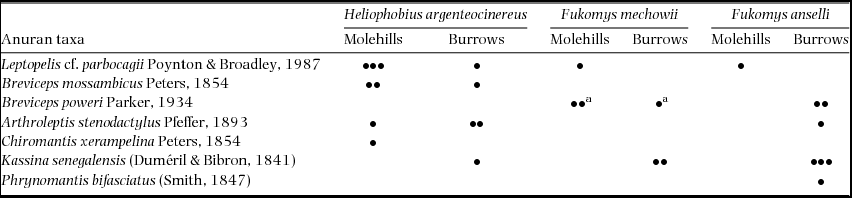
Seven anuran species were identified (Table 1). In the burrow systems of H. argenteocinereus, most frogs were found in/under the molehills, Leptopelis cf. parbocagii being the most frequent. In this species we regularly observed a keratinized-skin cocoon. Fewer frogs were found in unused burrows (Figure 1a). On one occasion we found five individual frogs belonging to four species (Kassina senegalensis, L. cf. parbocagii, Breviceps mossambicus, Arthroleptis stenodactylus) in a single blind tunnel whose connection to the burrow system inhabited by a mole-rat was blocked off by a soil plug at a depth of 65 cm. In the burrow systems of F. mechowii, only three species of frog were encountered. One of them, K. senegalensis, was found in tunnels actually inhabited by mole-rats. In the burrow systems of F. anselli the most common of the five detected anuran species was also K. senegalensis. It was found in at least 10 of the 16 mapped burrow systems and was conspicuously concentrated close to the nests actually utilized by mole-rats. In at least two cases, more than 50 individuals of K. senegalensis were encountered per burrow system. The stomachs of three frog species contained the remnants of prey consisting of ants (Camponotus, Crematogaster, Tetramorium and Pheidole in B. mossambicus, Pheidole in C. xerampelina), cockroaches (in K. senegalensis) and Homoptera or Psocoptera (in C. xerampelina). In contrast to this, all examined L. cf. parbocagii and A. stenodactylus had empty stomachs.
Frogs encountered in burrows and in/under molehills of three species of African mole-rats in Malawi (Heliophobius argenteocinereus) and Zambia (Fukomys mechowii and F. anselli) during mapping of their burrow systems in dry seasons 2005–2010. ● rare, ●● common, ●●● very common, a Identification uncertain, only photos available.
Although some frog species were encountered in small numbers, indicating either a low population density, or accidental use of burrows and molehills, three genera which differ in their ecology, behaviour and reproduction were encountered regularly (Table 1). Soil buffers the daily temperature fluctuation substantially and even shallow burrows maintain a humidity of around 80% during the dry season (Šumbera et al. Reference ŠUMBERA, KUBOVÁ, CHITAUKALI and BURDA2004, Reference ŠUMBERA, ŠKLÍBA, ELICHOVÁ, CHITAUKALI and BURDA2008). In addition, the frogs probably find molehills much easier to dig in than undisturbed ground and also might pose relatively easy entry points to sealed mole-rat burrow systems. Finally, mole-rat burrows host a variety of invertebrates (Šumbera et al. Reference ŠUMBERA, KUBOVÁ, CHITAUKALI and BURDA2004, unpubl. data). In our sample, the stomachs of three frog species contained prey, indicating active feeding during the dry season. In B. mossambicus and C. xerampelina, which mostly hide under molehills, the spectrum of prey included arboreal and terrestrial ants, which indicates feeding on the surface. In K. senegalensis, the presence of potentially subterranean prey (cockroaches) might indicate occasional feeding inside burrows. The feeding of K. senegalensis on insects inside the burrows of C. hottentotus has been reported by Kingdon (Reference KINGDON1984).
Leptopelis cf. parbocagii may be confused with the very similar L. bocagii. Both species are largely ground-dwelling and able to dig. They usually lay eggs in holes in the ground near water (Channing Reference CHANNING2001, Mercurio et al. Reference MERCURIO, BÖHME and STREIT2009). Breviceps, a genus found both in burrows and in/under molehills, is characterized by non-swimming, non-feeding tadpoles hatching in subterranean nests away from water bodies (Channing Reference CHANNING2001, Mercurio et al. Reference MERCURIO, BÖHME and STREIT2009). The two species encountered are well adapted for digging, but apparently can also take advantage of the mole-rat presence. The most ubiquitous of the frogs detected, K. senegalensis, has, on the contrary, poor digging adaptations, but can travel long distances between dry-season refugia and breeding pools. It is also known to hide in the burrows of various animals (Channing Reference CHANNING2001). We found this species in the highest numbers in burrows close to the nest chambers of F. anselli. This is surprising, since mole-rats are usually aggressive and in captivity forcefully bite unfamiliar objects (J. Šklíba pers. obs.). Since the Ansell's mole-rat burrow systems generally have only a few deep tunnels except for those close to the nest chambers (Figure 1c), we suppose that occupying nest areas might be important to the frogs in securing optimal microclimatic conditions. Interestingly, some other frogs, such as Kassina fusca and Phrynomantis microps, live in the nests of ponerine ants in the West African savanna without being attacked, which is enabled by skin chemicals (Rödel et al. Reference RÖDEL, BREDE, HIRSCHFELD, SCHMITT, FAVREAU, STÖCKLIN, WUNDER and MEBS2013). Kassina senegalensis has also been recorded in nests of the ant Megaponera foetens in Cameroon (Dejean & Amiet Reference DEJEAN and AMIET1992). The purpose and mechanism of mole-rat tolerance towards the frogs is unknown, it may, however, also involve frog skin chemicals. The defensive skin secretions of African kassinids contain bioactive compounds, often in connection to antimicrobial activity (Wang et al. Reference WANG, LI, XI, MENG, ZHOU, WANG, ZHANG, CHEN and SHAW2013). The skin secretions of some amphibians are also believed to deter ectoparasitic arthropods (Weldon & Carroll Reference WELDON, CARROLL, Debboun, Frances and Strickman2007). Interestingly, ectoparasitic mites (Trombiculidae), which were commonly found on the bodies of H. argenteocinereus and F. mechowii and in the bedding of their nests (Šumbera et al. Reference ŠUMBERA, KUBOVÁ, CHITAUKALI and BURDA2004, unpubl. data), were not found in the examined population of F. anselli. Although very speculative, there is a possibility that the frogs might act as cleaners in mole-rat burrow systems and even reduce the parasitic load of their hosts, which would make the relationship an interesting example of mutualism.
ACKNOWLEDGEMENTS
We thank the National Research Council of Malawi, the Genetic Resources and Biotechnology Committee and Zambian Wildlife Authority (permit 4036 and 4791) for permission to carry out our research in Malawi and Zambia, Wilbert Chitaukali and the Chancellor College, University of Malawi, for kind cooperation, Pavel Pech for the stomach analyses, Chris Steer for correcting the English and two anonymous reviewers for useful comments on the manuscript. The study was funded by GAČR (14-36098G).