

Introduction
Redistribution is on the agenda. No longer principally a subject of philosophical debate, distributive concerns now occupy the minds of policy makers seeking to ward off deflation by getting money into the hands of regular people (Mosler and Silipo, Reference Mosler and Silipo2017). The challenge is how to redistribute while maintaining, or even increasing, labour market flexibility by limiting upward pressure on the minimum wage. Rather expectedly, unconditional guaranteed annual income—hereafter referred to as basic income—is once again being considered as an appropriate instrument to correct market deficiencies and ensure a standard of welfare for all. Yet considerable doubt remains as to both the technical feasibility and normative palatability of basic income.
The purpose of this article is to assess whether unconditional basic income is, or can be, a viable alternative to current “workfare” policies. Unlike previous discussions on basic income, many of which have focused explicitly on technical issues, I consider moral concerns to be inseparable from the technical debate. Engaging the controversy on unconditional basic income from Rawlsian perspectives on justice, the following discussion compares two predominant positions on the issue of wealth distribution: the “moral incentives” position and “real freedom for all” (Carens, Reference Carens1981; Van Parijs, Reference Van Parijs1995). Such a discussion is integral to assessing the feasibility of basic income because it establishes conditions necessary for its success in the absence of formal conditionality.
From the moral incentives position, gains to be made from instituting basic income will be enhanced if formal conditionality is replaced with a stronger ethos of social duty than currently exists. The free rider problem is solved by supplementing monetary incentives with moral incentives to contribute to the good of society, whether through paid or voluntary work (Carens, Reference Carens1981: 94–95; Weeks, Reference Weeks2011: 147–50). From the real freedom perspective, the valuation of individual agency demands that notions of duty be avoided as much as possible. The idea is to allow individuals to behave as they please absent any contravening pressures. Whether this means acting dutifully or free riding is a matter of individual choice (Van Parijs, Reference Van Parijs1991). Whereas free riding is seen as problematic from the moral incentives vantage point, it is unobjectionable under real freedom for all because, from the real freedom perspective, entitlement to the spoils of productive assets extends naturally to all. Any “ride,” notwithstanding important exceptions, is bought and paid for in advance as something of a birthright.
I find that, insofar as moral incentives risk substituting formal conditionality for informal but nevertheless coercive codes of social conduct, moral incentives are an undesirable alternative. While informal codes of conduct may solve problems of efficiency by supplanting a costly bureaucratic apparatus with voluntary forms of social monitoring, the solution is objectionable from the point of view of a liberal conception of justice.
The big question is if, and by how much, individuals’ sense of duty has to be enhanced in order for basic income systems to foster incentives equivalent to those found in a market setting. I investigate this puzzle in two steps. The first reviews the literature on past income maintenance experiments. The second analyzes data from the World Values Survey (WVS) and Statistics Canada's Canadian General Social Survey on Giving, Volunteering and Participating (CGVP). The findings inspire cautious optimism about the expected level of social contribution under a system of guaranteed income. Importantly, current norms of reciprocity appear to be sufficient to prevent pervasive free riding upon its implementation.
On the issue of fairness, confronted with evidence that society is divided on questions of social duty and individual freedom, I favour the organic development of liberal (non-coercive) social norms. Given that survey data reveal the majority already subscribe to a work-duty ethos, and given that experimental findings suggest only modest reductions in work effort when income is guaranteed, there is reason to expect society will continue to both live by and espouse a work-duty ethos regardless of the system of distribution. That said, based as they are on a social context without an institutionally entrenched basic income guarantee, the findings are speculative with respect to the long-term effects of basic income on attitudes toward reciprocation. Only experience with basic income policies can tell us whether norms prevalent in the current system of distribution will travel to another.
Pathologies of Conditionality and the Justification for Basic Income
Income assistance in North America is highly conditional. In order to receive assistance, recipients in most jurisdictions must demonstrate both financial need (means testing) and reduced employability. Taken together, the two criteria are what I will refer to as conditionality.
Beginning with the assumption that able adults should be gainfully employed, advocates of the current approach to social assistance cite relative incentives as the foundation of sound policy design (Besley and Coate, Reference Besley and Coate1992). Consequently, avoiding incentives that lead recipients into “poverty traps” became a topic of public discourse in the early 1990s (Soss and Schram, Reference Soss and Schram2007). The resulting welfare reform—implemented under the aegis of “welfare to workfare”—sought to enhance work incentives by gradually phasing out welfare benefits as personal income increased, as opposed to ceasing benefits outright, as had been the case under previous schemes (Moreira and Lødemel, Reference Moreira, Lødemel, Lødemel and Moreira2014). Part of the rationale for increasing work incentives was to alleviate strain on the administrative apparatus charged with monitoring qualifying criteria—namely, that recipients capable of working were indeed seeking employment (Blumkin et al., Reference Blumkin, Margalioth and Sadka2013).
Opponents of the existing system criticize workfare for being demeaning, infantilizing and inefficient (Friedman, Reference Friedman1962; Soss, Reference Soss1999; Steensland, Reference Steensland2008). It has long been recognized that work undertaken out of necessity or desperation does not conform to the ideal of market exchange between free, consenting parties (Satz, Reference Satz2010). Beyond this, some critics maintain that workfare is ineffective and unproductive. Van Parijs (Reference Van Parijs1995), for instance, explains that economies are non-Walrasian in the sense that labour markets would not clear, even under ideal circumstances, due to the frictions created by “employment rents.” Employment rents are costs incurred hiring, firing and training workers. These costs are added to the exchange value of labour in the calculation of wages. Consequently, labour markets may be less “liquid” than is often supposed, since workers have incentive to accumulate rents by remaining employed. This, according to Van Parijs, renders employment analogous to a scarce asset.
From this perspective, as with any scarce asset, productivity is increased when those who will maximize the productive potential of the asset are given access to it (see Van Parijs, Reference Van Parijs1991: 105–12). According to Van Parijs, the unemployed should not be punished for relinquishing shares of scarce resources (in this case, employment) to those who wish to reap the rewards in terms of both exchange value and excess rents. Conditionality and job sharing are rejected from this perspective for diminishing productive output and, consequently, the size of employment rents. Adding unfairness to the pathologies of conditionality listed above, Van Parijs insists that a fair division of societal resources would require unemployment benefits at least equal to the sum of employment rents (1995: 108–09).
On the whole, critics of workfare tend to argue that, since desirable jobs will always be in demand, workfare policies either prevent people who want jobs from accessing them or force recipients into work that is not adequately compensated (Muirhead, Reference Muirhead2004; Weeks, Reference Weeks2011). One way to overcome both normative and technical objections to workfare is to institute unconditional basic income.
Historically, most proposals for guaranteed income have taken the form of negative income tax (Rhys-Williams, Reference Rhys-Williams1943). Support for this de facto guaranteed income has predominantly stemmed from its potential to make market distorting alternatives unnecessary, particularly minimum wage (Stigler, Reference Stigler1946). Under negative income tax, entitlements are paid out beyond the zero threshold. For instance, if a household qualifies for an allowance but does not have any income whatsoever, it receives the full amount of the entitlement in the form of a subsidy. There are, of course, variations on the theme. Milton Friedman's proposal for negative income tax was premised on the idea that subsidies greater than 50 per cent of the positive tax equivalent would erode incentives to work (Friedman, Reference Friedman1962: 192; 1968: 112).
Another approach is to pay out a uniform sum to individuals below a certain income threshold. Under such an arrangement, the relative (dis)incentive to free ride would depend on the amount of the dividend. If the amount borders on what is required for subsistence, the dividend will take the form of a supplement and will do little to erode incentives to seek gainful employment.
It almost goes without saying that egalitarians insist upon much greater transfers than do conservative proponents of basic income. The challenge is to devise a basic income scheme that is both normatively acceptable and technically feasible. These considerations are in many ways two sides of the same coin. Incentives are closely tied to individuals’ understanding of what is just (Carens, Reference Carens1981: 120). Support for basic income therefore depends crucially on the popular perception that proposed arrangements are both effective and fair (Herzog, Reference Herzog2015; McTernan, Reference McTernan2013). While one cannot be given due consideration without reflection upon the other, it is nevertheless analytically useful to distinguish between the normative and technical dimensions of the debate.
The technical debate
As pointed out by Atkinson (Reference Atkinson1995), earlier work examining the technical feasibility of basic income relied heavily on formal modelling. The problem is the optimum rate of taxation is significantly affected by the elasticity of the labour supply, which is not easily estimated. Consistent with Van Parijs's argument regarding non-Walrasian economies, Atkinson contends “the incidence, and hence the design, of policy can be very different once we leave the standard Arrow-Debreu model of the economy… in a world with segmented labour markets, efficiency wages, and involuntary unemployment, policy variables can have an impact unlike that typically assumed in the optimum taxation literature” (1995: 155). Experimental results are therefore illuminating.
In an assessment of the extent to which negative income tax affected the labour supply in the 1971–1974 Gary, Indiana, experiment (N = 1800), researchers found a small but discernible reduction in work effort among a non-random sample of African American participants. More specifically, Burtless and Hausman concluded that “this pattern of response indicates that most individuals will vary their labor supply very little in response to the introduction of [negative income tax]… a few individuals, however, will react with large reductions in labor supply”—a phenomenon to which the authors attribute unemployed participants taking more time to settle on new occupations (Burtless and Hausman, Reference Burtless and Hausman1978: 1125–27).
The greatest effect on work hours was found in the 1971–1982 Seattle-Denver income maintenance experiment (N = 4800): the experiment with the most generous transfers. Primary breadwinners had a mean negative response of 8 to 9 per cent for males and 14 to 20 per cent for females. For caretakers and dependents, the average response was between negative 21 and 25 per cent (Greenberg and Halsey, Reference Greenberg and Halsey1983).
A discernible response was also found in the revised estimates of the 1968–1972 New Jersey-Pennsylvania negative income tax experiment (N = 1357). In contrast to earlier analyses of these data, Cogan (Reference Cogan1983) assessed the extent to which white male heads of households altered their work habits in Scranton, Pennsylvania, and found an average paid work reduction of five to seven hours per week.
The most thorough study to date on the behavioural effects of guaranteed income was the 1974–1979 Mincome experiment in Manitoba. Compared to earlier studies in the United States, many of which suffered from biased estimators, work activity responses among Mincome participants were virtually non-existent for men and rather modest for women (although new mothers tended to take longer maternity leaves) (Hum and Simpson, Reference Hum and Simpson1991). The study also found basic income does not promote family dissolution, which had been suggested by previous studies, but rather leads to reduced incidence of hospitalization—particularly for mental distress—and higher rates of high school graduation (Forget, Reference Forget2011).
While behavioural indicators based on experiments inspire cautious optimism (Widerquist, Reference Widerquist2005), the more pertinent question has to do with whether the current fiscal climate can sustain basic income. When assessing financial feasibility, consideration should be made for the fact that there presently exists a complex of overlapping social and economic programs intended to solve many of the problems basic income, it is hoped, would alleviate. The administrative savings alone have been enough to pique the interest of commentators on the political right, many of whom, like Friedman, favour negative income tax for its presumed efficiency compared to alternative schemes (Friedman, Reference Friedman and Bunzel1968; see also Murray, Reference Murray2006). A good deal of debate nevertheless remains concerning whether basic income could ever be economically viable (Atkinson, Reference Atkinson1995).
Even among radical egalitarians there is more than a hint of doubt about the financial feasibility of basic income. Granted, egalitarians tend to dismiss more conservative schemes—such as Freidman's negative income tax proposal—as being insufficient to solve problems of distribution. Among the detractors, Bergmann (Reference Bergmann2004) concludes that guaranteed income would have to come at the expense of “merit goods”—namely health care, housing, transportation, child care, education—which ought to have priority over cash transfers. According to Bergmann's calculations, governments in industrialized countries would have to amass the equivalent of an additional 15 per cent of GDP in order to implement a basic income scheme of any significance. Given the already high taxes in countries with ample state provision of merit goods, Bergmann dismisses basic income as unrealistic and advocates instead for greater investment in existing programs.
Bergmann does not consider the ways in which basic income would relieve fiscal strains elsewhere in the public sector. Nor is it clear why basic income should be given less priority than, say, housing or public transportation, both of which are included in Bergmann's list of prior merit goods. What if society were to prioritize basic income? In the interest of realizing possibilities in a down economy, let us consider Canadian data from 2009. In that year, with debt repayment and the priority areas of health, education, police, military and emergency services excluded, government expenditure in Canada totaled $281 billion.Footnote 1 The number of persons eligible to receive a basic income, including 371,161 working minors, was 27,053,000, 55 per cent of whom earned less than $30,000 after tax.Footnote 2 If the above expenditures were redirected toward a guaranteed income for those who earned less than $30,000, the amount of the dividend could have been as high as $1,574 per month (2009 CAD).
Placing priority on basic income would, of course, mean that program and administrative dollars redirected to basic income would have to be recouped by increasing tax revenues. Note, however, that the question is no longer whether Canada can afford basic income. Rather, the question is now whether Canadian society would submit to financing an array of “non-priority” services and to what extent.
While considerable resources could be marshalled by consolidating expenditures currently directed toward social assistance, unemployment insurance, job sourcing and job creation—never mind the costs associated with the administrative apparatus governing these programs—reallocation of expenditures only goes so far. Considering current intolerance to tax increases, it is likely that dividends paid out of any forthcoming guaranteed income scheme would be modest. The argument that basic income would create disincentive to work is thus rendered moot by fiscal realities. The level of basic income currently attainable is such that there would remain strong incentive to top up dividends with paid employment, at least for individuals who aspire to a standard of living above subsistence.
But what, if anything, is to be done about those who are content to live on basic income alone? Consideration of recipients’ rights and duties under unconditional basic income schemes quickly reveals that normative concerns are intimately linked with technical arguments both for and against basic income. I will briefly outline the dimensions of this normative-technical nexus before considering two distinct positions on unconditional basic income.
The normative-technical nexus
Aside from questions of feasibility, the technical debate surrounding basic income has fixated on the question of whether income assistance lends itself to moral hazard and free rider problems. Due to limitations of space, I will focus on the latter.
In most of the economics literature, normative conclusions have followed from the assumption that individuals are self-serving (Miller, Reference Miller1999). This is despite the fact that groups are recognized as being able to come to agreement upon moral truths. Individuals are understood to be capable of recognizing norms, but they cannot be counted on to adhere to them when left to their own devices. Hence the supposition:
Individuals ought not to free ride because free riding shifts costs from culpable parties onto others. This is both unfair and inefficient.
But,
If we allow people to free ride, they will exploit the opportunity.
Ergo,
Free riding will be pervasive under unconditional income schemes.
Thus,
Unconditional schemes are both unfair and inefficient.
If we accept this (perfectly plausible) supposition, we are left with a case for conditionality. As previously argued, however, it is unlikely that income schemes are, or ever will be, sufficiently generous to generate incentives for pervasive free riding. Insofar as we would like to eliminate the incentive to free ride among those who are tempted, conditionality seems like an awfully costly way of getting people to alter their incentives. For this reason, many who subscribe to the above supposition nevertheless consider the cost of conditionality to outweigh its gains. Yet others maintain that conditionality is integral to any politically acceptable social assistance scheme, regardless of its pathologies (see Miller, Reference Miller1989). Disagreement with respect to what constitutes an appropriate response to the free rider problem suggests that a solution grounded in some sort of logical framework is worth pursuing.
Eschewing the premise that actors are materially self-serving, behavioural economics lead us to an alternative argument regarding free riding that justifies a relaxed form of conditionality known as “nudging” (Thaler and Sunstein, Reference Thaler and Sunstein2008). Relaxing conditionality is appropriate because the paradox in the above example—that actors will behave in ways they recognize as unfair in the absence of enforcement mechanisms—is not sustained empirically. For example, research on common pool resources demonstrates that, left to their own devices, producers are capable of establishing self-maintaining, self-governing systems, making a “leviathan” unnecessary (Ostrom, Reference Ostrom1990). Similarly defying conventional assumptions about actors’ behaviour in the “prisoner's dilemma,” laboratory experiments also reveal a propensity toward co-operation and other-regardingness in the absence of enforcement mechanisms (Wilson, Reference Wilson2011).Footnote 3 With insights such as these in mind, the last three points from the above example can be restated the following way:
If people are not encouraged to free ride, they will make the right choice for the most part.
Ergo,
Free riding will be limited under unconditional income schemes.
Thus,
Unconditional schemes are efficient.
But are they fair? In my reading, the solution afforded by behavioural economics necessitates a utilitarian perspective the likes of which were critiqued by Rawls (Reference Rawls1971) for putting the practical goal of maximizing aggregate welfare before justice. If we accept utilitarianism, the behavioural perspective offers a convincing justification for unconditional transfers. However, ambiguity over whether the above solution is just has been troubling for political theorists and moral philosophers, the majority of whom do not subscribe to utilitarianism.
Evidently, rejecting conditionality on technical grounds is but one step in the process of arriving at a coherent justification for basic income. Questions remain concerning how normative objections to the free rider problem may be resolved in the absence of conditionality. The next section considers two leading positions on the issue.
Two Perspectives on Distributive Justice
Much of the literature on distributive justice has followed from Rawls's Theory of Justice (1971). In spite of a common liberal foundation, the two main threads in the normative discourse—moral incentives and real freedom for all—diverge markedly with respect to both their moral orientation and policy prescriptions (compare, for instance, Van Parijs, Reference Van Parijs1991; White, Reference White2000). At the risk of oversimplifying, we may say that the moral incentives position follows from an egalitarian interpretation of Rawlsian liberalism, whereas real freedom for all follows from a libertarian interpretation.
The moral incentives position
The moral incentives position was first developed in Carens’ Equality, Moral Incentives and the Market (1981). Extending Rawls's concept of natural duties, Carens offers a revised conception of duty whereby citizens freely accept a social duty to earn as much before tax income as possible so that it may be available for redistribution (Carens, Reference Carens1986: 32; Rawls, Reference Rawls1971: 293). Actors’ motivations are said to derive from a moral commitment to egalitarian principles which, like many wants, are considered to be instilled over the course of a lifelong process of socialization (Carens, Reference Carens1981: 98–100). Against the critique that the position is too “maximalist” to preserve individual freedom, Carens concedes that “one is obliged to choose among the uses that contribute more rather than less, although one is not obliged to choose that use which contributes the most” (Carens, Reference Carens1986: 35).
Bringing the moral incentives position to the basic income debate, White (Reference White2000) rejects complete unconditionality in favour of “participation income” (see also Atkinson, Reference Atkinson1996). Under this scheme, receiving basic income is conditional on “productive participation in the community,” broadly defined. White (Reference White2000: 531) argues that there is nothing intrinsically objectionable about what he calls “welfare contractualism” so long as it is implemented in such a way so as to give the recipient choice over what qualifies as productive participation. Expanding the menu of what constitutes participation beyond what unfilled positions may exist in the paid labour market bolsters the moral incentives argument by turning the expected direction of exploitation on its head; the concern is no longer exploitation of the unemployed but rather exploitation of productive members of society by the unemployed, the latter of whom would have little justification for refusing to contribute.
White does not delve into what is to be done with free riders. For his part, Carens is intentionally ambivalent, conceding that “justice should not presuppose human perfection… it matters to my argument that the egalitarian ethos can perform its function as a social mechanism adequately even if some people do not live up to its requirements” (Carens, Reference Carens and Kaufman2014: 53). In other words, while he acknowledges that the instillation of the ethos necessary for a functioning egalitarian society would require somewhat more intense socialization than is the norm, Carens does not go so far as to advocate for conditionality, formal or otherwise. To do so would trade away his liberal orientation only to quash what little deviance might remain in his egalitarian society (Carens, Reference Carens1981: 129–33). Carens thus avoids advocating for informal but nevertheless coercive social codes of conduct. As many have pointed out, however, there is a definite air of conditionality surrounding the moral incentives position (Birnbaum, Reference Birnbaum2011; Titelbaum, Reference Titelbaum2008).
Real freedom for all
Unlike the moral incentives perspective, real freedom for all tends to avoid notions of duty. How, then, can both positions be Rawlsian? Aside from acknowledging that both perspectives are in many ways revisionist (that is, “post-Rawlsian”), it is pertinent to recognize that Rawls was inconsistent with respect to the scope and breadth of his theory of justice. As acknowledged by Rawls in Political Liberalism (1993), treating “justice as fairness” as a comprehensive moral doctrine in Theory of Justice ran afoul of his liberal commitments. Thus, in contrast to Theory of Justice, wherein justice as fairness was presented as the basis of a well-ordered society, Political Liberalism recast justice as fairness as a purely political conception of justice by advancing the idea of “overlapping consensus” (Rawls, Reference Rawls1993: xvii). Rawls consequently came to relax some of his earlier ideas regarding natural duties from which, it may be recalled, the moral incentives position initially sprang.
The point of disagreement between moral incentives and real freedom for all hinges on what proponents of each perspective consider to be necessary conditions for the exercise of liberty. From the moral incentives position, income equality is necessary for a fair opportunity to pursue one's conception of the good life. This entails a highly productive society committed to substantial redistribution and guaranteed income (Carens, Reference Carens and Kaufman2014: 54). From the real freedom perspective, a commitment to personal liberty requires that individuals be free to pursue their wants, regardless of whether or not individuals’ pursuits involve a commitment to economic production (Van Parijs, Reference Van Parijs1991). As mentioned, Rawls straddles both positions (see, for example, Reference Rawls2001: 153–57).
The two perspectives diverge on both technical and normative grounds. In some sense, the first area of disagreement leads to the second. As we have seen, advocates of moral incentives argue from an egalitarian perspective that emphasizes production (Carens, Reference Carens1981). Contributing to the total output of society is a burden that all have a duty to share so that all may benefit (Carens, Reference Carens1986: 31–32). By contrast, recall that real freedom for all advances a sophisticated argument regarding the scarcity of desirable occupations and excess employment rents, which are considered to be societal assets to which all have equal claim. From this standpoint, the unemployed perform a social function by making work available to those who wish to maximize, not their own productive potential per se, but the productive potential of employment as an economic asset (Van Parijs, Reference Van Parijs1995: 121–24).
The hitherto unresolved issue between the two positions revolves around duties to be socially oriented with regard to community maintenance, stewardship and care (Weeks, Reference Weeks2011). While the issue will no doubt continue to occupy the minds of normative theorists and political philosophers, it is largely moot. Advocates of moral incentives posit that there will be few misers in an egalitarian society owing to the power of socialization (Carens, Reference Carens and Kaufman2014: 53). Conversely, proponents of moral incentives believe that, in the context of “real freedom,” individuals will for the most part fulfill what some might otherwise call “duties” organically (Van Parijs, Reference Van Parijs2004: 16–17).
On the above point it should be noted that, despite their differences, there are areas of overlap between moral incentives and real freedom for all; advocates of moral incentives occasionally elevate liberty over duty, and proponents of real freedom occasionally elevate duty over liberty. For instance, Carens (Reference Carens and Kaufman2014: 68, 72) makes room for occupational preference and wage differentials, while Van Parijs (Reference Van Parijs1995: 228–30) is amenable to compulsory public service under the auspices of “solidaristic patriotism.” In my reading, from a real freedom perspective, individuals are duty bound in the sense that actions which produce negative externalities fall outside the scope of legitimate freedoms (Van Parijs, Reference Van Parijs1991: 122). As Scott Gordon once quipped, “freedom may be a better singular value than any other, just as cheese may be the best thing to eat if one eats only one thing. But a mixture of plural goods is better still, in morals as well as diet” (Reference Gordon1981: 474). In other words, in a world in which negative externalities are considered a moral bad, there is clearly more to justice than ensuring all have an opportunity to maximize their freedom. On this point, it should be emphasized that there is ambiguity with respect to what qualify as externalities in the Rawlsian literature. From the moral incentives position, consumption without contribution is parasitic because, we may surmise, opportunities to contribute to production are virtually endless. Conversely, from the real freedom vantage point, desirable occupations—those which do not impinge terribly on personal liberty—are scarce. Thus, while advocates of real freedom may insist that “surfers should be fed” (Van Parijs, Reference Van Parijs1991), the auxiliary verb “should” is contingent on the moral benignity of the noun “surfers” or, more precisely, the moral benignity of the surfer lifestyle with respect to negative externalities.
Summary
In light of the fact that those in favour of fostering moral incentives stop short of advocating bullying and harassment, we may say that the prescriptive strength of moral incentives is weakened by a commitment to liberalism (Birnbaum, Reference Birnbaum2011). I think this is a good thing, but it means that the moral incentives argument is by and large utopian. Even if the participation component of “participation income” advocated by Atkinson (Reference Atkinson1996) and White (Reference White2000) could be monitored in any meaningful way (which it almost certainly could not), the moral incentives position lacks means of enforcing informal conditionality by definition. While it is possible to conceive of soft conditionality with hard consequences, this is not the route taken by proponents of moral incentives, and with good reason. However, as acknowledged by Carens (Reference Carens and Kaufman2014), we should expect that true misers will scarcely be swayed by informal codes, no matter how firmly entrenched.
Insofar as we are interested in implementing basic income in this generation, the immediate question has to do with the extent to which miserly attitudes are prevalent in society. Estimates to this effect will assist in discerning whether stronger norms of reciprocity are truly necessary for basic income policies to succeed. Contrary to those who assume individualist attitudes to be entrenched, particularly among higher income earners (Cohen, Reference Cohen2008; McTernan, Reference McTernan2013), the following analysis suggests the opposite. On one hand, other-regarding attitudes are pervasive both domestically and worldwide. On the other, public regardingness is positively associated with income (see also Inglehart, Reference Inglehart1997). In other words, lack of financial security and the sense of discouragement and helplessness that often goes with it, may beget individualistic tendencies many egalitarians find troubling (Bryerton, Reference Bryerton2016).
Evaluation
Is a stronger ethos of reciprocation necessary? Is it desirable? Determining whether there is room for improvement with respect to individuals’ sense of social duty requires that we first establish current levels of public regardingness.
Survey responses collected between 1981 and 2014 by the World Values Survey (WVS) allow us to glean the complexion of existing norms toward duty and reciprocation at the global level. With the WVS data aggregated worldwide over six waves and weighted for representativeness, we find 86 per cent of respondents indicate that service to others is important, with 45 per cent responding that service to others is very important. Among those who volunteer, 49 per cent claim to do so regardless of any social pressure, whereas 24 per cent cite social pressure as the determining factor. Seventy-six per cent cite a sense of duty to contribute as the impetus for volunteering, while 13 per cent claim that duty is irrelevant to the decision to volunteer (the remaining 11% report neutrality). With respect to work, 75 per cent of WVS respondents agree that work is a social duty, while the remaining 24 per cent is divided evenly between those who disagree and those who report neutrality. However, when the question is phrased “people should not have to work if they don't want to,” only 51 per cent of respondents disagree, with 33 per cent in agreement and 16 per cent neutral.
The data reveal there exists a sense of social duty among much of the world's population. Yet there is also voluntarism absent a sense of duty, in which case respondents may have other reasons for contributing or, like many libertarians, may simply reject the idea of duty (or the idea that individuals should be duty bound). Interestingly, the higher one's income, the less salient duty seems to be.
In order to assess the extent to which earning power is associated with moral incentives or real freedom for all, we need to employ a regression technique appropriate for the data. Multinomial logistic regression is a suitable choice, the form of which is:
 $$Pr(y_i = m\; \vert{\rm \; }x_i) = \displaystyle{{{\rm exp}\left( {x_i{\rm \beta }_m} \right)\; } \over {\mathop \sum \nolimits_{\,j = 1}^J {\rm exp}\left( {x_i{\rm \beta }_j} \right)}}{\rm where}\ {\rm }{\rm \beta }_1 = 0$$
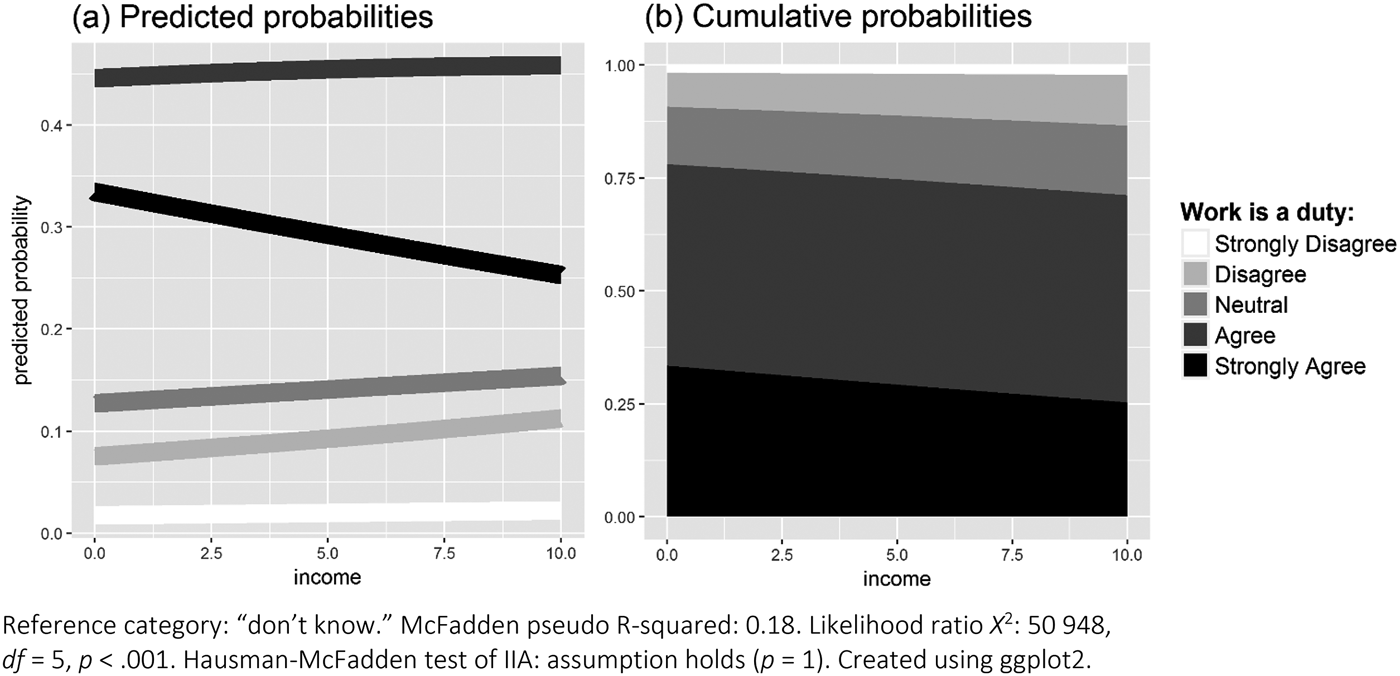
In plain terms, Pr(y i = m | x i) is the probability of observing a response m, relative to a reference category β1, given x. The predicted and cumulative probabilities displayed in Figure 1 are generated from a multinomial logistic model regressing respondents’ opinions regarding work and duty on income, holding age and education constant.Footnote 4
Multinomial logit, WVS effect of income on attitudes toward work and duty

As revealed by Figure 1, the majority of WVS respondents do not adhere strictly to either moral incentives or real freedom for all. If they did, the predicted probabilities for the responses “strongly agree” and “strongly disagree” would be greater. Rather, while most respondents agree that work is a social duty, the extent to which respondents “strongly agree” that work is a social duty is negatively associated with income. This suggests that while moral incentives are quite evident under current norms, there is a tendency for individuals to move from the moral incentives to the real freedom for all frame of mind as they become more financially secure. Note, however, that the proportion of respondents adhering to a strict interpretation of real freedom for all is negligible as evidenced by the infinitesimal proportion of respondents who “strongly disagree” that work is a social duty.
Importantly, the relationship between income and sense of duty is inverse to that suspected by those wary of free riders. Contrary to the idea that lower earners are weakly bound by sense of duty and therefore likely to exploit basic income, the data suggest lower earners are more likely to subscribe to a strict version of moral incentives than are higher earners. Simply put, the data do not support the view that basic income recipients would shirk fulfilling contributory roles. The norm is widely internalized.
While WVS data on attitudes toward work and duty are revealing, they say nothing about the current rate of social contribution. For this we may turn to Statistics Canada's Canadian Social Survey on Giving Volunteering and Participating (CGVP, 2004–2010). Specifically, we are interested in drawing inferences about whether individuals with reduced work obligations are likely to contribute to society in other ways, holding other variables constant. If so, we may conclude that existing norms are sufficient to prevent free riding from becoming a major issue under a system of guaranteed annual income.
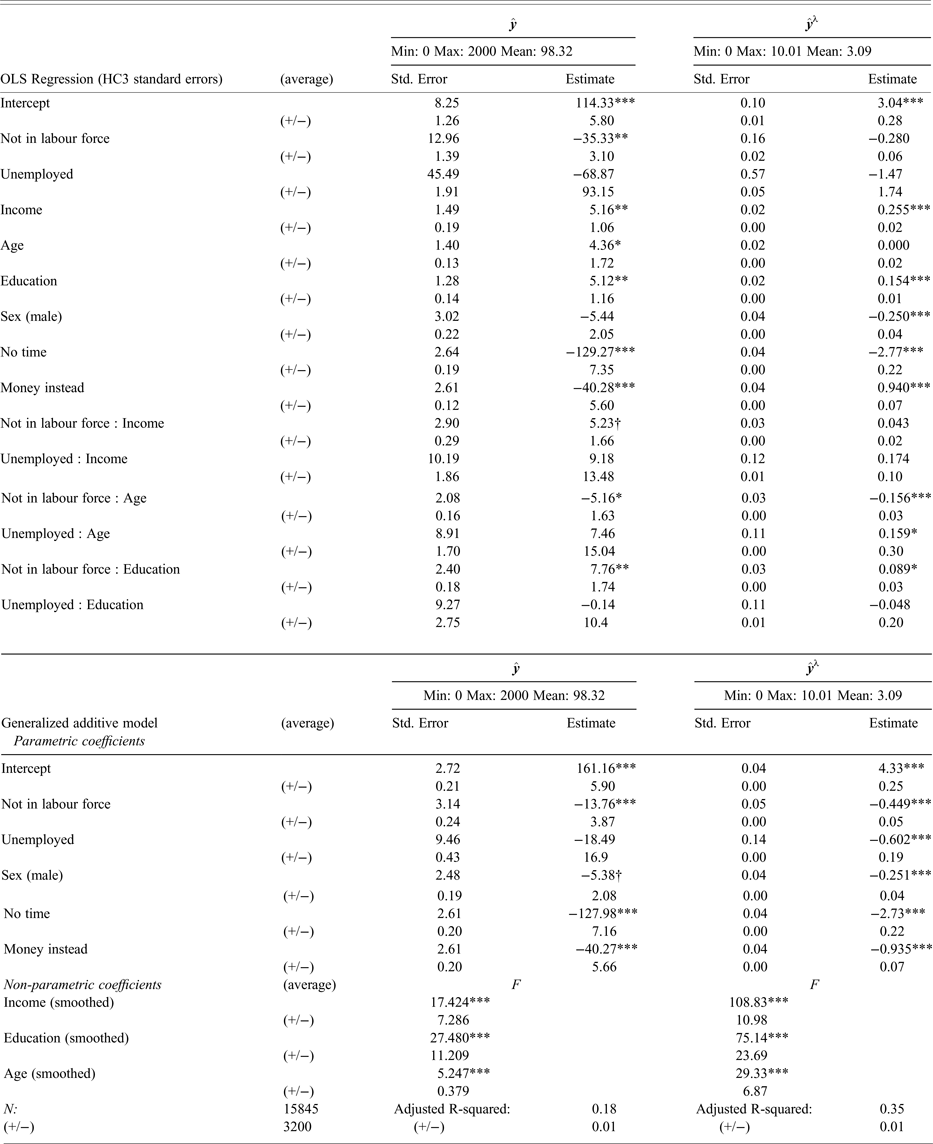
Unlike the WVS data, successive waves of the CGVP survey have not been compiled for longitudinal analysis. This means there exists no weighting variable to ensure representativeness of the compiled data. A solution is to run the analyses on each wave of the data with weights applied and report average coefficients, errors and goodness of fit statistics (Table 1 below).
CGVP estimates, effects on volunteer hours per year

† p < 0.1, * p < 0.05, ** p < 0.01, *** p < 0.001
An additional challenge with the CGVP data stems from the fact that the relationships between the response variable of interest volunteer hours per year and the independent variables income, age and education are non-linear. Moreover, tests of linear fit reveal the data are resistant to transformations toward linearity. This is in no small part because, although the response variable is continuous, all predictors are either on ordinal scales or categorical. Thus, while the dependent variable volunteer hours per year can be better fit by implementing a Box-Cox power transformation (denoted by yλ), ordinal x variables cannot be meaningfully transformed. While non-parametric or, more accurately, semi-parametric regression pose as alternatives, so long as we are interested in examining interaction effects between parametric and non-parametric regressors, a model fit that is entirely satisfactory is beyond reach.
Nevertheless, we may gain insight about the relationships under consideration by analyzing descriptive statistics, evaluating interaction effects produced via least squares estimation, and assessing graphical representations of non-parametric and semi-parametric relationships. Let us evaluate each in turn.
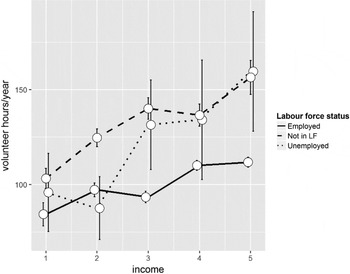
Returning to the question of whether income affects one's propensity to contribute, the CGVP data are encouraging. Figure 2 plots the unweighted mean values for volunteer hours per year according to a respondent's income and labour force status. It is clear that, regardless of labour force status, the trend is generally positive. Note, however, that it is not entirely additive. What is more, the unemployed category is characterized by substantial errors (represented by vertical bars).
CGVP mean effects of income and labour force status on volunteer hours

The non-additive, non-linear relationships between income and volunteer hours are not likely the product of randomness.Footnote 5 Rather, they are plausibly explained. The CGVP data suggest voluntarism is curbed by professional and familial obligations as evidenced by a dip in voluntarism in the age 25–34, professionally educated and middle-income cohort. On this point, 68 per cent of respondents indicate they would volunteer more if they had time. Moreover, no time as the main reason given for not volunteering increases from 48 per cent in the lowest income group to 73 per cent in the highest. In other words, lack of time as a reason for not volunteering more increases with income. Nevertheless, higher earners do volunteer, on average, more hours per year than do respondents with lower incomes. By implication, rather than detracting from the level of social contribution, basic income would serve to stimulate other-regardingness by freeing up resources that facilitate voluntarism, namely time and money.
Insofar as the causal mechanism is attitudinal, with lower income individuals expected to be more prone to discouragement, the data support the inference that higher income earners are more positively disposed to voluntarism whether they actually find time to volunteer or not. Variation in levels of discouragement among the unemployed may also explain the wide errors on that series (see Figure 2). That said, not only do higher income earners have more financial freedom to engage in non-paid work, they are also likely to have access to social resources that encourage volunteering, such as clubs, associations and other social networks. As indicated in Figure 4 below, individuals with simultaneously high income and education are especially disposed to voluntarism. The suggestion is that socialization with respect to how and why one could and should volunteer is complementary with having the financial freedom to donate one's time.
Table 1 displays the results of least squares interactive regression of the familiar form
 $$\hat y = \alpha + {\beta _1}{x_1}\cdot {\beta _2}{x_2} \ldots + {\beta _k}{x_k}$$
Importantly, to eliminate the effect of outliers, the dependent variable volunteer hours per year has an artificial upper bound of two thousand hours. Table 1 continues with results for semi-parametric generalized additive regression of the form
 $$\hat y = \alpha + {m_1}\left( {{x_1}} \right) + {m_2}\left( {{x_2}} \right) + {\beta _1}{x_3} \ldots \; + \; {\beta _k}{x_k}$$
where m j are partial regression functions fit using a smoother. All results are averaged across the 2004, 2007 and 2010 waves of the CGVP. Each dataset is weighted for representativeness, and least squares estimates are calculated using heteroskedasticity-corrected standard errors (White-Sandwich HC3). For ease of interpretation, results for both the y-transformed (yλ) and non-y-transformed variations of the models are presented. In the latter case, coefficients can be interpreted as the change in hours volunteered from the intercept value per unit change in the x variable. The rows below the estimates report variation across the three waves of the CGVP survey; they provide measures of the robustness of the reported coefficients, standard errors and R-squared values across the waves of the CGVP.
Significant predictors of voluntarism are many. The positive effect of income and education on voluntarism is sustained across all four models reported in Table 1, as expected. Although age is a positive and significant predictor of voluntarism in the non-transformed linear model, age has a null effect on voluntarism when the dependent variable is power transformed. This is likely a symptom of the fact that the relationship between volunteer hours and age—much like the other continuous regressors—is non-linear (see Figure 3 below).
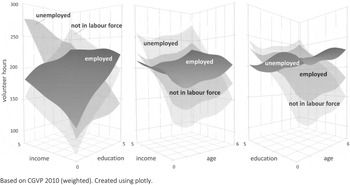
CGVP effect of income, age, education and labour force status on voluntarism

Most conspicuous among the negatively signed predictors is the control variable no time, which is a constructed dummy variable identifying respondents who volunteered fewer than fifty hours in the previous twelve months and reported not having time as the primary reason they did not volunteer more. Not surprisingly, the variable money instead, which controls for respondents who state that they do not volunteer because they prefer to give money, is also negatively associated with hours volunteered. Interestingly, in light of Figure 2, labour force status is also strongly and negatively associated with voluntarism when other variables are controlled, with both unemployed respondents and those outside the labour force expected to commit significantly fewer hours than employed respondents (see Figure 3 below).
The coefficients for the interaction terms are also revealing, particularly for education. Starting from the intercepts of 79 hours for not in labour force and 45.5 hours for unemployed, the increase in voluntarism for each additional unit of education (scaled from 1 to 5) is 12.88 hours for the former and 4.98 hours for the latter. The effect per unit increase in the age variable (scaled in ten-year increments) is -0.8 hours for not in labour force and 11.82 hours for unemployed. Finally, the response per unit change in income ($20,000 increments) is 10.39 hours for not in labour force and 14.34 hours for unemployed. While six out of twelve p-values for these interactions do not meet the threshold for statistical significance, the interactions are substantively interesting. As shown in Figure 3, although nuanced, the relationships between regressors and the response variable and are illuminating.
The hyperplanes in the three panels of Figure 3 are calculated with unplotted variables held at their means and with the money instead variable at its “no” value. In other words, Figure 3 presents the differential rate of social contribution controlling for the preference to give money instead. As seen in the leftmost panel of Figure 3, aside from the unemployed category, which is characterized by wide errors and likely influenced by youth volunteers, income and education are both strong predictors of voluntarism in their own right but are also complementary; simultaneously high income and education yields high values on y. As indicated by the centre and right panels, age is not a meaningful predictor of voluntarism on its own.
The findings from the CGVP analysis support the inference that, given the means, individuals will, on average, fulfill contributory roles under current norms. The data do not, however, support the conclusion that volunteer work amounts to a full-time occupation for most people with the means to focus solely on volunteer work. Rather, the highest predicted value of y in the semi-parametric model is 270 hours per year (5.2 hours per week). Notice, however, that employed respondents generally volunteer more hours than those outside the labour force when no time is controlled (this explains the differences between Figures 2 and 3). We may infer from this observation that, should hours of paid contribution for employed respondents decrease, losses will be compensated with unpaid contribution.
Such a conclusion seems to fit the experimental findings discussed earlier, which suggested that employed recipients of basic income do not drastically curb their work effort, especially when transfers are modest. In a word, neither the survey nor experimental data support the conclusion that large numbers—or particular segments of the population—will withdraw from fulfilling contributory roles upon the introduction of basic income (Widerquist, Reference Widerquist2005).
The claim that existing norms are sufficient to prevent objectionable free riding should not be interpreted as an attack on the moral incentives position. Rather, as evidenced by the WVS data, it would appear that existing practices of socialization have done a fine job fostering a work-duty ethos in approximately 75 per cent of WVS respondents (Figure 1). In sum, the statistical findings suggest that it may be possible to have it both ways. Consistent with theories of post-materialism, a society that privileges individual freedom may nevertheless exhibit conscientiousness the likes of which the institutions of moral incentives seek to encourage but without imposing stronger constraints or conditions on liberty than currently exist (Inglehart, Reference Inglehart1997).
Conclusion
Having argued that the provision of basic income, however modest, is attainable in most industrialized countries, and having analyzed two specific arguments on what institutions ought to govern the basic income project, I have concluded that existing conditions are conducive to the fruitful implementation of unconditional basic income. Based on survey evidence indicating the majority subscribe to a soft version of moral incentives, we may expect society to submit to a basic income guarantee close to subsistence levels, resources permitting.
Of course, the extent to which the work-duty ethos owes its present strength to current institutions surrounding work (including conditionality) remains to be seen. We should exercise caution when speculating about how norms cultivated in one institutional context will carry over to another. On this point, while the experimental evidence regarding work effort under guaranteed income is encouraging, long-term behavioural responses to basic income are unknown. Consequently, it is difficult to specify what other reforms, if any, should accompany basic income. To be clear, it is not my intention to advance basic income as either a panacea or a substitute for existing programs, conditional welfare notwithstanding. On the contrary, at the very least, basic income should be viewed as a complement to a wider array of existing opportunity-enhancing policies, particularly those related to education and training.
For these reasons, while data suggest unconditional basic income under current norms of reciprocation is feasible, I make no claim as to the finality of these findings. Only further research and, more importantly, experience with the implementation of basic income will tell us whether these provisional findings hold in the real world. It is nonetheless my contention that the barriers to instituting basic income have been overblown in both the public and academic discourse, including that which is sympathetic to the basic income project.