Introduction
India has the third largest number of people living with HIV in the world and is considered to have a ‘concentrated’ epidemic. According to the 2009 Government of India national estimates, there are 2.4 million people living with HIV/AIDS (World Bank, 2010). Based on a population of over 1.2 billion, the adult HIV prevalence has been estimated as 0.31% (National AIDS Control Organization (NACO, 2011). However, HIV prevalence among migrants (3.6%) is ten times higher than among the general population (NACO, 2010). There is a growing concern that inter-state migration in India is fuelling the HIV epidemic, and districts with low HIV prevalence are now showing increasing trends.
In the last two decades, there has been an exponential growth in temporary migration in India, especially from economically underdeveloped states to industrially advanced ones. Migration most commonly occurs among men who move from rural to urban areas primarily for work (Halli et al., Reference Halli, Blanchard, Satihal and Moses2007; Saggurti et al., Reference Saggurti, Schensul and Verma2009). Though migration has increased employment opportunities and livelihoods, it has also had negative public health consequences. Nineteen million men migrate across states every year in India. More than one-fifth (4 million) of them migrate to Maharashtra, making it the state with the highest in-migration (Office of the Registrar General, 2011). The HIV prevalence in Maharashtra state is much higher (0.55%) than the national average of 0.31% (NACO, 2010) and the prevalence among migrants is also high at 3%, which is five times greater than among the general population (HIV Sentinel Surveillance, 2007, unpublished data).
A number of studies have documented that migrants have higher levels of risky sexual behaviours than non-migrants and that they serve as bridge populations for the spread of HIV from destination areas to their places of origin. Being a migrant is not a risk factor in itself, but the process of migration and integration into local communities can expose the migrant to the risk of acquiring infectious disease (Bailey, Reference Bailey2008). The National Family Health Survey-3 (NFHS-3) data show that the migrant stream has a significant impact on HIV infection. HIV prevalence among male migrants is 0.55% as compared with 0.29% among non-migrant men (Keshri, Reference Keshri2009). Migration is male dominated, and men are more likely to engage in high-risk behaviour patterns. A study conducted in the industrial city of Surat in Gujarat (India) found that male migrant workers who live alone and have some disposable income are more likely to indulge in risky sexual behaviour (Gupta & Singh, Reference Gupta and Singh2002). It is estimated that out of the total numbers of adults living with HIV, 62% are male. Also, condom use was found to be three times less likely among migrants as compared with non-migrants (Keshri, Reference Keshri2009).
Migrants' sexual relationships with multiple partners in their destination work areas and their frequent visits to their places of origin is assumed to be the main factor in spreading HIV infection from high HIV prevalence areas to low HIV prevalence areas (Saggurti et al., Reference Saggurti, Verma, Jain, RamaRao, Kumar, Subbiah and Bharat2008). Studies have documented that migrants living without families and earning higher wages facilitates alcohol use and high-risk sex. These risks are exacerbated by the high density of alcohol and transactional sex venues within migrant male communities (NACO, 2011).
It has also been reported that low levels of education and income, socially marginalized status and limited opportunities to meet their emotional and physical needs may cause socially isolated rural-to-urban migrants to engage in commercial sex (Elmer, Reference Elmer2001; Settle, Reference Settle2003). About 45% of the migrants in Maharashtra reported alcohol use in the past one month (Tata Institute of Social Sciences & Population Council, 2008).
Several studies have reported low condom use among migrants engaging in sex with female sex workers (FSWs) (Saggurti et al., Reference Saggurti, Verma, Jain, RamaRao, Kumar, Subbiah and Bharat2008; Deb et al., Reference Deb, Deb, Saha, Chakraborty, Bhattacharya and Detels2009). But research on factors affecting consistent condom use among migrants is limited. In a study conducted among Mexican migrants in the United States, consistent condom users tended to be older (>35 years) and more educated (Fosados et al., Reference Fosados, Caballero-Hoyos, Torres-López and Valente2006). A meta-analysis of studies conducted on alcohol and condom use found that drinking is related to unprotected sex only in first sexual encounters (Leigh, Reference Leigh2002). Most studies have focused on adolescents or youth in educational settings. It is critical to enhance the body of knowledge on factors associated with condom use among migrants as 12% of migrants are engaging in sex with FSWs in India (Tata Institute of Social Sciences & Population Council, 2008). Condom promotion programmes are primarily focused on ‘most-at-risk populations’ (MARPs) such as FSWs and men who have sex with men (MSM). The present study aims at understanding the factors associated with non-use of condom consistently by analysing data from a large Behavioural Surveillance Survey (BSS) in Maharashtra State.
Research indicates that providing people with comprehensive information on reducing HIV risk – including abstinence, partner reduction and correct condom use – is most effective at preventing new infections (Global HIV Prevention Working Group, 2006). Coates et al. (Reference Coates, Richter and Caceres2008) state that reductions in HIV transmission need widespread and sustained efforts, and a mix of communication channels to disseminate messages to motivate people to engage in a range of options to reduce risk. This study therefore explores the factors associated with migrants ‘having sex with FSWs’ to understand their specific characteristics and assesses the factors associated with ‘non-use of condoms consistently’.
Methods
This paper draws its findings from a cross-sectional study in Maharashtra state assessing the knowledge, behaviour and attitudes of single in-migrants in the state. The study was part of the larger National Behavioural Surveillance Survey conducted in six states in India. The USAID-funded Avert Society commissioned the study for the state of Maharashtra, one of the aforementioned six states. The survey covered 4595 male migrants aged 15–49 years, living away from their family (irrespective of their marital status) and who visit their home at least once a year. The study was approved by the Government of India designated agency for AIDS Control, the National AIDS Control Organization (NACO). The data collection was undertaken in two rounds between February and December 2009.
Data collection
A study on HIV risk behaviours among migrants in Maharashtra state reported that 12% of migrants had engaged in sex with a female sex worker (Tata Institute of Social Sciences & Population Council, 2008). In order to estimate the migrants having sex with FSWs with 95% confidence interval, with a precision of 2.5% and with the drop-out of 10%, a sample size of 775 migrants per stratum was used.
The state of Maharashtra has a population of 112 million (Office of the Registrar General, 2011). Maharashtra comprises six geographical divisions (a division has approximately six districts); each of these divisions was considered as a stratum. The mapping estimates for migrants in the state, which included information on the number and size of enumeration sites, congregation points at work sites, construction sites and place of residence by district, was used to develop a sampling frame. The mapping exercise was undertaken in each migrant site employing an ethnographic walk (tour of the community using basic ethnographic methods, to gain an understanding of the community settings), key informant interviews, snowballing and the Delphi technique. The enumeration of migrants at the congregation points (sites where migrants congregate either for work or residence) was completed, which served as a sampling frame. A sample of 775 was allocated to each stratum and, based on Probability Proportionate to Size (PPS) method, migrants were selected from the districts covered under these strata. Based on the sampling frame a couple of sites (congregation points) were selected from each district. The required number of migrants was selected randomly using systematic sampling in the field.
The state-wide data collection was undertaken by 72 field investigators experienced in conducting behavioural surveys. These were supervised by eighteen experienced researchers. The supervisors and investigators underwent four days of training on the survey process and data collection tools.
Field investigators approached potential respondents at enumeration sites around either the work site or the residence site. Using the sampling plan, the field investigator approached every nth potential respondent, explained the survey and elicited information regarding age, whether they had migrated with their family and whether they travel home at least once a year. The respondents meeting the inclusion criteria of age 15–49 years, who had migrated to the place of destination without their family and who travel to their home town at least once a year were invited to participate in the survey. Prior to interviewing the respondent, the purpose of the study and confidentiality of the information collected was explained and oral consent was obtained. No incentives were provided to the participants. A suitable place was identified to conduct interviews in the field to ensure privacy.
The structured interview schedule included 160 questions designed to be completed in approximately 45 minutes. The interviews were conducted in Hindi and Marathi, the local languages of the study area. Survey responses were back-translated into English. Data validation included full review of 10% of the completed interviews by the survey supervisors, including spot checks (visit to the field to ascertain if people were interviewed) and response checks (review of completeness of the interview schedule and consistency of responses). Data were double-entered into a central database.
The structured interview schedule covered the following modules: socio-demographic characteristics, alcohol consumption, sexual history and behaviour, condom use, exposure to an HIV prevention intervention, stigma and discrimination, knowledge about HIV/STI, experience of STI symptoms, testing for HIV and awareness of, and accessibility to, HIV-related services.
The key outcome variables for this study are ‘sex with FSWs in the past 12 months’ and ‘non-use of condoms consistently with FSWs in the past 12 months,’ also termed as ‘having sex with sex worker’. The question asked for the first outcome variable was, ‘Did you have sex with female sex worker in the past 12 months?’ to which binary responses were collected as ‘yes’ and ‘no.’ All those answering ‘yes’ to this question were reported as ‘had sex with FSWs in the past 12 months’. However, the respondents who did not respond to the question on ‘whether they had sex in the past 12 months’ (the non-respondents) were classified into married and non-married, and the unmarried non-respondents' missing values were coded as ‘no’.
For the second outcome variable the question asked was ‘With what frequency did you or your female commerical partner use condom over the last 12 months?’ The responses were recorded as ‘every time’, ‘most of the times’, ‘half of the times’, ‘sometimes’, ‘never’ and ‘don't remember’. All these responses, apart from ‘every time’, were reported as migrants ‘not using condoms consistently with FSWs’. Socio-demographic characteristics such as age, education, duration of stay at destination, mobility (frequency of visits to other towns and villages), income, marital status, occupation, alcohol consumption and watching pornographic films were taken as independent variables for logistic regression analyses.
Duration of migration was measured from the month and year the migrants reached their destination in Maharashtra for employment and for the purpose of analysis was categorized as less than or equal to 2 years and more than 2 years. Migrants who often travelled to other towns and villages were considered to be mobile. These measures were kept consistent with the standard definitions used in other BSS. The most commonly reported occupations were workers in industry, textile, quarry and construction sites. The remaining responses were classified as ‘others’ (sugar cane cutter, fish vendor, musician, cook and currently not working) due to small numbers. As a substantial proportion of respondents were from the textile industry this was taken as a separate category.
Habitual alcohol consumption was considered as very often/often, while social drinking was taken as sometimes/rarely. A question was asked on leisure time activities, of which watching pornographic films (popularly known as ‘blue films’) was one.
Data analysis
The association between socio-demographic characteristics and having sex with a sex worker was assessed through univariate (unadjusted) analyses, using chi-squared tests with Yate's correction. The variables that were significant in the univariate analyses (p≤0.70) were considered as potential variables for multiple logistic regression analyses. In the multiple logistic regression analysis age (≤24 [reference], 25–29, 30–34, 35+), marital status (yes [reference] or no), level of education (no schooling [reference], up to middle school; higher secondary; and above secondary), income (≤Rs3000 [reference], 3001–5000, 5000+), occupation (industry worker [reference], textile worker, quarry worker, construction worker; other); migration duration (≤2 [reference] and >2 years); mobility (yes, no [reference]); alcohol consumption (very often/often, sometime/rarely, no [reference]); and watching pornographic films (yes, no [reference]) were considered as independent variables. The dependent variables were ‘sex with FSWs in the past 12 months’ and ‘sex with commercial partners in the past 12 months’. The models were run using the Enter method. The goodness-of-fit of the model was assessed using Hosmer and Lemeshow chi-squared statistics. Nagelkerke's R 2 statistics were also considered to study the contribution of the study variables. SPSS 16.0 software was used to analyse the data. The Christian Medical College IRB provided ethical approval for the study.
Results
Of the 4595 migrants studied 71 respondents did not respond to the question on having had sex with FSWs. Of the 4524 who responded, 1814 (40%) reported that they had had sex with FSWs in the last 12 months. Among the migrants who had had sex with FSWs, 201 (11%) did not use condoms consistently.
Demographic characteristics of the migrant respondents
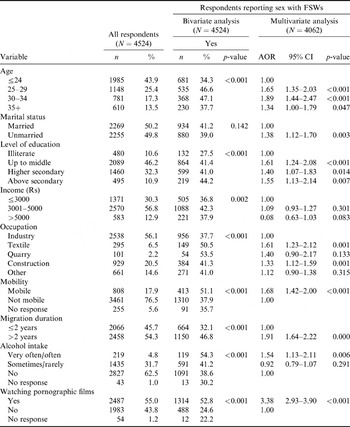
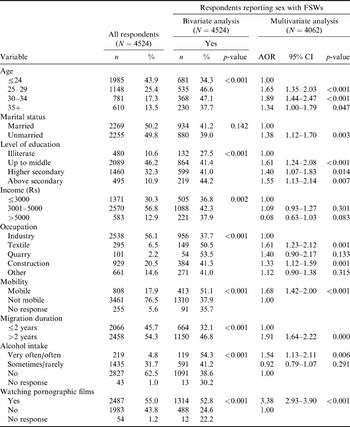
The mean (SD) age of the 4524 migrants interviewed was 26.6 (6.5) years; 43.9% were under 25 and 13.5% were over 34 (Table 1); 49.8% were unmarried. Overall literacy was good, with only 10.6% being illiterate. The majority (57%) reported an income of between 3000 to 5000 Rs per month. Almost one-fifth of the respondents (21%) worked on construction sites.
Bivariate and multivariate analysis of socio-demographic and behavioural variables of migrants reporting sex with FSWs in the past 12 months, Maharashtra, 2009
AOR: adjusted odds ratio.
Risk factors for reporting sex with FSWs in the last 12 months
The risk factors for reporting sex with FSWs are presented in Table 1. In multivariate analyses, after adjusting for other variables, middle-aged migrants (25–29 and 30–34 years) had a significantly higher risk of reporting sex with FSWs as compared with ≤24-year-olds (p<0.001). The unmarried migrants had a significantly higher risk of having sex with FSWs as compared with married migrants (p<0.01). The literate migrants were more likely to have had sex with FSWs as compared with non-literates (p<0.01). A larger proportion of migrants working in textile industries and construction work reported having sex with sex workers as compared with industry workers (p<0.001). A significantly higher proportion of mobile migrants reporting travel to other places reported sex with FSWs, nearly twice more than non-mobile migrants. Migrants who migrated >2 years ago reported a higher risk of reporting sex with FSWs as compared with migrants who had migrated recently (p<0.001). Migrants who consumed alcohol very often or often were significantly more likely to report sex with FSWs as compared with migrants who did not consume alcohol (p<0.01). However, migrants who watched pornographic films were more likely to report sex with FSWs as compared with others.
Demographic characteristics of migrants who had unprotected sex with FSWs in the last 12 months
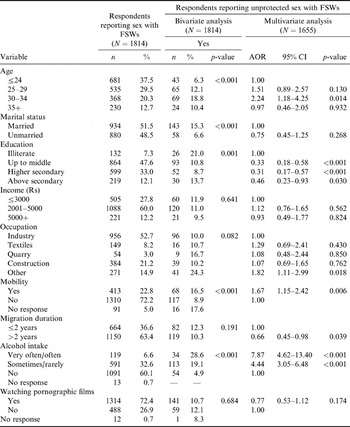
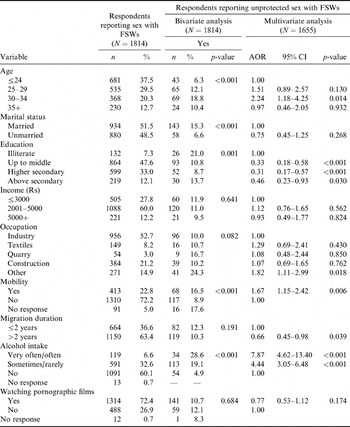
Of the 1814 migrants who had sex with FSWs in the last 12 months, 201 (11%) did not use condoms consistently with the FSWs. The socio-demographic characteristics and behavioural variables are presented in Table 2 (column 1). Of the 1814, 37.5% were under 25 years and nearly 13% were over 34 years old; 51.5% were married and about 7.3% were non-literate. Nearly 53% were employed in industry, while 21% did construction work. Nearly one-fifth of the migrants were mobile and 63.4% had longer duration of migration (>2 years). Nearly 40% of the migrants consumed alcohol either very often or sometimes. Nearly three-quarters of the migrants watched pornographic films.
Bivariate and multivariate analysis of socio-demographic and behavioural variables of migrants reporting sex with FSWs and not using condoms consistently in the past 12 months (unprotected sex), Maharashtra, 2009
AOR: adjusted odds ratio.
Risk factors for unprotected sex with FSWs in the last 12 months
The risk factors for unprotected sex with FSWs in the last 12 months are presented in Table 2. The middle-aged migrants (30–34 years) were significantly more likely to have had unprotected sex with FSWs as compared with younger migrants (≤24 years). The literate migrants were less likely to have been involved in unprotected sex with FSWs than illiterate migrants. The migrants who had been migrant for a longer duration (>2 years) were more likely to have had unprotected sex with FSWs as compared with those who had been migrants for a shorter duration. The migrants who consumed alcohol were significantly more likely to have had unprotected sex with FSWs.
Discussion
This study looked at Indian migrants having unprotected sex with FSWs to understand their background characteristics. Forty per cent of the total migrant respondents reported having had sex with FSWs, and 11% of these did not use condoms consistently. The proportion of migrants having sex with FSWs is higher than that previously reported in a five-district study in Maharashtra (Tata Institute of Social Sciences & Population Council, 2008). This difference could be due to considerable variations in the two studies, including definition of migrants, sampling frame and geographical coverage. The study was undertaken in only five districts of Maharashtra: Mumbai, Thane, Nagpur, Pune and Nashik. Census 2001 estimates were used as the sampling frame, and profiling of selected districts was undertaken. Migrants aged 18 years and above, who had moved to the current place in the past 2 years and who had visited two or more places for the purpose of work in the previous 2 years, were selected for the study. However, the study covered all districts and sampling was based on the mapping exercise. Also, the study did not have any restrictions on the duration of migration.
The non-response rate to sensitive questions such as whether they had sex in the past 12 months is expected to be high, especially in the unmarried group. In this study, of the total migrants, the non-response from unmarried migrants was 22.8%, while it was 1.5% in the married migrants. A study among youth aged 15–29 years in India showed that 70% of unmarried youth below the age of 25 years did not have sex. Similarly, the clients of sex workers covered under the Integrated Behavioural and Biological Survey in Maharashtra (Indian Council of Medical Research & Family Health International, 2009, 2011), showed that 30% of clients were below the age of 25 years. The response of unmarried migrants who did not respond to the question on sex with sex workers was therefore considered as ‘no’ for the purpose of the analysis, while that for married migrants was considered as ‘missing value’. Some of the unmarried migrants who did not respond to this question may have had sex with sex workers, but considering it would be a low proportion this cannot be accounted for and remains as a limitation for the study. Fenton et al. (Reference Fenton, Johnson, McManus and Erens2001) considered that those who decline to answer more intimate questions are, if anything, likely to be at lower HIV risk. Dunne et al. (Reference Dunne, Martin, Bailey, Heath, Bucholz, Madden and Statham1997) reached similar conclusions, that participation bias may have led to overestimation of HIV risk behaviours, which counteracts the observed tendency for survey respondents to minimize or under-report the frequency and diversity of their sexual behaviour. Considering these factors it is safe to assume that the missing values for unmarried migrants may actually be ‘no’ for having had sex with sex workers.
The findings of this study show variation in the characteristics of those who reported having had sex from those who had unprotected sex. A significant association is observed between sex with sex workers and older migrants (>24 years), the literate, those who are mobile, unmarried, employed in the textile, quarry and construction industries, who often consume alcohol and who watch pornographic films. The factors associated with unprotected sex are age between 30 and 34 years and no literacy. Migrants who are mobile and consume alcohol show a significant association with unprotected sex; these two factors are common to sex with sex workers and unprotected sex.
A significant proportion of the older (>25 years) and unmarried migrants reported sex with sex workers. Marital status exhibited a stronger association of having sex with sex worker as compared with age, indicating that older unmarried migrants are significantly more likely to have sex with sex workers. This finding is consistent with a study conducted in five districts of Maharashtra that showed a larger proportion of unmarried migrants engaging in sex with FSWs (Tata Institute of Social Sciences & Population Council, 2008).
A significant finding of the study is the high vulnerability to high-risk behaviour of textile industry workers. This category was taken separately as 6.5% of the total respondents were employed in textile industries and Maharashtra has a large number of these industries. The huge textile industry in the state, with its high concentration of temporary migrants, provides an environment conducive to high-risk sexual behaviour, with large numbers of brothels, bars and video parlours screening pornographic films.
The study shows that drinking alcohol and watching pornographic films is significantly associated with having sex with sex workers, as the migrants who watched these were at nearly three times higher risk of reporting sex with sex workers as compared with others, while those who consumed alcohol were 1.5 times more at risk of reporting sex with sex workers. A study among migrants in South India reported that socializing activities that take place with peer groups, including alcohol use, viewing of pornographic films and visiting bars and sex workers, strongly influence sexual behaviour. Migrants who are stressed due to their difficult work conditions, poor housing in a crowded locality and lack of recreation facilities, resort to drinking, indulge in entertainment activities such as watching pornographic films and engage in high-risk sex as coping mechanisms. This is evident from the present study, with 37% of migrants reporting alcohol consumption and 55% reporting watching pornographic films.
A few studies have also reported an association between watching pornographic films and high-risk sexual behaviours. In a study conducted among migrant workers in Surat town in northern India, substance abuse and watching of blue films at video parlours emerged as the strongest and most significant predictors of risky sexual behaviour (Chakraborty, Reference Chakraborty2004). The odds of low substance abuse are 82% higher than no substance abuse. Watching pornographic films at video parlours increased the odds of risky sexual behaviour four times compared with not watching pornographic films (unpublished report; Gupta & Singh, Reference Gupta and Singh2002). Similar findings were reported in a study conducted among young factory workers in Nepal (Poudel et al., Reference Poudel, Jimba, Okumura, Sharma, Poudel and Wakai2004; Nepal, Reference Nepal2007). Watching pornographic films was identified as a factor for risky sexual behaviour in the multivariate analysis (Puri & Cleland, Reference Puri and Cleland2006). The present study indicates that migrants who rarely consume alcohol are 0.9 times less likely to have sex with sex workers as compared with those who do not consume alcohol. Migrants who reported watching pornographic films were three times more likely to have sex with sex workers as compared with those who do not watch them.
The findings on the rate of unprotected sex (inconsistent use of condoms) with FSWs are in line with those of the study among migrants in select districts of the state, which is 13.1%. Among migrants who had sex with FSWs, a significant association is seen between migrants aged 30–34 years and unprotected sex. This indicates that though a strong association is seen between migrants <25 years and sex with sex workers, these migrants reported using condoms consistently with FSWs in the past 12 months. The Tata Institute of Social Sciences & Population Council (2008) study states that the possibility of having sex at multiple locations is slightly higher among those aged 20–24 years as compared with men in other age groups. Interventions should therefore aim at reaching younger migrants with messages on reduction in number of sexual partners, while older ones should be targeted with education on correct and consistent condom use.
Though unmarried migrants showed a significant correlation with sex with sex workers, a significant association is seen between married migrants and unprotected sex with FSWs. A study among migrants in two districts of India showed that a high proportion of returned migrants (with a history of migration) who were married had sex both at their place of origin as well as destination. Of the total migrants infected with HIV, 67% were reportedly married as compared with 33% of single migrants. This is a matter of serious concern. Unprotected sex in places of destination with high HIV prevalence (like Maharashtra) poses a risk of transmission from high-risk population groups to migrants, and in turn to their married and other sexual partners in places of origin (Saggurti et al., Reference Saggurti, Mahapatra, Swain and Jain2011).
Mobile migrants are 1.7 times more likely to have had sex with FSWs in the past 12 months and 1.7 times more likely to have had unprotected sex. This is in line with the findings of other studies (Saggurti et al., Reference Saggurti, Mahapatra, Swain and Jain2011), indicating that men with a history of migration and mobility are three times more likely to contract HIV infection. ‘Mobility’ in the current study refers to short-duration travel away from destination sites, which, depending on the availability of sexual partners, could provide an opportunity to indulge in sexual activities. However, the findings indicate that these sexual acts are also unprotected and the reasons for this need to be further explored in terms of ignorance or lack of access to condoms, or any other reason.
Occupation is known to influence behaviour through various factors such as timing, nature of the work, work environment and peer pressure. This study showed a significant association between some occupation categories such as textile, quarry and construction workers with reported sex with sex workers. However, this association is not significant for consistent condom use. Programme planners and implementers should therefore focus on factors influencing sex with sex workers among these categories of workers to reduce the number of sexual contacts with sex workers and reinforce safe sexual practice.
A strong association is seen between alcohol consumption and unprotected sex, with an almost eight times higher likelihood of having sex without consistent use of condoms with FSWs. Various studies, including in south India, among Mexican migrants in the US, in Bangladesh and Africa, have indicated a strong influence of alcohol on both high levels of sexual indulgence and higher propensity to not use condoms.
The present findings, in conjunction with those of others, strongly argue for the need to target alcohol use and abuse in HIV prevention programmes. While causality cannot be determined from a cross-sectional study, the consistency of the results across many studies, the strength of the associations and the biologic plausibility all suggest that alcohol use is a cause rather than a consequence of risky sexual behaviour (Kongnyuy & Wiysonge, Reference Kongnyuy and Wiysonge2007). Video parlours and bars that screen pornographic films need to be involved in prevention activities, such as creating a condom depot and spreading awareness about HIV. Besides, migrants could be engaged in productive and entertaining pursuits during their free time. In China, special films are screened for migrants ‘free of cost’ to offer them healthy entertainment and keep them off pornographic films (Xinhua, 2005).
The finding that among migrants a significant proportion of married migrants indulge in unprotected sex necessitates taking social and sexual needs of the migrants into consideration when designing an intervention strategy. An enabling environment where negotiation of safe sex is possible should be ensured. To facilitate risk reduction in terms of lesser sexual contacts, migrants should be provided with a decent life, normal wages, normal working hours, a good living environment and opportunities to self-organize (Wolffers et al., Reference Wolffers, Fernandez, Verghis and Vink2002). This creates a classical high-risk environment and the findings clearly showed that the environment in which the migrant stays at the destination or workplace puts him at a higher risk of acquiring HIV infection. Further, the migrants could then infect their wives on return to their hometown/villages. So it is not the migrants per se, but the conditions associated with the migration process that affect the vulnerability of individuals to HIV, as argued elsewhere (International Organization for Migration & Joint United Nations Program on HIV/AIDS, 2003; Anarfi, Reference Anarfi2005; Banati, Reference Banati2007).
It is a cause for concern that five out of ten people who migrate to cities and towns are engaging in high-risk sex. The epidemiological rationale for investing in HIV prevention programmes among migrants has been debated (Saggurti et al., Reference Saggurti, Schensul and Verma2009). The findings of the present study call for such investments as these environmental factors contribute towards fuelling the epidemic in the country. This is particularly true for Maharashtra, which is the largest destination state for migrants in the country with 3.23 million migrants (Office of the Registrar General, 2011).
Limitations of the study
The analysis is based on a cross-sectional study and hence no causal relationship can be established. The inconsistency in condom use was assessed on the basis of a single question, ‘In general, with what frequency did you or your female commercial partners use condoms over the last 12 months?’ This estimate was used as episodes of ‘unprotected sex’ and would probably be an overestimate. The missing values for the question on having had sex with sex workers by unmarried migrants has been considered as ‘no’. Though this is a limitation, the literature indicates that those who decline to respond are generally at low risk: that is, do not indulge in sex with sex workers.
Implications of the findings
The findings suggest a need for a comprehensive HIV prevention programme including strategies to address the stressful work conditions of migrants by creating an ‘enabling’ environment at workplaces. HIV prevention programmes targeting this population should focus not only on skills for safer sex practices, but also on alcohol use reduction. To be effective, prevention efforts need to address the specific risk factors contributing to alcohol intoxication among migrants. Proper guidance and information about employment, housing and occupational training, which aims to improve young migrants' living and employment conditions, might be helpful in reducing migration-related stress, and in turn, lead to a reduction in alcohol intoxication, reduced exposure to pornographic materials and thereby a substantial decline in high-risk sex. Appropriate training in life skills and adaptive coping strategies should be provided to young migrants.
Acknowledgments
The study was undertaken by the Avert Society with financial assistance from the United States Agency for International Development (USAID). The authors are grateful for the support and overall guidance provided by the Maharashtra State AIDS Control Society (MSACS), Mumbai District AIDS Control Society (MDACS) and National AIDS Control Organization (NACO). Funding was provided by USAID, New Delhi, India.