In spring 1875 the aristocrat and promising young zoologist Francis Maitland Balfour travelled from Cambridge to Naples to study the embryology of elasmobranchs. However, his friend Edwin Ray Lankester thought that rather than pursuing sharks in Italy, Balfour should be hunting lampreys on the Severn Estuary. Balfour stayed to work on the sharks and the research he produced helped to make his name. He formed an internationally renowned school of animal morphology at Cambridge University that dominated British zoology in the late nineteenth century.Footnote 1 Balfour died in a climbing accident in July 1882 but the school's success seemed to continue until the early twentieth century, when morphology fell out of favour. Historians have generally assumed that the school's fall from grace was in part due to the death of Balfour, but was largely due to wider changes within the life sciences from morphological and descriptive methods to physiological and experimental methods.Footnote 2
This paper argues that animal morphology, with its reliance on good specimens from difficult places, fitted well with late nineteenth-century Cambridge. The school performed microscopic studies of the form and development of various animal species, making comparisons and speculating on evolutionary relationships. For this work they needed specimens of assorted species at every stage of development. If such specimens could not be obtained directly by zoologists they could recruit old college friends in the empire to collect on their behalf. The university provided the men who governed Britain and the empire, ranging from the prime minister to civil servants in African outposts. Balfour came from a wealthy and powerful family and was able to use his abilities to network socially and politically to the school's advantage. During the 1890s the school expanded and adapted. A new generation of zoologists emerged as explorer–heroes, who travelled in Africa and the Americas, risking their lives to capture primitive fish. Balfour relied on small personal networks, whereas these men took their research much further afield. However, Cambridge University literally had no room for them. The school's position had always been tenuous and during the 1890s it was swallowed by the Department of Zoology. As posts in animal morphology became vacant they were replaced by posts in zoology. The Special Board for Biology and Geology (SBBG) felt that they should be available for ‘ordinary teaching in zoology’. Balfour's successor, Adam Sedgwick, was already burdened with teaching and needed help. College lecturers still provided a substantial amount of teaching in zoology and the SBBG was concerned that their positions might cease.Footnote 3 Morphology still had some successes, but as the Department of Zoology expanded the school increasingly had to compete with other teaching in zoology, including economic entomology and variation and heredity.
The paper starts with a brief introduction to the school and its place within the university, since this is vital to understanding its apparent trajectory of success and failure. It then examines the Balfour family's political and social connections. They were part of a network of families who were hugely influential in Cambridge, and in British and imperial politics. As the third section of this paper shows, Balfour and his compatriots were instrumental in founding the Zoological Station at Naples. They helped to give it its international character, so important to its founder, Anton Dohrn, particularly once the German state began to contribute large amounts of funding. Yet during Balfour's stay, Lankester, then teaching zoology in London and Oxford, tried to persuade Balfour to return to England and study the development of the lampreys. Despite Lankester's persistence, Balfour seems never to have worked seriously on the lampreys and used the work of other zoologists on the jawless fishes in his major work, Comparative Embryology (1880–1). Lankester had already published on the Cephalaspida (extinct armoured fish) and argued over their relationship with modern lampreys. This section explores his reasons for choosing lampreys, whereas Balfour preferred the elasmobranchs. Naples suited Balfour better and Dohrn worked hard to keep the connection with Cambridge in the decades after Balfour's death, trying to ensure that the university continued to send students there.
After Balfour's death, a studentship was founded in his honour. The research undertaken by holders of the award shows just how varied the school's work became. It was designed to give less well-off students the opportunity to continue with a career in the sciences. William Hay Caldwell, the first holder of the award, began a tradition of travel as he searched for the platypus in Australia. Instead of Balfour the aristocratic hero, the school lauded adventurer–heroes who would take the opportunities given to them, risking life and limb in the cause of science. The final section contrasts Balfour's work and reputation with those of John Graham Kerr and John Samuel Budgett. Kerr began his travels in homage to Darwin, as a medical student and ship's naturalist travelling through the Gran Chaco. He returned with fellow Cambridge student Budgett and their work shows the hardships faced by zoologists. Both pursued the lungfish with a determination that belies the idea that the Cambridge school were museum- and laboratory-bound morphologists.
The Cambridge school of animal morphology
When Balfour arrived at Cambridge University in 1870 the natural sciences were only just beginning to be established there. The university had set up an honours degree in sciences, the Natural Sciences Tripos (NST), in 1848. In 1866 the various science departments were accommodated on the New Museums Site and were expected to exist cheek by jowl.Footnote 4 The sciences were taught and examined together. Students often studied across half a dozen topics, choosing from physics, chemistry, mineralogy, geology, botany, zoology, physiology and human anatomy.Footnote 5 Balfour studied with Michael Foster, then employed as a praelector in physiology by Trinity College, one of the largest of the Cambridge colleges. Balfour took Foster's course on embryology and was hooked. He published on the development of the chick embryo whilst still an undergraduate, then helped Foster to write up his embryology lectures as a textbook, Elements of Embryology (1874).Footnote 6
After graduating in late 1873 Balfour travelled in Scandinavia and the Americas, returning to a fellowship at Trinity. He began lecturing on embryology and was given a post as lecturer by the college. From a handful of students taught in rooms borrowed from the professor of zoology, Balfour came to teach around ninety students in a new, purpose-built laboratory.Footnote 7 His colleagues referred to him as head of the school of animal morphology, but he held no official university post. The first professor of zoology and comparative anatomy, Alfred Newton, taught courses on evolution and geographical distribution of animals. Animal morphology was included with zoology for the NST, but the school did not have an official structure within the university. By March 1882 Balfour's colleagues had become concerned about this situation and they campaigned for him to have a university chair.Footnote 8 He was appointed professor of animal morphology in May 1882, but the post died with him two months later.
The school's position was no clearer under Balfour's successor, his friend and pupil Adam Sedgwick. Sedgwick took over Balfour's teaching and became head of the school without the chair. He was initially employed by Trinity College, taking Balfour's old lecturing position. He was then employed as university lecturer in animal morphology before a readership in the subject was created for him in 1890. The post of professor in animal morphology was never reinstated. Sedgwick became professor of zoology in 1907 when Newton died.Footnote 9 The structures of the varying departments of natural science are most easily seen in annual reports made to the Museums and Lecture Rooms Syndicate (MLRS). The MLRS was formed in 1853 to investigate the use of the site of the old botanical gardens and to see what steps, if any, should be taken to erect additional lecture rooms and museums in the expanding and modernizing university. It came to oversee the use of laboratories, museums and lecture rooms within the university, putting suggestions forward to the Senate, the university's governing body, for approval. Each year every department would send a report to the MLRS, giving details of the facilities they needed for teaching. Sedgwick reported for the ‘Morphological Laboratory’ until 1893, when the name was changed, apparently without explanation, to the ‘Zoological Laboratory’.Footnote 10 During the 1880s more staff were taken on to teach animal morphology. From 1884 Hans Gadow was employed as lecturer in advanced morphology of vertebrates. W. F. R. Weldon, S. J. Hickson and A. E. Shipley successively held the lectureship in advanced morphology of invertebrates. However, Sedgwick's appointment as professor of zoology in 1907 left his readership in animal morphology open and the SBBG recommended that it be changed to zoology and that William Bateson be appointed.Footnote 11 This brought about a series of changes. When Bateson resigned in 1908 Shipley was appointed reader in zoology and his former post in invertebrate morphology was changed to a university lectureship in zoology.Footnote 12 Since animal morphology was never officially a department it was relatively easy to allow it to wither away and positions such as Sedgwick's readership were only held by one person before they were changed to zoology.
At its height the school concentrated on comparative embryology. Researchers made comparisons between embryos of different species in a bid to find out more about development as a whole. Embryologists had noted similarities between embryos of different species throughout the nineteenth century. According to the Meckel–Serres law development was linear, since the embryo repeated the forms of adult animals lower down the scale. In 1828 Karl Ernst von Baer argued that development always proceeded from the general to the special, every animal passing through a series of stages in which it resembled the embryos of lower members of the animal scale. Von Baer's work was widely taken up by zoologists of various nationalities although in practice it was often conflated with the Meckel–Serres law.Footnote 13 After Darwin's Origin of Species in 1859, such observations acquired new meaning. Resemblances between embryos could be seen as having evolutionary significance. This theory was put forward most forcefully by Ernst Haeckel, who posited that ontogeny, or individual development, was a re-enactment of phylogeny, or species development. According to Haeckel phylogeny caused and therefore directed ontogeny. Thus if embryologists could observe the entire development of a species they could watch as the species evolved. Haeckel formulated these ideas in the late 1860s, referring to them as the biogenetic law. In a lengthier discussion in 1872 he explained that there were problems because ontogenesis became foreshortened as the embryo took the straighter road. He therefore distinguished between cenogenesis, or secondary adaptation leading to non-recapitulation; and palingenesis, real recapitulation.Footnote 14 Primary and secondary adaptation became highly problematic for recapitulationists, since it was all but impossible to decide which characteristics were secondary and what their significance was. Embryologists at Cambridge adhered to some form of the biogenetic law although they were quite flexible in its application.
As embryologists puzzled over the relationship between phylogeny and ontogeny, they became fascinated by germ layers. Early in development an embryo passes through a stage known as a gastrula, when it forms a hollow sphere, surrounded by two apparently distinct layers of cells, then called the epiblast and hypoblast. Haeckel noted that the gastrula appeared in widely divergent forms, from sponges to higher vertebrates. Since it was clearly present across divergent taxa he argued that it must be a conserved form which had appeared very early in evolution before those taxa had diverged. Reasoning that the gastrula might once have been the end-stage of development, Haeckel posited a hypothetical organism, the gastraea, from which all multi-celled organisms (Metazoa) had developed. This sparked a series of contested investigations in which embryologists compared the germ layers in different species, seeking homologies (structures with the same evolutionary origin).Footnote 15 They found that structures such as the skin and nervous tissue developed from the outer layer (the epiblast, now known as the ectoderm), whereas the inner layer (the hypoblast, now known as the endoderm) gave rise to the gastrointestinal tract, the lungs and associated structures. Later, a third layer known as the mesoblast (or mesoderm) developed between the epiblast and hypoblast. The Cambridge school of animal morphology became known for their careful observations, development of new techniques and discoveries of new structures. They were careful to draw quite tentative conclusions from their work, but from the early 1890s they became ever more disillusioned about just how tentative they needed to be.Footnote 16
Mark Ridley has argued that without Balfour's ‘personal magnetism’ to hold the school together, his pupils abandoned comparative embryology.Footnote 17 However, this did not happen immediately or completely. The school's gradual move away from comparative embryology from the late 1880s was affected by other issues within zoology as a wider discipline. Robert Kohler argues that the ‘biological world of 1890 was contested terrain’. Laboratories and experimental disciplines had grown in number and gathered force since the 1850s, creating
a zone of tension between an expansive, confident scientific culture and an older culture of field science that was cast as old-fashioned (though in fact it was not) and pushed to the periphery of the new scientific world.Footnote 18
According to Kohler, at the turn of the century this rivalry mellowed to interaction. Biologists created a ‘scientific natural history’ that drew on both traditions and was in part an attempt to recruit students. Zoologists felt that students disliked dry microscopic morphology. Kohler condemns evolutionary morphology and embryology as a ‘narrowly reductive and cultish’ discipline reliant on a minute study of anatomy and embryology that focused narrowly on a few anatomical features and on marine invertebrates. He argues that ‘it was done exclusively at the bench, indoors, with microtome and microscope’.Footnote 19 But the Cambridge school does not readily fit this pattern. In the 1870s and 1880s students were encouraged to go to Naples. When they could not find marine life they found ingenious ways of netting lizards and capturing toads, writing up the results of studies on whatever animals came readily to hand.Footnote 20 Caldwell extended this enterprise by travelling to Australia as a Balfour student and investigating the platypus. He began what was to become a more extensive and intensive tradition of travel and collection within the school. Kerr and Budgett followed Caldwell, taking comparative embryology out into the field. Good specimens could not be found indoors.
Travel was important for all zoologists, including the Cambridge school. Towards the end of the nineteenth century, military and political rivalries intensified in Europe as newly emerging nation states sought to fulfil imperial ambitions on other continents. Harriet Ritvo argues that ‘the competitive colonization of soldiers and diplomats had its analogue in the nomenclatural activities of zoologists’. By naming a creature, zoologists laid claim to it and by extension its territory. They preferred journals to battlefields but their aims were intertwined with those of the soldiers. Zoologists struggled to be the first to name a creature. Priority disputes broke out as they debated whether or not they had found an animal before another zoologist who had published an account in a less well-known and non-English journal. Synonyms and confusion between species made it very hard to tell the relationship between different species. Even if a researcher managed to find a reference to a similar creature, they could not be sure whether or not it was the same species.Footnote 21 Balfour became quite adept at dealing with these disputes, making use of networks based around Cambridge and around European zoologists. His successors were able to take this networking ability much further afield, making similar connections on distant continents.
Politics and the Balfour family
The Balfours intermarried with the Salisburys and the Rayleighs, reinforcing a familial power base. Balfour's uncle the Marquis of Salisbury was secretary of state for India, then in spring 1877 was made foreign secretary. Balfour's eldest brother, Arthur James, was appointed Salisbury's parliamentary private secretary, travelling to the Berlin Congress in 1878.Footnote 22 Salisbury became prime minister for the first time in 1885 and Arthur followed in his footsteps in 1902. Such political power was also exercised within Cambridge. The Universities of Oxford and Cambridge Act of 1877 appointed commissioners at both universities who continued to make recommendations for reform until 1881. Commissioners included Balfour's brother-in-law Lord Rayleigh, then Cavendish professor of physics. They reported to the Universities Commission of the Privy Council, which included Salisbury, who kept his nephew up to date with developments.Footnote 23 After Balfour's death these links were less direct, although Arthur continued to be interested in and to support the biological sciences at the university. Under Balfour animal morphology was part of a network which reached into the government and across the empire.
For Balfour, his friends and colleagues, the world beyond the immediate territories of western Europe was ripe for exploration. In summer 1873 Balfour travelled in Scandinavia with his old schoolfriend Arthur J. Evans. The pair planned the trip carefully, warned by Newton that food would be difficult to obtain. Just over a year later Balfour toured South America for four months in a similar spirit of exploration. He and Evans also saw mountaineering in the European Alps as part of this same process of discovery.Footnote 24 International politics were of some concern, particularly to Evans who became heavily involved with Bulgarian politics and the situation with the Ottoman Empire, encouraging Balfour's inclination to send financial aid to the Bulgarians in their nationalist uprisings against the Turks. Evans was later imprisoned in Dalmatia and lamented to Balfour that, having got information from him about an insurrection, the British government did nothing to help him.Footnote 25 Other friends were interested though not as directly involved. In 1878 Dohrn exclaimed, ‘Give peace to the world, and science will enjoy it.’Footnote 26 Yet on 16 September 1879 he congratulated the British on their ‘dashing ways in Afghanistan’.Footnote 27 The country was of prime importance to the British for it acted as a buffer between Russia and India. On 3 September 1879 after a series of conflicts in which the Afghans had sought Russian aid, the British envoy in Kabul and his staff were killed. At the time that Dohrn wrote, the British were marching towards the city.Footnote 28
Naples and Elasmobranchs
A German zoologist and pupil of Haeckel's, Dohrn opened the Zoological Station at Naples in 1872 as an independent base for advanced research. One of the earliest such stations, it quickly became a template for those that followed, including the Marine Biological Laboratories opened in 1888 at Woods Hole in the US and at Plymouth in the UK.Footnote 29 Dohrn believed that the embryology of marine organisms would provide the key to discovering the genealogy of species, having worked with Haeckel as they searched for the direct descendents of the most primitive forms on the seashore at Messina. Biologists travelling to the coast had to pack up temporary supplies, carting around microscopes, glassware and preservative fluids. Dohrn's idea was to set up a more permanent establishment to attract the best zoologists of whatever nationality, providing them with workstations and marine organisms, whilst they supplied their own microscopes, microtomes and microtome knives. To attract funding the aquarium was made open to the public, but the rest of the station building was for serious researchers only.Footnote 30
Both Lankester and Balfour were connected with Naples in the early 1870s, but Balfour's wealth enabled him to have a more active involvement. Dohrn met Lankester in Liverpool at the 1870 meeting of the British Association for the Advancement of Science. Their association continued when Lankester attended Dohrn's lectures at Jena University the following year. The two discussed Dohrn's plans for a marine station. Lankester stayed in Naples from October 1871 until May 1872 working on molluscan embryology. By that time building work had started on the marine station.Footnote 31
Balfour graduated in December 1873 and, together with his friend Albert George Dew Smith, made his first trip to Naples that winter, staying until July 1874. He visited again in March 1875, arriving with Lankester and staying for several months. Throughout this time Balfour was actively involved with the station. Balfour, Foster, Thomas Henry Huxley, Charles Darwin and Dew Smith began to correspond about the possibility of raising funds at least as early as November 1873. Darwin's son George, later Plumian professor of astronomy and experimental philosophy at Cambridge, apparently contributed. Darwin himself suggested asking the Duke of Devonshire and Salisbury. Balfour was anxious to include his relatives – the establishment of the station was perceived and conceived as a family venture.Footnote 32 The families involved were amongst the richest and most influential in British politics and science. Dew Smith, an aristocrat and pupil of Foster's, had similar social standing to Balfour. And Huxley, for all his protestations, not only knew how English society worked but was fully prepared to make use of such connections. As he wrote to Dohrn in March 1874,
I am glad that Balfour & Dew Smith are with you. I do not know the former personally but hear good of him on all sides. Dew Smith is very modest+retiring – but has good abilities and is a thorough gentleman – which as you know in English means a good deal.Footnote 33
The day-to-day running of the station still required money. Balfour suggested to Foster and Dohrn that it might pay its way if the tables were hired or subsidized.Footnote 34 In spring 1874 Dew Smith and Balfour continued to lend Dohrn money, which he felt ‘literally have save [sic] me from destruction.’Footnote 35 That summer his financial worries continued and Dohrn complained of heart palpitations and insomnia, of which his doctor told him to make the best.Footnote 36 However, despite these health and money problems an international station was gradually taking shape.
Balfour's close involvement continued and at his suggestion Dohrn arranged a bell for every table so that the boy who worked in the laboratory could fetch supplies where needed. They agreed that the biggest problem was animal supply and Dohrn campaigned to get a small steam launch. He said he would fish all the following season, if no one else would. The naturalists could go on board with him on regular runs, then they would see that it was not always possible to get material.Footnote 37 Their favourite fishermen were the brothers Domenico and Giovanni di Giovanni, on whom they relied heavily for their collecting skills.Footnote 38 Dohrn lamented to Balfour, ‘Just as you say, if Giovanni dies, who will provide animals?’Footnote 39 Recognizing that he was there for the long haul, Dohrn confided in his friend:
The station cannot be in one or two years, what it may be in 4 or 5. Things and persons must be trained and found, and I regret deeply, that just you and Dew, who have so immensely added to the thing, have to complain about the necessary incomplete state of everything. But I delight in knowing, that you will come back, for if my health assists me in the least way, you shall find, that my own good will is a very powerful thing there, and may go a long end to remove obstacles.Footnote 40
Indeed his good will seemed to work and by autumn 1874 Dew Smith reported improvements at the station since ‘the water in the aquarium is clear as you could wish it to be. The stock of animals is greatly increased both in number and variety’.Footnote 41 The following spring Dohrn tempted Balfour back to Naples with the promise of fresh and preserved dogfish and shark eggs.Footnote 42
Balfour's work on the elasmobranchs was in some ways a continuation of work he had done on the chick. Whilst still an undergraduate he had begun original research. Foster realized Balfour's financial situation was such that he did not need to concentrate entirely on his degree, so Foster recommended that Balfour work on chick embryology. Although guided by Foster as an undergraduate, even at this early stage in his career Balfour had more freedom to choose what material to work on than did other researchers. In July 1873 he had published a series of papers in which he carefully plotted the development of the three germ layers, concluding that the primitive groove in the chick was the homologue of the blastopore. As the gastrula forms, an opening is left which links the archenteron, or primitive gut, to the exterior. This opening is known as the blastopore. In some animals it remains as the anus, in others it closes up and the anus opens at the same spot or nearby. Blastopore development was readily seen in invertebrates, but was difficult to see in vertebrates. The primitive streak appeared briefly during the very early development of the chick, then disappeared, leaving embryologists wondering about its function. By examining its point of origin, Balfour concluded that it was likely to be the homologue of the blastopore. Contemporaries regarded this as a discovery ‘of the greatest importance as proving the identity of the early processes in the formation of the layers in the lower and higher forms’.Footnote 43
Moving on to make his own choices, Balfour began work on the elasmobranch fishes in winter 1873 because ‘his knowledge and insight had already led him to expect that much might be learnt from the investigation of their early history’. Having seen how the chick could be linked to lower forms, the elasmobranchs, as one of the most primitive vertebrates, seemed to raise exciting possibilities. By the time he left Naples in summer 1874 Balfour had obtained some ‘striking results as to the development of the layers of the blastoderm’ and had ‘solved the difficult problem of the nature and origin of the urogenital system of vertebrates’.Footnote 44 In October 1874 Balfour sat an examination for a Natural Science Fellowship at Trinity College. He would probably not have got the place had it been decided by examination results alone, but his original research on the elasmobranchs was taken into account. Huxley, as examiner, praised its ‘value and promise’, thereby encouraging Balfour to continue working on them.Footnote 45 Initially their ‘great antiquity and comparative simplicity as vertebrata’ appealed to Balfour.Footnote 46 They were readily available at Naples, enabling him to continue his connection with the station, to meet zoologists from all over the world and to exchange information on techniques.
When Balfour arrived in Naples for the second time in mid-March 1875 he was ill for at least a week. Lankester sent him a letter saying he would shortly write about the lampreys and that he was ‘much alarmed’ by Balfour's state of health. ‘Pray be very careful’, he urged, ‘It does not do to defy the evil powers of Naples. A lady I know has just been there and caught typhoid.’Footnote 47 This was a particular concern of Lankester's, since he had had a bout of fever whilst at Naples in April 1872.Footnote 48 The city, with its hot summers and sirocco, was not an easy place to live. Dohrn's doctor had already warned him not to stay there the entire year and Dew Smith had developed quite an aversion to the place, reporting to Balfour during one visit that the boy Dionigi who attended the tables was learning English and ‘asks many questions for this purpose, as to what is the English equivalent for Italian words. Among others he asked me the English word for the Italian L'Inferno. I tell him it is Naples.’Footnote 49 Dew Smith also turned down Balfour's request to return to Naples for a third visit, stating that he had ‘tempted Providence twice’ and that he was not about to do so again.Footnote 50 So whilst the correspondence between Dohrn and Balfour shows a close friendship, Balfour did not travel there because he enjoyed the city, however much he liked the station and its founder.
In April Lankester wrote again, explaining he was too busy teaching in London and Oxford to work on lampreys himself. He had a fellowship at Exeter College, Oxford, and in February 1875 had taken up a post as professor of zoology at University College London. The lampreys would spawn after the middle of April and probably all through May. He was waiting for news from Worcester, and Foster had enquired at a place near Cambridge (probably St Ives). Lankester's attempt to encourage Balfour back to England is worth quoting at length. ‘You should determine entirely by your work at Naples whether to come back for the Lamperns’, he said:
Unless you are on to some track which requires sticking to there and at this season – you should be back by the last week in April, I think – and work at the Lamperns quite independently of me – except as far as I may be able to help you to get spawn. I don't see exactly how we can work together since I cannot give the time at first. But I could during June and July give the time to cutting sections and working at them of one stage – if you would take more especially another. I do not feel sure that this is a good or even possible arrangement – and I hope you will not feel hampered in any way by me – but work out the lamperns as you think best if you get hold of the material.Footnote 51
Balfour was already marked as a rising star by his co-workers in the biological sciences, whereas Lankester, some four years his senior, did not have the personal wealth of the younger man, or the charm. Lankester was seen as a little awkward and whilst he had a good reputation as a zoologist, co-workers did not praise him as they did Balfour. And yet Lankester was quite prepared to work out an itinerary for Balfour and to try to inveigle him into working on the lamperns independently without any help from Lankester. With his teaching load and limited budget, Lankester needed local animals that bred out of term-time.
Two weeks later Foster wrote to Balfour from Cambridge, reporting that their young colleague John Follett Bullar had been to St Ives to talk to ‘Jim Lewis the drunken fisherman’ about the lampreys. Foster liked the work that Balfour was producing but felt ‘one would be glad to have the gap from shark to fowl not quite so broad – I think you have worked the alimentary cleft exceedingly well’. Adopting a different attitude from Lankester, Foster thought that Balfour would ‘of course know’ himself whether he ‘ought to leave for the lampreys or no’. Though he would have been delighted to see Balfour, Foster knew that if he did not it would be because he was ‘getting out results’. Foster was quite content to leave his twenty-three-year-old protégé to his own devices.Footnote 52
In early May Lankester asked Balfour if he would ‘fix approximately his days for going to Worcester to see about the lamprey spawn’ since it seemed that the first week in June was the best time to get hold of eggs. Lankester wanted them to take lodgings for a week and supply themselves with chromic acid and bottles, a very different picture from the facilities available at Naples. Although the station had teething problems, staying there meant that Balfour avoided the inconvenience of trying to work at preserving specimens in impromptu lodgings. Lankester assured Balfour that as soon as he heard from him he would ‘write to the fisherman at Worcester and demand his advice and co-operation’.Footnote 53 Such ‘demands’ turned out to be ill advised, for ten days later Foster reported to Balfour that the lamperns at Worcester, creatures capable of living in a bucket on a ship in the North Sea, were dead.Footnote 54 Lamperns, good food in pies and a tempting bate for catching fish, were rather difficult for zoologists to obtain.
Foster had a little more luck, contacting Balfour later in the summer and recounting his rather different collecting methods:
I am making further inquiries all round Huntingdon about Lampreys, or “Lawmpers” – (I fancy I rather bore my H. and St Ives friends whom I meet on the train) – and a friend at St Ives has found an aged fisherman at St Ives – who knows more about fish than any one in the kingdom – & can also catch them when no one else can – he knows “lampers” very well – and is going to let me know directly they come up.Footnote 55
Foster had more respect for the fishermen, granting their knowledge and adopting their language, albeit in a jocular manner. Whilst Dohrn sent men out in a steamer, or went himself, Cambridge men relied on these very informal local networks of friends on trains. Through these means, Foster had found a very skilled person who could perform the difficult and unacknowledged task of catching the animals. Balfour did little original work on the lamprey and those caught at St Ives were put in pickle for Arthur Milnes Marshall.Footnote 56 Marshall had just gained a first in the NST and was with Balfour in Naples, but despite his stunning results in the examination, Marshall never achieved Balfour's status. When Balfour had freshly caught shark, Marshall had pickled lamprey.
In June 1875 Lankester was elected FRS on the strength of his work on molluscs, so his interest in the lampreys seems tangential. But in 1870 he had published on the Cephalaspida, armoured fish which most authorities regarded as relatives of the modern lamprey. Lankester argued that the Cephalaspida, as a detached group of primitive jawless vertebrates, were unrelated to any living fish.Footnote 57 Since lampreys lacked a complex head structure, knowledge of their anatomy and embryology could have cast light on the evolution of the skull, a problem of continuing interest to Lankester and many other embryologists. They could also be more readily collected than sharks. Teddington, a town on the Thames a few miles to the south-west of London, was popular with fishermen who could provide lampreys.Footnote 58 Worcester, on the Severn, was not far from Oxford or London and was well known for its lamprey pies. Thus lampreys seemed to be a good choice for Lankester, since he would not have to travel far and so could fit collecting around busy lecturing and exam schedules. Lankester was also busy editing the Quarterly Journal of Microscopical Science and was trying to encourage Balfour to become involved with the journal and possibly to provide financial support.Footnote 59 Balfour was able to remain on cordial terms with other zoologists, no matter how much they bickered with each other. Working with Balfour, perhaps providing him with specimens, had its own appeal.
Balfour did not begin teaching until summer 1875 so had none of these problems. It was therefore easier for him to remain in Naples, and use the species available there. Whilst lampreys, like sharks and rays, appeared to be primitive, they also presented problems for embryologists. As Edwin Goodrich commented in 1909, ‘like most isolated remnants of ancient stocks, the surviving members are very specialised, and they appear to be also somewhat degenerate. This, together with the absence of palaeontological evidence, renders the interpretation of their structure very difficult’.Footnote 60 Without any available fossils zoologists could not tell which features of modern lampreys were primitive and which were degenerate. In Comparative Embryology Balfour was careful to point out that some features of lamprey embryology might be the result either of a primitive condition or of degeneration.Footnote 61 The elasmobranchs were not free from this problem, but there were at least some fossils available for comparison.
Whilst zoological reasons were a factor, organisms were also chosen for their availability in favoured locations. These combined with a zoologist's technical abilities to make the best use of the material. Despite its importance, Dohrn was glad Balfour did not try Amphioxus, remarking in May 1875 that it apparently ‘wants quite different ways of treatment, than those at our disposition now, and I hope you shall profit by them next year’.Footnote 62 Zoologists continued to debate the ancestry of the fishes but on the whole agreed that cyclostomes, including the lamprey, were a relic of the most primitive vertebrate form, although Dohrn dismissed them as an offshoot of the true fish. Amphioxus was believed to be a similarly degenerate side branch since it had no head structure. Carl Gegenbaur had earlier cast doubts on the idea of cyclostomes as ancestors but generally zoologists felt that they matched very closely what would be expected.Footnote 63 In the midst of the 1875 debates Lankester remarked to Balfour, ‘If lamprey eggs only turn up. What a revelation these ought to be!’Footnote 64 Yet capturing lampreys depended on fishermen, the demands of examination and lecturing schedules, breeding seasons and particular networks of friendship. Balfour was able to make good use of his connections. He was also able to fund any travel he might need to undertake and to help others with advice and funds when necessary.
The founding of the Balfour studentship
Balfour's death in July 1882 meant the immediate loss of this support. In October 1882 Cambridge staff and students and men of science from further afield gathered to discuss possible memorials to Balfour. Their comments make it clear how they saw Balfour and what qualities they looked for in a man of science. Balfour's appeal extended far beyond his work as an embryologist. One mourner said that he
had become so necessary to all earnest students of biology as a counsellor and friend that they found it difficult to realize that he was not amongst them … day by day they felt the need of his aid and fellowship.Footnote 65
Realizing how much Balfour's support would be missed, his friends felt that the best way to remember Balfour was by founding a studentship in his name. They collected over £8,000 pounds which when invested in railway stock earned some £300 interest per annum. The fund was to be administered by Museum Superintendent John Willis Clark and Balfour's brother Arthur and by three managers, initially Foster, Newton and Sedgwick. Given that Balfour had not shown his best work in examinations, the managers decided that the studentship should be awarded according to potential research ability, not decided by competitive examination. The student was to concentrate purely on research, since Foster in particular was very aware of the pressures that teaching could create.Footnote 66
Those present at Balfour's memorial meeting, and the managers of the fund, were concerned about the type of man to whom the studentship would be awarded. At Foster's suggestion, the stipend was carefully fixed at £200 for this would be sufficient
to support a man who is really called to this kind of work, and will be willing to undergo some little privation for the sake of it. And any real harm those privations might do would be more than counterbalanced by the sum proposed preventing, as we imagine it will, any person making application for it, or successful application for it, who simply regarded it as so much money to be secured.
Foster argued that the electors might not in ‘all cases choose the right man’ and that if a larger sum were on offer ‘some wolf might be the successful applicant’.Footnote 67 He felt the need to strike a careful balance. The award must be sufficient for someone to live on, since the whole idea was to aid someone of limited means (and at £200 it was twice some university lectureships). However, it could not be so much that the money alone would seem a reward in itself. The studentship was, then, a break with the past. This was not a fellowship to be held in perpetuity by a man who did no work. One newspaper reported that ‘Mr. Balfour resisted all the temptations to an idle and a selfish life, which beset the path of a young favourite of fortune’.Footnote 68 Men of science at Cambridge were proud that Balfour had chosen to work with them, when he could have set up a laboratory at home.
In proposing the studentship, Foster gave a very cogent summary of the aims of embryology and its possible expenses. Sedgwick, he argued, or indeed ‘any of the young men who with him are hopefully and manfully carrying on the work left behind for them by him who is gone’, might suddenly find they needed to travel. They might, Foster proposed, set about investigating the embryology of the common pond snail by making ‘delicate sections’ and using ‘varied microscopical appliances’. They would work ‘their way along the series of dissolving views, through which the snail beginning as a speck of almost formless matter finally passes into its adult form’. At some point in the course of their investigation they might
come upon certain twists and twirls of the body they are studying, and these twists and twirls suggest to them as they anxiously examine them, a certain view, start a certain theory. That theory thus started might be of the highest importance. It might be a broad generalization going to the very bottom of things. It might be that the theory, if established, would upset Mr. Darwin, and so prove a bulwark to everything Mr. Darwin is supposed to upset. On the other hand, the effect might be to strengthen Mr. Darwin's views to such an extent as to justify the admission of even biology in the exclusive group of the exact sciences.Footnote 69
At this point Foster was promising an immense amount from embryology. His audience at the Balfour memorial meeting were aware of the achievements of the exact sciences. Foster was deliberately trying to link the successes of embryology with those of physics. Yet embryology's theories, according to Foster, would need testing. This was an exciting new science not a museum-bound exercise in observation. Theories might depend on observations made on the
early history of some rare slug, hitherto seen only by few, some slug browsing on the sea-weed of a lone coral reef in the mid Pacific. To settle this question the young of the slug must be got at by some means or other. They must be obtained in a condition which will permit of an adequate examination. Perhaps they need to be investigated on the very spot itself. And all this, I need hardly tell you, involves an expenditure of not a few pence, but of many pounds.Footnote 70
Foster was adept at convincing his audience of the importance of embryology. Building up through an appeal to Darwin and the exact sciences, he explained why a student might need to set off to the Pacific in search of a rare slug.
The early Balfour students were researching at a time of great change for zoology. According to Roy Macleod, the Balfour students ‘form a chapter in the history of British science in which the advancement of research proceeded in harmony with the expansion of political and commercial interests’. Macleod labels the tenures of the first nine students the award's ‘Heroic Age’, pointing out that at that time they were among the few resources available to researchers. They were a valuable resource, peculiar to Cambridge. Oxbridge fellowships were not often given to natural scientists and there were no government scholarships for research.Footnote 71 However, both Macleod and Mark Ridley argue that Balfour's successors turned away from Balfour's project. They argue that the Cambridge school departed from morphology and turned to experiment.Footnote 72 Kohler has made this picture somewhat more complex, arguing that the ‘biological world of 1890 was contested terrain’. He states that ‘laboratory and field biologists were not warring camps, despite their exchanges of jibes and jokes. Their relations were more like the rivalry between generations or among the inhabitants of rival neighbourhoods’.Footnote 73
It is difficult to place the Balfour students in this contested terrain. Macleod argues that the students turned away from Balfour's work and dismisses Budgett by saying that he died before ‘he could make a name for his studies in Africa’.Footnote 74 Here instead it is argued that the work of Budgett and of Kerr demonstrates a continued interest in comparative embryology and shows how section-cutting in the laboratory was reliant on exploration. Budgett's work was in fact highly important to the school, at least symbolically. When he died of blackwater fever, Budgett was the same age to the month that Balfour had been and his death was marked in similar ways and portrayed as similarly heroic, perhaps even more so. Balfour had died in a climbing accident, whilst Budgett had died in the name of science. Before examining Budgett's work, discussion turns to the fourth Balfour student, Arthur Willey. Kerr was Willey's biographer and his account of Willey's work helps to shed light on Kerr's and Budgett's motivations.
Willey (1867–1942), a former student of Lankester's, was lecturing at Columbia College, New York, when he applied for the Balfour studentship in October 1893. He managed to beat off an impressive field including Richard Assheton, the anthropologist W. L. H. Duckworth and Ernest William MacBride.Footnote 75 MacBride and Assheton went on to hold influential positions in embryology. Willey was to study the development and life history of the pearly nautilus in its native home. The nautilus is a cephalopod (a marine mollusc) and was of interest because it appeared in the fossil record for hundreds of millions of years, indicating that it was a ‘persistent type’, little changed since Palaeozoic times. Willey came close to Foster's ideal student, searching for a marine mollusc in the East Indies in the hope that it would provide evolutionary clues. However, the managers of the Balfour fund felt it necessary to communicate the ‘difficulties and dangers attending the investigation’ to Willey before finally nominating him.Footnote 76 Willey arrived on the north-east coast of New Britain, in Papua New Guinea, in December 1894. He spent almost three years trying to find and study the pearly nautilus, attempting to find eggs and to breed it in captivity with very little luck. After periodic bouts of fever, Willey returned to England without finding embryonic nautilus material, but he did uncover substantial information about the local wildlife, publishing Zoological Results in six volumes over four years. In 1902 he became director of the Colombo Museum, Ceylon (Sri Lanka), then in 1909 he took over MacBride's position as professor of zoology at McGill University in Montreal when MacBride moved to Imperial College London.Footnote 77
Willey's obituary gives almost as much information about its writer as it does about its subject. Kerr stated that Willey was hampered by a lack of understanding of the distorting influence of yolk upon the development of Cephalopoda. Rather than argue that such distortion was problematic for comparative embryology, Kerr simply argued that zoologists needed to find and investigate ‘some, so far unknown, cephalopod possessing a small-sized egg unladen with yolk’. Kerr did not see the need to experiment to find out about development, rather it was necessary to find nature's own experiments. The obituary also makes it clear that morphologists were not laboratory-bound section-cutters. Kerr refers to ‘the great thrill in the life of a naturalist – his first real experiences of tropical nature’.Footnote 78 Since Willey had such difficulty obtaining embryos, he concentrated on the anatomy of the adult, giving a much more detailed account than had previously been available. Kerr believed he had made ‘excellent contributions to field natural history’.Footnote 79
Yet Kerr knew that Willey had become disillusioned with comparative embryology and the phylogenetic project that lay at the heart of the school's enterprise. He recognized a general disillusion amongst zoologists brought about by
enthusiasm for working out the evolutionary history of particular animal types leading to failure to apprehend the extreme difficulty and complexity of such problems; with consequential uncritical formulation and acceptance of somewhat hastily constructed hypotheses as reliable solutions.Footnote 80
According to Kerr, Willey and his contemporaries began to doubt the principles on which morphology was based. For Kerr, animal morphology was the evolutionary interpretation of animal structure. Convergent evolution caused problems, for if similar characteristics could be shown to have evolved independently, it was all but impossible to tell if different species with shared characteristics were related or had simply evolved those characteristics separately under similar conditions. Kerr thought that animal morphology was not at fault and that it could deal with convergent evolution, but that researchers in the early days of animal morphology tended to be carried away by their own enthusiasm. They forgot that their subject was extremely complex and difficult, requiring ‘much time and labour’ and ‘a severely critical frame of mind’.Footnote 81 Kerr felt that animal morphology was only temporarily overshadowed by other branches of zoology and that it would emerge again. During his own career, Kerr combined careful morphological work with exploration and natural history, yet he never experienced the same disillusion.
The search for lungfish
John Graham Kerr (1869–1957) had travelled extensively as a naturalist before he arrived in Cambridge. As a young medical student in Edinburgh he saw an advertisement in Nature for a naturalist to go to Rio Pilcomayo to explore the flora and fauna of the Gran Chaco. Inspired by Charles Waterton's Wanderings in South America (1802), Darwin's Voyage of the Beagle (1843) and Henry Walter Bates's Naturalist on the River Amazon (1863), Kerr saw an opening through which he ‘might pass from my lecture room and laboratory haunts of the past three years right away into the realms of romance’.Footnote 82 Thus began a two-year adventure, during which Kerr's family were informed that he was dead. The bulk of his specimens were lost when the ship he was travelling on was grounded and abandoned.Footnote 83 However, on return he decided to give up his medical training and in 1891 he went to Cambridge to study for the NST.
Kerr was able to exploit Cambridge networks whilst drawing on his own experiences of foreign travel. The school was skilful at finding funds to send its researchers on these extended trips, and skills were needed as funding was scarce and problematic. They were continuing a wider tradition within zoology and natural history: Alfred Russel Wallace, Bates, Waterton, Darwin and Huxley had all taken extended trips. The year that Kerr arrived in Cambridge, the post of museum superintendent became vacant and applicants for the position emphasized their travel experiences. J. J. Lister, a Cambridge graduate, recounted how in spring 1886 his health had given way and he was told to go abroad. Qualifying MRCS before he left, he sailed to and from Australia. The voyage gave him the opportunity to collect and study pelagic fauna. He returned to England in 1887 and became naturalist to HMS Egeria, travelling to the Seychelles and collecting there. He then spent over a year in the Pacific, returning to England in autumn 1890.Footnote 84 Kerr and Lister's trips were possible because they were employed as naturalists. Others, such as the Balfour Student Walter Heape, managed to top up funds by applying to the Royal Society. The school could also apply to use the University's Worts' Travelling Fund, an endowment from which the University could award grants for travel. There were problems: both Caldwell and Alfred Cort Haddon had to change their work because of lack of funds. The work of Kerr and Budgett is a good example of one of the school's more successful ventures.
Balfour's pupils did not entirely follow in his footsteps. Balfour had worked mainly in Naples, gaining results quickly, researching relatively near to home and at an institution he had helped to found. His followers travelled much further and had less institutional support. Balfour and his followers contrast well with Haeckel and his students. Whilst Balfour was working on the Comparative Embryology, Haeckel was travelling in India and Ceylon.Footnote 85 One of Haeckel's pupils, Richard Semon, was inspired by his master to travel himself and in 1885 he left for Africa with the experienced German explorer Robert Flegel. Germany had just joined in the scramble for Africa and the trip's progress was hampered when the English National African Company became suspicious that Flegel's motives were not entirely scientific.Footnote 86 Semon was then sent home when he became ill and almost died of malaria. Undeterred, he planned a trip to Australia to investigate the embryology of the ‘missing links’ in Darwinian evolution. Haeckel helped him find private funding for the trip and Semon left in June 1891. He headed for Queensland in search of Ceratodus. Like Budgett and Kerr, he encountered many problems. His ‘native’ helpers dined on his prize specimens, his camp was flooded out and he could find no more lungfish. His eventual success, like theirs, depended on an enormous amount of persistence in the face of what initially seemed like failure.Footnote 87
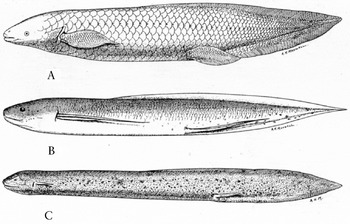
Kerr's autobiography includes a plate showing the ‘three surviving types of lungfish’, Ceratodus from Queensland, Protopterus from Africa, and Lepidosiren from South America (Figure 1). The simple, diagrammatic pictures belie the complex disputes over the nature of these creatures and whether or not they could in fact all be characterized as lungfish, or any other kind of fish. Zoologists wanted to know how the amphibia had evolved and these animals, with features that placed them somewhere between fish and amphibia, seemed the most likely ancestors. Huxley published on them in 1861, creating the order Crossopterygidae to include extinct and living animals with lungs and fleshy pectoral fins fringed with numerous fin rays (lepidotrichia). Balfour and his students believed that the embryology of Polypterus and the lungfish could provide answers to questions about amphibian evolution, especially since the development of the lungfish was so similar to that of amphibians. Carl Gegenbaur and his students believed that amphibians had evolved from the Dipnoi, air-breathing fish of inland fresh water. Gegenbaur argued that the vertebrate limb had evolved from the fin of Ceratodus. Balfour's former pupil Henry Fairfield Osborn characterized this theory as ‘the last of the great hypotheses regarding vertebrate descent to be founded exclusively upon comparative anatomy and embryology as opposed to the triple evidence afforded by these sciences when reinforced by palaeontology’.Footnote 88 Osborn argued that lungfish, Polypterus, coelacanths and the first land vertebrates evolved from the ganoids, primitive armoured fish.
The three surviving types of lungfish. A, Ceratodus (Queensland); B, Protopterus (Africa); C, Lepidosiren (South America). Reproduced from J. G. Kerr, A Naturalist in the Gran Chaco, Cambridge, 1950, Plate 19.

Recalling his student days in Cambridge over half a century later, Kerr said that the ‘School of Zoology’ occupied an international position comparable with that of the Cavendish Laboratory in physics. He said the school was largely morphological, ‘concerned with investigating the form and structure of animals, and with the fascinating problem of how their diversity had come about in the course of evolution’. Embryology was important and the student
was able to view with his own eyes the process of evolution at work: seeing for himself how a highly developed creature such as a bird or a mammal passes through a stage when the main features of its organisation are those of a fish: that, to put it shortly, a bird or a mammal goes through a fishlike stage in the course of its individual evolution.Footnote 89
Kerr felt that this was a gripping study, but he also detected a weakness in the science of embryology because ‘the builders of embryological science had been restricted in their material’. They had studied easily accessible animals, rather than those that were ‘simple and primitive’. However, Balfour had studied sharks and Sedgwick had studied the invertebrate Peripatus. By choosing to investigate the lungfish Kerr saw himself as following in their footsteps, since they were similarly ‘old-fashioned’ in their anatomy. Hearing that specimens had been found in the Gran Chaco, Kerr determined to return there.Footnote 90
Kerr was eventually persuaded to take Budgett, then an undergraduate, with him as a companion. They arrived in South America in late August 1896 to find the missionaries they were staying with eating Lepidosiren for dinner. Kerr enlisted a ‘corps of Indians’ to collect for him, so spent his time in his makeshift hut laboratory, preserving material so that it would arrive back in Cambridge in good condition.Footnote 91 Both Kerr and Budgett felt that the main task of the ‘naturalist’ was to learn about living animals in their natural environment. Laboratory knowledge of their anatomy was important because of its bearing on their living activities and because of ‘the light it casts upon the means by which the evolution of the animal kingdom has been brought about’.Footnote 92 After their work, Kerr felt that Lepidosiren was one of the best known of the important types of vertebrates. This success was due to ‘a combination of good fortune with the co-operation of loyal and able helpers, ranging from red-skinned Indians to highly trained laboratory researchers’.Footnote 93 Kerr decided that he had so much material on Lepidosiren that he could not also investigate Polypterus and Protopterus, so Budgett agreed to look for these.
After his work with Kerr, Budgett made two separate trips to the Gambia, another to Kenya and one to Nigeria. Gambia was initially suggested by Budgett's friend the zoologist Philip Lutley Sclater and the expedition was made under instructions from the council of the Zoological Society, of which Sclater was secretary. Cambridge men often held posts in the society, or knew the more important members, and could use the society as another source of help and funding. Budgett arrived in November 1898 and stayed for eight months, based at McCarthy Island, 150 miles from the mouth of the river. He found ripe eggs in the ovaries of adult fish, but could not find developing ova in the surrounding streams. Artificial fertilization also failed and in July 1899, suffering badly with fever, Budgett left for England.Footnote 94 On his return he found the country on the eve of war with South Africa. Too ill to volunteer, he was active in training the Cambridge University Volunteers, his experience in the Gambia apparently standing him in good stead.Footnote 95 He went to the Gambia again in June 1900 and, despite the state of unrest there, he collected various fish and amphibians, although lungfish embryos continued to elude him. He went back to Cambridge to work in the museum and in 1902 was elected Balfour Student. He could then plan his next trip, this time to east Africa, arriving in Mombasa in June 1902. After much travel he realized that he was not going to find developing lungfish in the Nile either, and he arrived back in Cambridge at the end of November 1902. Budgett was determined, and the following summer he left again, this time travelling to the Niger. This trip was made possible by the help of Arthur James Balfour, then prime minister. Arthur attempted to get Budgett a passage in a king's ship and when this failed paid the fare himself. In the Niger Budgett was finally successful in obtaining the results he was after, watching eggs he had fertilised artificially in the early stages of their development. On return to England he had malarial fever and after a short illness he died of blackwater fever on 19 January 1904.Footnote 96
Budgett and Balfour were both just a few months short of their thirty-second birthdays when they died; there are peculiar echoes created in the way the school portrayed both men. Cambridge men and their friends gathered a collection in Budgett's name and published his collected papers in a memorial volume, just as they had done for Balfour. Contributors were mainly men of science and family members, some of whom had donated to the Balfour fund over twenty years earlier: Arthur James Balfour, Bateson, Thomas William Bridge, Clark, Foster, Sidney Frederic Harmer, Lister, Newton, Sedgwick, Shipley and Mrs Eleanor Sidgwick. The same networks that had served Balfour's memory served Budgett's. They felt that Budgett was a scientific hero.
In his sketch of the life of Budgett in the memorial volume Shipley commented on his trip with Kerr to collect Lepidosiren in 1896–7:
It was a remarkable feat. To go straight as an arrow to the place where this almost unknown fish lives, to arrive at about the time of the breeding season, quite unknown before, and to collect and preserve all the delicate and varying stages of development within some seven months, places the expedition in the first rank of Zoological exploration.Footnote 97
Despite all the possible problems with it, the material was impressively well preserved. For the Cambridge school this was the exemplary expedition. Shipley's description shows the extent to which they valued skills beyond the museum and laboratory. Budgett and Kerr were naturalists; they had to use their knowledge to find an animal unknown to them and gather it in its various stages. Their ability then to preserve this material differentiated them from collectors and naturalists who had other occupations too. The complete zoologist was an adventurer–hero who was also precise and methodical. Shipley described Budgett as a young boy, awakening at three in the morning during the summer to watch the sunrise and the awakening birds and beasts. Budgett was ‘in a great measure self-taught’: ‘His knowledge of bird-life, his acquaintance with the methods of mounting objects, and his skill in keeping animals in captivity healthy, could not have been acquired in the Lecture-room.’Footnote 98 Acquaintances of Budgett's were killed whilst in the Gambia, along with their servants and the nine policeman who were protecting them. Fellow travellers also died of yellow fever and Budgett himself had malaria.Footnote 99 Shipley's account of Budgett's work emphasizes the dangers that explorer–zoologists faced as they tried to track down embryos.
Budgett's own accounts of his work are not dry descriptions of microscopic research. Much of the detailed work had to be performed by colleagues after his death. He gave systematic descriptions suited to natural history, including size, colour, number of fins, shape of body and head, differences between male and female and, where possible, migratory habits and details of when they spawned. Systematic zoologists valued such information for it enabled them to categorize animals, placing them in classes, orders and families. Budgett also described the animal's habits in the wild and in captivity, including its daily behaviour and feeding habits.Footnote 100 Shipley recounted a diary entry that Budgett had made in October 1896 in which he described searching for frogs during a walk, shooting a lizard, cleaning his guns and watching ‘Indians’ catch two large skates, one of which gave birth to fifteen tiny skates which Budgett then ‘secured’.Footnote 101 Zoology as practised by Budgett and described by Shipley was a mixture of science, exploration, hunting, natural history and enthusiasm for nature.
Budgett's success depended on his communication with the ‘natives’ and colonizers in the countries he visited. Whilst in the Gran Chaco he commented that ‘the boys are very sharp and jolly, quite like nice English boys’.Footnote 102 Boys often brought him specimens and Budgett needed local knowledge if he was to find fish quickly in areas unknown to him. He went prepared with drawings of the animals he was looking for, so he could show them to people who often used different terminology. Budgett blended his knowledge with that of the natives, adapting and appropriating their methods by damming swamp outlets to catch fish. When trying to catch polypteri in the Gambia he found that his seine-net and trammel were far less effective than the native cast-net, although he tried his own nets first.Footnote 103 An expedition such as Budgett's required considerable resources and at one stage his trip in the Gambia involved thirty-nine of his own porters and fifteen more that he borrowed.Footnote 104 He travelled with English mineralogists and a French prospector, stayed with colonial officials and traders, and on one occasion had his interpreter sleep outside his hut to ward off two men overheard discussing how to kill the white man. On occasion he found local knowledge invaluable, whilst at other times he complained of the ignorance of local fishermen.Footnote 105 Amused by his porters' attachment to their particular load, Budgett claimed he would recognize a porter ‘more by the load he carried than by his own name’.Footnote 106 Yet he did acknowledge the ‘native’ expertise he used in his published works. The varied cast members in the drama were there for all to see.
Budgett's persistence paid off. On his final trip he managed to fertilize the ripe ova of Polypterus senegalus. Shipley recounted,
For the next five days he was watching one of the most wonderful sights this world affords us, the development of an animal from the egg. After years of patience, after three unsuccessful journeys into the heart of Africa, he had at last succeeded where all others had failed, and as he watched under the microscope the gradual unfolding of the ovum, the formation of the layers, the building up of the organs, he must have experienced a joy peculiar to men of science, and experienced by but few of them.Footnote 107
After a week the embryos developed a fungal infection and died. There are a few later accounts of Polypterus development, but the questions that Budgett posed by and large remain unanswered.Footnote 108
Conclusion
An examination of the reasons Cambridge zoologists selected animals and their methods for obtaining them reveals the skills they needed, showing them to be far more than section-cutters in thrall to comparative embryology and recapitulation. Balfour concentrated on making use of fairly local networks, drawing on friends and family to help him fund the zoological station at Naples. There he found that elasmobranch embryos were readily available, especially since Dohrn made sure that they were put aside for him. Having already obtained a fellowship on the strength of his work on the elasmobranchs, Balfour was not to be tempted back to England by Lankester and the more dubious prospect of the lampreys. There were no fossils against which to compare living forms, and lampreys were degenerate as well as primitive. They were useful for Lankester, since they were available in England, but Balfour had the wherewithal to remain in Naples.
The studentship founded in Balfour's honour enabled a different kind of research. Balfour students could draw upon funding from the Royal Society and the Zoological Society. There were travel grants available from the university and they could also ask patrons such as Arthur James Balfour for help with costs. These possibilities enabled them to make extensive trips. The studentship was deliberately cautiously funded so that it would only attract men who were truly interested in science rather than in possible monetary reward. Holders were to be guided by Sedgwick, who continued in his friend's tradition, despite his rather more irascible temper. Willey searched for the pearly nautilus, but became disillusioned with comparative embryology. Kerr and Budgett, both educated in the decade following Balfour's death, continued to research in comparative embryology using morphological methodology. Their search for the lungfish was a Balfourian project, drawing not just upon skill in the laboratory and museum but upon the heroic ability to survive in the wilds of South America and Africa. They were well-rounded naturalists, showing a love for nature whilst attempting to understand it, and the ability to mix with people of all backgrounds in their search for unusual animals.
Whilst the Cambridge school maintained some aspects of its success, it lost a heroic young figurehead. Balfour and Budgett both died early. The First World War put paid to the recruitment of young male students and also changed the nature of the world in which zoologists were operating. Collecting and networking skills learnt in Cambridge colleges, whilst still valuable, did not quite carry the clout they had once done. The new explorer–heroes did not fit so well with Cambridge as had Balfour. Caldwell fell foul of the university's residence regulations by his prolonged absence.Footnote 109 All the zoologists were short of space; when Balfour students returned from trips with material, they literally found that there was no room in which they could work.Footnote 110 The MLRS was eventually persuaded to allow a corrugated lean-to to be placed atop an existing building. Balfour and his methods had fitted well with Cambridge in the 1870s, but the zoology department could barely accommodate the new heroes it had created – comparative embryology and animal morphology were allowed to wither away.
My thanks to participants at the Europe in Science–Science in Europe Conference, Maastricht, November 2004, those who attended a seminar at Exeter University in March 2005, and the journal's referees for their comments on earlier versions of this paper. I am grateful to the Syndics of Cambridge University Library and to the Archives of Imperial College London for permission to use material held in their collections. I would also like to thank the Balfour family for permission to cite material held in the Balfour family papers at the National Archives of Scotland. The research for this article was funded by a Wellcome Trust Research Fellowship.