INTRODUCTION
In this paper, I explore the integration of Honduras in long-distance economic and sociopolitical relations in the transition from the Classic to Postclassic period, revisiting and revising my previous discussion of this topic (Joyce Reference Joyce1986). I review evidence that suggests that circulation of a distinctive type of white-slipped pottery, Las Vegas Polychrome, is one of the most visible reflections of the participation of Honduran sites in the exchange of multiple goods of restricted circulation through networks extending from Central Mexico to Costa Rica. The distribution of a second highly visible but rarer material of restricted circulation, copper alloy objects, is related to the distribution of Las Vegas Polychrome, but does not entirely align with it, suggesting that Honduran sites participated in multiple networks of interaction at the same time. The use of these and other materials of restricted consumption testifies to the emergence of a smaller, more closed elite group in Honduran societies after a.d. 800.
I begin with a discussion of Las Vegas Polychrome, developed in Honduras and long recognized as a marker of the Early Postclassic period there. Understanding Las Vegas Polychrome is challenging because, unlike the earlier Ulua Polychrome tradition from which it developed, Las Vegas Polychromes do not appear to be used as common food-serving vessels, making their occurrence in sites less frequent. Outside Honduras, Las Vegas Polychrome is often misidentified as one of the white-slipped types manufactured in the Nicoya region, further obscuring relationships.
Until recently, there was a paucity of well-documented excavation contexts for this period in Honduras. By clarifying the distribution inside and outside Honduras of well-documented whole vessels and sherd samples, I refine the dating of this style of pottery, showing that it was made substantially earlier than originally proposed.
Contexts in which Las Vegas Polychrome pottery is found provide a strong basis to interpret it as a ware used within Honduras primarily by a small social elite in burials and other ritual deposits, a break with patterns of consumption of polychrome pottery in earlier times. Las Vegas Polychrome vessels that made their way in small numbers to distant locations outside Honduras were employed in similar ways, with differences in range of activities suggested by preferences for vessel forms.
In the final section of this paper, I review evidence that use of new goods in Honduras, of kinds known to have been important in the sixteenth century, began in the Early Postclassic period in association with changes in painted pottery. Analysis of the iconography of Las Vegas Polychrome identifies a common theme of a serpent-bird hybrid which, while rooted in local precedents, would have been legible outside Honduras to people using imagery of feathered serpents in practices identified as shaping new social relations across Mesoamerica. This image remains the single most common feature of Late Postclassic painted pottery in Honduras, depicted on pottery types that continued to be restricted in their distribution to social leaders, including the traders in cacao and copper objects mentioned in the earliest Spanish accounts of coastal Honduras. The shift to more restricted use of painted pottery and its employment in new practices shows that the period around a.d. 800–1000 was a time of significant social change in Honduras.
UNDERSTANDING LAS VEGAS POLYCHROME: KEY SITES
Las Vegas Polychrome is recognized as part of a group of white-slipped polychromes that were developed in a zone extending from Costa Rica to Honduras and El Salvador. Recent excavation of Las Vegas Polychrome vessels in well-dated sites helps in understanding their chronology and role in political and economic relationships within and outside Honduras.
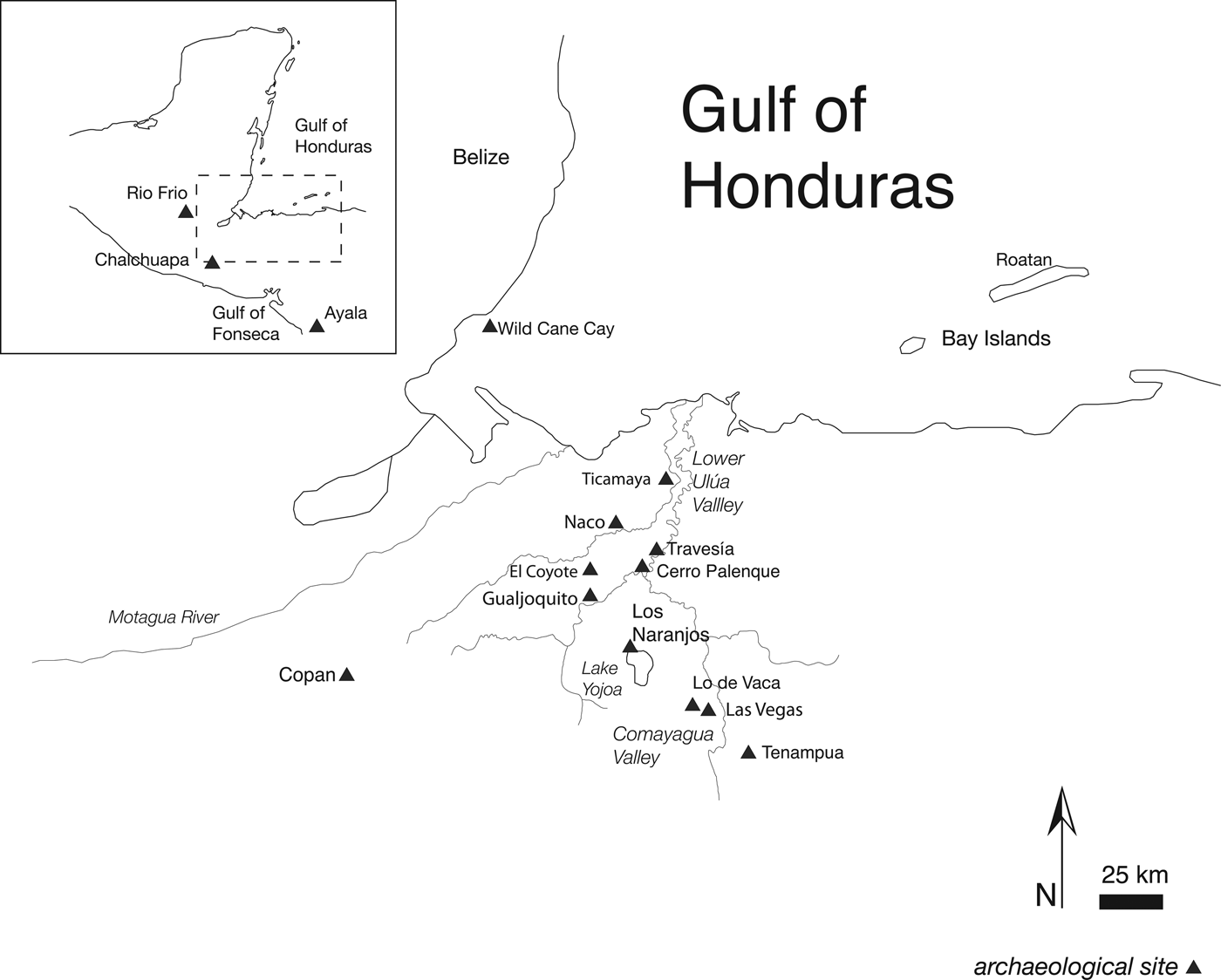
Las Vegas Polychrome was named by Stone (Reference Stone1957:33–34), and described by her as originating in sites in the Comayagua valley, including the type site Las Vegas (Figure 1). Baudez and Becquelin (Reference Baudez and Becquelin1973:313–318) provided the first modern typological description, based on a sample of 58 sherds (two in stratigraphic sequence) and seven vessels excavated at Los Naranjos, a site located on the shore of Lake Yojoa, north of Comayagua. They proposed a chronological placement between a.d. 950–1250, as part of the Early Postclassic Rio Blanco Phase (Baudez and Becquelin Reference Baudez and Becquelin1973:93–96, 313–318).
Map showing major sites. Drawing by the author.

Recent research in Nicaragua has begun to address the specific relationships of Las Vegas Polychrome to other Central American white-slipped pottery types. Based on a sample of 100 vessel images from online sources, Steinbrenner (Reference Steinbrenner2010:533–534) argued that Las Vegas Polychrome closely parallels the southern Papagayo Polychrome type. Dennett (Reference Dennett2016) analyzed the chemical composition of sherds identified as possible Las Vegas Polychromes excavated in sites in Nicaragua. Their chemical and petrographic profiles were diverse. Some were possibly produced in the Gulf of Fonseca area, while others indicated imitation of the style by potters working with materials local to the Granada area of Nicaragua (Dennett Reference Dennett2016:178–213, 229, 315).
In research on the communities of practice that produced diverse painted vessels in Honduras, I recorded vessels in museum collections in the United States, Europe, and Central America, or illustrated in published sources (Joyce Reference Joyce2017). This included recording 54 whole or reconstructed Las Vegas Polychrome vessels. Based on my analysis, presented in detail here, I identify the strongest connections of Las Vegas Polychrome with the earliest Papagayo Polychrome variety, Culebra (Steinbrenner Reference Steinbrenner2010:767–773).
The previously proposed initial date for Las Vegas Polychrome (a.d. 950) is considerably later than the development of Papagayo Polychrome, yet Las Vegas Polychrome has its strongest ties to the earliest Papagayo variety, and was imitated in Nicaraguan sites where Papagayo was produced. The precise combinations of vessel forms, design structure, and motifs of Las Vegas Polychrome do not duplicate Papagayo Polychrome, so it cannot be described as derived from the southern group. A review of contexts where Las Vegas Polychrome vessels have been excavated establishes that Las Vegas Polychrome likely was created significantly earlier than previously thought, contemporary with Papagayo Polychrome. The same data indicates that Las Vegas Polychrome traveled from Honduras through networks that facilitated the movement of luxury goods, providing the opportunity for southern potters to become familiar with it and, in some cases, emulate aspects of the vessels whose roots in Honduras can now be explicitly specified.
Contexts in Honduras
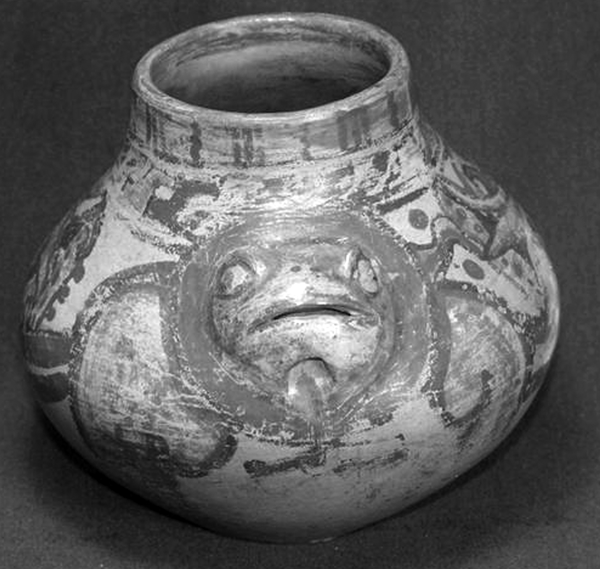
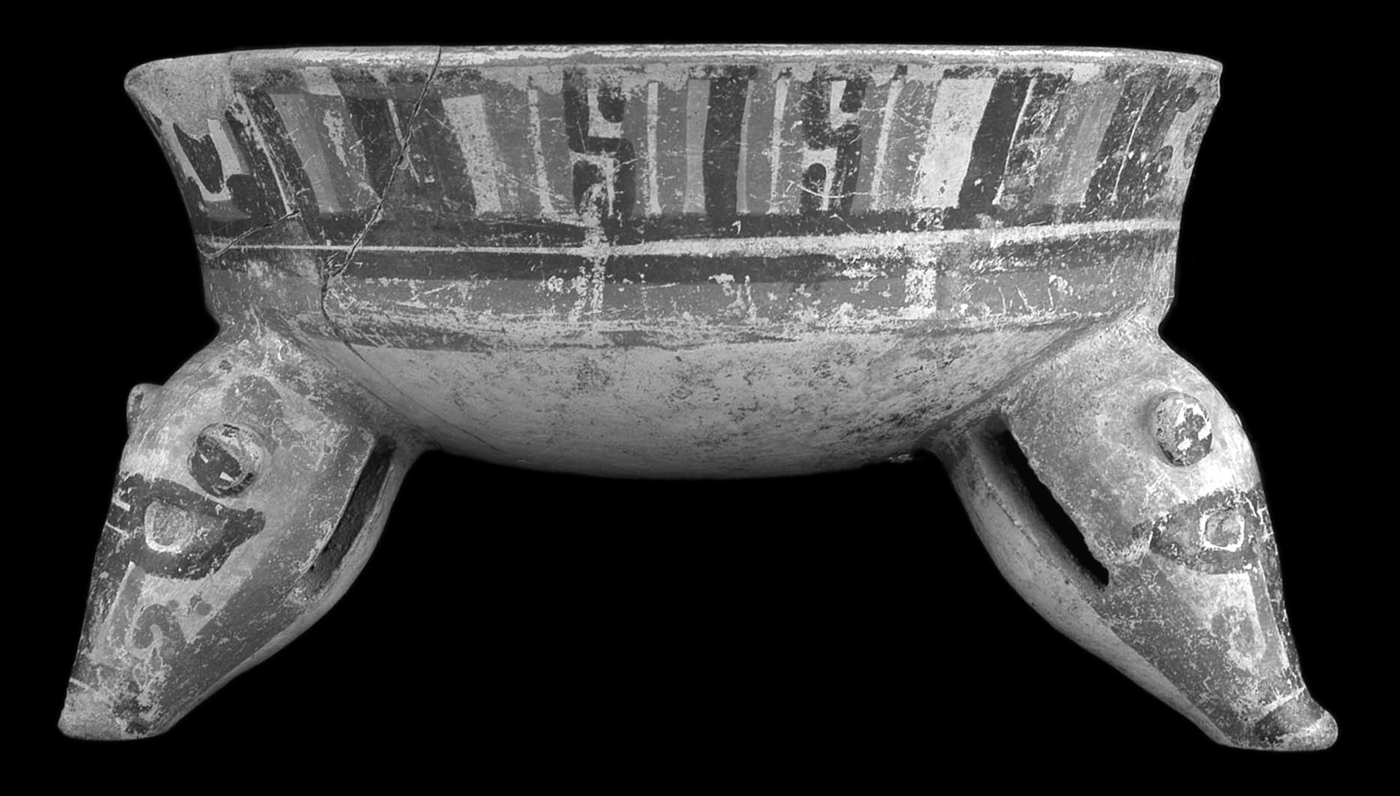
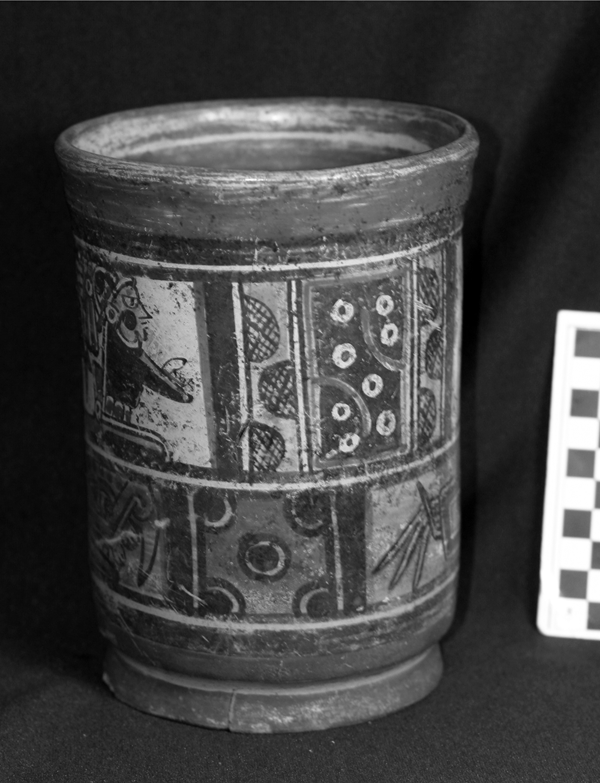
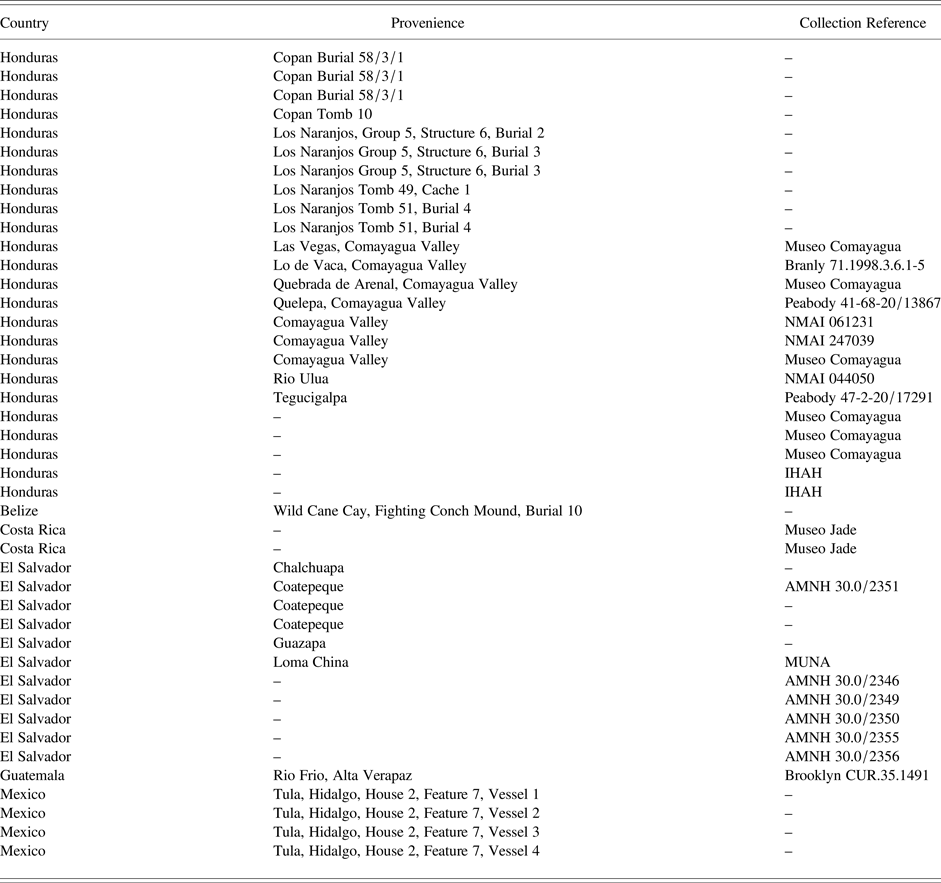
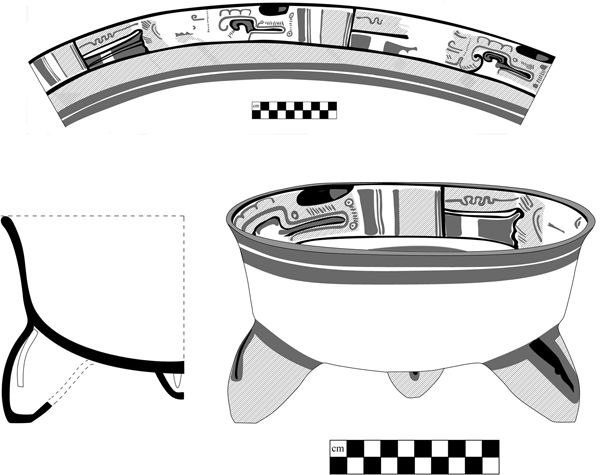
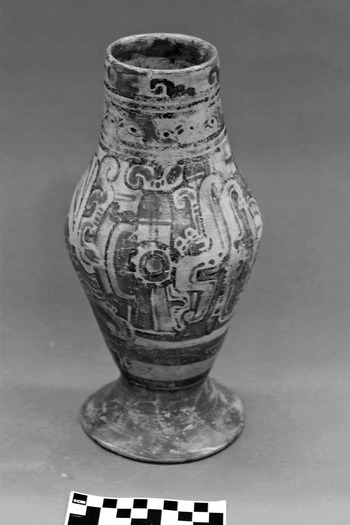
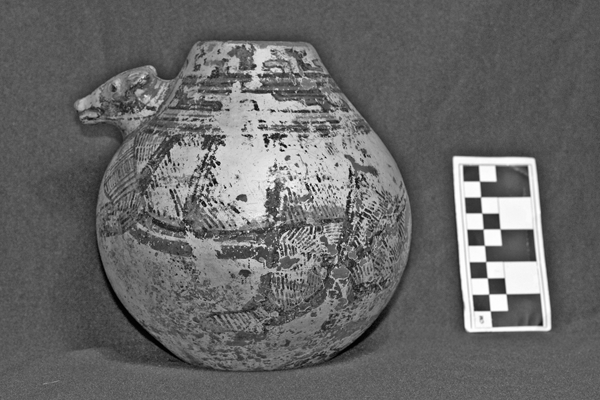
The majority of my sample of complete or nearly complete Las Vegas Polychrome vessels comes from Honduras (Table 1). Three form classes are known: incurved rim vases, or periforms (Figure 2); tripod bowls (Figure 3); and cylindrical and complex silhouette forms with pedestal bases (Figure 4). Whole vessels have been recovered in Honduras at Copan; near the modern towns of La Lima and Progreso, both in the lower Ulua valley; at Los Naranjos, on Lake Yojoa; at the Las Vegas, Lo de Vaca, Quebrada de Arenal, and Quelepa sites in Comayagua; and at Berrinche Hill, near Tegucigalpa (Baudez and Becquelin Reference Baudez and Becquelin1973; Longyear Reference Longyear1952; Manahan Reference Manahan2004; Stone Reference Stone1957; and unpublished museum collections). Sherds are reported from the same sites in Comayagua, as well as Los Naranjos (Baudez and Becquelin Reference Baudez and Becquelin1973); at Travesia and Cerro Palenque in the Ulua valley (Hendon Reference Hendon2010:189; Joyce Reference Joyce1985:514); and in the Department of Santa Barbara at Gualjoquito (Schortman et al. Reference Schortman, Urban, Ashmore and Benyo1986:271; Sheptak Reference Sheptak1985) and El Coyote (Urban et al. Reference Urban, Shugar, Richardson, Schortman, Simmons and Shugar2013).
Periform vase with flat base and modeled frog effigy from Comayagua, Honduras. Smithsonian Institution, National Museum of the American Indian 06/1231. Photograph courtesy of Russell Sheptak.

Tripod dish with effigy feet in form of animal heads from Lo de Vaca, Comayagua. Musée du Quai Branly No. 71.1998.3.6.1. Copyright Musée du quai Branly-Jacques Chirac, Dist. RMN-Grand Palais/Art Resource, New York.

Cylinder with pedestal base, Comayagua. Smithsonian Institution, National Museum of the American Indian No. 24/7039. Photograph courtesy of Russell Sheptak.

Sources of recorded vessels. Abbreviations for collections: AMNH, American Museum of Natural History; BA, Banco Atlantida; IHAH, Instituto Hondureño de Antropología e Historia; MUNA, Museo Nacional de Antropología, Dr. David J. Guzman; NMAI, National Museum of the American Indian, Smithsonian Institution.

In the Ulua valley, sherds of Las Vegas Polychrome co-occur with late Ulua Polychromes and with the Baracoa Fine Paste ceramics that replace Ulua Polychromes in the ninth century (Hendon Reference Hendon2010:189; Joyce Reference Joyce1985:514). The transition from use of late Ulua Polychromes to use of Baracoa Fine Paste vessels and the introduction of Las Vegas Polychrome in this region took place between a.d. 780 and 880, based on a series of 18 radiocarbon dates from late components of sites in this area (Lopiparo et al. Reference Lopiparo, Joyce, Hendon, López Varela and Foias2005). This is considerably earlier than the suggested dates for the Rio Blanco phase at Los Naranjos, located in the mountains just south of the Ulua valley.
At Los Naranjos itself, a series of deposits in Structure 6 of Group 5 document a transition from use of Ulua Polychromes to use of Las Vegas Polychrome vessels in burials and caches (Baudez and Becquelin Reference Baudez and Becquelin1973:93–96; Joyce Reference Joyce2017:192–194, 201–203). The construction of Structure 6, a low platform in a residential compound adjacent to a ball court, begins with placement of two architectural caches. One contained a Cancique Polychrome bowl. Originally assigned to the Yojoa Phase (a.d. 500–900), I place this vessel between a.d. 650 and 750 (Joyce Reference Joyce2017:202). The first of ten burials was then placed in the platform. This burial contained an Ulua Polychrome bowl too fragmented for more precise identification, used as a lid on a local incised jar of a type common in the Yojoa Phase (Joyce Reference Joyce2017:202).
The platform was then expanded, with an added foundation cache of a single complex-silhouette Las Vegas Polychrome vase. Eight burials, three with Las Vegas Polychrome vessels, were put in place in continuing episodes of use of the platform. Stratigraphic evidence indicates the three burials with Las Vegas Polychrome vessels were placed in succession. The first contained two Las Vegas Polychrome dishes. A second contained a Las Vegas periform vase, a Tohil Plumbate vessel, and an imported Mixteca-Puebla-style censer. The third burial in this series contained a periform vase accompanied by a possible non-local Papagayo Polychrome dish (Baudez and Becquelin Reference Baudez and Becquelin1973:Figures 121A and 121B).
This platform at Los Naranjos remains the only excavated context in which a sequence of Las Vegas Polychrome vessels has been documented archaeologically. The placement of burials is uninterrupted from a period when Ulua Polychrome vessels were used through two later phases during which Las Vegas Polychrome replaced Ulua Polychromes, ending with a final period of use when burial patterns changed and the only ceramics included were of later red-slipped and incised types (Joyce Reference Joyce2017:203).
At Gualjoquito, southwest of the lower Ulua valley, and west at the site of El Coyote, Las Vegas Polychrome has been recovered in contexts that also yielded Tohil Plumbate potsherds (Sheptak Reference Sheptak1985; Schortman et al. Reference Schortman, Urban, Ashmore and Benyo1986; Urban et al. Reference Urban, Shugar, Richardson, Schortman, Simmons and Shugar2013). The combination of Las Vegas Polychrome and Tohil Plumbate seen at these sites, and in one burial at Los Naranjos, was also noted at Copan.
Copan Tomb 10, excavated in the nineteenth century, contained multiple Plumbate vessels and a periform vessel described as a “Chorotegan polychrome turkey effigy jar, much like a Nicoya polychrome jar” (Longyear Reference Longyear1952:43). More recent excavations at Copan have recovered additional examples of Las Vegas Polychrome vessels in burials in a neighborhood that developed after the dynastic period (Manahan Reference Manahan2004). Burial 58/3/1, placed in Structure 11L-137, included three Las Vegas Polychromes: two tripod bowls and a periform vase. Burial 58/3/1 contained the skeletal remains of “at least three individuals: two females, one child of approximately two years, and possibly an infant” (Fash et al. Reference Fash, Wyllys Andrews, Kam Manahan, Demarest, Rice and Rice2005:282). Radiocarbon dating of bone samples yielded three dates: one with a calibrated intercept at a.d. 980; one at a.d. 1060–1160; and one at a.d. 1260, suggesting that the tomb was reused over time.
The latest date considerably postdates the proposed occupation of this area, and is a single outlier in the overall suite of radiocarbon dates for this neighborhood (Manahan Reference Manahan2004). The other nine radiocarbon dates from the neighborhood have intercepts between a.d. 970 and 1085. Manahan (Reference Manahan2004) argues that the samples best interpreted as dating the occupation here fell between a.d. 990 and 1020, and suggests dates of a.d. 950–1100 for this occupation phase. This would indicate that Las Vegas Polychrome remained in use in Honduras from its initial adoption, which we can assign to between a.d. 780 and 880 based on the radiocarbon record in the Ulua region, until after a.d. 950, perhaps as late as a.d. 1100, based on the Copan dates. Evidence from sites outside Honduras where Las Vegas Polychrome vessels have been recovered strongly supports considering them as products of the same span of time, roughly a.d. 800–1100.
Las Vegas Polychrome Vessels Outside Honduras
Las Vegas Polychromes are widely distributed, if not common, outside Honduras. I recorded 19 vessels with known (or likely) provenience in detail, 11 from El Salvador; four recovered in Mexico; two from Costa Rica; and one each from Guatemala and Belize (Table 1). Three excavations provide context for Las Vegas Polychrome outside Honduras, including chronometric dating.
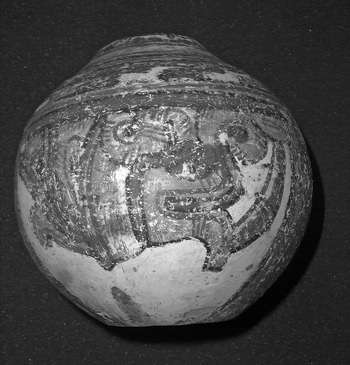
The most detailed contextual information available is for a periform vase (Figure 5) excavated in Burial 10 at Wild Cane Cay, Belize (McKillop Reference McKillop2005:60–84). The individual buried was a female, whose dental traits suggest non-local origin (Heim et al. Reference Heim, McKillop, Morris and Joyce2011). McKillop (Reference McKillop2005:60) says that Burial 10 “rested on the floor of structure 3” and was placed at the beginning of remodeling that created Structure 4 in the sequence of buildings here. Two relevant radiocarbon dates are associated (McKillop Reference McKillop2005:66, Figure 6.9). One spanning a.d. 940–1260 at the 95-percent confidence interval came from the floor of Structure 3, on which the burial rested. A sample from the floor of the succeeding Structure 4 produced a span of a.d. 590–990.
Periform vase, flat base, excavated at Wild Cane Cay, Belize. Photograph courtesy of Heather McKillop.

The overlap between these dates, from a.d. 940–990, may bracket the period when the episode of renovation that included placement of this burial occurred. An earlier burial contained a Silho Fine Orange cylinder, similar to examples assigned to the Sotuta complex at Chichen Itza, dated a.d. 800/850 to 1000/1050 by Bey and Ringle (Reference Bey, Ringle, Kowalski and Kristan-Graham2007:389), or as starting at a.d. 900/950 in more recent proposals (Volta and Braswell Reference Volta, Braswell and Braswell2014). Stratigraphically later burials at Wild Cane Cay contain Tulum Red vessels, which can be assigned to Tases Phase, starting at a.d. 1250.
The second context outside Honduras where chronometric dates are associated with Las Vegas Polychrome vessels is a famous cache of four polychrome vessels and five Tohil Plumbate jars in a subfloor chamber in a house at Tula, Hidalgo, Mexico (Diehl et al. Reference Diehl, Lomas and Wynn1974). The polychrome vessels were originally described as “Nicoya Polychrome” (e.g., Papagayo Polychrome) but are not consistent with the Nicaraguan-Costa Rican white-slipped types.
The cache was assigned to the Tollan phase, dated a.d. 950–1150 (Cobean and Mastache Reference Cobean, Mastache and Healan1989:Table 5.3). A close examination of the radiocarbon chronology for the structure and neighborhood suggests these vessels were put in place in the earliest part of this phase. The chamber in which they were found is Feature 7 in Room 5 of House II in the “Canal Locality” (Healan Reference Healan and Healan1989a, Reference Healan and Healan1989b). The four radiocarbon dates from the Canal Locality are said to be “equivalent to the period a.d. 900–1000, which probably is an early part of the Tollan phase” (Cobean and Mastache Reference Cobean, Mastache and Healan1989:44).
The detailed presentation of these radiocarbon dates shows that they have a maximum 2-sigma range from a.d. 675 to 1030, and completely overlap between a.d. 850–910 (Healan Reference Healan and Healan1989b:Figure 11.1). A sample that comes from House II itself (QL 132) is especially early, with a two-sigma range from a.d. 675–950.
Taking all of the chronometric information into account, this context must at the latest be assigned to the tenth century, and actually may best be interpreted as dating slightly earlier. This would place the event involving these Las Vegas Polychrome vessels in either the Terminal Corral phase (a.d. 850–900) or Early Tollan phase (a.d. 900–950), as refined by Bey and Ringle (Reference Bey, Ringle, Kowalski and Kristan-Graham2007).
Additional support for considering relatively early dates for the emergence of Las Vegas Polychrome comes from the site of Corinto, Costa Rica. There, probable Las Vegas Polychrome sherds are associated with a radiocarbon sample with a two-sigma calibrated range with intercepts at a.d. 680–830 or a.d. 840–870 (Patricia Maria Fernández Esquivel, personal communication 2013; Silvia Salgado González, personal communication 2013).
Development of Las Vegas Polychrome
The radiocarbon dates discussed suggest that Las Vegas Polychrome made its way to both Costa Rica and Mexico quite early, while the dated examples from Wild Cane Cay and Burial 58/3/1 at Copan relate to a slightly later period of production and use. This interpretation is supported by analysis of different vessel shapes represented.
Pedestal-base cylinders appear to be an early Las Vegas Polychrome vessel form. Two were included in the early context at Tula. This is a form that was executed by Ulua Polychrome potters before the development of Las Vegas Polychrome, as early as a.d. 650–750 (Joyce Reference Joyce2017:50). I identified two examples in the Museo de Jade in San Jose as possible examples of Las Vegas Polychrome. They are comparable in format and execution of painted motifs to a Las Vegas Polychrome vessel from Comayagua in the collection of the National Museum of the American Indian (Figure 4). The Costa Rica vessels depict a standing human or anthropomorphic feline figure, motifs used on Ulua Polychromes dating from a.d. 750–850 (Joyce Reference Joyce2017:73–74). A sixth example of this rare, potentially early Las Vegas Polychrome vessel form was reported from Chalchuapa, El Salvador (Baudez Reference Baudez and Hogarth1970:Plate 59). This would indicate that Honduran potters or patrons had established ties reaching from Costa Rica to El Salvador and Mexico in the earliest stage of development of Las Vegas Polychrome.
The two other vessels reported from Tula, a tripod bowl and a periform vase with a tall neck and a pedestal base, also use vessel forms that are typical of Ulua Polychromes dating between a.d. 750 and 850 (Joyce Reference Joyce2017:84–85). The motifs on all four vessels at Tula overlap with the Tenampua group of Ulua Polychromes, made in Comayagua at this time. Tenampua group Ulua Polychromes include pedestal-base cylinders with white-slipped exteriors in which the main design field has no additional motifs, the design structure of the two examples from Tula, otherwise unattested in my sample of Las Vegas Polychrome vessels.
The evidence from excavated vessels suggests that Las Vegas Polychrome developed over a period lasting from a.d. 800 to 1100 through innovations in the existing Ulua Polychrome tradition of Honduras. In order to understand why Las Vegas Polychrome was developed, and how it compares to Ulua Polychromes on the one hand and other white-slipped polychromes on the other, a closer examination of the type and variability across its spatial distribution is helpful.
LAS VEGAS POLYCHROME STANDARDS
The number of Las Vegas Polychrome vessels I recorded, a total of 54 vessels, is a tiny fraction of the 1,500 complete Ulua Polychrome vessels I reviewed in the same repositories. The sample is most comparable to the counts of vessels representing subgroups within the Ulua Polychrome tradition that were each produced in a restricted area for a short period of time (Joyce Reference Joyce2017). This suggests we should view Las Vegas Polychrome vessels as the products of a similar scale of production, possibly workshops in a single site.
Relatively few sites dating to the Early Postclassic period in Honduras have been reported and even fewer have been extensively investigated. Las Vegas Polychrome is noted in published sites in low frequencies that suggest it is not a local product. At El Coyote, Las Vegas Polychrome is reported as making up less than one percent of the ceramics recovered (Urban et al. Reference Urban, Shugar, Richardson, Schortman, Simmons and Shugar2013). At Cerro Palenque and Travesia, the total sample recorded is also less than 1 percent (Hendon Reference Hendon2010:189; Joyce Reference Joyce1985:514). The proportion of Las Vegas Polychromes in the seriated sample from Los Naranjos was equally low, with only two out of 18,236 sherds identified as this type, although it reportedly constituted 5.8 percent of the sherds from construction fill in a second ballcourt in Group 6 (Baudez and Becquelin Reference Baudez and Becquelin1973:313).
I use the full set of 54 vessels that I recorded for quantitative analysis of patterns in production. Of these, 47 vessels provided sufficient information for assignment to provenience on the country level, and 31 could be identified on a regional, site, or intra-site level (Table 1). This provides a distributional basis to consider the role and associations of Las Vegas Polychrome in interregional relationships.
Ten of the 24 recorded vessels from Honduras can be attributed origins in sites in the Comayagua valley, identified by Stone (Reference Stone1957) as the center of Las Vegas Polychrome production. I trace the development of Las Vegas Polychrome from the Tenampua group of Ulua Polychromes, made in the Comayagua valley from ca. a.d. 750 to 850 (Joyce Reference Joyce2017). These dates overlap with the chronometric data discussed here for Las Vegas Polychrome. Tenampua group Ulua Polychromes provide precedent for white slip predating a.d. 800 in Honduras. Features that link the Nicoya region ceramic Papagayo Culebra variety to Las Vegas Polychrome appear in Tenampua group Ulua Polychromes, as well. Las Vegas Polychrome shows notable regularity in vessel form preferences, design construction, and use of motifs that distinguish it from both Ulua Polychromes and contemporary white-slipped pottery in Nicaragua and Costa Rica.
Vessel Morphology
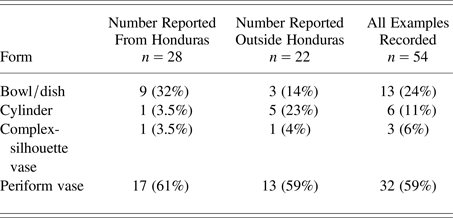
In my sample, the most commonly encountered form (59 percent of the recorded vessels) is a periform vase (Table 2). While most periform vases have a direct rim or short vertical collar, about 20 percent have a taller neck extending above the body (Figure 2). These vessels normally have flat bases (80 percent), with low ring or taller pedestal bases as less common alternatives. About half have modeled animal heads emerging from the vessel side, and more rarely limbs or tails are applied.
Frequencies of vessel forms. Based on 50 vessels with an attributed country of origin and four without.
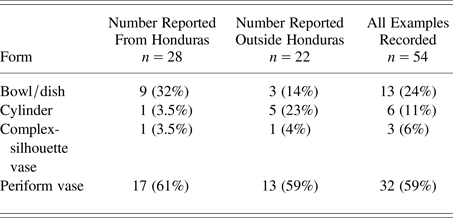
Second in frequency (24 percent) are bowls or dishes with tripod supports (Figure 6). About one-quarter of the bowls and dishes I recorded have supports modeled and painted to represent an animal head (Figure 3). The rarest forms in the sample are vases, which include cylinders (11 percent) and complex-silhouette forms (6 percent). All have pedestal bases. Complex-silhouette vases are tall, closed forms that reach their widest diameter near the middle of the wall (Figure 7).
Tripod dish with main painted surface interior, excavated in Copan Burial 58/3/1. Drawing courtesy of T. Kam Manahan.

Complex silhouette vase, reportedly from Rio Frio, Alta Verapaz, Guatemala. Brooklyn Museum, A. Augustus Healy Fund, No. 35.1491. Photo by Russell Sheptak.

Cylinder forms are more frequent in sites outside Honduras (23 percent), while bowls and dishes are rarer (14 percent). The higher frequency of vase forms outside Honduras is likely to reflect differences in the practices in which Las Vegas Polychromes participated. Bowls and dishes were used in food serving in Honduran sites throughout the period from a.d. 500–1000 (Joyce Reference Joyce2017). Outside Honduras, Las Vegas Polychrome vessels likely were used for more limited purposes, not general food serving.
Design Construction
Las Vegas Polychromes have highly standardized design construction. Half of the periform vases recorded are animal effigies. At the simplest, these have a lug head supplemented by a painted body representing other features of the animal. At their most complex, the vessel has additional modeling of limbs and tail. The most common animal represented (half of the recorded examples) is a frog (Figure 2), followed by human/monkey images, and rarer animals including birds, felines, and other quadrupeds (Figure 8).
Periform vase, flat base, animal effigy, Ulua Valley, Honduras. Smithsonian Institution, National Museum of the American Indian 04/4050. Photograph courtesy of Russell Sheptak.

One or two red bands over the vessel lip and just below, and another red band or bands above the base of the vessel wall, frame two to five superimposed design fields, sometimes bordered with narrow, black lines that contain single or alternating motifs (Table 3). Vessels with two or three design fields are most common (70 percent). In the majority of cases with four or five design fields (71 percent), at least one design field repeats motifs from another, in alternating design fields. The sample of bowls and dishes with the main painted designs on the interior is small (less than one-third of recorded bowls/dishes), but all feature a continuous design field on the interior wall (Figure 6).
Design structures by vessel form.

Motifs
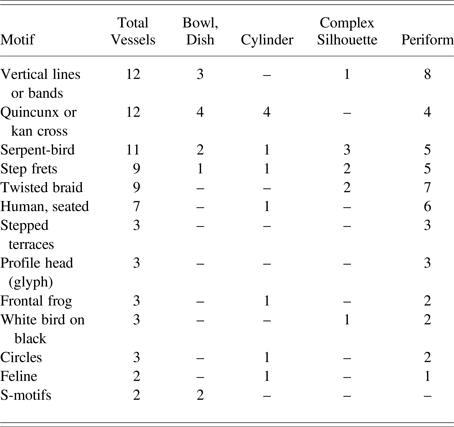
Las Vegas Polychrome motifs have limited overlap with those on other Central American white-slipped polychromes, but do include a group of motifs shared with Ulua Polychromes. The most common motifs recorded are vertical bars or horizontal bands of different colors (black, orange, and red); a quincunx; a serpent-bird; step frets; a twisted braid; and a seated human figure (Table 4). Most of these can appear in the first design field below the lip. The second design field can contain solid color bands, step frets, twisted braid motifs, the quincunx, the seated person, and the serpent-bird, as well as a variety of less common motifs.
Repeated motifs on Las Vegas Polychromes.

In these two design fields, a common motif may alternate with a less common one. In two-thirds of the cases of alternating motifs, one of the two is a quincunx. The next most common motifs are a seated person or profile human heads, found in one-third of the vessels with alternating motifs in a design field.
On animal effigy vessels, the modeled head and sometimes limbs of the animal normally emerge from the second or third design field. This is also the preferred location of the single large motif of a hybrid serpent-bird. In a small number of cases (3 vessels in the sample) both an animal effigy and the serpent-bird motif are present, alternating in the same design field.
The fourth and fifth design fields often repeat simpler geometric motifs from a previous band. The fourth design field can contain red bands, vertical bars, a twisted braid, or step frets. When a fifth design field is present, it contains only red bands or vertical red bars. These motifs are also found on most supports, with two examples of step frets on the pedestal base of a cylinder as exceptions.
Tripod feet on some Las Vegas Polychrome dishes are modeled and painted as animal heads (25 percent of the recorded vessels). These depict the head of an animal previously featured on Tenampua group Ulua Polychromes, where it is identified as a tapir (Figure 3). Steinbrenner (Reference Steinbrenner2010:1094) suggests identification with the coatimundi or a peccary. While earlier Ulua Polychromes do not feature coatimundis, they do include peccary images, especially common on vessels from the Comayagua region. This is one of several features that suggest that Las Vegas Polychromes developed out of the Ulua Polychrome tradition in Comayagua.
THE DEVELOPMENT OF LAS VEGAS POLYCHROME
Following Stone (Reference Stone1957), the Las Vegas archaeological site has been identified as the center of production of Las Vegas Polychrome. Dixon (Reference Dixon1989:265–266) has demonstrated that Las Vegas was the only large settlement on the Comayagua valley floor that continued to be occupied during a period when the hilltop fortress site of Tenampua exercised control over the valley. The development of Las Vegas Polychrome is intimately connected to the histories of these two sites.
Orange-slipped Ulua Polychromes were produced between a.d. 450 and 850 in an area encompassing much of modern Honduras (Joyce Reference Joyce2017). In the Comayagua Valley, distinctive regional characteristics of Ulua Polychromes can be identified before the mid-eighth century, culminating in the emergence of the Tenampua group of Ulua Polychrome after a.d. 750, slipped white over an underlying orange slip, or sometimes dispensing with the orange slip entirely (Joyce Reference Joyce2017:50–56, 67–69, 146–148). The Tenampua group shares vessel forms with the broader Ulua Polychrome tradition, including a tripod dish with low walls, hemispherical bowls, and tripod cylinders. None of these forms are found in Las Vegas Polychrome.
The Tenampua group also features three vessel forms not otherwise seen in Ulua Polychromes, that are shared with Las Vegas Polychrome: incurved rim (periform) vases, cylinder vases with pedestal bases, and deep bowls with three or four supports, often in the shape of animal heads. These three vessel forms likely developed late in the history of the Tenampua group. The same forms are noted in the early Culebra variety of Papagayo Polychrome, the white-slipped polychrome of Costa Rica and Nicaragua, where the cylinder is characterized as “exotic,” that is, not of local derivation (Steinbrenner Reference Steinbrenner2010:770).
There is a greater disjunction between Las Vegas Polychrome and Tenampua group Ulua Polychromes in design structure than in slip color. Tenampua group vessels conform to norms shared by eighth-century Ulua Polychromes and lowland Maya polychromes from Peten and Belize (Joyce Reference Joyce2017:67–71). These combine a single, narrow upper band on vessel exteriors with a wider main design field, often depicting a group of anthropomorphic figures engaged with each other in action that wraps around the vessel. Las Vegas Polychrome never uses this design structure.
Despite this, considerable overlap in motifs exists between these two polychrome groups. Step frets (Figures 7 and 8); continuous twisted braids (Figures 2 and 7); and “kan cross” motifs, a square with a central dot and four corner dots, also called a quincunx (Figure 4), are found on both. Step frets and twisted braids have a long history on Ulua Polychromes, in use by the mid-seventh century. Las Vegas Polychrome also shares a repeated profile human head motif in upper design fields, seen on Ulua Polychromes beginning in the seventh century. All four of these motifs are also featured on the early Papagayo Culebra variety (Steinbrenner Reference Steinbrenner2010:767–771).
Many of the animals featured on Las Vegas Polychrome overlap with those depicted on earlier Ulua Polychromes. These include monkey, feline, and possible armadillo images, which appear as early as the mid-seventh century on Ulua Polychromes. A particularly striking overlap between Tenampua group and Las Vegas Polychrome is the depiction of a long-beaked bird, painted in white on a black band, on vessels in both groups.
While these aspects of the animal imagery of Las Vegas Polychromes are consistent with its roots in the Ulua Polychrome tradition, the two most common animal images on Las Vegas Polychrome are innovative. Many Las Vegas Polychrome periform vases are modeled as frog effigies (Figure 2). I have recorded no frog effigies among more than 1,500 Ulua Polychrome vessels and tens of thousands of sherds. Las Vegas Polychrome frog effigy vessels closely resemble Tohil Plumbate vases, including some that have been recovered from sites in Honduras, such as an unpublished vessel found near Progreso in the Ulua Valley, now in the Smithsonian Institution National Museum of Natural History.
The single most common zoomorphic image painted on Las Vegas Polychrome vessels is a serpent-bird hybrid (Figures 5–7). I identify it as a precursor of the serpent-bird image typical of the Late Postclassic Nolasco Bichrome type of Naco (Wonderley Reference Wonderley, Chase and Rice1985, Reference Wonderley1986). Similar images are the main motif of the orange-slipped Early Postclassic Bay Islands Polychrome of the northeast coast of Honduras, which sometimes has a “cream-white slip,” and features a periform vase form (Strong Reference Strong and Steward1948:79). Similar motifs are noted on Papagayo and Vallejo Polychromes, the main white-slipped types from Nicaragua and Costa Rica (Steinbrenner Reference Steinbrenner2010:1053–1058).
Rice (Reference Rice1983) noted a Mesoamerica-wide use of related images in the Postclassic period, and included Honduran examples in her survey. Ringle et al. (Reference Ringle, Gallareta Negron and Bey1998) argued that the wide distribution of such images indexed a feathered serpent deity central to a shared religious cult promoted through a network of pilgrimage centers, beginning around a.d. 800, related to the emergence of new political structures and promotion of long-distance exchange.
Ulua Polychromes already had a long history of related profile and frontal heads combining serpentine and feathered attributes beginning at least by the mid-sixth century. A new emphasis on the religious importance of a serpent-bird hybrid in Epiclassic Mesoamerican sites with which Honduran makers of Las Vegas Polychrome had, or wished to have, continuing connections could have motivated elaboration of this existing Ulua Polychrome imagery. Here, the presence of a set of Las Vegas Polychrome vessels at distant Tula, one of the identified pilgrimage centers of the proposed pan-Mesoamerican religious cult, is particularly suggestive of participation by Las Vegas Polychrome potters in related practices.
This cosmopolitan orientation included ties south in Central America, as well. The features of Las Vegas Polychrome support the argument that it was developed by potters who were thoroughly familiar with the repertoire of Tenampua Polychrome, which alone among Ulua Polychrome groups used the same vessel forms (the periform vase, pedestal cylinder, and animal-foot bowl) and some particular motifs (the quincunx and the white bird on black background). The two groups of potters shared an interest in lighter background colors, achieved in Tenampua group by applying a white slip over an orange background slip, and in Las Vegas Polychrome through a white slip directly covering the pink to red body.
Yet Las Vegas Polychrome potters rejected central aspects of the pictorial content of the Tenampua group, and thus, of the Ulua Polychrome tradition. Where Tenampua potters excelled in depicting scenes of ritual and political action, Las Vegas Polychrome potters abandoned the design structure that designated a large part of the vessel as a field for a continuous scene. They do not depict interactive engagement of anthropomorphic figures. Human and animal figures are used as single, repeated, or alternating motifs in multiple superimposed registers. In these ways, Las Vegas Polychrome potters more closely resemble contemporaries in Nicaragua who Dennett (Reference Dennett2016:213, 222–226) has demonstrated produced Papagayo Polychrome in the Granada region, exploiting a clay resource exposed after a.d. 700.
Technological distinctions between Tenampua group and Las Vegas Polychrome are significant. Despite their apparent shared origin in the Comayagua Valley, Las Vegas potters used a very different clay, and/or firing, than Tenampua group potters, so that the body of Las Vegas Polychromes is normally pink to brick red. The white slip they employed is dense, thick, and hard, and often matte rather than presenting the glossy surface typical of Ulua Polychromes. These preferences follow innovations seen in early Papagayo Polychrome, resulting from decision making that Dennett (Reference Dennett2016) calls emulation.
The differences in design structure and technology between Tenampua group Ulua Polychromes and Las Vegas Polychrome lead me to suggest that Las Vegas Polychrome was created by potters in the Comayagua Valley who were working within the same cosmological universe as Tenampua potters (with concepts of a center and four quarters and beliefs about certain animals) but who rejected the overt political and social content of Ulua Polychromes as part of their participation in new political and social structures. To understand this shift, we need to look at the histories of the two dominant sites of the Comayagua region in the eighth and ninth centuries, Tenampua and Las Vegas, where the patronage of these two polychrome groups can be located.
Las Vegas and Tenampua
Dixon (Reference Dixon1989) shows that the Las Vegas site, the only rival to Tenampua's dominance in Comayagua, grew larger after Tenampua ceased to be the main center in the valley, an event he dates to ca. a.d. 1000. He reports that the Las Vegas site had significant lithic workshops, possibly exploiting the Guinope obsidian source, which lies along a route south from the Comayagua valley (Dixon Reference Dixon1989:266–267). Analyses show that the vast majority of the obsidian used in northern Nicaraguan sites came from the Guinope source (Braswell et al. Reference Braswell, González, Fletcher and Glascock2002). This includes 85 percent of the obsidian used during the period when Papagayo Polychrome was developing at the Ayala site in the Granada district, where imitations of both Tenampua Polychrome and Las Vegas Polychrome were produced (Dennett Reference Dennett2016:205).
The use of carved stone metates or seats of Central American style indicates that leaders of Las Vegas and Tenampua were engaged closely with areas further south (Joyce Reference Joyce and Graham1993). Jones (Reference Jones1992:67) used an example excavated at Tenampua to define a northern Central American group, including others from Guanacaste in Costa Rica and Moyogalpa in Nicaragua. Jones (Reference Jones1992:59–60) identified a second style of carved metate/seat at Tenampua, again with a northern distribution, largely within Honduras but extending as far south as the Lago de Masaya in Nicaragua. She assigned both groups of metates present at Tenampua dates between a.d. 500 and 1000.
In contrast, carved metates reported from the Las Vegas site dated after a.d. 800 (Jones Reference Jones1992:62). These, again, had a largely northern Central American distribution extending from the northeast Honduran coast to the Gulf of Fonseca and Quelepa, El Salvador. The sequential but overlapping dating of metate types with slightly different distributions used at Tenampua and Las Vegas points to a.d. 800 to 1000 as a period when a shift took place in the engagement between Comayagua and southern social groups.
This agrees with other lines of evidence that a relationship between Tenampua and Copan, possibly facilitated by marriages between noble families at the two sites, ended in the early ninth century (Hendon et al. Reference Hendon, Joyce and Lopiparo2014:161–165). At this time, Copan was occupied by a population that did not continue the cultural and political practices of the Classic dynasty (Manahan Reference Manahan2004). The new group instead imported Las Vegas Polychrome for use in burials, presumably obtained through social relationships with the resurgent center of power in the Comayagua Valley, Las Vegas.
HONDURAS IN POSTCLASSIC NETWORKS
The pedestal-base cylinder form shared by Tenampua group Ulua Polychromes and Las Vegas Polychrome may be one of the earliest shapes used for the new white-slipped Honduran pottery, represented by vessels that arrived at Tula and others that made their way to El Salvador and Costa Rica in the early ninth century, the first evidence of Honduran participation in new networks of interregional scale. Within Honduras at sites like Los Naranjos, Las Vegas Polychromes were integrated in a pattern of practices that was already established using Ulua Polychromes. The earliest examples in the sequence of burials there, periform vases and tripod dishes, shared forms with Tenampua group Ulua Polychromes. Along with the pedestal-base cylinder, these are also basic shapes of the early Culebra variety of Papagayo Polychrome that developed in Nicaragua by a.d. 770, with an overlapping suite of motifs (Dennett Reference Dennett2016:315–316).
Las Vegas Polychrome was succeeded in the later Honduran Postclassic period by other white-slipped painted types of more restricted distribution. The best studied, a red-on-white type from the Naco valley called Nolasco Bichrome, features as its two most frequent motifs a profile serpent-bird and a continuous twisted braid (Wonderley Reference Wonderley1986:Figure 3). While the fully developed Nolasco Bichrome type dates after a.d. 1250, the beginning of red-on-white painted pottery in the Naco valley lies in the period immediately before (Wonderley Reference Wonderley1986:515–516). I argue that, between a.d. 1100 and 1250, Nolasco Bichrome developed through a re-invention of Las Vegas Polychrome.
Where archaeologists have emphasized discontinuities in Honduras in the succession from Ulua Polychromes to Las Vegas Polychrome and then to less widely distributed types like Nolasco Bichrome, there was actually a great degree of continuity in motifs employed and color preferences binding Tenampua group Ulua Polychromes, Las Vegas Polychrome, and Nolasco Bichrome in a tradition of white-slipped painted pottery. The emphasis on stylistic change has over-shadowed what may in fact be the greatest discontinuities in these polychrome ceramics across the transitional centuries from a.d. 850 to 1250: the more limited practices in which decorated ceramics were employed.
Practices Employing Honduran White-Slipped Polychromes
Ulua Polychromes, prior to the development of the Tenampua group, formed a consistent set of food serving vessel forms including bowls (probably cups for drinking); small jars and cylinders (probably serving as containers from which individual portions of beverages were poured into bowls); and low plates and dishes with three or four legs, appropriate for the presentation of solid food (Joyce Reference Joyce2017). Ulua Polychromes are the main serving wares in sites within their zone of production and use, and were not limited in use to a small social group.
Tenampua group Ulua Polychromes did not greatly change the proportions of these vessel shapes. Most were bowls, cylinders were rarer, and low dishes rarer still. An increase in deep bowls or dishes with tripod supports suggests the possibility of changes in what was being presented in dishes. Yet, overall, these are still all food-serving forms.
Two innovative forms executed by Tenampua potters would have been used for very different purposes: burning resin, rubber, copal, or other substances. Tenampua potters applied the identifying slip and paints of Ulua Polychrome style to ladle censers, which were in use in other areas of Honduras, but decorated in red paint on an unslipped background. Tenampua potters also developed a unique group of cylindrical containers with lids, resting on unusual twisted strand feet, that featured zones of applique spikes. These vessels have extensive residues of charring and smoke on the interior, and served as a second form of incense burner. The production of Ulua Polychrome incense burners reflects an increase in the importance of ritual practices involving burning, which also appear in pictorial imagery on Tenampua polychrome vases (Joyce Reference Joyce2017).
Las Vegas Polychrome potters produced forms that overlapped with Tenampua group Ulua Polychromes, but in very different proportions. These potters did not produce incense burning implements. Vases, containers for large volumes of liquids, are more common than the bowls that constituted individual serving vessels in Ulua Polychrome assemblages. Instead, a tripod dish or bowl, usually with high sides, was emphasized. Outside Honduras, it is Las Vegas Polychrome vases, forms that were arguably beakers, that are most commonly encountered. The development of Las Vegas Polychrome may not just witness a chronological and/or political shift, but the initiation of an emphasis on ritual drinking as the purpose of painted pottery, replacing a more expansive practice of using polychrome pottery for everyday meals.
The differences between Tenampua group Ulua Polychromes and Las Vegas Polychrome are evidence of emphasis on different practices by the social leaders of two sites vying for power in Comayagua in the ninth century. On one side was Tenampua, stressing the practice of rituals involving burning incense, and ritual dances depicted on pottery vessels that closely echo specific rituals of the Peten Maya (Hendon et al. Reference Hendon, Joyce and Lopiparo2014; Joyce Reference Joyce2017). On the other side was Las Vegas, whose social leaders promoted the elevation of shared drinking and presentation of liquid food or drink in vessels that turned away from patterns of representation legible to Peten or Belize visitors to symbols used in a wider, pan-regional network.
The new drinking vessels Las Vegas potters shaped were transmitted to distant partners through networks that extended west to Mexico, south to Costa Rica, and north along the coast of Yucatan. Las Vegas potters presented a locally important symbol of long existence, a serpent-bird, which in these new international networks could be read in many different societies as a common icon, a feathered serpent. Las Vegas Polychrome vessels were deposited in graves along with Tohil Plumbate pottery and Mixteca-Puebla censers, exotic goods that reached Honduras from Mexican sources that also provided green obsidian from the Pachuca source to Honduran sites (Hendon Reference Hendon2010; Urban et al. Reference Urban, Shugar, Richardson, Schortman, Simmons and Shugar2013). The people who received Las Vegas Polychrome vessels and used them, including in Honduras, apparently constituted small groups bound by the consumption of luxuries and the promotion of a common ideology.
We can identify the products from Honduras that entered into these networks of luxury exchange. These include copper and cacao, among the goods enumerated as the cargo of a canoe Columbus encountered on the Honduran coast in 1502. While often identified as a Maya trading canoe, the presence of passengers of varied ages and both sexes argues for the canoe being engaged in local voyaging (Sheptak Reference Sheptak2013:174). All the materials on board this canoe are known to come from Honduran sources valued by Yucatecan Maya (Henderson Reference Henderson1977:365–366).
Las Vegas Polychrome is associated with the earliest evidence of copper production in Honduras. A copper bell recovered in stratigraphic association with Las Vegas Polychrome, Tohil Plumbate, and green obsidian (likely from the Pachuca source) at Gualjoquito is almost identical to copper bells recovered inside a Bay Islands Polychrome vase on Roatan (Sheptak Reference Sheptak1985:202–203; Strong Reference Strong1935:53, Reference Strong and Steward1948:Plate 4). In shape, these closely match a bell from San Agustin Acasaguastlan, in the Motagua valley, for which Pendergast (Reference Pendergast1962) suggested a date of a.d. 900–1050. Lothrop (Reference Lothrop1952:Figure 8) illustrates a bell of similar shape from a second location in the Motagua valley.
Copper smelting in Honduras, contemporary with the Gualjoquito and Roatan bells, is well documented due to the scrupulous excavation and analysis of craft debris from the El Coyote site (Urban et al. Reference Urban, Shugar, Richardson, Schortman, Simmons and Shugar2013). There, Las Vegas Polychrome is reported in association with copper smelting debris. The same contexts produced rare but distinctive imports from Mexico, Plumbate pottery, and Pachuca obsidian. The radiocarbon samples for the site are interpreted to date the copper smelting, and thus the associated Las Vegas Polychrome, between a.d. 840 and 1040 (Urban et al. Reference Urban, Shugar, Richardson, Schortman, Simmons and Shugar2013:102).
Las Vegas Polychrome makers were also connected to the producers of white-slipped polychrome styles of Nicaragua and Costa Rica, in particular Papagayo Polychrome. The development in Honduras and Nicaragua of distinctive northern Central American styles of effigy metates in the period from a.d. 800 to 1000, and circulation of obsidian from northern sources to Nicaragua, link a chain of sites in Honduras including Copan, Gualjoquito, Los Naranjos, and Las Vegas with centers in Nicaragua and Costa Rica.
These Honduran sites were also connected to Epiclassic Mesoamerican pilgrimage centers, notably Chichen Itza, through movement of copper objects. Based on their composition and style, Lothrop (Reference Lothrop1952:108) concluded that all copper bells with zoomorphic effigies recovered from the cenote at Chichen Itza were probably from Honduras. The Honduran copper tradition was characterized from large numbers of bells, including a cache recovered from a cave not far from El Coyote (Blackiston Reference Blackiston1910). This may be part of a broader pattern of depositing bells in ritualized locations that included other caves such as Taulebe, on the southeast side of Lake Yojoa (Lothrop Reference Lothrop1952:25).
We might expect that Honduran bells at Chichen Itza were products of exchange during the early period from a.d. 800–1100. Coggins (Reference Coggins, Coggins and Shane1984:124), however, assigned three feline effigy bells from the Cenote, with compositional profiles suggesting Honduran origin, dates of a.d. 1450–1539. Pendergast (Reference Pendergast1962) identified eight morphologically defined categories of bells in the Blackiston cave, including effigy bells he suggested dated a.d. 1200–1450. The post-1200 dates suggested by Coggins and Pendergast suggests the possibility of continued connections between sites of the Honduran copper working tradition and sites in Yucatan after the decline of Chichen Itza, when Mayapan took its place as a regional center (Paris and Peraza Lope Reference Paris, Peraza Lope, Simmons and Shugar2013). In fact, Root (Reference Root, Pollock, Roys, Proskouriakoff and Ledyard Smith1962:398) identified five of 38 metal objects he analyzed from Mayapan as matching the composition of metal objects from Honduran cave caches. More recent researchers have suggested that the development of metallurgy at Mayapan was related to the Honduran copper working tradition, through sharing of technological knowledge and provision of worked objects reused in production of locally made pieces (Paris Reference Paris2008; Paris and Peraza Lope Reference Paris, Peraza Lope, Simmons and Shugar2013).
Honduran participation in long-distance networks through which copper flowed continued into the sixteenth century, when a canoe in Honduran waters carrying copper blanks, axes, and bells was reported by Columbus. The presence of axes in this cargo aligns it with the late copper working industry of Lamanai (Simmons and Shugar Reference Simmons, Shugar, Simmons and Shugar2013:140–141). This industry continued to produce bells, but also new utilitarian forms, including two types of objects, fishhooks and axes, known from multiple sites in northern Honduras (Lothrop Reference Lothrop1952:24–25). One fishhook was excavated in a late burial at Las Flores Bolsa (Strong et al. Reference Strong, Kidder and Drexel Paul1938:41), and a second was recovered at Ticamaya (Blaisdell-Sloan Reference Blaisdell-Sloan2006:172–174), both on the lower Ulua river. At Ticamaya, the context can be dated between a.d. 1350 and 1521. At Lamanai, the production of axes and fishhooks dates between a.d. 1450 and 1544 (Cockrell and Simmons Reference Cockrell and Simmons2017:159). Historical sources link Yucatecan Maya noble families with the Ulua valley at this time, where they maintained ties to obtain cacao (Henderson Reference Henderson1977; Sheptak Reference Sheptak2013:64–65).
Within Honduras, the production of Las Vegas Polychrome, and the practices in which it was embedded, fundamentally changed social relations in settlements that had been the producers of Ulua Polychrome pottery. Instead of being used by everyone for common food serving, Las Vegas Polychromes were less common, used by a restricted social group. Where Ulua Polychromes were rarely used in burials, Las Vegas Polychromes were often placed with the dead of this select social group. The same people consumed luxuries of restricted circulation originating in Mexico and Nicaragua. They produced copper ore, copper bells, and likely cacao that circulated in return for exotic luxuries. They participated in practices in which symbols legible to their international partners were used, evident both in the serpent-bird motif on Honduran pottery, and the creation and use of carved stone seats in new, northern Central American styles. Together, these novel practices mark not just the beginning of an Early Postclassic period, but a major shift in social and political relations that transformed Honduran societies into the forms observed in the sixteenth century when the first Spanish accounts were recorded, creating a sharp break with previous practices and histories.
RESUMEN
Este analysis trata las relaciones externas de Honduras en el periodo posclásico temprano (800–1100 d.C.), demostrando que habia un fuerte cambio en las formas sociopoliticas para iniciar esta epóca. Empieza con un intento de definir el tipo diagnostico Las Vegas Polychrome, basado en una revision de vasijas enteras y contextos estratigraficos de tiestos. Demuestra que las fechas tradicionales para el desarrollo de tal tipo cerámico deben ser avanzada por lo menos por un siglo, a empezar no mas tarde que 800 d.C., y tal vez mas temprano aún, cerca de 780 d.C.
El articulo revisa ejemplos de Las Vegas Polychrome en contextos fuera de su zona de producción en Honduras, en sitios tan lejos como Tula, Wild Cane Cay y Copan. Traza las patrones de asociaciones con otros tipos cerámicos de distribución restringida, como el Plomizo Tohil e incensarios de estilo Mixteca-Puebla. En Honduras, estos ocurren con obsidiana verde de la fuente de Pachuca, y con objetos de cobre. Algunos de estos objetos son de estilos y composiciones que indiquen producción en una tradición hondureña, de la cual el sitio de El Coyote provee evidencia de procesar el metal. Por medio del cobre, se puede trazar vínculos con Chichen Itza y Mayapan, parte de la fuerte reorientación de sociedades hondureñas en el posclásico.
ACKNOWLEDGMENTS
I thank the museums that provided access for research: the Brooklyn Museum, the Middle American Research Institute at Tulane University, the National Museum of the American Indian and the National Museum of Natural History of the Smithsonian, the Peabody Museum of Harvard University, the Berlin Ethnological Museum, the British Museum, the Manchester Museum, the Musee Quai Branly, the Castello d'Albertis, and the Danish National Museum, the Museo de Comayagua, the Museo de San Pedro Sula, the visitor's center of Los Naranjos, and the Banco Atlantida in Tegucigalpa. For El Salvador, I relied on the published catalogue of the Museo Nacional de Antropología “David Guzman” in El Salvador (Bello-Suazo Reference Bello-Suazo2009), and gratefully acknowledge former director Gregorio Bello-Suazo, who presented me with this resource. I was provided information about vessels in the Denver Art Museum collection by Carrie Dennett, whose input I gratefully acknowledge. For the University of Pennsylvania Museum, the American Museum of Natural History, and the Michael Carlos Museum at Emory University, I used online catalogues.