Introduction
The expeditious removal of clothing to identify potentially life-threatening conditions and perform emergency medical interventions is an essential component of the initial management of critically ill or injured patients.Reference Krantz 1 – Reference Cornwell 3 This practice has long held true in the care of the traumatically injured patient, and has gained increased acceptance in critically ill patients presenting with a wide range of medical emergencies. In cardiac arrest patients, one study found lower rates of survival for every minute of delay in emergency defibrillation of patients with ventricular fibrillation, a procedure that requires exposure of the bare chest.Reference Chan, Krumholz, Nichol and Nallamothu 4 The need to adequately expose patients in such circumstances, through the safe and effective removal of their clothing, is a clinical tenet that has been universally accepted.
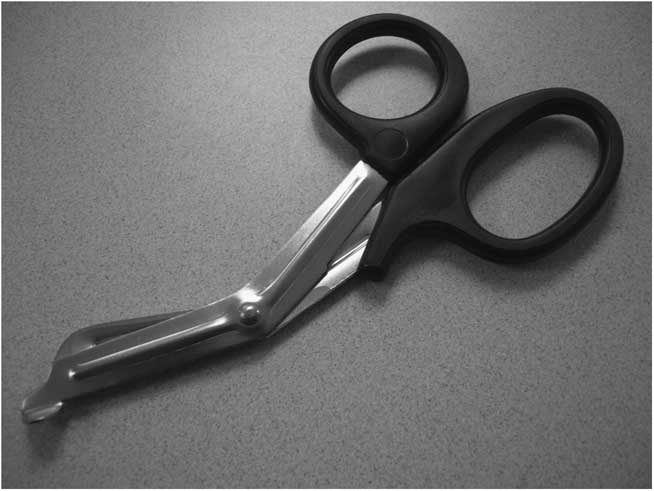
Any device or technique that can aid in the rapid identification of life-threatening conditions ultimately may save lives when seconds count. Historically, this ubiquitous practice has been accomplished through the use of heavy-duty, blunt-tipped, serrated scissors (Figure 1). Use of these scissors to remove patient clothing can require well over a minute to fully expose a patient.Reference Hurtado and Montoya 5 This amount of time is not insignificant, particularly in cases of life-threatening hemorrhage or in mass-casualty situations. The medical literature is devoid of any evidence-based guidelines for the standardized approach to expeditious clothing removal in the emergency and critical care settings.
Heavy-duty, Blunt-tipped, Serrated Scissors Commonly Used to Facilitate Rapid Removal of Clothing

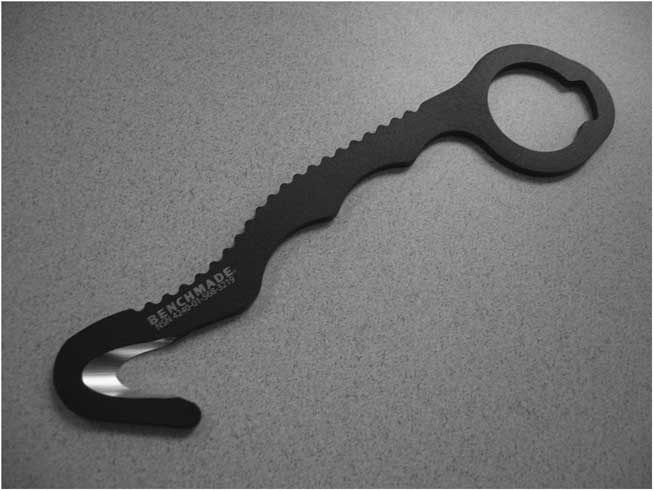
Newer rescue cutting devices, such as the Hook/Safety Cutter (Benchmade Knife Company, Inc., Oregon City, Oregon USA), have been developed specifically to allow the rapid removal of clothing in emergency situations (Figure 2). These devices feature a hooked end with a semi-protected curved cutting surface that enables the user to “catch” the edge of an article of clothing and, while pulling the device, subsequently cut and remove the clothing.
Hook/Safety Cutter (Benchmade Knife Company, Inc., Oregon City, Oregon USA)

One single prior pilot study evaluated a hooked cutting device as compared with trauma scissors on simulated patients in a forward-positioned military medical facility used by US Army combat medics formally trained in the use of both types of devices.Reference Hurtado and Montoya 5 The study found that the hook was 43% faster than trauma shears when exposing a simulated patient. The current study set compared the efficacies of these devices in an urban, domestic emergency department setting, examining a broader population of health care providers without specific training in the use of either device. Investigators evaluated the speed of patient exposure using both scissors and a hooked cutting device. Additionally, the subjective comfort of providers utilizing both devices was examined.
Methods
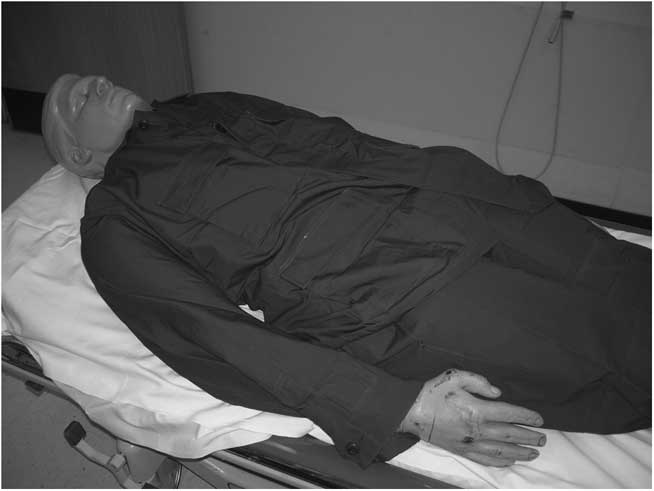
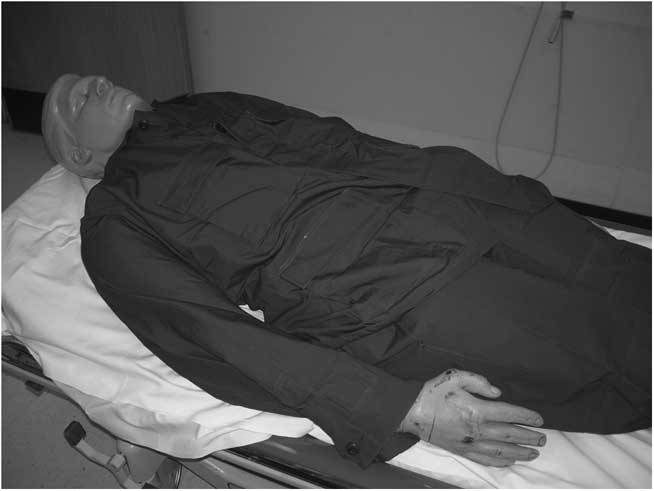
A sample consisting of 50 hospital-based medical personnel was contemporaneously, serially recruited during an overnight shift from the emergency department of an urban, academic, Level-1 trauma center. Study participants were all clinical personnel who typically expose critical care patients using conventional trauma scissors as part of their normal duties. Two actual patient treatment rooms, identically configured, were utilized for the study; one designated for the scissors and the other for the hooked cutting device. An identical human patient simulator mannequin (Rescue Randy Simulation Training Device, Simulaids, Inc., Saugerties, New York USA) weighing 75 kilograms, was placed on an identical standard hospital bed in each room. Each mannequin was clothed in brand new, identical (manufacturer, style, size, and material content) shirt and pants constructed of 50% polyester and 50% cotton material. The shirt and pants all featured button closures that were fully fastened in every session (Figure 3). After each timed cutting session, the mannequins were redressed with identical new shirts and pants in preparation for the next participant. The mannequins were not dressed with a belt, undergarments or footwear.
Simulated Study Patient with Standardized Clothing
Each cutting device used in this study, regardless of type, was discarded after no more than 10 cutting sessions. The hooked devices were provided without cost by the manufacturer in new condition with standard retail packaging. Scissors used in this study were purchased commercially by investigators from a medical supply retailer. Clothing items were acquired through surplus supply channels. No extramural funding was used to conduct this study. This study was approved by the Johns Hopkins University School of Medicine Institutional Review Board.
Each participant was timed using both types of devices in this study. Each cutting session was timed by a dedicated investigator using a single stopwatch certified by the US National Institute of Standards and Technology (NIST). The same investigator, devoid of any other study responsibilities, conducted all time measurements in this study.
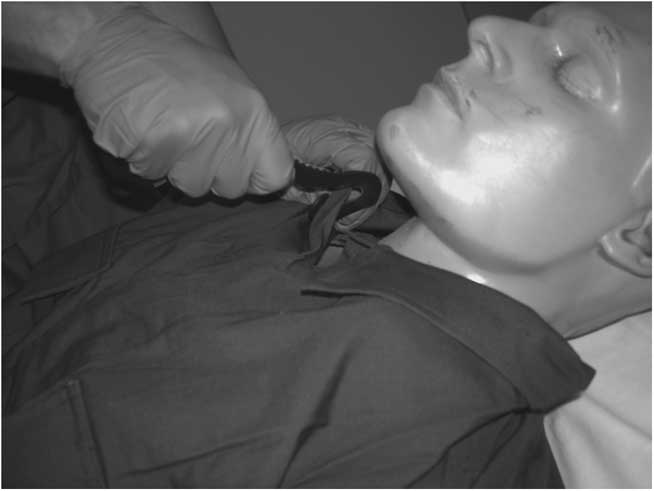
Each participant was introduced to the purpose of the study through a standardized five-sentence verbal statement and, if the participant desired, a single practice cut on a sample article of clothing with either or both devices. Participants were assigned in alternating fashion to using the hook device or the scissors first, moving from one study room to the other. For each session, the designated investigator started the timing when the cutting device touched the intended article of clothing and ended when the investigator determined that the article was completely cut off and the mannequin was fully exposed (Figure 4). Shirt removal times and pant removal times in each session were recorded separately. After completion of all timed sessions, each participant was queried regarding tactile comfort using each device, rated on a scale (1-5). Basic statistical analysis was performed using Microsoft Excel 2010 (Microsoft Corporation, Redmond, Washington USA) and with Minitab Release 15.1.30 (MINITAB Inc., State College, Pennsylvania USA).
Cutting of Clothing Using the Hooked Device

Results
The mean exposure time for shirt removal using scissors was 83 seconds (SD = 55 seconds, 95% CI, 68-99). The mean time to exposure for shirt removal using the hook device was 28 seconds (SD = 21 seconds; 95% CI, 22-34). The mean difference between the two devices for removal of shirts was 55 seconds (SD = 35 seconds; 95% CI, 46-65).
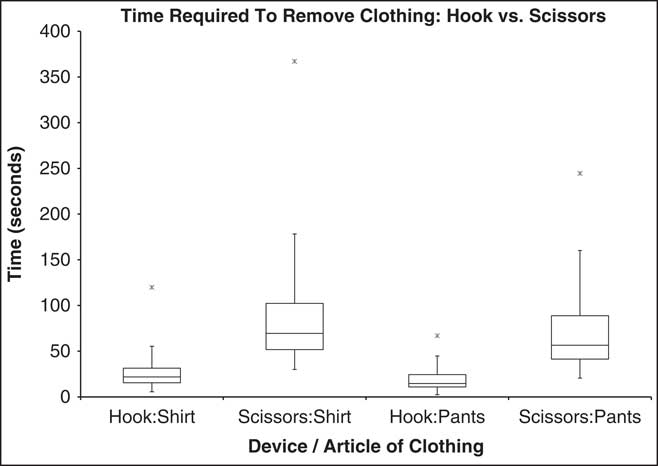
The mean time to exposure for pants removal using scissors was 69 seconds (SD = 40 seconds; 95% CI, 56-73). The mean time to exposure for pants removal using the hook device was 19 seconds (SD = 15 seconds; 95% CI, 15-23). The mean difference between the two devices for removal of pants was 50 seconds (SD = 27 seconds, 95% CI, 41-56). Figure 5 illustrates the difference in times to remove clothing, by device, expressed as a box whisker plot.
Box whisker plot demonstrating exposure time using hook cutting device versus standard scissors. Data are expressed as means, with first and third quartiles and data range (*outlying data point).

On a Likert-type scale, the mean provider comfort rating for the rescue hook was 4.62 (out of 5) (SD = 0.6; 95% CI, 4.49-4.79). The mean comfort score for the scissors was 2.24 (out of 5) (SD = 1.1, 95% CI, 1.94-2.54). Of the 50 study participants, 92% (n = 46) rated the hook higher than conventional shears in tactile comfort.
Discussion
It is well established that the rapid removal of clothing is a fundamental tenet of the early assessment and management of the critically ill or injured patient. In this subset of patients, time and clinical condition typically do not permit orderly disrobing. Appropriate medical management often requires the cutting of patient clothing for rapid exposure. Under these circumstances, seconds are critical, and the efficacy by which life-threatening conditions can be identified and interventions initiated may be essential for patient survival and potentially improved outcomes.
While the cutting of clothing of critical patients is a near universal practice, the current practice of using scissors to perform this task is driven principally by convention or necessity rather than by proven efficacy. Little attention has been directed towards evaluating this approach, particularly in the hospital setting. Few technical innovations have been developed towards improving this practice, whether driven by clinical effectiveness or provider comfort.
In this study, when compared to conventional scissors, a hooked cutting device was 66% faster at removing shirts and 72% faster at removing pants from simulated patients in an emergency department setting. Overall, the hooked device was 69% faster than scissors at removing clothes in this study. From a practical perspective, on average, the hooked device was nearly a full minute faster at removing clothing (55 seconds faster at removing shirts and 50 seconds faster at removing pants) to full patient exposure. The increase in speed would be expected to allow more expeditious identification of injuries and to decrease the time to initiation of life-saving interventions. Participants in this study, across a broad base of clinical provider types, indicated the hooked device was twice as comfortable to use, even in the absence of any formal instruction in its use. These results validate and greatly expand upon those demonstrated by Hansen et alReference Hurtado and Montoya 5 that showed the hook to be on average 43% faster than trauma scissors for clothing removal and a 90% preference for the hook over scissors by a cadre of Army medics working in a military medical facility.
This study was a prospective, comparative trial. Every attempt was made to control for potential confounders. Variables such as setting, mannequins, beds, and clothing were all matched between both studied devices. Interrater variability was minimized through the designation of a single investigator for all timing measurements. Technical variability was avoided through the use of a single NIST-certified stopwatch for all trials. The cutting devices used in this study were discarded after a finite number of sessions, thereby limiting the impact of potential blunting or dulling after successive applications. Human factors such as fatigue were controlled through alternating the order in which cutting devices was used by study participants.
Safety considerations regarding both devices were not addressed in this study. While it is generally recognized that commonly-used scissors for patient exposure have the real potential for cutting skin and soft tissue, the incidence of this has not been studied, nor reported. Similarly, it would be expected that the hooked device used in this study also might pose a risk of unintended cutting. Solely on an observational basis, the semi-enclosed design of the device's cutting surface (Figure 2) would appear to provide a degree of protection from incidental cutting. However, the authors deem it prudent for providers to be trained in the use of all such devices; it should be recognized the risk of cutting exists if skin, appendages, devices or cables are caught within the functional curve of the device.
Limitations
In an effort to control for as many variables as possible, only one identical type of clothing was used in this study. Other articles of clothing typically found on patients (belts, shoes, coats, and undergarments) were not evaluated. While the bulkiness and material content of clothing is infinitely variable, the highly favorable results demonstrated with the hooked cutting device would be expected to be replicated amongst other clothing types and content.
The population selected in this study was a convenience sample drawn from the clinical staff during an overnight shift in a hospital emergency department. While the variety of provider type was intentionally representative, the proportion of each type was not controlled. Although it is conceivable that certain provider types are more adept at patient exposure, this remains a basic task performed by all provider types and the technical aspects of using either cutting device would not be expected to favor one provider type over another.
The serial recruiting and enrollment of study participants may be a source of bias in this study. As participants completed their sessions and returned to the clinical environment, it is possible that discussion ensued subsequently with other potential participants that had not yet been recruited. While investigators attempted to dissuade this activity by verbal request to not discuss the nature of the study or their specific participation, participant behavior subsequent to their sessions was not directly observed or controlled by investigators.
Conclusion
This study demonstrates that a hooked cutting device is significantly faster than conventional scissors for the removal of clothing to fully expose a simulated patient. On average, shirt removal was accomplished 55 seconds (296%) faster and pants removal was accomplished 50 seconds (363%) faster using the hooked cutting device. It was also found to be more comfortable by providers in comparison with scissors. On average, participants noted their tactile comfort using the hooked device to be twice that experienced with use of scissors. This study expands upon limited prior work in this arena and confirms applicability in a variety of critical situations, both in the day-to-day in hospital critical care situations as well as during an influx of patients associated with a mass-casualty event.
Acknowledgements
The authors thank the clinical personnel who participated in this study as research subjects; Dr. Arjun Chanmugam for his mentorship and assistance; Lisa Steiner MS, PA-C; John Breznak NREMT-P; and Dr. Roshni Thakore for their assistance with data collection. The authors also wish to thank the Benchmade Knife Company for providing the hook cutter devices used in this study.