Accumulating evidence suggests that United States (U.S.) born second-generation Latin-American adolescents tend to show higher levels of various health-risking behaviors—including health-risking sexual behaviors (HRSB) and alcohol, tobacco, and other illicit drug use (ATOD)—than foreign-born first-generation Latin-American adolescents, while findings appear to be more mixed for emotional problems such as depressive symptoms or suicide attempts (e.g., Cavanagh, Reference Cavanagh2007; Galaif, Newcomb,Vega, & Krell, 2007; Lee & Hahm, Reference Lee and Hahm2010; McNulty Eitle, Gonzalez Wahl, & Aranda, 2009; Peña et al., Reference Peña, Wyman, Brown, Matthieu, Olivares, Hartel and Zayas2008; Prado et al., Reference Prado, Huang, Schwartz, Maldonado-Molina, Bandiera, de la Rosa and Pantin2009). The advantaged health status of foreign-born first-generation Latin-American adolescents in the U.S., which is observed even though these youths often experience stress and trauma before migrating to the U.S. as well as face language barriers and life in disadvantaged neighborhoods (e.g., Guarnaccia & Lopez, Reference Guarnaccia and Lopez1998; Pumariega, Rothe, & Pumariega, Reference Pumariega, Rothe and Pumariega2005), is referred to as “immigrant paradox” (e.g., Vega et al., Reference Vega, Kolody, Aguilar-Gaxiola, Alderete, Catalano and Caraveo-Anduaga1998). The immigrant paradox raises important public health concerns because of the potential costs and adverse long-term consequences associated with (especially early onset) health-risking behaviors and emotional problems (e.g., DiClemente & Crosby, Reference DiClemente, Crosby, Adams and Berzonsky2003; Fergusson & Woodward, Reference Fergusson and Woodward2002; Newcomb & Bentler, Reference Newcomb and Bentler1988). More work is needed to gain a better understanding of the factors that contribute to health-risking behaviors and emotional problems among second-generation Latin-American youth.
The concept of differential acculturation processes within the family may be a fruitful way to address this issue. Researchers have proposed that differences in acculturation level between parents and their children lead to family conflict and maladjustment among offsprings (Szapocnik & Kurtines, Reference Szapocnik and Kurtines1993). Latin-American children and adolescents not only learn English at a faster pace than their parents, but also adopt attitudes and behaviors related to autonomy and individualism that are likely to clash with the parents’ traditional values (Smokowski, Roderick, & Bacallao, Reference Smokowski, Roderick and Bacallao2008; Szapocnik & Williams, Reference Szapocnik and Williams2000). In response to the youngsters’ faster acculturation rate to the host culture and their distancing from the heritage culture, parents may become either disengaged from their children or overly rigid in trying to preserve traditional child rearing practices. Both parental disengagement and rigidity are believed to lead to increased family conflict and decreased family cohesion and adaptability, which in turn may lead to adolescent rebellion and engagement in risky behaviors (Szapocnik & Williams, Reference Szapocnik and Williams2000). Some studies have provided support for the notion that disruptions in family processes are the mechanism by which parent-child differential acculturation rates lead to youth maladjustment. For example, Martinez (Reference Martinez2006) found that family stress and effective parenting practices mediated the relation of parent-adolescent host culture acculturation gap to youth substance use.
The original formulation of the acculturation gap-distress hypothesis, which was based on a unidimensional conceptualization of the acculturation process, suggested that differences in acculturation levels are most problematic when children become more highly immersed in the host culture than their parents (Lau et al., Reference Lau, McCabe, Yeh, Garland, Wood and Hough2005). Bidimensional models were developed in order to—critically—distinguish two independent acculturation processes, one to the host culture and the other to the heritage culture (Berry, Reference Berry1997; Yoon, Langrehr, & Ong, Reference Yoon, Langrehr and Ong2011). These models highlighted that along with a process of acculturation to the U.S. culture there is an enculturation process that functions to retain the heritage culture. In line with this conceptualization, it is increasingly being questioned whether unidimensional approaches to examining the acculturation-gap-distress hypothesis adequately capture the complexity of intergenerational acculturation processes (e.g., Birman, Reference Birman, Bornstein and Cote2006; Telzer, Reference Telzer2010).
Acculturation Gaps and Youth Adjustment Problems
Recent studies that have examined the acculturation gap-distress hypothesis with Latin-American families have yielded mixed findings. Results from some studies have indicated that greater parent-youth acculturation gaps are associated with more substance use (e.g., Felix-Ortiz, Fernandez, & Newcomb, Reference Felix-Ortiz, Fernandez and Newcomb1998; Unger, Ritt-Olson, Soto, & Baezonde-Garbanati, Reference Unger, Ritt-Olson, Soto and Baezonde-Garbanati2009), greater likelihood of future substance use (Martinez, Reference Martinez2006) and more externalizing problems (Marsiglia, Kulis, FitzHarris, & Becerra, Reference Marsiglia, Kulis, FitzHarris and Becerra2009). Cultural discrepancies between parent and youth, a similar concept to acculturation gaps, also have been linked to higher levels of youth depression (Céspedes & Huey, Reference Céspedes and Huey2008). However, other findings have been inconsistent with predictions from the acculturation gap-distress hypothesis. For example, Pasch et al. (Reference Pasch, Deardorff, Tschann, Flores, Penilla and Pantoja2006) reported that parent-youth host-culture acculturation gaps were related to fewer youth sexual experiences and unrelated to youth anger, substance use, anxiety, and depression. Overall, the evidence base is quite scant and support for the hypothesized associations between acculturation gaps and Latin-American youths’ adjustment problems is tentative.
Increasingly, scholars are focusing on the extent to which these inconsistencies in findings may, in part, be due to differences in the measurement of parent-child acculturation gaps (e.g., Birman, Reference Birman, Bornstein and Cote2006; Lau et al., Reference Lau, McCabe, Yeh, Garland, Wood and Hough2005; Telzer, Reference Telzer2010). Acculturation-gap scores have been derived using unidimensional as well as bidimensional models of acculturation (for detailed reviews, see Birman, Reference Birman, Bornstein and Cote2006; Telzer, Reference Telzer2010). Parent-youth acculturation-gap scores are typically calculated by subtracting the adolescent’s score on the respective acculturation scale (assessed with paper and pencil instruments) from either the parent’s score on the same acculturation scale (e.g., Elder, Broyles, Brennan, Zúniga de Nuncio, & Nader, 2005; Lau et al., Reference Lau, McCabe, Yeh, Garland, Wood and Hough2005; Martinez, Reference Martinez2006; Schofield, Parke, Kim, & Coltrane, Reference Schofield, Parke, Kim and Coltrane2008) or the youth’s perception of the parents’ acculturation level (e.g., Céspedes & Huey, Reference Céspedes and Huey2008; Unger et al., Reference Unger, Ritt-Olson, Soto and Baezonde-Garbanati2009). Thereby, studies based on the unidimensional approach calculate parent-youth acculturation-gap scores in orientation to the host culture. In contrast, studies that use the bidimensional approach derive parent-youth acculturation-gap scores in orientation to the host and the heritage culture independently, which is sometimes referred to as “orthogonal” measurement approach (Birman, Reference Birman, Bornstein and Cote2006). Yet another common approach is to create acculturation-gap groups based on parent and youth scores in self-report measures of acculturation to the host and/or the heritage culture respectively (e.g., Lau et al., Reference Lau, McCabe, Yeh, Garland, Wood and Hough2005; Marsiglia et al., Reference Marsiglia, Kulis, FitzHarris and Becerra2009; Pasch et al., Reference Pasch, Deardorff, Tschann, Flores, Penilla and Pantoja2006). A weakness of this latter approach is that acculturation-gap groups are typically created by dichotomizing continuous measures of acculturation level, which is problematic because cut-points are arbitrary (in the sense that they are based on the given distribution of scores) and dichotomization of continuous data typically results in loss of statistical power (Cohen, Reference Cohen1983). Lower statistical power resulting from dichotomization of continuous data might be a contributing factor to inconsistent findings in the literature on the acculturation gap-distress-hypothesis. In general, bidimensional approaches are increasingly favored by many scholars who are interested in the examination of parent-youth acculturation gaps (Birman, Reference Birman, Bornstein and Cote2006; Telzer, Reference Telzer2010). Emerging evidence suggests that findings for Latin-American youths may indeed differ as a function of the parent-youth acculturation gap measurement strategy used in a given study. For example, Lau et al. (Reference Lau, McCabe, Yeh, Garland, Wood and Hough2005) found that parent-youth acculturation gaps (in orientation to either the host or the heritage cultures) were unrelated to youth conduct problems when operationalized as difference scores. However, gaps were related to youth conduct problems when operationalized as acculturation-gap groups, although the direction was opposite to expectations. Elder et al. (Reference Elder, Broyles, Brennan, Zúniga de Nuncio and Nader2005) reported that parent-youth acculturation gaps in orientation to the heritage culture were positively related to youth tobacco susceptibility but unrelated to youth alcohol use prevalence, tobacco use prevalence, and depressive symptoms, whereas parent-youth acculturation gaps in orientation to the host culture were positively related to youth alcohol use prevalence but unrelated to the other outcomes. Despite its compelling logic, the evidence thus provides mixed support for the acculturation gap-distress hypothesis. This study represented an advance over prior studies by including an observational measure of acculturation gap based on a mother-youth discussion task, in addition to using the self-report measures used in other studies.
Study Aims
The goal of the present study was to contribute to the emerging body of literature on the acculturation gap-distress hypothesis. Specifically, the study examined whether mother-youth acculturation gaps were related to various health-risking behaviors and emotional problems among Latin-American early adolescents, controlling for youth gender and age. The study advanced existing research in several ways. First, mother-youth acculturation gaps were broadly conceptualized, consisting of a bidimensional self-report component (i.e., actual discrepancies in acculturation to both mainstream and heritage cultures separately, based on mother and youth reports) and an observational measurement component (i.e., coder ratings derived from a videotaped mother-youth interaction task). Second, the study design allowed for an examination of specificity in variable associations as a function of the informant (mothers, youths, coders), method (self-reports, observational data), and youth adjustment problem domain. Third, the study specifically focused on youths who may be at particularly high risk for health-risking behaviors and emotional problems (i.e., predominantly second-generation youths of Mexican descent). Fourth, a broad range of youth adjustment problems was included, some of which are understudied in this area of research. It was hypothesized that wider acculturation gaps to either the host or the heritage culture between mothers and youths would be related to higher levels of health-risking behaviors and emotional problems among Latin-American early adolescents after controlling for demographic characteristics. Because of the scant literature and mixed findings currently characterizing the field of parent-youth acculturation gap research, more specific hypotheses could not be warranted in this study.
Methods
Participants
The data were collected during 2009–10. Out of all the families that were approached, a total of 40 mother-youth dyads participated in the study (i.e., 70.2% participation rate). Compliance with all data collection procedures was 100%, and all participants (except one youth) expressed a willingness to participate in future follow-up studies of this nature. All youth were enrolled in Grade 8 (M age = 13.42 years, SD = 0.55), gender-balanced (20 boys, 20 girls), and mostly second-generation (77.5%) of Mexican descent. The rest of the youth were either first-generation (10.0%) or third-generation (12.5%). Mother’s average age was 39.18 years (SD = 5.17). Seventy percent of the mothers were foreign born (82% of them in Mexico), 7.7% had lived in the United States for ≤10 years, and 27.5% were monolingual Spanish speakers (nine of these eleven monolingual Spanish speaking mothers indicated that their child is bilingual; the other two reported that their child speaks “more English than Spanish”). Only three mothers indicated that they could not communicate well with their child because their child speaks more English than Spanish (the other 37 mothers indicated that they did not have such communication problems with their child). As reported by the mothers, 82.5% of the youth’s fathers were born outside the United States. Almost all (95%) of the mothers had a spouse or partner. Finally, most of the families came from lower- or working-class backgrounds: About 42.5% of the mothers had completed no more than middle school as their highest level of education. According to mother reports on various indicators of the financial situation of the family (e.g., income, child support payments and deductions, assistance from specific financial aid programs, number of household members), 25% of the families were below the Federal Poverty Threshold, at least 40% of the families were below the Basic Family Budget Threshold, and 87.5% of the families received assistance from one or more financial aid or community programs.
Procedures
Participants were recruited from a public school in a large metropolitan region in the Southwest of the U.S., using a multi-step recruitment procedure that involved (a) sending a letter about the study to the home of the youths via the school, (b) requesting the parents to let the school know if they wished not to be contacted any further about the study, (c) sending another letter to the family announcing the visit of a recruiter (to be scheduled at the families’ discretion), and (d) introducing the study to the family during an approximately 40-minute home visit for which the families were paid regardless of whether they accepted or declined participation in the study. If the families agreed to take part in the study, then parent-informed consent and student-assent documents were completed. Data collection took place during a subsequent in-person assessment in reserved space at the youth’s school. Recruiter and interviewers were bilingual (English-Spanish) and trained in all data collection procedures.
For the in-person assessment, a multimethod multiagent design was used that included data collection from mothers, youths, and interviewers via structured interviews, questionnaires, rating forms, videotaped mother-youth discussion task, saliva sampling, and dried blood spot sampling. The videotaped mother-youth discussion task was 20 minutes long and consisted of four segments: (1) planning a fun activity together (this served as a warming up task; 5 minutes total); (2) comparing the American and Hispanic way of life (5 minutes total); (3) behaviors that get adolescents in trouble (5 minutes total); and (4) romantic relationships between boys and girls (5 minutes total). After the completion of the in-person assessment, coder ratings were provided on different aspects (e.g., content, affect) for each segment and also the entire task (sample rater items are given further below for the observational measures included in the present study). These ratings were designed based on experiences with family real-time (moment by moment) coding of family interactions and similar ratings completed at the end of the interaction session which have been used in numerous studies at the Oregon Social Learning Center for over 30 years (e.g., Capaldi, Forgatch, & Crosby, Reference Capaldi, Forgatch and Crosby1994; Patterson & Moore, Reference Patterson, Moore, Lamb, Suomi and Stevenson1979). All interactions were double-coded by two independent bilingual coders who successfully completed a 20-hour coder-training (reliability criteria were 75% for both content and affect).
A Federal DHHS Confidentiality Certificate was obtained from NIH to protect the confidentiality of the participants. Mothers and adolescents were given a choice whether to conduct their individual assessments in English or Spanish language (two thirds of the mothers chose Spanish) and jointly decided which language was used during the mother-youth discussion task. The average length of the in-person assessment was 2¾ hours. Families were paid $30 for the home visit. Mothers were paid $80 and adolescents $40 for the in-person assessment.
Measures
Acculturation
The Acculturation Rating Scale for Mexican Americans-II (ARSMA-II; Cuéllar, Arnold, & Maldonado, Reference Cuéllar, Arnold and Maldonado1995) was administered to both mothers and youth to assess their levels of acculturation. It consists of 30 items that are answered on a 5-point Likert-scale ranging from (1) not at all to (5) extremely often or almost always, yielding two subscales: Anglo orientation (17 items, e.g., “My friends, while I was growing up were of Anglo origin”, “My thinking is done in the English Language”) and Mexican orientation (13 items, e.g., “I associate with Mexicans and/or Mexican Americans” “My thinking is done in the Spanish language”. Minor modifications were made, where necessary, to items from the Mexican orientation subscale to accommodate the few participants not of Mexican descent, e.g., the item “My family cooks Mexican foods” was modified to “My family cooks Mexican foods (or from our country of origin, ex Peruvian food, Guatemalan, etc.)”. Each scale is computed by averaging responses across items. Higher values on the subscales indicate higher levels of Anglo and Mexican (aka heritage culture) orientation, respectively. Cronbach alphas were .78 and .83 for youths and .94 and .84 for mothers, similar to prior research (e.g., Céspedes & Huey, Reference Céspedes and Huey2008; Cuéllar et al., Reference Cuéllar, Arnold and Maldonado1995). The acculturation score for mothers and adolescents was computed by subtracting the Mexican orientation score from the Anglo orientation score, such that high values indicated high acculturation and low values indicated low acculturation. For purely descriptive purposes (the sample size was too small for sub-group analysis), acculturation types were also calculated for youths and mothers, using the cut-off values proposed by Cuéllar et al. (Reference Cuéllar, Arnold and Maldonado1995). Specifically, a total of five acculturation types can be obtained from the ARSMA-II. Cuéllar et al. (Reference Cuéllar, Arnold and Maldonado1995) have labeled them as follows: “Very Assimilated; Anglicized”, “Strongly Anglo Oriented”, “Slightly Anglo Oriented Bicultural”, “Mexican Oriented to Approximately Balanced Bicultural”, and “Very Mexican Oriented”.
Mother-Youth Acculturation Gaps
Self-report and observational measures were used to assess acculturation gaps between mother and youth. Similar to other studies on parent-youth acculturation gaps (e.g., Elder et al., Reference Elder, Broyles, Brennan, Zúniga de Nuncio and Nader2005; Schofield et al., Reference Schofield, Parke, Kim and Coltrane2008), the ARSMA-II was used to form the self-report measures of mother-youth acculturation gaps. Mother-youth acculturation gap in Anglo orientation was calculated as the difference between youth Anglo orientation score and mother Anglo orientation score, such that positive values indicated that the youth was more Anglo oriented than the mother. Mother-youth acculturation gap in heritage culture orientation was calculated similarly, but such that positive values indicated that the mother was more oriented toward the heritage culture than the youth. Scores could range from –4 to +4 on both self-report gap measures. A discussion of the strengths and weaknesses of difference scores as measures of parent-youth acculturation gaps can be found in other literature (e.g., Birman, Reference Birman, Bornstein and Cote2006; Telzer, Reference Telzer2010).
The observational measure of mother-youth acculturation gap was derived from coder-ratings of the mother-youth discussion task. During the second segment, the pair was asked to discuss how they felt about living in the U.S./city of residence as a Hispanic, what they liked about the U.S./city of residence compared to Mexico/other country of origin, and what is better in Mexico/other country of origin compared to U.S./city of residence (5 minutes total). Two trained bilingual coders rated each pair on this segment with a single item (i.e., “Mother and youth seemed about similar in degree of acculturation/assimilation to the U.S.”), using a five-point Likert scale ranging from 1 (very true) to 5 (not true). Higher values on this single-item observational measure indicated a larger mother-youth host-culture acculturation gap. An additional observational composite construct of mother-youth acculturation gaps was available for a subset (N = 18) of the mother-youth dyads who had brought up acculturation-related issues in all segments of the mother-youth discussion task (not just the second one). The composite construct consisted of five items (rated by the same two coders) that assessed the degree of mother-youth host-culture acculturation gap for all segments in the same manner as the single-item measure (i.e., higher values indicated larger gaps). The composite observational construct showed excellent interrater reliability (i.e., coder agreement, defined as percentage of global coder scale ratings with 0–1 unit discrepancies, was 92%) and was closely related to the single-item measure (r = .94, p < .001). These results provide support for the validity of the single-item measure used in this study to assess observed mother-youth host-culture acculturation gap.
Lifetime prevalence of alcohol, tobacco, and other illicit drug use (ATOD).
The youths reported separately whether they had ever used each of the following substance groups: Alcohol, tobacco, marijuana, cocaine/hallucinogens/uppers, inhalants/over-the-counter drugs, prescription medications/other drugs (Martinez, Reference Martinez2005). Because very few adolescents reported usage of more than one substance, a binary indicator was created which indicated the lifetime prevalence of ATOD use (1 = Yes, youth ever used one or more of these substances, 0 = No).
Number of delinquent acts
Engagement in delinquent behavior in the past 6 months was measured using 20 items from Elliott (Reference Elliott1983). Self-report measures of delinquent acts are not entirely free from a variety of biases (e.g., memory and concealment problems) but capture a larger fraction of the true number of offenses committed compared to official records data (e.g., Farrington et al., Reference Farrington, Jolliffe, Hawkins, Catalano, Hill and Kosterman2003; Huizinga & Elliott, Reference Huizinga and Elliott1986; Maxfield, Weiler, & Widom, Reference Maxfield, Weiler and Widom2000). Youths indicated for each delinquent behavior whether they had committed the act in the past 6 months. Delinquent acts differed in severity and included violence, property damage, drug, theft, and status offenses. Affirmative responses were summed across all items, ranging from “zero” to “four or more” delinquent acts. Skewness and kurtosis values for the total score were below ±1.
Relationship/dating experiences and attitudes
Self-report and observational measures were used to assess the youth’s dating experiences and acceptance of dating/sexual behaviors. The self-report measure assessed the youth’s current relationship/dating status as reported by the youth and consisted of a single ordinal variable, “Please circle the number of the option below that best describes you right now” (Capaldi, Metzler, Ary, & Noell, Reference Capaldi, Metzler, Ary and Noell1991), with response options ranging from 1 (dating one person regularly) to 6 (never dated/had a girl/boy friend). Higher values on this item indicated fewer relationship/dating experiences. The observational measure was the average of three items (e.g., “thought it was acceptable for eighth graders to date one-on-one”, “endorsed sexual behavior for eighth graders”; α = .80) obtained from the coder ratings of the mother-youth discussion task segment on romantic relationships. During this segment, the pair discussed romantic relationships between boys and girls in Grade 8 (e.g., whether they thought it is okay to date at this age). Each item was rated by two trained bilingual coders on a three-point Likert scale ranging from 1 (not true) to 5 (very true). Interrater reliability was good for this measure (i.e., coder agreement, defined as percentage of global coder scale ratings with 0–1 unit discrepancies, was 79%). The total score could range from 1 to 5. Higher values indicated higher levels of acceptance of dating/sexual behaviors by the youth.
Depressive symptoms
The Center for Epidemiological Studies Depression Scale (CES-D; Radloff, Reference Radloff1977) was used to assess youth’s depressive symptoms. It is a 20-item self-report scale that has been validated and used in many studies with youths (e.g., Crockett, Randall, Shen, Russell, & Driscoll, Reference Crockett, Randall, Shen, Russell and Driscoll2005). Adolescents indicated on how many days during the past week they experienced the emotions or behaviors indicated in each item (e.g., “I felt depressed”), using a four-point scale that ranged from 0 (rarely or none of the time) to 3 (most or all of the time). Cronbach alpha with this sample was .86, consistent with other work (e.g., Crockett, Randall, Shen, Russell, & Driscoll, Reference Crockett, Randall, Shen, Russell and Driscoll2005; Roberts Andrews, Lewinsohn, & Hops, 1990). Answers were summed across items to compute the total score (range: 0–60). Higher total scores indicated higher levels of depressive symptoms.
Internalizing and externalizing problems
Mothers reported on their youth’s levels of externalizing and internalizing problems using the widely administered Child Behavior Checklist (CBCL; Achenbach & Rescorla, Reference Achenbach and Rescorla2001, Reference Achenbach and Rescorla2007). Each item was rated on a three-point response scale ranging from 0 (not true of your child now or in the last 6 months) to 2 (very true or often true of your child now or in the last 6 months). The internalizing problems subscale consisted of 32 items (e.g., “cries a lot”; α = .75 in this study) and assessed anxious/depressed behaviors, withdrawn/depressed behaviors, and somatic complaints. The externalizing problems subscale consisted of 35 items (e.g., “steals outside the home”; Cronbach alpha .89 in this study) and assessed rule-breaking and aggressive behaviors. Internalizing and externalizing T-scores were used for the analyses. Higher scores on each subscale indicated higher levels of problems.
Results
Descriptive Information on Study Variables
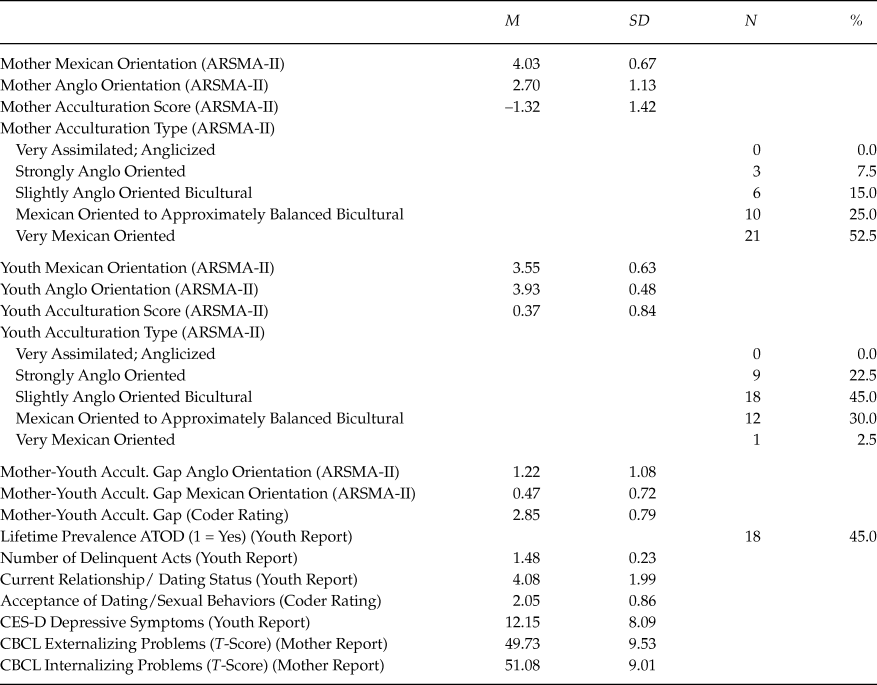
Descriptive information on all study variables is shown in Table 1. The ARSMA-II acculturation types of youths and mothers are cross-tabulated with each other in Figure 1. Out of the five acculturation types that were proposed by Cuéllar et al. (Reference Cuéllar, Arnold and Maldonado1995) for the ARSMA-II (i.e., “Very Assimilated; Anglicized”, “Strongly Anglo Oriented”, “Slightly Anglo Oriented Bicultural”, “Mexican Oriented to Approximately Balanced Bicultural”, “Very Mexican Oriented”), the “Very Assimilated; Anglicized” acculturation type is not shown in Figure 1 because it was observed neither for mothers, nor youths. The ARSMA-II acculturation type distributions revealed that mothers showed a stronger heritage–culture orientation (52.5% of mothers versus 2.5% of adolescents were “Very Mexican Oriented”) and a weaker Anglo orientation (7.5% of mothers versus 22.5% of adolescents were “Strongly Anglo Oriented”) than their adolescent. Paired t-tests indicated the same pattern of differences between mothers and their adolescent for the ARSMA-II Mexican orientation subscale, t(39) = –4.18, p < .001, and the ARSMA-II Anglo orientation subscale levels, t(39) = 7.14, p < .001. Hardly any mothers were more Anglo oriented than their adolescent according to the categorized ARSMA-II data (see Figure 1). In addition, the acculturation type distributions in Table 1 revealed that adolescents were more bicultural than mothers (75% of adolescents versus 40% of mothers fell into one of the two bicultural categories - “Mexican Oriented to Approximately Balanced Bicultural” or “Slightly Anglo Oriented Bicultural”). A final finding of interest was that the observational host-culture acculturation-gap measure was significantly related to self-reported acculturation gap in Anglo orientation (r = .46, p < .01).
Descriptive Information for Study Variables (N = 40)

Note: ARSMA-II = Acculturation Rating Scale for Mexican Americans-II; ATOD = Alcohol, Tobacco, and Other Illicit Drug Use; CES-D = Centers for Epidemiological Studies Depression Scale; CBCL = Child Behavior Checklist.
Cross-Tabulation of Youths’ and Mothers’ ARSMA-II Acculturation Types (N=40 each). Out of the five acculturation types posited by Cuéllar et al. (Reference Cuéllar, Arnold and Maldonado1995) for the ARSMA-II, the “Very Assimilated; Anglicized” acculturation type is not shown because it was observed neither for mothers, nor youths.

Acculturation Gap and Youth Health-Risking Behaviors and Emotional Problems
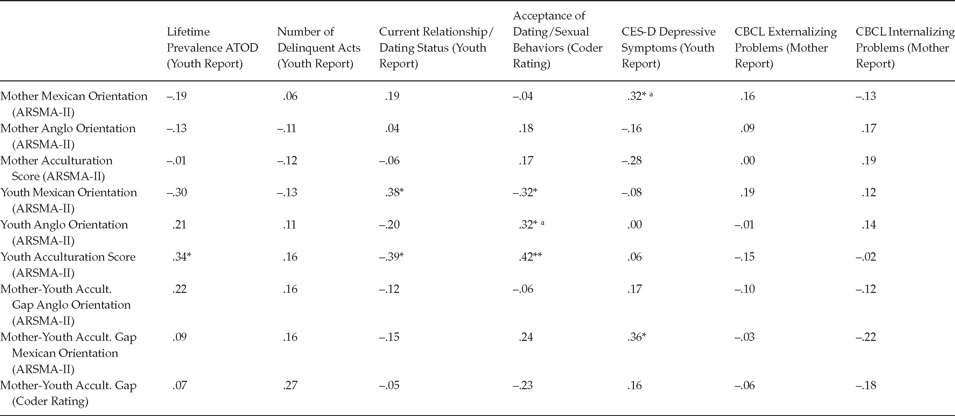
For comparison purposes, we first inspected associations among acculturation levels of mothers and adolescents and youth problems using partial correlation analysis with youth age and youth gender as control variables (see Table 2 for findings). With the exception of youth depressive symptoms, mother acculturation measures were unrelated (i.e., p > .05) to all youth problems. Higher levels of mother heritage culture orientation were significantly related to higher levels of adolescent depressive symptoms. Note that this association only emerged after controlling for youth age and gender, the zero-order correlation was not significant (r = .30, p = .06).
Interesting associations emerged between various youth acculturation measures and the youth ATOD and HRSB domains. The partial correlation coefficients showed that higher levels of youth heritage- culture orientation were significantly related to fewer self-reported dating experiences and lower acceptance of dating/sexual behaviors during the mother-youth discussion task. Higher levels of youth Anglo orientation were significantly linked to higher acceptance of dating/sexual behaviors during the mother-youth discussion task. Note that this association only emerged after controlling for youth age and gender, the zero-order correlation was not significant (r = .22, p = .17). Finally, higher levels of the adolescents’ orientation towards the host than the heritage culture were significantly positively related to self-reported higher rates of engagement in ATOD and dating experiences and to higher acceptance of dating/sexual behaviors during the mother-youth discussion task.
Next, our hypothesis regarding an expected association of larger acculturation gaps with higher levels of youth problem behavior was examined using the same analytic strategy (i.e., partial correlation analysis with control variables youth age and youth gender). Results are shown in Table 2. Regardless of whether they were measured via self-reports or coder ratings, mother-youth acculturation gaps were generally unrelated (i.e., p > .05) to youth health-risking behaviors and emotional problems, with the exception of youth depressive symptoms. The partial correlation coefficient for the latter revealed that wider acculturation gaps in Latin cultural orientation (i.e., mothers stronger heritage-culture oriented than their adolescents according to self-reports) were significantly associated with higher levels of youth depressive symptoms. The pattern of significant and non-significant associations between mother-youth acculturation gaps and youth health-risking behaviors and emotional problems did not change when associations were additionally controlled for initial status (i.e., youth Anglo orientation levels and youth Mexican orientation levels, respectively). Results from these additional analyses are available from the first author on request.
Partial Correlations of Acculturation Measures with Youth Health-Risking Behaviors and Emotional Problems, Controlled for Youth Age and Gender (N = 40)

Note: ARSMA-II = Acculturation Rating Scale for Mexican Americans-II; ATOD = Alcohol, Tobacco, and Other Illicit Drug Use; CES-D = Centers for Epidemiological Studies Depression Scale; CBCL = Child Behavior Checklist.
*p < .05; **p < .01.
a Suppressor effect.
Discussion
Consensus is emerging that there is a need to further refine the construct of intergenerational acculturation gaps from both a conceptual and psychometric perspective in order to advance research on the acculturation gap-distress hypothesis (e.g., Birman, Reference Birman, Bornstein and Cote2006; Lau et al., Reference Lau, McCabe, Yeh, Garland, Wood and Hough2005; Telzer, Reference Telzer2010). The present study contributed to this effort and examined the association of mother-youth acculturation gaps (comprised of a bidimensional self-report component and a novel observational measurement component) to Latin-American youth health-risking behaviors and emotional problems. Such “mixed-methods” measurement approaches have the advantage of providing more comprehensive and ecologically richer information and also reducing the risk that significant findings are simply a function of single informant bias and shared measurement variance. We are not aware of other studies that have used this mixed-methods approach for the assessment of intergenerational acculturation gaps with Latin-American mother-adolescent dyads, although observational methods have been used with Latin-American families to study other topics of interest (e.g., Domenech Rodriguez, Davies, Rodriguez, & Bares, 2006).
Despite the intuitive appeal of the acculturation gap-distress hypothesis, empirical support for the association of parent-youth acculturation gaps to youth adjustment problems is tentative to date for Latin-American youths. The hypothesis was tested for a sample of Latin-American mother-youth dyads predominantly of Mexican descent, controlling for youth age and gender. Several important conclusions emerged from the findings. First, mother-youth acculturation gaps were not significantly related to almost all youth health-risking behaviors and emotional problems. Thus, empirical support for the acculturation gap-distress hypothesis was weak. This is not uncommon in the existing literature on this topic (e.g., Elder et al., Reference Elder, Broyles, Brennan, Zúniga de Nuncio and Nader2005; Pasch et al., Reference Pasch, Deardorff, Tschann, Flores, Penilla and Pantoja2006) and may be partially attributable to the developmental period under examination. Some of the youth adjustment problems, notably ATOD, delinquency, and HRSB, were in early stages of development for our participants. According to longitudinal research, annual prevalence rates of delinquency begin to increase during early adolescence to a peak at about age 17 years (e.g., Huizinga, Loeber, & Thornberry, Reference Huizinga, Loeber and Thornberry1993). The typical time for alcohol use onset is between Grades 7 and 10, whereas rates of illegal drug use onset peak in the high school years (e.g., Johnston, O’Malley, & Bachman, Reference Johnston, O’Malley and Bachman2000). Additional associations between mother-youth acculturation gaps and some outcome domains (particularly externalizing behaviors) might emerge for our study sample at a later point in time. As youth get older and more independent, it is likely that negative peer influences (e.g., opportunities for and modeling of substance use) as well as parent-youth conflicts about autonomy issues, the importance to show respeto (e.g., Guilamo-Ramos et al., Reference Guilamo-Ramos, Dittus, Jaccard, Johansson, Bouris and Acosta2007; Zucker & Howes, Reference Zucker and Howes2009), dating, and sexual behaviors will increase.
The single exception to the pattern of results in the study was that wider mother-youth gaps in heritage culture orientation (i.e., mothers with stronger orientation toward Latin culture than that of their adolescents according to self-reports) were significantly associated with higher levels of youth depressive symptoms. Higher levels of maternal heritage culture orientation were also significantly linked to higher levels of adolescent depressive symptoms. Thus, Latin-American early adolescents may experience some distress when their mother is still oriented to the country of origin, whereas they are more immersed in U.S. culture. It is noteworthy that the gap measure used in this study was derived from two informants (mother and youth self-reports). This implies that it captured actual mother-youth acculturation gaps. However, it has been questioned whether gaps in broadly defined acculturation orientation or discrepancies in specific cultural values are the decisive factor for such relations. Some research has shown that intergenerational discrepancies in cultural values, such as affiliative obedience and traditional gender role beliefs, are also linked to higher levels of adolescent depressive symptoms (e.g., Céspedes & Huey, Reference Céspedes and Huey2008; Livas Stein & Polo, Reference Livas Stein and Polo2014). Furthermore, it has been speculated that emphasis on affiliative obedience and related values in Latin-American families might encourage the suppression of acting out distress via externalizing behaviors among their offspring, while potentially raising their levels of internalizing symptoms (e.g., Livas Stein & Polo, 2014; Martinez, Polo, & Carter, Reference Martinez, Polo and Carter2012; Polo & Lopez, Reference Polo and Lopez2009). This might offer an alternative explanation for the lack of significant associations of mother-youth acculturation gaps with externalizing problems in this study.
Interestingly, mother-youth acculturation gaps in orientation to the heritage culture turned out to be the most salient dimension for adolescents’ depressive symptoms, whereas the original formulation of the acculturation gap-distress hypothesis focused on gaps in orientation to the host (U.S.) culture. This underscores the importance of moving toward bidimensional measures of mother-youth acculturation gaps in future research. Congruent with recent literature (e.g., Telzer, Reference Telzer2010) calling for a less restrictive formulation of the acculturation gap-distress hypothesis, the present study distinguishes differing patterns of gaps in orientation to the heritage versus host culture. Summarizing, our findings suggest that lack of involvement with the culture of origin among (predominantly second-generation U.S. born) Latin-American early adolescents who have mothers showing relatively low U.S. acculturation levels may be associated with parent-youth conflicts or ruptures in the mother-child relationship. In order to cope with the demands of school and their peer group, these Latin-American youth must acculturate to mainstream society. If they become estranged from their less acculturated parents during this process, they may receive less emotional support from their parents and experience increased distress. Further delineation of the exact processes underlying this association would be helpful. It is unlikely that lack of a common language between mothers and youths (see, e.g., Hwang, Reference Hwang2006; Schofield et al., Reference Schofield, Beaumont, Widaman, Jochem, Robins and Conger2012) was a key underlying mechanism in this study because none of the monolingual Spanish speaking mothers reported that their youth was a monolingual English speaker and almost none of the mothers in this sample indicated that she could not communicate well with her son/daughter because the youth spoke more English than Spanish (the low variability of this measure did not allow to examine its empirical associations with the youth’s health-risking behaviors and emotional problems).
Another intriguing finding of the present study was related to the significant associations among youth heritage culture orientation, youth Anglo orientation, youth acculturation score, and youth HRSB. Collectively, these associations suggested that stronger relative adherence to the heritage culture by Latin-American early adolescents may be linked to less engagement in early forms of HRSB. This pattern of results was evident for both self-report and observational measures of youth HRSB, which reduces concerns about single-informant bias and shared-measurement variance. Similar promotive effects have sometimes been observed in other studies with older Latin-American youths for more advanced forms of youth HRSB (e.g., Adam, McGuire, Walsh, Basta, & LeCroy, Reference Adam, McGuire, Walsh, Basta and LeCroy2005). It is noteworthy that the majority of the adolescents (i.e., 75%) in the present study fell into one of the two bicultural groups on the acculturation type measure derived from the self-report instrument. Therefore, this effect for youth HRSB might be the result of selective acculturation processes (e.g., Portes & Rumbaut, Reference Portes and Rumbaut2001). These adolescents may have selectively retained certain elements of their heritage culture (e.g., importance of virginity, modesty, and values associated with abstaining from sex) that lowered the acceptance of dating/sexual behaviors and discouraged engagement in dating behaviors/romantic relationships at this age. This interpretation of the results merits further research.
It is also of interest that, contrary to the findings for the youth depressive symptoms domain, mother-youth acculturation gaps and mother acculturation measures were not significantly related to youth HRSB. Pending replication, this suggests that, irrespective of intergenerational acculturation gaps, the decisive factor for the HRSB domain among Latin-American early adolescents might be the youth’s own acculturation process and, presumably, its complex interrelationship with the adolescent’s cultural identity and values (e.g., familismo), phenotype, and peer influence (e.g., Ayers, Kulis, & Marsiglia, Reference Ayers, Kulis and Marsiglia2013; Codina & Montalvo, Reference Codina and Montalvo1994; Codina, Yin, Katims, & Zapata, Reference Codina, Yin, Katims and Zapata1998; Guilamo-Ramos, Bouris, Jaccard, Lesesne, & Ballan, Reference Guilamo-Ramos, Bouris, Jaccard, Lesesne and Ballan2009; Love, Yin, Codina, & Zapata, Reference Love, Yin, Codina and Zapata2006; Marsiglia, Kulis, Hecht, & Sills, Reference Marsiglia, Kulis, Hecht and Sills2004). Although the documented associations were more scant for youth ATOD, this also appeared to be the case for engagement in substance use among Latin-American early adolescents. These study findings highlight again the importance of evaluating multiple dimensions of acculturation processes in an integrative perspective (see Schwartz, Unger, Zamboanga, & Szapocznik, Reference Schwartz, Unger, Zamboanga and Szapoczmik2010).
The results of this study are subject to some study limitations. Statistical power was limited by the small sample size, raising the possibility of Type II errors, e.g., power to detect a small effect of f 2 = .10 (Cohen, Reference Cohen1988) for a nominal alpha-level of p < .05 after adjusting for two control variables was .49 in this study. Various sample characteristics and the community context in which the study was conducted limit the generalizability of the results. It should not be assumed that findings readily apply to Latin-American youths who attend schools with a much more ethnically diverse student body or live in residential areas with a much more mixed ethnic makeup. Results may also be quite different for older Latin-American students engaging in more advanced forms of ATOD, HRSB, and delinquency. Finally, the cross-sectional design does not permit inferences about the direction of the associations among acculturation gaps and youth adjustment problems.
The study had several notable strengths, including the sample from a large urban area with high Mexican immigration, youth age homogeneity, and the multiagent multimethod study design. This allowed for a comprehensive examination of multiple dimensions of acculturation processes and facilitated the initiation of developing a sound observational construct of mother-youth acculturation gaps. Its single-item version was significantly related to self-reported acculturation gaps in Anglo orientation, which supports its convergent validity. However, the moderate effect size of this relation indicates that the observational measure offers a lens on intergenerational acculturation gaps that is distinctive from self-report measures. Although the observed mother-youth acculturation-gap measure was not significantly related to youth adjustment problems in this study, other findings for this sample (Arbona, Kim, Capaldi, & Wiesner, Reference Arbona, Kim, Capaldi and Wiesner2013) revealed significant associations with parent-youth relationship quality, which is in keeping with other propositions from the acculturation gap-distress hypothesis literature. Future work on this novel observational construct of acculturation gaps must continue with larger samples and should also include longitudinal research, but these initial results appear very promising.
We thank the following funders: National Institute on Drug Abuse (NIDA) University of Houston Drug Abuse Research Development Program (1R24DA019798–01A1), Oregon Social Learning Center, and College of Education/University Houston. We also thank the participants in the study, the participating public school district, the cross-site project team (including project coordinator Jane Wilson and University of Houston doctoral students Juan Castaneda, Brett H Talbot, Adrianne Andersson, John T. Spoede, & Veronica Juarez), and Sally Schwader for editorial assistance with the manuscript.