1. Introduction
Forest products play an important role in supporting rural livelihoods and food security in many developing countries. Forests provide critical sources of food, medicine, shelter, building materials, fuels and cash income. It is estimated that more than 15 million people in sub-Saharan Africa earn their income from forest-related enterprises such as firewood and charcoal sales, small-scale saw-milling, commercial hunting and handicraft production (Kaimowitz, Reference Kaimowitz, Oskanen, Pajari and Tuomasjukka2003). Most research related to household use of forest resources in developing countries is concerned with forest depletion and sustainable use of natural resources. However, the increasing demand for forest products has enhanced rural livelihoods and enabled the expansion of domestic markets, particularly in urban areas where firewood and other forest resources are scarce (Arnold et al., Reference Arnold, Köhlin and Persson2006). Therefore, non-timber forest products (NTFPs) offer sources of income generation and opportunities for poverty alleviation in both rural and urban areas (Syampungani et al., Reference Syampungani, Chirwa, Akinnifesi, Sileshi and Ajayi2009). NTFPs contribute to poverty alleviation through two important avenues. First, the market for forest products provides opportunities for income generation from the collection and trade in NTFPs in rural areas and from their sale in urban areas; second, the market for NTFPs provides urban households with a convenient and reliable source of energy for cooking, as well as inexpensive food at relatively stable prices (Arnold et al., Reference Arnold, Köhlin and Persson2006; Richardson, Reference Richardson2010).
Pimentel et al. (Reference Pimentel, McNair, Buck, Pimentel and Kamil1997) found that the integrity of forests is vital to world food security, mostly because of the dependence of the poor on forest resources. In assessing the role of forests and NTFPs in the food system of developing countries, they categorized forest uses into groups, including food, fuel, shelter, erosion control and water conservation. They assessed the total amount of foods produced from trees, the wild foods gathered and animals hunted from forests, and the forest resources used in gener-ating non-farm income and wage employment and estimated that between 60 and 70 per cent of the population in developing countries live and work near forested areas, and many households subsist, in part, by collecting forest products.
Zambia lies in the heart of the Miombo woodlands, the most extensive tropical seasonal woodland and dry forest formation in Africa. Miombo forests cover an estimated 2.7 million km2 in regions across southern and eastern Africa that receive more than 700 mm mean annual rainfall on nutrient-poor soils (Campbell et al., Reference Campbell, Angelsen, Cunningham, Katerere, Sitoe and Wunder2007). In spite of low timber values and low productivity, Miombo woodlands are critical for poverty alleviation (Syampungani et al., Reference Syampungani, Chirwa, Akinnifesi, Sileshi and Ajayi2009). Miombo forest products can reinforce livelihoods by providing safety nets during periods of weak crop yields or seasonal shortages. Most rural households residing near forests extract a range of forest products for both direct consumption and trade (including food products and wood for cooking fuel and charcoal production). With rural poverty rates of approximately 80 per cent (CSO, 2006), most rural households in Zambia are unable to invest in expensive timber extraction and processing technologies. Generally, only wealthier households from urban areas engage in business activities related to timber because of high barriers to entry. Many rural households engage in trade of NTFPs mainly because of low capital requirements and relatively easy access. NTFPs help bridge seasonal gaps in income for many farmers, and thus they provide a safety net for many rural households during years with low crop yields. Charcoal, mushrooms, ants, caterpillars and wild honey are among the most commonly traded NTFPs in Zambia.
From an environmental point of view, harvesting NTFPs may be part of sustainable forest management and conservation practices, since their extraction (with the exception of wood fuelsFootnote 1 ) does not significantly compromise the integrity of the forest as compared to timber. Intensive management of forests for NTFPs could contribute to both development and conservation objectives (Arnold and Ruiz Pérez, Reference Arnold and Ruiz Pérez2001). However, the contribution of NTFPs to rural livelihoods in Zambia is not well understood, despite the widespread trade in NTFPs by rural households. NTFPs receive little attention from social scientists and development planners because of the small scale and dispersed nature of extractive activities. Information on the contribution of NTFPs to rural household income is important for both rural development and forest management policies because of their potential role in poverty alleviation and the growing demand among both rural and urban households (Arnold et al., Reference Arnold, Köhlin and Persson2006).
This study was motivated by an interest in understanding the role of NTFPs in rural household welfare and the characteristics of households that rely on NTFPs for livelihood and household income. The study contributes to the literature by providing empirical evidence on this scantly researched subject. Unlike most prior studies, which are based on case studies of particular regions or populations where NTFPs are important livelihood sources, this study uses nationally representative cross-sectional household survey data.
A two-stage model was used to identify the determinants of rural households' participation in NTFP-dependent business activities and the contribution of these activities to household income. Identification of these factors is important for designing interventions that will improve the incomes of participating households.
2. Non-timber forest products
NTFPs include a range of forest extracts including bark, roots, tubers, leaves, fruits, flowers, seeds, resins, honey, mushrooms and firewood (Sunderland et al., Reference Sunderland, Besong and Ayeni2003). They are collected from a wide range of ecosystems such as high forests, farm fallow and farmland and used for subsistence livelihoods including food, medicine and bartering. Neumann and Hirsch (Reference Neumann and Hirsch2000) and Wickens (Reference Wickens1991) define NTFPs as the biological materials (other than industrial wood products and derived sawn timber, wood chips, wood panels and pulp) that may be extracted from natural ecosystems, marketed, utilized within the household, or have social, cultural or religious significance. Jimoh (Reference Jimoh2006) extended this definition by including ecosystem services such as water purification and prevention of soil erosion.
However, NTFPs remain an important source of income for the rural poor throughout the developing world, especially in sub-Saharan Africa. In a study of household use of natural resources in the Kat River Valley of South Africa, the NTFP share of total household income was about 20 per cent (Shackleton and Shackleton, Reference Shackleton and Shackleton2006). The study revealed that a greater proportion of poor households were involved in the sale of one or more NTFPs, and they sold greater quantities and volumes per household, as compared to wealthy households. Detailed examination of the use and value of four NTFPs (wood fuel, wild fruits, edible herbs and grass) revealed that in all instances NTFPs constituted the highest share of incomes for the poorest households per capita than the other wealth classes.
Ad hoc trade in NTFPs is a common safety net for rural households in many sub-Saharan African countries (for example, as a fallback for income in the off season or during periods of weak crop yields), which in some instances becomes a permanent source of livelihood (Shackleton and Shackleton, Reference Shackleton and Shackleton2004). Although the cash incomes from NTFP trade are small, they provide an important contribution that complements the diverse livelihood strategies within a household, especially for the poorer sectors of rural society.
In developing countries, most of the rural households and a large proportion of urban households depend on NTFPs to meet some parts of their nutritional, health and raw material needs, and for income from selling these products. In some cases, NTFPs are the only source of income for local communities (Wollenberg and Septiani, Reference Wollenberg, Septiani, Wollenberg and Ingles1998), and they form an integral part of the rural economy. Muino (Reference Muino2009) observed that non-wood forest products are an important source of livelihood for rural communities in Mozambique, especially during times of economic, social or biophysical shocks.
Jimoh (Reference Jimoh2006) reported that in Nigeria's rural areas, NTFPs contribute significantly to household income and food security and thus play an important role in poverty reduction. He noted that income from sale of forest products constitutes a substantial amount of total household income in Nigeria. Most households in rural areas of developing countries obtain wild fruits, vegetables and edible insects from the forests for household consumption and/or commercial sale. In Zambia, a wide range of wild foods (e.g., fruits, tubers, mushrooms, honey and caterpillars) is common in rural diets and they provide income from sales. In a study of the contribution of NTFPs to livelihoods in Vietnam from a commercial point of view, Quang and Anh (Reference Quang and Ahn2006) found that, in an open economy where trading is free, NTFPs support both cash income and employment. Therefore, commercialization of NTFPs in poorer communities has the potential for market expansion and is expected to increase employment opportunities and rural household incomes.
Although Zambia has higher rates of available forestland per capita than its neighbors, rates of deforestation of Miombo woodlands in Zambia are greater than in most other countries in the region (Campbell et al., Reference Campbell, Angelsen, Cunningham, Katerere, Sitoe and Wunder2007; Jumbe et al., Reference Jumbe, Bwalya and Husselman2008). Dry forests are the primary source of household energy for more than 70 per cent of the population; firewood is the primary source of energy among rural households, and a growing urban population has led to an increased demand for charcoal as a cooking fuel in cities. Localized deforestation around urban areas threatens access to energy resources, and is also associated with environmental degradation and soil erosion, which threatens agricultural productivity. Given the widespread dependence on NTFPs by rural households, policies governing conservation of forest resources must consider the economic importance of NTFPs to rural livelihoods.
3. Theoretical model
The objectives of this study were to examine the contribution of NTFPs to rural household welfare and the characteristics of households that participate in business activities associated with NTFP markets. Household income is used here as the measure of welfare, which permits the use of statistical analysis to estimate the determinants of both household participation in NTFP markets and the income earned from those activities. The determinants of household income typically include human capital, physical capital and locational or institutional characteristics (de Janvry and Sadoulet, Reference de Janvry and Sadoulet2001). Human capital variables may include household characteristics such as the age, sex and education level of the household head, and household size. Physical capital variables may include total land holdings and productive assets owned (such as tractors, ploughs, wheelbarrows, fishing nets and traction animals). Locational and institutional characteristics may include population density, distance to social amenities and access to markets. The relationship can be represented as:
 $$Y = f\lpar HC\comma \; PC\comma \; LC\rpar$$
where Y represents the share of cash income from business activities related to NTFPs, HC is a vector of human capital variables, PC is a vector of physical capital variables, and LC is a vector of locational and institutional variables. The selection of variables included in the model is guided by a review of the literature on the role of NTFPs in rural livelihoods (Godoy and Bawa, Reference Godoy and Bawa1993; Fisher, Reference Fisher2004; Shackleton and Shackleton, Reference Shackleton and Shackleton2006), factors specific to Zambia that influence how these variables are specified, and data availability.
Since most households do not engage in business activities related to NTFPs, the dependent variable will have a value of zero for a substantial part of the sample, which results in a corner-solution outcome. Such outcomes generate biased and inconsistent parameter estimates with ordinary least squares regression, in which the dependent variable takes a zero value for a non-trivial part of the population and the values greater than zero are continuous (Gujarati, Reference Gujarati2003; Wooldridge, Reference Wooldridge2008). Tobit models are often used with corner-solution outcomes, but such models estimate the determinants of the probability of participation and the magnitude of its effects simultaneously. Estimation of a single set of parameters implies an assumption that coefficients on the probability and magnitude are equal, which may not always be reasonable (Lin and Schmidt, Reference Lin and Schmidt1984). Let Y i * be defined as a latent variable, as follows:
 $$Y_i^{\ast} = \beta X_i + \varepsilon_i \sim Normal \lpar 0\comma \; \sigma^2 \rpar$$
where X i is the combined vector of household and community characteristics assumed to influence the share of household income from NTFPs, β is a vector of parameters to be estimated, and ε i is the random error term, normally distributed with zero mean and constant variance. The relationship between the observed Y i and the latent variable Y i * is expressed as follows:
 $$Y_i = \left\{\matrix{Y_i^{\ast} &{if}\, Y_i^{\ast} \gt 0 \hfill \cr 0 &{if} \, Y_i^{\ast} \leq 0 \hfill} \right.$$
or alternatively, Y i = max(0, β X i + ε i ).
The Cragg tobit alternative model (Cragg, Reference Cragg1971) presents a variation of the tobit model that allows for separate estimation of the probability of participation and the value of income earned. Such two-stage models consist of both a probit and a continuous regression. In this study, the two-stage model is used to first estimate the determinants of household participation in NTFP markets and secondly to estimate the determinants of the level of income from NTFP market participation. We define a household as participating in NTFP markets if any of its members earned cash income from collection and sale of NTFPs in the last 12 months prior to the survey. The contribution of NTFPs to household income is measured as the share of cash income from NTFPs to total household cash income.
The Cragg tobit alternative model has been used extensively in other areas, such as technology adoption studies (Burton et al., Reference Burton, Dorsett and Young1996; Teklewold, Reference Teklewold, Dadi, Yami and Dana2006). However, this approach has not been used in the market participation studies of NTFPs cited in this paper. For example, in their studies to determine households' dependence on forest products, Jumbe et al. (Reference Jumbe, Bwalya and Husselman2008) and Fisher (Reference Fisher2004) used tobit models to estimate household dependence and level of dependence on forest products. Quang and Anh (Reference Quang and Ahn2006) also used the tobit model to estimate the determinants of households' dependence on NTFPs in Vietnam.
In an agricultural household model, an individual is willing to participate in non-farm work when the reservation wage (w ri ) is less than the non-farm wage (w mi ), net of transaction costs (Woldehanna et al., Reference Woldehanna, Lansink and Peerlings2000). If D i represents a household's decision to participate in NTFP markets, the participation decision can be expressed as a latent variable, as follows:
 $$\eqalign{D_i^{\ast} &= \gamma X_i + \mu_i \cr D_i &= \left\{\matrix{1 &{if}\, D_i^{\ast} = 1\, {or}\, \lpar w_{ri} \lt w_{mi}\rpar \cr 0 &{if}\, D_i^{\ast} = 0\, {or}\, \lpar w_{ri} \geq w_{mi}\rpar } \right.}$$
where D i * is a latent variable with a value of 1 if household i participated in NTFP markets and 0 otherwise. X i is a vector of explanatory variables postulated to influence a household's decision to participate in NTFP markets, and γ is a vector of parameters associated with participation.
The relationship between the latent variable Y i *, the observed share of NTFP income Y i , and the participation decision D i can be expressed as follows:
 $$Y_i = \left\{\matrix{Y_i^{\ast} \hfill &{if}\, Y_i^{\ast} \gt 0\, {and}\, D_i = 1 \cr 0 \hfill &{if}\ Y_i^{\ast} \leq 0\, {and}\, D_i = 0.} \right.$$
The Cragg tobit alternative model assumes independence between the error terms ε i and μ i . With this assumption, the model is equivalent to a combination of likelihood functions of probit and truncated normal regression (usually at Y i = 0). The model allows the probability of Y i > 0 and values of Y i to be determined by separate processes, and even different explanatory variables. Unlike the tobit model, the Cragg tobit alternative model does not impose any restrictions on the elements of X i , implying that the explanatory variables in the two equations (participation in NTFP markets and share of NTFP income) can have different coefficient signs and magnitudes.
4. Data and model estimation
The Cragg tobit alternative model was applied in an estimation of the determinants of the probability of a household participating in NTFP markets (participation) and the determinants of the share of NTFP income to total household cash income. The empirical model is specified as follows:
 $$Stage 1\colon \quad P\lpar D_i = 1 \vert X_i\rpar = \gamma X_i + \mu_i$$
 $$Stage 2\colon \quad Y_i = \beta X_i + \varepsilon_i$$
where D i takes the value of 1 if the household participated in NTFP markets; Y i is the NTFP share of total cash income; X i is the vector of explanatory variables postulated to influence participation and magnitude of NTFP contribution to household income, respectively, and is the same for both stages; γ is the vector of coefficients associated with X i in the first stage; and β is the vector of coefficients associated with X i in the second stage.
The study uses data collected in the supplemental survey of the Zambia Post-Harvest Survey (PHS) of small- and medium-scale rural holdings, conducted by the Central Statistical Office (CSO) and Food Security Research Project in 2008. The sampling frame of primary sampling units, or Standard Enumeration Areas (SEAs), was constructed using the results from the 2000 Census of Population and Housing. The SEAs were sorted by geographical codes to ensure that geographical distribution of the sample SEAs is also representative. The sampling frame included all rural SEAs, and a two-stage sampling scheme was adopted. At the first stage, SEAs in each district were selected using a Probability Proportional to Size (PPS) procedure, where the measure of size was the number of agricultural households (as listed in the Census) in each SEA. A sample of 410 SEAs was drawn nationwide from a total of 12,789 SEAs from the sampling frame.
The household was the second-stage sampling unit. First, all households in each sample SEA were listed and agricultural households were stratified into three categories, based on total area under crop production, quantity of specified crops and livestock, and sources of income. Households were selected from each category using systematic random sampling, with a predetermined total of 20 sample households in each sample SEA, which resulted in a total sample size of 8,200. Due to non-responses, data were collected from 8,094 households.
The supplemental PHS collected data on NTFPs that included the type of product and values of sales and consumption. This study focused on four types of products – wood fuels, ants/caterpillars, mushrooms and wild honey – which are some of the most commonly collected and traded NTFPs in rural Zambia. The analysis proceeds in three stages. First, we present weighted national-level descriptive statistics regarding household participation in NTFP markets. Second, we define a sub-sample of households in districts where at least 10 per cent of the interviewed households collected and sold NTFPs, in order to focus the analysis on areas where NTFP business activities are most prevalent. Third, we analyze the determinants of participation in NTFP markets for this sub-sample using the two-stage model presented in equations (6) and (7) above.
We posit that participation in NTFP markets and the NTFP share of household income are influenced by variables that include demographic factors, household assets and location characteristics, per equation (1). Specifically, we posit that there is a positive relationship between poverty and dependence on NTFPs for livelihoods. We use the value of household assets as a measure of relative wealth to test for the effect of asset holdings on the probability of participation in NTFP markets and on the level of cash income earned from those activities. Demographic factors include the age, sex and education level of the household head. Household asset base is measured by the value of assets owned as well as landholding size. Household location factor is represented by distance to the nearest district town and population density. Average rainfall in the season preceding the survey year (2006/2007 agricultural season) is also included in the model to estimate the effect of expected maize production on household participation in NTFP markets and the share of household income from NTFPs. This variable captures variation in NTFP market participation across districts with more or less favorable weather conditions for maize production.
5. Results and discussion
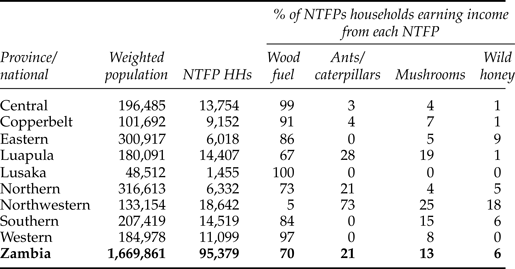
Table 1 presents descriptive results of the distribution of households that earned income from NTFPs in Zambia by province. The results were weighted using the sampling weights from the PHS. From a weighted national population of 1.7 million smallholder farming households, we estimate that 95,379 (about 6 per cent) earned income from NTFP-related business activities. Variations in number of households deriving income from NTFPs were observed across all the nine provinces. Northwestern Province had the highest share of households that reported income from NTFPs (14 per cent), followed by Copperbelt (9 per cent), Luapula (8 per cent), Southern (7 per cent), Central (7 per cent) and Western Provinces (6 per cent).
Households with income from NTFPs, by province and product (weighted)

Source: Calculated from PHS data, 2008.
In terms of products, wood fuels were the most common source of NTFP income with 70 per cent of all the households that earned NTFP income having obtained income from this source. This is not surprising given the increasing demand for charcoal for cooking in urban areas, which is driven in part by the increase in urban population, electricity tariffs and few affordable alternatives. Northwestern Province is the main beekeeping and honey production area in Zambia (Jumbe et al., Reference Jumbe, Bwalya and Husselman2008), and households in that province reported the greatest participation in the sale of wild honey as well as mushrooms and ants and caterpillars. However, households in Northwestern Province reported negligible participation in wood fuel trade relative to other provinces.
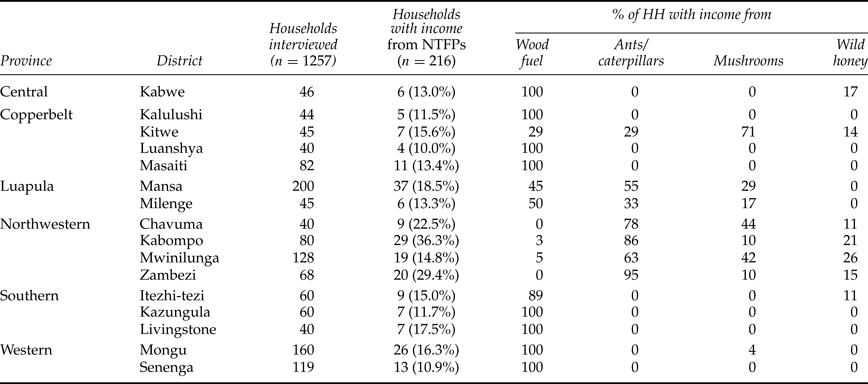
In order to focus the analysis on areas where household participation in NTFP-related activities is greatest, we define a sub-sample of households in districts where at least 10 per cent of the interviewed households reported income from the sale of NTFPs. Table 2 provides a summary of descriptive statistics of NTFP-participating households by product for districts that met this 10 per cent threshold. Of the 72 districts in Zambia, only 16 districts had at least 10 per cent of sampled households obtaining income from NTFP-related business activities, with four districts in Northwestern Province leading in terms of percentage of households deriving income from NTFPs. Although NTFPs are prevalent as business activities in only a few districts, their contribution to household income in these districts is noteworthy.
Households with income from NTFPs by district and product a

Source: Calculated from PHS data, 2008.
Notes:
a Some households in all the districts except Livingstone derived income from multiple NTFPs; thus total percentage of households with income from NTFPs across products is more than 100.
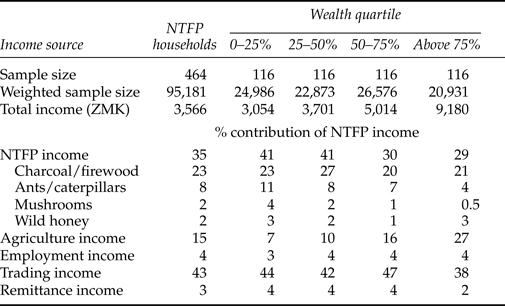
In order to examine the contribution of NTFP income by wealth strata, NTFP-dependent households were divided into four quartiles based on the value of assets owned. The results in table 3 reveal that the wealthiest 25 per cent derive more income from NTFPs than the other three wealth quartiles in absolute terms, but the share of total income (29 per cent) is considerably lower than the share for the poorest 50 per cent of the population (41 per cent). This implies that poorer households are relatively more dependent on income from the extraction and sale of NTFPs than wealthier households. Overall, NTFPs account for over a third (35 per cent) of total household income for participating households in all 16 districts, a finding that highlights the important role of NTFPs in rural livelihoods. While agriculture is the dominant economic activity in rural Zambia, income from NTFP-related business activities surpasses even agricultural income across all four wealth quartiles. Further analysis to examine the characteristics of households that participate in NTFP markets in districts where NTFP collection and sale are less common reveal that NTFP-dependent households in these districts are characterized by low levels of socioeconomic indicators such as landholding, assets and maize production, compared to their counterparts who do not participate in NTFP markets.
Income sources by wealth quartiles (weighted)

Source: Calculated from Supplemental PHS, 2008.
We compared the use of a tobit model against the two-stage Cragg model in the estimation of determinants of participation in NTFPs and contribution to income. The results of the formal log-likelihood ratio (LR) test between the two models confirmed the superiority of the Cragg tobit alternative model; that is, the test statistic Γ = 112.72 exceeds the critical value of the χ2 distribution (p-value = 0.0000), suggesting that the decision to participate in NTFPs and the level of NTFPs' contribution to household income are governed by different processes.
The lack of nationally representative panel data about NTFP participation presented a limitation of this study, as the use of cross-sectional data limited our ability to account for unobserved heterogeneity. To partially address this issue, provincial dummy variables were used to account for unobserved spatial differences that may exist across provinces, and also control for variations in many of the unobserved factors that could be correlated with some explanatory variables. In addition, error terms were clustered around villages, as this smaller unit (village) is likely to be more able to account for intra-village correlations which are typical in socioeconomic studies.
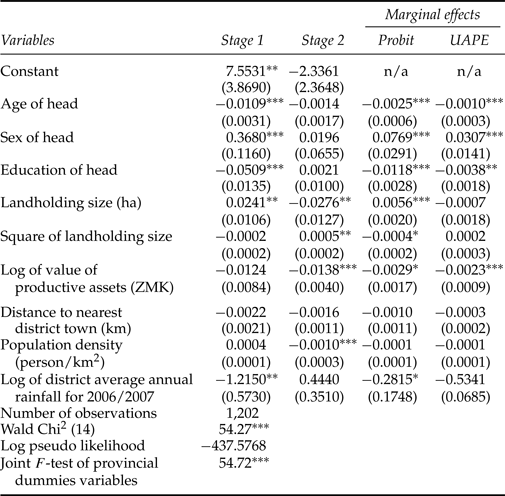
Table 4 presents results of the Cragg tobit alternative model of household participation in NTFPs markets and the NTFP share of household income. Stages 1 and 2 are maximum likelihood coefficients of the determinants of the probability of participation in NTFP markets and the contribution of NTFPs to total household income, respectively. For easier interpretation, the coefficients for the first stage are presented as the marginal effects in the fourth column (Probit); coefficients for the second stage are presented as unconditional average partial effects (UAPE) in the fifth column. Test of significance for the average partial effects for the second stage was performed using the Delta method in Stata. The terms marginal effect and partial effect are used consistently with the literature on these techniques, and share the same interpretation (see Wooldridge, Reference Wooldridge2008, for treatment of UAPEs). Model estimation and computation of UAPEs draws from Burke (Reference Burke2009), which uses the Delta method in Stata for computation of significance level for UAPEs.
Determinants of household probability of NTFP participation and share of NTFP income a

Notes: Robust standard errors in parentheses; ***p < 0.01; **p < 0.05; *p < 0.1.
a Six provincial dummy variables were included in the model, although they are not included in the table.
The fourth column (Probit) in table 4 presents marginal effects of the independent variables on a household's probability of participating in NTFP markets. The fifth column (UAPE) shows the expected overall effect of each independent variable on household's share of NTFP income to total household cash income across all households (i.e., both participants and non-participants). Thus, UAPE takes into account both the probability of participating in NTFP markets and the share of NTFPs income to total household income, for those that depend on NTFPs. This column is therefore useful as a summary indicator of the effects of independent variables on income from NTFPs.
The results show that age of the household head is a significant determinant of both the probability of participation and the contribution of NTFPs to household income. The negative sign of age of the household head in both stages suggests that households with relatively older heads are less likely to participate in NTFP markets and, if they do, the share of NTFP income is relatively less. In order to capture the relationship between household life cycle and participation in NTFP markets, we tested for the significance of the square of age of the head in the model, but the quadratic term was not significant. The positive and significant coefficient of sex of the household head in both stages indicates that male-headed households are more likely to participate in NTFP markets, and depend more on NTFP income than households headed by women. A negative and significant relationship exists between education and both the probability of participation in NTFP markets and the contribution of NTFPs to household income. Households with heads with higher levels of education are less likely to participate in NTFPs, mainly because education is associated with a wider range of income-generating opportunities. Education expands the possibilities for labor and employment, whereas household heads with low levels of education may be more economically vulnerable, and thus more likely to collect forest products for income.
The marginal effect of landholding size is positive and statistically significant, while its quadratic term is negative and statistically significant in explaining probability of participation. These results imply that, as landholding size increases, a household's likelihood of participation in NTFP markets increases, but at a declining rate. Thus, policies that increase household access to land have the potential to reduce dependence on NTFPs for income. However, landholding size is not a significant determinant of the contribution of NTFP income to total household income. The effect of wealth on NTFP participation and income can be estimated by the variable representing the value of household assets. The negative and significant marginal effect (Probit) and the average partial effect (UAPE) for the log of the value of household assets imply that households with more valuable assets rely less on NTFPs than those with less valuable assets. Using assets as a measure of overall wealth, these results imply that poorer households are relatively more dependent upon NTFPs as a livelihood, and confirm our hypothesis of a positive relationship between poverty and dependence on natural resources such as NTFPs.
In order to capture variation in NTFP market participation across districts with more or less favorable weather conditions for maize production, the model estimates the relationship between district average rainfall in the previous season and participation in NTFP markets. The rainfall variable was obtained from data from the Zambia Meteorological Department, which collects rainfall data through its weather stations dotted around the country. These data are compiled at the district level. Districts that do not have stations have their data points interpolated from nearby districts and through satellite imagery. Although rainfall may also affect NTFP participation, we find no literature that suggests a theoretical foundation for a link between rainfall and NTFP production. However, there may be some indirect effect related to maize production through participation in NTFP markets as a coping strategy during periods of weak maize crop yields. The negative and significant marginal effect of rainfall indicates that the likelihood of participation in the collection and sale of NTFPs increases following low rainfall in the previous season. This implies that households are more likely to participate in NTFP markets following poor crop seasons as a safety net or coping strategy, which is consistent with the literature on NTFPs (Godoy and Bawa, Reference Godoy and Bawa1993; Byron and Arnold, Reference Byron and Arnold1997; Shackleton and Shackleton, Reference Shackleton and Shackleton2004). In future research, panel data could be used to better evaluate the safety net role of NTFPs by evaluating households' participation in the collection and sale of NTFPs over time (as opposed to a one-time snapshot).
In order to control for any spatial differences such as local market conditions, availability of alternative household income generating activities and forest cover, which may exist across provinces, we included provincial dummy variables in the model. The joint F-test of the provincial dummy variables was significant, confirming the significance of location in determining both participation in NTFP markets and the contribution of NTFP income.
6. Conclusions
This study examined the determinants of rural household participation in NTFP-related business activities and the contribution of cash income from NTFPs to total household income in Zambia. The study has shown that NTFPs contribute about 35 per cent of household income for participating households, on average. Human capital factors – specifically, age, sex and educational level of the head of household – are significant determinants of household participation in NTFPs and of the contribution of NTFPs to household income. All else being equal, an increase in age and education is associated with a decline in the probability of participation in NTFP-related business activities and in the associated contribution to household income. Other significant determinants are landholding size and wealth status of the household. Both the descriptive and econometric model results show that poor households rely more on NTFPs than the wealthy, confirming the hypothesis of a positive relationship between poverty and dependence on NTFPs. This finding is consistent with other literature on the role of NTFPs in rural livelihoods (Cavendish, Reference Cavendish2000; Arnold et al., Reference Arnold, Köhlin and Persson2006; Shackleton and Shackleton, Reference Shackleton and Shackleton2006). In terms of absolute value, the wealthy recorded higher income from NTFPs, indicating that wealthier households either trade in larger volumes of NTFPs than the poor, or sell their products at higher prices.
The use of the Cragg tobit alternative model allowed this analysis to consider the separate effects of some explanatory variables (for example, landholding size and rainfall) on participation in NTFP markets and on the share of household income from NTFPs. With the tobit model, it is not possible to separately estimate the effects of a variable on the two stages (i.e., participation in NTFP business activities and the level of NTFP income), since the model only generates one set of coefficients for the two stages. Hence the use of the Cragg tobit alternative model provides useful insights that can help to further understand how variables affect the probability of participation and the share of NTFP income or the extent to which households rely on NTFP cash income. Thus, policies that are concerned with forest conservation should take into account this differing effect of factors on participation and extent of participation.
The relationship between wealth and dependence on NTFPs underscores the importance of integrating forest management policies and rural development strategies to take into account the central role NTFPs play in the livelihoods of the rural poor, because of the economic vulnerability that drives poorer households to collect and sell NTFPs. However, careful policy considerations are required to ensure rural household welfare improvement while sustaining the forest. Interventions that address rural poverty more directly have the potential to reduce rural household dependence on NTFP income, and hence can effectively contribute to sustainable forest management. Further, policies that improve land access for rural households have the potential to reduce pressure on forests by reducing the probability of households collecting and selling NTFPs. Generally, the results of this study indicate that NTFPs play an important part in supporting rural livelihoods, and the findings can be used to build a case for sustainable forest management in rural communities by ensuring that rural households understand that the continued availability of NTFPs depends on the integrity of the forests.
Generally the collection and trade of most NTFPs by rural households may have negligible ecological impacts, with the exception of charcoal and firewood. Projections of growing demand for charcoal suggest that, if left unchecked, expansion of charcoal production may compromise the integrity of forests and adversely affect ecosystem functions and the availability of other NTFPs that sustain households (Richardson, Reference Richardson2010). The demand for charcoal is often driven by urban household consumption and, as such, urban population growth is likely to increase the pressure on rural households to engage in charcoal production. Demand-side strategies (such as the promotion of improved or efficient charcoal braziers, gas stoves and alternative cooking fuels) should be considered for their possible role in reducing charcoal demand.
Promotion and expansion of markets for other NTFPs (such as caterpillars, wild honey and mushrooms) could help to reduce households' reliance on wood fuel as an income source. As indicated in table 4, other NTFPs contribute substantially to household income; in the presence of appropriate interventions, these other products could contribute even more to household incomes. However, expansion of NTFP markets should be flanked by appropriate harvest monitoring systems to ensure the sustainable harvest of NTFPs. In Zambia, the clearing of forest for agricultural purposes is the major contributor to deforestation (Government of the Republic of Zambia, 2009); thus, caution needs to be exercised with regard to the clearing of forests for agriculture, as continued excessive clearing may threaten access by poor rural households to forests for alternative income-generating activities. Programs that build capacity for alternative livelihoods or offer incentives for the conservation of forest resources could be effective at reducing pressure on forests.