INTRODUCTION
Periphytic ciliate communities have been widely accepted as a robust indicator to monitor responses to environmental stress and anthropogenic impacts using their colonization features (Cairns et al., Reference Cairns, Lanza and Parker1972; Munawar & Weisse Reference Munawar and Weisse1989; Finlay & Esteban, Reference Finlay and Esteban1998; Gong et al., Reference Gong, Song and Warren2005; Norf et al., Reference Norf, Arndt and Weitere2007, Reference Norf, Arndt and Weitere2009). However, conventional artificial substrate methods have been less efficient for protozoan colonization in marine ecosystems, mainly due to the influence of tidal current and circulation (Coppellotti & Matarazzo, Reference Coppellotti and Matarazzo2000; Xu et al., Reference Xu, Choi, Yang, Lee and Lei2002). Our previous studies have suggested that a modified glass slide method, the polyurethane foam enveloped slide (PFES) system, might provide an efficient strategy for assessing marine periphytic ciliates, allowing an analysis of species diversity and colonization parameters (Xu et al., Reference Xu, Min, Choi, Jung and Park2009a, Reference Xu, Min, Choi, Kim, Jung and Limb). However, this method requires evaluation, associated with aspects of temporal dynamics of colonization across different taxonomic levels. To this end, in this study we compare our PFES method to the standard conventional slide (CS) system for periphytic ciliate community analysis. Specifically, we applied and compared these two methods, using a range of statistical analyses, while assessing a 20-day baseline field survey, conducted on the impact of tidal currents and circulations on periphytic ciliate colonization.
MATERIALS AND METHODS
Study site and sampling strategy
The study was conducted during 2–21 April 2007 in coastal waters, near Incheon Harbour, Korea (Xu et al., Reference Xu, Min, Choi, Jung and Park2009a, Reference Xu, Min, Choi, Kim, Jung and Limb). This polluted coastal area is ~8 m deep and is turbid, due to mixing of sediments from the muddy-sandy bottom (Xu et al., Reference Xu, Min, Choi, Jung and Park2009a). CS and PFES were deployed at 1 m. The sampling strategy followed that described by Xu et al. (Reference Xu, Min, Choi, Kim, Jung and Lim2009b).
Polyurethane foam enveloped slide and CS, were designed, deployed, anchored, and sampled as described by Xu et al. (Reference Xu, Min, Choi, Jung and Park2009a, Reference Xu, Min, Choi, Kim, Jung and Limb). A total of 40 glass slides (2.5 × 7.5 cm) were used as artificial substrates for collecting periphytic ciliates from a depth of 1 m below the water surface. For each method, a total of four PVC frames were used to hold the 40 slides, 20 of which were used as an independent sampling replicate. For each replicate, two slides were randomly collected from each PVC frame at the time interval of 1, 3, 5, …, 19 days, during the study period. From both the PFES and the CS systems, samples were collected simultaneously. Ciliate identification and enumeration followed methods outlined by Xu et al. (Reference Xu, Min, Choi, Jung and Park2009a), according to the taxonomic scheme of Corliss (Reference Corliss1979).
Data analyses
Taxonomic diversity (Δ), taxonomic distinctness (Δ*), average taxonomic distinctness (Δ+) and variation in taxonomic distinctness (Λ+) of samples were calculated as: Δ = [ΣΣi<j ωijx ix j]/[N(N –1)/2]; Δ* = [ΣΣi<j ωijx ix j]/[ΣΣi<jx ix j]; Δ+ = [ΣΣi<j ωij]/[S(S – 1)/2]; Λ+ = [ΣΣi<j (ωij –Δ+)]/[S(S – 1)/2], where x i (i = 1, 2, …, S) denotes the abundance of the i st species; N is the total number of individuals in the sample; ωij is the ‘distinctness weight' given to the path length linking species i and j (with i < j, for sake of definiteness); and S is the number of species (Warwick & Clarke, Reference Warwick and Clarke1995; Clarke & Warwick, Reference Clarke and Warwick1998).
The distinctness weights used in this study were according to Clarke & Warwick (Reference Clarke and Warwick1998), in context of the class of periphytic ciliates: ω = 1 (species in the same genus); 2 (same family but different genus); 3 (same order but different family); and 4 (same class but different order). The distinctness of two species connected at the highest taxonomic level is set equal to 100 (Clarke & Warwick, Reference Clarke and Warwick1998; Warwick & Clarke, Reference Warwick and Clarke2001). A regional master list of periphytic ciliates was compiled using the present data from the 20 total samples collected using both sampling systems.
The colonization process of periphytic ciliate communities can be followed by sampling replicate glass slides over time to follow the rate and magnitude of each taxon accrual process. Data can thus be fitted to the colonization equilibrium model developed by MacArthur & Wilson (Reference MacArthur and Wilson1967): S t= S eq (1– e–Gt), where S t = the taxon number at time t; S eq = the estimated equilibrium taxon number of ciliate colonization; G = the constant value of colonization rate; and T 90% = the time taken for reaching 90% S eq.
Three colonization parameters (S eq, G, and T 90%) were obtained by the computer program M-W (Xu et al., Reference Xu, Gao, Xie, Deng, Feng and Xu2005). Fitness tests were conducted to assess if the taxon numbers observed according to days fit with the MacArthur–Wilson model at the 0.05 significance level.
All multivariate analyses and routines were conducted using PRIMER v6.1 (Clarke & Gorley, Reference Clarke and Gorley2006). The temporal patterns of ciliate communities across taxonomic levels were summarized by the routine multidimensional scaling (MDS), based on the Bray–Curtis similarity from the log-transformed abundance data. The similarities of the colonization patterns at different ciliate taxonomic levels were analysed by the second-stage MDS ordination on the second-stage similarity matrix from the Bray–Curtis similarity matrices above (first-stage similarity matrix) using the 2STAGE routine. The consistencies/matches among the colonization patterns at five taxonomic levels and the matching correlations with the temporal seriations of samples in each system were analysed using the Spearman rank-correlation coefficients (ρ values) which were computed by the submodule RELATE. The differences between the PFES and the CS samples were tested by the second-stage analysis of similarities (ANOSIM) routine at the significance level of 0.05 (Clarke & Gorley, Reference Clarke and Gorley2006).
The non-parametric Kolmogorov–Smirnov test was used to evaluate the differences in temporal patterns of taxonomic diversity and colonization patterns between the PFES and the CS ciliate communities at the 0.05 level.
RESULTS
Taxonomic structure and diversity
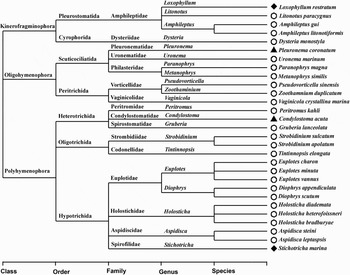
In this study, periphytic ciliates were classified into five taxonomic levels: class, order, family, genus and species. A total of 29 ciliate species, identified from both the PFES and the CS systems during the study, belonged to 21 genera, 16 families, 7 orders and 3 classes, of which 25 species, 17 genera; 13 families occurred in both collection systems (Figure 1). The taxonomic structure of ciliate samples showed similar patterns between the two systems. A total of 27 ciliate species representing 19 genera, 7 orders, and 3 classes were found in both systems, but there were 14 families found in the PFES system and 15 families in the CS system (Figure 1).
Five-level classification used for the construction of taxonomic diversity between 29 periphytic ciliates identified from a total of 20 (10 polyurethane foam enveloped slide (PFES) and 10 conventional slide (CS)) samples. White cycles, occurred in both systems; shaded triangles, only in the CS system; shaded rectangles, only in the PFES system.

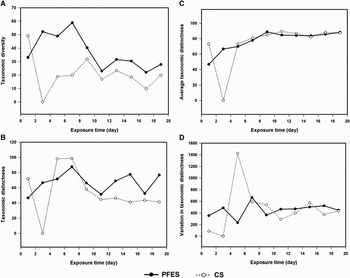
The temporal variations of four taxonomic diversity indices are summarized in Figure 2. The non-parametric test revealed that taxonomic diversity (Δ) and distinctness (Δ*) were significantly higher in the PFES system than in the CS system (P < 0.05), while the average taxonomic distinctness (Δ+) and variation in taxonomic distinctness (Λ+) showed no significant differences between the two systems (P > 0.05). On the other hand, in both systems, all four taxonomic diversity/distinctness indices showed a clear temporal pattern, i.e. levelling off at a relatively stable level after an unstable period (9 days). However, there was higher variability in the CS system than in the PFES system, e.g. the coefficients of variation of Δ and Λ+ values were 30.4% and 22.4% in the CS samples, compared with 23.1% and 10.9% in the PFES samples (Figure 2).
Temporal variations of taxonomic diversity (A), taxonomic distinctness (B), average taxonomic distinctness (C) and variation in taxonomic distinctness (D) of periphytic ciliate communities in the polyurethane foam enveloped slide (PFES) and the conventional slide (CS) systems on days 1, 3, 5, … , 19 respectively.

Colonization patterns of ciliate communities across taxonomic levels
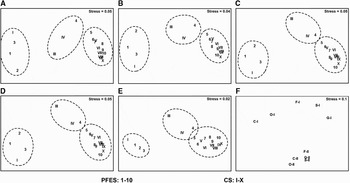
The temporal patterns of ciliate community structures at five taxonomic levels are summarized by the sub-MDS ordinations from Bray–Curtis similarities on log-transformed abundance data from the 19 samples (Figure 3A–E). The similarities of ciliate communities showed a clear increasing trend over the increasing temporal scales through all five classification ranks in both systems (Figure 3A–E). Clustering analyses resulted in all samples falling into three groups at a 35% similarity level, with significant differences at a 0.05 level (ANOSIM test) (Figure 3A–E). The second-stage MDS ordination indicated that the similarities among/between the colonization patterns at five taxonomic levels became lower with increasing the classification rank, in both systems (Figure 3F). However, the RELATE analyses showed that the five colonization patterns represented a significantly high similarity between each other in each system (ρ values > 0.95; P < 0.05). Otherwise, these five colonization patterns in the PFES system showed lower similarities than those in the CS samples (Figure 3F). The second-stage ANOSIM test demonstrated their consistency was significantly different between both systems (P < 0.001).
Multidimensional scaling (MDS) ordination of 20 (10 polyurethane foam enveloped slide (PFES) and 10 conventional slide (CS)) samples using the Bray–Curtis similarities on log-transformed abundance data. (A) Species; (B) genus; (C) family; (D) order; (E) class; (F) second-stage MDS across five taxonomic levels; 1-10, PFES sample 1-10, I-X, CS sample I-X; S-, G- F-, O- and C-I, classification of PFES samples at species, genus, family, order and class level; S-, G- F-, O- and C-II, classification of CS samples at the same taxonomic level as PFES data.

The matching correlations with the temporal seriations of samples in each system at all taxonomic levels are given in Table 1. It was demonstrated that the temporal seriations for matrices of the PFES samples represented higher ρ values (>0.75) than those of CS samples (<0.60) (Table 1). Furthermore, the matching correlation with the temporal seriations of the PFES ciliate communities showed a clear gradient in ρ values with increasing classification rank compared to the CS samples (Table 1).
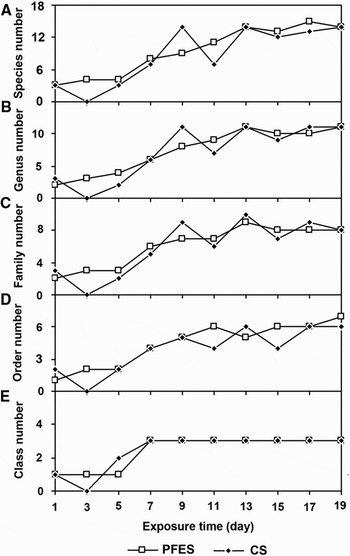
Colonization curves of periphytic ciliate communities on the polyurethane foam enveloped slide (PFES) and the conventional slide (CS) systems at different taxonomic levels during the 19-day colonization period in Incheon coastal waters. (A) Species; (B) genus; (C) family; (D) order; (E) class.

Results of matching (RELATE) analyses for temporal seriations of periphytic ciliate assemblages in both polyurethane foam enveloped slide (PFES) and conventional slide (CS) systems based on similarity matrices from log-transformed abundance data at various taxonomic levels during the 20-day study period in April 2007.

Colonization process at five taxonomic levels
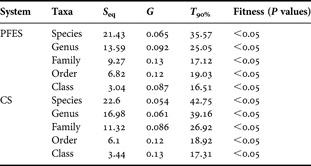
Colonization curves of ciliate communities on both systems exposed for 1, 3, 5, …, 19 days are illustrated at five taxonomic levels in Figure 4. The colonization rates expressed by the taxon number over time obtained from this study were comparably higher in the PFES system than in the CS system, in spite of no significant differences in colonization patterns between them (Table 2).
Colonization parameters of periphytic ciliates on polyurethane foam enveloped slide (PFES) and conventional slide (CS) system at five taxonomic levels during the period of 20-day study in April 2007.

S t, the taxon number at time t; S eq, the estimated equilibrium taxon number of ciliate colonization; G, the constant value of colonization rate; T 90%, the time taken for reaching 90% S eq.
Estimates of three colonization parameters, i.e. taxon number during the equilibrium (S eq), constant value of colonization rate (G), and time taken to reach 90% S eq (T 90%) were calculated for the colonization process based on fitting the MacArthur–Wilson taxon equilibrium model (Table 2). The G values, as a parameter that represents the colonization rates, were higher in the PFES system than in the CS system. The T 90% values that positively correlated with the G values were lower in the PFES communities compared to the CS communities. With increasing taxonomic rank, the colonization rates represented greater values, when the T 90% values became distinctly shorter in substance (Table 2).
DISCUSSION
Although many investigations on colonization, using artificial substrate methods, have been conducted on freshwater ciliates (Cairns & Yongue, Reference Cairns and Yongue1968; Cairns & Henebry, Reference Cairns, Henebry and Cairns1982; Railkin 1995; Franco et al., Reference Franco, Esteban and Téllez1998; Xu et al., Reference Xu, Gao, Xie, Deng, Feng and Xu2005), few have been carried out in marine systems (Xu et al., Reference Xu, Choi, Yang, Lee and Lei2002, Reference Xu, Min, Choi, Jung and Park2009a). Our previous studies have demonstrated that the tidal events, in marine systems, influence both species diversities and species colonization parameters of periphytic ciliate communities colonizing CS (Xu et al., Reference Xu, Min, Choi, Jung and Park2009a, Reference Xu, Min, Choi, Kim, Jung and Limb). This was mainly because fragile ciliates were removed by rough tidal conditions during the colonization process. In this study, we carefully explore the uses of a different method to examine colonization of ciliates at different taxonomic levels in marine systems: PFES.
We demonstrate that the matching correlation with temporal seriation of the ciliate colonization patterns at each taxonomic level was higher in the PFES system (ρ values > 0.75) than those of the CS system (ρ values < 0.60). This suggests that the colonization patterns of ciliate communities represented a higher variability in less (PFES) than in more disturbed (CS) environments at all five taxonomic levels. Furthermore, our results also revealed that the ρ values of the PFES samples showed a clear increasing trend with increasing the taxonomic rank compared to the CS system (e.g. from 0.778 at species level to 0.816 at family level). This might be described by the fact that the influence on temporal seriations of ciliate colonization pattern from the tidal events became lower with increasing taxonomic ranks.
Several investigations have demonstrated that the taxonomic relatedness is useful to evaluate marine biodiversity and environmental issues (Clarke & Warwick, Reference Clarke and Warwick1998; Mouillot et al., Reference Mouillot, Gaillard, Aliaume, Verlaque and Belsher2005; Clark & Gorley, 2006; Leonard et al., Reference Leonard, Clarke, Somerfield and Warwick2006; Prato et al., Reference Prato, Morgana, Valle, Finoiaand and Lattanzi2009). In our study, the statistical analysis demonstrated that the taxonomic diversity (Δ) and distinctness (Δ*) were significantly higher in the PFES system than on the CS system (P < 0.05). In addition, all four indices represented low coefficients of variability in the PFES samples compared to that of the CS system during the colonization period. These findings suggest that the PFES system is effective for measuring the taxonomic relatedness indices by reduction of strong disturbances from tidal current and circulation in marine ecosystems (Xu et al., Reference Xu, Min, Choi, Jung and Park2009a, Reference Xu, Min, Choi, Kim, Jung and Limb).
In summary, our present study demonstrated that: (1) although the ciliate communities represented similar taxonomic structures and colonization patterns at different taxonomic levels, they represented great differences in colonization patterns between the PFES system and the CS method; (2) the taxonomic diversity (Δ) and taxonomic distinctness (Δ*) were distinctly higher in the PFES system than on the naked glass slides; and (3) all four taxonomic diversity/distinctness indices represented lower variability in PFES samples than in those of the CS system, despite that the average taxonomic distinctness (Δ+) and variation in taxonomic distinctness (Λ+) showed minor differences in both systems. These findings suggest that the PFES system is more effective than the conventional glass slide method for measuring the colonization patterns and taxonomic distinctness parameters that were increasingly used as potential indicators of water quality. This supports our previous suggestion that the PFES system is a better tool than the conventional glass slide method for monitoring water quality in the marine ecosystem, using periphytic ciliates.
ACKNOWLEDGEMENTS
This work was supported by Korea Research Foundation Grant (KRF-2008-013-C00064), the grants of Korea Research Foundation (KRF-2007-COO265) and Ministry of Environment (The Eco-technopia 21 project of 2007), a post-doctoral fellowship from Inha University to H. Xu, and the National Natural Science Foundation of China (project number: 41076089). Our special thanks are due to Professor David J.S. Montagnes, Institute of Integrated Biology, BioSciences Building, University of Liverpool, UK, for his helpful discussion with preparing the manuscript.