Three highly successful amateur composers active in Venice in the first half of the eighteenth century are today familiar names: Tomaso Albinoni (1671–1751), Alessandro Marcello (1673–1747) and Benedetto Marcello (1686–1739). Less well known – indeed, scarcely recognized – is a fourth figure, Diogenio Bigaglia (1678–1745). Well known in his day and particularly admired for his musical erudition, Bigaglia was as versatile as Albinoni and the younger of the Marcello brothers, but his conditions of life were radically different: between 1694, when he took his vows, and his death Bigaglia was attached as a Benedictine (Cassinese) monk to the abbey of San Giorgio Maggiore on the Venetian island of the same name.Footnote 1 In a few respects, his membership of such a powerful and highly respected monastic community aided Bigaglia's activity as a composer, but in most ways it circumscribed it – by limiting his opportunities to perform or direct music in public, reducing his ability to travel freely, narrowing the range of musical genres to which it was acceptable for him to contribute (opera was a no-go area) and filling up much of his time with religious, pedagogical or administrative duties. Conversely, there is no sign that the abbot or his fellow monks ever disapproved of Bigaglia's musical involvements: his achievements and reputation in that area seem, rather, to have been regarded as a feather in the cap of the Venetian Benedictines and even of the Republic itself.Footnote 2
The modern revival of Bigaglia's music after the Second World War was spearheaded by recorder players – a little ironically, since only three of his solo sonatas are assigned specifically to recorder. Most of the remainder, including a set of twelve published in Amsterdam by Michel-Charles Le Cène (c1684–1743) in 1725, are ‘multi-purpose’ works playable without adaptation equally by violin and at least one woodwind instrument (choosing from recorder, transverse flute and oboe). More recently, his cantatas and concertos have attracted attention,Footnote 3 and there are signs that a revival of his sacred vocal music is at last beginning.Footnote 4 A serious re-evaluation is finally underway.
The Biographical and Social Background
In its essentials, Bigaglia's life can be described very simply, since it has few landmarks or changes of direction. He was born on the Venetian island of Murano as Antonio Bigaglia on 11 March 1678, a week after Antonio Vivaldi.Footnote 5 His father, Bernardino Bigaglia (1640–1690), was a very prominent glassmaker specializing in the production of mirrors. Antonio was the third of four sons, among whom the second, Giovanni (‘Zuane’ in Venetian), was chosen to inherit the family business, the eldest son having died young. In all probability, the adolescent Antonio was directed by his family towards the religious life in keeping with a traditional Venetian strategy to avoid division of the family property among several sons and at the same time gain social capital through this connection. Because of its restriction to sons of the nobility and the upper levels of the citizen (cittadino) stratum, the community of San Giorgio Maggiore was the ideal destination for a member of an upwardly mobile family of artisans. With its large population of professed monks, reported to number around sixty in 1721 and eighty in 1729,Footnote 6 this wealthy abbey was a thriving hub of Venetian civic life rather than any kind of austere retreat.
Antonio's forename ‘in religion’ became Diogenio. This name appears, even in documents of the abbey itself, in several variants (Diogene, Dionigio, Dionisio), and outside its precincts even sometimes – but surely by mistake – as Eugenio.Footnote 7 The surname is sometimes given in Venetian form (Bigaja) or in a variety of corrupt spellings such as Bigalgia or Bigaggia.Footnote 8 The abbreviations P. and D., with which Bigaglia's name is often prefaced in musical and other documents, stand respectively for ‘Padre’ and ‘Don’, while the letters M. C. that commonly follow it are short for ‘Monaco Cassinense’.
On 12 June 1704, four years after his ordination, Bigaglia was made a dean, with the assigned duty of instructing novices.Footnote 9 In 1713 he was elected to the important fixed-term post of prior (deputy to the abbot), which he probably held for several (typically, six) years. Starting in 1731, he served the abbey as senior cellarer (administrator). It was in this capacity, five years later, that he oversaw in person the sale to Emperor Charles VI of the Shrine of the Holy Martyrs (Loco pio dei Santi Martiri) in Trieste, which had for centuries been in the possession of his community.Footnote 10
One other occasion on which Bigaglia is known to have left Venice was between April and July 1715, when he accompanied (as her confessor, one would imagine) the exiled Electress of Bavaria, Therese Kunigunde (1676–1730), back to Munich, remaining with her there for several weeks. As a musician, Bigaglia must already have been in Therese Kunigunde's favour, since she acquired two of his chamber cantatas in 1713.Footnote 11 On his homeward journey Bigaglia was briefly a guest, from 15 to 18 July 1715, at his order's sister house at Benediktbeuern, where he enjoyed the company of the savant and music-lover Karl Meichelbeck. We learn of this visit from Meichelbeck's unpublished diary, compiled in a mixture of Latin and Italian.Footnote 12 For 23 July Meichelbeck wrote in his diary: ‘Si canta Laudate del P. Diogenio Bigaglia’ (A Laudate [pueri] by Fr Diogenio Bigaglia is sung). Clearly, Bigaglia had been travelling with some of his own music among his personal effects.Footnote 13
A more significant contact occurred towards the end of Bigaglia's life. In 1740 the abbot of the Austrian Benedictine monastery of Kremsmünster sent the talented young musician Franz Sparry (1715–1767) on an extended study tour of Italy in preparation for his expected later appointment as regens chori (which duly happened in 1747). In the summer of 1742 Sparry lodged for a short time at San Giorgio Maggiore, where he met Bigaglia and came away with a large number of sacred vocal compositions, many of which (including eight mass settings) survive in manuscript at Kremsmünster, whose monastery library is today the prime repository of Bigaglia's sacred vocal music.Footnote 14
Bigaglia the Musician
How Bigaglia developed his musical skills during boyhood and adolescence is unknown. He was of the right age to have been taught by Antonio Lotti (1666–1740), for from the very start of his career, when employed initially as a singer and later as an organist at the ducal church of San Marco, Lotti was a sought-after teacher of budding composers in vocal genres.Footnote 15 But there is no concrete evidence for this supposition. It is undeniable, however, that Bigaglia belongs among the many Venetian followers of Lotti, a circle much wider than that of the latter's actual pupils.
What instruments Bigaglia learned is not known for certain. The description by Joachim Christoph Nemeitz (1679–1753) of him as ‘ein berühmter Componist und Virtuoso’ (a famous composer and virtuoso) does not clarify the matter by expanding on the second term.Footnote 16 Recorder players have sometimes claimed him as one of their own, but on very flimsy evidence, since, as we have seen, the number of solo sonatas he composed specifically and exclusively for recorder does not exceed two or three. Besides, writing idiomatically for an instrument needs merely compositional know-how, not necessarily personal experience as a performer.
More plausible is the suggestion that he was an organist. As a high-status instrument, the organ was favoured, unsurprisingly, by those from a wealthier background such as Bigaglia, providing an excellent basis both for musical accompaniment and direction and for compositional and theoretical studies. But the mention of his prowess on this instrument appears to originate in the nineteenth rather than the eighteenth century, which raises slight suspicions.Footnote 17 Nevertheless, the existence of a concerto by Bigaglia for the unusual combination of organ and violin (strikingly similar in style to the examples by Vivaldi) is perhaps a faint hint in that direction, establishing at the very least that he knew how to write idiomatically for solo keyboard.Footnote 18 His liking for very long pedal notes in compositions such as his chamber duets could be another pointer.
Bigaglia also acquired a reputation during his lifetime as a scholar. A reference from 1736 speaks of him as a ‘uomo dottissimo’ (a most learned man), although here it is probably theological or scientific rather than musical learning that is being spoken about.Footnote 19 However, in 1780 Jean-Benjamin de La Borde (1734–1794) comments anecdotally: ‘Bigaglia . . . s'est distingué au point que les maîtres allaient le consulter, & faisaient le plus grand cas de ses conseils’ (Bigaglia . . . distinguished himself to such an extent that masters went to consult him and set very great store by his advice).Footnote 20 Like his English counterpart Sir John Hawkins (1719–1789), La Borde was privy to many little snippets of information imparted by those who had known deceased musicians at first hand, and there is a good chance that his statement is true. Supporting it is the fact that many of Bigaglia's compositions reveal a liking for the more recondite devices of the contrapuntist, such as thematic inversion and especially imitation with displaced accents (per arsin et thesin).
Bigaglia the Composer
There was doubtless much private music-making among the monks at San Giorgio Maggiore, where Bigaglia's more intimate compositions, such as solo sonatas and continuo-accompanied chamber cantatas, could be tried out. Sometimes the monks even welcomed musical ensembles from the outside to their island. In a diary entry for 26 July 1757 we read, for example, of a
Ricreazione filarmonica eseguita da’ più civili dilettanti di Musica, stromenti, e canto, fiancheggiati da Professori, si adempisce in S. Giorgio maggiore con soddisfazione de[’] Monaci, q[ua]li impartiscono agl'Accademici Cose dolci; frutta, e Rinfrescamenti gelati.Footnote 21
Musical recreation performed by the most courteous amateur players and singers, reinforced by professional musicians; this takes place on San Giorgio Maggiore to the great satisfaction of the monks, who ply the academicians with sweetmeats, fruit and iced refreshments.
What stands out in this account is the segregation of the two parties: the musicians, who play and eat, and the monks, who listen and provide food. Bigaglia will rarely, if ever, have had the opportunity to rub shoulders in music-making with members of either professional ensembles or amateur music societies, since questions of decorum were involved on both sides. (In Venice, however, such mixing was tolerated for the diocesan clergy and especially for secular priests (abati) such as Vivaldi.) As a composer, Bigaglia laboured under fewer restrictions. Even when he was unable to direct, or even merely participate in, their performance, his compositions written at the behest of individual or institutional patrons could subsequently circulate freely, spreading his reputation. Additionally, copying shops (copisterie), which, apart from making fair copies for their composer clients, regularly produced and surreptitiously stockpiled second copies to use for their independent commercial activity, could multiply their diffusion immensely. An operatic commission was out of the question, but there was evidently no barrier to his composing a concert aria on a much-loved text taken from a Metastasio libretto.Footnote 22 Even distinctly racy texts, such as those of his two comic cantatas on texts in Venetian, could be set without apparent censure.Footnote 23
The question then arises: did Bigaglia compose music for public performance at his own abbey or its church? One such instance is documented. In 1731 Pietro Orseolo, a former doge of Venice who in the year 978 had abandoned his office to become a Benedictine monk in the south of France, was canonized. Joining in the civic celebrations, San Giorgio Maggiore hosted in its church, on 28 August, a solemn mass and Te Deum in the morning and what is described simply as ‘musica’ in the afternoon.Footnote 24 This non-liturgical event is identifiable as a performance of La Giaele, an oratorio by Bigaglia on a text by the nobleman Daniele Giuppone that had been premiered in Rimini in 1727 and went on to earn revival several times subsequently.Footnote 25 One suspects that the abbey's choice of an already existing work and a composer close to hand (and in possession of the music) had something to do with a shortage of preparation time. It tells us nothing about the possible contribution of Bigaglia to the three major festivals observed annually at the church with figural music provided by handpicked visiting musicians: the patronal festival on 23 April and St Stephen's Day on 26 December – each with mass in the morning and First Vespers on the vigil – plus some functions during Holy Week.Footnote 26
During the period 1700–1710, when Bigaglia almost certainly composed the Dixit Dominus to be discussed, it appears that Antonio Lotti was engaged year after year to supply the performers and the music for these occasions, as he did for similar functions all around Venice for which no salaried maestro di cappella or other musicians beyond, perhaps, an organist were available. Surviving documents that include receipts, orchestra lists and reports in newsletters confirm that Lotti composed the music and ‘fixed’ the orchestra and singers for the patronal festival at San Giorgio Maggiore in 1708 and 1711, doing the same (somewhat less lavishly) for Holy Week in 1712.Footnote 27
Particularly instructive is a complete list of musicians (besides Lotti himself), with a note of their personal payment, for the 1708 Vespers and mass. This list can be taken as fairly typical in make-up for festive occasions taking place in large churches catering for the upper levels of Venetian society and foreign visitors.Footnote 28 There are sixteen singers divided equally among the four customary sections. Unsurprisingly, most of the singers are identifiable as cantori on the payroll of the ducal church. This generous number allows up to four solo singers of the same voice type to be in action simultaneously, and in any ‘tutti’ sections where a part divides into two a ripieno singer is available for reinforcement. The five organists include Benedetto Vinaccesi, Carlo Francesco (or Antonio?) Pollarolo and Lodovico Fuga, all employees of the ducal church, and their number corresponds exactly to the number of portable organs (organetti) that San Giorgio Maggiore had at its disposal for such occasions.Footnote 29 The violoni Footnote 30 number two and are supported by a theorbo. There are ten violins, divided into the usual two parts, and they are headed by the concertmaster at San Marco, Giorgio Gentili, and his co-leader, Giovanni Battista Vivaldi. The violas (violette) number eight, which implies division into two parts: alto viola and tenore viola. This division was a conservative feature: already in a reform of the orchestra at San Marco undertaken in 1714 we find evidence of a growing tendency to assign only a single part to this section, evidenced by a reduction in the number of violas and a corresponding increase in that of violins.Footnote 31 There are only two cellos: until well into the nineteenth century it was usual for Italian orchestras to make contrabass tone (played by the violoni) stronger in relation to ‘eight-foot’ bass tone than we favour nowadays. Finally, there is a lone oboist, Onofrio Penati, and two trumpeters, one of whom is Lunardo (Leonardo) Laurenti. Both named players were concerti (as instrumentalists were termed) at San Marco.
But even if he rarely figured in large-scale music performed in his own church, Bigaglia had the opportunity throughout the year to accept commissions from local churches. Moreover, he could circulate his music via the network of Benedictine houses and institutions in Italy and beyond: for instance, the Benedictine University of Salzburg in 1726 hosted a serenata by him, L'Amorat, and possibly on the same occasion heard his oratorio La passione d'Abele innocente.Footnote 32 Other monastic congregations, such as the Franciscans of Padua and Assisi, cultivated his music (particularly his solo motets), while several churches belonging to the new, post-Tridentine orders (Jesuits, Theatines, Philippines and others) as well as various confraternities either commissioned or revived his oratorios.Footnote 33 Nor did Bigaglia lack local patrons, for whose private concerts (conversazioni) he supplied, besides instrumental music, secular vocal music in large quantity. One such patron was the very gifted poet Antonio Ottoboni, who, before being made to leave Venice for political reasons in 1712, received from the composer a solo cantata and a serenata-like dramatic cantata for two voices, Plutone e Proserpina, both set to his words.Footnote 34 The independent activity of copying shops brought Bigaglia's music to the attention of collectors and performers, many of them non-Italian, keen to possess his music. The fact that in the later 1720s the English traveller Humphry (or Humphrey) Mildmay was able to buy in Venice a manuscript volume containing twenty-two of his cantatas for soprano illustrates both his status as a cult figure and the readiness – in both senses – of copisterie to profit from it.Footnote 35 Bigaglia was also able to turn his hand to composing works of non-standard type. For instance, he wrote a set of three trio sonatas for an experimental type of transverse flute pitched in C major that briefly interested some transalpine makers in the 1720s,Footnote 36 and also a collection of twelve chamber duets all taking their texts from Carlo Gesualdo's (1566–1631) five-part madrigals, composed over a century earlier.Footnote 37
A telling pointer to Bigaglia's Europe-wide popularity at the height of his career is the fact that the title-page of his published opera prima of 1725, the twelve multi-purpose solo sonatas, prefaces the publisher's name in the imprint with ‘Aux depens de’ (at the expense of). Normally, a composer – and especially an amateur one – committing his music to print for the first time would be expected to foot the bill himself, with or without the help of a dedicatee. Le Cène generally absorbed the production costs only when the composer was already a public favourite or when pirating from another publisher, so his generous treatment of Bigaglia's sonatas bespeaks great respect for the composer and an anticipation of high sales.
Bigaglia's Dixit Dominus: Provenance and Bibliographical Details
There are various reasons why a close study of Bigaglia's Dixit Dominus is worthwhile, apart from the fact that it is a fine work deserving modern performance. One is that it is clearly the earliest of his known large-scale sacred vocal works, and quite possibly his earliest surviving work in any genre. Further, it is a ‘liminal’ work that on one hand reflects the late seventeenth-century Venetian musical (and music-theoretical) culture in which Bigaglia grew up and on the other hand already expresses the composer's personality and points forward to some lines of future stylistic development.Footnote 38 A relationship of particular interest is that between Bigaglia's setting and one by Lotti in the same key (A major, with a two-sharp key signature), with which it shares several features and which could conceivably have served directly as its model.Footnote 39 The latter setting has already been claimed, with strong (albeit not quite conclusive) supporting argument, to have been used not only as a model but also, more specifically, as a source for thematic ideas in Handel's Dixit Dominus in G minor (hwv232, begun in late 1706) and some later Handel works.Footnote 40
Finally, Bigaglia's Dixit Dominus illustrates several general features of settings of Psalm 109 (110 in Protestant Bibles) during its period. As the opening psalm of the five sung at Vespers and the only one required on practically every day of the year, it was among the most commonly set. Its position at the head of the group virtually guaranteed that it would be set for the complete ensemble and that it would assume the solemn, ritualistic character of an intrada, as befitted a text speaking of God's favour towards the psalmist's king and readiness to exact divine retribution on his enemies. The regal imagery suggested the use, where possible, of one or more trumpets. This encouraged in turn the choice of C and D major – particularly the second key, which suits not only the baroque trumpet but also the violin, on account of the enhanced opportunities for sympathetic resonance of the open strings and their employment in multiple stopping or bariolage. In that context Handel's G minor setting deviates markedly (and perhaps quite deliberately) from the norm: it brings out incomparably the unapologetically violent, uncompromising side of the biblical text, but at the expense of its straightforwardly celebratory aspect.Footnote 41
Add. MS 14401 at the British Library is a volume in oblong quarto format (measuring 22.5 by 32 cm) comprising sixty folios (numbered 2–61 by the library) of music paper pre-ruled with twelve staves on each side plus an enclosing bifolio in plain paper (its first folio numbered 1), which evidently served as a folder for the score prior to binding. Folio 2r is a title-page; the text of its florid handwriting, where all initial letters become absurdly inflated with curlicues, reads: ‘Dixit Dominus.│Musica│del Padre Maestro Bigaglia│// 1690: //’ (Figure 1). Exactly the same title (minus the year) is reproduced, with scarcely any graphical deviation, on the opening page of the folder. In the top right-hand corner of fol. 2r the donor of the manuscript to the ‘musical library’ of the British Museum writes his name and address, recording the date of the donation: 12 September 1843. This person is the distinguished musician, editor, publisher and collector Vincent Novello (1781–1861). The scribal hand of the two title-pages is equally easy to identify. This is Giuseppe (in Venetian, Iseppo) Baldan, the owner of Venice's best-known and most active copisteria, strategically located in the vicinity of the San Giovanni Grisostomo opera house, which was active during a period stretching from the 1730s to the 1780s.Footnote 42 The score itself is written in a different, more everyday hand by one of Baldan's numerous assistants. Baldan has a well-earned bad reputation among musicologists for his serial falsification of composers’ names and dates of composition when fulfilling commissions for customers.Footnote 43 In the present instance, the composer's name is correctly given, as stylistic indices amply confirm, but his title of ‘Maestro’, suggesting a professional musician holding a senior post, is manufactured, and the date (presumably of composition), 1690, is patently false: in that year Bigaglia celebrated his twelfth birthday.
Main title-page of Diogenio Bigaglia, Dixit Dominus. British Library, Add. MS 14401, fol. 2r. © British Library Board

The connection between Baldan and Novello is in all likelihood the celebrated double-bass player Domenico Dragonetti (1763–1846), who left his native Venice for London in 1794 and before then was active as a player in the San Marco orchestra and the city at large, as well as being a composer (mainly for his own instrument) and a collector of older music. He befriended Novello in England, and it is known that several items in the latter's collection were gifts from him. He was also old enough to have been able to purchase the Dixit Dominus directly from Baldan's shop before his emigration, although it could equally well have come into his possession at second or third hand. The exemplar, autograph or otherwise, from which the copy ultimately acquired by Novello was made could well have lain undisturbed on Baldan's premises over many decades.
Economy of effort is a feature of this copy (and of Baldan copies in general). Wherever possible, verbal or musical elements are written only once rather than multiplied. Thus instrumental and verbal designations for individual parts before the opening system of a movement are omitted unless needed for clarity.Footnote 44 General directions such as ‘Tutti’ and ‘Solo/Soli’ or ‘piano’ and ‘forte’ are frequently entered for only one part, on the assumption that the copyist of the separate parts will remember to add them where relevant. Where vocal textures are homophonic, the underlaid text is normally entered only for one part, generally the highest or lowest. Doubling parts may be cued in rather than separately notated. More unexpectedly, Baldan and his assistants make copious use of very modern-looking forward slashes across stems as an abbreviation for repeated quavers or shorter values. To save paper, the number of systems per page is kept flexible. Where the required number of staves exceeds six, there is room for only one, but when it reduces to three (for solo numbers with a single obbligato instrument partnering the voice), as many as four systems can be accommodated. All twelve movements begin on a fresh page, recto or verso.
Bigaglia's Dixit Dominus: Layout and Tonal Organization
A convenient way to begin analysis and evaluation of this Dixit Dominus is by considering Table 1, which sets out some important elements. From columns 1 and 2 one sees immediately that this is a setting on the grandest scale: namely, with one movement per verse. Movements V and IX of this psalm, following an established practice, are subdivided into two sections, the rationale being that in these two verses there is a contrast, even an antithesis, between the content of each semiverse. Psalms in general are often set in a more condensed way (in a single movement or with more than one verse assigned to a movement), both for the sake of variety and in order to keep the duration of a Vespers within the desired time limit (remembering also that there is no necessity for all five psalms proper to the feast in question to be sung in figural music, since from a liturgical standpoint plainsong will always serve for any of them). For reasons already given, a Dixit Dominus is more likely than any other psalm to spread itself over a dozen or so movements. Besides the Lotti setting in A major, Vivaldi's three settings in D major display an identical pattern of movement division.
Layout of Bigaglia's Dixit Dominus

A = Alto; B = Bass (singer); bc = Basso continuo; ob = Oboe; S = Soprano; str = Strings (violins 1 and 2 and viola); T = Tenor; tr = Trumpet in D.
Major keys are represented by upper case, minor keys by lower case. Movements in A major employ a two-sharp key signature.
The keys charted in column 3 give pause for thought. Like Lotti's A major setting, Bigaglia's one in the same key uses a two-sharp key signature for the home key. This is an inheritance from the rather unstable seventeenth-century system of tuoni ecclesiastici, derived in turn from renaissance modes and psalm tones.Footnote 45 For simplicity (and borrowing from the more familiar renaissance terminology), the home key can be described as ‘A major Mixolydian’, since without alteration its seventh degree is G natural instead of G sharp. Around 1700 composers in Italy and elsewhere began, at varying rates, to modernize their notation of the various key signatures that until then had usually employed one accidental less than their modern counterpart. For A major, Bigaglia remained true to the two-sharp signature, whereas his exact contemporary Vivaldi adopted a three-sharp signature right from the time of his earliest published collection (Op. 1, dating from 1705).
A more interesting question is whether the choice of an ‘obsolete’ key signature encourages a similarly ‘obsolete’ treatment of tonality. Although this may well have been the case for composers who believed in distinctions between modes finer than the modern major-minor duality or who were willing to ‘go with the flow’ of the chosen key signature, it was equally possible for them to be notationally conservative but musically progressive. Lotti, for instance, is quite happy to place the second movement of his setting in E major while retaining the original two-sharp signature, even though that choice demands the continual insertion of sharps for not only G but also D.
In Bigaglia's case, a backward-looking ‘Mixolydian’ bias (somewhat greater than that found in Lotti) is clearly observable at movement – and sometimes even at phrase – level. In the three A major movements employing trumpet in D (I, V and XII) this bias is partly explainable as a means of taking that instrument to the key where it performs most easily in a melodic role. Elsewhere, however, the flattened seventh may sometimes appear in a rather self-conscious guise foreign to Bigaglia's later music. Example 1 shows a typical instance taken from movement VI (see the C♮ in bar 8).Footnote 46 One should add in parenthesis that in his maturity Bigaglia became not merely an orthodox exponent of modern tonality but in fact an unusually adventurous one: some of the modulations in his cantatas and chamber duets are wide-ranging and densely packed enough to bring to mind Domenico Scarlatti's keyboard sonatas.Footnote 47
Diogenio Bigaglia, Dixit Dominus, movement VI (‘Dominus a dextris tuis’), bars 1–14. British Library, Add. MS 14401

The tonal ambit of Bigaglia's twelve movements, with no key ‘sharper’ than the home key of A major and two appearances of G major, which is two degrees ‘flatter’, at first sight seems to betray the same Mixolydian tendency writ large. But here, one must be careful. Whenever the home key has two or more accidentals, there is a general tendency in eighteenth-century interior movements to gravitate towards the ‘mean’ (which is C major) rather than to go in the opposite direction and multiply accidentals. This observation is borne out by a comparison between Bigaglia's setting and the ones by Lotti and Vivaldi mentioned earlier (Table 2). All five settings contain movements in the key of the flattened seventh degree, and Vivaldi's second setting does not have even a single movement on the sharp side of the home key. But one striking tonal feature differentiating Bigaglia's setting from the other four is the paucity of movements, period structures within movements or even transitory tonicizations within periods that appear in related minor keys. Whereas three or four movements in each of Vivaldi's settings and two in Lotti's turn to the minor mode, the same is true of only one in Bigaglia's: the fourth. This high degree of modal uniformity, verging on rigidity, with regard to the major–minor polarity is perhaps the single characteristic of his setting most firmly rooted in the seventeenth century.
Comparison of the succession of keys in Dixit Dominus settings by Bigaglia, Lotti and Vivaldi

The Roman numerals from I to IX represent the successive verses of Psalm 109/110. In the appended Lesser Doxology (X–XII) X contains the sentence starting ‘Gloria Patri’, while XI and XII divide up the portion of text running from ‘Sicut erat in principio’ to ‘Amen’ in ways that vary from setting to setting.
Returning to Table 1, there is little to surprise in Bigaglia's choice of key signatures and tempo marks. The 12/8 metre and Larghetto tempo for movement VII anticipate Bigaglia's predilection for siciliana rhythms (and movements so named) in his later music, while the 3/8 metre chosen for the second semiverse of movement IX typifies his liking for ‘short’ metres, a forward-looking trait.
The two columns indicating the vocal and instrumental requirements for each movement reveal a similarity to the resources employed by Lotti in his Dixit Dominus of 1708. Although Lotti divides each of his four vocal sections (SATB) into three for certain movements, whereas Bigaglia divides them only into two (the tenor part remaining undivided), the two settings are alike in appearing to call for a minimum of four singers per section, given that Bigaglia continues to prescribe ‘Tutti’ even where a section is split into two parts. It is interesting that a solo oboe added to voice and continuo appears twice in Bigaglia (III, VII) but only once in Lotti, who replaces oboe with solo violin on the second appearance of ‘a 3’ scoring (in his ‘De torrente’ movement). Perhaps the factor that dissuaded Bigaglia from varying the obbligato instrument similarly was simply the absence of a sufficiently capable violinist. Unlike both Lotti and Vivaldi, Bigaglia includes one movement (X) with a cantata-style scoring for voice and continuo alone. This is a clear indication of an early date: such simplicity, in stark contrast to the complexity displayed elsewhere, became increasingly unfashionable in opera and church music alike as the eighteenth century progressed. In terms of the ‘dramaturgy’ of the setting, however, it could not be better positioned, since the ‘Gloria Patri’ opening of the Doxology can be stylized very convincingly as a lone individual's invocation of the Trinity, signalling a fresh start after the conclusion of the Old-Testament psalm and acting as a bridge to the composition's weighty ending.
The number of bars for each movement, taking account of metre and tempo, produces no surprises. As usual, the first and last movements, standing as impressive framing pillars, balance one another very well, while there is somewhat less consistency in the length of the interior movements.
Bigaglia's Dixit Dominus: Movement Structure and Style
Around 1700 there were two general templates for the construction of a vocal movement, or section thereof, in Italian church music. One, which we can label the unitary model, is founded on the continuous statement in imitation or dialogue of a single thematic element (or small group of elements) with no, or minimal, insertion of complementary material. To create movements of reasonable length without risking tedium in the absence of alternative variety-producing mechanisms such as extended tonal plateaux in keys other than the tonic (which were still a rarity), seventeenth-century composers made copious use of the device called by musicologists concertato,Footnote 48 which entails the continual tossing of ideas from one instrument or instrumental group to another, possibly with deliberate antiphonal effect if there is spatial separation between them. Obviously, multiplying the parts meant multiplying the number of usable concertato combinations, thereby allowing the movement's length to increase while maintaining variety. Indeed, the concertato-dominated movements present in Lotti's and Bigaglia's settings coincide exactly with those in which the voice types divide for that very purpose. Concertato treatment at its most rigorous implies that the instruments share the thematic material of the voices rather than introduce their own. This is still largely true for Lotti, but not for the more adventurous Bigaglia, who likes to give the instruments attractive independent material, often with ostinato figuration approaching the pointillistic, that can enrich the musical effect extraordinarily. Nowhere is this more evident than in the second movement, ‘Donec ponam’, where suddenly, in bar 7, the two violins enter with loosely imitative interlocking four-note figures (strikingly prophetic of those in the exultant ‘Amen’ coda to the ‘Gloria’ section of Alessandro Scarlatti's Messa di S. Cecilia of 1720) that electrify the atmosphere (Example 2). This insistent background sound disappears twice and re-enters twice, each time for a greater number of bars (7–9, 14–23 and 26–45 respectively). After the voices finally drop out, the violin figures briefly become a foreground feature, as the music winds down gently in a delicious ‘throwaway’ ending. It is at moments like this that Bigaglia becomes a brother-in-arms of Vivaldi, deploying the instrumental component to maximum musical advantage.
Bigaglia, Dixit Dominus, movement II (‘Donec ponam’), bars 3–8

Equally remarkable is the imposing opening movement, where not only the main, vocal section of the movement but also its thematically related instrumental introduction (thirty bars long) are bipartite, following an adagio in common time with an allegro in 3/4. In the second allegro the instruments and voices enjoy a kind of teasing relationship where each component in turn has continuous material, over which the other playfully tosses more fragmentary ideas.
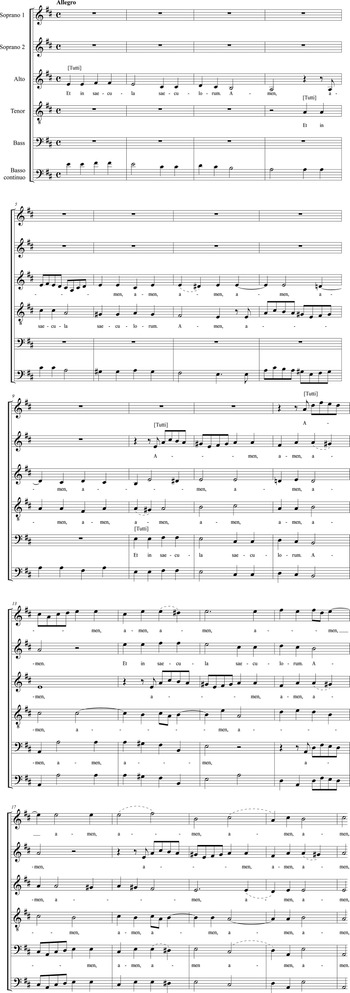
At many points in his setting Bigaglia deploys fugato casually as part of his contrapuntal armoury, but in movement XII he gives us the full-blown fugue with which large-scale sacred works customarily end. He plans its structure meticulously, starting with the voices in five parts (bars 1–20), inserting an interlude for strings plus trumpet (bars 21–28), continuing with the voices again (bars 29–44), introducing another interlude with the instruments (bars 45–51) and concluding with a massive extended tutti where strings double the upper voices while the trumpet pursues its independent, often thematically very relevant, course (bars 52–83). In one form or another the subject and/or its florid countersubject appear in the vast majority of bars, copious use being made of stretto: the near absence of free episodic writing is a conservative trait, as is also Bigaglia's habit of starting entries on the third beat, recalling a frequent practice in renaissance polyphony (see bar 4 of Example 3a). Remarkably, Bigaglia achieves this very high density of thematic quotation (no fewer than seven complete entries of the three-bar countersubject are crammed into the opening exposition) without resorting to the sometimes excessively predictable procedures of the so-called permutation fugue as cultivated shortly before 1700 by such composers as Rosenmüller, Purcell and Reincken. The main subject of Example 3a has the lilt of a popular melody, but its actual affinity could conceivably be to the opening subject of Palestrina's motet (and derived parody mass) Dies Benedictus, which sets the text of an Alleluia verse proper to Christmastide.Footnote 49 For comparison, Example 3b gives the opening of the ‘Agnus Dei’ from Palestrina's Mass.
Bigaglia, Dixit Dominus, movement XII (‘Et in saecula saeculorum’), bars 1–21

Palestrina, Missa Dies sanctificatus, Agnus Dei, bars 1–5 (soprano), from Missarum liber sextus (Venice: Gardano, 1596). Österreichische Nationalbibliothek (A-Wn), MS12-8o/1-5

This suggestion of a veiled quotation is not so outlandish, since Bigaglia does something similar with the opening subject of Palestrina's motet Assumpta est Maria, which is quoted in his Credo in G major and several of his secular compositions, as if constituting a personal motto.Footnote 50 If so, the chances are that the purpose of the Dies sanctificatus quotation is to link the composition to the feast of the Nativity. In that case, the performance will almost certainly not have taken place at San Giorgio Maggiore, busy with musical preparations for St Stephen's Day and its vigil, but perhaps occurred at another Venetian location.
The second general structural model, complementing the one earlier labelled ‘unitary’, is describable as sectional. Here, vocal and instrumental sections are neatly separated and possibly also contrasted in their musical material. In eighteenth-century church music the primary form displaying these characteristics is the so-called church aria (Kirchenarie), which in its simplest version is identical in form to the ‘A’ section of a typical da capo aria, having two vocal sections (the first leaving, the second returning to, the tonic) that are framed and usually also separated by instrumental ritornello material. The number of vocal sections, hence also of ritornellos, can be increased, creating a structure akin to full-scale Vivaldian ritornello form, although this solution is still relatively uncommon. Fully half the movements in Bigaglia's Dixit Dominus (III, IV, VI, VII, X, XI) are based on this sectional template. It must be acknowledged that in most of them one senses that Bigaglia is feeling his way a little awkwardly on account of inexperience, although all contain attractive features foreshadowing the mature composer.
The ‘Virgam virtutis’ movement (III) exemplifies the use of the ‘double Devise’ (a twofold statement of the same vocal motto, the first time interrupted by ritornello material, the second time continuing normally), a feature that briefly flourished in the years around 1700. The duetting between voice and oboe is fluent and euphonious (in the manner of the evergreen ‘Domine Deus, Rex caelestis’ movement in Vivaldi's Gloria rv589), and there are some deft touches of invertible counterpoint also involving the continuo. Nevertheless, the form is unbalanced, fettered too much of the time to the tonic and including a rather unconvincing visit to the supertonic (A minor) in lieu of the more conventional dominant. One highly unorthodox feature of Bigaglia's word-setting in this movement (and similarly in movements IV and VII) is that although the opening ritornello introduces us in conventional manner to both of the contrasted motives used for the text of the two semiverses, the first vocal section contains the words of only the first semiverse, the second vocal section those of only the second semiverse – whereas in its later, classic form the church aria presents the complete text in each section. One suspects that Bigaglia was not yet fully reconciled to jettisoning a ‘linear’ presentation of the text (as in AA, BB) in favour of a ‘rotational’ one (as in AB, AB).
Despite its complex texture, ‘Tecum principium’ (IV), scored for four-part choir and strings, is much more satisfactory in structural terms. Particularly welcome are the cheekily disruptive per arsin et thesin imitations occurring already in the opening ritornello (Example 4) and permeating the subsequent imitative play, where, during the vocal sections, either one or both violins may emerge suddenly from the wings to add extra strands to an already full contrapuntal texture.
Bigaglia, Dixit Dominus, movement IV (‘Tecum principium’), bars 5–10

The ‘Dominus a dextris tuis’ movement (VI) is not unlike movement IV except for being in the major mode. In relation to the problem of the linear succession (or not) of the texts of the two semiverses, it cleverly cuts the Gordian knot by using the animated motive for the second semiverse (beginning ‘confregit’), anticipated in Example 1, as a counterpoint to the first motive.
‘Judicabit in nationibus’ (VII) is identical in key, scoring, structure and mood to movement III: only metre and rhythm offer a clear contrast. It barely has the space to develop its ideas adequately, but in bars 6–9 it gives us a sample of one of Bigaglia's favourite devices, recycled from work to work in a pleasing variety of versions (Example 5). This device, most familiar from the music of Corelli (who was an early popularizer of it), is commonly described as ‘leapfrogging’: an upward-moving sequence employing suspensions (typically of the ninth) on the strong beats makes each part in turn leap up a fourth after resolving the dissonance conventionally by step downwards, thereby immediately transferring the suspension to its partner and enabling the sequence to continue for as long as desired.
Bigaglia, Dixit Dominus, movement VII (‘Judicabit in nationibus’), bars 5–9

‘Gloria Patri’ (X), if retexted, could easily have formed the ‘A’ section of an aria from an early Bigaglia chamber cantata. Like many arias of the period, it is underpinned by a free ostinato treatment of the bass. The first three bars of its introductory ritornello (Example 6) illustrate a type of motion much liked by Bigaglia: a blend of sequence (the stepwise descent made by the first notes of bars 2–4) and ostinato (the only minimally changing group of five quavers ending bars 1–3).
Bigaglia, Dixit Dominus, movement X (‘Gloria Patri’), bars 1–8

But the best of the sectional movements and the one most eloquently expressing the direction that Bigaglia's music was to take as it matured is the next one, ‘Sicut erat in principio’. This is a duet for soprano and bass with full string accompaniment. The bustling opening ritornello, with its vigorous cut and thrust between the violins, so reminiscent of Vivaldi, is joined before its course is fully run by the soprano, who is immediately imitated (as if in a ‘stretto’ fugue) by the bass singer (Example 7). Most composers would have delayed the soprano entry to either the closing chord of the ritornello (half-way through bar 8) or the first beat of bar 9. By imaginatively taking this entry back to the cadential dominant chord, Bigaglia gives the listener a delicious frisson, supercharging the music with an energy that he manages to sustain up to the very last bar.
Bigaglia, Dixit Dominus, movement XI (‘Sicut erat in principio’), bars 1–9

Bigaglia's Dixit Dominus: Illustration of the Text
It was a given during the seventeenth and eighteenth centuries that vocal music should illustrate the text by pointing up key words and phrases with the aid of word-painting. Not every conceivable opportunity for pictorialism could be seized, for that would saturate and perhaps even stultify the music, but all composers worth their salt made sure to introduce some instances of it, as well as ensuring that the overall mood (affetto) of the movement matched that of the text. In the case of the most frequently set liturgical texts, such as those of the Magnificat and Dixit Dominus, conventions grew up regarding both which words and phrases should be highlighted through word-painting, and what particular means should be employed. In the ‘Crucifixus’ portion of the Credo, for instance, it became customary to set the words ‘passus et sepultus est’ (he suffered and was buried) with long notes for ‘passus’ (emphasizing the duration of Jesus’ suffering) and a descent to a low register for ‘sepultus est’ (representing entombment).Footnote 51 In the first verse of the Magnificat, which is unusually rich in word-painting possibilities, a particular fullness of sound is sought in Latin settings (such as J. S. Bach's) to capture the sense of the opening word, which means ‘magnifies’, while German settings (such as Telemann's in G major, tvwv9:18) habitually use rising motion to accompany the corresponding word ‘Erhebt/Erhebet’ (lifts up). In the Dixit Dominus the word ‘Sede’ opening the second semistrophe of the first verse is commonly marked either by a descending motion (if interpreted as the act of sitting down) or by pausing on a monotone (if interpreted as the state of being seated). Imaginatively, Vivaldi employs both interpretations in turn in his earliest setting, rv595 .
It must be conceded immediately that Bigaglia shows himself to be an absolute novice in this art in his Dixit Dominus. It is not that he holds back from pictorialism in a liturgical work out of religious scruple: there are enough instances of ‘accurate’ word-painting in line with traditional treatment in this setting to suggest the contrary. It is rather that he is inconsistent in its application, sometimes either ignoring it or, worse, even appearing to contradict the sense of the words. Quite soon afterwards – for instance, in his Plutone e Proserpina dramatic cantata – he was to demonstrate admirable fluency in it, but that time has not yet come. Thus in movement I, far from illustrating ‘Sede’ in either of the traditional ways, he excitedly bounces up and down in flagrant contradiction of its accepted sense. In movement III, where the psalmist writes ‘dominare’, he makes no departure from the mildness that marks the entire movement. He does better in movement V, where ‘Juravit Dominus’ (The Lord hath sworn) has appropriate solemnity, and ‘Tu es sacerdos’ (Thou art a priest) follows convention to the letter by adopting a kind of ‘patter’ style in quavers.Footnote 52 In movement VII, ‘Judicabit in nationibus’ (He shall judge among the heathen), where a sonorous evocation of Judgment Day, complete with the Last Trump (conveniently at hand in the orchestra), is required, Bigaglia perversely gives us a gentle siciliana with chamber scoring. Even the horrifying vision of destruction, ‘implebit ruinas’ (He shall fill the places), that ends the first semiverse fails to rouse him from placidity. But the setting, for the full ensemble, of the second semiverse, movement VIII, is more appropriate: Bigaglia here adopts the time-honoured practice of expressing ‘conquassabit capita’ (He shall wound the heads) with a martellato sound simulating the cracking of heads. Disappointingly, there is no evocation of a rippling brook in movement IX, ‘De torrente’, although the raising of the head (‘exaltabit caput’) in the second semiverse is very cogently represented by continuous waves of ascending sequences. The texts of the Doxology movements (X–XII) offer fewer opportunities for word-painting, but it is pleasing to see the composer respond with long final melismas in both vocal parts at the word ‘semper’ (for ever).
Bigaglia's failure to remain constantly alert to the need to express not only the sound of the words – which his word-setting, with its accurate accentuation patterns, captures very well – but also their sense is a weakness born of inexperience, and perhaps of youthful over-confidence. It may additionally reflect a background in instrumental music and (in his monastic vocation) vocal music of a simpler, more abstract kind. One recalls that Vivaldi, for similar reasons, took time to acclimatize himself to the sacred vocal genre, initially fitting words to notes (rather than the other way round) in an almost slapdash manner before eventually achieving mastery. This shortcoming should not inhibit too much the modern revival of Bigaglia's Dixit Dominus in a concert situation, but would perhaps have raised eyebrows in his own day.
In Conclusion
There are many counts on which to champion Bigaglia, but the one that stands out is his rare ability to build up to climaxes patiently, constantly adding (but sometimes also subtracting) voices in an ever-changing texture that directs the listener's attention now this way, now that way. In matters of harmony and counterpoint he likes to display his learning but always does so with a light, sometimes even humorous, touch. His melodic sense, too, is acute: he is able to give pleasing shape not only to prominent upper parts, but also to inner ones (as Example 4 evidences). The Dixit Dominus shows him near the start of his career attempting, not without a struggle, to reconcile what was clearly a conservative musical education with exciting new currents favourable, within the sphere of church music, to the imaginative employment of instruments not just as simple reinforcements or ‘wordless voices’ but as important and semi-autonomous contributors to the musical effect.
To date, only a single scholarly article has been dedicated to any part of Bigaglia's sacred vocal oeuvre, and that is one by Reinmar Emans on the Miserere in C minor preserved in Kremsmünster and in the past mistakenly attributed to Giovanni Battista Pergolesi (1710–1736).Footnote 53 Occupied mainly with debunking the attribution of this Miserere by Francesco Caffarelli to Pergolesi, which led to its publication under the latter's name, this article does not dwell in detail on the make-up and musical attributes of the composition in question, but its last sentence is eloquent and telling: ‘One therefore ought to say out loud that a Kleinmeister has managed to write a more intimate and moving setting of Psalm 50 than the “great Pergolesi”’ (‘Si dovrebbe dire perciò molto chiaramente, che un “Kleinmeister” è riuscito a scrivere una versione più intima e commovente del 50o salmo che non il “grande Pergolesi”’).Footnote 54 Quite so, and the time is now ripe for a doctoral dissertation on Bigaglia's musica sacra similar in scope to Benjamin Byram-Wigfield's on that of Lotti.Footnote 55 Ultimately, however, the real test will be whether choirs choose to follow where recorder players once led. My belief is that if they do, they will not be disappointed.Footnote 56