Introduction
Caregiver strain in dementia is increasingly recognized as a public health problem. Yet interventions that target specific risk factors may lack straightforward results (Selwood et al., Reference Selwood, Johston, Katona, Lyketsos and Livingston2007; Thompson et al., Reference Thompson, Spilsbury, Hall, Birks, Barnes and Adamson2007), as multiple determinants interact in complex circular ways (Campbell et al., Reference Campbell2008). Caregiving experiences include not only objective burden, subjective burden and psychological distress, but also positive aspects of providing care. The whole process is shaped by caregivers' and patients' characteristics, their previous and current relationship, illness-related variables, social networks and ways of coping. As a result, assessment of dementia caregivers remains a challenging area in research and clinical practice (Brodaty, Reference Brodaty2007).
Knowledge about dementia influences caregivers' appraisals and reactions, and irrational beliefs may predict depression and poor health (McNaughton et al., Reference McNaughton, Patterson, Smith and Grant1995). Graham et al. (Reference Graham, Ballard and Sham1997b) suggested that self-confidence, competency, reduction of unrealistic expectations and use of positive comparisons are more likely if accurate information is understood. They also found knowledge to be positively related to anxiety, but depressed caregivers evidenced lower levels of information about dementia. It may be that higher levels of anxiety in knowledgeable caregivers stem from the information they have acquired in specific domains (e.g. disease progression) and their anticipation of loss. Alternatively, anxiety-prone subjects may be more inclined to information-seeking as well. Caregivers who are more knowledgeable about the biomedical features of dementia or adopting “monitoring for threat” coping may present higher anxiety levels (Proctor et al., Reference Proctor, Martin and Hewison2002). Some depressed caregivers, by contrast, may avoid seeking further information that might make them feel worse, while others won't be able to seek it or may perform inadequately in assessments due to depression-related disability.
Previous work has identified populations with low general education, the elderly and spouse caregivers as eligible targets for education about Alzheimer's disease or other dementias (Werner, Reference Werner2001; Reference Werner2003; Shaji et al., Reference Shaji, Smitha, Praveen Lal and Prince2003), though education about dementia by itself has not been shown to be effective for caregiver burden or distress (Selwood et al., Reference Selwood, Johston, Katona, Lyketsos and Livingston2007; Thompson et al., Reference Thompson, Spilsbury, Hall, Birks, Barnes and Adamson2007). Information acquisition may not even ensure effective coping or competence, if dissociated from other aspects of psychoeducation, such as behavioral management.
Considerable recent work has focused on caregivers' positive attitudes and experiences. Caregivers' positive experiences are directly associated with well-being and inversely associated with the amount of burden involved (Tarlow et al., Reference Tarlow, Wisniewski, Belle, Rubert, Ory and Gallagher-Thomson2004). To our knowledge, however, there is no published material on the relationship between positive aspects of caregiving and knowledge about dementia.
We examine these constructs in the context of a broad multidimensional assessment, which has not been done consistently in the past. This study addresses knowledge of dementia and its relationship with other aspects of caregivers' experiences, particularly its association with caregivers' burden and positive feelings, in a Portuguese sample. As in many countries, the number of elders and hence of caregivers has been increasing in Portugal. The family-focused care of elders that has been the dominant tradition is increasingly challenged by modern trends, particularly increasing participation of women in the workplace. While dementia caregiver research has been conducted in Portugal (e.g. Sequeira, Reference Sequeira2007; Figueiredo and Sousa, Reference Figueiredo and Sousa2008), health knowledge has not previously been addressed. Some of us conducted a preliminary exploration of knowledge of dementia in relation to burden (only subjective components), caregiving rewards and psychological distress, in a smaller sample (Gonçalves Pereira et al., Reference Gonçalves Pereira, Papoila and Mateos2008). We build on this preliminary work in the present study.
The goals of this study are to: (1) conduct a survey on dementia-related knowledge and caregiving experiences (subjective and objective burden, positive aspects and psychological distress) in Portuguese relatives of dementia non-institutionalized sufferers; and (2) determine the extent to which knowledge adds to our understanding of negative and positive experiences in caregiving.
Methods
Design, settings and sample
Among participants in the FAMIDEM cross-sectional survey, we utilized a convenience sample of 116 caregivers related to 75 consecutively attended outpatients with a previously established primary diagnosis of dementia (Alzheimer's, vascular or mixed subtypes), according to ICD10-Diagnostic Criteria for research. FAMIDEM (Families of People with Dementia) is a study on caregivers of demented elderly patients conducted in Lisbon for which first wave results have been reported (Gonçalves Pereira et al., Reference Gonçalves Pereira, Papoila and Mateos2008).
The sample was drawn from family caregivers of elderly outpatients who were coming for follow-up in three health practices: Neurology Service, Hospital Egas Moniz (n = 44), Department of Psychiatry and Mental Health, Hospital S. Francisco Xavier (n = 18) and Clínica Psiquiátrica de S. José (n = 54, including some previous participants in support groups provided by this psychiatric semi-public facility). At the time of this study, formal educational packages were not available at any of these practices, and information on dementia would have been provided by services on an as-needed basis (or sought by caregivers outside services). For each patient, the primary caregiver was approached by trained research assistants, all of them mental health professionals. Whenever possible, one other caregiver was also considered. This was done because involvement of two or more relatives in the care of the elderly is a frequent care arrangement in Portugal. For 34 patients, only primary caregivers could be considered. For the remaining 41, we were able to assess two different caregivers, always including the principal one. Two caregivers refused to participate stating lack of time, and two others were not reachable. Our final sample was composed of 116 caregivers, all of them relatives of the patient.
Exclusion criteria for caregivers were: significant cognitive impairment or severe mental illness (acute state), according to the clinical judgment of research assistants. However, no approached caregiver was excluded due to these criteria in this sample. Assessments were obtained at the outpatient clinics or were home-based, as convenient.
Measures
Patients and caregivers' sociodemographic and clinical data were obtained from medical files and from semistructured interviews. Social class was determined according to the Graffar index, as in other Portuguese surveys (Fernandes et al., Reference Fernandes2009). Clinical and functional assessments of dementia were made using Portuguese versions of the Mini-mental State Examination (MMSE) and Global Deterioration Scale (GDS), recently compiled by the Portuguese Research Group on Brain Ageing and Dementia (GEECD, 2008). The Barthel Index and the Dysfunctional Behavioral Rating Instrument (DBRI; Molloy et al., Reference Molloy, McIllroy, Guyatt and Lever1991) were also used.
Caregivers completed several assessments that measured the constructs of interest for this study: knowledge, subjective and objective burden, positive aspects of caregiving and emotional distress. In addition, we assessed need for help.
The Dementia Knowledge Questionnaire (DKQ; Graham et al., Reference Graham, Ballard and Sham1997a) was used for information about dementia. It includes seven items covering four areas of knowledge on dementia (rudimentary and epidemiological knowledge, clinical symptoms and etiology). Scores range from 0 to 19. Burden was assessed by means of the Zarit Burden Interview (ZBI; Zarit et al., Reference Zarit, Reever and Bach-Peterson1980) for subjective aspects, and the Caregiving Activity Survey (CAS; Davis et al., Reference Davis1997) for objective burden. Gratification related to the caregiver role was assessed by the Positive Aspects of Caregiving scale (PAC; Tarlow et al., Reference Tarlow, Wisniewski, Belle, Rubert, Ory and Gallagher-Thomson2004; Boerner et al., Reference Boerner, Schulz and Horowitz2004). ZBI and PAC totals were computed as follows: each item was scored from 0 to 4 in the former and 1 to 5 in the latter questionnaire, so that higher scores mean higher burden or higher satisfaction (range 0–88 and 1–55, respectively). The original version of the PAC included 11 items and was subsequently simplified to a nine-item measure (Tarlow et al., Reference Tarlow, Wisniewski, Belle, Rubert, Ory and Gallagher-Thomson2004), but we maintained the original structure to provide comparability to published studies (Boerner et al., Reference Boerner, Schulz and Horowitz2004). On the CAS, caregivers report the amount of time they spent in the last 24 hours in caregiving activities (communication, using transportation, dressing, eating, grooming, supervision). We used a measure of general psychological distress, the 12-item General Health Questionnaire (GHQ; Goldberg and Williams, Reference Goldberg and Williams1988). GHQ scores may be computed according to several methods: Likert, original and c-GHQ (Goldberg et al., Reference Goldberg1997). We report the Likert method of scoring (range 0–36), unless stated otherwise. A higher score means higher distress. The GHQ is also widely used as a screening test for psychiatric morbidity in non-psychiatric clinical settings, adopting cut-offs to define “GHQ caseness”. Assuming cultural similarities with other European populations, we postulated the 2/3 cut-off using the original method scorings (range 0–12).
The two caregiver-related items of the Camberwell Assessment of Need for the Elderly (CANE; Orrell and Hancock, Reference Orrell and Hancock2004) were used in order to address needs for care (information and psychological distress domains). Regarding these items, CANE assessments involved ratings of need according to caregiver and interviewers' views.
Although social network, coping and sense of coherence were also assessed in the FAMIDEM survey, we chose not to focus on those results in this study: not all participants completed assessments on those dimensions, and lower numbers in the sample would compromise multivariable analyses. Accordingly, only data on information-seeking, pertaining to the corresponding item of the Carers Assessment of Management Index (CAMI; Nolan et al., Reference Nolan, Keady and Grant1995), are reported here. Depression was screened only in elderly caregivers as part of a parallel protocol, also representing a minority of responders.
Validity and reliability of the original versions of these measures have been thoroughly documented (e.g. Graham et al., Reference Graham, Ballard and Sham1997a; Zarit et al., Reference Zarit, Todd and Zarit1986; Boerner et al., Reference Boerner, Schulz and Horowitz2004; Orrell and Hancock, Reference Orrell and Hancock2004). The Portuguese ZBI and PAC translations used in this study were developed according to international conventions (the former was published in GEECD, 2008). Two focus group discussions were arranged with caregivers and preliminary drafts refined. Back translations were performed by an English native translator, also fluent in Portuguese and familiar with the mental health field. When revised by authors of the original tools, only minor corrections were made. Face, content and ecological validity were grounded in these arrangements and confirmed in pre-tests. Back-translation procedures were skipped for the DKQ, given the straightforward nature of the translation itself.
Test-retest reliability data for these ZBI and PAC Portuguese translations are as follows. Sixty-five caregivers repeated these measures within a time-frame of 1 to 3 weeks. Intra-class correlation coefficients (ICC) values were 0.93 for ZBI total scores (95% CI 0.88–0.96; p < 0.001) and 0.85 for PAC total scores (95% CI 0.75–0.91; p < 0.001). Internal consistency was also assessed for these translations (Cronbach's α = 0.88 for ZBI and 0.87 for PAC; n = 116). Internal consistency is similar to another published Portuguese ZBI translation (Sequeira, Reference Sequeira2007), despite differences in wording of some items.
The official Portuguese version of GHQ-12 and those of the remaining instruments, including CANE (Fernandes et. al., Reference Fernandes2009) and CAMI (Brito, Reference Brito2002), were already available.
All measures were administered at one time point.
Ethical issues
The protocol was locally approved by ethical committees. Informed consent was obtained from all caregivers and, whenever clinically possible, from patients.
Data analysis
Throughout the analysis, we assumed independence between caregivers' assessments even though some of the caregivers were related to the same patient. In all cases, however, each individual in the same family reported his/her own experience independently of the other caregiver.
Descriptive statistics and nonparametric (χ2, Fisher's exact, Mann-Whitney U and Kruskall-Wallis) tests were used as required. Although normality could be assumed for some scores, we adopted a conservative uniform nonparametric approach. Patient and caregiver characteristics are presented as frequencies and percentages for categorical data, and as mean or median, standard deviation (SD), range and minimum/maximum values for continuous variables. 95% confidence intervals (CI) for the mean value were calculated whenever appropriate.
When a linear association was present between continuous variables, correlations were assessed with Spearman's coefficients.
Hierarchical multiple regression analyses were carried out using ZBI and PAC scores as dependent variables. The order of entry was selected to examine if knowledge would have a relation to the dependent variables after taking into account other possible predictors. In the first regression, we considered ZBI as the outcome variable. Independent variables were entered in three blocks: (1) sociodemographic variables; (2) DKQ total score; and (3) positive caregiving, objective burden and psychological distress (PAC, CAS and GHQ scores). A second model was fitted to the data to study which covariates influenced the PAC score, considering the following blocks: (1) sociodemographic variables; (2) DKQ total score; and (3) burden and psychological distress (ZBI, CAS and GHQ scores).
To detect multicollinearity problems, the variance inflation factor was calculated. Normality of residuals was tested with the Kolmogorov-Smirnov test.
The significance level of α = 5% was considered. All data were entered and analyzed using the Statistical Package for the Social Science for Windows 15.0 (SPSS, Inc.).
Results
First, we describe the characteristics of the 75 patients whom caregivers were assisting. Patients' mean age was 77.6 (SD 7.8), ranging from 62 to 96 years. Forty-nine (65%) were female and 62 were living at home. Forty-seven (63%) patients had a diagnosis of Alzheimer's disease, 17 (23%) had vascular dementia, six (8%) had other forms of dementia (most with frontotemporal features) and five (7%) had mixed or unspecified dementia. Somatic comorbidities were reported for 53 (71%) patients. Thirty-eight (51%) patients were taking cholinesterase inhibitors, 16 (21%) were taking memantine and 10 (13%) were on both medications. Other prescribed drugs were antidepressants (33 cases, 44%), atypical antipsychotics (30, 40%), benzodiazepines (22, 29%) and mood stabilizers (13, 17%).
MMSE assessments yielded mean scores of 16.4 (SD 6.9). The median score was 65 for the Barthel Index (P25 = 45; P75 = 85) and 29 for DBRI (P25 = 16; P75 = 48). GDS ratings were stage 5 or higher in 42 cases (56%).
Caregivers' sociodemographic characteristics and caregiving situation
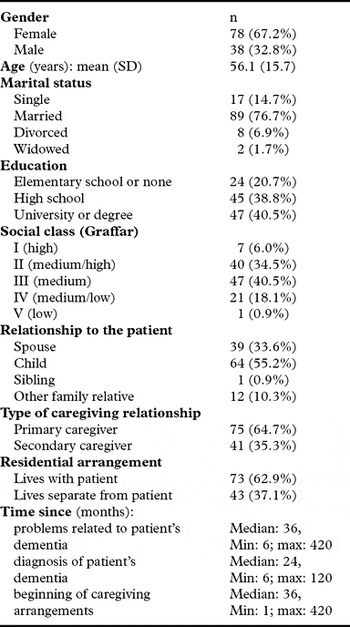
Caregivers' sociodemographic characteristics and information about their caregiving situation are presented in Table 1. Thirty-nine (33.6%) caregivers were aged 65 years or more. Sixty-nine caregivers (59.5%) had no more than 12 years of education, including 24 (20.7%) who were illiterate or had elementary degrees. The amount of face-to-face contact with the patient was considerable, more than 32 hours/week in 77 (66.4%) cases.
Caregivers' sociodemographic characteristics and caregiving situation (n = 116)

Min – minimum; max – maximum
Sixty-three caregivers (54.3%) reported significant medical conditions. These included cardiovascular problems (coronary heart disease, arrhythmia or arterial hypertension) in 30 cases (25.9%). Forty caregivers (34.5%) indicated that they had a prior psychiatric condition. In thirty-two cases (27.6%), the previous diagnosis had been a depressive disorder. The remainder of psychiatric disorders were anxiety states or other (two cases of former substance dependence, three of psychosis in remission and one of bipolar disorder, currently euthymic).
The number of health consultations arranged by caregivers for themselves in the preceding six months ranged from 0 to 12 (median 1). Fifty-five (47.4%) caregivers were not under any kind of treatment, although 36 (31.0%) were taking psychotropic medications, mostly benzodiazepines, and 36 (31.0%) reported general medicines’ prescription. Eight caregivers (6.9%) had psychotherapeutic support and three (2.6%) were receiving alternative medicine treatments. No one was currently attending group support interventions, but 13 (11.2%) caregivers stated they had had previous contact with self-help or psychoeducational groups.
Caregivers' assessments
The characteristics of all instruments, including the DKQ, ZBI and PAC Portuguese versions, were acceptable to participants, as shown by the fact that all caregivers who were interviewed completed all the instruments. Caregivers varied in their ability to complete the assessments on their own, but 95 respondents (81.9%) were able to fully self-complete questionnaires, and only 15 (12.9%) required significant help with self-completion, while 6 (5.2%) had to be interviewed due to their limited literacy levels. According to interviewers' impressions, assessments were easily conducted and item formulation and understandability seemed adequate, even for illiterate respondents. Furthermore, no questionnaires had to be discarded from the analysis.
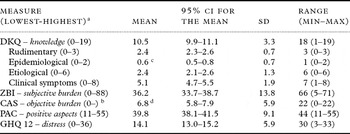
Table 2 summarizes results of DKQ, ZBI, CAS, PAC and GHQ assessments.
Participants’ scores on knowledge about dementia, psychological distress and other aspects of the caregiving experience (n = 116)

a Lowest and highest possible score; b Caregiving hours may artificially approach 24 hours/day, as a result of overlapping in hours dedicated to different caregiving activities; c Median 1.0; d Median 5.5
DKQ = Dementia Knowledge Questionnaire; ZBI = Zarit Burden Interview; CAS = Caregiving Activity Survey; PAC = Positive Aspects of Caregiving; GHQ = General Health Questionnaire-12.
Adopting cut-offs proposed in earlier research (Hébert et al., Reference Hébert, Bravo and Préville2000), we found 45 (38.8%) caregivers experienced “severe burden” (ZBI > 33), while 16 (13.8%) indicated low levels (<21).
GHQ scores were also computed according to the original scoring method (mean: 3.8; SD: 3.6; median: 3; minimum: 0, maximum: 12) and 62 (53.4%) caregivers were “GHQ positive” (2/3 cut-off).
Concerning searching for information on dementia (CAMI assessments), most caregivers stated they used to do it, finding some or great usefulness in this coping strategy (98; 84.5%), whereas three (2.6%) expressed discontent with their efforts. Fifteen caregivers (12.9%) were not currently seeking information.
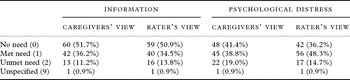
CANE results are presented in Table 3. Nearly half the sample (47.4 or 48.3%, depending on caregivers or raters’ view) had information-related needs. A higher proportion expressed (57.8%) or was rated (62.9%) as having psychological distress needs.
Caregivers' needs concerning information and psychological distress (n = 116)

Bivariate analysis
In order to identify sources of differences in scores on the DKQ, ZBI, CAS, PAC and GHQ, the following categorical caregiver variables were considered: gender, being elderly (aged 65 years or more), living situation (with the patient or not), social class, education level, GHQ-12 original scoring caseness (GHQ+ vs GHQ-) and having or not having information-related or psychological stress needs (no need vs met or unmet need, taking into account expressed and rated needs).
Older caregivers tended to recognize more positive aspects in caregiving (p = 0.016). The same happened with those living with the patient (p = 0.041), who additionally presented higher CAS scores (p < 0.001). Having found no significant differences across the five Graffar categories, we decided to compare caregivers from “higher” (I and II) vs “lower” ranks (III to V), the latter evidencing only higher PAC scores (p = 0.029). The lower education group (i.e. less than 12 years of education) scored higher in PAC (p < 0.001) and lower in knowledge about dementia, namely rudimentary (p = 0.010), epidemiological (p = 0.001) and total DKQ (p = 0.005); a similar trend in knowledge about clinical symptoms almost reached significance (p = 0.055). DKQ rudimentary knowledge was higher (p = 0.030) in the GHQ+ group, the same applying to ZBI (p < 0.001) and CAS scores (p = 0.014). Caregivers with information needs had lower levels of epidemiological knowledge than their counterparts (expressed needs: p = 0.028; rated needs: p = 0.006). Regarding psychological stress needs, caregivers expressing them had higher rudimentary knowledge (p = 0.021), ZBI (p < 0.001), CAS (p = 0.033) and GHQ (p < 0.001) scores, while caregivers in-need according to interviewers' ratings also scored higher in rudimentary knowledge (p = 0.032), ZBI (p < 0.001) and GHQ (p < 0.001), but presented lower PAC levels (p = 0.015). No other significant differences were found.
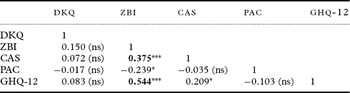
Correlations among continuous variables are shown in Table 4.
Patients and caregivers' assessments – correlation matrix (n = 116)

*p-value < 0.05; ** p-value < 0.01; *** p-value < 0.001; bold type indicates coefficients > 0.35.
DKQ = Dementia Knowledge Questionnaire; ZBI = Zarit Burden Interview; CAS = Caregiving Activity Survey; PAC = Positive Aspects of Caregiving; GHQ = General Health Questionnaire-12.
Multivariable analysis
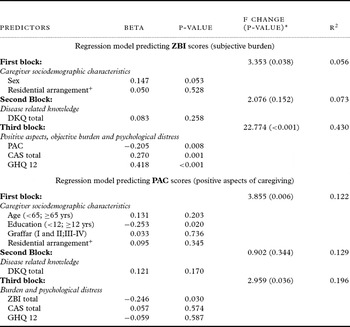
Two hierarchical multiple regression models were fitted in order to clarify which variables were related to ZBI and PAC scores. Sociodemographic variables which related to ZBI or PAC in the exploratory analysis with a p value lower than 0.15 were included. In the first regression, shown in Table 5, there was no significant relationship between DKQ and ZBI, after adjusting for the other variables. There was, however, strong evidence of associations of the PAC, CAS and GHQ-12 scores with the ZBI. This model explained 43% of the variability of ZBI scores, with the third block (which contained PAC, CAS and GHQ) being responsible for most of the explained variance.
Hierarchical multiple regression models predicting Zarit Burden Interview (ZBI) and Positive Aspects of Caregiving (PAC) scores (n = 116)

* Results of the F-test used to compute the significance of each added block
+ Lives with patient; lives separate from patient
Residuals were normally distributed (ZBI scores: p = 0.376; PAC scores: p = 0.110)
DKQ = Dementia Knowledge Questionnaire; ZBI = Zarit Burden Interview; CAS = Caregiving Activity Survey; PAC = Positive Aspects of Caregiving; GHQ = General Health Questionnaire-12.
The second regression model used the PAC score as the dependent variable. Once again, there was no significant relationship between DKQ and the dependent variable (Table 5). Lower education was related to higher levels of PAC. Evidence of a relationship between ZBI and PAC total scores was found, but this model attained a very low measure of explained variance (r2 = 0.196). For both models, the low values (<1.7) of the variance inflation factor revealed that there was no multicollinearity.
Discussion
General findings and comparisons with other studies
The first aim of this study was to conduct a survey on dementia knowledge and family caregiving experiences in Portuguese secondary care outpatient settings.
As is the case in most Mediterranean countries, caregivers were mostly female and living with their relative with dementia (at least prior to worsening of dementia). Although some patients presented severe pathology, general cognitive function and functional ability were not at the lowest levels, reflecting diagnostic heterogeneity within dementia and a priori exclusion of institutionalized cases.
Caregivers' knowledge seemed fair, in comparison with the results of the original DKQ study by Graham et al. (Reference Graham, Ballard and Sham1997a), which included caregivers of patients with dementia, some of them attending Alzheimer's support groups. Regarding a subsample of participants who had been in contact with services but were not attending groups, Graham and colleagues reported the following mean (SD) scores: 9.9 (3.4) for DKQ totals, 2.5 (0.7) for rudimentary, 0.5 (0.6) for epidemiological, 3.4 (1.6) for etiological, and 3.5 (1.9) for symptom knowledge. Using other measures, Werner (Reference Werner2001) detected lack of information in a sample where general education levels were not strikingly different from these Portuguese caregivers. We confirmed Werner's finding that having at least 12 years of education is associated with better knowledge about dementia, but we could not detect gender differences in knowledge as other studies have done (Graham et al., Reference Graham, Ballard and Sham1997b).
Information-related needs were absent in half the sample and only a minority of caregivers presented unmet needs. This was in accordance with the CAMI information item results and may be interpreted as follows: considering Portuguese general education standards, our sample was negatively skewed; and some caregivers had benefited from previous psychoeducational programs and others had acquired information in routine clinical consultations (CANE data). This outcome regarding knowledge may be encouraging, but the picture was different regarding caregivers' psychological morbidity.
About half of the sample scored GHQ+, which indicates that these subjects represented probable clinical cases of depression and/or anxiety. While GHQ case prevalence interpretation calls for prudence, GHQ scores were high when compared to a mean (SD) score of 8.5 (5.4) found in a Spanish sample (which is culturally close to our Portuguese sample) (López and Dresch, Reference López and Dresch2008). It is hard to determine the causal role that caregiving might have played here. A large proportion of participants also reported psychiatric antecedents in which etiological explanations are presumably multifactorial.
As expected, GHQ scores were directly correlated to burden measures (moderate associations) but no relation with DKQ results was found. These findings are not directly comparable to the previous results of Graham et al., namely that more knowledgeable caregivers experienced lower levels of depression and higher levels of anxiety (Graham et al., Reference Graham, Ballard and Sham1997b), as we used a composite distress measure, the GHQ, rather than separate measures for depression and anxiety.
Positive aspects of caregiving were valued by participants, as found in previous surveys, where mean (SD) PAC scores were 41.7 (10.7) (Boerner et al., Reference Boerner, Schulz and Horowitz2004). This was the case regardless of levels of psychological distress and objective burden, although overlap among activities assessed by CAS may yield an overestimation of actual time spent. ZBI levels were higher than reported in some community samples, where mean (SD) scores were 22.4 (16.2) (Hébert et al., Reference Hébert, Bravo and Préville2000) and closer to other reports (Zarit et al., Reference Zarit, Reever and Bach-Peterson1980).
Regarding the second aim of this study, our results failed to suggest that dementia knowledge may add much to our understanding of positive and negative experiences in caregiving. No association patterns were found between DKQ total scores and subjective burden (ZBI), positive aspects of caregiving (PAC) or psychological distress (GHQ). DKQ total scores did not predict either ZBI or PAC scores. Higher subjective burden was predicted by increments in CAS and GHQ, and to a lesser degree by lower PAC scores.
Strengths and limitations of our study
We comprehensively assessed dementia-related knowledge and multiple aspects of the caregiving experience, which are seldom jointly considered in research. This approach allowed us to explore, for instance, relations between positive aspects of caregiving and dementia knowledge, although leading to negative findings.
Of course this non-randomized sample does not allow for generalization to the population of Portuguese dementia caregivers. For instance, caregivers in Alzheimer's associations or those not contacting neurology/mental health services might have different levels of knowledge and burden and also different associations among these measures. Our sample also was somewhat skewed towards higher income and education.
Another limitation of the study is that we analyzed only the factual knowledge that caregivers have on dementia, but not other forms of practical knowledge, such as strategies to cope with specific problems that their relatives are actually presenting. Regarding coping, we were only able to report on information-seeking. We cannot rule out that some caregivers may have received professional guidance that improved their skills at some point during the disease process.
Finally, using the GHQ-12 did not allow for discrimination between anxiety and depression in the whole sample, as in Molyneux et al. (Reference Molyneux, McCarthy, McEniff, Cryan and Conroy2008). As there are no established cut-offs for Portugal, GHQ Likert or original scores may prove more reliable than defining caseness per se.
Implications on dementia health literacy strategies and future research
Good levels of knowledge about dementia were not consistently found, even among these above-average educated Portuguese caregivers. Our findings support the need to invest in dementia literacy, both in clinical settings and public health domains. Many of the dilemmas that caregivers make regarding daily care, as well as major decisions involving medical treatment and institutionalization should be informed by knowledge about dementia (Werner, Reference Werner2003).
As Proctor and colleagues (Reference Proctor, Martin and Hewison2002) point out, research should identify profiles of caregivers who are in need of education, in order to match individually tailored interventions. This ought to be done not only in secondary services or in samples related to caregivers' associations, but also in community or primary care populations.
Delivering knowledge, however, should not be seen as a sole treatment for subjective burden experienced as part of dementia care, or as a way of directly improving positive aspects of caregiving. This interpretation of the results is consistent with what has generally been found in the literature on family psychoeducation in dementia (Selwood et al., Reference Selwood, Johston, Katona, Lyketsos and Livingston2007; Thompson et al., Reference Thompson, Spilsbury, Hall, Birks, Barnes and Adamson2007). It may be, however, that specific intervention components could address caregiver rewards.
Naturalistic research should further document associations (or lack of them) between dementia-related knowledge and burden or positive aspects of caregiving. Our negative findings warrant confirmation in a larger community-representative sample, making it possible to study distress, which by itself is a multifactorial construct, as an outcome, or to consider separate knowledge components (e.g. DKQ subscores) as covariates.
As there is increasing evidence that most caregiving-implicated variables are inter-dependent (Campbell et al., Reference Campbell2008), it may be interesting to further equate the role of caregivers' social networks, coping strategies and resilience traits or sense of coherence in multivariable models. The ongoing FAMIDEM survey is moving in these directions.
Conclusion
Although our findings lack generalizability, being informed did not protect these caregivers from the burden of care, nor from related suffering, nor did it add to their sense of reward from caregiving.
These results suggest that we should be cautious not to rely on informative educational approaches or health education strategies to prevent the negative impact of caregiving. These caregivers, though presenting acceptable dementia knowledge and few related unmet needs, were at risk in several other domains.
Conflict of interest
None.
Description of authors' roles
MGP designed and led the research, with methodological supervision from SZ and RM. IC and JAS coordinated data collection at center level. Statistical analysis was carried out by ALP, MGP and JAS. The initial draft was written by MGP and thoroughly reviewed by all other authors, who provided valuable contributions to the whole manuscript.
Acknowledgments
We sincerely thank all patients and caregivers for participating in our study.
Portuguese translations of ZBI, PAC and DKQ were developed in 2005 by the first author, with that for DKQ being undertaken in collaboration with R. Almeida and N. Goulão. The ZBI translation was refined in 2006 with Dr. M. Sobral (GEECD, 2008). Dr. R. Rogers was responsible for back-translation procedures. Professor R. Schulz offered valuable help in checking the PAC back-translation. Professor C. Graham kindly provided the DKQ guidelines.
Preliminary (first-wave) FAMIDEM results were presented at the ninth Congreso Virtual de Psiquiatria and published in the associated online journal (Gonçalves Pereira et al., Reference Gonçalves Pereira, Papoila and Mateos2008). The corresponding abstract was published in Spanish in Anales de Psiquiatria, 24, 33.
Members of the FAMIDEM Workgroup contributing to the second-wave data collection were Drs. A. Neves and L. Santos (patients' assessments), Drs. A. M. Cardoso, C. Conceição, M. Gomes and M. M. A. Neves, and FCM-UNL medical students A.S. Freire and P. Melo (caregivers' assessments, data entry and quality assurance procedures).
The FAMIDEM study was supported by a clinical research grant from the faculty (FCM-UNL, 2006).
We thank the three anonymous reviewers for their thoughtful comments on the first version of this paper.