Introduction
Patients with difficult venous access or oral intolerance and clinical situations with inadequate response to oral therapy have generated the need for alternative routes of delivery for drugs and fluids.
Positive experience in palliative care of administering drugs subcutaneously included many with potential clinical utility outside this setting, for example fluids, antibiotics, analgesics, anxiolytics, diuretics, corticosteroids and anti-emetics. This experience suggests that the subcutaneous (SC) route may be the possible alternative route that is needed.
Search methods
A broad search strategy was employed using electronic databases CINAHL, EMBASE, PubMed and Cochrane library. Key terms and ‘Medical Subject Headings’ (MeSH) used included ‘subcutaneous route’, ‘hypodermoclysis’ and the name/group of each of the drugs most used by this route (e.g. ‘ketorolac’, ‘morphine’, ‘ceftriaxone’, ‘analgesics’, ‘opioids’, ‘antibiotics’). The criterion for finding and assessing individual studies followed Institute of Medicine guidelines, and studies were selected without limitations on publication year or language. Included were all original articles, reviews, letters to the editor, and communications related to the topic. A total of 178 articles were identified. These studies were very heterogeneous, conducted in primary care, hospitals, nursing homes and health care centres, and with sample size varying from one to 235 patients for drug administration and from 12 to 150 for hydration. Principal methodological shortcomings were due to their small sample size, no standardized methods for comparison, differences in comparison groups and lack of randomization.
Anatomical and physiological considerations
The third skin layer (named the hypodermis) extends over the entire body surface, located between skin and the deep fascia that covers muscle. It functions as a thermal isolation layer, and as energy storage and a protection against trauma. 1 It is composed of blood vessels, lymphatic capillaries and adipose/connective tissue, directly connected to the epidermis by collagen and elastic fibres. In the deepest part resides large venous branches and the lymphatic capillary bed.
Unlike other skin layers, the hypodermis has few pain receptors, is well irrigated (favouring drug absorption) and has low proteolytic activity (ideal for drug administration and with the added benefit of avoiding first liver metabolism). However, the SC route introduces other uncertainties in drug delivery, such as variable bioavailability between different formulations and sites of infusion.Reference Kinnunen and Mrsny 2
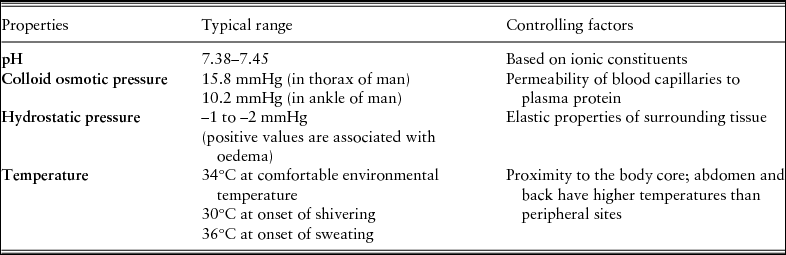
SC-injected therapeutic agents must pass through the extracellular matrix (ECM) of the skin to reach the circulation. The ECM is an ordered structure, with collagen providing mechanical stability and glycosaminoglycans, most commonly hyaluronic acid and chondroitin sulphate, constituting the gel-like phase. It represents a significant barrier to SC delivery of many agents, limiting both bioavailability and injection volumes. Understanding ECM physiology can help us to understand why many agents have not been successfully administrated by this route. Details on physiology and composition of the ECM have been researched by Kinninen and others.Reference Kinnunen and Mrsny 2 – Reference Uitto, Olsen and Fazio 4 Some properties of SC injection sites, their normal values and controlling factors are noted in Table 1.
Properties of the SC injection siteReference Kinnunen and Mrsny 2

SC drugs can reach the systemic circulation either by blood capillaries or lymphatic vessels. At a basic level, absorption of administered solution occurs by perfusion, diffusion, balance between hydrostatic/osmotic pressure and lymphatic drainage. Although drug absorption rate is determined mostly by drug solubility, interaction with the ECM and blood/lymphatic flow, it can be influenced to a small extent by other factors noted in Table 2.Reference Dychter, Gold and Haller 3 , Reference Supersaxo, Hein and Steffen 5 , Reference Richter, Bhansali and Morris 6
Factors influencing absorption/tolerance after SC administration
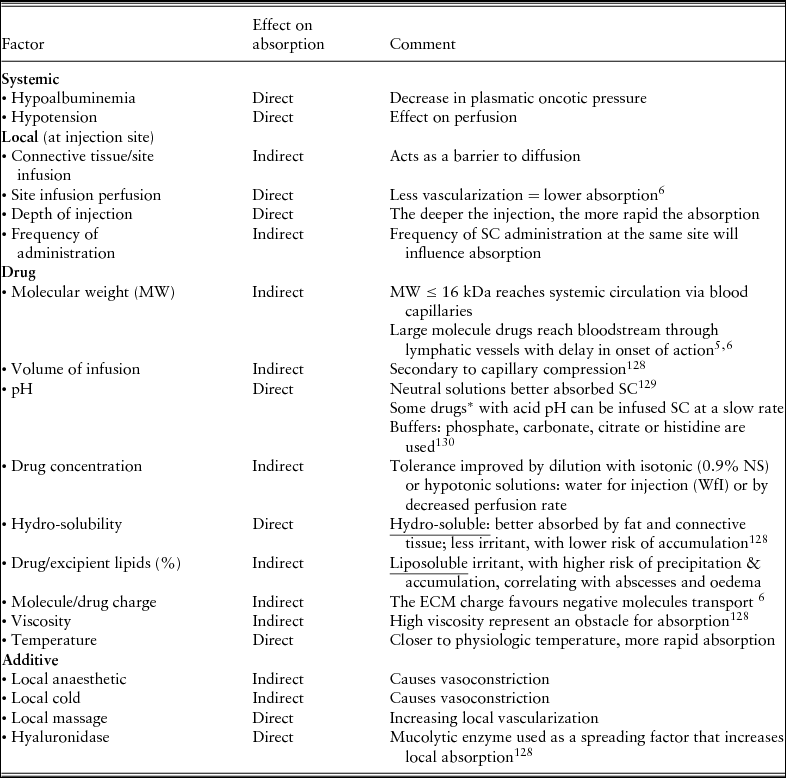
*e.g. Haloperidol (3.0–3.8); Metoclopramide (3.0–5.0); Ondansetron (3.5); Butylscopolamine (3.7–5.5), Levomepromazine (3.2–4.7), Cyclizine (3.2–4.7).
Place of insertion, materials and technique
SC thickness differs across different parts of the body and from person to person, decreasing as nutritional intake declines, or disease progresses. It has been shown that a minimum thickness of 1–2.5 cm is needed for SC administration. 1 , Reference Schoenbeck and McBride 7
Site of insertion
In order to maximize drug absorption, it is recommended to site the SC infusion on proximal areas, avoiding when possible bony prominences (where SC tissue is scarce), areas with previous surgical incisions (that limit lymphatic circulation) or radiotherapy (due to destruction of lymph vessels), or areas of damaged skin (infected, inflamed and/or ulcerated).Reference Justad 8
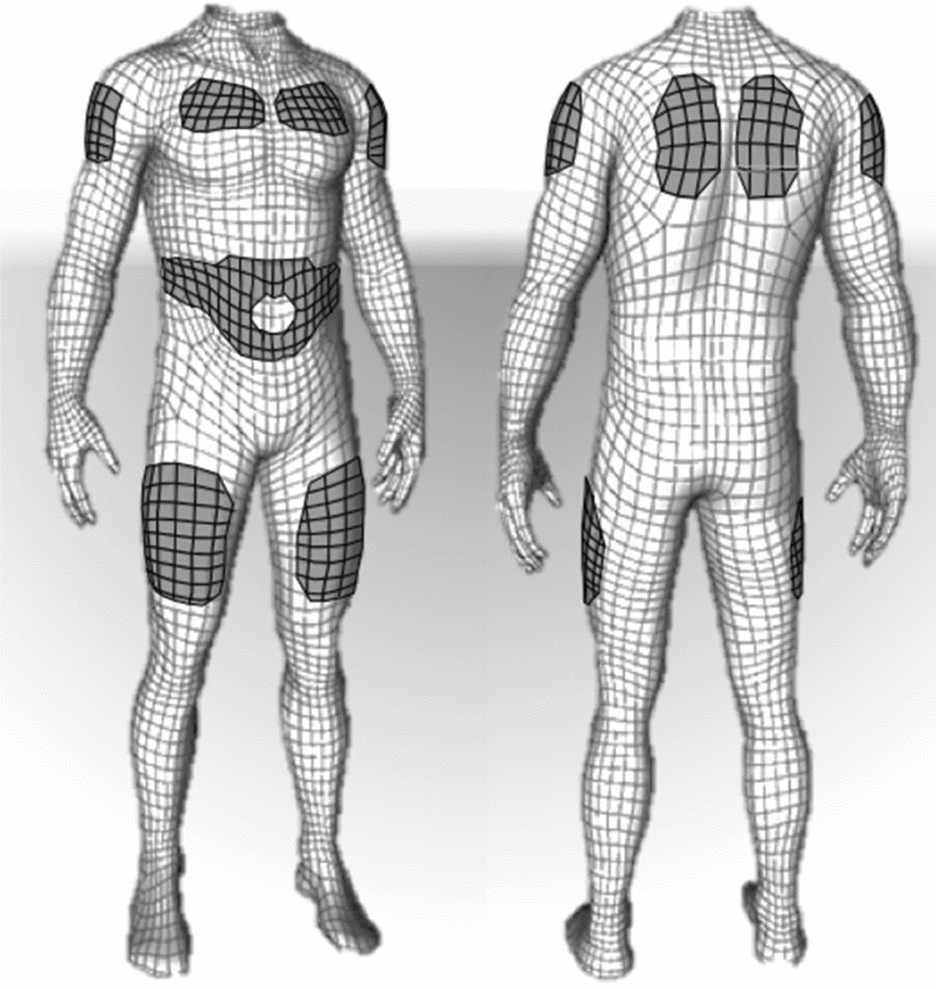
Various areas have been considered as potential insertion sites (Fig. 1):
-
• The abdominal wall, with its large absorptive surface, is useful for hydration. The left iliac fossa is considered the preferred zone (with maximal distance between colon and abdominal wall).Reference Schoenbeck and McBride 7
-
• The suprascapular and interscapular areas also offer a large distribution surface. As they are difficult to access for patients, they are especially useful in confusional states and they do not interfere with patients’ mobility.Reference Dugas 9
-
• The chest area with its lower distribution surface is ideal for drug delivery.
-
• The extremities: upper (preferably in the deltoid region) and lower limbs (lateral aspects of thighs) are considered the most painful places,Reference Schoenbeck and McBride 7 with a lower distribution surface that limits administration.
Insertion sites for subcutaneous administration 1 , Reference Schoenbeck and McBride 7

It is important to avoid insertion of a SC infusion near to a joint because it may limit patients’ mobility.
Materials
SC infusion requires a 21 to 27 gauge (G) butterfly needle.Reference Schoenbeck and McBride 7 Considering that SC tissue is located below the dermis and that layers of thickness vary between patients, 25 G needles generally avoid reaching the muscle layer (with the related pain and absorption difficulties. However, it is advisable to individualize catheter selection): 1
-
• 21 G is recommended for wasting diseases, where adipose tissue is scarce.
-
• >23 G is recommended for patients with thicker adipose tissue.
Technical aspects
After preparing the insertion site with povidone-iodine or chlorhexidine 2%, the skin is pinched to pull SC tissue away from muscle. The needle must be inserted at an entering angle of 45–60 deg.Reference Schoenbeck and McBride 7 Before starting the infusion, venipuncture must be ruled out and the needle fixed with a transparent adhesive dressing that allows visualization of the puncture site. The SC cannula can remain in situ for up to 72 h, or even longer if there is no local reaction.Reference Justad 8 It is advisable to periodically check the insertion site for local effects (oedema, redness, bruising and/or infection).
Most cannulas for SC use have a dead space of 0.2 ml and so drugs administered by this route are required to be flushed through with at least 0.2 ml of appropriate diluents. 1 The choice of diluent will vary depending on the medication being given. Usually a maximum volume of up to 2.5 ml can be administered as a bolus at the injection site. It is advisable to avoid bolus of larger volumes as it is more painful and favours appearance of induration and erythema, especially in the case of repeated injections.
The advantages and disadvantages of the SC route are detailed in Table 3.
Advantages and disadvantages of SC route of infusion

Hydration by the SC route
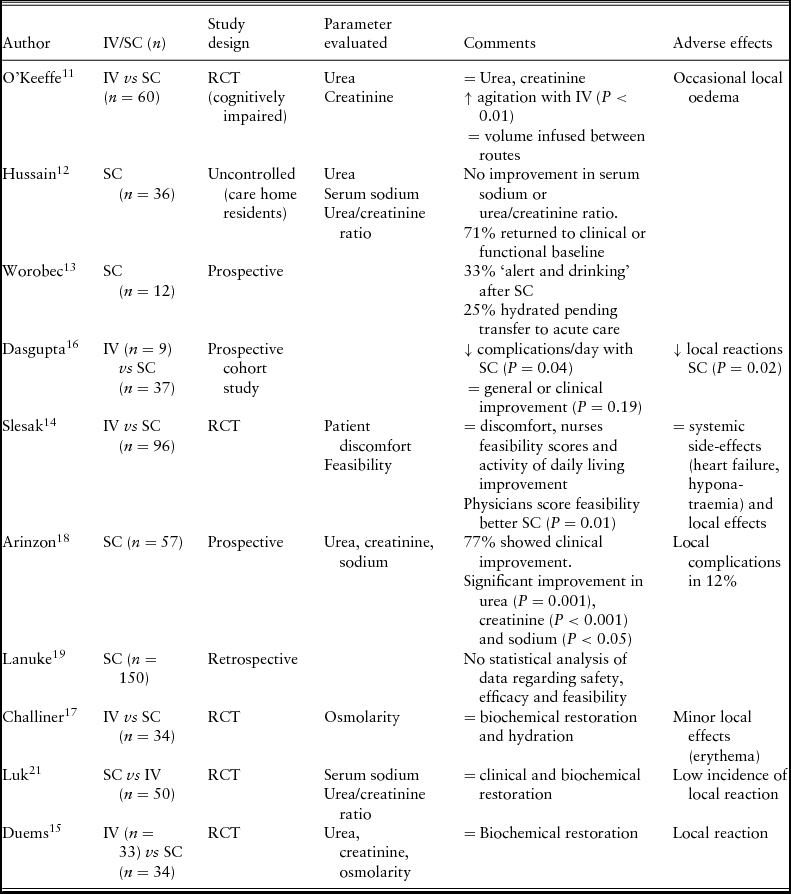
Despite many prejudices and initially discouraging results mostly related to poor technique,Reference Barua and Bhowmick 10 SC rehydatrion (or hypodermoclysis) is now accepted as an effective fluid replacement method in mild to moderate dehydration, with bioequivalence to IV infusion and restoration of biochemical parameters,Reference O’Keeffe and Geoghegan 11 – Reference Luk and Chu 21 excellent tolerance, easy placement and minimal risk in situations where other routes have been shown to be ineffective. Thus it offers a number of potential advantages in appropriately selected patients (Table 4).
Studies of rehydration by SC infusion

=, no statistical difference; ↑, increment; ↓, decrease; IV, intravenous; SC, subcutaneous; RCT, randomized controlled trial.
Solutions to infuse
Administration of isotonic solutions is recommended over hyper- or hypotonic formulations in order to avoid side-effects.Reference Schoenbeck and McBride 7 , Reference Lybarger 22 Adequate results have been reported with the use of different solutions:
-
• 0.45% sodium chloride (0.45% SC);
-
• 0.9% sodium chloride or normal saline (0.9% NS);
-
• mixed solution (33% NS; 67% dextrose 5%).
Dextrose 5% alone is poorly tolerated and has a high risk of adverse effects. This situation is generally solved by adding electrolytes to the infusion.Reference Turner and Cassano 23 To improve safety and tolerance (with the objective of reducing osmotic fluid mobilizations) it is also recommended to add 20–40 mmol/l of potassium chloride(equivalent to 20–40 mEq/l), or a combination with sodium chloride.Reference Turner and Cassano 23
Although Ringer lactate solution (with its pH closest to physiological values) theoretically has advantages over other fluids after SC administration (except normal saline), studies are scarce and recommendations limited.Reference Dychter, Ebel, Mead and Yocum 24 Hyperosmolar, colloidal or hypotonic solution without electrolytes should be avoided by the SC route given the high risk of adverse side-effects (which include shock or occurrence of third space oedema). 1 , Reference Schoenbeck and McBride 7
Rate of infusion
According to different authors, infusion rate can vary between 30–80 ml/h (or up to 1.2 litres per 24 h). This amount can be increased to 2.4 litres/day if infused by two different sites (Table 4). However, adding hyaluronidase to the infusion can increase infusion rates up to 300 ml/h, comparable to rates achieved by the intravenous (IV) route.Reference Dychter, Ebel, Mead and Yocum 24 Recently, SC rehydration facilitated by recombinant human hyaluronidase has been recognized in paediatric emergency departments as more cost-effective than conventional IV replacement fluids, with greater clinical resolution in special situations. For further information on paediatric SC rehydration the reader is recommended to consult MaceReference Mace, Harb, Friend, Turpin, Armstrong and Lebel 25 and Spandorfer.Reference Spandorfer, Mace, Okada, Simon, Allen and Spiro 26
Side-effects and complications
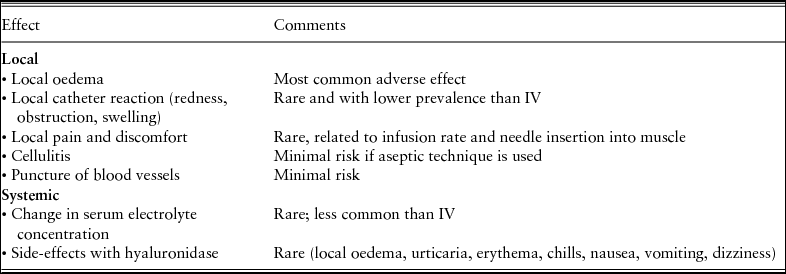
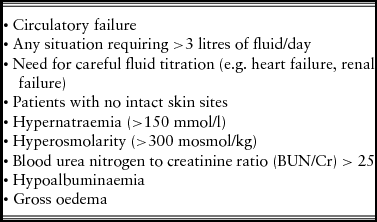
Adverse effects of SC hydration are frequent, but usually of a local type and easily avoidable. They depend mainly on the chosen solution and infusion rate.Reference O’Keeffe and Geoghegan 11 – Reference Duems Noriega and Arino Blasco 15 Most frequent adverse effects are stated in Table 5. The addition of hyaluronidase has been shown to reduce complications, with mild local reaction in only 17% (moderate oedema) and severe oedema in less than 5%.Reference Dychter, Ebel, Mead and Yocum 24 Although studies suggest comparable volumes can be infused (with similar improvement in dehydration symptoms) whether using SC or IV rehydration, hypodermoclysis is not appropriate for all patients and several limitations have been described (Table 6).
Adverse effects related to SC infusion

Contraindications to SC fluid infusion

Drug administration by the SC route
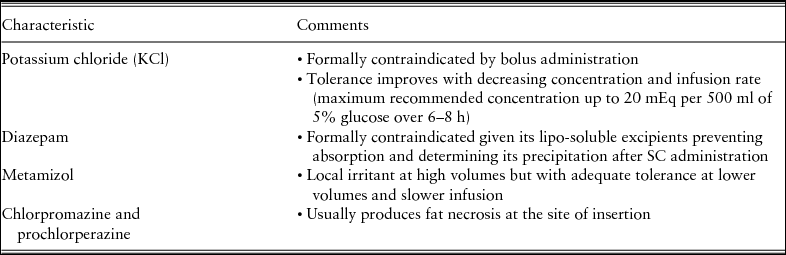
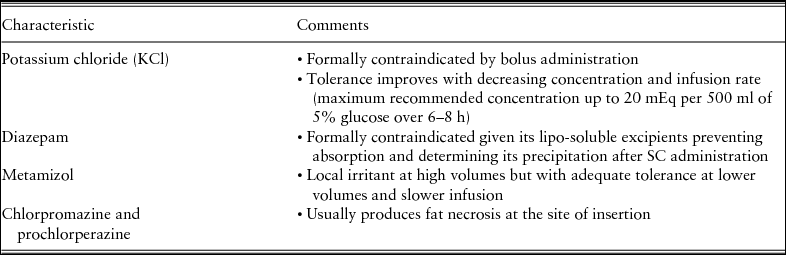
Recent evidenceReference Cockshott, Thompson, Howlett and Seeley 27 confirms that a large percentage of intramuscular drugs are actually administered into SC tissue, without loss of efficacy and with few side-effects. Some authors have thus concluded that most drugs approved for intramuscular (IM) injection could also be considered to be administered subcutaneously, with some exceptions. However, it is important not to generalize. Recently, it has been shown that to optimize effects and minimize risks, the ideal drug for SC injection should be hydro-soluble, of neutral pH, with low viscosity and low molecular weight.Reference Dychter, Gold and Haller 3 More details of drug factors influencing absorption and tolerance are shown in Table 2. There are also irritating excipients (for example, propylene glycol, glycerin and ethanol) that it is recommended to avoid in order to prevent reactionsReference Pramanick, Singodia and Chandel 28 , Reference Carpenter and Shaffer 29 (Table 7).
Drugs contraindicated or with high risk for local reactions after SC injection
Clinicians administering SC drugs should consider that:
-
• SC and IV routes are not equivalent; drugs administered via the SC route are absorbed slowly but in some cases reach the same plasma concentration as if given IV.
-
• Absorption may be slower than via the IM route and irritant drugs may cause greater inflammatory reaction with SC than IM.
-
• Total volume for a bolus injection is limited (2.5 ml) and absorption is limited in cases of hypovolemia, oedematous state or shock.
-
• Only a small number of drugs used SC have the indication for this route. However, it should be noted that licensing processes regulate the activities of pharmaceutical companies and not the prescribing practice of a qualified prescriber.
Drugs most frequently used SC are reviewed below. Characteristics and results of studies involving SC drugs are listed in Table 8.
Studies of drugs given by SC route

RCT, randomized controlled trial; IV, intravenous; IM, intramuscular; SC, subcutaneous; HER2, human epidermal growth factor receptor 2; ↑, increase; ↓, decrease; =, similar; AUC, area under the curve; Tmax, time to maximum concentration; Cmax, maximum concentration.
Antibiotics
Different antibiotic groups have been evaluated for SC use in humans, some of them with minimal complications and encouraging results. These are discussed further below.Reference Soler Mieras, Santaeugenia Gonzalez and Montane Esteva 30 – Reference Farias Azevedo and De Bortoli 32 Pharmacokinetic changes after SC injection (for example, reduction in Cmax) can interfere with an antibiotic's clinical applicability, particularly in those that are ‘concentration dependent’ (such as aminoglycosides), with a decrease in their bactericidal power. By contrast, the clinical efficacy of those antibiotics that are ‘time dependent’ (such as penicillins, cephalosporins, carbapenems and glycopeptides) is not affected after SC administration.
Cephalosporins
-
• Ceftriaxone: given the efficacy and tolerability data and pharmacokinetic properties (with 100% bioavailability after SC injection, lower Cmax and slower time to Tmax: see Table 8) SC ceftriaxone may be considered as an alternative for patients unable to use the IV or oral routes.Reference Soler Mieras, Santaeugenia Gonzalez and Montane Esteva 30 , Reference Robelet, Caruba, Corvol, Begue, Gisselbrecht and Saint-Jean 31 Mild local reactions are described occasionally. The use of hyaluronidase increases absorption capacity of SC tissue, with an increase of 12% in Cmax and an hour's delay in reaching Tmax.Reference Harb, Lebel, Battikha and Thackara 33
-
• Cefepime: SC cefepime is well tolerated (only mild local reactions described), with similar pharmacokinetics between SC and IM routes. However, studies have been performed in healthy volunteers, with lower doses than those used in clinical practice (1 g/day), questioning their applicability to clinical practice.Reference Walker, Neuhauser, Tam, Willey, Palmer and Bruera 34
Penicillins
-
• Ampicillin: few adverse reactions have been reported and given that pharmacokinetic properties are consistent with clinical efficacy and bactericidal activity, the SC route might be considered. However, the only published study was conducted in healthy volunteers, limiting its potential applicabilityReference Champoux, Souich, Ravaoarinoro, Phaneuf, Latour and Cusson 35 and it is probably advisable to wait for more clinical experience supporting these results before a recommendation is made.
Glycopeptides
-
• Teicoplanin: safety data observed after SC injection of teicoplanin in critically ill hospitalized subjects using an antibiotic dose consistent with clinical practice is encouraging and therapeutic indices achieved were greater than bacteria's Minimal Inhibitory Concentration (MIC).Reference Barbot, Venisse, Rayeh, Bouquet, Debaene and Mimoz 36 Nevertheless, it seems advisable to limit its use to specific situations given the high risk of developing resistance.
Carbapenems
-
• Ertapenem: after SC injection, there are reductions in Cmax and increased Tmax, but clinical efficacy is not affected because ertapenem has a time-dependent effect. The SC route may be an option for patients with difficult venous access.Reference Frasca, Marchand, Petitpas, Dahyot-Fizelier, Couet and Mimoz 37 Encouraging clinical results in treating multi-resistant germs, even in out-patient settings, and a simple dosing regimen (every 24 h) means that SC ertapenem is an attractive option, allowing home treatment and reducing hospitalization.Reference Forestier, Gros, Peynaud, Levast, Boisseau and Ferry-Blanco 38
Aminoglycosides
This class of antibiotics has the largest number of studies performed after SC administration, with a focus on tolerance and local side-effects.Reference Soler Mieras, Santaeugenia Gonzalez and Montane Esteva 30 , Reference Robelet, Caruba, Corvol, Begue, Gisselbrecht and Saint-Jean 31 Although most of the studies have a low level of evidence (level C), they provide useful information about adverse effects that were mainly of local type (skin necrosis and irritation) and possibly related to frequency of administration (more frequent if administered two or three times/day) and in relation to concomitant use of anticoagulants.
-
• Amikacin: lower Cmax after SC injection with ‘loss of bactericidal power’ and therefore an increased risk of treatment-failure discourages use as monotherapy. However, synergistic use with a beta-lactam in order to expand the antimicrobial spectrum (avoiding selection of resistant mutants and shortening length of treatment) appears to be a useful and adequate strategy. Local side-effects are described with higher infusion rate.Reference Robelet, Caruba, Corvol, Begue, Gisselbrecht and Saint-Jean 31 , Reference Plantin, Mahe, Le Noac’h and Le Roy 39 , Reference Leng, Saux and Latrille 40
-
• Gentamicin: SC use is discouraged due to frequent and serious cutaneous adverse effects.Reference Duterque, Hubert-Asso and Corrard 41 – Reference Doutre, Beylot, Vendeaud-Busquet and Bioulac-Sage 43
-
• Netilmicin: SC injection is associated with poor cutaneous tolerance (localized vasculitis) limiting its use.Reference Courcol, Pol, Dufay, Lafitte and Martin 44
-
• Tobramicin: favourable clinical results have been obtained, but local skin reactions limit its use. Pharmacokinetic changes (as seen with other members of this family) reduce possible use of tobramicin as monotherapy, but it remains recommended as synergistic treatment.Reference Champoux, Souich, Ravaoarinoro, Phaneuf, Latour and Cusson 35
Fosfomycin
Clinical experience suggests low tolerance (with frequent local adverse effects related to its concentration and infusion rate), limiting its use.Reference Cree, Stacey, Graham and Wainwright 45 Pending further studies, its role in clinical practice seems limited.
Diuretics
-
• Furosemide: after SC injection, the onset of diuretic effect (increased urine volume and urinary sodium concentration) is delayed by about 30 min compared with IV injection (shorter than after oral dosing and similar to IM), with the effect lasting for about 4 h. As well as the delayed onset of action, this route is limited by the small amount of drug possible to administer by bolus (maximum of 2.5 ml = 25 mg), a situation solved by giving multiple boluses at different time points or by continuous infusion.Reference Verma, da Silva and Kuhl 46 SC continuous infusion, employing pumps or elastomers, of 20–140 mg/day has shown good results in practice, with increased diuresis and reduction of oedema and dyspnoea.Reference Goenaga, Millet, Sanchez, Garde, Carrera and Arzellus 47 , Reference Tarabini-Castellani 48 Mild local adverse effects, such as itching, a stinging sensation and irritation, are described after SC administration in over 90% of cases, but these effects are attenuated by continuous infusion.Reference Verma, da Silva and Kuhl 46 , Reference Tarabini-Castellani 48 Several studies supporting the use of furosemide by the SC route can be found in the literature (Table 8).
Electrolytes
-
• Potassium: absolutely contraindicated as bolus by the SC route, the problems can be solved by decreasing concentration and infusion rate. Administration of potassium by SC infusion now has extensive experience that favours its use, even improving local tolerance of the solution infused and reducing osmotic mobilization of fluid (particularly dextrose 5%).Reference Schein and Arieli 49
-
• Magnesium: although good anecdotal results are described by continuous infusion of magnesium,Reference Aries, Schubert, Muller-Wieland and Krone 50 further studies are needed before recommendation.
Corticosteroids
-
• Dexamethasone: this is used in palliative settings for treatment of anorexia, cachexia, pain (as adjuvant medication), intracranial hypertension, spinal cord compression and superior vena cava syndrome, in doses ranging from 16 to 24 mg/day (similar to oral doses) and has given excellent clinical results. 1 , Reference Walker, Lane and McKenzie 51 Adverse effects described are frequent and of local type (redness, tenderness, lumpiness, swelling) and may be minimized by slowing infusion rate.
-
• Hydrocortisone: this has proved useful (as a continuous infusion) for glucocorticoid replacement in patients with Addison's disease, with even better results than those obtained via the oral route, re-establishing circadian cortisol rhythm and normalizing ACTH. This has led to it being considered as a potential alternative in specific situations.Reference Russell, Durant, Ataya, Papastathi, Bhake and Woltersdorf 52 – Reference Lovas and Husebye 55 Recent pharmacokinetic trials (versus IM administration) have shown excellent tolerance and it is a valid approach in cases with no venous access, with only occasional local reactions described.Reference Hahner, Burger-Stritt and Allolio 56
Benzodiazepines
-
• Midazolam: this is the only water-soluble benzodiazepine and is considered the best choice for SC administration, with a fast onset, excellent tolerance and short half-life, with quick reversibility by its antidote flumazenil.Reference Pecking, Montestruc, Marquet, Wodey, Homery and Dostert 57 Nevertheless, there remains a great inter-individual variability and minor local effects. 1 , Reference Gremaud and Zulian 58 The excellent bioavailability (with sedative and anxiolytic effects even at lower doses) shown after SC injection, combined with the low proportion of patients developing hypotension or respiratory depression (compared with IV administration), consolidates the role of SC midazolam. Doses are highly variable by bolus and continuous infusion and tolerance is described after several days of infusion, requiring a dose increment. 1 , Reference Gremaud and Zulian 58
-
• Clonazepam: the clinical applicability of SC clonazepam is unclear because the only study concerns the pharmacokinetics of a new formulation that is not yet available.Reference Greenblatt, Blaskovich, Nuwayser, Harmatz, Chen and Zinny 59
-
• Flunitrazepam: studies support SC use for agitation, insomnia and dystonia.Reference Smales, Smales and Sanders 60
Neuroleptics
-
• Typical neuroleptics, including haloperidol and levomepromazine (methotrimeprazine), are employed as anti-emetics and anti-psychotics with less sedating action and local irritation when given SC than IV or IM, a delayed onset of action (about 30 min later than IV) and with a long half-life (12–24 h).Reference Tanguy-Goarin and Cogulet 61 – Reference O’Neill and Fountain 65 The only atypical neuroleptic tested by the SC route is olanzapine, with adequate clinical results and local tolerance in a palliative setting.Reference Elsayem, Bush, Munsell, Curry, Calderon and Paraskevopoulos 66
Anti-epileptics
-
• Levetiracetam: there are no studies on SC pharmacokinetics and pharmacodynamics, with only a case reportReference Lopez-Saca, Vaquero, Larumbe, Urdiroz and Centeno 67 and a retrospective studyReference Remi, Lorenzl, Vyhnalek, Rastorfer and Feddersen 68 of its administration by continuous infusion in a palliative setting with positive results and local tolerance. Further prospective studies should explore efficacy, effectiveness and safety of SC levetiracetam before any recommendation is made.
Anti-spasmodics
Butylscopolamine and scopolamine have been used by SC route for many years in palliative care, with excellent tolerance and clinical efficacy. They are used as antispasmodicsReference Dosda, Marti-Bonmati, Ronchera-Oms, Molla and Arana 69 and, given their anti-cholinergic effects, to reduce gastrointestinalReference Conno, Caraceni, Zecca, Spoldi and Ventafridda 70 and respiratory secretions.Reference Kintzel, Chase, Thomas, Vancamp and Clements 71
Anti-emetics
-
• Metoclopramide has been used SC in palliative settings, with adequate results and minimal local side-effects. It is indicated in treatment of nausea and vomiting, as a bolus or continuous infusion.Reference Reichmann and Kirkbride 72
-
• Anti-emetics with selective serotonin receptors antagonism (5-HT3), including ondansetron, granisetron and palonosetron, have all been administered SC with adequate clinical results and good tolerance. Side-effects of ondansetron, that has an acid pH of 3.5, can be minimized by lowering infusion rate.Reference Klauser, Fox, Istwan, Rhea, Rebarber and Desch 73 – Reference Gurpide, Sadaba, Martin-Algarra, Azanza, Lopez-Picazo and Campanero 75
-
• Cyclizine: this may cause irritation and redness at the insertion site, but there is evidence of its utility by SC route (by bolus or continuous infusion) for reducing peristalsis through its anti-cholinergic effect.Reference Varma, Deakin and Claydon 76 , Reference Vella-Brincat, Begg, Jensen, Chin, Roberts and Fairhall 77
Proton pump inhibitors
There is only limited clinical experience, with a case report in a palliative setting involving esomeprazole and omeprazole, with adequate results and few local side-effects (tissue inflammatory reaction at injection site). More studies are needed before any recommendation is made.Reference Desmidt and Constans 78 , Reference Agar, Webster, Lacey, Donovan and Walker 79
Non-steroidal anti-inflammatory drugs (NSAIDs)
There is broad evidence for use of SC NSAIDs as anti-inflammatory, analgesic or anti-pyretic drugs, especially with ketorolac (described as the best-tolerated NSAID after SC injection), with mild local reactions occasionally reported including bleeding, pain or burning at injection site.Reference Duncan, Hardy and Davis 80 , Reference Menegaldo 81 Other members of this group with SC experience are diclofenac and tenoxicam (Table 8), with occasional local reactions described.Reference Zeitlinger, Rusca, Oraha, Gugliotta, Muller and Ducharme 82 , Reference Chiarello, Bernasconi, Gugliotta and Giannini 83
Triptans
-
• Sumatriptan: extensive experience exists for use of SC sumatriptan as abortive therapy for migraine attacks, justifying it as an alternative route for individuals experiencing nausea or vomiting, and with adequate clinical results and tolerance. Full details of its safety and efficacy after SC injection are given in Moore et al.Reference Derry, Derry and Moore 84 , Reference Moore and Miner 85
Opioids
This is the drug family with most clinical experience by the SC route, mainly in the palliative setting and with evidence of a different pharmacodynamic profile compared with other routes.Reference Nelson, Glare, Walsh and Groh 86 – Reference Walsh, Perin and McIver 91 A clear example is morphine. 1 , Reference Nelson, Glare, Walsh and Groh 86 After IV administration, its effect starts in less than 1 min and reaches a maximum concentration after 20 min, whilst IM morphine starts its effect within 15–30 min reaching a peak analgesic effect within 45–90 min. The SC effect begins within 15–30 min, with maximum analgesic peak at 30–60 min. This can be improved if combined with hyaluronidase that reduces Tmax by 33% and increases Cmax by 13% after SC administration (see below).Reference Thomas, Wallace, Yocum, Vaughn, Haller and Flament 90
Opioids administered SC may have some pharmacokinetic advantages over administration by other routes. Oral morphine undergoes hepatic first-pass, resulting in an active metabolite responsible for its adverse effects, a situation minimized by parenteral administration. Morphine-6-glucuronide (M6G), the active metabolite of morphine, has analgesic activity lasting for longer when administered SC rather than orally and equivalent to that after IV administration.Reference Stuart-Harris, Joel, McDonald, Currow and Slevin 92 Adverse reactions reported following SC administration of any opioid are mostly of local type, moderate and of transitory character including rash, erythema and pruritus.Reference Kestenbaum, Vilches, Messersmith, Connor, Fine and Murphy 93
Other members of this group with favourable clinical experiences in their use by SC route are: fentanyl (a lipid-soluble drug with high analgesic potency);Reference Watanabe, Pereira, Hanson and Bruera 94 , Reference Miller, Peterson, Abbott, Maddocks, Parker and McLean 95 sufentanil (with even higher potency than fentanyl);Reference Paix, Coleman, Lees, Grigson, Brooksbank and Thorne 96 alfentanil (safe in cases of renal failure);Reference Doutre, Beylot, Vendeaud-Busquet and Bioulac-Sage 43 hydromorphone (more hydro-soluble than the majority of opioids);Reference Watanabe, Pereira, Tarumi, Hanson and Bruera 97 diamorphine (considered the most potent opioid, with high solubility facilitating administration);Reference Anderson and Shreve 88 oxycodone hydrochloride (an alternative if side-effects of other opioids are not tolerated); methadone (without active metabolites and renally eliminated, but unpredictable half-life; it is useful in opioid dependence and tolerance of others); ketamine (recently re-emerged in neuropathic pain treatment and in cases of tolerance or dependence with other opioids); buprenorphine (useful in opioid addiction treatment);Reference Vadivelu and Hines 98 tramadol (with fewer side-effects of nausea and vomiting compared with when given IV)Reference Khajavi, Aghili, Moharari, Najafi, Mohtaram and Khashayar 99 and pethidine or meperidine (Table 8).
-
• Methylnaltrexone: this is indicated in treatment of opioid-induced constipation (based on the restricted antagonism of peripheral μ-opioid receptors) and SC administration offers potential advantages given its high bioavailability, terminal half-life of about 8–9 h, minimal metabolism, elimination involving renal/non-renal routes and limited potential for drug–drug interactions.Reference Rotshteyn, Boyd and Yuan 100 – Reference Candy, Jones, Goodman, Drake and Tookman 102
Vitamins
-
• Phytonadine (vitamin K1): although more rapid and predictable onset of action and international normalized ratio (INR) correction are shown after IV injection, SC injections can be considered an effective reversal route for dicoumarin-associated coagulopathy in patients not able to have an IV line, with few side-effects and good tolerance.Reference Raj, Kumar and McKinney 103 , Reference Mottice, Soric and Legros 104
-
• Cyanocobalamin (vitamin B12): parenteral administration (IM or SC) has been standard protocol for decades, with few associated side-effects constituting a very effective treatment. Patients report less burning when given SC, which gives it a slight advantage over IM.
Hormones
-
• Insulin and analogues: years of experience of SC administration of different types of insulin support its use in daily practice. Details of pharmacokinetics and pharmacodynamics after SC injection are considered by Guerci et al.Reference Guerci and Sauvanet 105
-
• Glucagon-like peptide 1 receptor agonists (GLP-1RAs): these are incretin-mimetics that stimulate insulin production and suppress glucagon secretion. Several GLP-1 receptor agonists have been developed for SC administration with excellent tolerance and good clinical results.Reference Gutniak, Linde, Holst and Efendic 106 – Reference Gerich 111
-
• Teriparatide (PTH1–34): a synthetic form of natural human parathyroid hormone with good clinical experience and tolerance after SC injection and used as an anabolic drug that increases new bone formation in osteoporosis treatment.
-
• Parathormone (recombinant full-length human PTH 1–84 (rhPTH1–84): Recent studies demonstrate its potential clinical utility by the SC route with minimal local reaction.Reference Clarke, Kay Berg, Fox, Cyran and Lagast 112
-
• Somatropin (human growth hormone): SC injection is currently the route of choice for administration, with efficacy, pharmacokinetic and immunogenic potential similar to when given IM, but with fewer side-effects.
-
• Leuprolide: agonist of pituitary GnRH receptor with studies supporting its use by the SC route with adequate tolerance.
-
• Medroxyprogesterone acetate: this and other contraceptive drugs are frequently used in routine practice by SC injection. There is evidence supporting its use by the SC route and in older patients it may play a role in oncological treatment.
-
• Calcitonin has high bioavailability after SC injection equivalent to IM. It may be considered an option in metastatic bone pain treatment, with better tolerance.Reference Mystakidou, Befon, Hondros, Kouskouni and Vlahos 113
-
• Octreotide: this somatostatin analogue is indicated for vomiting associated with bowel obstruction, bleeding oesophageal varices, gastro-entero-pancreatic tumours and pancreatic surgery. No significant adverse effects have been reported after SC injection, except mild hyperglycemia due to the inhibition of hormone secretion from the pancreas and gastrointestinal tract.Reference Mercadante, Spoldi, Caraceni, Maddaloni and Simonetti 114
-
• Erythropoietin (EPO): advantages of SC injection (over IV administration) have been described in different settings, with a longer half-life, more sustained plasma concentration (requiring lower dose) and, possibly, a lower risk of EPO-induced hypertension. However, some patients complain of pain at the injection site, possibly induced by the citrate used as a stabilizer. This may be minimized by using a concentrated formulation.
-
• Other colony-stimulating factors (CSFs) employed by the SC route have shown adequate response and minimal local effects and include the granulocyte-macrophage CSF (GM-CSF).
Anti-cancer agents
-
• Anti-cancer agents given SC display a high bioavailability (up to 80%) and are rapidly absorbed (with exception of the monoclonal antibody trastuzumab), easy to administer (except omacetaxine that requires hospitalization), have less impact on rate of elimination (compared with IV administration) and have comparable clinical results and lower risk of side-effects.Reference Leveque 115 Unfortunately relatively few anti-cancer agents are capable of being injected SC due to the fact that most of them are irritant or vesicant. Currently approved anti-cancer drugs for SC injection are methotrexate, cytarabine, azacitidine, cladribine, bortezomib, omacetaxine, bleomycin and six monoclonal antibodies (adalimumad, canakinumab, efalizumab, omalizumab, ustekinumab and trastuzumab).
Biological agents for treatment of rheumatoid arthritis and ankylosing spondylitis
-
• A high proportion of agents employed for immunological treatment can be delivered by the SC route, including the second-generation biological agents ertanercept, adalimumab, certolizumab pegol and golumumab (tumour necrosis factor (TNF)-inhibiting agents) and anakinra (inhibitor of cytokine interleukine-1), all with adequate clinical resultsReference Migliore, Bizzi, Bernardi, Picchianti Diamanti, Lagana and Petrella 116 (Table 8).
-
• Immunoglobulin G (IgG): in 2006, the US FDA approved the first formulation of immunoglobulin G (IgG), to be given using portable pumps for SC infusion at home, with 73% bioavailability requiring a 37% higher dose to attain AUC comparable to IV infusion. There are only occasional local and infrequent systemic effects.Reference Torgerson 117
-
• Methotrexate (MTX): this disease-modifying anti-rheumatic drug is well absorbed by the SC route, with pharmacokinetics and clinical efficacy comparable to oral or IM administration. It is well tolerated (even better than IM) and solves issues of variable absorption and saturation of absorption mechanism with increasing dose that occur when taken orally.Reference Leveque 115 , Reference Jay 118 , Reference Braun, Kastner, Flaxenberg, Wahrisch, Hanke and Demary 119
Anti-coagulation
-
• Low molecular weight heparins and fondoparinux: after several studies showing safety and efficacy when given by SC injection, this has become standard practice, as discussed by Gould et al.Reference Gould, Dembitzer, Doyle, Hastie and Garber 120
Other drugs
-
• Baclofen: experience with progressive tapering of baclofen dose by SC continuous infusion in order to prevent withdrawal symptoms has been recently described. There was good tolerance and adequate clinical results, but the only experience is a Case Report and more studies are needed before making any recommendations (Table 8).Reference Remi and Albrecht 121
-
• Adrenaline: although faster and better performance has been shown after IM or IV administration of adrenaline, the SC route can be considered an option in emergency cases.Reference Simons, Gu and Simons 122
Hyaluronidase
This enzyme hydrolyses hyaluronan, a mucopolysaccharide found in the ECM of most types of connective tissue. ECM acts as a viscoelastic gel that buffers convective forces and gives rise to tissue distortion after SC infusion, with increasing injection pressure and resistance as substances spread in SC tissues. Broken down by hyaluronidase, hyaluronan is replaced every 3 days in the body. Hyaluronidase transiently increases permeability of the connective tissue matrix, facilitating movement of SC fluids, with improved systemic absorption via capillary beds. The effects of a single SC hyaluronidase 150 IU dose lasts approximately 24 to 48 h, with no residual effects.
It has been used as an aid to re-hydrating geriatric patients for decades with good results.Reference Simpson 123 Recent discoveries of the human hyaluronidase gene family and molecular engineering of a purified soluble human rDNA-derived PH20 hyaluronidase enzyme (rHuPH20) enabled the generation of a new line of studies and renewed interest in their use in clinical settings. Good results have been shown enhancing absorption of fluids and drugs (morphine, ceftriaxone, insulin, bupivacaine, lidocaine, trastuzumab) 24 , Reference Harb, Lebel, Battikha and Thackara 33 , Reference Thomas, Wallace, Yocum, Vaughn, Haller and Flament 90 , Reference Dychter, Harrigan, Bahn, Printz, Sugarman and DeNoia 124 – Reference Muchmore and Vaughn 127 ) (Tables 4 and 8).
Conflicts of interest
None.