The boundaries which divide life from death are at best shadowy and vague. Who shall say where the one ends, and where the other begins?Footnote 1
Angela Gheorghiu’s 2011 studio album Homage to Callas includes an unusual musical offering. In addition to a number of ‘favourite arias’, the CD cover promises ‘exclusive online access to a ground-breaking duet’: a video of Gheorghiu singing the ‘Habanera’ from Carmen with Maria Callas.Footnote 2 A one-off experiment within the realm of opera, posthumous duets have been a significant trend in popular music since the early 1990s and are becoming increasingly common due to the extended possibilities of audio-visual digital manipulation. They are also attracting a healthy amount of scholarly attention.Footnote 3 In a particularly influential and far-reaching analysis, Jason Stanyek and Benjamin Piekut have argued that duets between the dead and the living can provide a new model for understanding all manner of performance, complicating ‘an unhelpful and overvalued schism between presence and absence that undergirds much literature on performance’.Footnote 4 Stanyek and Piekut’s particular target is ‘liveness’, a cultural logic that – as Emanuele Senici, Martin Barker and others have noted – has imbued much opera on screen, over the last sixty years, with a rhetoric of presence, authenticity and televisual immediacy.Footnote 5 The sense in which posthumous duets may offer an alternative model for thinking about opera and media is best encapsulated by Stanyek and Piekut’s notion of ‘intermundane collaborations’. In their reading, such duets are paradigmatic examples of the ways in which, in all types of performance, ‘distended pasts swell up with delays, pre-echoes, calls and incitements that spill over into multiple presents and futures’.Footnote 6 Posthumous duets, as they see them, ‘amplify and reverberate these ubiquitous acts of deadness’.Footnote 7
The audio production of the Habanera duet is a good example of the way in which intermundane collaborations complicate the ontologies of liveness and force us to reckon with the ‘hauntologies’ of deadness.Footnote 8 As a starting point, the studio engineers took a recording made by Callas for EMI in France in 1961.Footnote 9 They digitally isolated Callas’s voice, and replaced the original orchestra with a new track recorded by the Royal Philharmonic Orchestra. The musicians of the RPO used headphones and an automated click track to match the tempi of the Callas recording. Gheorghiu then sang to the RPO recording.Footnote 10 The musical design of the duet is simple. There is no chorus, and Gheorghiu strictly adheres to the solo line – not a single note is added. The singers are given alternate verses, typically switching every four bars and converging in unison towards the end of sectional subdivisions. Various adjustments were made in post-production, with EMI engineer Jonathan Allen speaking of the need to reduce the overtones of Gheorghiu’s voice in order to ‘create the illusion that Angela and Maria were in the same acoustic space’.Footnote 11 All these operations – the digital extraction of Callas’s voice, the way in which the French orchestra is made present (in absentia) through the tempi of the RPO recording, the use of the canned voice of the dead diva and the spatial properties of the French studio as a point of reference for modulating Gheorghiu’s voice – are examples of the kind of overlaps between past and present events, living and dead humans, and human and non-human agencies that are becoming increasingly ubiquitous to recorded music. They exemplify (or ‘amplify’, to use Stanyek and Piekut’s term) the non-linear assemblages and delayed interactions of deadness.
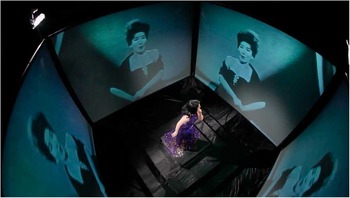
Yet when we shift our attention from the ‘hauntologies’ of studio production to the aesthetics of the Habanera video, we see opera caught between potentially contradictory cultural logics. This shift goes against the grain of Stanyek and Piekut’s theorisation, in that it involves thinking of deadness as a discursive effect. But this allows us to explore a potential tension between the ontologies and the (audiovisual) aesthetics of intermundane collaborations within specific musical contexts. In the video, Gheorghiu is placed at the centre of a pentagonal studio space, shot in widescreen, in a purple dress, surrounded by four large plasma screens that show historical footage of Callas singing Bizet’s aria. The footage is from a 1962 televised concert at Covent Garden, though the fact that Callas’s voice and body are assembled from two different sources is nowhere revealed.Footnote 12 The fifth side of the pentagon provides an opening for a camera that, mounted on a crane, ‘flies’ around the studio in a metaphorical rendering of the aria’s oiseau, constantly moving between high and low angles. On the whole, the montage follows the voice, cutting from crane shots of Gheorghiu singing in the studio, to static, frontally framed, ‘pillarboxed’ footage of Callas singing at Covent Garden, and again to shots including both singers in unison.Footnote 13 In one recurring visual effect, the Covent Garden stage is duplicated in order to make space for Gheorghiu, who is digitally overlaid next to Callas, wearing similar clothes and largely mirroring her gestures.
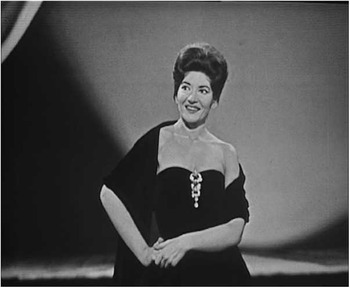
To an extent, in keeping with Allen’s aural manipulations, the video editors attempt to bring the dead and the living into the same imaginary space. The digital overlay is an obvious way of achieving this, and the intimation of real-time interaction is also produced by another detail: at the very beginning of the video, as an exception to the alignment of voice and image, we see Callas smiling while we hear Gheorghiu singing. The smile, which originally took place during the orchestral introduction and was directed towards the live audience at Covent Garden, is sampled and turned into a reaction shot: in a version of the ‘Kuleshov effect’, now Callas smiles while waiting for her turn to sing.Footnote 14 This moment gives us a glimpse into the possibilities of operatic deadness. Callas’s gesture is re-signified, the effectivity of her smile extended, its affordances explored. A new causal link encourages us to think of causality itself as a non-linear, provisional process. In this case, the montage enrols the dead singer in a particular fiction, allowing Callas a gently ironic, amused nod, almost in acknowledgement of the playful nature of the intermundane experiment (Fig. 1).
Callas smiles while Gheorghiu sings, still frame from Gheorghiu-Callas ‘Habanera’ from Bizet’s Carmen, 2011 EMI Classics Music Video. © 2011 EMI Records Ltd. All rights reserved.

On the whole, however, the video limits the interaction between the two singers, keeping them in distinct and tightly bounded audio-visual environments. Some of these boundaries are ‘imported’ with the 1962 footage. In keeping with the technical and aesthetic limitations of its era, the static, frontal framing of Callas is typical of the neutral rhetoric of liveness. Liveness, that is to say, creeps into the posthumous duet as a residual mode of presentation. The footage’s remediation makes framing an even more significant feature of the 1960s televisual broadcast: ‘pillarboxing’ thickens the spatiotemporal boundaries that enclose the historical performance, emphasising the footage’s value as a memento able to capture Callas’s past presence. This is confirmed by how, even within an otherwise overtly constructed video, the fact that the memento is a combination of recordings made at widely different times and places is never revealed. That Callas herself is a post-production construct is kept secret.
Gheorghiu’s presence is signified by radically different means – her place in the land of the living evidenced by colours, widescreen format and a camera crane that collects three-dimensional information about her body. But her space, too, is conspicuously bounded. While Callas was delimited by the televisual frame, Gheorghiu is framed by Callas. Indeed, if the crane shots are meant to invoke the figure of a bird, the restlessness of the camerawork and the arrangement of plasma screens also unwittingly invoke the sense of a cage (Fig. 2).
(colour online) Gheorghiu sings while surrounded by screens, still frame from Gheorghiu-Callas ‘Habanera’ from Bizet’s Carmen, 2011 EMI Classics Music Video. © 2011 EMI Records Ltd. All rights reserved.

Callas delimits Gheorghiu’s performance also by means of her gestures. While more expansive and explicitly sensual in comparison to Callas’s stage demeanour, Gheorghiu’s moves consistently imitates Callas’s. Even with the digital overlay, where the sense of interplay could most easily be established, the relationship between the two singers is arranged along lines of symmetry and dramatised as a matter of duplication, rather than dialogue.
The interaction is further limited by the strict vocal adherence to the solo line. Not only is there no additional musical material (no countermelody, no re-harmonisation), but also the duet does not take advantage of the opportunities for interplay that Bizet’s own orchestration would have offered by means of its choral interjections. Somewhat analogously to the ways in which ‘Nessun dorma’ was once made to fit the three tenors, the aria’s melodic profile acts as a narrow, well-trodden path that has to accommodate both dead and living singers. In this sense, while invoking a ‘ground-breaking’ intermundane collaboration, the video also grounds the duet on a well-established linear narrative of homage and operatic legacy.
When we thus consider the way in which the relationship between Callas and Gheorghiu is discursively constructed on screen, the Habanera duet shows a cautious approach to the boundaries that separate the dead from the living. And it shows that, when it comes to opera, such boundaries are heavily over-determined. They are the conceptual boundaries that separate the performance from its visual mediation and the operatic voice from the microphone. They protect the aesthetic identity of the popular aria, the memory of the immortal diva and the truth of the photographic image. In this sense, the Habanera duet can be seen as a representation of what is at stake in the debate about opera and digital culture: not so much the survival of the operatic canon, its canonical performances and canonised performers, but rather the role that media will play in their afterlife.Footnote 15 The sampling of smiles, the digital overlays, the pillarboxing and cage of screens are anticipations of possible futures to come, with the duet seemingly oscillating between two scenarios. One is characterised by a continuing investment in the (potentially ideological) transparency of mediation and in the documentary value of recordings, where ‘presence’ is conceived as the indexical relationship between an event and its audio-visual trace. But there is also another, where the screen is a site for the re-mixing of operatic recordings, where past and present are entangled, media can take a life of its own, unexplored potentialities are (potentially irresponsibly) exploited and a dead singer can smile at the strangeness of her afterlife.