A large literature in international relations explores the role of international law, human rights organizations (HROs), and transnational advocacy in generating human rights reforms. However, human rights diplomacy (HRD)—the public and private efforts of government officials to engage with their foreign counterparts on human rights issues—receives less attention, despite the centrality of human rights to the diplomatic agendas of many governments. Analyses of HRD are difficult in part because actions by state officials are rarely visible to the public. While we observe leaders' attempts to publicly “name and shame” human rights abusers, diplomacy in the human rights space is largely conducted in private. Some scholars question the effectiveness of HRD because international relations scholarship often characterizes private diplomacy as “cheap talk.” Policymakers are also skeptical about its efficacy, given that human rights issues are routinely subordinated to competing economic and security interests.
In this paper we ask: Can HRD have concrete impacts on human rights practices? If so, how? We introduce a theoretical framework for understanding HRD and then use a unique opportunity to analyze how it works in practice: a coordinated effort by the US government to free twenty female political prisoners in thirteen countries. Launched in September 2015 under the Obama administration, in advance of the seventieth Session of the United Nations General Assembly, #Freethe20 was conceived of as a media campaign to “name and shame” target governments. A cursory look at release rates suggests that it was successful. Within three years, seventeen of nineteen women had been released.Footnote 1 However, without a comparable set of cases, it is challenging to evaluate the effectiveness of the campaign.
We assess the results of the campaign by comparing release rates among #Freethe20 women with two comparison groups.Footnote 2 For the first comparison group, we obtain a “long list” of women proposed internally by the US State Department for inclusion in the campaign. However, given that women were not randomly selected from this long list to be featured in #Freethe20, we also analyze outcomes for a second comparison group. We construct a database of all female political prisoners highlighted in Amnesty International's Urgent Action reports in countries targeted by the campaign during the same period. We collect arrest and release information for these women and compare their outcomes to women featured in #Freethe20. Using both strategies, we show that #Freethe20 women were released at a faster rate than other, comparable female political prisoners.
To make sense of the conduct of HRD, we propose a typology of strategies of diplomatic actions and outline the conditions under which they are more or less likely to occur. We argue that strategies of HRD vary on two dimensions. First, they vary by the type of action the government undertakes. Expressive actions raise a human rights issue to a foreign counterpart, whereas coercive actions attach positive or negative inducements (“carrots and sticks”) to change the behavior of a target. Second, strategies of HRD vary by the forum in which diplomacy takes place: public diplomacy is observable by an international audience, while private diplomacy consists of unobservable engagement between government officials.Footnote 3 Although both expressive and coercive actions can occur in either forum, the visibility of expressive public diplomacy—publicly raising human rights concerns with the intent to “name and shame” a target state—makes it a central focus of human rights scholarship.
We explore these two dimensions of HRD in #Freethe20 by analyzing media coverage of the campaign and conducting interviews with government officials to understand how HRD influenced state behavior. On the surface, #Freethe20 appears as it was designed: a successful example of expressive public diplomacy. Existing research highlights two mechanisms through which expressive public diplomacy can result in human rights reforms.Footnote 4 First, “naming and shaming” can impose direct reputational costs on governments who commit human rights abuses. Second, public diplomacy can mobilize foreign publics and other international actors to impose costs on target governments. Our analysis of #Freethe20, however, finds little evidence for these mechanisms. While the campaign appears to have affected the behavior of target states, we do not find evidence that it did so through public diplomacy alone.
Instead, our interviews reveal a third mechanism through which public diplomacy works: by elevating the priority US officials attached to this issue and thus paving the way for private diplomatic pressure. This private diplomacy was especially effective when US policymakers offered inducements to target governments in exchange for the release of political prisoners. We argue that public diplomacy can be used to overcome bureaucratic deadlock that constrains the ability of officials to pursue coercive private diplomacy around human rights. A strong, public-facing campaign elevates human rights issues above competing equities, providing opportunities for entrepreneurial policymakers to advance these issues through the foreign policy bureaucracy.
To illustrate this central mechanism—the use of a public human rights campaign to galvanize the foreign policy bureaucracy—we discuss evidence from political prisoner cases in Azerbaijan and Vietnam, two countries targeted by #Freethe20. We show that beyond target states and international actors, a key audience of the #Freethe20 campaign was other foreign policymakers within the US government. The public nature of the campaign and its association with senior leadership enabled lower-level bureaucrats to make substantial progress on many political prisoner cases behind the scenes.
Our findings highlight how international relations scholarship that measures the effectiveness of publicly observable “naming and shaming” efforts without taking into account complementary forms of private diplomacy misses a critical mechanism through which governments engage in human rights reforms. Overall, we call for greater attention to the interaction of private and public diplomacy, both with respect to human rights and in other domains of foreign policy.
The Study of Human Rights Diplomacy
How can international actors stop human rights abuses? Researchers focus on three forms of international action to reform human rights practices abroad: international human rights law; HROs and transnational advocacy; and HRD. The first form of international action to curb human rights abuses consists of multilateral action by intergovernmental organizations—most notably the United Nations—through the use of international human rights law. An extensive literature analyzes when and why states ratify human rights agreementsFootnote 5 and the conditions under which states comply with human rights agreements they ratify.Footnote 6
A second form of international action to generate human rights reforms is conducted by nongovernmental HROs and their associated partners in civil society. Transnational advocacy networks (networks of activists spanning state borders)Footnote 7 organize to influence both public opinion and state behavior. HROs like Amnesty International and Human Rights Watch raise awareness of human rights abuses by providing information to the public in the form of detailed reportingFootnote 8 or performance metrics.Footnote 9 This information can be used to “name and shame” target states. IR scholars have explored the impacts of “naming and shaming” on human rights reforms,Footnote 10 and on the mobilization of both foreign publicsFootnote 11 and the international community.Footnote 12
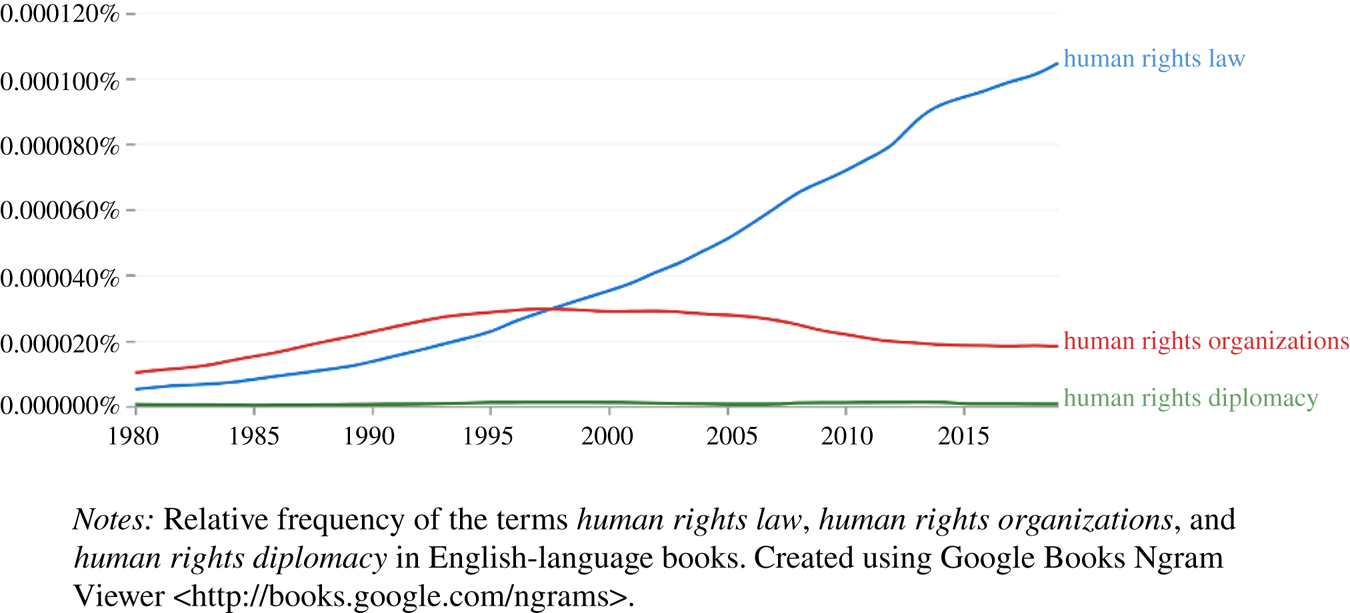
A third form of international action, called human rights diplomacy, consists of public and private forms of engagement between governments with the objective of improving human rights conditions in a target country.Footnote 13 This includes actions taken by states to “name and shame” foreign governments or to induce states to change their behavior via “carrots and sticks” (e.g., economic sanctions, foreign aid, security sector assistance, or international recognition). For both theoretical and practical reasons, HRD receives less scholarly attention than human rights law and HROs (Figure 1).
Scholarly attention to forms of international action around human rights

The primary obstacle in studying HRD is that many of the diplomatic activities of governments are not publicly observable. Diplomats and other government officials working in the human rights space usually communicate via confidential, private channels. This makes data collection and analysis difficult. For this reason, much social science research on diplomacy writ large is driven by case studies or formal models rather than quantitative empirical analysis. Drawing inferences about diplomatic actions is also complicated by the fact that their visibility may be endogenous to their success. We observe diplomatic breakthroughs but often do not see failures of private diplomacy that maintain the status quo. Another inferential challenge comes from the fact that different strategies of HRD can be used simultaneously. As Forsythe summarizes, “Private action for human rights is frequently merged, or dovetails, with public action … making it extremely difficult to separate the lines of influence that went into a decision or impacted a situation.”Footnote 14
In addition to these obstacles, researchers and policymakers have been skeptical about the efficacy of HRD. In international relations, private communication between states is often perceived as “cheap talk.” Many studies on coercive diplomacy and audience costs, for example, argue that signals from democratic leaders are more credible when issued publicly rather than privately.Footnote 15 Policymakers also often question the effectiveness of HRD. When there are competing interests at stake, policymakers are reluctant to issue coercive threats to advance human rights because they risk undermining other aspects of the bilateral relationship. An overarching skepticism about HRD stems from the fact that it is typically ineffective in places where human rights abuses are severe. This is because many of the worst human rights offenders—countries like Iran, North Korea, and Syria—are diplomatically isolated.
Despite these challenges, HRD merits greater attention. In many democracies, HRD is a critical function of the foreign affairs bureaucracy. In the United States, for example, the State Department formed a separate bureau in 1977 (now the Bureau of Democracy, Human Rights, and Labor) to integrate human rights concerns into the foreign policymaking process. Although HRD is routinely used in US foreign policy, our understanding of contemporary diplomacy is limited. Data sets in international relations probe the conditions under which diplomacy occurs,Footnote 16 but much of what we know about when and how diplomacy works comes from memoirs of political officials.Footnote 17 These works provide crucial snapshots of HRD in practice but tend to be divorced from analytic frameworks in political science. The next section introduces a typology of HRD and discusses how public and private forms of diplomacy interact.
Strategies of Human Rights Diplomacy
Human rights practices in a given country reflect a calculation by the regime about how to manage domestic opposition. To ensure their political survival, leaders may repress dissent by perpetrating human rights abuses. However, leaders must weigh the costs and benefits of these abuses. For example, while imprisoning large swaths of civil society prevents coordination among political opponents, it may backfire by mobilizing domestic actors or drawing attention from the international community. Extrapolating from this framework, strategies of HRD attempt to either raise the costs of perpetrating human rights abuses or increase the benefits of human rights reforms in the target state. These benefits and costs can be imposed directly or indirectly and may be tangible (e.g., changes in foreign aid) or intangible (e.g., changes in a state's reputation).
We argue that strategies of HRD vary on two dimensions. The first is the type of action: Are the state's actions expressive or coercive? Expressive diplomacy occurs when government officials raise a human rights issue, most commonly to shame target states. When states “name and shame,” they publicly highlight human rights abuses in another state.Footnote 18 This can change the cost–benefit calculus of human rights abusers by imposing direct reputational costs or by mobilizing civil society in the target state. By contrast, coercive diplomacy uses implicit or explicit promises (“carrots”) or threats (“sticks”) to change human rights practices.Footnote 19 Even when states do not explicitly link HRD to concrete carrots and sticks, target governments may act in anticipation of punishment or rewards.
The second is the forum in which diplomatic action takes place: Are states engaging publicly or privately? Public diplomacy is visible to the target state and other international actors. States engage in public diplomacy by issuing press releases, speeches, statements, or reports on human rights practices. These can occur independently or in the context of multilateral forums, such as the United Nations Universal Periodic Review process.Footnote 20 Private diplomacy, also called quiet diplomacy,Footnote 21 occurs when interactions with government officials from the target state happen out of public view. Memoirs from political officials tell us that a considerable amount of HRD is conducted in private. However, this form of diplomacy is “hard to track and evaluate, precisely because it may be some years before outsiders know what has transpired.”Footnote 22 Most private HRD, such as communications that occur in bilateral meetings and through diplomatic cables, is confidential but not secret.Footnote 23 Some forms of highly sensitive private diplomacy, such as diplomatic “back channels”Footnote 24 that open communication between adversaries, are conducted in secret, but most diplomatic interactions simply occur out of public view.
We use this framework to discuss the conditions under which different strategies of HRD are more or less likely to be deployed. We argue that the frequency and visibility of expressive public diplomacy like “naming and shaming” makes it a central focus of human rights scholarship. However, these strategies are often complemented by private diplomacy that researchers do not observe. By exploring the intersection of public and private HRD, we identify an additional pathway through which expressive public diplomacy can be effective. While existing scholarship suggests that public diplomacy works by “shaming” a target state or mobilizing foreign actors, we argue that it can also be used instrumentally to spur or reinforce coercive private diplomacy. When senior officials draw public attention to human rights abuses, it orients a heterogeneous foreign policy bureaucracy around a common goal. This enables entrepreneurial policymakers to advance human rights reforms that would otherwise be stalled in the inter-agency process.
Expectations for Different Strategies of Human Rights Diplomacy
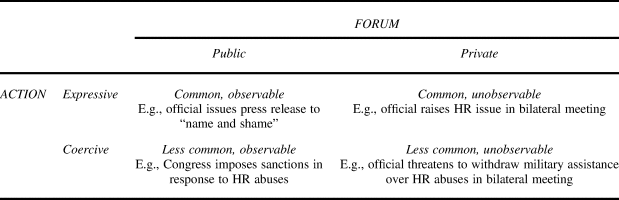
Table 1 outlines four strategies of HRD that combine the diplomatic action (expressive or coercive) with the forum in which the action takes place (public or private). While these categories can be thought of as analytically distinct, governments can use multiple strategies of HRD either sequentially or simultaneously to address a given problem.
Strategies of human rights diplomacy

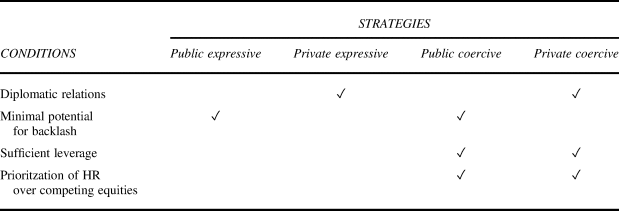
When are these strategies more or less likely to be employed effectively? Table 2 emphasizes four conditions. First, whether or not a state can plausibly engage in private diplomacy with a target depends on whether they have established diplomatic relations. A routine form of HRD is raising a human rights issue in a private, bilateral meeting with government officials in a target state.Footnote 25 However, this expressive private diplomacy is unlikely if states do not already have a meaningful diplomatic relationship. For example, since the United States has no formal diplomatic ties to Syria, most HRD conducted by the US in response to human rights abuses in Syria comes in the form of public diplomacy.
Conditions under which strategies of human rights diplomacy are more or less likely

Second, when considering whether to engage in public diplomacy, governments must evaluate the potential for backlash. Memoirs from government officials tell us that diplomats are reluctant to publicly condemn human rights abuses because they fear negative repercussions for the bilateral relationship.Footnote 26 Depending on the relationship between the sender state and the target, public shaming may be unwise or even counterproductive.Footnote 27 For example, research on “naming and shaming” efforts targeted at Iran and China shows that citizens are more likely to reject criticism that comes from a geopolitical adversary.Footnote 28 If governments anticipate backlash from public diplomacy, they may prefer to raise human rights issues privately with target states. Of course, raising human rights issues privately is not costless. Uncomfortable conversations can strain diplomatic relationships. However, in most circumstances, the social dimensions of public diplomacy make backlash from the target state a greater concern than comparable forms of private diplomacy.
Third, for coercive diplomacy to be possible, the sender state must have sufficient leverage over the target state. These forms of leverage could be implicit or explicit, intangible or tangible, and may vary in scale. Major forms of leverage may be economic, such as the imposition of sanctions or changes in foreign aid or security-sector assistance.Footnote 29 Beyond economic tools, states may promise or threaten to add or remove a target state from an institution, such as a regional organization or preferential trade agreement. When human rights reforms are a prerequisite for accession to an institution, the benefits of membership may induce changes in human rights practices.Footnote 30 Increasingly, international institutions, such as bilateral investment treaties and preferential trade agreements, also incorporate clauses related to democracy and human rights.Footnote 31
Finally, for any coercive diplomacy to occur either privately or in public, human rights must be prioritized over competing equities. Diplomats and policymakers juggle multiple economic, political, and security interests in a given bilateral relationship. Even if governments have sufficient leverage over a target, they must be willing to expend political capital and resources on human rights issues to the possible detriment of other issue areas. For example, while the United States had serious problems with human rights practices in Egypt under both the Mubarak and Al-Sisi regimes, HRD was constrained by concerns about the essential cooperation the US maintains with Egypt on counterterrorism and the Israeli–Palestinian conflict.Footnote 32 This is the primary reason HRD is so difficult in practice: policymakers are reluctant to engage in coercive diplomacy to advance human rights because it risks undermining other aspects of the bilateral relationship.
The existence of competing equities makes coercive diplomacy around human rights much less common than expressive diplomacy. To clarify, we are not suggesting that coercive diplomacy does not occur or is not important. There are substantial bodies of research on the effectiveness of different strategies of coercive diplomacy—such as threats to use force,Footnote 33 nuclear threats,Footnote 34 military mobilization,Footnote 35 or economic sanctionsFootnote 36—in the context of crisis bargaining. However, it is far less common for governments to take coercive actions strictly for humanitarian ends rather than in response to national security concerns. In managing complex bilateral relationships, policymakers are reticent to burn bridges with their diplomatic counterparts solely in pursuit of human rights objectives.
This does not mean that coercive diplomacy around human rights never occurs. One of the most visible forms of coercive HRD is the imposition of economic sanctions on states that commit human rights abuses.Footnote 37 However, in the routine conduct of diplomatic activities around human rights, these major, coercive actions are the exception rather than the norm. For example, the Threat and Imposition of Sanctions data set shows (in over 1,400 instances of sanctions between 1945 and 2005) that human rights are often identified as a motivation for sanctions, but that they are the primary motivation in less than 6 percent of cases.Footnote 38 Major coercive HRD tends to occur in extreme cases, where alternatives are exhausted and diplomatic relations are strained or nonexistent, making private diplomacy unlikely. When countries maintain a productive diplomatic relationship, the coercive HRD that occurs tends to be much smaller in scale and usually undertaken in private. States make incremental progress on human rights by using targeted inducements to extract minor concessions.
The Intersection of Public and Private HRD
Given the visibility of public diplomacy and the fact that coercive diplomacy in human rights is relatively rare, the bulk of research on HRD focuses on government efforts to “name and shame” states perpetrating human rights abuses. However, public and private forms of HRD often intersect. Studying one without the other may lead researchers to draw conclusions based on incomplete information.
Scholars identify two main pathways through which expressive public diplomacy affects a leader's cost–benefit calculus. First, it can impose direct but intangible costs by damaging a regime's reputation. This process occurs through social behaviors like “isolating or embarrassing the target”Footnote 39 or through “shaming, shunning, exclusion, and demeaning.”Footnote 40 These strategies increase the discomfort of leaders in the target state, making the human rights violation appear less attractive.
Second, expressive public diplomacy can impose indirect but tangible costs on a state by mobilizing two distinct audiences. Shaming can mobilize HROs and civil society domestically in a target country, increasing public pressure on a leader.Footnote 41 It can also mobilize other international actors to impose direct, tangible costs on the target state. These actors include transnational advocacy networks,Footnote 42 as well as international organizations and other powerful states. Countries shamed for their human rights record are less likely to receive multilateral foreign aid,Footnote 43 official development assistance,Footnote 44 and foreign direct investment.Footnote 45 They are also more likely to be targets of economic sanctionsFootnote 46 and foreign military intervention.Footnote 47
An Alternative Pathway: Resolving Bureaucratic Deadlock
While we do not dispute the importance of these mechanisms, we argue that public HRD has another important audience: other actors in the foreign policy bureaucracy. This logic parallels scholarship on intra-elite signaling. Leaders make strategic choices about when to “go public” on different issues. When leaders address their domestic publics, another important audience is other political elites like legislators or government bureaucrats.Footnote 48 In a similar vein, leaders may instrumentally use public HRD to signal priorities to other actors in the foreign policy bureaucracy. This process can resolve bureaucratic deadlock to spur coercive private diplomacy around human rights issues.
To understand this causal pathway, it is useful to conceptualize a foreign policy bureaucracy as made up of heterogeneous organizations with independent priorities. In the United States, for example, conflicting interests that emerge in the inter-agency process can create a deadlock that prevents action to address human rights concerns. Similar deadlocks arise within agencies. For instance, the US State Department can be broadly divided into “regionalists,” who specialize in countries or regions, and “functionalists,” who focus on specific issue areas.Footnote 49 These roles create competing priorities, since officials manage a delicate balance of security and economic interests in bilateral relationships with other states. A functionalist working on human rights may, for instance, advocate for coercive private diplomacy but be impeded by a regionalist concerned that these actions would undermine other aspects of the relationship. Because human rights concerns tend to be subordinated to competing economic or security concerns, meaningful diplomatic action on these issues is hard to advance.
We argue that expressive public diplomacy can be useful in resolving intragovernmental deadlock to prompt private diplomacy. When senior officials highlight a human rights issue as part of a public-facing campaign, it has three effects. First, it signals the priorities of the administration to other actors in the government. Second, it establishes a set of shared facts, facilitating coordination within and across the bureaucracy. Third, these processes empower entrepreneurial policymakers at lower levels of government who are already working on the human rights issue at hand. The increased salience of the issue gives these officials windows of opportunity to advocate for greater private diplomatic action on human rights concerns that were previously met with internal resistance.
Resolving bureaucratic deadlock makes it much more likely that human rights concerns will be incorporated into private diplomacy. With sufficient pressure from the senior foreign policy leadership above and entrepreneurial bureaucrats below, government officials across different agencies begin to use positive and negative inducements. These “carrots and sticks” increase the likelihood of successful human rights reforms.
Referring back to Table 2, we see this successful interplay between expressive public diplomacy and coercive private diplomacy can occur only under certain conditions. For one, the government must have a productive bilateral relationship with the target state. Public-facing diplomacy is unlikely to spur private action if the bilateral relationship presents no opportunity for routine diplomacy. Second, for a public pressure campaign to occur in the first place, there must be minimal potential for backlash. Third, states must have sufficient leverage over the target government to use inducements. If these three conditions are met, public diplomacy can help resolve one of the largest obstacles to coercive HRD: prioritization of human rights over competing equities.
This causal pathway illustrates why inattention to private diplomacy in human rights scholarship is problematic for drawing inferences about the role of states in generating reform. We know from existing scholarship that “naming and shaming” can have important impacts on target states and their leaders. However, without understanding how government officials are interacting behind the scenes, we are likely to overestimate the direct impacts of expressive public diplomacy.
Evidence from US Diplomacy Around Political Prisoners
To understand the intersection of public and private HRD, we evaluate #Freethe20, a campaign by the US government to free female political prisoners. We focus on HRD around political prisoners—people who are unjustly detained for criticizing their government—because imprisoning individuals for their beliefs is a clear example of human rights abuse that infringes on civil and political liberties. Unjust detentions are a major focus of civil society groups and HROs. These advocacy groups have spurred intergovernmental efforts to investigate political prisoner cases, such as the United Nations Working Group on Arbitrary Detention.
The United States has a long history of state-led diplomatic efforts to negotiate the release of political prisoners. Skeptics of HRD say that target countries may release political prisoners as token concessions to avoid larger structural reforms. Yet the release of political prisoners has tangible consequences for these individuals and their communities. In addition, releases can serve broader, symbolic functions to indicate changes in human rights practices, draw international attention, or rally domestic opposition. As one government official who worked on political prisoner cases noted, there is “something very emblematic about the emphasis on a single individual … the one standing for the many” (interview 9). Some of the world's best-known political prisoners—Aung San Suu Kyi in Myanmar, Nelson Mandela in South Africa, and Václav Havel in the Czech Republic—later became major political figures or even heads of state.
From a methodological standpoint, tracking data on political prisoners is a more concrete way to measure human rights abuses than human rights indices aggregated at the country level. The international relations literature on “naming and shaming,” for instance, uses indices from Freedom House, the Polity Project, and the Cingranelli-Richards Human Rights Data Project to measure trends in human rights practices cross-nationally. These approaches are essential for understanding macro-level patterns, but they are less useful for disaggregating the conditions under which diplomatic actions taken by states are successful.
The #Freethe20 campaign presents an opportunity to study the efficacy of HRD. The campaign involves multiple forms of HRD, including efforts to “name and shame” and use coercive diplomacy, as well as attempts to engage foreign counterparts publicly and privately. Through interviews with government officials and human rights advocates involved in #Freethe20, we can detail the diplomatic actions of the US government, including strategies employed in private that are otherwise unobservable.
Overview of the #Freethe20 Campaign
#Freethe20 was launched in September 2015 by the United States Mission to the United Nations (USUN). It was crafted as a response to the Beijing+20 conference on the twentieth anniversary of the Fourth World Conference on Women, held in Beijing. The initial intent of the public-facing campaign was to draw attention to the hypocrisy of the Chinese government, which earlier that summer had detained more than 250 human rights lawyers, including many women.Footnote 50 Under the leadership of ambassador Samantha Power, USUN expanded the campaign to feature twenty political prisoners from thirteen target countries: Azerbaijan, Burma, China, Egypt, Ethiopia, Eritrea, Iran, North Korea, Russia, Syria, Uzbekistan, Venezuela, and Vietnam.
Ambassador Power profiled one #Freethe20 woman each day in September 2015 at the State Department press briefing. The briefings were accompanied by online videos, press releases, and a social media campaign designed to “name and shame” the target countries. The campaign included images of President Obama reviewing photographs of the imprisoned women, which were tweeted from the official White House account. Simultaneously, US government officials exerted private pressure on foreign officials. Within three years, all but two #Freethe20 women had been released.
Assessing the effectiveness of a human rights campaign requires the construction of a plausible counterfactual: Would these seventeen of nineteen women have been released in the absence of the #Freethe20 campaign and subsequent efforts? Would they have been released as quickly? Since this counterfactual is impossible to observe, we use two strategies to construct comparison groups with characteristics similar to the #Freethe20 women. We then compare the release outcomes of these political prisoners to the set of women featured in the campaign.
Evaluating the overall efficacy of the campaign, however, does not tell us which strategies of HRD were effective. This is because #Freethe20 involved elements of public and private diplomacy, as well as expressive and coercive actions. To understand why the campaign was effective, we conducted ten in-depth interviews with government officials from USUN, the State Department, and select Congressional offices who were involved in #Freethe20. We identified participants through snowball sampling, beginning with those who worked on the campaign most directly. The interviews were semi-structured, lasted between thirty and sixty minutes each, and took place between August 2018 and January 2019. We then corroborated case-level details with another fifteen government officials working on specific cases.Footnote 51 After providing an assessment of the campaign, we return to this qualitative evidence to understand how officials conducted HRD on behalf of these women.
Comparison Group 1: The #Freethe20 Long List
The first comparison group is a set of female political prisoners who were proposed for inclusion in the campaign but ultimately not featured. The State Department undertook an extensive process of internal consultation to identify potential women to include. The campaign's objective was to highlight women from diverse regions and backgrounds for whom raising their case would not be harmful to their own safety or that of their families. This vetting process gave the State Department's regional bureaus some influence over which countries would be targeted. Overall, forty women were proposed in a “long list,” nineteen of whom were ultimately highlighted. Through interviews with political officials, we obtained access to the long list of female political prisoners compiled internally by the US Department of State and compared their outcomes to those on the “short list.”Footnote 52
A simple statistical test suggests that women on the short list were more likely to be released than women on the long list. Within three years of #Freethe20, 89 percent of women on the short list (seventeen of nineteen) and 52 percent of women on the long list (eleven of twenty-one) had been released. This disparity is surprising in such a small sample. At the 99 percent confidence level (p < .01), a two-tailed, two-sample t-test suggests that we can reject the null hypothesis that there is no difference in average release outcomes between the two groups.
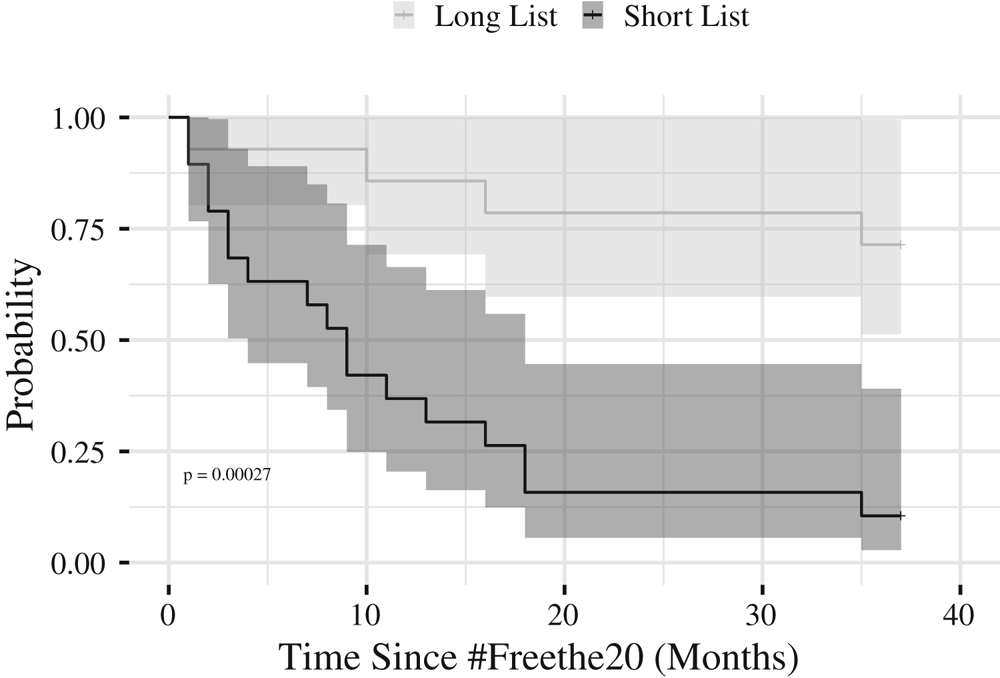
Next, we use survival analysis to examine differences in release rates between the short list and long list. Figure 2 displays a Kaplan-Meier plot of the survival curves of the women in each group. A survival curve estimates the probability that an event (here, a release from prison or house arrest) has not occurred at a given time. The women included in this analysis are those who were still in prison at the launch of #Freethe20 in September 2015.Footnote 53 Here, the time unit on the x-axis is months since the launch of the #Freethe20 campaign in September 2015. A log-rank test assesses whether the survival curves of the samples differ statistically; the test is significant at the 99 percent confidence level. Women featured on the short list were released at a much faster rate than women on the long list.
Release outcomes for #Freethe20 long list versus the short list

While these results suggest that #Freethe20 was relatively effective, the women featured on the short list were not randomly selected. Our concern is that officials selected cases from the long list that they expected they could most likely influence. To understand the case selection process, we interviewed government officials who organized the campaign. The first criterion officials established for a name to be considered for the long list was a “do no harm” principle: raising an individual's case should not worsen their situation. To narrow to a short list, the next priority was to feature a diverse set of women, in both occupation and region. If two women shared a similar background and country, usually only one made the short list.
The online supplement details the selection process and lays out a systematic comparison of the long list and the short list to discuss potential threats to inference. We find that the two groups were fairly balanced in the countries and cases that were targeted. In terms of country-level characteristics, we show there are no systematic differences in the military and economic power of states targeted by the campaign. It does not appear that the US government selected a subset of less powerful states from the long list that they could easily coerce. We also show they did not select targets from the long list that were easier or more acceptable to “name and shame”—only highly autocratic countries, for example. We find no evidence that either set of countries was systematically targeted in high-level diplomatic meetings during the summer of 2015 while the #Freethe20 campaign was constructed. Moreover, there were no significant differences in the average level of democracy between the lists, and they both included cases in countries with whom the United States has a complicated bilateral relationship (e.g., Egypt, Russia, and Syria). The main systematic difference we found was regional: a higher percentage of women on the short list than the long list were from Asia—specifically, China—given that the campaign highlighted the arrest of female activists in China prior to the Beijing+20 Congress.
In terms of individual-level characteristics, we compare the backgrounds of the women featured on each list and find no evidence that those with “difficult” cases were excluded from the campaign. Officials we interviewed stressed that the short list featured a mix of cases. As one said, “I don't think we just went after low-hanging fruit … [Some cases] were high-profile prisoners that were getting significant attention from others. At the same time, we had cases of individuals who were not on anyone's radar” (interview 1). Yet we cannot rule out the possibility that cases from certain countries, such as Bahrain, did not make the short list because the State Department was balancing human rights concerns with a set of competing security interests. Ultimately, because the twenty women were not selected at random, we use a second strategy to compare the outcomes of #Freethe20 women to women imprisoned in the same countries during the same period.
Comparison Group 2: Amnesty International Urgent Actions
As an alternative comparison group, we constructed a data set of all female political prisoners imprisoned between 2000 and 2015 in the #Freethe20 target countries. Since no comprehensive database of political prisoners exists, we identified these women from Amnesty International Urgent Action reports (UAs). Amnesty International is a nongovernmental HRO with a global Urgent Action Network used to mobilize activists around instances of human rights abuse. UAs often feature political prisoners unjustly targeted by their government. One benefit of working with Urgent Action data is that this subset of political prisoners was already receiving international attention. In other words, women from this group could plausibly have been on the radar of the US government and featured in #Freethe20. Therefore, one major difference between the #Freethe20 women and the Amnesty cases was focused diplomatic engagement by the United States.
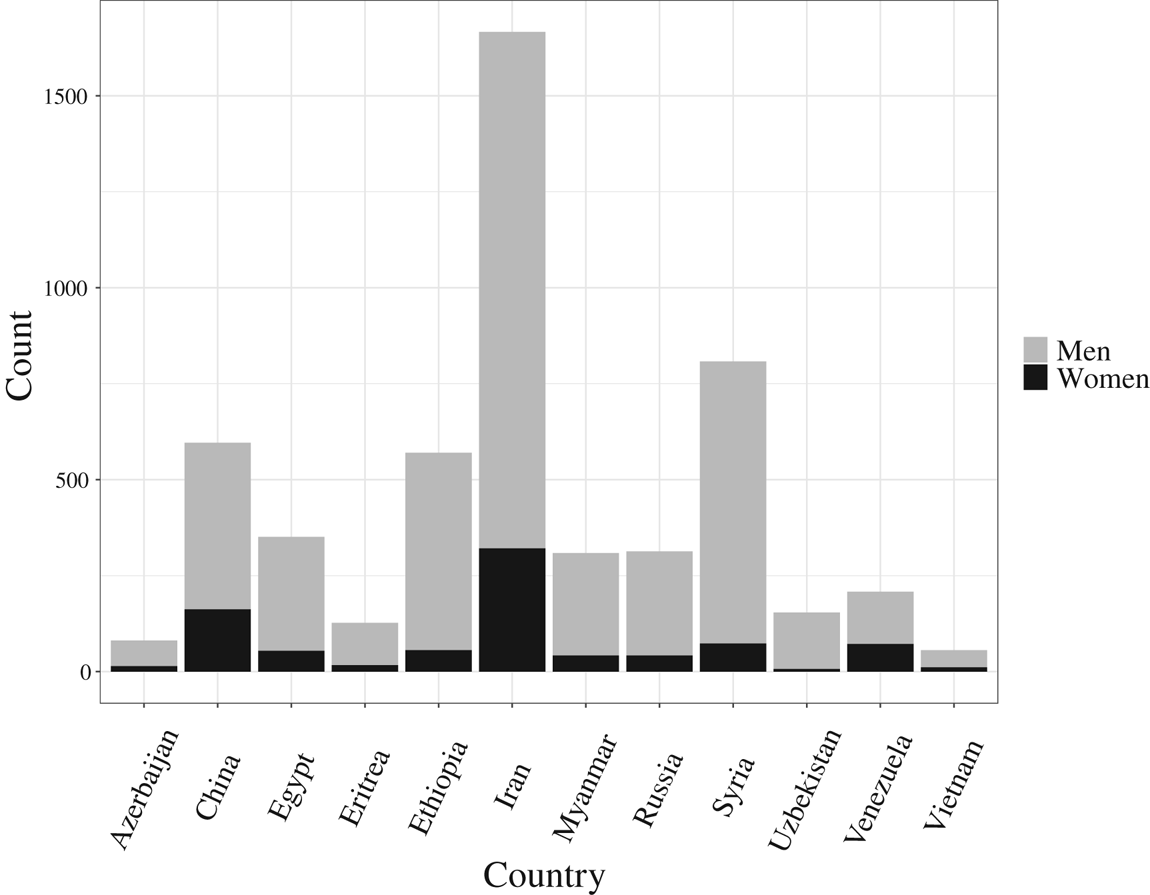
We began with an existing database of UAs collected from Amnesty International.Footnote 54 We updated this data through September 2015, the start of the #Freethe20 campaign (over 1,100 unique UAs). After identifying UAs from the target countries between January 2000 and September 2015, we went through each UA and manually coded the name and sex of all individuals it mentioned (over 2,800 unique names). Figure 3 shows the number of times individual men and women were featured in UAs from each target country.
Sex distribution in Amnesty International urgent actions in #Freethe20 target countries, 2000 to 2015

To construct a comparable set of cases, we focused on women named in UAs (n = 455). Since there were often multiple UAs for each person, we aggregated data by individual. We then researched the cases to determine whether or not each individual could plausibly be a “political prisoner.” Political prisoners had to meet two criteria: having been reported as arrested, detained, or disappeared; and having been detained or imprisoned for a minimum of two months. Using these coding rules, political prisoners comprised roughly 60 percent of the cases. We then tracked down approximate arrest and release dates for every woman in the data set. We provide details about the coding process in the online supplement.
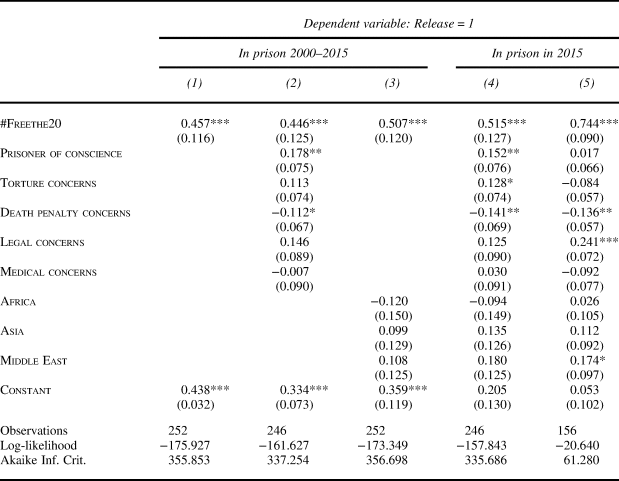
Next, we analyzed the differences in release outcomes for #Freethe20 women versus this sample of female political prisoners. We first looked to see whether, on average, women featured in #Freethe20 were more likely to be released. We use a logistic regression to model release outcomes (the dependent variable is a binary indicator, with 1 indicating release), controlling for location and other characteristics of the case. The unit of analysis is the individual, and the coefficient of interest is the coefficient on a #Freethe20 indicator variable.
The consistently positive, statistically significant coefficient on the #Freethe20 indicator means that #Freethe20 women were more likely to be released from prison than a comparable set of women imprisoned in a similar location and time frame (Table 3). Models 1 through 4 include the full sample of female political prisoners imprisoned between 2000 and 2015. A substantive interpretation of model 1 is that the baseline probability of release is roughly 44 percent in the overall sample but 89 percent among #Freethe20 women. Exponentiating the coefficient on the #Freethe20 variable shows that the odds of a #Freethe20 woman being released from prison were more than 1.5 times the odds of a woman in our sample who was not featured in the campaign. In model 5, we subset this data to only women who were in prison in 2015 (i.e, who feasibly could have been considered for #Freethe20), and the effects are stronger. Here, the odds of #Freethe20 women being released are more than twice the odds of being released otherwise. The online supplement shows that these results are robust to different modeling choices, alternative subsets of the data, and the inclusion of country fixed effects. In the online supplement, we also add a sensitivity analysisFootnote 55 to demonstrate that it is unlikely that unobserved confounding variables could change our overall conclusions.
Were #Freethe20 women more likely to get released?

Note: *p < .1; **p < .05; ***p < .01
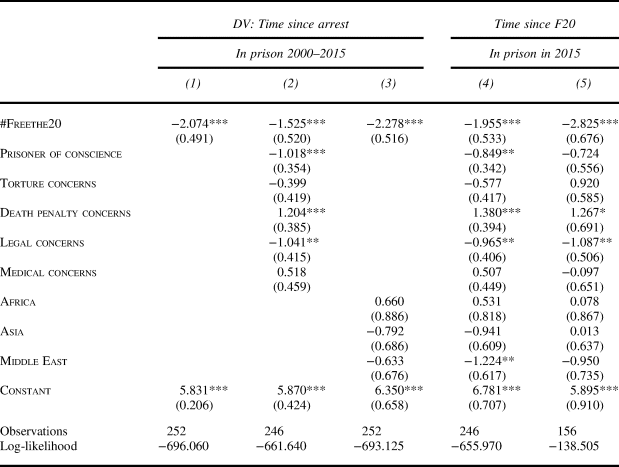
Next, we use survival analysis to look at the rate at which women were released. Table 4 uses Weibull regression analyses to model “time to release” (in months).Footnote 56 Negative coefficients in these models indicate shorter duration, which in this case captures months in prison (models 1–4) or months since the launch of #Freethe20 (model 5). The coefficient on #Freethe20 is consistently negative and statistically significant, indicating that, on average, women featured in the campaign were released from prison sooner than those who were not featured. For example, the models suggest that a woman not featured in #Freethe20 spent, on average, between four and eight times as long in prison as a woman featured in the campaign. Once again, these effects are even larger in model 5, where we subset the analysis to the sample of women that were in prison at the launch of #Freethe20 and thus could hypothetically have been featured in the campaign.
Were #Freethe20 women released at a faster rate? (Weibull models)

Note: *p < .1; **p < .05; ***p < .01
Assessing Strategies of Human Rights Diplomacy
Our analyses show that women featured in the #Freethe20 campaign were more likely to be released from prison and were released at a faster rate relative to comparable political prisoners. In our interviews, officials working on the campaign said they were surprised by the results of #Freethe20. One interviewee said, “Had you interviewed me before we started on the campaign, I would not have placed our odds at high at securing a release of a large number of prisoners” (interview 9). The next—and arguably more interesting—question is why?
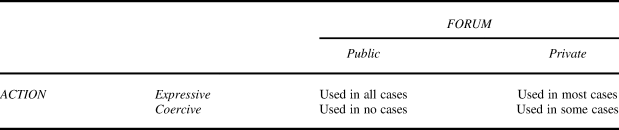
Table 5 shows the strategies of HRD used in the #Freethe20 cases. The next two sections explore evidence for public and private diplomacy conducted by the US government on behalf of the women featured in #Freethe20. The first exploits cross-temporal variation to analyze whether expressive public diplomacy raised the public profile of #Freethe20 women. The second draws on interviews with government officials to illustrate how private diplomacy was occurring behind the scenes around #Freethe20 cases. We provide examples of private diplomacy across two contexts, Azerbaijan and Vietnam, to demonstrate how officials used different forms of leverage to work toward the release of political prisoners.
Strategies of human rights diplomacy used in #Freethe20

Overall, we find that it is unlikely that expressive public diplomacy from #Freethe20 worked by mobilizing foreign publics or other international actors as the campaign had intended. Instead, we argue that public diplomacy was instrumental in facilitating buy-in from actors within the US foreign policy bureaucracy. The support of senior officials resolved intragovernmental deadlock to initiate or reinforce coercive private diplomacy. This private diplomatic action contributed to the release of some, although not all, of the #Freethe20 women.
Evidence for Public Diplomacy
We first look for evidence of coercive and expressive actions taken publicly by the US government. While we found no evidence of coercive public diplomacy, #Freethe20 used expressive public diplomacy to “name and shame” target states. There were five public-facing elements of the campaign. First, the State Department issued press releases and daily press briefings that featured stories of #Freethe20 women throughout the month of September 2015. Second, the campaign created and maintained an online presence via a website and social media accounts. Third, stories about #Freethe20 were featured in major media outlets like the New York Times, the Wall Street Journal, and USA Today. Fourth, the US Mission to the United Nations created a display in their building on First Avenue in New York, which was visible to press and diplomats attending the seventieth session of the UN General Assembly. Finally, the team coordinated with high-ranking US officials to serve as public faces for the campaign. Examples include former secretary of state Hillary Clinton tweeting about the campaign with the #Freethe20 hashtag, president Barack Obama visiting the #Freethe20 display before the UN General Assembly, and twenty female senators sponsoring a concurrent resolution to #Freethe20 in September 2015.Footnote 57
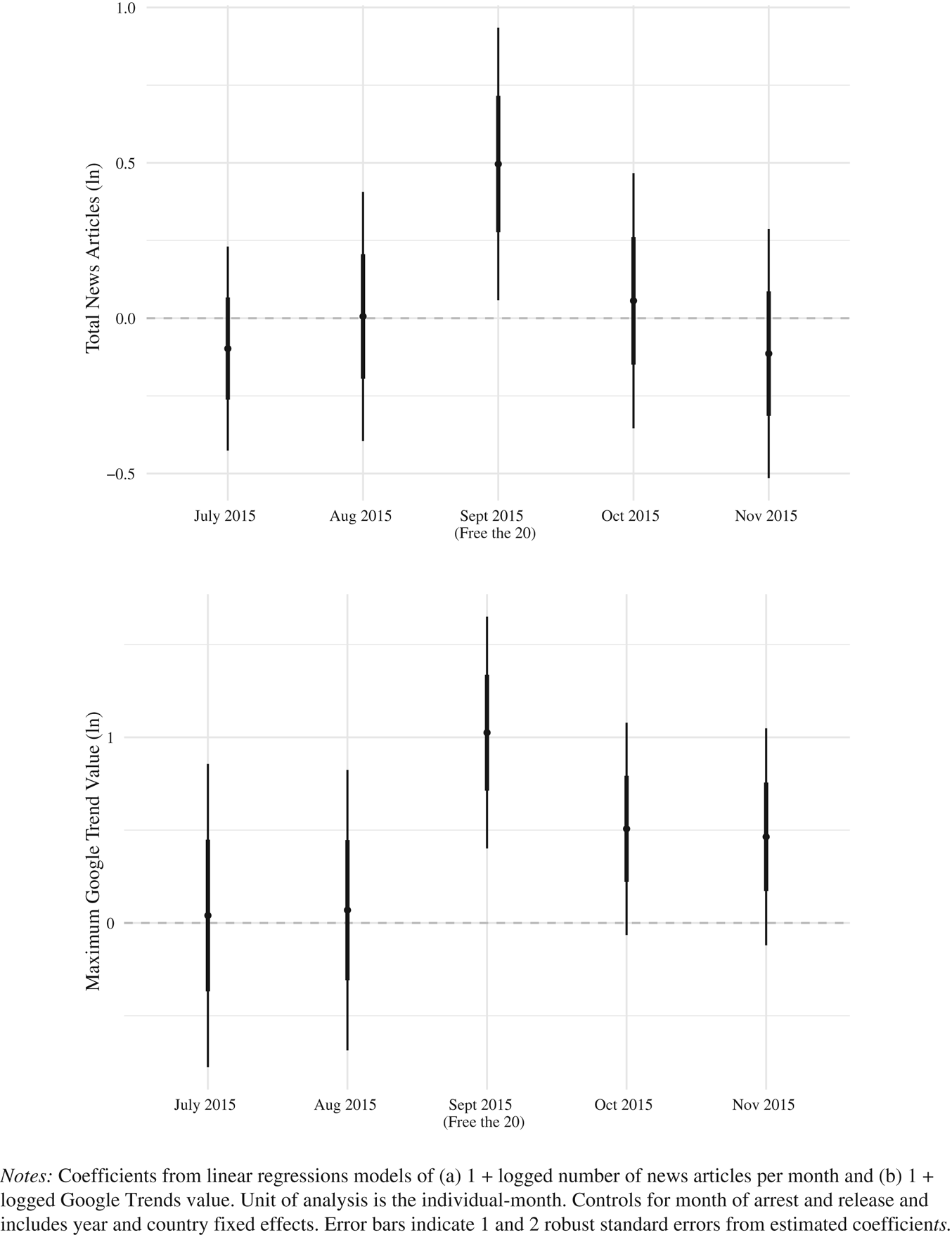
As mentioned, scholarship on “naming and shaming” tells us that expressive public diplomacy can impose direct costs by marring a leader's reputation or indirect costs by mobilizing international actors or civil society groups against the target regime. To substantiate these mechanisms, we would need to find evidence that the #Freethe20 campaign amplified the public profile of the featured women internationally. To assess this, we built a panel data set that captured online searches and media coverage of each of the #Freethe20 women. Each woman entered into the data set during the first month of detention or arrest and exited when released. We then exploit the timing of the #Freethe20 launch to explore whether public attention to these women increased as a result of the campaign.
For the analysis, we use the LexisNexis Academic database to identify all articles that mention #Freethe20 women, totaling the number of articles mentioning each woman every month. This database provides access to over 2,700 English-language newspapers globally. Next, we use Google Trends—a tool that identifies the relative search popularity of a given topic or term, normalized to a value between 0 and 100—to capture worldwide interest expressed via the Google search engine. We collect Google Trends data over a five-year period (September 2013 through September 2018) for all the #Freethe20 women for which there were sufficient data.
With this data set we ran linear regression models with the dependent variable (Y it) as either the logged Google Trend value or logged number of news articles about individual i in month t.Footnote 58 To examine the media coverage directly before and after the #Freethe20 launch, we create binary indicator variables for five months: July, August, September, October, and November of 2015. The coefficient of interest is the coefficient on the month of the #Freethe20 launch (September 2015) and the months thereafter. The models also control for the month of each individual's arrest and release, to account for the fact that online searches and media coverage likely increase in these months. We also include individual fixed effects and year fixed effects.Footnote 59
Figure 4 plots the coefficient estimates on monthly dichotomous indicators.Footnote 60 Media coverage and online searches for #Freethe20 women increased in September 2015. A substantive interpretation of the coefficients is that in September 2015, the number of news articles mentioning any of the #Freethe20 women increased by 50 percent, and search interest for these women roughly doubled. However, the baseline level of media coverage for the #Freethe20 women is low (a median of one news article per month per woman), so it is difficult to read deeply into these results.
Media coverage and online search interest around #Freethe20 women

If expressive public diplomacy directly affected target regimes, we should see descriptive evidence that sustained press coverage preceded releases of individual women. However, Figure 4 suggests that public attention to these cases did not generally persist beyond September 2015, although officials “started seeing progress on those cases not immediately but within six months” (interview 5). If expressive diplomacy instead worked by mobilizing domestic publics abroad, we should observe increased attention to these cases in international media. However, while #Freethe20 was widely covered in the US, we find little evidence that foreign media outlets in the target countries systematically covered the campaign. Our interviews confirmed that “a hole in the strategy was in-language translations” (interview 5) for international media outlets.
Instead, we believe that expressive public diplomacy primarily worked through a third mechanism. Rather than directly affecting target regimes, “naming and shaming” initiated and reinforced efforts by the US government to conduct private diplomacy. As we show in the next section, once cases were publicly raised, it was easier for US officials to raise them again in a private, bilateral setting and, in some cases, to couple that engagement with coercive action. In sum, public advocacy mattered in “the fact that [it] launched a private effort” (interview 1) and “was tied to all these other things behind the scenes” (interview 8). As one official summarized, “It was that the selection focused the mind of the bureaucracy. We broke the seal, and then there was more advocacy and a ripple effect out of #Freethe20 that would have not have been foreseeable on the front end” (interview 9).
Evidence for Private Diplomacy
During the launch of the #Freethe20 campaign, no coercive action was initiated publicly. To investigate whether coercive actions were taken privately, we interviewed government officials involved in the campaign. We identified senior officials at the key foreign policy agencies, each of whom had personal knowledge of the diplomacy around these political prisoners. We invited our interviewees to share their recollection of events, including why each woman was selected for the campaign, how the campaign shaped internal government processes, and the ways in which private diplomacy was carried out with the target state.
Our interviews suggest that a substantial amount of private engagement occurred, although it was contingent on whether the US government had a diplomatic relationship with the target country. We find that in some cases, coercive private diplomacy was tied to release of political prisoners. But in order for the US to take coercive action on a given case, officials needed to have sufficient leverage over the target and a willingness to prioritize human rights over competing equities.
We explore the private diplomacy that accompanied the campaign using cases in two countries in different regions: Azerbaijan and Vietnam. The campaign featured two women from Azerbaijan (Khadija Ismayilova and Leyla Yunus) and two from Vietnam (Ta Phong Tan and Bui Thi Minh Hang). The purpose of these case studies is not to “test” a particular theory but to illustrate the mechanism of interest: the interplay between private and public diplomacy.
The cases highlight different ways that government officials capitalized on the expressive public diplomacy around the #Freethe20 campaign to resolve intragovernmental deadlock and advance coercive private diplomacy. In the Azerbaijan cases, despite initial setbacks, the US government negotiated a quid pro quo with President Ilham Aliyev for the release of specific political prisoners. In the Vietnam cases, US officials exploited the leverage they had during the negotiation of the Trans-Pacific Partnership (TPP) to work toward the release of the women, with differing degrees of success. Our interviews reveal substantial diplomatic activity behind the scenes that traditionally may not be visible to researchers.
Azerbaijan
In early 2015, given an array of competing interests in the bilateral relationship between the United States and Azerbaijan, progress on human rights reforms was stalled. Since the beginning of Azerbaijani President Ilham Aliyev's rule in 2003, his regime was associated with fraud, corruption, and repression.”Footnote 61 In the inter-agency process, the US government struggled to balance economic and security interests with calls for human rights reform. Around the launch of #Freethe20, the Department of Energy was working on the development of a Southern Gas Corridor, an infrastructure project to bring natural gas from the Caspian region to the European Union. The Department of Defense was also cooperating with the Azerbaijani government on counterterrorism efforts against the Islamic State.
The two Azerbaijani women featured in #Freethe20, Leyla Yunus and Khadija Ismayilova, were already on the radar of US officials when their names were proposed internally for the campaign. Yunus, a human rights activist, was arrested in July 2014 and sentenced to eight-and-a-half years in prison. Ismayilova, an investigative journalist, was arrested in December 2014 and sentenced to seven-and-a-half years in prison. Following their arrests, US officials expressed concern about the women in State Department briefingsFootnote 62 and Congressional floor speeches.Footnote 63 Major international HROs, including Amnesty International, Human Rights Watch, the Committee to Protect Journalists, and Front Line Defenders, also highlighted these cases in their advocacy networks.
Interviews with US officials in the executive and legislative branches who worked on these cases from 2014 to 2016 reveal a high volume of private, bilateral engagement, which predated the #Freethe20 campaign. But progress was stalled because of internal disagreements about policy priorities, given the conflicting economic and security interests in Azerbaijan. In the late summer and fall of 2015, following the launch of #Freethe20, US officials redoubled efforts to engage in private HRD with Azerbaijan. As one official described, “The efforts of [specific US officials] to engage with senior officials [in Azerbaijan] following the [#Freethe20] campaign to do continued advocacy afterwards was particularly helpful in maintaining pressure” (interview 1).
The approach officials adopted was described as largely transactional. In this case, the specific “carrot” the US government had was the ability to boost Aliyev's status and legitimacy. A former government official summarized: “As it relates to the political prisoners, a person like Aliyev wants legitimacy … He wanted an invitation to the US. He wanted a smiling picture with Obama as they shake hands … Much discussion went into if certain individuals were released in advance of the [Nuclear Security Summit], we would get [Aliyev] a ‘grip and grin’ with Obama” (interview 6).
In January 2016, the White House invited President Aliyev to the Nuclear Security Summit, which was set to take place in Washington, DC, in the spring. President Aliyev's invitation to the summit was described by the Azerbaijani press as signaling the country's position as a “responsible, trusted, and reliable partner of the community of nations.”Footnote 64 The transactional nature of the arrangement was evident to US officials working on human rights reform in Azerbaijan. Before Aliyev traveled to the summit, the Azerbaijani government released fifteen political prisoners.Footnote 65 Leyla Yunus was permitted to leave the country for medical treatment, and a month later, in May 2016, Khadija Ismayilova was released on probation. As one official described, “These [deals] were made pretty darn explicitly. It was something like, ‘We need the following things to happen: [the release of] Leyla [Yunus], Khadija [Ismayilova] … There's a chance you might get to meet with the president … Here's what we might need to see”’ (interview 6).
Overall, our research suggests that the success of the cases in Azerbaijan can be attributed in part to two things: a specific source of leverage (in this case, a positive inducement to raise Aliyev's status), and the willingness of government officials to engage in coercive private diplomacy over human rights. We do not interpret these results to mean that public diplomacy was unimportant in the release of these two women. In fact, the officials we interviewed thought that public pressure generated by the campaign was essential precisely because it made senior US officials willing to engage in HRD despite initial internal resistance.
Vietnam
In Vietnam, US officials also used coercive private diplomacy on behalf of two #Freethe20 women: Ta Phong Tan and Bui Thi Minh Hang. Here diplomatic actions were less explicitly transactional. Instead, US officials leveraged negotiations on the TPP (a multilateral trade agreement that included both the United States and Vietnam) to make progress on human rights abuses. In part, this process contributed to the first release following the launch of the #Freethe20 campaign, that of Ta Phong Tan. A few months after this success, however, the signing of TPP and a leadership change in the Vietnamese Communist Party stalled progress on the case of Bui Thi Minh Hang.
A former member of the police force, Ta Phong Tan blogged about political corruption in the security services. She was arrested in September 2011 and sentenced to ten years in prison for “propaganda” against the Vietnamese government.Footnote 66 Bui Thi Minh Hang is a human rights activist and blogger who focuses on religious and land rights. She was arrested for “causing public disorder” in February 2014 when visiting another political prisoner and later sentenced to three years in prison.Footnote 67 During their imprisonment, both Ta Phong Tan and Bui Thi Minh Hang participated in hunger strikes to protest their detention. But their release outcomes differed. Ta Phong Tan was released into forced exile in the United States shortly after the public launch of the #Freethe20 campaign after serving three years of a ten-year sentence. In contrast, Bui Thi Minh Hang completed the entirety of her three-year sentence before her release in February 2017. The disparity in the timing of these releases provides some insight into private diplomacy in the #Freethe20 campaign.
For Ta Phong Tan, US officials were able to leverage the ongoing TPP negotiations. As one official summarized, “There is no question that the fact that we were trying to conclude TPP had real impact. We had real leverage both on individual cases and on the reforms we were seeking” (interview 7). While the US government had been following Ta Phong Tan's case before the launch of #Freethe20, they considered the campaign the “extra push” (interview 10) needed to get the case across the finish line. In particular, #Freethe20 elevated efforts by State Department officials working on these cases. As one official said, the result of the campaign was to “focus people in the government to do that type of advocacy, which they may not do” (interview 10).
In contrast, the release of Bui Thi Minh Hang was complicated by two changes within six months after the #Freethe20 launch. In early 2016 the Vietnamese Communist Party held its twelfth congress,Footnote 68 and the leadership transition stalled progress on the release of political prisoners. And in February 2016, after five years of negotiation, twelve countries signed the TPP. But the 2016 US presidential nominees of both parties announced their opposition to the TPP, so US ratification of the agreement seemed increasingly unlikely. As one official said, “When the TPP was no longer on the table, there was a lot of leverage that we lost on these issues. It also happened to coincide with a changing in the guard in the [Vietnamese] Politburo and the presidency” (interview 10).
The Vietnam cases highlight how private diplomacy complemented public efforts generated by the #Freethe20 campaign and other transnational advocacy groups. As in Azerbaijan, public pressure from #Freethe20 provided the “extra push” (interview 10) needed for US foreign policymakers to conduct coercive private diplomacy on behalf of Ta Phong Tan. However, unlike the specific, transactional diplomacy used in Azerbaijan, in Vietnam, officials used inducements tied to the ongoing TPP negotiations. This dynamic likely contributed to Ta Phong Tan's release, but progress on Bui Thi Minh Hang's case was stalled after the US government lost the leverage it had used in the first case.
Discussion
Our assessment of the relative effectiveness of different strategies of HRD used during the #Freethe20 campaign has important implications. First, we believe that on its own the expressive public diplomacy at the core of the #Freethe20 campaign is not sufficient to explain its surprising success. While #Freethe20 was a public-facing campaign, we found little evidence that the campaign worked through traditional mechanisms associated with “naming and shaming.” Media coverage of the #Freethe20 women generally did not persist beyond September 2015, yet most of the releases occurred many months after the campaign's launch. Our interviews also reveal that the international media coverage of the US-led campaign was likely unable to mobilize foreign publics. This is because the #Freethe20 media strategy did not include in-language translations or sustained partnerships with civil society organizations in target countries.
Instead, we argue that expressive public diplomacy had a critical, indirect effect on the campaign's outcomes by helping government officials overcome the internal bureaucratic deadlock that had stalled diplomacy around these cases. Interviewees working within government on human rights issues repeatedly stressed that the “heaviest lift was the internal buy-in” (interview 5), noting that people across the government “represent[ed] views that were wildly diametrically opposed to one another” (interview 6). In #Freethe20, the visibility of senior officials, like President Obama and former secretary of state Hillary Clinton, enabled lower-level officials to persuade more senior officials to double down on this set of cases. As one architect of #Freethe20 summarized (interview 5), “You really have two audiences for something like this. The first is the general public and the countries targeted, and the second is an internal audience”—that is, within the US government.
Our findings also show that private engagement—and specifically the use of concrete “carrots and sticks”—was a crucial component of HRD in this campaign. As one US official stated, “The public diplomacy component is a single component to a pie of other components” (interview 2). Without tracing instances of private diplomacy, cross-national analyses of the effectiveness of “naming and shaming” campaigns risk omitting a critical way in which states influence human rights practices. Multiple officials told us that efforts to replicate components of the #Freethe20 campaign in different contexts have been unsuccessful when they lack sustained private engagement. One official commented, “When I've seen people try to replicate this, a principal will say, ‘Let's do a campaign,’ and it's more about the public. But these things only work if there's a real ground game … It's not just about this public-facing media campaign” (interview 8).
Finally, while coercive private diplomacy occurred in many successful #Freethe20 cases, it is important to note that some women were released without private engagement. This was the case in countries targeted by #Freethe20 in which private diplomacy with the United States was impossible given the lack of diplomatic relations. For instance, a Syrian woman featured in the #Freethe20 campaign, Rasha Chorbaji, was released in February 2017 as part of a prisoner-swap deal between the Assad regime and the Syrian opposition. After Chorbaji's release, NGOs reporting on Syrian human rights abuses noted that her case had “gained worldwide attention” as a result of #Freethe20, but it is unclear whether this attention was instrumental in securing her release.Footnote 69 This case highlights how state-led private diplomacy is just one of a myriad of different ways that human rights reforms occur. Although the intersection of public and private diplomacy proved fruitful for advancing many of the #Freethe20 cases, we emphasize that it does not provide an exhaustive explanation for the outcomes of the campaign.
While our research suggests that #Freethe20 contributed to the release of the women in the campaign, our results cannot speak directly to the long-run impacts of political prisoner releases. Important debates about the second-order consequences of HRD and a growing literature on backlash around human rights campaignsFootnote 70 emphasize that more scholarship is warranted in this area. Future work, for example, could involve larger data collection efforts to track government responses in target states and trace individual cases beyond their release. Quantitative and qualitative data collection on political prisoners could be used both to complement existing cross-national data sources on human rights and to explore how strategies of HRD work in practice.
Extensions Beyond Political Prisoners
How might our findings generalize to other areas of human rights or to broader theories of diplomacy? With respect to HRD, many of the central takeaways apply to other areas of human rights. Put simply, diplomacy around human rights is difficult because of the bureaucratic deadlock that arises from competing equities in a diplomatic relationship. In most cases, it is unlikely that purely expressive efforts by the United States will change the behavior of target states. However, concentrated public pressure campaigns may be effective in creating or sustaining other forms of private diplomacy. When applied correctly, coercive diplomatic action can induce specific reforms. But these actions will not be taken if the US government lacks leverage over the target state, or if it prioritizes economic and security interests over human rights.
The most relevant distinction between diplomacy around political prisoners relative to other human rights issues is that the release of prisoners is both tangible and observable. This makes it easier to mobilize internal and external actors for a specific cause and hold target states accountable for outcomes. It also increases the likelihood that small, targeted inducements can be effective in creating incremental reforms. The interplay between public pressure and private diplomacy in the #Freethe20 campaign suggests that the mechanism we outlined in this paper is most likely to succeed when human rights reform targets a specific set of individuals or policies rather than raising general awareness of human rights abuses in one or more contexts.
Of course, skeptics of diplomacy around political prisoners point out that leaders may use smaller concessions like releasing political prisoners to stave off meaningful human rights reform. However, efforts to highlight individual cases and to direct attention toward structural reform can be complementary. The release of political prisoners, for example, can have broader impacts in rallying opposition or drawing attention to human rights abuses. As one interviewee notes, “It seems worth helping individuals at the same time you push for structural reform. The attention that was drawn to these individuals drew more attention to the structural problems” (interview 9).
Beyond human rights, we can consider how our findings speak to scholarship on coercive diplomacy in international politics. Much research on this topic focuses on crisis bargaining and high-stakes interstate disputes. A key difference between coercive diplomacy in national security and coercive HRD is that human rights issues are far more likely to face the bureaucratic deadlock described here. This makes public, coercive diplomacy around human rights rare relative to comparable activities on other national security issues.
However, two overarching lessons from this analysis are relevant to diplomacy in other foreign policy domains. For one, our research emphasizes that private diplomacy should be given more emphasis. While private diplomacy was traditionally labeled “cheap talk” in international relations, recent work takes seriously the scope of public and private communication between states. A growing literature on secrecy in international politics draws on declassified documents to understand the strategic choices states make about whether to engage adversaries in public, private, or secret.Footnote 71 This research anticipates circumstances under which information or interactions between states will remain privateFootnote 72 and demonstrates that some forms of private communication can be just as credible as public signals.Footnote 73 For instance, declassified materials from the Berlin Crisis illustrate that private messages were more likely to be incorporated into assessments of Soviet resolve than public statements.Footnote 74
These recent advances in scholarship on coercive bargaining deepen our understanding of both private and secret diplomacy. Moving forward, a second lesson from our research is that the interaction of public and private diplomacy merits much greater attention. Scholarship that pits private and public diplomacy against each other or studies each in isolation may miss important avenues in which they complement, undercut, or reinforce one another. More work is needed to understand how strategies of diplomacy are employed sequentially or simultaneously, both in HRD and other areas of foreign policy.
Conclusion
Given the lack of visibility around HRD and the skepticism about its efficacy, international relations scholars are often dissuaded from evaluating its impact. While researchers study how HROs and international institutions influence human rights practices, we know less about the diplomatic actions states take to induce repressive leaders to change their behavior. We used a concrete example of HRD—a coordinated effort by the US government to free twenty political prisoners—as a lens to explore the effects diplomacy can have on human rights practices. Our analysis suggests that the #Freethe20 campaign was relatively effective. Within three years, seventeen of the nineteen women featured in the campaign were released, many within six months of the campaign's launch in September 2015. Using original data, we demonstrated that women featured in #Freethe20 were released from prison sooner than both other women considered by the State Department for the campaign, and a comparable set of female political prisoners in the targeted countries.
Although expressive public diplomacy was a core feature of the #Freethe20 campaign, it would be inaccurate to attribute the campaign's success solely to “naming and shaming.” Our analysis of media coverage shows that #Freethe20 women were more visible during the campaign's launch, but this increased media attention was not sustained past September 2015. Given the limited international coverage of the campaign, it is unlikely that expressive diplomacy by the United States mobilized civil society in the target countries. We argue instead that the media attention around #Freethe20 in the United States helped pressure stakeholders in the US government to initiate or maintain private diplomacy around these cases. Public pressure from the campaign enabled lower-level government officials to advance human rights issues that are routinely subordinated to competing security, economic, and political issues.
Among #Freethe20 cases, HRD appeared to be most effective when the US government could identify and employ specific inducements in a private context. Without investigating the private diplomacy that accompanied a public-facing campaign, it is likely that we would overestimate the independent effects of expressive public diplomacy. Our interviews revealed examples of US officials taking coercive private actions—such as an invitation to the White House in the Azerbaijan case or the concurrent negotiation of the TPP in the Vietnamese case—to negotiate the release of individual women. In sum, #Freethe20 was relatively successful because high-level attention to this set of cases helped resolve some of the bureaucratic deadlock that emerges around human rights issues in the inter-agency process.
Overall, we argue that diplomacy conducted by states, and particularly the diplomatic activities that occur in private, merit closer attention in human rights scholarship. While private diplomacy is an integral part of contemporary foreign policymaking, we lack the tools to adequately investigate its effects. Studies of defined issue areas and identifiable campaigns are promising avenues for future research on HRD in international relations. A natural next step is to explore variation in the success of HRD across geographic contexts and human rights issues. Precisely because private diplomacy is not observable or measurable, studies that aggregate across countries and issues will have greater difficulty providing tangible guidance to policymakers or tracing why, when, and how applications of HRD are successful.
Data Availability Statement
Replication files for this article may be found at <https://doi.org/10.7910/DVN/T2W8VV>.
This paper uses Annotation for Transparent Inquiry (ATI), an approach to openness in qualitative scholarship. Access to the annotations, as an overlay to the digital article, can be found here: https://doi.org/10.1017/S0020818321000424#annotations:group:2Nopp9mx Access to a stand-alone copy of the annotations and underlying data is available here: https://doi.org/10.5064/F6OYTNPQ.
Supplementary Material
Supplementary material for this article is available at <https://doi.org/10.1017/S0020818321000424>.
Acknowledgments
We thank Annie Shiel for invaluable research assistance. We also thank participants at the Journeys in World Politics workshop at University of Iowa, the Annotation for Transparent Inquiry Challenge Workshop in New York, and workshops at the Johns Hopkins School of Advanced International Studies, Stanford University, Duke University, and Columbia University for helpful comments. This paper further benefited from feedback from Kyle Beardsley, Sarah Bush, Page Fortna, Justin Grimmer, Kelly Kadera, Asfandyar Mir, Tara Slough, Jim Steinberg, and more than a dozen anonymous current and former US government officials involved in the #Freethe20 campaign. Judith Kelley and Daniel Nielson generously shared data for this project.