Introduction
A field collection of almond (Prunus dulcis (Mill.) D.A. Webb) germplasm assembling local traditional varieties, locally collected genotypes and some commercial varieties was organized and is currently maintained by the regional (Algarve) office of the Portuguese Ministry of Agriculture (DRAALG).
The Laboratory of Genomics and Genetic Improvement (University of Algarve) has been using isozymes and DNA markers for the assessment of interspecific and intraspecific genetic relationships of fruit crop germplasm collections (Elisiário et al., Reference Elisiário, Neto, Cabrita and Leitão1998; Elisiário et al., Reference Elisiário, Santos, Guerreiro, Ollitrault, Luro and Leitão1999; Monte-Corvo et al., Reference Monte-Corvo, Cabrita, Oliveira and Leitão2000; Goulão et al., Reference Goulão, Cabrita, Oliveira and Leitão2001).
Isozymes and DNA markers have also been used extensively for molecular characterization, genetic relatedness assessment and mapping studies in almond (Arulsekar et al., Reference Arulsekar, Parfitt and Kester1986; Arús et al., Reference Arús, Olarte, Romero and Vargas1994; Bartolozzi et al., Reference Bartolozzi, Warburton, Arulsekar and Gradziel1998; Joobeur et al., Reference Joobeur, Periam, de Vicente, King and Arús2000; Cao et al., Reference Cao, Jiang, Ma, Ma, Xie, Xu, Oliveira and Cordeiro2005; Dangl et al., Reference Dangl, Yang, Golino and Gradziel2009), in particular, for the Portuguese almond germplasm, either for evaluating genetic diversity (Martins et al., Reference Martins, Farinha, Ferreira, Cordeiro, Monteiro, Tenreiro and Oliveira2001, Reference Martins, Tenreiro and Oliveira2003) or for identifying and mapping genes of interest (Cabrita et al., Reference Cabrita, Neves and Leitão2004).
The two main goals of the present study were to assess the genetic diversity and relationships among the almond germplasm accessions cultivated in Algarve orchards and maintained in the field collection, and to contribute to the identification of new, genetically divergent, accessions for the field collection. To achieve these goals, 123 almond genotypes identified throughout the Algarve region and 53 trees of the field collection were assessed using isozyme and DNA (inter-single sequence repeat (ISSR) and simple sequence repeat (SSR)) markers.
Materials and methods
Plant material
Plant prospection was carried out throughout the Algarve region and 123 trees were identified among local farmers. Trees were labelled, their geographical coordinates registered, fruit samples collected for phenotypic and organoleptic analyses (data not shown), and leaf samples collected for isozyme and DNA marker analyses. Fifty-three trees of the regional collection were also sampled for analysis. Among the analysed genotypes were the traditional late-blooming varieties Bonita, Barrinho Grado, Ferragudo, Lourencinha, Boa Casta, Molar Sales, and Bonita de S. Brás, early-blooming varieties José Dias, Galamba, Amarelo Grado, Duro Amarelo, Duro da Estrada, and Molar da Fuseta and multiple commercial varieties. Altogether 176 plants were assessed using isozyme and ISSR and SSR (microsatellite) marker techniques.
Isozyme and DNA marker analyses
Four isozyme systems, malate dehydrogenase (MDH), isocitrate dehydrogenase (IDH), phosphoglucomutase (PGM) and phosphoglucoisomerase (PGI), were analysed as described by Elisiário et al. (Reference Elisiário, Santos, Guerreiro, Ollitrault, Luro and Leitão1999).
ISSR and microsatellite (SSR) analyses were carried out as described previously (Farinhó et al., Reference Farinhó, Coelho, Carlier, Svetleva, Monteiro and Leitão2004). ISSR amplifications were carried out with 18 primers, (AC)8YA, (AC)8YG, (AG)8YC, (AG)8YT, (AG)8C, BDB(CA)7, (CA)8RG, (CA)8RY, CCC(GT)7, (CT)8RC, (CT)8RG, (GA)8A, (GA)8C, (GA)8YC, (GA)8YG, (GT)8YG, HVH(TG)7, and VHV(GT)7, and the respective products analysed using agarose gel electrophoresis. Three almond microsatellite (SSR) loci, PS7A2, PS8E8 and PS8F9 (Joobeur et al., Reference Joobeur, Periam, de Vicente, King and Arús2000), and a primer pair for the peach microsatellite locus UDP-9605 (Cipriani et al., Reference Cipriani, Lot, Huang, Marrazzo and Peterlunger1999) were used in the analyses. The forward primer was end-labelled with 33P, and the polymerase chain reaction products were analysed on the autoradiographs of sequencing polyacrylamide gels.
The amplified DNA markers were recorded as a binary (0, 1) matrix and data analysed using the NTSYSpc software. The genetic similarity among the samples was calculated using the DICE coefficient, and the cluster analysis was carried out using the unweighted pair group method with arithmetic mean algorithm.
Results and discussion
Isozyme analysis
The analysis of the four isozyme systems (IDH, MDH, PGI and PGM) among the sampled trees allowed the identification of five loci, of which four were polymorphic. Of the two MDH1 loci, one, although apparently heterozygous, was monomorphic among all the plants and was assumed to be cytoplasmic.
Some alleles were relatively rare. The slow-moving allele-S of the locus MDH2 was found in only four trees, while the fast-moving allele-F of PGI was found only in the local variety Barrinho Grado and in the commercial varieties Guara and Moncayo and the S-allele of the same isozyme system (PGI) was found uniquely in the commercial variety Texas. In consequence, some patterns were also rare, and the commercial variety Ferrastar was the unique genotype homozygous for the PGM F-allele.
The isozyme analysis allowed the distribution of plants into 13 groups of isozyme pattern identity. Seven genotypes, the commercial varieties Ferrastar, Texas, Guara and Moncayo, the traditional variety Barrinho Grado and two trees from the localities Bensafrim and Barão S. Miguel, respectively, exhibited unique and exclusive isozyme pattern combinations. The distribution of the remaining 169 plants into only six different isozyme patterns was very restricted and did not allow discriminating the plants belonging to the same group.
ISSR and SSR analyses
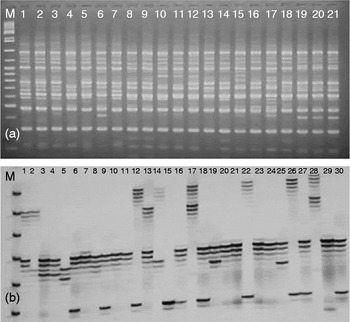
To assure better discrimination and clear molecular identification of the accessions, we carried out ISSR (Fig. 1(a)) and SSR (Fig. 1(b)) marker analyses.
Amplification patterns of several almond trees generated by the (a) inter-single sequence repeat primer HVH(TG)7 and (b) microsatellite (simple sequence repeat) primer combination PS9F8. Note the stutter bands in the amplification of microsatellite slower (larger) alleles. Conversely, the shorter (and faster in the gel) alleles are amplified as a single band.

The 13 ISSR primers used for analysis generated 139 markers, of which 72 (51.8%) were polymorphic. The number of markers per primer varied from a minimum of 8 for the primers (CT)6, (CT)8RG and (GT)8YG to a maximum of 14 for the primer (GA)8A.
One locus was found for each of the four tested microsatellite pairs of primers. The number of alleles was 5 for the locus PS8F8, 10 for the locus PS7A2, 14 for the locus PS9F8 and 16 for the combination of primers of the peach locus UDP-96 005. The microsatellites demonstrated a very strong discriminating power for 92 of the analysed genotypes exhibiting specific and unique molecular marker patterns (data not shown).
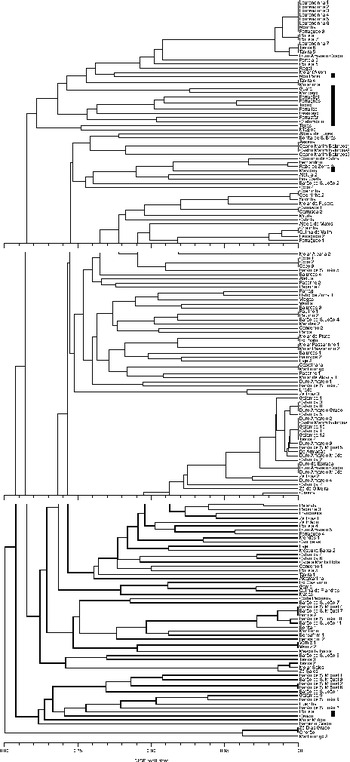
The data obtained using both techniques were joined in a single matrix, and a common dendrogram was constructed, in which the 176 plants were distributed by 140 discriminating molecular patterns (Fig. 2 and see online supplementary Fig. S1).
Genetic relatedness among the Portuguese traditional almond varieties, commercial varieties and genotypes selected in the Algarve region. Dark rectangles indicate the position of commercial varieties in the dendrogram. Note that most of these varieties are assembled in a common major cluster, which provides evidence, by comparison, for the wider genetic diversity of the Algarve almond germplasm.

Multiple cases of homonymy and synonymy were identified, and a large number of plants were not assigned to a specific traditional variety. These results were expected, as the traditional varieties have been interchanged for a long period of time between farmers based on simple oral information with no appropriate registration and multiple new genotypes that originated from chance seedlings are continuously introduced into cultivation.
One of the traditional varieties, Lourencinha, appeared to be the best identified and recognizable phenotypically as six of the seven plants collected under this denomination were apparently the same genotype and genetically very close to the seventh plant. Nevertheless, a genotype referred to as Norinha appeared to be a synonym of Lourencinha. Conversely, another traditional variety Galamba emerged as a genetically close population and not a single clone. Ferragudo was a clear case of homonymy with multiple and very different genotypes having the same denomination.
It is worth noting that except Genco and Marcona, all other commercial varieties analysed in this study, Cristomorto, Desmayo, Ferraduel, Ferragnés, Ferralise, Ferrastar, Guara, Moncayo, Nonpareil, Texas and Tuono, gathered in one and the same major cluster.
In certain cases, some commercial varieties played the role of control in our analyses, the accuracy of which was confirmed by them, as Ferraduel and Ferragnés appear in a subcluster together with their progeny Ferralise, their common parent Cristomorto and Ferrastar, an half-sibling that originated from the cross Cristomorto × Ardechoise.
Except Lourencinha, the other traditional varieties of Algarve and most of the anonymous trees identified in local orchards are more distanced genetically from the major cluster of commercial varieties and represent a repository of genetic variability of eventual interest for future breeding programmes. A good example is Barrinho Grado, which has recently been identified as exhibiting resistance to Phomopsis amygdali (Cabrita et al., Reference Cabrita, Neves and Leitão2004).
Supplementary material
To view supplementary material for this article, please visit http://dx.doi.org/10.1017/S1479262114000471