Introduction
International literature suggests that patients with far-advanced diseases often prefer to receive end-of-life care and die at home (MacArtney et al., Reference MacArtney, Broom and Kirby2016; Woodman et al., Reference Woodman, Baillie and Sivell2016; Wright et al., Reference Wright, Keating and Ayanian2016). The provision of end-of-life care at home is a complex endeavor that would not be possible without the informal caregivers’ support (Nuño-Solinís et al., Reference Nuño-Solinís, Herrera-Molina and Librada-Flores2016). Informal caregivers are laypeople who play a close supportive role to patients, share in their illness experiences, and provide essential instrumental and emotional support for them (Gardiner et al., Reference Gardiner, Brereton and Frey2014). It is believed that the experience of providing end-of-life care at home can be burdensome, and informal caregivers may experience difficulties in maintaining their own health and quality of life (Dalai & Bruera, Reference Dalai and Bruera2017; MacArtney et al., Reference MacArtney, Broom and Kirby2016). For this reason, it is crucial that healthcare professionals explore informal end-of-life caregivers’ experiences on an individual level so that their real health needs are identified and meaningful support is offered (Applebaum, Reference Applebaum2017; Granero-Molina et al., Reference Granero-Molina, Díaz-Cortés and Hernández-Padill2016; Jack et al., Reference Jack, O'Brien and Scrutton2015; Reblin et al. Reference Reblin, Cloyes and Carpenter2015; Reyniers et al., Reference Reyniers, Houttekier and Cohen2014; Robinson et al., Reference Robinson, Bottorff and McFee2017; van der Steen et al., Reference van der Steen, Radbruch and Hertogh2014).
The assessment of informal end-of-life caregivers’ needs and the provision of meaningful support are services offered by healthcare systems that have achieved advanced integration of palliative care within their mainstream service provision (Lynch et al., Reference Lynch, Connor and Clark2013). Unfortunately, this is not the case in many Spanish-speaking countries, where the provision of palliative care is not fully integrated into all levels of care (e.g., Spain, Argentina, Chile) (Lynch et al., Reference Lynch, Connor and Clark2013). In such contexts, informal end-of-life caregivers may have limited access to palliative care services and they are at risk of becoming “invisible” to their healthcare systems (Lynch et al., Reference Lynch, Connor and Clark2013; Veloso & Tripodoro, Reference Veloso and Tripodoro2016). To avoid this, and until full integration of palliative care into all levels of care is achieved in Spanish-speaking countries, it is necessary for all healthcare professionals attending to end-of-life patients (irrespective of their work setting and whether they are palliative care specialists or not) to be able to explore the informal end-of-life caregivers’ experiences so that their needs can be identified and the appropriate support can be provided (Fernández-Sola et al., Reference Fernández-Sol, Cortés and Hernández-Padilla2017). This could be done ad hoc, for example, when informal caregivers accompany the end-of-life patient to hospital admissions or to community-based consultations (Fernández-Sola et al., Reference Fernández-Sol, Cortés and Hernández-Padilla2017; Rocque et al., Reference Rocque, Barnett and Illig2013). However, evidence suggests that healthcare professionals who are nonspecialists in palliative care often lack competence to manage emotionally charged conversations and have limited time available to effectively explore informal end-of-life caregivers’ experiences (Adams et al., Reference Adams, Bailey and Anderson2011; Bloomer et al., Reference Bloomer, Endacott and O'Connor2013; Caswell et al., Reference Caswell, Pollock and Harwood2015; Gagnon & Duggleby, Reference Gagnon and Duggleby2014; Robinson et al., Reference Robinson, Gott and Ingleton2014; Smith et al., Reference Smith, Sudore and Pérez-Stable2009; Willard & Luker, Reference Willard and Luker2006). To overcome such barriers, these healthcare professionals could use standardized and culturally adapted psychometric instruments that would allow them to quickly assess the informal end-of-life caregivers’ experiences without having to have a difficult conversation for which they may not be prepared.
To the best of our knowledge, most of the psychometric instruments that are available to explore informal end-of-life caregivers’ experiences focus on assessing only one particular dimension of end-of-life caregiving such as self-efficacy (Porter et al., Reference Porter, Keefe and Garst2008), burden (Dumont et al., Reference Dumont, Fillion. and Gagnon2008; Higginson et al., Reference Higginson, Gao and Jackson2010), or comfort (Novak et al., Reference Novak, Kolcaba and Steiner2001). Consequently, they would not allow healthcare professionals to easily and quickly explore the experience of informal end-of-life caregivers as a whole using just one questionnaire. In this context, the “Scale for End-of Life Caregiving Appraisal” (EOLCAS) emerges as a useful instrument insofar as it comprehensively assesses the experience of end-of-life caregivers in four domains: physical suffering, caregiving burden, positive caregiving appraisal, and social support pursuit (Lee et al., Reference Lee, Yoo and Kim2010). Using the EOLCAS as a tool to explore informal end-of-life caregivers “experiences would allow healthcare professionals in any type of setting to better understand individuals” subjective responses to potential stressors and identify whether their coping mechanisms actually help them to maintain a healthy biopsychosocial balance (Lee et al., Reference Lee, Yoo and Kim2010). However, only an English version of the EOLCAS (validated amongst a Korean sample) has been published (Lee et al., Reference Lee, Yoo and Kim2010). The translation, cultural adaptation, and validation of its Spanish version would allow healthcare professionals to explore the experience of Spanish-speaking informal end-of-life caregivers worldwide.
The aim of this study was to translate, culturally adapt, and psychometrically evaluate the Spanish version of the EOLCAS (SEOLCAS).
Methods
Study design and participants
An observational cross-sectional design guided this study. The pilot and main study samples were recruited using the same convenience sampling method. Individuals who attended the internal medicine ward in a general southern Spanish hospital between April 2015 and May 2016 were formally invited to participate in the study if they met the following inclusion criteria: (1) ≥18 years old, (2) be the main informal caregiver for a patient with a far-advanced disease, and (3) not suffer any cognitive impairment that could interfere with the understanding and completion of the scale. A total sample of 201 individuals volunteered to participate and their demographics were collected (age, gender, occupation, relation to the patient, household income, level of education completed, and time as main informal caregiver).
Ethical considerations
The institutional Research Ethics Committee granted ethical approval before initiating the data collection (TE_15_34). All individuals fulfilling the eligibility criteria were invited to participate and given a written document with information about the participants’ rights, the study's aim, and the data collection process. Volunteer participants signed an informed consent form before participating. The collected data were treated according to the current European legislation on data protection (Directive 95/46/EC, 1995).
Translation, cultural adaptation, and pilot study of the SEOLCAS’ initial version
The English-to-Spanish translation of the EOLCAS was performed following a forward-backward procedure (Koller et al., Reference Koller, Aaronson and Blazeby2007). Two independent bilingual experts (native Spanish, proficient in English) individually undertook an English-to-Spanish translation of the EOLCAS. Minor differences between both translators’ versions were easily reconciled and a common initial Spanish version of the EOLCAS (i-SEOLCAS) was created. An independent bilingual translator (native English, proficient in Spanish) undertook a blind back-translation of the i-SEOLCAS (Koller et al., Reference Koller, Aaronson and Blazeby2007). Before initiating the pilot study, the researchers and a panel of five independent bilingual experts reviewed the English version of the original EOLCAS, the i-SEOLCAS and the blind back-translation. It was unanimously agreed that the i-SEOLCAS fully respected the semantic and conceptual meanings of the original EOLCAS.
The i-SEOLCAS was critically revised by a panel of 15 independent experts in palliative care from six different institutions and was tested among a sample of 51 participants who only participated in the pilot study. The experts were asked to score each item as 1 = not relevant, 2 = somewhat relevant, 3 = quite relevant, or 4 = highly relevant for evaluating the experience of informal end-of-life caregivers. Each item's content validity index (I-CVI) was calculated by adding the number of experts who rated each item as either quite relevant or highly relevant and dividing it by the total number of experts in the panel (Polit & Beck, Reference Polit and Beck2006). An I-CVI ≥ 0.78 is considered acceptable when evaluated by 15 experts (Delgado-Rico et al., Reference Delgado-Rico, Carretero-Dios and Willibald2012; Polit & Beck, Reference Polit and Beck2006); the items with an I-CVI < 0.78 were removed from the i-SEOLCAS before piloting it.
To examine the i-SEOLCAS’ reliability and temporal stability, the 51 participants composing the pilot sample completed the scale on two different occasions separated by a 4-week interval. After assessing and corroborating that the variable followed a normal distribution, temporal stability of the i-SEOLCAS was examined by calculating Pearson's correlation coefficient (r) for the test-retest results. The i-SEOLCAS’ reliability was assessed using the following three estimators: (1) the scale's Cronbach's coefficient alpha (α), (2) the items’ corrected item-total correlation (C-ITC), and (3) the estimated α of the tool if a particular item was removed. Items were retained as part of the i-SEOLCAS if (1) the instrument's α did not increase after removing that item and (2) the items’ C-ITC > 0.3.
To explore the i-SEOLCAS’ readability, understandability, and cultural appropriateness, the experts and the participants were requested to provide feedback on whether they had any difficulties when reading or completing the scale. They were also encouraged to add any other items that could contribute to better exploring the experience of informal end-of-life caregivers.
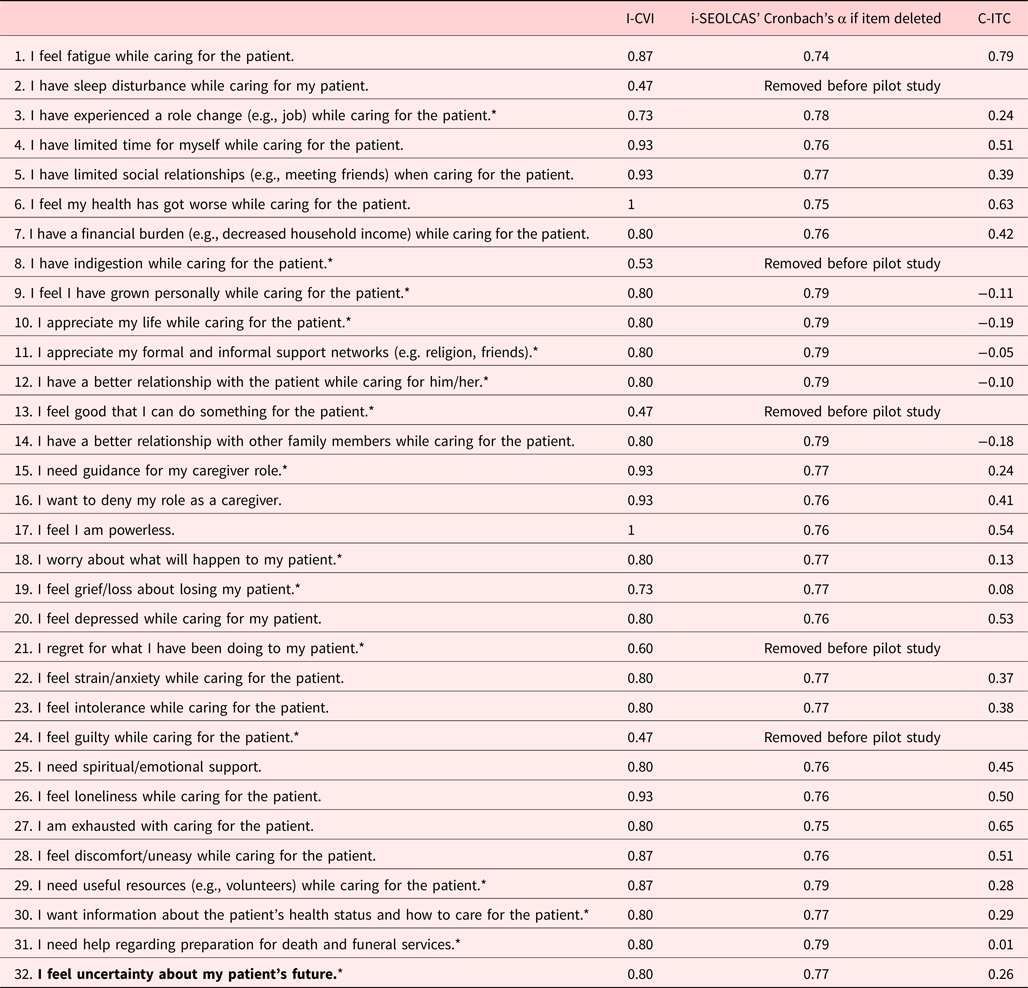
The results of the content validity and reliability analysis are presented in Table 1. Before administering the tool to the pilot sample, items 2, 8, 13, 21, and 24 were removed from the i-SEOLCAS because the experts considered they were redundant and agreed that they were not relevant in measuring the experience of informal end-of-life caregivers in the context of the study (all I-CVI < 0.78). Then, the 27-item pilot version of the SEOLCAS was tested among the pilot sample (N = 51) and although it evidenced an excellent temporal stability (r = 0.87; p < 0.001), its internal consistency was not sufficiently strong (α = 0.76). As Table 1 shows, items 3, 9–15, 18, 19, and 29–32 did not meet the criteria to remain part of the SEOLCAS. Furthermore, all of these items received negative comments about their appropriateness to measure the experience of providing informal end-of-life care from both the experts and participants. Therefore, they were all removed from the already-piloted SEOLCAS version. After this, the 14-item SEOLCAS evidenced an α = 0.91 and all its items’ C-ITC > 0.3. Last, neither the experts nor the participants in the pilot study reported any issues reading or understanding the SEOLCAS and did not recommend adding any items. Consequently, no changes in the scale were needed.
Results of the content validity and internal consistency analysis of the i-SEOLCAS.

C-ITC = Corrected Item-total Correlation; I-CVI, Item Content Validity Index; SEOLCAS, Scale for End-of Life Caregiving Appraisal.
*Item did not meet the criteria to be retained as part of the SEOLCAS.
Data analysis and psychometric evaluation of the SEOLCAS
The already-piloted 14-item version of the SEOLCAS (see Appendix 1) was administered to the main sample (N = 150) and psychometrically tested following other authors’ recommendations and guidelines (Coaley, Reference Coaley2014; Delgado-Rico et al., Reference Delgado-Rico, Carretero-Dios and Willibald2012; Hernández-Padilla et al., Reference Hernández-Padilla, Granero-Molina and Márquez-Hernández2016; Reference Hernández-Padilla, Granero-Molina and Márquez-Hernández2017; Polit & Beck, Reference Polit and Beck2006). An independent statistician was consulted for advice on the data analysis strategy and IBM® SPSS® v.21 was used to perform the statistical analysis. The normality graphs (histograms and Q-Q plots), the Shapiro-Wilk test, and the skewness and kurtosis z-values demonstrated that the observed variables were normally distributed. Linear regression analysis and exploratory factor analysis (EFA) were performed (see the following section for more details).
The grade level and overall readability of the SEOLCAS was evaluated using the Flesch-Kincaid tool in Microsoft Word® 2011. The scale's understandability was assessed by asking the participants to provide feedback about the difficulties they might have encountered when completing the SEOLCAS. The completion time for the SEOLCAS was also recorded.
The methodology that guided the evaluation of the SEOLCAS’ reliability and content validity has already been described in the section “Translation, cultural adaptation, and pilot study of the SEOLCAS’ initial version.” Additionally, the scale's content validity index (S-CVI/Ave) was calculated and a result higher than 0.78 was interpreted as evidence of the SEOLCAS’ ability to operationalize the experience of informal end-of-life caregivers as a measurable construct (Coaley, Reference Coaley2014; Delgado-Rico et al., Reference Delgado-Rico, Carretero-Dios and Willibald2012; Polit & Beck, Reference Polit and Beck2006). The SEOLCAS’ criterion validity was explored through the assessment of its predictive validity. To do so, the SEOLCAS’ ability to predict the participants’ caregiving burden was explored performing a linear regression analysis. The Zarit Burden Interview (ZBI) was used to measure participants’ caregiving burden (Gort et al., Reference Gort, March and Gómez2005). Preliminary analyses were performed to ensure that there was no violation of assumption of normality and linearity. For the evaluation of the SEOLCAS’ construct validity, an EFA using principal axis factoring (PAF) was undertaken. First, the pertinence of carrying out EFA was tested by performing Bartlett's test of sphericity and Kaiser-Meyer-Olkin measure of sampling adequacy. Then, a PAF with Varimax rotation was performed. Items were kept in a factor if they had a factor-loading value ≥0.45 (Tabachnick & Fidell, Reference Tabachnick and Fidell2013). Factors were considered a structural part of the SEOLCAS if they met the following criteria: to have an eigenvalue ≥1 and to have a clear break in eigenvalues in the scree plot (Tabachnick & Fidell, Reference Tabachnick and Fidell2013).
Scoring and interpretation system for the SEOLCAS
To facilitate the interpretation of the individuals’ results on the SEOLCAS, an internal scoring system was developed. First, the sample's mean score and its SD were calculated. Then, the following three scoring categories were developed: (1) scores >1 SD below the mean, (2) scores ≤ 1 SD below or above the mean, and (3) scores >1 SD above the mean (Van de Broeck & Brestoff, Reference Van den Broeck and Brestoff2013).
Results
Description of the main sample
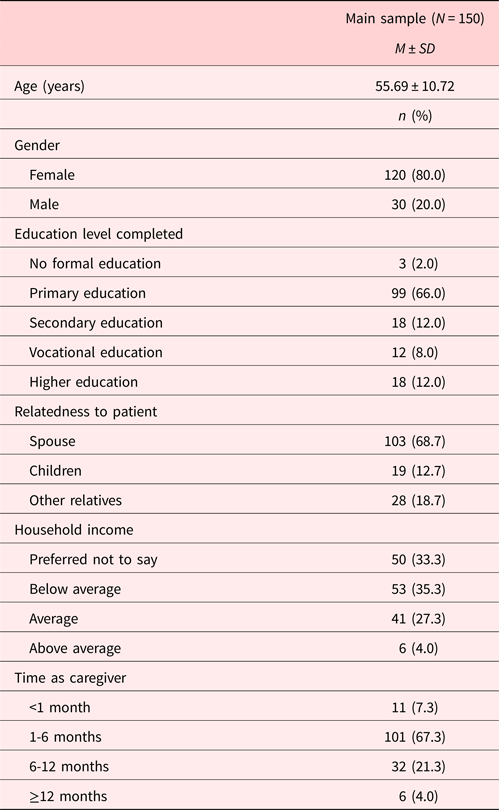
Table 2 shows the main sample's demographics in detail. Participants’ mean age was 55.69 years (SD = 10.72; range = 20–79) and 80% of the sample was female. The mean “time being the main informal caregiver” for the patient was 5.42 months (SD = 4.86; range = 0.50–38).
Demographic characteristics of main sample

Psychometric properties of the SEOLCAS
The reading level of the SEOLCAS equates to fifth grade. None of the participants reported any difficulties when reading and completing the SEOLCAS. Moreover, the mean time of completion for the scale was <13 minutes (range = 5–20 minutes).
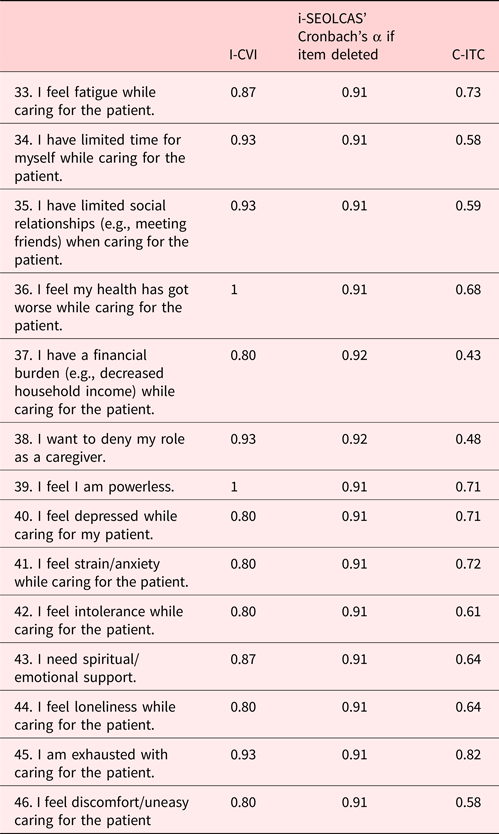
The results for the SEOLCAS’ internal consistency analysis are presented in Table 3. In summary, the SEOLCAS Cronbach α was 0.92, and this would not have increased after removing any of the items. The C-ITC for the 14 items ranged between 0.43 and 0.82.
Results of the content validity and internal consistency analysis of the SEOLCAS

C-ITC = Corrected Item-total Correlation; I-CVI, Item Content Validity Index; SEOLCAS, Scale for End-of Life Caregiving Appraisal.
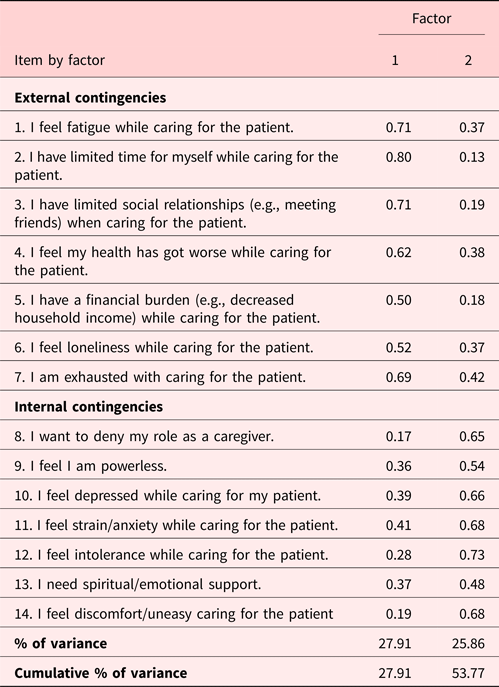
Content validity analysis showed that the I-CVI for the 14 items composing the SEOLCAS ranged from 0.80 to 1 (Table 3) and the S-CVI/Ave = 0.88. Predictive validity analysis showed a significant regression equation (F(1,148) = 567.69; p < 0.001) in which the participants’ scores on the SEOLCAS explained 79.3% of the between-subject variation of their results on the ZBI. Participants’ score on the ZBI is equal to 4.32 ± 0.58 points when their scores on the SEOLCAS are also measured in points. Participants’ scores on the ZBI increased by 0.58 points for each point they obtained on the SEOLCAS. Construct validity analysis results are as follows: Barlett's test of sphericity (chi-square = 1164.51; p < 0.001) and Kaiser-Meyer-Olkin measure of sampling adequacy (0.91) showed that it was appropriate to conduct an EFA. Table 4 summarizes the results of the PAF on the 14-item SEOLCAS. Two factors presented eigenvalues ≥1, a clear representation on the plot of eigenvalues, and all items with a factor-loading coefficient ≥0.45. These two factors accounted for 53.77% of the total variance found and contributed to measuring the extent to which either external contingencies (factor 1) or internal contingencies (factor 2) affect the informal end-of-life caregiver's experience in Hispanic culture (Table 4).
Factor loadings and total variance explained from the rotated factor structure of the SEOLCAS (N = 150)

SEOLCAS, Scale for End-of Life Caregiving Appraisal.
Scoring and interpretation system for the SEOLCAS
The scoring system developed allows for the interpretation of the participants’ results on the total SEOLCAS and its two subscales. First, the mean score on the total SEOLCAS was 28.99 and the SD was ±11.09. Consequently, the following three scoring categories were created for the interpretation of the participants’ results on the total SEOLCAS: low impact = 0–17 points (scores >1 SD below the mean); moderate impact = 18–40 points (scores ≤ 1 SD below or above the mean); and high impact = 41–56 points (scores >1 SD above the mean). Second, the mean score on the external contingencies subscale was 16.80 and the SD was ±5.98. Therefore, the following three scoring categories were created for the interpretation of the participants’ results on the external contingencies subscale: low impact = 0–10 points (scores >1 SD below the mean); moderate impact = 11–23 points (scores ≤ 1 SD below or above the mean); and high impact = 24–28 points (scores >1 SD above the mean). Third, the mean score on the internal contingencies subscale was 12.19 and the SD was ±6.08. Accordingly, the following three scoring categories were created for the interpretation of the participants’ results on the internal contingencies subscale: low impact = 0–5 points (scores >1 SD below the mean); moderate impact = 6–18 points (scores ≤ 1 SD below or above the mean); and high impact = 19–28 points (scores >1 SD above the mean).
Discussion
Many Spanish-speaking countries have not achieved an advanced level of integration of palliative care into their mainstream service provision and informal end-of-life caregivers are at risk of becoming invisible to healthcare systems (Lynch et al., Reference Lynch, Connor and Clark2013). For this reason, and regardless of their speciality, level of expertise, and work setting, all healthcare professionals in such contexts should use the encounters with end-of-life patients to also explore informal end-of-life caregivers’ experiences and discover their specific health needs (Fernández-Sola et al., Reference Fernández-Sol, Cortés and Hernández-Padilla2017; Rocque et al., Reference Rocque, Barnett and Illig2013). However, healthcare professionals’ ability to explore informal end-of-life caregivers’ experiences may be hampered by their lack of competence to conduct difficult conversations and/or their limited time availability (Adams et al., Reference Adams, Bailey and Anderson2011; Bloomer et al., Reference Bloomer, Endacott and O'Connor2013; Caswell et al., Reference Caswell, Pollock and Harwood2015; Gagnon & Duggleby, Reference Gagnon and Duggleby2014; Robinson et al., Reference Robinson, Gott and Ingleton2014; Smith et al., Reference Smith, Sudore and Pérez-Stable2009; Willard & Luker, Reference Willard and Luker2006). The use of valid and culturally adapted psychometric instruments could help healthcare professionals with little or no knowledge of palliative care not only to overcome the aforementioned barriers, but also to easily highlight those in need of extra support. This study aimed to translate, culturally adapt, and psychometrically evaluate the Spanish version of the only already published tool that assesses the experience of informal end-of-life caregivers as a whole: the SEOLCAS (Lee et al., Reference Lee, Yoo and Kim2010).
The psychometric analysis of the SEOLCAS focused on examining its ability to measure the construct informal end-of-life caregiving experience (validity), its ability to accurately measure this construct (reliability), and its usability and cultural relevance (Coaley, Reference Coaley2014; Furr, Reference Furr2014).
To explore the SEOLCAS’ ability to measure the construct informal end-of-life caregiving experience, its content, criterion, and construct validity were assessed. Regarding the instrument's content validity, the results from the review performed by the expert panel suggest that all the items included in the final 14-item version of the SEOLCAS contribute to operationalize “informal end-of-life caregiving experience” as a measurable construct (Coaley, Reference Coaley2014; Furr, Reference Furr2014; Hernández-Padilla et al., Reference Hernández-Padilla, Granero-Molina and Márquez-Hernández2016, Reference Hernández-Padilla, Granero-Molina and Márquez-Hernández2017). In terms of criterion validity, results have shown that the SEOLCAS can predict the informal end-of-life caregivers’ burden. This can be seen as evidence of the SEOLCAS’ ability to provide valid information about the experience of informal end-of-life caregivers (Coaley, Reference Coaley2014; Furr, Reference Furr2014). Construct validity analysis has clearly shown that the SEOLCAS comprises two factors that represent different dimensions in the experience of Hispanic informal end-of-life caregivers. All of these results provide evidence the SEOLCAS’ ability to provide valid and specific information about the individual experiences of Hispanic informal end-of-life caregivers (Coaley, Reference Coaley2014; Furr, Reference Furr2014; Hernández-Padilla et al., Reference Hernández-Padilla, Granero-Molina and Márquez-Hernández2016, Reference Hernández-Padilla, Granero-Molina and Márquez-Hernández2017). Complementing these psychometric properties, the SEOLCAS’ internal consistency and its pilot version's temporal stability can be interpreted as strong indicators of the instrument's ability to measure this construct reliably (Coaley, Reference Coaley2014; Furr, Reference Furr2014). Having a valid and reliable tool like the SEOLCAS would allow healthcare professionals to effectively explore the experiences and understand the needs of informal end-of-life caregivers without having to engage in emotionally charged conversations that they may find difficult to manage (Caswell et al., Reference Caswell, Pollock and Harwood2015; Robinson et al., Reference Robinson, Gott and Ingleton2014; Willard & Luker, Reference Willard and Luker2006). Additionally, evidence has shown that the SEOLCAS is very easy to understand and quick to complete; hence, it can be considered not only a valid and reliable instrument, but also a usable one. Having an easily applicable tool like the SEOLCAS would help healthcare professionals overcome a potential lack of time to explore the informal caregivers’ experiences.
Whereas the original EOLCAS comprised 32 items and four dimensions that comprehensively assessed the experience of informal end-of-life caregivers as a whole (Lee et al., Reference Lee, Yoo and Kim2010), the SEOLCAS only comprises14 items and two dimensions that mainly assess the impact of the experience on Hispanic informal end-of-life caregivers’ lives. The result of this transformation could be explained by the well-documented influence of the stoic tradition on Hispanic culture (Benavente, Reference Benavente2013; de Ros & Omlor, Reference de Ros and Omlor2017). In the stoic tradition, passions and emotions must be mitigated and life experiences are confronted with serenity (Nussbaum, Reference Nussbaum2009). This could explain why many items of the original EOLCAS did not meet the criteria to be retained in the SEOLCAS. First, the experts considered that some items represented feelings that are very rarely associated with the experience of providing end-of-life care to a relative within Hispanic culture (see items 13, 21, and 24 in Table 1). Consequently, these items were removed from the questionnaire before its pilot study. Then, the participants’ responses in the pilot study led to poor correlation between several items and the rest of the scale (see items 3, 9–12, 14, and 29–32 in Table 1). These results could reflect the stoic attitude toward adversity that is often attributed to Hispanic culture (Im et al., Reference Im, Guevara and Chee2007; Scherz, Reference Scherz2017; Smith et al., Reference Smith, Sudore and Pérez-Stable2009). Our participants were mostly middle-aged women who might accept their caregiver role as a moral obligation and not as a source of personal reward or extreme suffering (Scherz, Reference Scherz2017). The stoic tradition holds that virtue is in itself sufficient for happiness; it is only by rejecting what is external to the person (“external contingencies”) and by cultivating reason as the ability to achieve appropriate judgements of our impressions (“internal contingencies”) that virtue and therefore happiness can be attained (Becker, Reference Becker2003; Løkke, Reference Løkke2015; Nussbaum, Reference Nussbaum2009). This philosophical construct is clearly reflected in the two factors that emerged from the SEOLCAS. The external contingencies dimension includes all the items reflecting the aspects of the caregiving experience that are external to one's virtue (e.g., money, friendship, physical health, social relationships). The internal contingencies dimension includes all the aspects of the caregiving experience that are internal to the individual and therefore fully dependent on his or her ability to achieve appropriate judgments of his or her impressions (e.g., ability not to feel powerless, strained, anxious). Consequently, the SEOLCAS has the ability to not only measure the impact that providing end-of-life care has on Hispanic informal caregivers, but also to differentiate between the type of support that they may need depending on their scores. For example, information gathered from the dimension external contingencies will indicate whether instrumental support may be needed and it can orientate the decisions or interventions that must be taken to offer the instrumental support an individual needs (Rini et al., Reference Rini, Emmerling and Austin2015). Equally, the information gathered from the dimension internal contingencies will indicate whether emotional support may be needed and it can orientate the decisions or interventions that must be taken to provide it (Rini et al., Reference Rini, Emmerling and Austin2015).
Although the SEOLCAS has shown robust psychometric properties, some limitations must be highlighted. First, having used a convenience sampling method limits the generalization of the study's results. All participants were Spanish caregivers recruited from a single institution. This means that those willing to use the SEOLCAS amongst samples with radically different characteristics may need to undertake a validation study beforehand. Second, because of organizational constraints, the temporal stability of the SEOLCAS was examined in its pilot version only. It is important that future research tests the SEOLCAS’ temporal stability using a larger sample of participants. Third, the cultural adaptation and validation processes of the SEOLCAS have led to having an instrument with a narrower focus than the original one. Although the SEOLCAS can confidently assess the impact that providing end-of-life care has on Hispanic informal caregivers and can differentiate between whether instrumental or emotional support may be needed, it is unclear as to whether its items and dimensions will suffice to understand how Hispanic informal end-of-life caregivers experience the phenomenon as a whole. Last, it is important to consider that our sample was predominantly middle-aged females; this may have impacted our results.
Conclusions
Although the SEOLCAS has a narrower focus than the original EOLCAS, its relevance remains unaffected. Following a rigorous validation test, the SEOLCAS has evidenced very good psychometric properties. The SEOLCAS has proven to be an easily applicable, valid, reliable, and culturally appropriate instrument that can be used to explore the impact that the experience of providing end-of-life care has on Hispanic informal end-of-life caregivers. The SEOLCAS can enable healthcare professionals with little or no knowledge of palliative care to effectively explore the informal end-of-life caregivers’ experiences regardless of their level of competence to manage emotionally charged conversations or their time availability. All of this could contribute to discovering what the needs of Hispanic informal end-of-life caregivers may be so that appropriate support can be offered. We actively encourage healthcare professionals to use this tool in their clinical context (whichever this may be). This could be done ad hoc, for example, when informal caregivers accompany the end-of-life patient to hospital admissions or to community-based consultations. Furthermore, we also encourage healthcare professionals to develop specific local protocols that allow them to make appropriate decisions about the type of referrals and/or interventions that caregivers may need on the basis of their results on the SEOLCAS.
Supplementary material
The supplementary material for this article can be found at https://doi.org/10.1017/S1478951518000470.
Acknowledgments
This research was supported by the Ministry of Economy and Competiveness, Government of Spain (FFI2016-76927-P). The authors thank all the informal caregivers who voluntarily participated in this study and the authors of the original EOLCAS for giving us permission to use their tool.