Stress ulcers in the upper gastrointestinal tract may develop in critically ill patients requiring mechanical ventilation. Approximately 10%–25% of stress ulcers manifest as gastrointestinal bleeding,Reference Ali and Harty1 which is associated with increased mortality and extended length of hospital stay.Reference Ali and Harty1–Reference Cook, Griffith and Walter3
Acid suppressants (ie, proton pump inhibitors (PPIs), histamine-2-receptor antagonists (H2RAs), and sucralfate) are commonly prescribed as stress ulcer prophylaxis to prevent gastrointestinal bleeding and its associated risks.Reference Daley, Rebuck and Welage4, 5 Most clinical trials have demonstrated that these agents, particularly PPIs and H2RAs, are effective at lowering the rate of gastrointestinal bleeding in critically ill patients compared to no prophylaxis or placebo.Reference Cook, Reeve and Guyatt6–Reference Barbateskovic, Marker and Granholm13 However, there is increasing concern about the adverse effects of these agents on risk for ventilator-associated pneumonia and Clostridioides difficile infection.Reference MacLaren, Reynolds and Allen14–Reference Tleyjeh, Abdulhak and Riaz22
Multiple randomized clinical trials and large observational studies have compared different suppressants, but findings have been contradictory and thus inconclusive.Reference Barkun, Bardou and Pham9–Reference Tleyjeh, Abdulhak and Riaz22 In addition, it remains unclear whether and how well the selective enrollment of randomized trials generalizes to broader study populations encountered in routine practice. Most previous studies have focused on the effects of initiating different agents without taking into account whether these agents were continued, changed, stopped, or combined with other acid suppressants. Finally, most prior studies have used clinical definitions for pneumonia that are subjective and vary in their associations with adverse outcomes rather than using ventilator-associated events, the Centers for Disease Control and Prevention (CDC) current surveillance standard for ventilated populations. These deficits in the current literature suggest the potential value of analyzing real-world observational data using state-of-the-art adjustment methods to account for time-fixed and time-varying confounding.
The few trials and observational studies that have considered effects of continuous use of different acid suppressants have either not adjusted for or have not appropriately adjusted for time-varying confounders, defined as evolving prognostic factors for adverse events that change over time and also affect decisions to change, stop or add a treatment.Reference Krag, Marker and Perner12, Reference Howell, Novack and Grgurich21 An example of a time-varying confounder is steroid use (or gastrointestinal bleeding) because it can be started at any time during the course of mechanical ventilation, it affects the decision on which acid suppressants to use and at what dose and duration, and it may be associated with risk for pneumonia and/or death.
When estimating effects of continuous treatment with different classes, failing to adjust for time-varying confounders results in biased effect estimates. However, adjusting for time-varying confounders by including them as covariates in a standard outcome regression may also generate biased effect estimates when time-varying confounders are themselves affected by past treatment decisions.Reference Robins23–Reference Greenland25 For example, steroid use (or gastrointestinal bleeding) is also, itself, affected by past acid suppressant decisions during the same ventilation period. There is growing recognition in the literature that alternative analytic approaches must be used for such cases.Reference Mansournia, Etminan, Danaei, Kaufman and Collins26, Reference Lederer, Bell and Branson27
In this study, we aimed to evaluate the effect of continuous daily treatment with different acid suppressants on risk of ventilator-associated events in a cohort of mechanically ventilated critically ill patients. We used the parametric g formula, an approach to estimating effects of time-varying treatment strategies in observational data with time-varying confounders like steroid use and gastrointestinal bleeding that may be affected by past treatment.Reference Robins23, Reference Young, Cain and Robins28
Methods
Study population
We identified a retrospective cohort of critically ill patients aged ≥18 years who underwent mechanical ventilation through an endotracheal tube or tracheostomy during an inpatient admission in Brigham and Women’s Hospital (Boston, MA) between January 1, 2006, and December 31, 2014. If a patient had multiple eligible ventilation episodes or hospital admissions within the study period, the first eligible episode during the first eligible admission was chosen. Patients were excluded if the ventilation episode lasted ≤3 days or they developed possible ventilator-associated pneumonia (PVAP) or an infection-related ventilator-associated complication (IVAC) on day 3 of ventilation. Data were obtained from the hospital’s electronic medication administration records (for daily medication information) and the Research Patient Data Registry, which gathers comprehensive clinical information recorded routinely during clinical care, including demographic characteristics, encounters, intensive care unit (ICU) type, laboratory test results, diagnosis codes, procedure codes, and discharge information. This study was approved by the Partners Healthcare and Harvard Pilgrim Health Care Institute Institutional Review Boards with a waiver of individual patient consent.
Exposure
We identified the class of acid suppressant (ie, H2RAs, PPIs, and sucralfate) each patient received each day, if any, using the electronic medication administration records. For patients receiving a PPI, we further categorized daily dosage into high- and low-doses, with high-dose defined as ≥40 mg pantoprazole or omeprazole for all administration routes. We defined the index date as day 3 of ventilation because ventilator-associated events, by definition, cannot occur prior to this time.
Outcomes
We identified IVAC and PVAP electronically using CDC definitions.29, Reference Magill, Klompas and Balk30 Ventilator mortality data were acquired from the hospital’s vital statistics records.
Clostridioides difficile infection was diagnosed using enzyme immunoassays or polymerase chain reaction assay. Clinically significant upper gastrointestinal bleeding was defined as a bleeding event that required endoscopy or transfusion on the same day. Due to observed low incidence, only descriptive statistics are presented for these 2 outcomes during the 30-day follow-up. Also, a composite gastrointestinal-related event indicator including gastrointestinal bleeding was considered a time-varying confounder in analyses for other outcomes (discussed in the following section). As discussed previously, all outcomes were defined relative only to the first eligible ventilator episode.
We followed patients beginning the day after the index date through occurrence of a study outcome, 30 days following the index date, the end of the study period (December 31, 2014) or a competing event, whichever occurred first. By definition, a competing event is an event that precludes later occurrence of the outcome of interest.Reference Geskus31 Because all outcomes refer only to the first eligible ventilator episode, ventilator mortality and extubation alive are competing events for IVAC and PVAP (eg, once a patient dies during the current episode, he cannot later experience IVAC during that episode). Similarly, extubation alive and ventilator mortality are mutually competing events (eg, once a patient is extubated alive during the current episode, he cannot later die during that episode and vice versa).
Utilization of acid suppressants for stress ulcer prophylaxis
In the full cohort, we calculated the proportion of patients who used each acid suppressant class on the index date. Patients who used ≥2 classes or the same class with different dosage intensities were classified as combination therapy users. We described the baseline characteristics of patients across treatment groups and visually assessed their tendency of staying on the same class during follow-up through graphical representations of their treatment trajectories and cumulative probabilities of staying on their initial class throughout follow-up.
Comparative safety of daily stress-ulcer prophylaxis treatment strategies
Treatment effects of interest
The treatment effects of interest compare the 30-day risks of each outcome during the first eligible ventilator episode associated with different daily treatment strategies during that episode. We modeled what would have happened if all patients were treated with only a single class of acid suppressant from the index date until their end of follow-up. For example, under the daily H2RA strategy, all patients would be treated with only a H2RA on every day of ventilation during follow-up. We then modeled potential treatment strategies and compare outcomes between strategies. The strategies considered were (1) daily PPI, (2) daily low-dose PPI, (3) daily high-dose PPI, and (4) daily H2RA, which was used as the reference strategy for risk ratios (RRs). We did not consider daily sucralfate or “never treat with any acid suppressant” because very few patients received sucralfate or no treatment on the index date. These patients may be particularly different from other patients in terms of unmeasured outcome risk factors, which would have increased the potential for residual confounding.
Statistical analysis
We constructed a subcohort that excluded patients initiating sucralfate, combinations of different agents, or no agent (Fig. 1). We also excluded patients with insufficient information to calculate the predicted mortality risk on the first day of ventilation.
Flow chart showing how patients were selected into the final cohort for utilization analysis and the subcohort for comparative safety analysis.

Using this subcohort, we estimated the 30-day risks of each outcome under the specified daily treatment strategies with the parametric g-formula,Reference Robins23, Reference Young, Cain and Robins28 an approach that has been previously applied to estimate effects of time-varying strategies in HIV-infected cohorts,Reference Lodi, Phillips and Logan32 end-stage renal disease patients,Reference Zhang, Young, Thamer and Hernan33 and other longitudinal studiesReference Taubman, Robins, Mittleman and Hernán34 subject to time-varying confounding. The parametric g-formula aims to estimate population-level effects, averaged with respect to baseline and time-varying confounders using observational data, rather than conditioning on them, as in standard regression. As with any observational method, we relied on the assumptions of no residual confounding, no measurement error, and no model misspecification.
Because of the presence of competing events, we estimated the 30-day cause-specific cumulative incidence function for each outcome, a measure of outcome risk that depends on the time-varying hazards of both the outcome of interest and the competing events.Reference Geskus31 Details of the estimation procedure can be found elsewhereReference Young, Cain and Robins28 as well as in the Supplemental Material (online), where SAS programming codes are provided.
Briefly, this procedure has 2 steps. First, parametric regression models are fit to estimate the probability density functions of the time-varying variables (ie, hazards of the outcome and competing events, time-varying confounders) conditional on previous treatment and covariate history. Second, a Monte Carlo simulation is conducted using these estimates to simulate the distribution of the postindex date outcomes and time-varying covariates (including competing events) separately but with the simulated treatment value at each time replaced with the value required under the specific strategy. The RRs relative to daily H2RA were computed as ratios in estimated risks, estimated by the proportion experiencing the outcome by 30 days in the simulated data. We used a nonparametric bootstrap procedure with 500 resamples to obtain percentile-based 95% confidence intervals (95% CIs). Although this approach involves a simulation, this simulation was implemented using models estimated from the longitudinal daily data measured in the cohort.
For the first step, we fit logistic regression models for time-varying indicators of each outcome and its competing events. All regression models included the following covariates: follow-up day; the cumulative average values for time-varying confounders, that is, indicators of gastrointestinal-related conditions (ie, clinically and nonclinically significant gastrointestinal bleeding, esophagitis, esophageal ulcer, gastric ulcer, peptic ulcer, duodenal ulcer, gastrojejunal ulcer, gastritis, duodenitis without bleeding, or upper endoscopy), steroids (prednisone, methylprednisolone, dexamethasone), vasopressors, sedatives (benzodiazepine, dexmedetomidine, propofol), and neuromuscular blockers (cisatracurium); and the baseline confounders (ie, age, race, sex, predicted mortality risk on ventilation day 1 as a marker for their illness severity using a prediction model developed specifically for patients undergoing mechanical ventilation,Reference van Mourik, Moons and Murphy35 upper gastrointestinal bleed, ICU type, alcohol abuse, blood-loss anemia, liver disease, lymphoma, metastatic cancer, solid tumor without metastasis, and medication use). Additional time-varying confounders were included in the models for ventilator mortality and extubation alive: minimal platelets, minimal hematocrit, and IVAC; additional baseline confounders: myocardial infarction, congestive heart disease, peripheral vascular disease, cerebrovascular disease, diabetes, mild liver disease, moderate to severe liver disease, renal disease, and rheumatologic disease. These comorbid conditions were derived from the Elixhauser comorbidity algorithm using data from the index hospitalization.Reference Elixhauser, Steiner and Harris36 All analyses were performed using the SAS software (SAS Institute, Cary, NC) with the GFORMULA version 3.0 macro (https://www.hsph.harvard.edu/causal/software/).
Results
Utilization of acid suppressants for stress prophylaxis
The full cohort included 6,133 critically ill patients undergoing mechanical ventilation for ≥3 days between 2006 and 2014 (Fig. 1). Supplemental Table 1 (online) summarizes the patients’ baseline characteristics: 58.7% were male, 8.6% were African American, and their mean age was 60.6 years (SD, 16.4). More than half of the patients were in the medical ICU (27.8%) or general surgical ICU (23.5%), with approximately one-third in the neuroscience or coronary care ICU.
On the index date, 3,606 (58.8%) patients received H2RAs, 1,603 (26.1%) received PPIs, 254 (4.1%) received sucralfate, 308 (5.0%) received no acid suppressant, and 362 (5.9%) received a combination of high- or low-dose PPIs, H2RAs, or sucralfate. Compared to patients using H2RAs, PPI recipients were older, more likely to receive care in the medical, coronary care, and cardiac surgery ICU, had higher predicted mortality risk on ventilation day 1 (0.33 [SD, 0.22] vs 0.24 [SD, 0.20]), and were more likely to have chronic heart failure, coagulation deficiency, and renal failure (Supplemental Table 1 online).
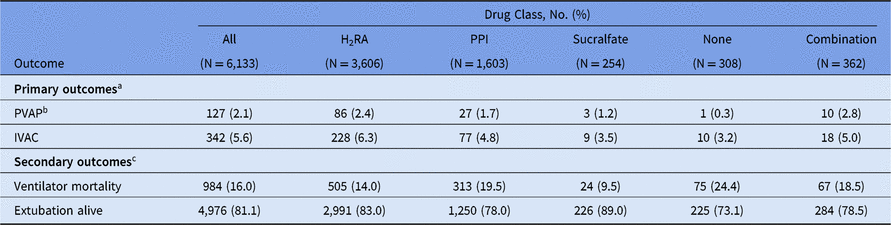
During the 30-day follow-up, 127 patients included in this study experienced a PVAP, 342 experienced an IVAC, 984 died during this ventilation episode, and 4,976 extubated alive (Table 1). Only 17 patients had clinically significant gastrointestinal bleeding. Reliable microbiology laboratory data detailing Clostridioides difficile infection were only available for 3,852 patients admitted between 2009 and 2014, of whom only 22 had a Clostridioides difficile infection.
Outcomes During the 30-Day Follow-Up for 6,133 Patients Who Underwent Mechanical Ventilation for 3 Days or Longer, 2006–2014

Note. H2RA, histamine-2-receptor antagonist; PPI, proton pump inhibitor; IVAC, infection-related ventilator-associated complication; PVAP, possible ventilator-associated pneumonia.
a For primary ventilator-associated outcomes, PVAP and IVAC, ventilator mortality and extubation alive are competing risks.
b PVAP is a subset of the IVAC outcome.
c For secondary outcome, ventilator mortality and extubation alive are each other’s competing risks.
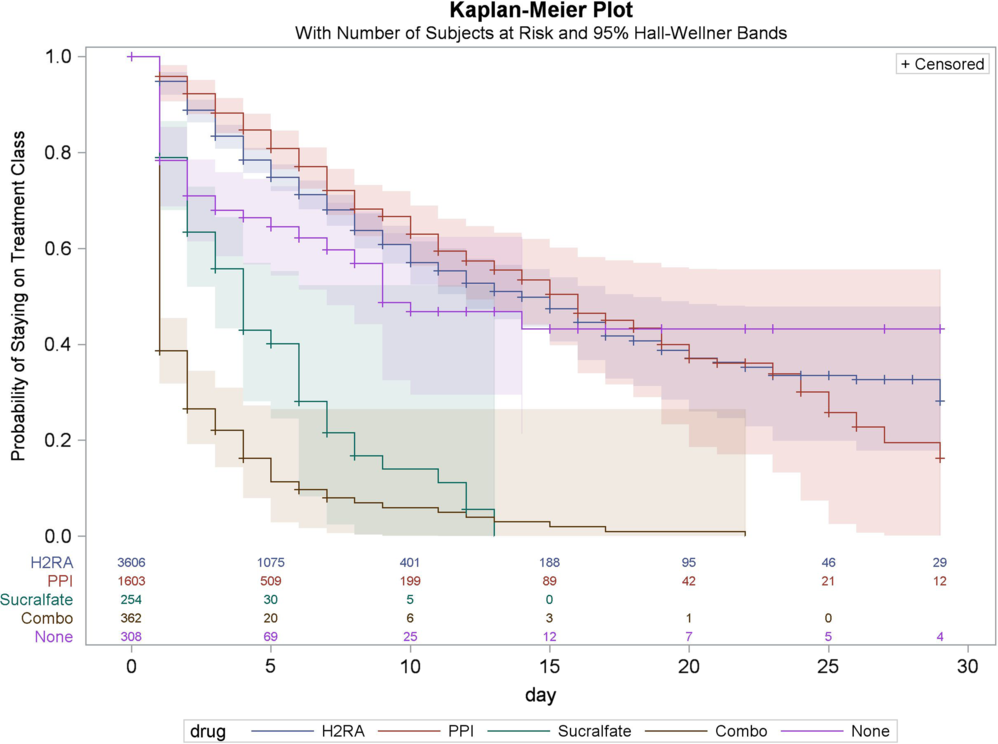
Treatment trajectories of patients in Supplemental Figure 1 (online) show that patient treatment frequently changed during follow-up. Patients who received PPIs or H2RAs on the index date were more likely to stay on therapy than those receiving sucralfate, combinations of different agents, or no agent. The median days to treatment class change was 16 days for those receiving PPIs, 14 days for those receiving H2RAs, 4 days for those receiving sucralfate, 1 day for those receiving a combination of these agents, and 9 days for those receiving no agent. Only a small number of patients stayed on their initial therapy throughout follow-up (Fig. 2).
Probability of staying on the initial treatment class for 6,133 patients during the 30-day follow-up period. Note. H2RA, histamine-2-receptor antagonist; PPI, proton pump inhibitor; Combo, having more than 2 classes of acid suppressants.

Comparative safety of daily stress ulcer prophylaxis treatment strategies
The subcohort included 4,595 patients receiving only an H2RA (n = 3,230) or a PPI (n = 1,365) on the index date (Fig. 1). Supplemental Table 2 (online) summarizes their baseline characteristics.
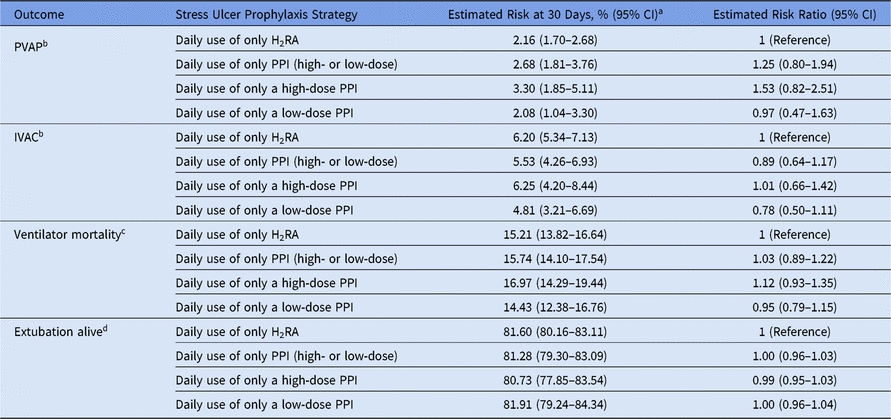
For all outcomes, the results failed to reach statistical significance at the 5% type I error level (ie, all RR 95% CIs contained 1.0). For PVAP, the estimated 30-day risk was 2.68% (95% CI, 1.81–3.76) under daily PPI and 2.16% (95% CI, 1.70–2.68) under daily H2RA, with an RR of 1.25 (95% CI, 0.80–1.94). The magnitude of point estimates depended on PPI dose: RRs for daily high-dose PPI and daily low-dose PPI compared with daily H2RA were 1.53 (95% CI, 0.82–2.51) and 0.97 (95% CI, 0.47–1.63), respectively (Table 2).
Estimated 30-Day Risk of Ventilator-Associated Outcomes and Risk Ratio by Stress Ulcer Prophylaxis Strategy Among 4,595 Patients Undergoing Mechanical Ventilation Treated With Proton Pump Inhibitors (PPIs) or Histamine-2-Receptor Antagonists (H2RAs) on the Third Day of Ventilation, 2006–2014

Note. PVAP, possible ventilator-associated pneumonia; IVAC, infection-related ventilator-associated complication; PPI, proton pump inhibitor; H2RA, histamine-2-receptor antagonist; CI, confidence interval.
a The estimated 30-day risk of outcomes and risk ratio were obtained using the parametric g-formula to adjust for time-varying confounders affected by prior treatment as well as for time-fixed confounders measured at baseline.
b PVAP is a subset of the IVAC outcome. The competing events for ventilator-associated outcomes pneumonia and IVAC are ventilator mortality and extubation alive. For these 2 outcomes, adjusted time-varying confounders included gastrointestinal conditions, steroids, vasopressors, benzodiazepine, dexmedetomidine, propofol, and cisatracurium; time-fixed baseline confounders included age, race, sex, baseline predicted mortality risk, upper gastrointestinal bleed, intensive care unit type, alcohol abuse, blood loss anemia, liver disease, lymphoma, metastatic cancer, and solid tumor without metastasis.
c The competing event for ventilator mortality is extubation alive. For this outcome, adjusted time-varying confounders included minimal platelets, minimal hematocrit, IVAC, gastrointestinal conditions, steroids, vasopressors, benzodiazepine, dexmedetomidine, propofol, and cisatracurium; time-fixed baseline confounders included age, race, sex, baseline predicted mortality risk, upper gastrointestinal bleed, intensive care unit type, alcohol abuse, blood loss anemia, myocardial infarction, congestive heart disease, liver disease, lymphoma, metastatic cancer, peripheral vascular disease, cerebrovascular disease, diabetes, mild liver disease, moderate to severe liver disease, renal disease, rheumatologic disease, and solid tumor without metastasis.
d The competing event for extubation alive is ventilator mortality. For this outcome, adjusted time-varying confounders included minimal platelets, minimal hematocrit, IVAC, gastrointestinal conditions, steroids, vasopressors, benzodiazepine, dexmedetomidine, propofol, and cisatracurium; time-fixed baseline confounders included age, race, sex, baseline predicted mortality risk, upper gastrointestinal bleed, intensive care unit type, alcohol abuse, blood loss anemia, myocardial infarction, congestive heart disease, liver disease, lymphoma, metastatic cancer, peripheral vascular disease, cerebrovascular disease, diabetes, mild liver disease, moderate to severe liver disease, renal disease, rheumatologic disease, and solid tumor without metastasis.
For IVAC, the estimated 30-day risk was 5.53% (95% CI, 4.26–6.93) under daily PPI and 6.20% (95% CI, 5.34–7.13) under daily H2RA with an RR of 0.89 (95% CI, 0.64–1.17). Again, the magnitude of point estimates depended on PPI dose: RRs for daily high-dose PPI and daily low-dose PPI compared with daily H2RA were 1.01 (95% CI, 0.66–1.42) and 0.78 (95% CI, 0.50–1.11), respectively (Table 2).
For ventilator mortality and extubation alive, the estimated 30-day RRs were close to 1.0 comparing daily PPI versus daily H2RA (Table 2). The RR point estimates remained close to 1.0 for extubation alive and increased in magnitude only slightly for ventilator mortality comparing different PPI dose strategy to daily H2RA. The RR for daily high-dose PPI was 1.12 (95% CI, 0.93–1.35), and for daily low-dose PPI it was 0.95 (95% CI, 0.79–1.15). These results were robust to various sensitivity analyses including to model assumptions (Supplemental Tables 3 and 4 online).
Discussion
Using real-world operational data on critically ill patients, we estimated similar 30-day risks of IVAC and PVAP with daily use of PPIs compared to H2RAs. For all outcomes, estimates were imprecise, with wide 95% confidence intervals containing the null. Point estimates were in line with a higher risk of PVAP with daily high-dose PPI compared to daily H2RA, but confidence intervals were wide and the effect was not statistically significant.
We did not assess the comparative safety of these treatment strategies with respect to clinically significant gastrointestinal bleeding and Clostridioides difficile due to their very low incidence in our cohort. The occurrence of IVACs and PVAPs was also low, which was likely due to the implementation of ventilator bundles within the hospital.Reference Klompas, Li, Kleinman, Szumita and Massaro37
Previous studies have found positive dose response between PPI use and risk of both community-acquired and hospital-acquired pneumonia.Reference Laheij, Sturkenboom and Hassing38 Although the confidence intervals were wide and the results were not significant, our point estimates were similarly in line with a higher risk of PVAP under daily high-dose PPI compared to other strategies. These findings are consistent with the hypothesis that acid suppression may increase infection risk by increasing gastrointestinal pH, facilitating microbial proliferation in the upper gastrointestinal tract, leading to infections.Reference Torres, El-Ebiary and Soler39, Reference Bonten, Gaillard and de Leeuw40
One strength of our study was the availability of rich information on daily treatment and clinical characteristics of these patients, essential for studying the effects of continuous use of these medications.Reference Li, Young and Toh41 Furthermore, compared to previous studies that utilized administrative claims databases, the exposure information in this study represents the actual use of medications, not just the provider’s initial treatment choices. To our knowledge, our study is the first observational study to evaluate the effect of continuous daily treatment with different acid suppressants for stress prophylaxis on safety outcomes in ICUs, using careful methods for time-varying confounding control. Our findings complement results from previous studies that have focused only on the initiation of these agents, ignoring treatment changes after initiation. We found that treatment changes were quite common in this study (Fig. 2 here and Supplemental Fig. 1 online).
Our study has several limitations. First, we did not capture practice or database changes occurring between December 2014 (due to data availability) and the present. Although we observed that H2RAs and PPIs were the 2 most commonly used agents, which is consistent with previous surveys,Reference Krag, Perner and Wetterslev19, Reference Barletta, Kanji and MacLaren42 our observation that H2RAs were the most common agent differs from these surveys. This finding suggests potential changes in practice patterns over time or differences in practice patterns between hospitals. Second, as in any observational study, the validity of our results relies on the assumption of no unmeasured confounding. Although we adjusted for extensive baseline and time-varying confounders including steroids and gastrointestinal-related conditions, we cannot exclude the possibility that unmeasured factors (eg, the route of feeding) could have affected the choice of acid suppressants or risk of ventilator-associated events. Third, the daily query of diagnosis codes for time-varying confounding control might be subject to measurement error. However, this approach likely had good performance to detect the occurrence and timing of complications like gastrointestinal bleeding. Fourth, this cohort came from a single hospital system, possibly limiting the generalizability of our results. Finally, our study may have been underpowered given the limited sample size and rare events. Future studies combining data across multiple sites with access to rich longitudinal data for control of time-varying confounding may provide improved estimates in terms of both precision and generalizability.
In conclusion, we estimated no effect of daily use of PPIs compared to H2RAs on 30-day risk of ventilator mortality, extubation alive, PVAP, or IVAC in mechanically ventilated critically ill patients. Higher doses of PPIs may increase PVAP risk, but our study may have been underpowered. Further research is warranted.
Supplementary material
To view supplementary material for this article, please visit https://doi.org/10.1017/ice.2019.323
Acknowledgment
All statements in this article, including its findings and conclusions, are solely those of the authors and do not necessarily represent the views of the Department of Population Medicine.
Financial support
This work was supported by an internal faculty grant at the Department of Population Medicine.
Conflicts of interest
All authors report no conflicts of interest relevant to this article.