Introduction
The life-threatening emergency (LTE) has been defined as a situation associated with an imminent life-threatening risk that entails the deployment of special resources and measures to resolve the situation.Reference Moya-Mir 1 The duties assigned to the Primary Health Care (PHC) physicians in Spain include health care for health problems and the prevention of illness, together with health care for the LTEs that arise.Reference Van Damme, Van Lerberghe and Boelaert 2 Health General Law of Spain, promulgated in 1986, specifies that PHC physicians are responsible for emergency response in prehospital emergencies. For this reason, PHC physicians must solve the emergency situations that may occur in the geographic scope of activity of the PHC teams, and they must also collaborate with the Emergency Medical Services in the areas where they are deployed.Reference Martín Zurro, Ledesma Castelltort and Sans Miret 3 In the last 10 years, there has been a constant increase in demand for urgent health care, both in hospital emergency services and in PHC (with an increase of up to 70.0% in the latter case).Reference Canals and Riesgo 4 The causes of this increase probably include the socio-demographic characteristics of the patients and also the undeniable problems of the current health care model (ie, waiting lists, overcrowding of primary care centers, and delay in diagnostic tests).Reference Canals and Riesgo 4 In recent years, an important number of family physicians have joined the staffs of hospital and out-of-hospital emergency services; more than 70.0% of the most recent graduating residents of Family and Community Medicine (FCM) are working in different fields of Urgent and Emergency Medicine (UEM), both in and outside of hospitals.Reference Castro Villamor 5 In any case, the physicians who make up the health care teams in the PHC model, in order to be able to perform their function in an adequate way, must have coherent and adequate theoretical knowledge and practical skills related to UEM.Reference Martín Zurro, Ledesma Castelltort and Sans Miret 3
Asturias is a region located in the North of Spain, with an area of 10,603.57 km2 and a population in 2016 of 1,085,319 inhabitants. The center of the region is eminently urban with a flat terrain, while the ends are semi-urban and rural with a mountainous terrain that makes it difficult to transport patients and presents an important dispersion of the population. Asturias’ health system is public, as in the rest of Spain. This system consists of eight health districts, each of them with their referral hospital. 6 , 7
The goals of this study were: (1) to find out the training received in UEM by the PHC physicians of Asturias, as well as their perception of their own theoretical knowledge and practical skills in a series of procedures employed in LTEs, and also (2) to analyze the differences according to the geographical area of their work.
Methods
This was a cross-sectional survey of the training received and the theoretical knowledge and practical skills, as self-perceived, regarding 33 procedures or techniques that are employed in treatment of LTEs, in a simple random sample of 213 physicians (n) from PHC centers in the eight health care districts of Asturias from among the total of 851 physicians (N) who make up the staff of PHC centers in Asturias. The interview was conducted by mail from April through May 2017, and the sample was determined by a computer generating system.
In the previous review of bibliography, any validated survey to detect self-perception of the degree of theoretical knowledge and practical skills was found. For this reason, an ad hoc survey was drafted using the Doctrinal Body of Emergency Medicine (DBEM) proposed by the Spanish Society of Emergency Medicine (Sociedad Española de Medicina de Urgencias y Emergencias; Madrid, Spain), which indicates the theoretical and practical procedures that must be acquired by the PHC physicians. 8 From among all the procedures included in the DBEM, 33 were selected because they are used systematically in LTEs. Firstly, a pilot test and cognitive pre-test of the 30 physicians was conducted in order to establish the most suitable type of question and response scale, the extent, comprehensibility, and logical order of the questions, and also the duration and acceptance of the survey. The value of the Cronbach Alpha coefficient considered adequate in terms of internal consistency was an alpha value greater than 0.7. Finally, the definitive survey was drafted. The survey also included questions regarding the training received in procedures of UEM and its features and time-frame.
In order to demarcate the geographical areas of work into rural, suburban, and urban, the classification used by the Spanish National Institute of Statistics (INE; Madrid, Spain) was used. In this manner, the category “rural” corresponded to population centers with 2,000 or less inhabitants; the category “suburban” corresponded to population centers from 2,001 to 10,000 inhabitants; and the category “urban” included population centers with 10,001 inhabitants or more. 9
The data processing made use of absolute and relative frequencies, central tendency parameters, and dispersion parameters. Correlation analysis has been used in the bivariate analysis. The estimates for the entire population have been made using confidence intervals for the mean of 95%. In comparisons of parameter difference, parameters with a probability of error less than five percent (P<.05) have been considered significant. In order to compare averages between the different techniques in the different working areas, Levene’s test was used to evaluate the homoscedasticity of the techniques studied. For those techniques in which Levene’s test yielded a value of P<.05 (significant difference in variance), ANOVA was applied in order to determine whether the intergroup differences were significant (P<.05) or not significant on a two-by-two basis (rural versus urban, rural versus suburban, and urban versus suburban).
In order to determine whether the difference of averages between the different techniques in the different working areas was significant, post hoc comparisons were made. In the case of techniques whose intergroup differences were significant and their variance equal, the Scheffé test was used. In the techniques whose intergroup differences were significant and whose variance was not equal, the Tamhane T2 test was used. For Tables 1–4, a 0-10 Likert scale was used for self-perception measurement. The statistics software used was SPSS Statistics v20 (IBM; Armonk, New York USA).
Average Theoretical Knowledge and Practical Skill in Emergency Procedures for All Primary Health Care Physicians in Asturias in Techniques Employed in Life-Threatening Emergencies

a Significantly greater than the mean (P<.05).
b Significantly lower than the mean (P<.05).
Average Self-Perception of Theoretical Knowledge and Practical Skills of Rural Primary Health Care Physicians in Asturias in Techniques Employed in Life-Threatening Emergencies

a Significantly greater than the mean (P<.05).
b Significantly lower than the mean (P<.05).
Average Self-Perception of Theoretical Knowledge and Practical Skills of Semi-Urban Primary Health Care Physicians in Asturias in Techniques Employed in Life-Threatening Emergencies

a Significantly greater than the mean (P<.05).
b Significantly lower than the mean (P<.05).
Average Self-Perception of Theoretical Knowledge and Practical Skills of Urban Primary Health Care Physicians in Asturias in Techniques Employed in Life-Threatening Emergencies

a Significantly greater than the mean (P<.05).
b Significantly lower than the mean (P<.05).
Results
All potential respondents to the survey responded. Of the 213 participating physicians, 88 (41.3%) were men and 125 (58.7%) were women. Of these, 161 (75.6%) had a medical specialty acquired in the Resident Medical Intern program. Of the total specialists, 129 (80.1%) were specialists in FCM. Of the remaining 52 physicians, 51 (23.9%) had not studied any regulated medical specialty, and one did not respond to the item (0.5%).
Regarding the institution that provided them with their training in UEM, 41 (19.2%) indicated that this took place in courses held by the Healthcare Service of Asturias (SESPA; Oviedo, Spain); 33 (15.5%) had acquired this training on their own; while 122 (57.3%) had been trained both by SESPA and on their own. A total of 17 (7.9%) professionals refused to answer this question.
More than 53.0% of the 213 professionals had studied an official post-graduate university degree in UEM. Regarding training in basic cardiopulmonary resuscitation (CPR), 2.8% of the total had not taken any course in basic CPR in their professional career; 3.8% had taken only one course; 13.1% took two courses; 22.1% took three courses; 12.7% took four courses; and 40.0% took five or more courses during their professional career. Of those surveyed, 5.6% preferred not to answer this question.
Almost 19.7% of the physicians surveyed had completed their last course in basic CPR in the year 2013; 17.8% in the year 2012; 15.5% in 2011; and 18.3% in 2010. Only 2.3% had last taken one of these courses more than 10 years ago. Regarding training in advanced CPR, 9.4% of 213 had not taken any course during their professional career; 36.6% had taken one course; 23.0% had taken two courses; 16.4% had taken three courses; 4.7% had taken four courses; and 8.0% had taken five or more courses during their professional career. Of physicians surveyed, 1.9% refused to answer this question.
The most recent year for receiving training in advanced CPR was 2013 for 5.2% of physicians; another 5.2% took this course for the last time in 2012; 10.3% in 2011; and 12.2% in 2010. Lastly, 17.3% had completed this course for the last time more than 10 years ago.
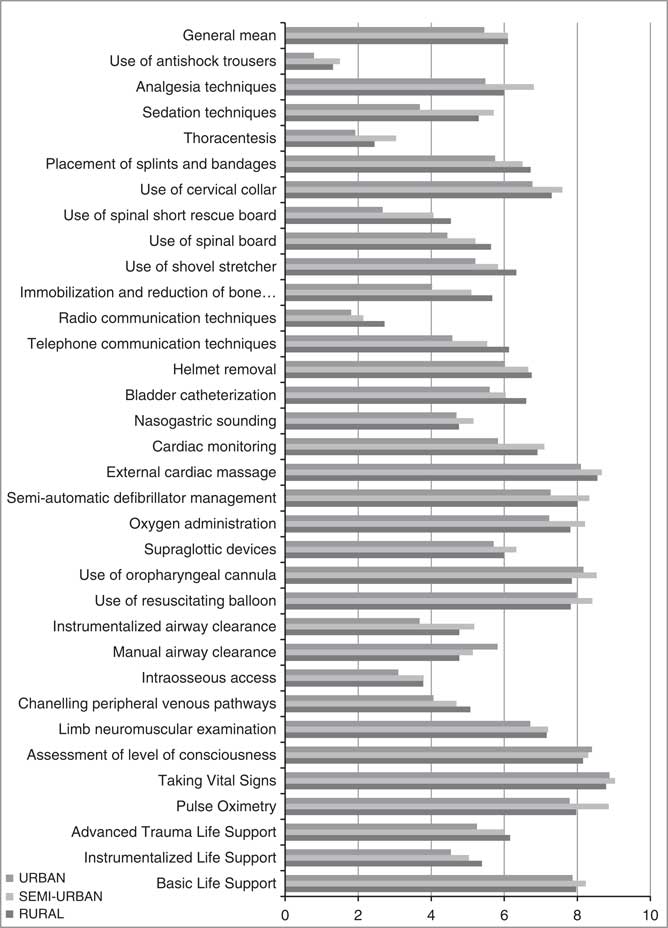
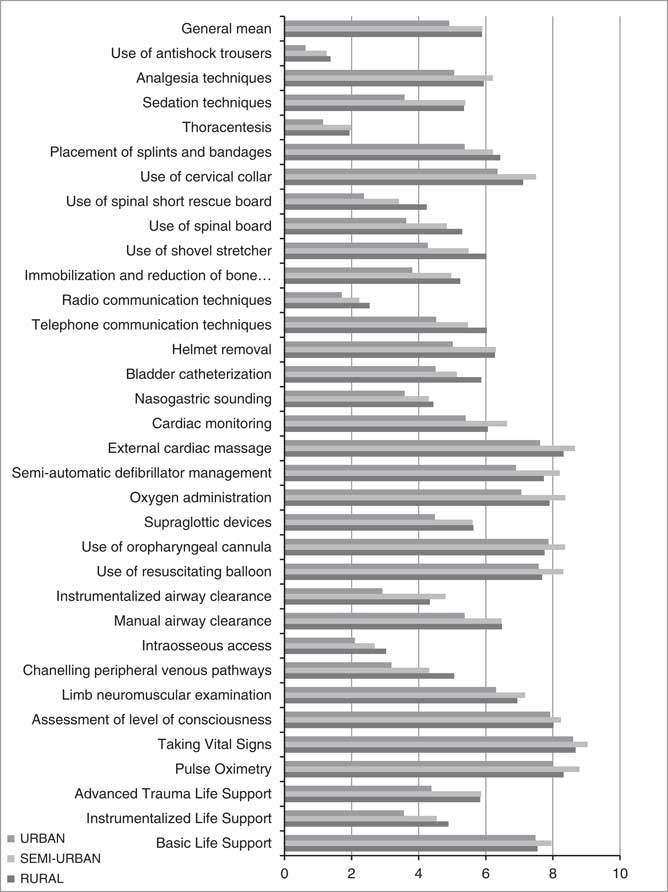
Almost 20.0% of the 213 physicians had never taken an Advanced Trauma Life Support course in their entire professional career; 39.9% had taken one course; 27.2% took two courses; 7.5% took three courses; 1.4% had taken four courses; and 3.8% had taken five courses or more during their professional career. As for the most recent year of completion of this type of training, 3.3% had taken the most recent course in 2013; 6.6% in 2012; 10.8% in 2011; and 8.9% in 2010. A total of 14.5% had completed this course most recently more than 10 years ago. Table 1 displays the average theoretical knowledge and practical skill in emergency procedures for all PHC physicians in Asturias. Table 2, Table 3, and Table 4 show, respectively, the averages of perception of theoretical knowledge and practical skill in Emergency Medicine procedures for PHC physicians in Asturias who work in rural, suburban, and urban areas. Figure 1 and Figure 2 show, respectively, the comparison of the average degree of theoretical knowledge in emergency procedures for PHC physicians in rural, suburban, and urban areas in Asturias, and the comparison of the average of the degree of practical skills in emergency procedures for PHC physicians in rural, suburban, and urban areas of Asturias. There was a strong correlation between the average degree of theoretical knowledge and the average degree of practical skill in emergency procedures (R2 = 0.987; P<.000).
Comparison of the Average Degree of Theoretical Knowledge in Emergency Procedures for Primary Health Care Physicians in Rural, Suburban, and Urban Areas in Asturias Employed in Life-Threatening Emergencies.

Comparison of the Average Degree of Practical Skill in Emergency Procedures for Primary Health Care Physicians in Rural, Suburban, and Urban Areas in Asturias Employed in Life-Threatening Emergencies.

As for the training of physicians, in general, for handling LTEs, both at the regional level and by areas of work (rural, suburban, and urban), none of the groups analyzed scored five points (on a scale from 0 to 10); the average in Asturias was 3.80 points. Regarding the areas of work, it was the suburban area that showed a greater average in general level of knowledge (4.25 of 10), followed by the rural (3.90 of 10), and the urban (3.00 of 10).
Moreover, the theoretical training, in general, for attending LTEs of the PHC physicians in Asturias was at an average level of knowledge; it was practically equal in the rural and suburban areas, but much lower in the urban area, and this situation was repeated with the degree of practical skill, although this was even lower than the degree of theoretical knowledge.
There were significant differences in the mean theoretical knowledge and the mean practical skill in the procedures studied depending on the different areas of work. In this respect, there was evidence that the greater number of significant differences had been between the urban and suburban areas (11 of 33; 33.3 % in theoretical knowledge and 19 of 33; 57.8% in practical skill) and between urban and rural (10 of 33; 30.3% in theoretical knowledge and 13 of 33; 39.4% in practical skill). There were scarcely any significant differences by techniques between rural and suburban areas at the level of theoretical knowledge; there was only a significant difference in two techniques of the total of 33, both of these in theoretical knowledge (6.0%). Table 5 shows the existence of significant or non-significant differences in the different techniques according to the area of work of the PHC physicians in Asturias, according to the post hoc test used.
P Value in the Different Techniques According to the Area of Work of Primary Health Care Physicians in Asturias

a Significant differences between means (P≤.05) with the Tamhane T2 test.
b Significant differences between means (P≤.05) with the Scheffe test.
-No significant differences between means (P>.05).
Discussion
According to the data from this study, there seem to be differences in the PHC physicians’ self-perceived abilities to perform their duty in situations of LTE, if the area in which they work is taken into account. These differences may be due to the specific geographical and organizational features of the suburban and rural areas, since the geographical spread is greater due to the features of the terrain, and some important population centers are not equipped with mobile Advanced Life Support (ALS) ambulances. Hence, it is the PHC physicians themselves who must handle the situation from the outset. These data could not be compared with previous studies since no evidence has been found in the available literature.
Regarding the techniques most often employed in LTEs, it is noteworthy that, at the individual level of each technique, the physicians who work in the suburban areas consider themselves better prepared both at the theoretical and practical level than their counterparts in the rural and urban areas, and also that this perception is greater regarding the degree of theoretical knowledge than the degree of practical skill. These data suggest that in the rural and suburban areas, since the physicians must perform these techniques more often as they often do not have access to ALS units, they consider that they are better trained to perform these techniques, both at the theoretical level and the practical level. On the other hand, in the urban areas, physicians do not usually intervene in LTEs that require the use of these techniques, and hence, their perceptions of their theoretical knowledge and practical skills are significantly lower than those of their colleagues in the rural and suburban areas. It is noteworthy, also, that more significant differences are in regard to the practical skill in the different techniques. This may be because the theoretical training received is more or less uniform, but the frequency of use of the different techniques causes a better perception of their practical skill.
In light of the data obtained in this study, the PHC physicians in Asturias themselves, in general, and in any of the areas of work analyzed, have the perception that they are not sufficiently trained to intervene in LTEs and to apply the techniques necessary to provide adequate attention in these situations.
A study carried out in MexicoReference Wheatley, Pérez and Macías 10 observes that health care professionals who received formal training in Basic Life Support (BLS), one of the techniques most often used in treatment of LTEs, attained a percentage of knowledge of 77.0% (7.7 points of 10), while those health care professionals with informal training or without training attained an average knowledge of 64.0% (6.4 points of 10).
In a study at the hospital level conducted in Gijón (Spain),Reference Montes, Martín, Ordiz and Piedra 11 which included nurses, medical interns, associate specialized physicians, and surgeons, 51.0% of those surveyed attained an average knowledge in CPR and BLS between 60.0% and 80.0% (between 6.0 and 8.0 points of 10); 34.0% attained knowledge greater than 80.0% (more than 8.0 points of 10); and 4.0% less than 20.0% (less than 2.0 points of 10). In another study conducted in Turkey in 2008 of PHC physicians,Reference Yorganci and Yaman 12 the physicians scored 65.5 points of 100 in theoretical knowledge. These figures are in the range obtained for the self-perception of the Asturian professionals surveyed. The authors of this study concluded that the level of training is low, and that, hence, it is necessary to improve training on this subject. It is necessary to stress that PHC professionals provide care to the population that demands a solution to their health needs,Reference Mercenier 13 in harmony with other aspects of the society such as education, social development, and infrastructures.Reference Kanji and Manji 14 - Reference Van Lerberghe 16 In order to attain maximum health with limited resources, the health services must be rationalized in an effective and efficient manner.Reference Evans and Stoddart 17
In spite of the curriculum existing in Spain for professional skills for intervention in emergencies by family physicians, some authors such as EscobarReference Escobar 18 criticize this organization and argue for a clearer division between family physicians and emergency physicians. On the other hand, the PHC physician has two important social characteristics: the autonomy and the participation, both crucial for achieving an acceptable level of health, 19 , Reference Passmore 20 and it thus creates a positive synergy between professionals and citizens that can benefit all parties involved.Reference Van Balen 21 , 22 The geographic characteristics of the system of PHC physicians in Asturias are different in some respects when different areas of health are analyzed. This could create inequalities in health care or in its quality and homogeneity. For this reason, it seems necessary that the Health Administration (HA) would be capable of ensuring adequate homogeneity in levels of theoretical knowledge and practical skill of its health care staff with periodic evaluations and reinforcing deficient knowledges and skills, together with availability and adequate conditions in the use of material resources that enable the HA to ensure that equity in conditions of provision of health care services in LTEs in the health care areas in Asturias.Reference Hernández Aguado, Santaolaya Cesteros and Campos Esteban 23
Limitations
This study explores self-perception of theoretical knowledge and practical skills, and results don’t allow verifying if they are really qualified to intervene in LTEs. On the other hand, this study is restricted to a specific region with particular characteristics, so it is not appropriate to generalize this to other countries. It would be necessary to compare this study with other European studies to check if results by geographical area are similar.
Conclusion
This study has determined the profile of self-perception by PHC physicians about their theoretical knowledge and practical skills in LTEs, as well as their differences according to the geographical area of their work.
There is a heterogeneous profile at the level of theoretical knowledge and practical skills according to the different techniques, but there are specific techniques like Instrumentalized Life Support, channeling peripheral venous pathways, intra-osseous access, nasogastric sounding, and thoracentesis or use of anti-shock trousers in which physicians perceive limitations both in the theoretical knowledge and in the practical skills to execute them. This profile makes known which of these knowledges and skills must be reinforced by PHC physicians to ensure quality assistance in LTEs.
Training in Emergency Medicine is a fundamental part of curriculum development in FCM and PHC physicians. In spite of the need for these physicians to acquire the necessary skills, both at the theoretical and practical levels, to be able to handle these events successfully, not all PHC physicians believe that they are sufficiently prepared. The degree of self-perception and acquisition of this knowledge and these skills, which are so important and necessary, is varied, with clear difference according to area of work. A sanitary network with a correct interrelationship between its members will favor an adequate attention in LTEs.