INTRODUCTION
Since the discovery of allelopathy (Molisch, Reference Molisch1937), researchers have found numerous examples of allelopathic effects between primary producers as well as between primary producers and microorganisms. There is a growing interest in allelopathy among aquatic organisms. Indeed, allelopathy has been shown to have a remarkable influence on the structure and dynamic equilibrium of aquatic ecosystems (van Donk & van de Bund, Reference van Donk and van de Bund2002; Gross, Reference Gross2003; Kim et al., Reference Kim, Choi, Kang, Cho, Jin, Chun and Hong2004; Gross et al., Reference Gross, Hilt, Lombardo and Mulderij2007; Hu & Hong, Reference Hu and Hong2008; Tang & Gobler, Reference Tang and Gobler2011; Slattery & Lesser, Reference Slattery and Lesser2014).
Environmental factors such as temperature, salinity, irradiance, pH and nutrient availability change frequently in marine and freshwater ecosystems and these changes have a considerable impact on the growth and physiology of aquatic organisms (Taylor et al., Reference Taylor, Fletcher and Raven2001; Cohen & Fong, Reference Cohen and Fong2004; Kakinuma et al., Reference Kakinuma, Coury, Kuno, Itoh, Kozawa, Inagaki, Yoshiura and Amano2006; Cade-Menun & Paytan, Reference Cade-Menun and Paytan2010; Kim et al., Reference Kim, Spivack and Menden-Deuer2013; Wallace & Gobler, Reference Wallace and Gobler2015). Moreover, environmental conditions can abate (Keating, Reference Keating1977; Hu & Hong, Reference Hu and Hong2008) or enhance (Gross, Reference Gross2003; Gross et al., Reference Gross, Hilt, Lombardo and Mulderij2007) allelopathic interactions. Despite recognition of these influences, data on the dynamics of allelopathy in aquatic ecosystems are limited (Gross, Reference Gross2003; Gross et al., Reference Gross, Hilt, Lombardo and Mulderij2007; Hu & Hong, Reference Hu and Hong2008; Wallace & Gobler, Reference Wallace and Gobler2015).
Harmful algae blooms (HABs) generated by excessive growth of deleterious micro- and macroalgae in response to coastal eutrophication are becoming increasingly frequent along shorelines worldwide. Because of the severe economic and public health problems caused by HABs, researchers have begun to concentrate on how undesired algal growth can be controlled. Some promising control methods have been developed, including the use of yellow loess (Na et al., Reference Na, Choi and Chun1996), clay (Sun et al., Reference Sun, Song and Zhang1999), copper sulphate (Steidinger, Reference Steidinger1983), and some biological agents, including bacteria (Imai et al., Reference Imai, Ishida and Hata1993; Kim et al., Reference Kim, Yoshinaga, Nagasaki, Itakura and Ishida1998) and viruses (Garry et al., Reference Garry, Hearing and Cosper1998) that infect algae. Although short-term experiments have yielded promising results regarding the potential efficacy of these methods, there is apprehension concerning the potential for dangerous environmental consequences (Jeong et al., Reference Jeong, JIN and Sohn2000; Hu & Hong, Reference Hu and Hong2008; Tang & Gobler, Reference Tang and Gobler2011).
With the aim of developing efficient HAB control methods that do not risk harming the environment, researchers have been examining how the growth of troublesome HAB species could be inhibited by allelopathic substances released by other aquatic organisms (Jin & Dong, Reference Jin and Dong2003; Jin et al., Reference Jin, Dong and Wang2005; Hu & Hong, Reference Hu and Hong2008; Nan et al., Reference Nan, Zhang, Lin, Zhao and Liu2008; Tang & Gobler, Reference Tang and Gobler2011). Many aquatic organisms have been shown to secrete allelopathic substances against HAB species (Nakai et al., Reference Nakai, Inoue, Hosomi and Murakami1999, Reference Nakai, Inoue, Hosomi and Murakami2000; Jeong et al., Reference Jeong, JIN and Sohn2000; Lee et al., Reference Lee, Kim, Kim, Seo, Jeong and Hong2000; Jin & Dong, Reference Jin and Dong2003, Reference Jin, Dong and Wang2005; Nelson et al., Reference Nelson, Lee and Smith2003; Alamsjah et al., Reference Alamsjah, Hirao, Ishibashi and Fujita2005, Reference Alamsjah, Hirao, Ishibashi, Oda and Fujita2008; Hu & Hong, Reference Hu and Hong2008; Tang & Gobler, Reference Tang and Gobler2011; Ye et al., Reference Ye, Liao and Yang2014). Aquatic organisms that are endemic to aquatic ecosystems, such as macrophytes and macroalgae, are attractive potential mediators of targeted allelopathic HAB control because they should not cause the severe environmental problems associated with chemical treatments, which have broad-spectrum toxicity affecting diverse aquatic organisms (Gross, Reference Gross2003; Gross et al., Reference Gross, Hilt, Lombardo and Mulderij2007; Hu & Hong, Reference Hu and Hong2008). Unlike many synthetic toxins, allelochemicals secreted by aquatic organisms are both highly efficacious at very low concentrations and naturally degradable (Nakai et al., Reference Nakai, Inoue, Hosomi and Murakami1999, Reference Nakai, Inoue, Hosomi and Murakami2000; Jin & Dong, Reference Jin and Dong2003; Hu & Hong, Reference Hu and Hong2008). Furthermore, many macrophyte and macroalgae species have a high nutrient assimilation capacity, thus reducing eutrophication of aquatic ecosystems and mitigating harmful microalgal blooms (Jin et al., Reference Jin, Dong and Wang2005; Tang & Gobler, Reference Tang and Gobler2011; Ye et al., Reference Ye, Liao and Yang2014).
Moreover, some investigators are exploring how environmental factors may affect the occurrence of HABs (Taylor et al., Reference Taylor, Fletcher and Raven2001; Yan et al., Reference Yan, Zhou and Qian2002; Kakinuma et al., Reference Kakinuma, Coury, Kuno, Itoh, Kozawa, Inagaki, Yoshiura and Amano2006; Shikata et al., Reference Shikata, Nagasoe, Matsubara, Yamasaki, Shimasaki, Oshima and Honjo2007; Valenti et al., Reference Valenti, James, Lahousse, Schug, Roelke, Grover and Brooks2010; Butron et al., Reference Butron, Madariaga and Orive2012; Kim et al., Reference Kim, Spivack and Menden-Deuer2013; Wallace & Gobler, Reference Wallace and Gobler2015). Researchers have obtained evidence suggesting that HAB algae can gain competitive advantages through their allelopathic effects on other marine organisms (Smayda, Reference Smayda1997; Nelson et al., Reference Nelson, Lee and Smith2003; Hu & Hong, Reference Hu and Hong2008; Slattery & Lesser, Reference Slattery and Lesser2014). If so, it may be possible to suppress HABs by adjusting environmental factors in confined areas, including small water areas in aquaculture factories, in a manner that enhances algae growth inhibition by other aquatic organisms. However, few researchers have focused on the relationship between changes in aquatic environmental factors and allelopathy. There have been some studies focused on examining the influence of pH and temperature on allelopathy of aquatic organisms (Ray & Bagchi, Reference Ray and Bagchi2001; Schmidt & Hansen, Reference Schmidt and Hansen2001; Valenti et al., Reference Valenti, James, Lahousse, Schug, Roelke, Grover and Brooks2010; Valenti, Reference Valenti2010).
In our previous experiments (Jin & Dong, Reference Jin and Dong2003), we found that the macroalga Ulva pertusa (both non-sexual and sexual strains), which is commonly found within HABs, secretes molecules that have allelopathic growth inhibition and algicidal effects on Heterosigma akashiwo, a harmful microalgae species in HABs. We investigated whether changes in non-nutrient environmental factors could affect the growth inhibitory influence of U. pertusa on H. akashiwo and monitored their growth rates.
MATERIALS AND METHODS
Algae
Because the sexual strain of U. pertusa would release spores during experimental cultures and might interfere with the results of this study, we decided to use an axenic non-sexual strain of U. pertusa, which could also inhibit the growth of the microalgae (Jin & Dong, Reference Jin and Dong2003) and an axenic strain of H. akashiwo so that the effects of bacteria could be precluded as well.
An axenic strain of H. akashiwo was obtained from the Microalga Research Laboratory of the Ocean University of China in Qingdao, China. An axenic non-sexual strain of U. pertusa was provided courtesy of Professor Akira Taniguchi at Tohoku University in Japan. All algae were cultured aseptically in f/2 medium (Guillard & Ryther, Reference Guillard and Ryther1962) in illuminating incubators with an irradiance level, measured in photosynthetic photon flux density (PPFD), of 60 µmol m−2 s−1 and a 12:12-h light/dark cycle at 20°C. Cultures were refreshed with fresh f/2 medium every 4 days to ensure nutrient sufficiency. All flasks containing microalgae were shaken twice daily at set times to prevent algal growth on the flask walls.
Seawater for experiments
Aged natural seawater was filtered through glass-fibre papers (Whatman GF/C, 0.22-μm pore size) to eliminate bacteria, organic particles and debris. The pH and salinity of the seawater were adjusted to 8.5 and 35 g NaCl per kg water (salinity unit abbreviated as g kg−1 from here forward), respectively; seawater was used as the basic culture medium for algae in all experiments.
Culture experiments with single-factor and two-factor incubations
Before we tested two-factor combinations, we examined how the individual manipulation of temperature, salinity, irradiance and pH affects macro- and microalgal growth and macroalgal inhibition of microalgal growth to establish appropriate levels of these four factors for the two-factor combination experiments. Natural seawater pH ranges generally from 7 to 9, but this pH range might not encompass the limits of macro- and microalgal growth and inhibition. Therefore we used a pH range that extends beyond that found in natural seawater in this study. Various levels of the single factors were tested in parallel as follows: temperature (10, 15, 25 and 30°C), salinity (10, 20, 30 and 40 g kg−1), irradiance (20, 100, 200 and 400 µmol m−2 s−1), and pH (5.5, 7, 8.5 and 10). While one factor was varied, the other culture conditions were kept at baseline levels (i.e. temperature, 20°C; salinity, 35 g kg−1; irradiance, 60 µmol m−2 s−1; and pH, 8.5) with a 12:12-h light/dark cycle.
Temperature was controlled by way of culture-illuminating incubators. Medium with a salinity of <35 g kg−1 was prepared by diluting the stock culture medium (35 g kg−1) with distilled water. Medium with salinity adjusted to 40 g kg−1 was prepared by monitored evaporation of the basic culture medium in an oven at 60°C. Irradiance was varied by adjusting the lights in the culture-illuminating incubators. Medium pH was altered by titrating stock culture medium with 0.1 M HCl or 0.1 M NaOH. Because algae can change the pH of their culture medium through photosynthesis and respiration, pH was tested and adjusted as needed every 12 h to reset levels using the aforementioned reagents.
Microalgae and macroalgae were co-cultured in 100-mL conical glass flasks containing 40-mL of 2f culture medium. Nutrient concentrations were four times that of the stock f/2 medium to ensure that there were sufficient nutrients for the growth of both the microalgae and the macroalgae. Flask mouths were covered with kraft paper. Jin & Dong (Reference Jin and Dong2003) found that when they combined H. akashiwo cells (initial cell density 1 × 10⁵ cells mL−1) with fresh U. pertusa (initial fresh tissue weight, 0.025 g) in 40-mL of culture medium, growth of H. akashiwo was inhibited. Therefore, in the present study, we elected to use a lower initial fresh tissue weight of U. pertusa. Exponentially growing H. akashiwo cells (initial cell density 1 × 10⁵ cells mL−1) were placed in medium with fresh U. pertusa tissue (initial fresh tissue weight, 0.01 g). Monocultures of each alga served as controls. All experiments were performed separately for a period of 8 days in (at least) triplicate. Aseptic techniques were employed in all experimental steps.
At the end of the experiment, 1-mL samples were collected from each flask and preserved in Lugol's solution. Microalgal cells were counted under an Olympus optical microscope by a hemocytometer and microalgal cell densities were calculated for all groups. We also determined the wet weights of macroalgal fresh tissue in the control groups using an analytical balance. The procedures and culture conditions in the following experiments were the same as described above unless otherwise stated.
Six two-factor culture experiments (Temperature × Salinity, Temperature × pH, Irradiance × Salinity, Irradiance × pH, Salinity × pH and Temperature × Irradiance) were conducted with the same procedures and parameter combinations indicated above. For each of the six experiments, two of the four factors were combined (i.e. Temperature × Salinity) and the parameter levels were varied systematically across parallel trials. Only the two factors being tested varied between trials in each experiment, while the other culture conditions were at baseline levels. One of the test variables was varied between side-by-side incubators; and the other was varied between the four compartments within each incubator.
Data processing and statistical analysis
Mean U. pertusa and H. akashiwo growth rates are represented as μ U and μ H, respectively. Mean growth rate μ (% d−1) was calculated as:
 $$\mu = \displaystyle{{100\ln ({N_t}/{N_0})} \over t}$$
where N 0 and N t are the microalgal cell density or wet weight of macroalgal fresh tissue in the control groups at the beginning and designated end point of these experiments, respectively. The parameter t represents the duration of these experiments in days.
The growth inhibitory effects of the macroalgae on the microalgae were represented as the growth inhibition rate I of the microalgae, reported as a percentage, and calculated as:
 $$I = \displaystyle{{100({H_c} - {H_t})} \over {{H_c}}}$$
where H c and H t are the microalgal cell density of the control (microalga monoculture) and treatment (micro- and macroalgae co-culture) groups at the end of these experiments, respectively.
Single-factor culture experimental data were compared with t-tests. After normality and variance homogeneity tests were applied, two-factor culture experimental data were analysed by analyses of variance (ANOVAs) and Tukey's post hoc tests. A significance criterion of P < 0.05 was used in all cases.
RESULTS
Effects of individual environmental factors on algal growth and macroalgal inhibition of microalgal growth
Under our baseline factor conditions, maximal mean growth rates of U. pertusa (MGU) and H. akashiwo (MGH) were observed at 25°C, with macroalgal inhibition of microalgal growth (MIMG) also being maximal at 25°C (Figure 1A). MGU and MGH were maximal when the medium salinity was 30 g kg−1, whereas MIMG had the opposite response to salinity, with the MIMG nadir occurring at 30 g kg−1 (Figure 1B). MGU and MGH were maximal with irradiance PPFDs of 200 and 100 µmol m−2 s−1, respectively. MIMG increased with increasing irradiance, such that maximal inhibition was observed when the irradiance PPFD was at 400 µmol m−2 s−1 (Figure 1C). MGU and MGH were maximal at a pH of 8.5. MIMG increased with increasing pH, with the strongest inhibition occurring at a pH of 10 (Figure 1D).
Mean growth rates of Ulva pertusa (•) and Heterosigma akashiwo (■), and Heterosigma akashiwo growth inhibition rates (▴) by Ulva pertusa in single-factor incubations in which temperature (A, °C), salinity (B, g kg−1), irradiance (C, μmol m−2 s−1) and pH (D) were varied systematically. Mean values are shown with standard errors (N = 3 replicates per group).

Effects of temperature on algal growth in two-factor combination experiments
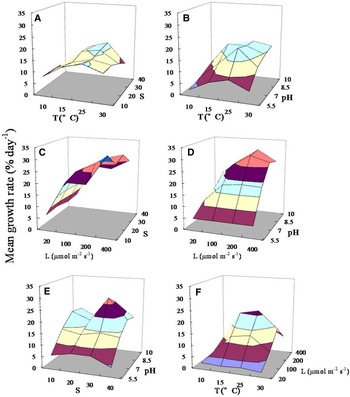
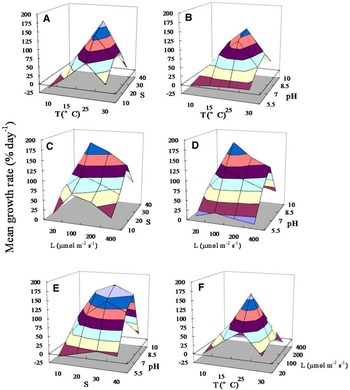
As summarized in Table 1, significant group variances in MGU were observed in three of the two-factor combination experiments: temperature-salinity, temperature-pH and temperature-irradiance. There was a significant temperature × irradiance interaction, but not significant temperature × pH or temperature × salinity interactions. The optimal temperature range for growth of U. pertusa was 20–25°C (Figure 2A, B, F). MGH also differed significantly with temperature changes, and significant interactions with temperature were observed in the MGH data (Table 2). The optimal temperature for growth of H. akashiwo was 25°C (Figure 3A, B, F).
Mean growth rates of Ulva pertusa in two-factor combination experiments wherein two of the following variables were changed across groups in each experiment: temperature (T), salinity (S, g kg−1), irradiance (L), and pH. Mean values are plotted (N = 3 replicates per group).

Mean growth rates of Heterosigma akashiwo in two-factor combination experiments wherein two of the following variables were changed across groups in each experiment: temperature (T), salinity (S, g kg−1), irradiance (L) and pH. Mean values are plotted (N = 3 replicates per group).

Effects of varying two-factor combinations of temperature (T), salinity (S), irradiance (L) and pH (P) on mean growth rates of U. pertusa.

Effects of varying two-factor combinations of temperature (T), salinity (S), irradiance (L) and pH (P) on mean growth rates of H. akashiwo.

Effects of salinity on algal growth rates in two-factor combination experiments
MGU differed significantly between the groups in the salinity-pH combination experiment, but not in the salinity-temperature or salinity-irradiance experiments. Similarly, a significant interaction between varied factors in the MGU data was observed only in the salinity-pH combination experiment (Table 1). The macroalgae grew in all levels of salinity, but the optimal salinity for U. pertusa growth was 30 g kg−1 (Figure 2A, C, E). In contrast to MGU, MGH varied significantly in all two-factor experiments in which salinity was one of the varied factors (Table 2). The optimal salinity for H. akashiwo growth was 30 g kg−1 (Figure 3A, C, E).
Effects of irradiance on algal growth in two-factor combination experiments
MGU differed significantly across groups in three of the two-factor combination experiments involving irradiance. Significant irradiance × pH and irradiance × temperature interactions were observed (Table 1). Optimal growth of U. pertusa was observed when irradiance was in the PPFD range of 200–400 µmol m−2 s−1 (Figure 2C, D, F). Similarly, MGH differed significantly in relation to irradiance (Table 2). Optimal growth of H. akashiwo was observed with an irradiance PPFD of 100 µmol m−2 s−1 (Figure 3C, D, F).
Effects of pH on the algal growth in two-factor combination experiments
MGU differed significantly across groups when pH was one of the two varied factors (Table 1). Significant pH × irradiance and pH × salinity interactions were observed in the MGU data (P < 0.001). Optimal U. pertusa growth occurred when pH was in the range of 8.5–10 (Figure 2B, D, E). MGH responsivity to pH in the two-factor experiments was similar to that of MGU, except that a pH × temperature interaction was also observed (Table 2). The optimal pH for H. akashiwo growth was 8.5 (Figure 3B, D, E).
Effects of non-nutrient factors on macroalgal inhibition of microalgal growth in two-factor combination experiments
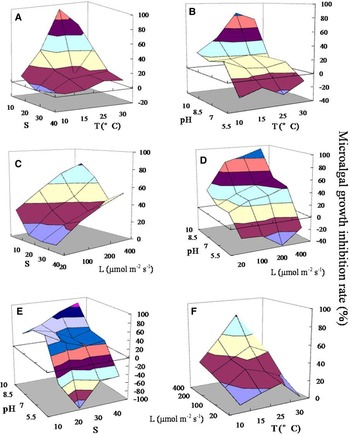
With the exception of the interactions in the irradiance-salinity manipulations, all treatment effects and all interaction effects were highly significant (Table 3; P < 0.001). Optimal MIMG was associated, generally, with a temperature of 25°C, salinity of 10 g kg−1 (except for pH-salinity, in which optimal salinity was 40 g kg−1), an irradiance level of 400 µmol m−2 s−1 and a pH of 10 (Figure 4). It is noteworthy that the inhibition rate was negative when the pH was 5.5 in three experiments involving pH manipulation, indicating that the macroalgae had a stimulating effect (of ~30–90%) on microalgal growth under acidic conditions (Figure 4B, D, E).
Inhibition of Heterosigma akashiwo growth by Ulva pertusa in two-factor combination experiments wherein two of the following variables were changed across groups in each experiment: temperature (T), salinity (S, g kg−1), irradiance (L) and pH. Mean values are plotted (N = 3 replicates per group).

Effects of varying two-factor combinations of temperature (T), salinity (S), irradiance (L) and pH (P) on U. pertusa inhibition of H. akashiwo growth.

DISCUSSION
In the present study, we conducted laboratory experiments under controlled environmental conditions, in which nutrient competition, light competition and possible bacterial effects were mitigated, to investigate the impact of non-nutrient environmental factors on the growth inhibitory effects of U. pertusa on H. akashiwo. We found that the growth inhibitory efficacy of the macroalgae on the microalgae was modulated by temperature, salinity, irradiance and pH. The present two-factor combination experiments pointed to the following parameters as optimal for U. pertusa inhibition of H. akashiwo growth: moderate temperature (25°C); low salinity (10 g kg−1); high irradiance (400 µmol m−2 s−1); and a highly alkaline pH (10).
Ulva pertusa can reduce eutrophication of mariculture waters and improve water quality; and polyculture with U. pertusa can improve the productivity, survival rate, and feeding coefficient of culture species, such as prawn and shrimp (Jin & Dong, Reference Jin and Dong2003; Tang & Gobler, Reference Tang and Gobler2011; Ye et al., Reference Ye, Liao and Yang2014). Our results demonstrate that harmful microalgae blooms in confined mariculture areas can be mitigated with U. pertusa polyculture. Moreover, when people use the macroalgae in marine polycultures in aquaculture factories, non-nutrient environmental factors of the culture water can be adjusted to optimize the HAB mitigating effects of the macroalgae.
Our findings are consistent with recent studies demonstrating that Ulva species, including U. fasciata, U. pertusa and U. linza, can have strong growth-inhibiting effects on H. akashiwo, Alexandrium tamarense and Prorocentrum micans (Jin & Dong, Reference Jin and Dong2003; Jin et al., Reference Jin, Dong and Wang2005; Wang et al., Reference Wang, Yu, Song, Tang and Zhang2007; Nan et al., Reference Nan, Zhang, Lin, Zhao and Liu2008). Additionally, polyunsaturated fatty acids (PUFAs) and organosulphur compounds have been implicated as potential allelopathic agents for Ulva species in three studies (Alamsjah et al., Reference Alamsjah, Hirao, Ishibashi and Fujita2005, Reference Alamsjah, Hirao, Ishibashi, Oda and Fujita2008; Tang & Gobler, Reference Tang and Gobler2011). Importantly, in natural ecosystems, the mechanisms by which Ulva inhibit HABs may include allelopathy, nutrient scavenging, algicidal bacteria, and pH changes (Schmidt & Hansen, Reference Schmidt and Hansen2001; Tang & Gobler, Reference Tang and Gobler2011).
It should be noted that the effectiveness of allelopathic chemicals does not necessarily coincide with the optimal growth conditions for the allelochemical donor organism. Rather, the allelopathic effects of aquatic organisms are generally enhanced under stressful conditions (e.g. disadvantageous environmental factors or nutrient limitations). There are two explanations for this phenomenon: (1) the allelochemical donor organism may augment productivity of allelochemicals when stressed; and/or (2) target organisms may be more sensitive when stressed (Gross, Reference Gross2003; Gross et al., Reference Gross, Hilt, Lombardo and Mulderij2007).
Temperature and salinity
Intertidal and coastal algae often experience extreme temperature and rapid salinity changes (Kakinuma et al., Reference Kakinuma, Coury, Kuno, Itoh, Kozawa, Inagaki, Yoshiura and Amano2006; Cade-Menun & Paytan, Reference Cade-Menun and Paytan2010; Martinez et al., Reference Martinez, Orive, Laza-Martinez and Seoane2010; Butron et al., Reference Butron, Madariaga and Orive2012). Temperature is a key factor in the growth and physiology of all aquatic organisms, and salinity is very important for the growth of the macroalgae U. pertusa and the microalgae H. akashiwo (Kakinuma et al., Reference Kakinuma, Coury, Kuno, Itoh, Kozawa, Inagaki, Yoshiura and Amano2006; Shikata et al., Reference Shikata, Nagasoe, Matsubara, Yamasaki, Shimasaki, Oshima and Honjo2007; Martinez et al., Reference Martinez, Orive, Laza-Martinez and Seoane2010; Butron et al., Reference Butron, Madariaga and Orive2012).
Our results showed that maximal inhibition of H. akashiwo growth by U. pertusa occurred at 25°C, which was also the optimal growth temperature for both species. Temperature affects enzyme activity, thereby potentially modulating a variety of biochemical processes including nitrogen absorption, which is essential for photosynthesis and respiration in algae (Lomas & Glibert, Reference Lomas and Glibert1999). Kakinuma et al. (Reference Kakinuma, Coury, Kuno, Itoh, Kozawa, Inagaki, Yoshiura and Amano2006) observed that thermal stress influenced protein and amino acid (AA) metabolism in sterile U. pertusa, suggesting that carbon and nitrogen metabolism in the macroalgae may be temperature-sensitive. The observed changes in metabolism could also be due to the formation of dormant H. akashiwo cells at extreme temperatures (Han et al., Reference Han, Kim and Cattolico2002; Martinez et al., Reference Martinez, Orive, Laza-Martinez and Seoane2010; Butron et al., Reference Butron, Madariaga and Orive2012), and such dormant cells may be more tolerant of allelochemicals secreted by U. pertusa.
Our observations of strong microalgal growth inhibition under low-salinity conditions may be due to the loss of cell walls around H. akashiwo cells (Guo, Reference Guo1994; Shikata et al., Reference Shikata, Nagasoe, Matsubara, Yamasaki, Shimasaki, Oshima and Honjo2007), and/or a general weakening of the structure and physiology of microalgal cells under low-salinity conditions that renders them highly sensitive to allelopathic influences. Secondly, the photosynthetic activity of U. pertusa may be suppressed under high-salinity conditions (Kakinuma et al., Reference Kakinuma, Coury, Kuno, Itoh, Kozawa, Inagaki, Yoshiura and Amano2006), which would make the macroalgae reduce allelochemical secretion. Finally, it is also possible that high salinity has severe effects on the carbon and nitrogen metabolism of the macroalgae (Kakinuma et al., Reference Kakinuma, Coury, Kuno, Itoh, Kozawa, Inagaki, Yoshiura and Amano2006), such that synthesis of allelochemicals in U. pertusa is disturbed.
Temperature and pH
Marine plants need CO2 or HCO3 − to sustain photosynthesis, and pH affects the dynamic equilibrium of CO2 and HCO3 − in seawater (Menéndez et al., Reference Menéndez, Martínez and Comín2001; Valenti et al., Reference Valenti, James, Lahousse, Schug, Roelke, Grover and Brooks2010; Kim et al., Reference Kim, Spivack and Menden-Deuer2013). Over at least the past 250 years, increasing atmospheric CO2 has resulted in a net uptake of CO2 by the surface waters of the oceans and increasing ocean temperature. The dissolution of anthropogenic CO2 leads to increasing carbonic acid (H2CO3) and carbonate (CO3 2−) ions with a decreasing pH, which is a phenomenon termed ocean acidification (Hofmann et al., Reference Hofmann, Barry, Edmunds, Gates, Hutchins, Klinger and Sewell2010; Kim et al., Reference Kim, Spivack and Menden-Deuer2013).
In this study, the macroalgae U. pertusa tolerated all temperature and pH levels tested (5.5–10), similar to previous results (Menéndez et al., Reference Menéndez, Martínez and Comín2001). However, H. akashiwo showed a relatively narrower temperature and pH tolerance, with dramatic decreases in its growth rate being observed under low pH (5.5) and high pH (10) conditions.
Strong macroalgal inhibition of microalgal growth was observed under highly alkaline conditions (pH 10). This phenomenon could be related to the increasing influence of high pH on the cellular carbon and nitrogen quotas of H. akashiwo (Kim et al., Reference Kim, Spivack and Menden-Deuer2013). We also hypothesized that U. pertusa increased productivity of allelochemicals, or there was an enhanced effectiveness of the allelochemicals, at high pHs. That is, alkalinity may disrupt the physiology of microalgal cells such that they are rendered highly sensitive to macroalgal influences. Valenti (Reference Valenti2010) proposed that pH can change the ionization of allelochemicals, and thereby influence the lipophilicity, bioavailability, bioaccumulation and aquatic toxicity of allelochemicals. Further research is needed to test this hypothesis.
Regardless of the mechanisms underlying the effects of pH on macroalgal inhibition of microalgal growth, our observation that alkalinity favours allelopathic inhibition of H. akashiwo growth is consistent with prior research. Schmidt & Hansen (Reference Schmidt and Hansen2001) investigated the impact of pH on the effectiveness of the allelopathic chemicals of Chrysochromulina polylepis on Heterocapsa triquetra. They found that the allelopathic effects of C. polylepis were strongest under alkaline conditions (pH, 8.9–9.6) but not detectable at a near-neutral pH (7.7). Likewise, Ray & Bagchi (Reference Ray and Bagchi2001) reported that the productivity of allelochemicals secreted by the cyanobacteria Oscillatoria laetevirens was increased under highly alkaline conditions. Recently, Valenti et al. (Reference Valenti, James, Lahousse, Schug, Roelke, Grover and Brooks2010) found that both temperature and pH influenced the toxicity of Prymnesium parvum. Toxins released by P. parvum were more potent when exposure occurred at a higher (e.g. 8.5) vs a lower pH. They suggested that the presence of a higher proportion of prymnesins in non-ionized forms at a pH of 8.5 could explain the greater toxicity of P. parvum; the same principle might explain the efficacy of U. pertusa's allelochemicals under alkaline conditions as well.
It is noteworthy that under acidic conditions (pH 5.5), the presence of macroalgae stimulated microalgal growth, because photosynthesizing macroalgae increased the pH of the culture medium, making it more hospitable to the microalgae (Tang & Gobler, Reference Tang and Gobler2011). Additionally, it is possible that a low pH lowers the allelochemical productivity of U. pertusa or reduces the effectiveness of its allelochemicals.
Irradiance and salinity
Light has a complex distribution pattern in natural aquatic systems. Both low and high light intensities can limit algal growth due to their effects on photosynthesis. At low light intensities, algae may not receive sufficient energy to meet their physiological needs, whereas high light intensities can cause photoinhibition (Cade-Menun & Paytan, Reference Cade-Menun and Paytan2010).
In this work, interactions between irradiance and salinity had a significant impact on the growth rates of the microalgae H. akashiwo, but not on the growth rates of the macroalgae U. pertusa or the macroalgae's allelopathic inhibition of H. akashiwo growth. A high level of inhibition of microalgal growth was observed under high-irradiance, low-salinity conditions. Light intensity is expected to affect the abundance of proteins and lipids in algae (Cade-Menun & Paytan, Reference Cade-Menun and Paytan2010). Given the hypothesis that PUFAs are active allelopathic agents of Ulva (Alamsjah et al., Reference Alamsjah, Hirao, Ishibashi and Fujita2005, Reference Alamsjah, Hirao, Ishibashi, Oda and Fujita2008; Tang & Gobler, Reference Tang and Gobler2011), an increased abundance of lipids in Ulva under high light intensities may elevate PUFA production. Moreover, Ulva can osmoregulate by altering tissue water content and K+ concentration (Cohen & Fong, Reference Cohen and Fong2004), but H. akashiwo cannot maintain normal growth under low-salinity conditions (Martinez et al., Reference Martinez, Orive, Laza-Martinez and Seoane2010), making the microalgae more susceptible to macroalgal influences.
We also hypothesized that photochemical reactions of the allelochemicals under high levels of irradiance might enhance their effectiveness. Consistent with this possibility, Sun et al. (Reference Sun, Yu and Yu1989) demonstrated that the productivity and secretion of algicides by Eichhornia crassipes were inhibited when its roots were exposed to high levels of irradiance. However, this hypothesis should be tested directly.
Irradiance and pH
Under low-irradiance and low-pH conditions, U. pertusa sustained good growth whereas the growth of H. akashiwo was significantly inhibited. As discussed above, diminished microalgal growth under low-irradiance conditions could be due to reduced photosynthesis (Yan et al., Reference Yan, Zhou and Qian2002; Shikata et al., Reference Shikata, Nagasoe, Matsubara, Yamasaki, Shimasaki, Oshima and Honjo2007; Butron et al., Reference Butron, Madariaga and Orive2012); and acidic conditions could produce structural compromise (Guo, Reference Guo1994; Shikata et al., Reference Shikata, Nagasoe, Matsubara, Yamasaki, Shimasaki, Oshima and Honjo2007).
The most pronounced inhibition of microalgal growth occurred under high-irradiance (400 µmol m−2 s−1), highly alkaline (pH 10) conditions. Butron et al. (Reference Butron, Madariaga and Orive2012) found that when the irradiance level reached 300 µmol m−2 s−1, H. akashiwo would develop a photoprotective response that was associated with slowed growth. However, Ulva demonstrated robust growth in the presence of high irradiance up to ~2000 µmol m−2 s−1 (Henley et al., Reference Henley, Lindley, Levavasseur, Osmond and Ramus1992). Different photoinhibition thresholds of U. pertusa and H. akashiwo may account for this phenomenon. Moreover, it is possible that the mechanisms of the microalgal growth inhibition by the macroalgae are strengthened in high pH conditions, as discussed above.
Salinity and pH
Maintenance of cell turgor by alteration of osmotic potentials, which are determined by concentrations of internal inorganic ions and organic osmolytes, is a typical salinity tolerance mechanism in marine algae (Kakinuma et al., Reference Kakinuma, Coury, Kuno, Itoh, Kozawa, Inagaki, Yoshiura and Amano2006). To our knowledge, experiments combining salinity and pH manipulations in aquatic ecosystems are rare. In this study, the microalgal cells likely could not sustain sufficient osmotic pressure under low- and high-salinity conditions to thrive (Yan et al., Reference Yan, Zhou and Qian2002; Martinez et al., Reference Martinez, Orive, Laza-Martinez and Seoane2010). Microalgal growth was inhibited most strongly by the macroalgae under high-salinity (40 g kg−1), highly alkaline (pH 10) conditions. It is reasonable to suppose that the structural integrity of the microalgal cells was compromised under these conditions, making them more susceptible to allelochemicals (Zhou et al., Reference Zhou, Wang and Yan2008; Valenti et al., Reference Valenti, James, Lahousse, Schug, Roelke, Grover and Brooks2010). Valenti et al. (Reference Valenti, James, Lahousse, Schug, Roelke, Grover and Brooks2010) concluded that increasing pH increases the potency of P. parvum-excreted toxins over a wide range of salinities. In a study examining interactions between plankton and the cyanobacterium Anabaena, Engstr et al. (Reference Engstr, Repka and Mikkonen2011) found that the growth and toxin production of Anabaena varied with salinity, suggesting that the salinity of open water areas might affect the allelopathy of aquatic organisms.
Temperature and irradiance
It has been demonstrated that allelopathic inhibition of terrestrial plant growth is enhanced in environments with a high temperature and high light intensity (Lobon et al., Reference Lobon, Gallego, Diaz and Garcia2002). The allelopathic effect has been reported to be temperature sensitive, and to be further enhanced when a high temperature is combined with high light intensity (Lobon et al., Reference Lobon, Gallego, Diaz and Garcia2002).
Our results demonstrated that the macroalgae U. pertusa grew under all conditions of the two-factor combination experiments, whereas the growth of the microalgae H. akashiwo was inhibited dramatically (near zero growth) under extreme temperature and irradiance conditions. Inhibition of photosynthesis in microalgal cells might explain this phenomenon to some extent (Yan et al., Reference Yan, Zhou and Qian2002; Zhou et al., Reference Zhou, Wang and Yan2008; Cade-Menun & Paytan, Reference Cade-Menun and Paytan2010; Butron et al., Reference Butron, Madariaga and Orive2012).
Microalgal growth was inhibited most strongly by macroalgae under moderate-temperature (25°C), high-irradiance (400 µmol m−2 s−1) conditions. There are several possible explanations for this finding. Firstly, photoinhibition at high light intensities will limit the total C that can be fixed by microalgae, thus affecting the abundance of proteins and lipids (Cade-Menun & Paytan, Reference Cade-Menun and Paytan2010). Decreased levels of internal proteins and lipids in H. akashiwo may damage the physiological functions of the microalgae, resulting in less growth. Secondly, high temperature stress can alter lipid composition in algae, particularly the degree of fatty acid saturation (Cade-Menun & Paytan, Reference Cade-Menun and Paytan2010). As discussed above, if PUFAs were potential active allelopathic agents of U. pertusa, increments in temperature may decrease PUFA saturation, thereby elevating the algicidal activities of PUFAs derived from the macroalgae (Alamsjah et al., Reference Alamsjah, Hirao, Ishibashi and Fujita2005, Reference Alamsjah, Hirao, Ishibashi, Oda and Fujita2008). Finally, (relatively) high temperature and high irradiance acted together to suppress the photosynthetic efficiency and capacity of H. akashiwo, much more than temperature or irradiance alone, resulting in microalgal growth inhibition (Henley et al., Reference Henley, Lindley, Levavasseur, Osmond and Ramus1992).
CONCLUSIONS
The present results demonstrate that the environmental factors of temperature, salinity, irradiance, and pH affect the growth of U. pertusa and H. akashiwo and the magnitude of macroalgal effects on microalgae. Ulva pertusa's inhibition of H. akashiwo growth was favoured under extreme conditions, including low salinity, high irradiance and high pH. These findings demonstrate that non-nutrient environmental factors have a pronounced importance in determining the growth inhibitory effects of macroalgae upon microalgae, and contribute to the understanding of the allelopathic potential of Ulva. Maintenance of appropriate levels of non-nutrient environmental factors in confined areas should be helpful in mitigating HABs by facilitating the allelopathic effects of aquatic macrophytes and macroalgae.
ACKNOWLEDGEMENTS
The authors thank Professor Taniguchi for his kind provision of U. pertusa and Dr Zhikui Hao for his substantial advice on this work.
FINANCIAL SUPPORT
This study was supported by the Program of Marine Biological Resources Exploitation and Utilization of Science and Technology Innovation Team of Taizhou No. MBR2012053 (Document of CPC Taizhou Municipal Committee Office of Zhejiang Province No. [2012] 58).