




No CrossRef data available.
Article contents
Effects of the increase in co-payments from 20 to 30 percent on the compliance rate of patients with hypertension or diabetes mellitus in the Employed Health Insurance System
Published online by Cambridge University Press: 26 April 2005
Abstract
Objectives: How to contain medical expenditures is a universal problem. The Japanese government has increased patient co-payments to control it. The purpose of this study is to clarify whether the increase in co-payments to 30 percent prevented patients with hypertension or diabetes mellitus from receiving necessary care in the Employee Health Insurance System.
Methods: The subjects were 211 patients with hypertension and 66 patients with diabetes mellitus who regularly visited physicians from October 2001 to March 2002 and were defined as a cohort that needed health care, and their medical indicators were examined between April and September 2002 (prestage) and between April and September 2003 (poststage).
Results: In the hypertensive patients with no complications, the compliance rate was 89.9 percent and 88.0 percent in the prestage, and poststage, respectively, showing no significant change. In the hypertensive patients with complications, the compliance rate was 90.5 percent and 92.1 percent in the prestage and poststage, respectively, showing no significant change. In the diabetic patients with complications, the compliance rate was 77.5 percent and 79.2 percent, in the prestage and poststage, respectively, with no significant change. In the diabetic patients with no complications, however, the compliance rate was 83.7 percent and 66.7 percent, in the prestage and poststage, respectively. A significant decrease was observed among diabetic patients without complications.
Conclusions: Increasing co-payments reduced necessary preventive care in diabetic patients without complications.
Information
- Type
- RESEARCH REPORTS
- Information
- International Journal of Technology Assessment in Health Care , Volume 21 , Issue 2 , April 2005 , pp. 228 - 233
- Copyright
- © 2005 Cambridge University Press
The Employee Health Insurance System of Japan was established for the employed in 1922 and was enacted by the Health Insurance Law enforced in 1927 (13). Although the medical expenses of the insured have been covered almost fully, in principle, by the Health Insurance Plan for the Employee except for a fixed charge per medical services since its establishment, a 10 percent co-payment was introduced in October 1984, and it was increased to 20 percent in September 1997 (14). Also, because of the exacerbation of the financial situation of the health insurance system due to causes including the increase in the payments for the redistribution system for the elderly health-care costs (4), the co-payments were further increased to 30 percent in April 2003 (14).
In Japan, increasing the co-payment has been shown to reduce medical expenditures (3;7). However, although it reduces need for medical services, it has also been suggested to prevent early diagnosis and treatment of patients who need treatment (9). Many of the studies on the effects of the increase in co-payments suggested that physician visits concerning milder disorders were deterred more as the burden on the patients increased (1;10;12;15;16;18–20). Although hypertension and diabetes mellitus cause mild symptoms, they must be treated to prevent the occurrence of more-severe diseases, such as cerebrovascular disorders and heart diseases.
We have reported that the effect of the introduction of the 10 percent co-payment system in October 1984 exerted only temporary effects on outpatient visits of patients with hypertension (2) but that the increase in co-payments to 20 percent exerted permanent effects on the compliance rate of highly compliant patients with hypertension or and diabetes mellitus (5;6). In a study of the effects of the raise of the co-payments to 20 percent, we also demonstrated that the consultation rate was lower but that the service days were longer in a health insurance association with a lower standard monthly wage (6). This finding suggests that income has an affect on visits to medical institutions and that insured people with insufficient incomes visit physicians after the diseases become more severe. The aim of this study was to clarify whether the increase in co-payments to 30 percent introduced in April 2003 prevented hypertensive and diabetic patients from receiving necessary care by analyzing their health care indicators in the Employee Health Insurance System.
SUBJECTS AND METHODS
Of the individuals who lived in Fukuoka Prefecture and had been affiliated with the A Health Insurance Association from October 2001 to September 2003, 211 hypertensive patients and 67 diabetic patients who regularly visited physicians from October 2001 to March 2002 were defined as a cohort that needed health care, and their medical indicators were examined between April and September 2002 (prestage) and between April and September 2003 (poststage). One of the diabetic patients was excluded from analyses, because the number of visits in the first stage was unusually high (79 days); therefore, 211 hypertensive patients and 66 diabetic patients were analyzed.
Characteristics of the subjects were studied according to the medical bills for outpatient services in March 2002. The hypertensive patients who had cerebrovascular disorders, renal disorders, or ischemic heart disease, and the diabetic patients who had diabetic nephropathy, diabetic retinopathy, diabetic neuropathy, ischemic heart disease, or cerebrovascular disorders were regarded as having complications. The ages of the subjects as of January 1 2002 were used for the analyses.
The compliance rate, the mean of number of monthly outpatient visits, the mean monthly medical expenditure per patient were examined as indicators of health care. The compliance rate was expressed as the percentage of the months in which drugs were prescribed during the period in question. Because drugs could not be prescribed beyond 1 month until March 2002, the compliance could be estimated by examining the state of monthly visits of the patient. However, as the amendment of the Health Insurance Law in April 2002 made it possible to prescribe drugs for 3 months, the state of compliance thereafter was examined by checking monthly bills for outpatient services.
The subjects were divided into those with complications and those with no complications, and the values of each parameter were compared stage by stage. Statistical analysis was performed by paired t-test at the 0.05 level of significance.
RESULTS
Table 1 shows the gender and age distribution of the hypertensive patients. Complications were absent in 190 (90.0 percent) and present in 21 (10.0 percent). Of those with no complications, 147 (77.4 percent) were men and 43 (22.6 percent) were women. Of those with complications, nineteen (90.5 percent) were men and two (9.5 percent) were women. As for complications, twelve (57.1 percent) had heart diseases only, three (14.3 percent) had cerebrovascular disorders only, three (14.3 percent) had kidney disorders only, one (4.8 percent) had heart disease and kidney disorder, and two (9.6 percent) had cerebrovascular disorder and kidney disorder.

Table 2 shows the gender and age distribution of the diabetic patients. Complications were absent in forty-six (69.7 percent) and present in twenty (30.3 percent). Of those with no complications, forty (87.0 percent) were men and six (13.0 percent) were women. Of those with complications, seventeen (85.0 percent) were men and three (15.0 percent) were women. As for complications, three (15.0 percent) had heart diseases only, one (5.0 percent) had a kidney disorder only, five (25.0 percent) had retinopathy only, four (20.0 percent) had neuropathy only, two (10.0 percent) had kidney disorders and retinopathy, one (5.0 percent) had kidney disorders and neuropathy, three (15.0 percent) had neuropathy and retinopathy, and one (5.0 percent) had a kidney disorder, retinopathy, and neuropathy. Twenty patients were using insulin, and none was undergoing dialysis.

Table 3 shows changes in the compliance rate. In the hypertensive patients with no complications, the compliance rate was 89.9 percent, and 88.0 percent in the prestage and poststage, respectively, showing no significant change. In the hypertensive patients with complications, the compliance rate was 90.5 percent and 92.1 percent in the prestage and poststage, respectively, showing no significant change. In the diabetic patients with no complications, the compliance rate was 83.7 percent and 66.7 percent, in the prestage and poststage, respectively. A significant decrease was observed between prestage and poststage. In the diabetic patients with complications, however, the compliance rate was 77.5 percent, and 79.2 percent, in the prestage, and poststage, respectively, with no significant change.

Table 4 shows changes in the number of monthly outpatient visits. In the hypertensive patients with no complications, the number of outpatient visits was 1.6 and 1.6 in the prestage and poststages, respectively, with no significant change. In the hypertensive patients with complications, it was 1.6 and 1.5, respectively, showing a significant decrease from the prestage to the poststage with the increase in the co-payment rate from 20 percent to 30 percent. In the diabetic patients with no complications, the number of monthly outpatient visits was 1.2 and 1.1, respectively, with no significant change. In the diabetic patients with complications, it was 1.2 and 1.2, respectively, with no significant change.

Table 5 shows changes in the mean monthly medical expenditure (in thousands of yen). In the hypertensive patients with no complications, it was 13.9 ($116) and 13.9 ($116) in the prestage and poststages, respectively, with no significant change. In the hypertensive patients with complications, it was 19.9 ($166) and 19.2 ($160), respectively, with no significant change. In the diabetic patients with no complications, it was 17.0 ($142) and 16.3 ($136), in the prestage and poststages, respectively, with no significant change. In the diabetic patients with complications, it was 20.9 ($174) and 19.9 ($166), respectively, in the prestage and poststage with no significant change.

DISCUSSION
Who should bear the increasing medical expenditures, how they should be borne, and how they should be distributed when the gross national product is not expected to increase as it had in the past are important political problems of the 21st century shared by many countries. Especially in Japan, unprecedented aging of the population is already causing contemporary problems (11). Although need for medical services increases steadily with aging of the population, the percentage of medical expenditures in the gross national product cannot be increased infinitely.
Japan has chosen the policy of increasing the percentage of the medical expenditure burdened by individual patients to reduce the increases in medical expenditure overall. Whether such a policy has been adequate from the viewpoints of fairness and efficiency must also be evaluated. More specifically, evaluation of whether increases in the percentage of medical expenditure burdened by individual patients have affected the patients' attitude to necessary medical care is a very important problem. “Quantitative evidence” should be provided to people to obtain their understanding about the increases in co-payments burdened by individual patients.
The health indicators of 221 hypertensive patients and 66 diabetic patients who regularly consulted physicians from October 2001 to March 2002 were studied between April and September 2002 (prestage), and between April and September 2003 (poststage), when the co-payment rate was raised to 30 percent.
We adopted medical indicators from 1 year to 6 months before the co-payment increase as prestage, because we found an increase in outpatient visits during the 6-month period before the introduction of the 10 percent co-payment in our previous study of the 1984 system change (2).
After the co-payment increase to 30 percent, the compliance rate decreased significantly only in the diabetic patients with no complications. The number of outpatient visits decreased significantly after the increase in co-payment only in the hypertensive patients with complications, but no change was observed in the medical cost either in the hypertensive group or the diabetic group. The change in the number of outpatient visits is a protective response to reduce the burden of medical expenditure, and a decrease in the compliance rate is considered to be due to discontinuation of treatment in patients who needed medications. Discontinuation of treatment is a risky option for patients with complications, but no such response was noted in this study. However, in the diabetic patients with no complications, the compliance decreased by 17.0 percent after the increase in the co-payment rate to 30 percent, suggesting an effect on the willingness of the patients to request necessary care. This finding indicates that the effect of the increase in co-payments from 20 percent to 30 percent differed according to the disease and the presence or absence of complications.
At the increase in the co-payment rate to 20 percent, we also studied its effects on outpatient visits of subjects of the same health insurance association who were treated for hypertension or diabetes mellitus at least once a month from September 1996 to February 1997 (5;6). The study demonstrated that the increase deterred both hypertensive and diabetic patients from getting necessary care. The compliance rate decreased as much as 8 percent. The subjects of the present study are considered to be highly compliant, because they continued to consult physicians even after the increase in co-payments to 20 percent. The effect of the increase in co-payments to 30 percent on diabetic patients without complication is much more than that of the increase in co-payments to 20 percent.
In July 2002, we conducted an investigation concerning the increase in the co-payment rate scheduled to be enforced in 2003 in the same health insurance association (8). In this investigation, the subjects were asked to select the upper limit of monthly patient co-payments that they could be burdened for the treatment of hypertension or diabetes mellitus from “2,500 yen ($21),” “5,000 yen ($42),” “7,500 yen ($63),” “10,000 yen ($83),” “15,000 yen ($125),” and “above 15,000 yen ($125).” As a result, 67.9 percent of the insured replied that the monthly patient co-payments that they could afford was less than 5,000 yen ($42), and 5,000 yen ($42) was found to be the upper limit of the bearable monthly co-payments of the insured. It was reported that monthly outpatient expenditure of the hypertensive patients was approximately 15,000 yen ($125), and the 30 percent co-payment was 4,500 yen ($38), which was less than 5,000 yen ($42) (2). On the other hand, it was reported that monthly outpatient expenditure of the diabetic patients was approximately 25,000 yen ($208), and the 30 percent co-payment was 7,500 yen ($63), which exceeded 5,000 yen ($42) (2). It is possible that 30 percent patient co-payments exceed the threshold to reduce necessary care in highly complied diabetic patients without complications. Although blood pressure can be reduced consistently by medication in hypertensive patients, therapeutic effects are small in diabetic patients without changes in their lifestyle, including diet and exercise. This finding may have resulted in the judgment of the subjects that the effect of treatment is smaller for patient costs in diabetes mellitus than in hypertension. However, it would be difficult for diabetic patients with complications to stop treatment, because they would fear that it would worsen their complications.
Diabetic patients with no complications are less likely to feel the benefit of health care because of the absence of subjective complaints. However, these patients need examination and treatment, and treatment while the patients have no subjective symptoms has been shown to prevent future complications. An increase in co-payments to 30 percent may cause deterioration of the health of workers with chronic disorders with no marked subjective symptoms and lead to an increase in the social cost. In the management of patients with chronic disorders, who are less likely to realize the effect of treatment, follow-up measures to promote regular consultation after screening and to prevent discontinuation of treatment should be considered also at each workplace.
There are limitations in the study. First, this study is a time-sequence analysis, but the randomized controlled design is considered to be desirable for policy assessments. However, a randomized controlled study was impossible, because the increase in co-payment system was enforced as a national policy under the insurance-for-all-people principle of Japan. Second, diagnoses of hypertension and diabetes mellitus were based on health insurance claims. Finally, direct medical costs for concurrent conditions such as the common cold or chronic gastritis could not be excluded from the data on costs. However, these nondifferential misclassifications likely occurred randomly, unassociated with the prestage or the poststage (17).
CONCLUSIONS
The effect of the increase in the co-payment rate from 20 percent to 30 percent differed according to the disease and the presence or absence of complications. The compliance rate decreased significantly after the increase co-payments to 30 percent only in the diabetic patients with no complications. An increase in the co-payments to 30 percent may cause deterioration of the health of workers who have diabetes mellitus with no marked subjective symptoms and lead to an increase in the social cost.
Policy Implications
Increasing patient co-payments is one way to control rising health care costs. However, co-payments may reduce the quality of care among working diabetic patients without complications. The patients generally do not realize the preventive effects of the treatment. The condition of diabetes mellitus of working individuals will deteriorate, leading to higher medical and social costs in the long-term. Policy-makers should understand the adverse influences of increasing outpatient co-payments when developing cost-effective medical policies.
CONTACT INFORMATION
Akira Babazono, MD, MS, PhD (babazono@his.kyushu-u.ac.jp) Associate Professor, Institute of Health Science, Kyushu University, 6-1 Kasuga-koen, Kasuga City, Fukuoka, 816-0811, Japan
Motonobu Miyazaki, MD, PhD (motonobu@cis.fukuoka-u.ac.jp), Associate Professor, Takuya Imatoh, MS (Imatoh@cis.fukuoka-u.ac.jp), Assistant Professor, Hiroshi Une, MD, PhD (une@cis.fukuoka-u.ac.jp), Professor, Department of Hygiene and Preventive Medicine, School of Medicine, Fukuoka University, 7-45-1 Nanakuma Jonan-ku, Fukuoka City, Fukuoka, 814-0180, Japan
Eiji Yamamoto, PhD (eiji@mis.ous.ac.jp), Professor, Department of Information Science, Okayama University of Science, 1-1 Ridai-cho, Okayama City, Okayama, 700-005, Japan
Toshihide Tsuda, MD, PhD (tsudatos@hotmail.com), Assistant Professor, Graduate School of Medicine, Okayama University, 2-5-1 Shikata-cho, Okayama City, Okayama, 700-8558, Japan
Kiyoshi Tanaka, MD (k.tanaka@jhnfa.org), Director, Management Office, Japan Health Food and Nutritional Food Association, 2-7-27 Tanisadohara-cho, Shinjuku-ku, Tokyo, 162-0842, Japan
Shinichi Tanihara, MD, PhD (taniyan@med.shimane-u.ac.jp), Associate Professor, Department of Public Health, School of Medicine, Shimane University, 89-1 Enya-cho Izumo City, Shimane, 693-8501, Japan
This study was funded by a grant-in-aid for scientific research from the Japanese Ministry of Health, Labor, and Welfare.
References
Anderson GM,
Brook R,
Williams A.
1991
A comparison of cost-sharing versus free care in children: effects on the demand for office-based medical care.
Med Care.
29:
890–
898.Google Scholar
Babazono A.
1990
The impact of partial cost sharing on the attitude of insured persons with hypertension.
Nippon Eiseigaku Zassi.
45:
849–
859
(in Japanese).Google Scholar
Babazono A,
Ogawa T,
Babazono T,
et al.
1991
The effect of a cost sharing provision in Japan.
Fam Pract.
8:
247–
252.Google Scholar
Babazono A,
Weiner J,
Tsuda T,
Mino Y,
Hillman AL.
1998
The effect of a redistribution system for elderly health care on the finance performance of Health Insurance Societies in Japan.
Int J Technol Assess Health Care.
14:
458–
466.Google Scholar
Babazono A,
Tsuda T,
Mino Y,
Miyazaki M,
Une H.
2002
The effect for patients with hypertension and diabetes mellitus on physician visits by increase in patient co-payments.
Jpn J Public Health.
49:
10:
321
(in Japanese).Google Scholar
Babazono A.
The effect of introduction of 20 percent co-payments on visits to physicians.
Scientific report for a grant-in-aid for scientific research from the Japan Ministry of Education, Science and Culture, Fukuoka, 2002 (in Japanese).
Babazono A,
Tsuda T,
Yamamoto E,
Mino Y,
Une H,
Hillman AL.
2003
Effects of an increase in patient co-payments on medical service demands of the insured in Japan.
Int J Technol Assess Health Care.
19:
465–
475.Google Scholar
Babazono A,
Miyazaki M,
Une H,
et al.
2004
A study on a reduction in visits to physicians after introduction of 30 percent co-payments in the Employee Health Insurance in Japan.
Indust Health.
42:
50–
56.Google Scholar
Folland S,
Goodman AC,
Stano M.
2001.
The economics of health and health care.
Upper Saddle River, NJ:
Prentice Hall;
Keeler EB,
Rolph JE.
1983
How cost sharing reduced medical spending of participants in the health insurance experiment.
JAMA.
249:
484–
490.Google Scholar
Kubota M,
Babazono A,
Aoyama H.
2000
Women's anxiety in old age and long-term care provision for the elderly.
Acta Med Okayama.
54:
75–
83.Google Scholar
Lohr KN,
Brook RH,
Kamberg CJ,
et al.
1986
Use of medical care in the Rand Health Insurance Experiment: Diagnosis- and service-specific analyses in a randomized controlled trial.
Med Care.
24:
72–
87.Google Scholar
2000
Ministry of Health and Welfare (MHW), Japan.
Hoken to Nenkin no Doko,
Tokyo:
Health and Welfare Statistics Association;
(in Japanese).
2000
Ministry of Health and Welfare (MHW), Japan.
Kokumin Eisei no Doko,
Tokyo:
Health and Welfare Statistics Association;
(in Japanese).
Newhouse JP,
Manning WG,
Morris CN,
et al.
1981
Some interim results of a controlled trial of cost sharing in health insurance.
N Engl J Med.
305:
1501–
1507.Google Scholar
O'Gray KF,
Manning WG,
Morris CN,
et al.
1985
The impact of cost sharing on emergency department use.
N Engl J Med.
313:
484–
490.Google Scholar
Rothman KJ,
Greenland S.
1998.
Modern epidemiology.
Philadelphia:
Lippincott-Raven Publisher;
Selby JV,
Frieman BH,
Swain BE.
1986;
Effect of a copayment on use of the emergency department in a health insurance organization.
N Engl J Med.
334:
635–
641.Google Scholar
Shapiro MF,
Ware JE,
Sherbourne CD.
1986
Effects of cost sharing on seeking care for serious and minor symptom: Results of a randomized controlled trial.
Ann Intern Med.
104:
246–
251.Google Scholar
Shekelle PG,
Rogers WH,
Newhouse JP.
1996
The effect of cost sharing on the use of chiropractic services.
Med Care.
34:
863–
872.Google Scholar

Age and Gender Distribution of Study Population with Hypertension

Age and Gender Distribution of Study Population with Diabetes Mellitus

Compliance Rates (1%) for Hypertension and Diabetes Mellitus

Number of Outpatient Visits for Hypertension and Diabetes Mellitus
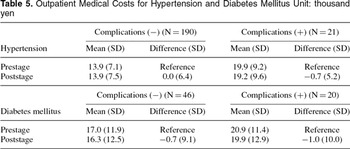
Outpatient Medical Costs for Hypertension and Diabetes Mellitus Unit: thousand yen
 You have
Access
- 21
- Cited by