INTRODUCTION
Stroke is one of the leading causes of long-term disability and death in the United States (Mozaffarian et al., Reference Mozaffarian, Benjamin, Go, Arnett, Blaha, Cushman and Huffman2016). Every year, approximately 795,000 people in the United States suffer strokes (Mozaffarian et al., Reference Mozaffarian, Benjamin, Go, Arnett, Blaha, Cushman and Huffman2016), and by 2050, the total number of incident strokes is expected to increase more than two-fold compared to 2010 (Howard & Goff, Reference Howard and Goff2012). This projected increase is due primarily to the increased older adult population size and diversity within the older adult population, as “baby boomers” and ethnic/racial minorities, which once comprised a large proportion of the younger population, are reaching stroke-prone ages (i.e., 45 years and older).
Blacks/African-Americans are the second largest racial/ethnic minority group in the United States, representing 13.2% of the total population (Colby & Ortman, Reference Colby and Ortman2015), and are disproportionally affected by stroke. Blacks are approximately twice as likely as non-Hispanic (NH) Whites to experience a first-ever ischemic (White et al., Reference White, Boden-Albala, Wang, Elkind, Rundek, Wright and Sacco2005) or hemorrhagic stroke (Kleindorfer et al., Reference Kleindorfer, Khoury, Moomaw, Alwell, Woo, Flaherty and Kissela2010), as well as recurrent strokes (Sheinart et al., Reference Sheinart, Tuhrim, Horowitz, Weinberger, Goldman and Godbold1998). Compared to NH Whites, Blacks also reportedly have more severe strokes (Jones et al., Reference Jones, Horner, Edwards, Hoff, Armstrong, Smith-Hammond and Oddone2000; Stansbury, Jia, Williams, Vogel, & Duncan, Reference Stansbury, Jia, Williams, Vogel and Duncan2005), worse functional recovery during hospitalization due to stroke as assessed by Functional Independence Measures (FIM) scores (Ottenbacher et al., Reference Ottenbacher, Campbell, Kuo, Deutsch, Ostir and Granger2008), and greater rates of mortality across all stroke sub-types (Ayala et al., Reference Ayala, Greenlund, Croft, Keenan, Donehoo, Giles and Marks2001).
Stroke and stroke symptoms are associated with neurocognitive impairment (NCI; Desmond et al., Reference Desmond, Moroney, Paik, Sano, Mohr, Aboumatar and Hauser2000; Desmond, Moroney, Sano, & Stern, Reference Desmond, Moroney, Sano and Stern2002; Levine et al., Reference Levine, Kabeto, Langa, Lisabeth, Rogers and Galecki2015; Tatemichi et al., Reference Tatemichi, Desmond, Paik, Figueroa, Gropen, Stern and Mayeux1993, Reference Tatemichi, Desmond, Stern, Paik, Sano and Bagiella1994; Wadley et al., Reference Wadley, McClure, Howard, Unverzagt, Go, Moy and Howard2007). However, specific rates of NCI among stroke survivors vary widely depending on a variety of factors, including the methods used to evaluate neurocognitive functioning, test score cutoffs used to indicate NCI, as well as the severity of stroke, the presence of vascular risk factors, and the age and education level of stroke survivors, among others (Sun, Tan & Yu, 2014). For example, Wadley et al. (Reference Wadley, McClure, Howard, Unverzagt, Go, Moy and Howard2007) found that older age, male gender, Black race, and less than a high school education were all associated with impaired neurocognitive status.
In addition, among Blacks, the risk of developing incident cognitive impairment has also been associated with reports of stroke symptoms and transient ischemic attacks (Kelley et al., Reference Kelley, McClure, Letter, Wadley, Unverzagt, Kissela and Howard2013). While NCI post-stroke is frequently mild (Sun et al., Reference Sun, Tan and Yu2014; Tatemichi et al., Reference Tatemichi, Desmond, Stern, Paik, Sano and Bagiella1994), even its milder forms have been linked to significant everyday cognitive functioning difficulties, including problems with medical decision making, financial management, and other activities of daily living (e.g., shopping, housework, driving, using public transportation) (Aretouli & Brandt, Reference Aretouli and Brandt2010; Baum et al., Reference Baum, Connor, Morrison, Hahn, Dromerick and Edwards2008; Edwards, Hahn, Baum, & Dromerick, Reference Edwards, Hahn, Baum and Dromerick2006; Pereira et al., Reference Pereira, Yassuda, Oliveira, Diniz, Radanovic, Talib and Forlenza2010; Schmitter-Edgecombe & Parsey, Reference Schmitter-Edgecombe and Parsey2014; Stephens et al., Reference Stephens, Kenny, Rowan, Kalaria, Bradbury, Pearce and Ballard2005). Problems in everyday functioning can compromise the independence, safety, and quality of life of stroke survivors as well as increase caregiver burden and community expenses (Aretouli & Brandt, Reference Aretouli and Brandt2010).
Even though NCI post stroke is common and impactful, and despite the disproportionate impact of stroke among Blacks, few studies have investigated racial differences in NCI among stroke survivors. The existing literature suggests that Blacks might be at increased risk for NCI (Patel, Coshall, Rudd, & Wolfe, Reference Patel, Coshall, Rudd and Wolfe2002), reduced cognitive recovery (Newman, Bang, Hussain, & Toole, Reference Newman, Bang, Hussain and Toole2007), and increased incident dementia (Desmond et al., Reference Desmond, Moroney, Sano and Stern2002) following stroke. In general, most of these studies have consisted of relatively large sample sizes, including large subgroups of Blacks. Cross-sectional studies examining neurocognition 3 months post stroke found increased NCI (defined as Mini-Mental State Examination [MMSE]<24) after first ever stroke (Patel et al., Reference Patel, Coshall, Rudd and Wolfe2002) and increased dementia (determined via clinical review based on a comprehensive neurocognitive battery and assessment of everyday functioning; Desmond et al., Reference Desmond, Moroney, Paik, Sano, Mohr, Aboumatar and Hauser2000) among Black stroke survivors compared to their NH White counterparts.
A longitudinal study that examined neurocognition within 3 months of stroke and at annual follow-up assessments found significantly less neurocognitive recovery over 2 years (Newman et al., Reference Newman, Bang, Hussain and Toole2007) among Blacks compared to NH Whites. Another longitudinal study found 47% of Blacks and 25% of Whites developed dementia over the course of the study (median follow-up=21.1 months) (Desmond et al., Reference Desmond, Moroney, Sano and Stern2002). While this racial difference was not significant in the multivariable models reported, the study was not focused on examining racial differences; thus, statistical models were not specifically constructed to address this question.
Overall, findings from these prior studies indicating worse outcomes post-stroke among Blacks highlight the importance of understanding the underlying mechanisms of racial differences. Neurocognitive studies to date, however, have used a single, screening measure of cognition (i.e., MMSE) or examined for dementia. Thus, they are unlikely to capture the milder, more prevalent forms of NCI. In addition, the MMSE has been found to be a suboptimal measure of NCI post-stroke (Nys et al., Reference Nys, Van Zandvoort, De Kort, Jansen, Kappelle and De Haan2005), and most prior studies lack adequate normative data or estimates of pre-morbid functioning, which are necessary to disentangle the impact of potential pre-stroke neurocognitive functioning. Importantly, none of the identified studies focused on determining factors that might help “explain” racial differences in NCI post stroke. Identifying these factors would be a major step toward the development and implementation of interventions aimed at reducing racial disparities post-stroke.
Differences in stroke characteristics, cardiovascular risk factors and premorbid functioning are likely to play a role in racial differences on NCI post-stroke. Additionally, poor healthcare, including suboptimal access, use and quality of health services, as well as worse health literacy, are potentially modifiable variables, which might exacerbate racial differences post-stroke. Previous research suggests that these healthcare variables are associated with differences in several health outcomes, and are important contributors to racial health disparities (Fiscella, Franks, Gold, & Clancy, Reference Fiscella, Franks, Gold and Clancy2000; Paasche-Orlow et al., Reference Paasche‐Orlow, Parker, Gazmararian, Nielsen‐Bohlman and Rudd2005; Waidmann & Rajan, Reference Waidmann and Rajan2000). Racial disparities in health literacy are well-documented (Kutner, Greenburg, Jin & Paulsen, Reference Kutner, Greenburg, Jin and Paulsen2006), and poor health literacy has been associated with worse health outcomes, including cognitive functioning among older adults (Federman, Sano, Wolf, Siu, & Halm, Reference Federman, Sano, Wolf, Siu and Halm2009; Kobayashi, Wardle, Wolf & Wagner, Reference Kobayashi, Wardle, Wolf and Wagner2015). Yet the role that health literacy might play in explaining racial disparities in NCI post-stroke has not been investigated. While the mechanisms linking health literacy and poor cognitive function are likely to be varied and bidirectional, among persons with stroke, worse health literacy might lead to worse healthcare practices pre-stroke and post-stroke, which in turn might impact neurocognitive recovery.
The objectives of the current study were two-fold: (1) to examine post-stroke differences in neurocognitive outcomes among stroke survivors who identify as either NH Black or NH White, using the NIH Toolbox-Cognition Battery (NIHTB-CB), which has extensive demographically adjusted normative data (including for race/ethnicity), includes estimates of premorbid functioning/quality of education, and allows for identification of milder deficits in cognitive domains and overall cognition; and (2) to investigate the potential roles of healthcare variables (i.e., health literacy, and healthcare access, use, and quality) in explaining any racial differences in neurocognitive outcomes post-stroke. We hypothesized that NH Blacks would show worse neurocognitive functioning than NH Whites, even after adjusting for stroke severity and estimates of premorbid functioning. Furthermore, we hypothesized that this difference in neurocognitive outcomes would be at least partly mediated by lower healthcare use and access, and lower health literacy among NH Blacks.
METHODS
Participants
Participants included in this analysis include 91 NH Black and 79 NH White adults with stroke who were enrolled in a multi-site study of medical rehabilitation outcomes among stroke, traumatic brain injury, and traumatic spinal cord injury survivors. Participants completed a comprehensive, 2-day assessment at two academic medical centers and one free-standing rehabilitation hospital in the Midwestern United States (located in St. Louis, Chicago, Ann Arbor). Participants were recruited via community outreach networks, registries, and flyers. Inclusion criteria for the multi-site study included medically documented diagnosis of stroke at least 1 year before enrollment; being 18 to 85 years of age; and being able to comprehend (5th grade reading level) and speak English.
Stroke survivors with significant aphasia as assessed by The Frenchay Aphasia Screening Test (Enderby, Wood, Wade, & Hewer, Reference Enderby, Wood, Wade and Hewer1987) were excluded. Eligibility for the current analysis required having a stroke diagnosis; self-identifying as NH Black or NH White; and having neurocognitive data available. All participants provided informed consent in compliance with the human subjects research institutional review boards at collaborating sites. Participants received an honorarium to acknowledge their contribution to the research.
MATERIALS AND PROCEDURES
Subjects completed comprehensive neurocognitive, stroke, and psychosocial assessments.
Neurocognitive Assessment
Neurocognitive function was measured using the NIHTB-CB. The details of the battery have been described elsewhere (Casaletto et al., Reference Casaletto, Umlauf, Beaumont, Gershon, Slotkin, Akshoomoff and Heaton2015; Heaton et al Reference Heaton, Akshoomoff, Tulsky, Mungas, Weintraub, Dikmen and Gershon2014; Weintraub et al., Reference Weintraub, Dikmen, Heaton, Tulsky, Zelazo, Bauer and Fox2013). In short, the battery includes five tests of “fluid cognition” assessing multiple cognitive domains that are vulnerable to acquired brain dysfunction (i.e., Picture Sequence Memory Task=episodic memory, Dimensional Change Card Sort Task=executive function/flexibility, Pattern Comparison Task=processing speed, Flanker Inhibitory Control and Attention Task=executive function/inhibitory control, and List Sorting Task=working memory).
In addition, the battery includes two tests of “crystallized cognition” that are less sensitive to acquired brain dysfunction and reflect past learning experiences (Oral Reading Recognition and Picture Vocabulary). The NIHTB-CB has extensive population-based normative data, and demographically adjusted T-scores (TS), which correct for age, gender, education, language, and race/ethnicity (Casaletto et al., Reference Casaletto, Umlauf, Beaumont, Gershon, Slotkin, Akshoomoff and Heaton2015). We used demographically adjusted Fluid Composite TS as our measure of global neurocognitive functioning or post-stroke functioning. This composite includes scores from all fluid tests, which are the most likely to be impacted by neurological conditions, such as stroke (Akshoomoff et al., Reference Akshoomoff, Beaumont, Bauer, Dikmen, Gershon, Mungas and Heaton2013; Heaton et al., Reference Heaton, Akshoomoff, Tulsky, Mungas, Weintraub, Dikmen and Gershon2014). Additionally, we used the Oral Reading Recognition TS as an indicator of reading level and estimate of premorbid functioning/quality of education (Weintraub et al., Reference Weintraub, Dikmen, Heaton, Tulsky, Zelazo, Bauer and Fox2013).
Stroke Characteristics
Stroke severity was classified with the FIM (Keith, Granger, Hamilton, & Sherwin, Reference Keith, Granger, Hamilton and Sherwin1987) and the NIH Stroke Scale (NIHSS) (Brott et al., Reference Brott, Adams, Olinger, Marler, Barsan, Biller and Hertzberg1989), and converted to the Modified Rankin Scale (MRS) to standardize classifications across measures. Strokes were classified as mild (scores of 1–2), moderate (scores of 3), or severe (scores of 4). Information on type of stroke (hemorrhagic/ischemic), post-stroke weakness, age at time of stroke, and family history of stroke was obtained via available medical records and/or self-report (see Table 1). Additionally, data on side of stroke (left or right cerebral hemisphere) and history of prior stroke was collected only at one of the sites (i.e., Washington University) via available medical records.
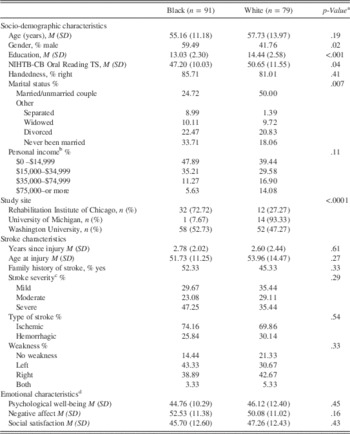
Socio-demographic, stroke, and psychiatric characteristics of the study cohort by racial group

a Results from independent sample t-tests and Chi-Square tests.
b Black: n=71; White: n=71; 19 participants (12 NH Black and 7 NH White) chose not to provide information on their income and 9 participants (8 NH Black and 1 NH White) did not know their income.
c Based on Modified Rankin Scale.
d Based on NIH Toolbox Emotion Battery.
Cardiovascular Risk
Data on cardiovascular risk factors (i.e., diabetes, hypertension, history of smoking) at the time of hospitalization for stroke was collected for the participants recruited at Washington University (54 NH Black and 44 NH White), and was ascertained via self-report and review of available medical records.
Socio-demographic Characteristics
Socio-demographic data, including age, gender, education, race/ethnicity, handedness, marital status, and income, were ascertained via self-report. Race/ethnicity was ascertained following NIH guidelines and consistent with the U.S. Census Bureau and National Institutes of Health methodology (Evans, Reference Evans2015).
Health Literacy
Health literacy was measured with the short form version of the Talking Touchscreen Technology (Health LiTT) assessment (Hahn, Choi, Griffith, Yost, & Baker, Reference Hahn, Choi, Griffith, Yost and Baker2011; Yost et al., Reference Yost, Webster, Baker, Jacobs, Anderson and Hahn2010). Subjects respond to three types of health related multiple-choice questions: prose (reading comprehension), document (identify and interpret information presented in charts, graphs, or tables), and quantitative (perform arithmetic operations). This assessment is in a self-administered, multimedia, multiple-choice format with one correct response. The health LiTT assessment has acceptable internal consistency (Cronbach’s alpha=0.73) and scores on the assessment have adequate convergent validity with scores on other commonly used measures of health literacy (i.e., Rapid Estimate of Adult Literacy in Medicine, Test of Functional Health Literacy in Adults, and Newest Vital Sign) (Davis et al., Reference Davis, Crouch, Long, Jackson, Bates, George and Bairnsfather1991; Parker, Baker, Williams, & Nurss, Reference Parker, Baker, Williams and Nurss1995; Weiss et al., Reference Weiss, Mays, Martz, Castro, DeWalt, Pignone and Hale2005).
Healthcare Access, Use, and Quality
Healthcare data, including items regarding healthcare access, use, and quality, were ascertained via self-report. The items comprising the healthcare assessments were informed by the Consumer Assessment of Healthcare Providers and Systems (CAHPS) survey item content (Dyer, Sorra, Smith, Cleary, & Hays, Reference Dyer, Sorra, Smith, Cleary and Hays2012; Hargraves, Hayes, & Cleary, Reference Hargraves, Hays and Cleary2003; Hays et al., Reference Hays, Shaul, Williams, Lubalin, Harris-Kojetin, Sweeny and Cleary1999). In the current study, a limited number of items were included; thus, it is not fully representative of the CAHPS survey. Please refer to Table 2 for specific items and response options. Items assessing healthcare access examined content such as the type of insurance benefits held by participants, the degree to which participants believed they had a choice in selecting their medical care and whether participants neglected to seek care for a medical problem or needed care but could not afford it in the year before enrollment.
Healthcare characteristics of the study cohort by racial group

Note. Values represent percentages unless otherwise noted.
a Results from independent sample t-tests and Chi-Square tests (or Fisher’s exact test).
b Quality of healthcare items concern the last doctor’s visit (i.e., “Last time you saw a doctor”).
ER=emergency room; SDI=State Disability; SS=Social Security; SSI=Supplemental Security Income.
Participants were provided six response options to the type of insurance benefits item: (1) Supplemental Security Income (SSI), State Disability Insurance (SDI), or Social Security (SS); (2) Medicaid; (3) Medicare; (4) services from an independent living center; (5) other; and (6) I prefer not to answer. We consolidated the latter two options into one category that we termed “Other (including private)” because of the type of response options and the low numbers of responses in the last category (n=2). Items examining healthcare use assessed participants’ use of healthcare, including how long it had been since their last doctor visit, whether they had seen a doctor in the 12 months before assessment, whether they had a regular source of care, and if so, the type of facility from which they receive care. Healthcare quality items assessed participants’ perceptions of healthcare quality indicators from their last doctor’s visit, including how much the doctor listened to them, how much they understood what the doctor expressed, whether they had questions they refrained from asking, the degree of confidence they had in their doctor, their satisfaction with the degree of involvement they had in decisions pertaining to their health, and their satisfaction with the amount of time the doctor spent with them.
NIH Toolbox Emotion Battery
Emotional functioning was assessed with the Toolbox Emotion Battery. The emotion battery was created to develop a set of measures that is sensitive to changes in health status and function over time (Salsman et al., Reference Salsman, Butt, Pilkonis, Cyranowski, Zill, Hendrie and Lai2013). Through self-report surveys, the battery assesses multiple emotional domains: with factor analysis-derived composites of psychological well-being, negative affect, and social satisfaction (Babakhanyan, Casaletto, & Heaton, Reference Babakhanyan, Casaletto and Heaton2015; Babakhanyan, McKenna, Casaletto, & Heaton, Reference Babakhanyan, McKenna, Casaletto and Heaton2016; Salsman et al., Reference Salsman, Butt, Pilkonis, Cyranowski, Zill, Hendrie and Lai2013).
Statistical Analyses
We contrasted groups on socio-demographic, stroke, psychiatric and healthcare characteristics via independent sample t tests for continuous variables and Chi-Square tests (or Fisher’s exact test) for categorical data. To examine racial differences in neurocognitive function post-stroke, we first ran a series of independent sample t tests by race on demographically corrected (including for race/ethnicity differences in normals) Fluid Composite T-scores and for each of the individual tests comprising this composite score. To investigate whether any racial differences in neurocognitive function might be accounted for by differences in other socio-demographic, stroke characteristics or emotional functioning, we examined the effects of potential covariates by running a multivariable linear regression model on Fluid T-scores with race (NH Black/White) as a predictor and adjusting for covariates that differed significantly between groups (listed in Table 1) and were associated with Fluid T-scores at p<.05. Given that Fluid T-scores already are adjusted for age, gender, and education, as well as race/ethnicity, these variables were not included as covariates.
To investigate the impact of healthcare characteristics (health literacy, healthcare use and access, quality of healthcare, and satisfaction with healthcare) we first ran separate multivariable regression models on Fluid T-scores including race, and each of the healthcare variables that differed between groups, and adjusting for significant covariates. For the healthcare variables that were significantly associated with Fluid T-scores in these analyses (i.e., health literacy and insurance type), we investigated whether they might help explain or mediate racial differences in neurocognitive function. To do so, we conducted separate path analyses for health literacy and insurance type, while adjusting for significant covariates.
The path analysis for health literacy also considered the effect of insurances status, and vice versa. We used estimation methods described by Preacher and Hayes for continuous mediators (i.e., health literacy) and causal mediation analyses by Imai et al. for binary mediators (i.e., insurance type; Imai, Keele & Tingley, Reference Imai, Keele and Tingley2010; Preacher & Hayes, Reference Preacher and Hayes2004; Tingley, Yamamoto, Hirose, Keele, & Imai, Reference Tingley, Yamamoto, Hirose, Keele and Imai2014). The first approach estimated the path coefficients in a mediator model and generated bootstrap confidence intervals (CIs, for bootstrapping, 1000 samples were requested) for total and specific indirect effects of race on neurocognitive function through health literacy, adjusting for insurance type, cognitive reserve (Oral Reading) and stroke severity. The latter approach used bootstrap CIs (1000 samples) for the total, direct, and specific indirect effects of race on neurocognitive function through insurance type, adjusting for health literacy, cognitive reserve, and stroke severity.
RESULTS
Socio-demographic, Assessment Location, Stroke, and Psychosocial Characteristics of the Study Cohort by Racial Group
Table 1 shows socio-demographic, assessment location, stroke, and psychosocial/emotion characteristics of the study cohort by racial group. There were significant differences in the racial composition of groups recruited across sites. While the sample collected at Washington University in St. Louis was nearly half NH Black and half NH White, only a quarter of the participants recruited at the Rehabilitation Institute of Chicago were NH Whites and virtually all participants from the University of Michigan were NH Whites. NH Blacks were more likely than NH Whites to be male, unmarried, have fewer years of education, and lower reading level (estimated by Oral Reading T-score). Racial groups were comparable in age and handedness.
There were no significant differences in stroke or psychosocial characteristics between racial groups: both groups primarily had ischemic strokes and on average reported mildly reduced psychological well-being and social satisfaction. Results on a subset of participants (NH Blacks: n=54; NH Whites: n=44) with available data showed that NH Blacks were more likely to report a history of hypertension (Black=81%, White=57%; p<.01) and smoking (NH Black=57%, NH White=20%; p<.001) than NH Whites. NH Blacks were less likely to report a history of previous transient ischemic attack than NH Whites (TIA; NH Black=4%, NH White=18%; p=.04), but there were no racial differences on reported prior history of stroke (NH Black=30%, NH White=32%; p=.82).
Neurocognitive Performance by Racial Group
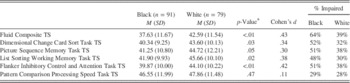
An independent samples t test indicated NH Blacks demonstrated lower neurocognitive performance (NIHTB-CB Fluid Composite T-scores: M=37.63; SD=11.67) than NH Whites (Fluid TS: M=42.59; SD=11.54; p=.006; Cohen’s d=0.43) (Table 3). Further independent sample t tests examining neurocognitive outcomes on specific NIHTB-CB tasks revealed that NH Blacks showed lower neurocognitive scores than NH Whites on the Dimensional Change Card Sorting (Cohen’s d=0.34), Flanker Inhibitory Control and Attention (Cohen’s d=0.42), and List Sorting Working Memory tasks (Cohen’s d=0.38) (Table 3). In addition, there was a trend toward significance for the Picture Sequence Memory task, wherein NH Blacks showed lower neurocognitive scores than NH Whites (Cohen’s d=0.30).
Neurocognitive performance by racial group

a Results from independent sample t-tests. Impairment=T-score of 40 or below (1 SD below the mean).
Results from a multivariable regression model adjusting for reading level, as assessed by the NIHTB-CB Oral Reading T-scores (this was the only variable among our list of potential covariates that differed significantly between groups and was associated with Fluid TS), showed that the racial difference in Fluid Composite T-scores remained significant (NH Black: Estimate=−3.29; SE=1.65; p<.05). In this model, higher Oral Reading T-scores were also an independent significant predictor of higher Fluid TS (p<.001). Stroke characteristics (i.e., stroke severity and type of stroke) did not differ between groups, but because of the known impact of these factors on neurocognitive function, we further investigated their role as potential covariates in follow-up analyses. To do so, we first ran two separate univariable linear regression models on Fluid T-scores and found that increased stroke severity was significantly associated with worse neurocognitive function (p<.001) but type of stroke was not (p=.93).
We then ran a multivariable model including race and stroke severity as predictors of Fluid T-scores and found that there were independent effects of both race and stroke severity (ps<.01). Because both Oral Reading and stroke severity were independently associated with Fluid T-scores in the models presented above, they were included as significant covariates in further analyses examining the impact of healthcare characteristics on racial differences in neurocognitive function.
In the subset of participants with available data (n=98), we found that having a history of hypertension and smoking were both significantly associated with lower neurocognitive function (ps<.04), and having a history of a prior TIA was not (p=.18). Given the relatively small sample size, these variables were not considered for further multivariable models examining the role of healthcare characteristics in explaining racial differences on neurocognitive outcomes post-stroke.
Impact of Healthcare Characteristics on Racial Differences in Neurocognitive Performance
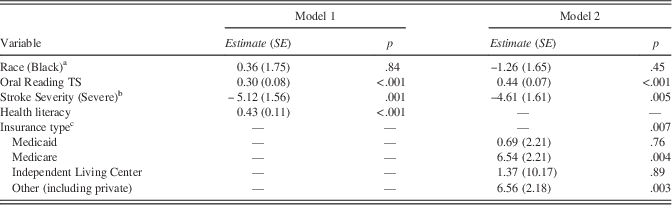
As compared to NH Whites, NH Blacks scored lower on health literacy, showed lower healthcare use and access in two of the variables assessed (i.e., insurance type and healthcare type), and reported less confidence in doctors treating them (see Table 2). Separate multivariable models investigating the impact of each of these factors on racial differences in Fluid T-scores, and adjusting for Oral Reading and injury severity, showed that health literacy and insurance type were significant predictors (shown in Table 4), while healthcare type and confidence in doctors were not (p=.18 and p=.97, respectively). Review of the variance inflation factors (VIFs) for each model indicated that multicollinearity was not a concern.
Impact of health literacy and insurance type on racial differences in Fluid Composite T-Scores post-stroke

Note. Results based on two separate multivariable linear regression models, both adjusting for similar covariates (Model 1: F[4,164]=19.53, p<.001, adjusted R 2 =0.31; Model 2: F[7, 159]=11.06, p<.001, adjusted R 2 =0.30).
a Reference group=White.
b Reference group=Mild to moderate.
c Reference group=Supplemental Security Income (SSI), State Disability Insurance (SDI), or Social Security (SS).
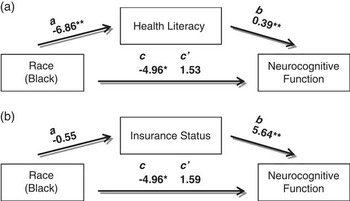
We then conducted path analyses to investigate whether health literacy might explain racial differences in neurocognitive function post-stroke, after adjusting for significant insurance type. Raw score (unstandardized) coefficients for all of the paths appear in Figure 1a. The overall multivariable model on neurocognitive function (Fluid Composite T-score) including terms for race, health literacy, insurance type, reading level and injury severity, was significant (F[5,161]=19.09; p<.001; Adj R 2 =0.37). The association between race and neurocognitive functioning not controlling for the other variables (path c) was significant and indicated that NH Blacks performed significantly worse than Whites.
a: Model examining the association between race and neurocognitive function (NIHTB-CB Fluid Composite TS), and whether health literacy might account for this association after adjusting for reading level, stroke severity, and insurance type. The c coefficient represents the total relationship between race and neurocognitive function (not controlling for health literacy, insurance type, or significant covariates). The c’ coefficient represents the strength of the association between race and neurocognitive function after controlling for the proposed intermediate factor (health literacy), significant covariates (reading level and stroke severity), and insurance type. The Coefficient for the direct effect (c’) was estimated directly from the models (Preacher & Hayes). The a and b paths represent the indirect path involving health literacy. The a path shows the coefficient for the association of race to health literacy based on a linear regression model adjusting for reading level, stroke severity and insurance type. The b path shows the coefficient for the association of health literacy to neurocognitive function when included in a multivariable regression model along with other variables. *p<.01, **p<.001. b: Model examining the association between race and neurocognitive function (NIHTB-CB Fluid Composite TS), and whether insurance type might account for this association after adjusting for reading level, stroke severity and health literacy. The c coefficient represents the total relationship between race and neurocognitive function (not controlling for insurance type, or significant covariates). The c’ coefficient represents the strength of the association between race and neurocognitive function after controlling for the proposed intermediate factor (insurance type) and reading level, stroke severity and health literacy. The Coefficient for the direct effect, c’, was estimated using the bootstrap approximations from causal mediation analysis (Imai et al.). The a and b paths represent the indirect path involving insurance type. The a path shows the coefficient for the association of race to insurance type based on a linear regression model adjusting for covariates (reading level, stroke severity, and health literacy). The b path shows the coefficient for the association of insurance type to neurocognitive function when included in a multivariable regression model along with other variables. *p<.01, **p<.001.

After adjusting for health literacy and other significant covariates, the association of race with neurocognitive function was no longer significant (path c’). The path through health literacy showed that its 95% CI [−4.62, −1.11] obtained by bootstrapping did not include 0, indicating that it was statistically significant; in other words, after considering insurance type, reading level and injury severity, health literacy explained or mediated remaining significant racial differences in cognitive outcomes. Figure 1b demonstrates path analysis investigating whether insurance type might also explain racial differences in neurocognitive function post-stroke, adjusting for significant covariates (reading level and injury severity) and health literacy. The path through insurance type showed that 95% CI [−0.187, −0.002] for indirect effect obtained by bootstrapping did not include 0, indicating that, after adjusting for health literacy, reading level, and injury severity, the path was statistically significant; that is, insurance type mediated the remaining significant racial difference in neurocognitive function.
Follow-Up Analysis: Potential Impact of Study Site
As noted above, the participants who were assessed across the three study sites were not balanced with respect to racial composition; the University of Michigan participants were virtually all NH White, whereas 73% of the Chicago group and 53% of the St. Louis group were Black. The possibility was considered that overall racial differences in Fluid Cognition might have resulted from site-related cohort effects, possibly influenced by geographic differences in access to or quality of healthcare. To address this question, we ran a linear regression model on Fluid TS, with predictors being race, site, and their interaction, including only participants from the Rehabilitation Institute of Chicago and Washington University. Results showed that the interaction was not significant (p=.79). The interaction term was then removed, and the resulting model showed significant independent effects of race (p=.03) and site (p<.01), such that Blacks and participants from Rehabilitation Institute of Chicago performed worse.
DISCUSSION
Consistent with prior findings (Desmond et al., Reference Desmond, Moroney, Paik, Sano, Mohr, Aboumatar and Hauser2000; Newman et al., Reference Newman, Bang, Hussain and Toole2007; Patel et al., Reference Patel, Coshall, Rudd and Wolfe2002), results from the present study showed worse neurocognitive outcomes among NH Black stroke survivors than their NH White counterparts. The present study extends the existing literature by showing these racial differences extend to multiple neurocognitive domains, and that possible pre-existing racial differences in quality of education/premorbid functioning and stroke severity do not fully account for these racial differences in stroke outcomes. Furthermore, they indicate that healthcare variables might be important factors underlying these racial differences.
Present findings showing racial differences in a cognitive composite score (NIHTB-CB Fluid TS) among stroke survivors are consistent with our hypothesis that NH Blacks might have worse neurocognitive outcomes post-stroke than Whites. Our measure of cognition included adjustments for age, education, gender, and race/ethnicity, and, in our models, we adjusted for other significant socio-demographic variables, including an estimate of premorbid functioning (i.e., NIHTB-CB Oral Reading). Thus, racial differences in post-stroke cognitive outcomes do not appear to be explained by pre-existing differences in neurocognitive function (Rushton & Jensen, Reference Rushton and Jensen2005).
In addition, groups scored comparably on the Toolbox Emotion Battery composites (negative affect, psychological well-being, and social satisfaction), which suggests that group differences in neurocognitive outcomes were not influenced by social or emotional problems associated with stroke. There are documented racial differences in stroke characteristics among NH Blacks and Whites, which could account for racial differences in NCI post-stroke. While information on stroke characteristics was fairly limited in our study, there were no significant racial differences on the variables assessed. Stroke severity was associated with neurocognitive function, yet it did not fully account for racial differences post-stroke.
The racial differences in global neurocognitive function appeared to result from compromised performance on individual NIHTB-CB Fluid tests assessing cognitive flexibility (Dimensional Change Card Sort Task), inhibitory control (Flanker Inhibitory Control and Attention Task), working memory (List Sorting Working Memory Task), and episodic memory (Picture Sequence Memory Task). Deficits in these domains are linked to problems in everyday functioning post-stroke, particularly driving (Marshall et al., Reference Marshall, Molnar, Man-Son-Hing, Blair, Brosseau, Finestone and Wilson2007) and managing a complex medication regimen (Zinn, Bosworth, Hoenig, & Swartzwelder, Reference Zinn, Bosworth, Hoenig and Swartzwelder2007). This suggests that the observed racial differences in neurocognitive deficits are likely to have real-world consequences in the lives of stroke patients.
Importantly, we examined racial differences in cognition at least 1-year post-stroke, which is likely representative of the long-term effect of stroke on neurocognitive function rather than acute effects. In addition, given that NH Blacks have a higher risk of mortality following stroke, requiring at least 1 year of recovery following stroke for enrollment might have produced a resilient group of NH Black stroke survivors. It is also worth noting that interactions between potentially explanatory variables that did not differ between racial groups or were not associated with the outcome were not explored. Future studies, especially those with larger sample sizes, might usefully examine such interactions.
In our sample of stroke survivors, NH Blacks showed lower health literacy than NH Whites, which is consistent with findings in the general population (Kutner et al., Reference Kutner, Greenburg, Jin and Paulsen2006; Morrow et al., Reference Morrow, Clark, Tu, Wu, Weiner, Steinley and Murray2006; Rushton & Jensen, Reference Rushton and Jensen2005). In the present study, health literacy helped explain racial differences in neurocognitive function, even after adjusting for the effects of estimated premorbid function, stroke severity, and insurance type. Health literacy affects a variety of health-related risks and behaviors. Low health literacy has been associated with decreased ability to interpret medical messages, read and comprehend medicine labels, and demonstrate proper medication consumption (Berkman et al., Reference Berkman, Sheridan, Donahue, Halpern and Crotty2011).
In addition, low health literacy has been associated with worse global health status and higher mortality rates (Berkman et al., Reference Berkman, Sheridan, Donahue, Halpern and Crotty2011). In the context of stroke, health outcomes are highly dependent on the ability of stroke survivors to comprehend medical information and follow their treatment plan. Individuals with low health literacy might be more likely than those with higher health literacy to have problems with compliance to stroke care because of issues with written and oral communication, understanding and following directions, self-empowerment, and trusting new information, among others (Cruz-Flores et al., Reference Cruz-Flores, Rabinstein, Biller, Elkind, Griffith, Gorelick and Peterson2011).
In addition, stroke survivors with low health literacy might be less likely to engage in positive health behaviors, such as adhering to and refilling medications and maintaining a healthy diet (Gazmararian et al., Reference Gazmararian, Kripalani, Miller, Echt, Ren and Rask2006; Murray et al., Reference Murray, Morrow, Weiner, Tu, Deer, Brater and Weinberger2004; Zoellner et al., Reference Zoellner, You, Connell, Smith-Ray, Allen, Tucker and Estabrooks2011). Among stroke survivors, Blacks are less likely than NH Whites with a history of stroke to recognize stroke symptoms and the need for urgent medical attention (Ellis & Egede, Reference Ellis and Egede2008). Future research might evaluate whether the role of health literacy in explaining racial differences in neurocognitive function is due to the decreased ability of NH Blacks to understand and thus adhere to treatment (Cruz-Flores et al., Reference Cruz-Flores, Rabinstein, Biller, Elkind, Griffith, Gorelick and Peterson2011; Ettenhofer, Foley, Castellon, & Hinkin, Reference Ettenhofer, Foley, Castellon and Hinkin2010; McDonald, Garg, & Haynes, Reference McDonald, Garg and Haynes2002).
Alternatively, worse neurocognitive functioning among NH Blacks might contribute to worse health literacy. Given the cross-sectional nature of our study, we cannot ascribe specific causal inference to these findings. Yet, while non-conclusive, findings showing worse health literacy among Blacks in the general population suggest that racial differences in health literacy might be, at least in part, premorbid. Furthermore, the relation between health literacy and neurocognitive function, regardless of the causation, highlights the need for appropriate interventions targeting health literacy, and the importance of matching provider communications to stroke survivors’ literacy and learning needs (Magasi, Durkin, Wolf, & Deutsch, Reference Magasi, Durkin, Wolf and Deutsch2009).
Insurance type also helped explain racial differences in neurocognitive function, even after adjusting for the effects of estimated premorbid function, stroke severity, and health literacy. Consistent with prior literature (National Center for Health Statistics, 2011), racial differences in insurance type were driven by the disproportionate number of NH Blacks compared to NH Whites with Medicaid coverage and the higher percentage of NH Whites compared to NH Blacks with Medicare coverage and “other” coverage (including private insurance). Given that the administrative burden and low reimbursement rates associated with Medicaid might decrease the incentives and likelihood of physicians to participate in Medicaid programs, this effect could influence differences in access to care among Medicaid beneficiaries compared to Medicare enrollees (Cunningham & O’Malley, Reference Cunningham and O’Malley2009).
Prior research examining the proportion of physicians accepting Medicaid patients suggests an oversaturation of the program (Cunningham & May, Reference Cunningham and May2006). Moreover, while there has been an increase in the number of Medicaid enrollees, there has been a decrease in the number of physicians accepting Medicaid beneficiaries (Cunningham & May, Reference Cunningham and May2006). Consistent with our finding that NH Blacks were less likely than NH Whites to receive treatment at a private clinic, prior research suggests that Medicaid beneficiaries are more likely to be treated at a federally qualified health institution (i.e., community clinic) than a private clinic (Rothkopf, Brookler, Wadhwa, & Sajovetz, Reference Rothkopf, Brookler, Wadhwa and Sajovetz2011). Community clinic patients are less likely than private clinic patients to take advantage of medical services for a preventable disturbance, which could be viewed as an indicator of quality of care (Rothkopf et al., Reference Rothkopf, Brookler, Wadhwa and Sajovetz2011).
Given the absence of data on healthcare access at the time of stroke, we cannot rule out the possibility that there were changes in insurance between the time of stroke and the time of neuropsychological testing, which could have influenced the associations reported here. More specifically, we cannot rule out the possibility that worse healthcare coverage and access may have occurred in some people because of post-stroke unemployment. In this regard, it is worth noting that 65% of participants reported being unemployed post-stroke and NH Blacks were more likely than their NH White counterparts to report being unemployed post-stroke (72.73% of NH Blacks, 55.84% of NH White; p=.02).
The present study has other limitations as well. Although we found that a history of hypertension and smoking were both more prevalent among NH Blacks, and were associated with neurocognitive outcomes, these data were only available in a subset of participants; thus, we did not examine their role in explaining racial differences in neurocognitive outcomes post-stroke. The number of prior strokes was not consistently recorded across sites. Given that recurrent stroke has been associated with the increased risk of neurocognitive impairment and Blacks are at a higher risk for recurrent stroke, our findings could at least partially be due to more NH Blacks suffering recurrent strokes than NH Whites (Park & Ovbiagele, Reference Park and Ovbiagele2016; Pendlebury & Rothwell, Reference Pendlebury and Rothwell2009).
Other stroke characteristics, such as the vascular territory of the infarction and the depth of infarction, might also play a role in explaining our findings, but these characteristics were not consistently recorded in the cohort. Available data on cardiovascular risk and stroke characteristics were collected via a combination of review of medical records, self-report, or report by informant. Unfortunately, we are not able to discern how these data were collected for each participant, limiting our ability to interpret findings based on these data.
Although the healthcare access, use, and quality assessments were developed using questions from validated surveys, only a subset of questions of the original surveys were included in the present study. Thus, we did not have composite measures of these variables. The present study also might have benefited from including objective measures of healthcare access, use, and quality; however, self-report assessments of healthcare usage have been found to be comparable to objective measures (Gordon, Wortley, Singleton, Lin, & Bardenheier, Reference Gordon, Wortley, Singleton, Lin and Bardenheier2008; Reijneveld & Stronks, Reference Reijneveld and Stronks2001). Given that these racial differences were observed in a community-dwelling NH Black population living in the Midwestern United States, our findings might not be generalizable to Blacks living in other areas of the United States, or more representative samples of the stroke populations (i.e., samples including patients from hospital and assisted living environments).
Follow-up analyses investigating the potential influence of study site on fluid cognition indicated that there could be an independent effect of study site in addition to racial differences. However, the relatively small sample sizes warrant future examination of this issue. Also, the number of potential participants who were excluded because of significant aphasia was not recorded. The exclusion criteria of significant aphasia could well have excluded more severe cases of cognitive impairment that would be present in a representative sample of the stroke population.
Overall, the present study identified health literacy and insurance type as variables that might help “explain” differences in neurocognitive outcomes between NH Blacks and NH Whites post-stroke. Health literacy is a potentially modifiable risk factor; thus, intervention studies aimed at improving health literacy among individuals with inadequate health literacy might decrease this disparity. Although insurance type is a risk factor less amenable to modification, efforts can be made to decrease disparities in the access to and quality of healthcare.
ACKNOWLEDGEMENTS
Conflicts of Interest: The authors report no personal or financial conflicts of interest. Funding: This work was supported by the National Institute on Aging (5R25AG043364-02); the National Institute on Disability and Rehabilitation Research (H133B090024, H133F140037); the National Institute of Mental Health (K23 MH105297); and James S. McDonnell Foundation (JSMF 98.32 CRH-QUA.11).