INTRODUCTION
The family Merlucciidae comprises three subfamilies: Merlucciinae, Steindachneriinae and Macruroninae (Nelson, Reference Nelson2006). The former includes one genus, Merluccius, with 13 recognized species (Nelson, Reference Nelson2006). The common name applied to these species is hake (Nelson, Reference Nelson2006), and they usually have commercial value throughout the world (Lloris et al., Reference Lloris, Matallanas and Oliver2003). The Argentine hake Merluccius hubbsi is endemic to the south-west Atlantic and has a latitudinal range from Brazil (21°30′S) to southern Patagonia (55°S) (Cousseau & Perrotta, Reference Cousseau and Perrota2004). It is the most important ground-fish resource found in the Argentine sea (Bezzi et al., Reference Bezzi, Verazay, Dato, Alheit and Pitcher1995; Pitcher & Alheit, Reference Pitcher, Alheit, Alheit and Pitcher1995).
There are two main stocks of M. hubbsi on the Argentinean continental shelf (ACS), the northern stock (NS, 34–41°S) and the Patagonian stock (PS, 41–55°S) (Bezzi et al., Reference Bezzi, Verazay, Dato, Alheit and Pitcher1995). A third small stock is located in the semi-enclosed San Matías Gulf (Di Giácomo et al., Reference Di Giácomo, Calvo, Perier and Morriconi1993). These stocks have different historical exploitation patterns and are managed as separated units (Aubone et al., Reference Aubone, Bezzi, Cañete, Castrucci, Dato, Irusta, Madirolas, Pérez, Renzi, Santos, Simonazzi, Villarino, Sánchez and Bezzi2004). The PS exhibits a well known migration pattern that could be summarized as winter offshore and summer inshore (Macchi et al., Reference Macchi, Pájaro and Dato2007). During early summer, hake move from deeper waters (more than 110 m depth) to the coast (close to the 50 m isobath) for spawning (Macchi et al., Reference Macchi, Pájaro and Dato2007). Spawning begins in November–December at 50 m depth at ~43–44°S. After spawning, the hake return to deeper waters where they remain broadly dispersed throughout the open sea during winter on the Patagonian continental shelf (Macchi et al., Reference Macchi, Pájaro and Dato2007).
The Argentine hake is an abundant species and an important predator on the Patagonian shelf waters (Laptikhovsky & Fetisov, Reference Laptikhovsky and Fetisov1999). Although numerous studies have focused on the diet of the Argentine hake on the ACS in the past decades (Angelescu et al., Reference Angelescu, Gneri and Nani1958; Angelescu & Cousseau, Reference Angelescu and Cousseau1969; Cordo, Reference Cordo and Angelescu1981; Angelescu & Prenski, Reference Angelescu and Prenski1987; Sánchez & Prenski Reference Sánchez and Prenski1996; Ruiz & Fondacaro, Reference Ruiz and Fondacaro1997), on different stocks (Sánchez & García de la Rosa, Reference Sánchez and García de la Rosa1999; Sánchez, Reference Sánchez2009; Ocampo Reinaldo et al., Reference Ocampo Reinaldo, González and Romero2011) or on certain age-classes (Temperoni et al., Reference Temperoni, Viñas and Buratti2013), feeding studies conducted at large spatio-temporal scales including many variables are lacking. For instance, the diet of M. hubbsi on the Malvinas Islands shelf still remains unknown (Arkhipkin et al., Reference Arkhipkin, Middleton, Portela and Bellido2003). Moreover, it is necessary to update the trophic role of the Argentine hake, especially in the PS where the community has been subjected to high fishing pressure during the last decades (Aubone et al., Reference Aubone, Bezzi, Cañete, Castrucci, Dato, Irusta, Madirolas, Pérez, Renzi, Santos, Simonazzi, Villarino, Sánchez and Bezzi2004). The aims of this study were to: (1) provide a quantitative taxonomic description of the diet of the Argentine hake on the PS; (2) analyse the influence of sex, maturity stage, size, age, season, region and hour on their diet; and (3) determine the trophic level of the species.
MATERIALS AND METHODS
Study area and sample collection
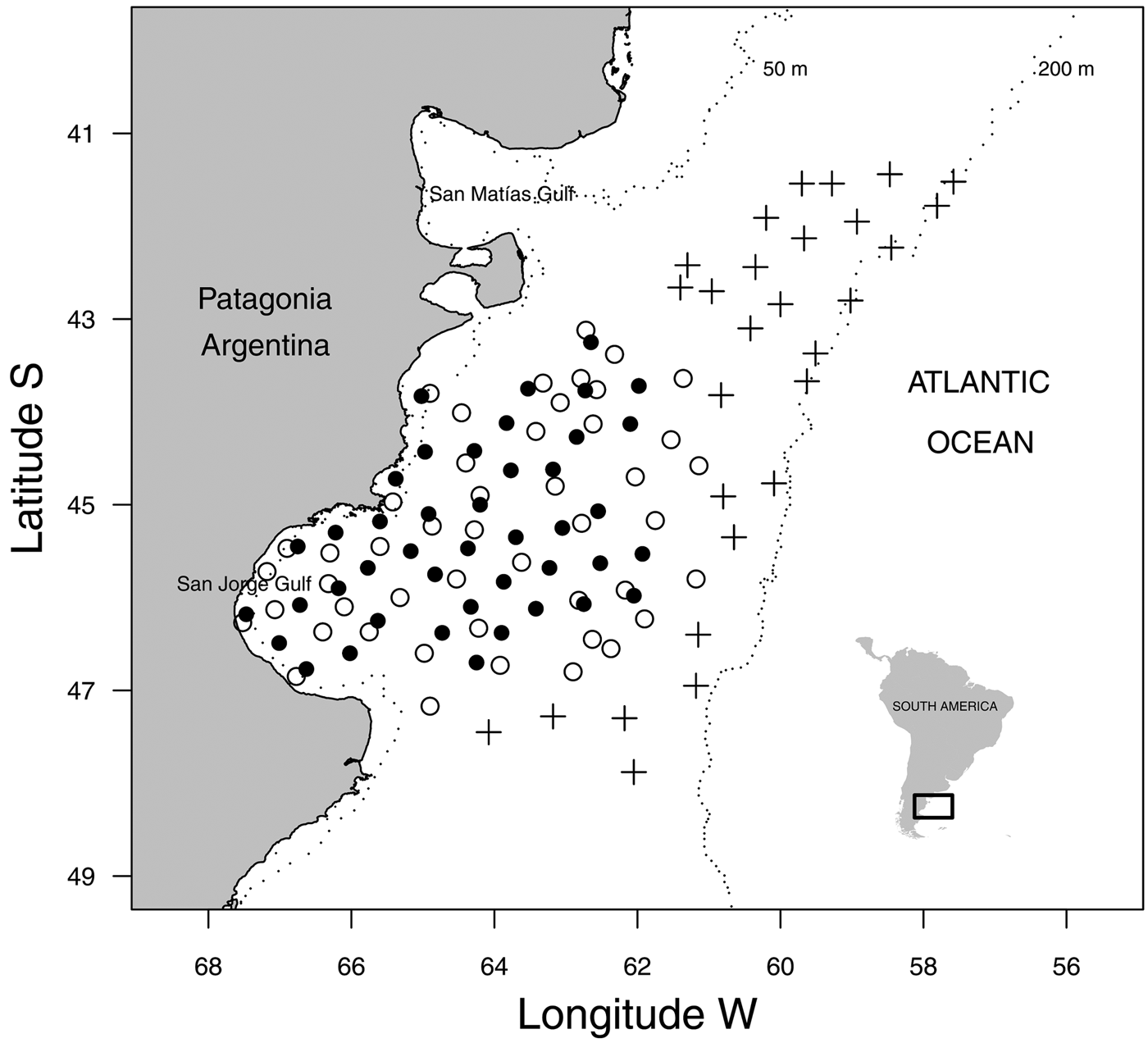
The study area covered the Patagonian continental shelf, between 41°S and 48°S, and from 57 m to 144 m depth (Figure 1). The Patagonian continental shelf is washed offshore by the Malvinas Current, which extends northward from Drake Passage (~55°S) to nearly 38°S (Bastida et al., Reference Bastida, Roux and Martínez1992; Piola et al., Reference Piola, Avellaneda, Guerrero, Jardón, Palma and Romero2010). This subantartic water enters the shelf, mainly between the Malvinas Islands and Tierra del Fuego, and is diluted by continental discharges (Guerrero & Piola, Reference Guerrero, Piola and Boschi1997). The mean current flow on the Patagonian continental shelf is from south to north (Guerrero & Piola, Reference Guerrero, Piola and Boschi1997). A tidal mixing front, located at 43–45°S during spring and summer, defines the boundary between stratified (offshore) waters and a coastal, vertically mixed body of water (Acha et al., Reference Acha, Mianzan, Guerrero, Favero and Bava2004). The spawing of Argentine hake in the Patagonian stock is primarily associated with this thermal front (Ehrlich & Ciechomski, Reference Ehrlich and Ciechomski1994).
Map of the study area showing the sample sites where specimens of Merluccius hubbsi were collected during winter on inner Patagonian continental shelf (winter inner Patagonian continental shelf (IPCS), black circles), winter on outer Patagonian continental shelf (winter outer Patagonian continental shelf, crosses) and summer on inner Patagonian continental shelf (summer IPCS, white circles).

The Argentine hake of the PS exhibits seasonal migrations, moving into inshore areas in summer at 43–45°S for spawning (Macchi et al., Reference Macchi, Pájaro and Dato2007). The specimens disperse after spawning, moving back to deeper waters during the cold season (Macchi et al., Reference Macchi, Pájaro and Dato2007). Based on this spatio-temporal a priori knowledge, the study area was subdivided into the inner Patagonian continental shelf (IPCS; depth <110 m, latitude >43°S, longitude >61°W) and the outer Patagonian continental shelf (OPCS; depth >110 m or latitude <43°S and longitude >61°W) (Figure 1). During winter, the Argentine hake is homogeneously distributed along both the IPCS and the OPCS (Macchi et al., Reference Macchi, Pájaro and Dato2007). During summer, the species aggregates for spawning on the IPCS (Macchi et al., Reference Macchi, Pájaro and Dato2007). Given the known migration pattern and the spawning aggregations during summer, the variables season and region were combined and categorized into the following spatio-temporal variable (SPTP): winter IPCS, winter OPCS and summer IPCS (Figure 1).
Specimens were caught during two trawling surveys conducted by the Instituto Nacional de Investigación y Desarrollo Pesquero (INIDEP, Argentina) during July, August and September 2011 and January 2012. Specimens caught between July and early September were regarded as having been caught during austral winter and those caught in January represented those caught in austral summer. Fishing was conducted during daylight (07.00–19.00 hours), at 3–4 knots for 30 min at each sampling site, using an Engel type bottom trawl net (200 mm mesh in the wings, 103 mm in the cod ends, 4 m vertical opening and 15 m horizontal aperture). Specimens captured were measured to the nearest cm and sexed. Sexual maturity (mature or immature) was determined for females according to the condition of ovary and the presence of yolk eggs, whereas male maturity was determined by the size and colour of testes (Macchi & Pájaro, Reference Macchi and Pájaro2003). The sagittae otoliths were collected for age determination following the method proposed by Renzi & Pérez (Reference Renzi and Pérez1992). Finally, stomachs were excised, labelled in plastic bags and frozen at −25°C for analysis at the laboratory.
Diet composition and data analysis
In the laboratory, prey items found in the stomachs were identified to the lowest possible taxonomic level using taxonomic works (Ramírez, Reference Ramírez1971; Bastida & Torti, Reference Bastida and Torti1973; Ramirez & Viñas, Reference Ramírez and Viñas1985), field guides (Cousseau & Perrota, Reference Cousseau and Perrota2004) and by consulting specialists. Prey items were counted and weighed to the nearest 0.01 g. The contribution of each prey to the diet was evaluated by calculating the percentage frequency of occurrence (%F, the total number of stomachs in which a given prey was found expressed as percentage of the total number of stomachs with food), the numerical percentage (%N, the total number of a given prey as percentage of the total number of prey found) and the percentage of weight (%W, the weight of a given prey as percentage of the total weight of prey found). These three parameters were integrated into the index of relative importance: IRI = %F × (%N + %W) (Pinkas et al., Reference Pinkas, Oliphant and Iverson1971), expressed as a percentage (%IRI; Cortés, Reference Cortés1997).
The trophic level (TrL) was estimated for the species following the method proposed by Cortés (Reference Cortés1999) as follows:
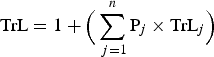 $$\hbox{TrL} = 1 + \Big( \sum\limits_{\,j = 1}^n {{{\rm P}_j} \times \hbox{TrL}_j} \Big)$$
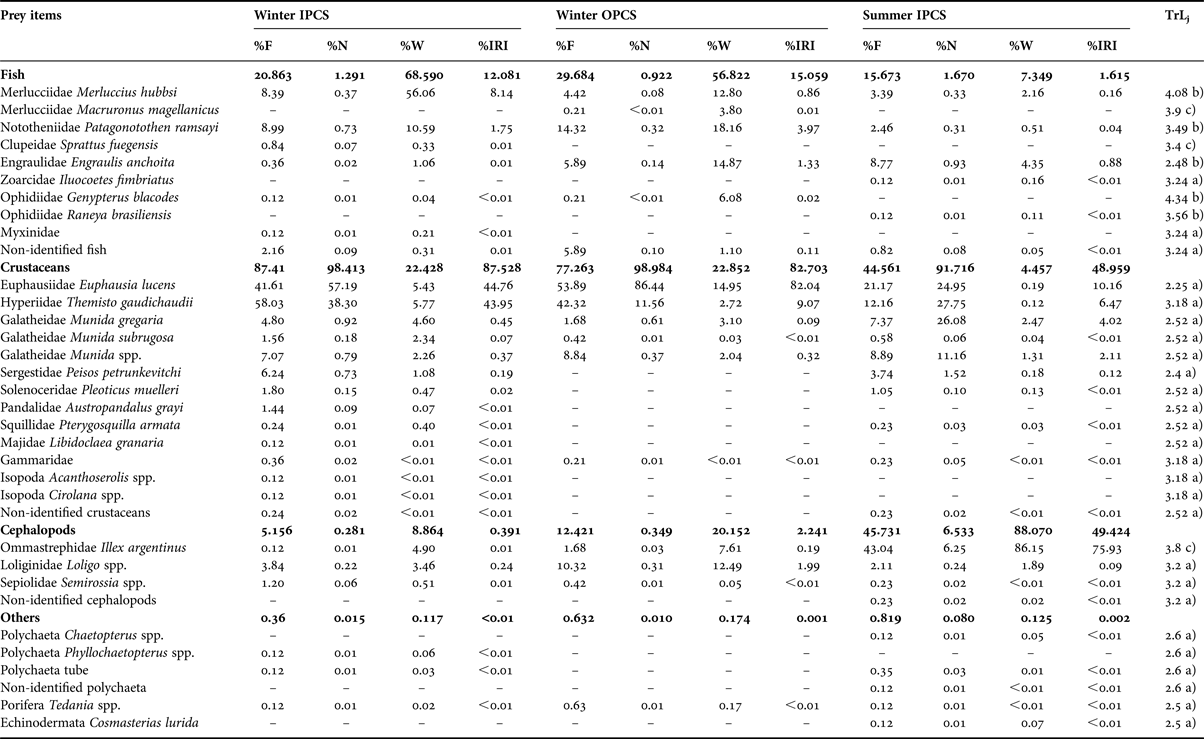
where TrLj is the trophic level of each prey item j and Pj is the proportion of each prey item j (using %IRI) in the diet of M. hubbsi, and n is the total number of prey items. The TrLj were obtained from the literature (Table 1; Ebert & Bizzarro, Reference Ebert and Bizzarro2007; Vögler et al., Reference Vögler, Milessi and Duarte2009; Sea Around Us, 2014).
Diet composition of the Argentine hake Merluccius hubbsi, on the winter inner Patagonian continental shelf (winter inner Patagonian continental shelf (IPCS)), winter outer Patagonian continental shelf (winter outer Patagonian continental shelf (OPCS)) and summer inner Patagonian continental shelf (summer IPCS). The diet is expressed by the percentage frequency of occurrence (%F), the percentage of number (%N), percentage of weight (%W) and the percentage of index of relative importance (%IRI). TrLj is the trophic level of each prey obtained from: Ebert & Bizzarro, Reference Ebert and Bizzarro2007; Vögler et al., Reference Vögler, Milessi and Duarte2009; and Sea Around Us, 2014.
Dietary models
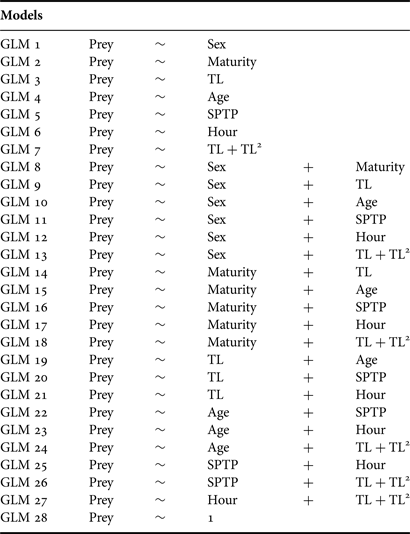
The numbers of the six main prey items of the Argentine hake (Themisto gaudichaudii, Euphausia lucens, fish, cephalopods, Munida spp. (includes M. gregaria and M. subrugosa) and Merluccius hubbsi (cannibalism)) were used as dependent variables. This kind of numerical data has many zeros, has a variance much greater than the mean and exhibits a negative binomial distribution (Crawley, Reference Crawley2005). All these issues are dealt with by using the generalized linear model (GLM) with negative binomial error distribution and a log link (Crawley, Reference Crawley2005). The independent variables selected to explain the consumption of the main prey were: sex; maturity stage (juvenile, adults); total length (TL, cm); age; SPTP (winter IPCS, winter OPCS and summer IPCS); and hour of the day (07.00–19.00). In order to test a curvilinear relationship between TL and the consumption of any prey, models including a quadratic term of TL (TL2) as independent were also fitted (Table 2). The models with all possible combinations of two independent variables were constructed (Table 2). A theoretical model without an independent variable was also constructed to test the hypothesis that none of the independent variables selected in this work influenced the consumption of any prey (Table 2) (Lucifora et al., Reference Lucifora, García and Escalante2009). Akaike's information criterion (AIC) and Akaike's weight (w) were used to compare and rank a total of the 28 competing models, and to estimate which of them best fit the data (Franklin et al., Reference Franklin, Shenk, Anderson, Burnham, Shenk and Franklin2001; Johnson & Omland, Reference Johnson and Omland2004). The model with the lowest AIC was selected and plotted (Franklin et al., Reference Franklin, Shenk, Anderson, Burnham, Shenk and Franklin2001; Johnson & Omland, Reference Johnson and Omland2004). When a quadratic relationship was selected for the consumption of any prey, the trend was evaluated by fitting LOESS regressions (Crawley, Reference Crawley2005). The LOESS fits a local quadratic regression model using non-parametric techniques to produce a smoothed model surface (Crawley, Reference Crawley2005). All analyses were performed using R program (http://www.R-project.org).
List of the generalized linear models (GLM) fitted to explain the consumption of the main prey of the Argentine hake Merluccius hubbsi. The independent variables selected are: sex; maturity, maturity stage; TL, total length; TL + TL2, quadratic total length; age; SPTP, spatiotemporal; hour, hour of the day; and 1, null model.
RESULTS
Diet composition
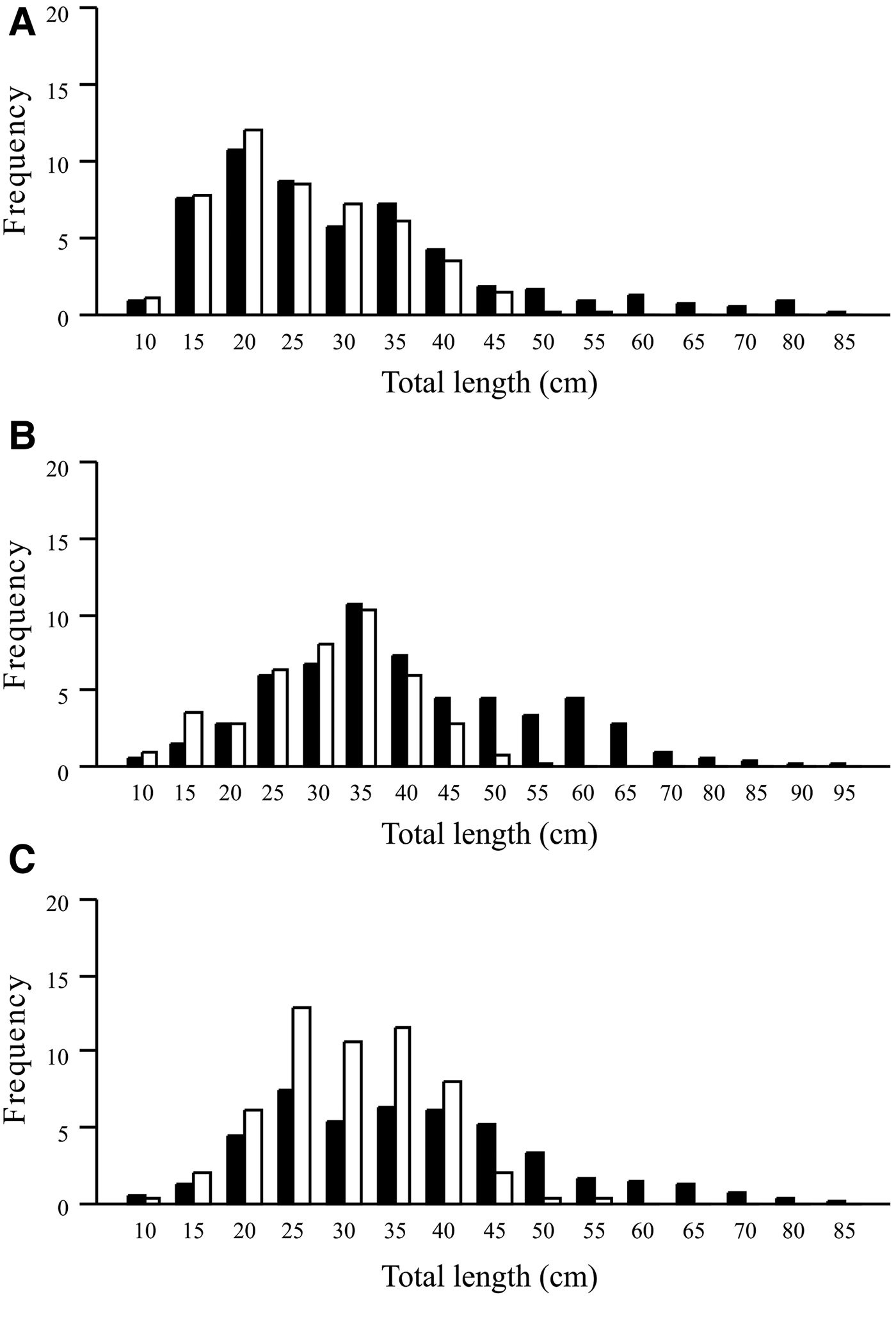
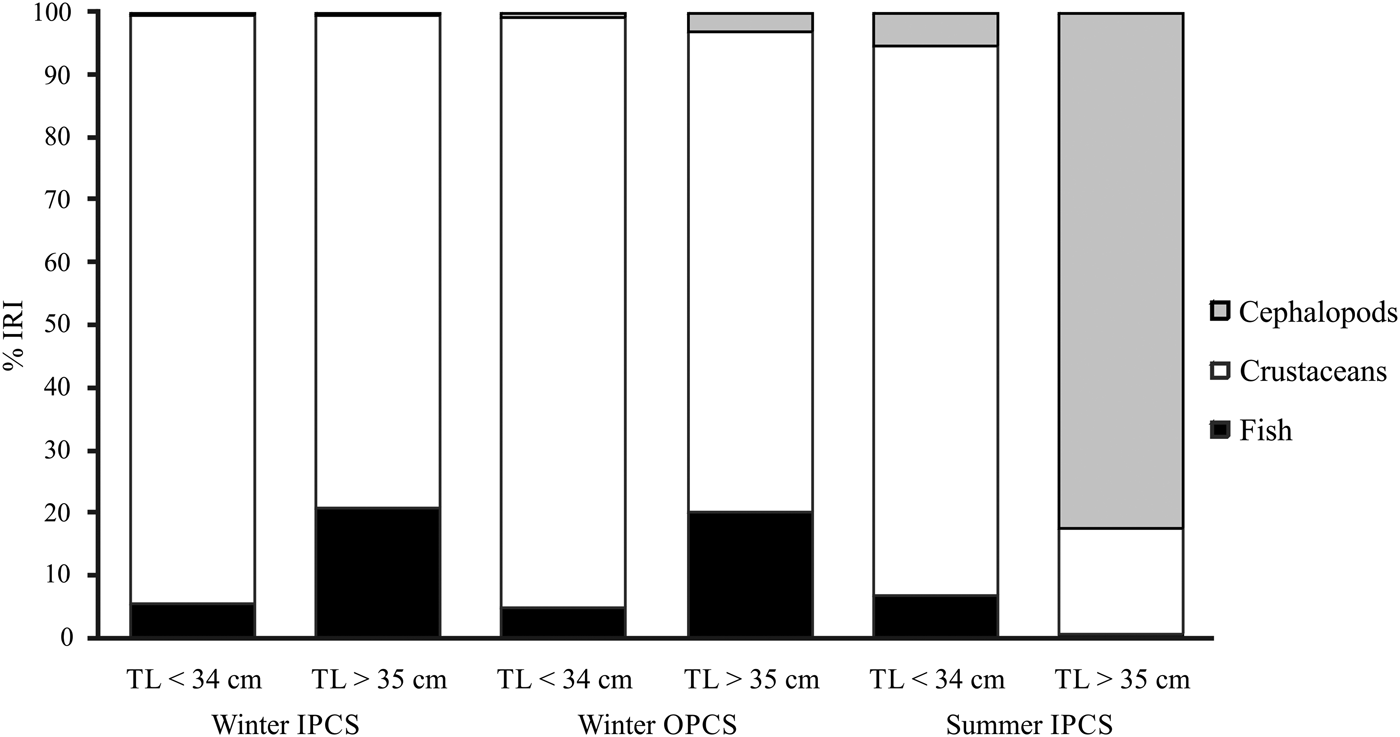
During winter in the IPCS, 1187 specimens ranging from 10 cm to 83 cm TL were examined (Figure 2), of which 834 (70.26%) contained prey items in their stomachs. Merluccius hubbsi fed mainly on crustaceans (Figure 3; Table 1). The euphausiid Euphausia lucens was the first in importance by %IRI and %N, and the second by %F (Table 1). The hyperiid amphipod Themisto gaudichaudii was the most important prey item in terms of %F, and the second one by %IRI and %N (Table 1). The gadoid M. hubbsi (by cannibalism) and the notothenioid Patagonotothen ramsayi were the most important prey in terms of %W (Table 1). The trophic level (TrL) of the Argentine hake M. hubbsi during winter in the IPCS was 3.84.
Size–frequency distribution of the Argentine hake, Merluccius hubbsi, caught for the diet analysis, by (A) winter inner Patagonian continental shelf (IPCS); (B) winter outer Patagonian continental shelf; (C) summer IPCS. Females (black bars) and males (white bars).
Percentage of index of relative importance (%IRI) for cephalopods, crustaceans and fish in the diet of the Argentine hake Merluccius hubbsi, by total length-classes (TL < 34 and TL > 35), during winter on inner Patagonian continental shelf (winter IPCS), winter outer Patagonian continental shelf (winter OPCS) and summer inner Patagonian continental shelf (summer IPCS).
During winter in the OPCS, 755 stomachs from M. hubbsi were examined, of which 475 (62.91%) contained prey items. The TL range of the specimens examined was 14–94 cm (Figure 2). Merluccius hubbsi fed almost exclusively on crustaceans in terms of %F, %N and %IRI (Figure 3; Table 1). The euphausiid Euphausia lucens was the main prey item by %F, %N and %IRI, but second in terms of %W (Table 1). Among fish, the notothenioid Patagonotothen ramsayi, the Argentine anchovy Engraulis anchoita and M. hubbsi contributed mostly by %W, followed by the cephalopods Loligo gahi and the Argentine squid Illex argentinus (Table 1). The TrL of M. hubbsi during winter in the OPCS was 3.43.
Of the 1463 specimens examined during summer in the IPCS, 855 (58.44%) contained prey items in their stomachs. The TL of the specimens analysed ranged from 13 cm to 82 cm (Figure 2). During this season, M. hubbsi preyed primarily on cephalopods in terms of %F, %W and %IRI (Figure 3), and crustaceans in terms of %N (Table 1). The Argentine squid Illex argentines was the main prey item by %F, %W and %IRI (Table 1). Among crustaceans, the euphausiid Euphausia lucens, the hyperiid amphipod Themisto gaudichaudii and lobster krill Munida spp. were the most important prey (Table 1). The TrL of M. hubbsi during summer in the IPCS was 4.51.
Dietary models
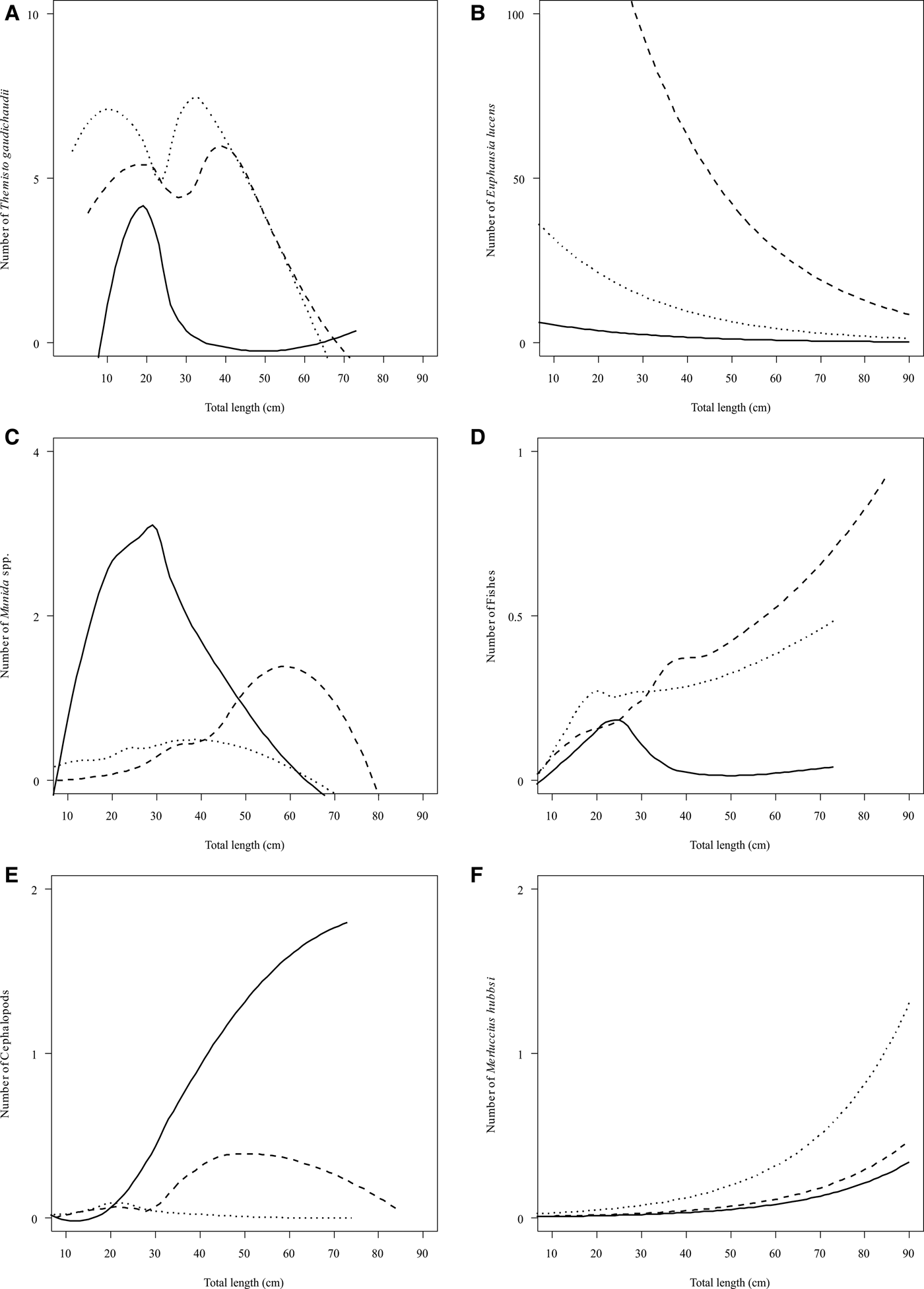
The consumption of Themisto gaudichaudii, fish, cephalopods and Munida spp. was related to the variables TL, TL2 and SPTP (GLM 26 in Table 2). On the other hand, the consumption of Euphausia lucens and other M. hubbsi (by cannibalism) was related to the variables TL and SPTP (GLM 20 in Table 2). The hyperiid amphipods Themisto gaudichaudii were more intensively consumed during winter in both OPCS and IPCS, than in summer (Figure 4A; Table 3). The consumption of hyperiid amphipods T. gaudichaudii increased from 10 cm to 40 cm predator's TL, and then decreased from 40 cm to 90 cm predator's TL (Figure 4A; Table 3). The euphausiids Euphausia lucens were more intensively consumed during winter in OPCS than in IPCS, and during winter in IPCS are also more intensively consumed than in summer (Figure 4B; Table 3). The consumption of the euphausiids E. lucens decreased with the predator's length (Figure 4B; Table 3). The lobster krill Munida spp. was more intensively consumed during summer in IPCS than during winter in both IPCS and OPCS (Figure 4C; Table 3). The consumption of this species increased from 10 cm to 30 cm and from 30 cm to 60 cm predator's TL in summer IPCS and winter OPCS, respectively, and then decreased as the predator became larger (Figure 4C; Table 3). The fish were more intensively consumed during winter in both OPCS and IPCS than in summer (Figure 4D; Table 3), and their consumption increased with the predator's TL (Figure 3; Figure 4D; Table 3). Cephalopods were more intensively consumed during summer than in winter in both IPCS and OPCS, and their consumption increased with the predator's length (Figures 3, 4E; Table 3). Cannibalism was higher during winter in IPCS than in OPCS, and it was also higher during winter in OPCS than during summer (Figure 4F; Table 3). The consumption of other M. hubbsi increased with the predator's TL (Figure 4F; Table 3).
Best models, fitted by generalized linear models for the number of the prey, that explain the changes in the consumption of (A) Themisto gaudichaudii; (B) Euphausia lucens; (C) Munida spp.; (D) fish; (E) cephalopods; (F) Merluccius hubbsi (cannibalism). Dotted line, winter IPCS; dashed line winter OPCS; solid line, summer IPCS.
Best models that explained the consumption of the most important prey of the Argentine hake Merluccius hubbsi. The intercept and coefficient with the standard errors in parentheses (SE) for the variables, the Akaike information criterion (AIC) and the Akaike's weights (w) are presented for each model. TL, total length (cm); WinIPCS, winter inner Patagonian continental shelf; WinOPCS, winter outer Patagonian continental shelf.
DISCUSSION
The Argentine hake Merluccius hubbsi of the PS fed mainly upon zooplankton crustaceans, such as euphausiids (Euphausia lucens), hyperiid amphipods (Themisto gaudichaudii) and lobster krill (Munida spp.). The importance of zooplankton crustaceans in the diet of M. hubbsi was consistent with earlier observations (Cordo, Reference Cordo and Angelescu1981; Sánchez & Prenski Reference Sánchez and Prenski1996; Ruiz & Fondacaro, Reference Ruiz and Fondacaro1997; Sánchez & García de la Rosa, Reference Sánchez and García de la Rosa1999; Sánchez, Reference Sánchez2009; Ocampo Reinaldo et al., Reference Ocampo Reinaldo, González and Romero2011; Temperoni et al., Reference Temperoni, Viñas and Buratti2013), but differed from others which gave a secondary role to this prey (Angelescu et al., Reference Angelescu, Gneri and Nani1958; Angelescu & Cousseau, Reference Angelescu and Cousseau1969; Angelescu & Prenski, Reference Angelescu and Prenski1987). High consumption of euphausiids is a common pattern observed in many other gadiform species in the world (Buckley & Livingston, Reference Buckley and Livingston1997; Garrison & Link, Reference Garrison and Link2000; Orlova et al., Reference Orlova, Dolgov, Rudneva and Nesterova2005), highlighting the importance of this group as a key energetic link between small phytoplankton and large predatory animals. This work also showed that cephalopods (mainly Illex argentinus) and fish (Patagonotothen ramsayi, Engraulis anchoita and other M. hubbsi) were also important in some regions and seasons, revealing spatio-temporal changes in the diet of the studied species. These spatio-temporal changes were always accompanied by ontogenetic shifts. On the other hand, the variables sex, maturity stage, age and hour of the day did not influence the consumption of any particular prey item by M. hubbsi.
The analysis of the diet of M. hubbsi revealed ontogenetic dietary changes associated with size, particularly from zooplankton (E. lucens, T. gaudichaudii and Munida spp.) to fish and cephalopods. The ontogenetic diet shifts appear to be a universal phenomenon in fish (Wootton, Reference Wootton1990). The diet of fish usually changes because of the morphological changes that accompany growth (increasing mouth dimensions and stomach capacity, improvement in their locomotion ability, etc.) and allow capture of a broader range of prey sizes and prey types (Wootton, Reference Wootton1990). Large M. hubbsi fed on larger, more active prey not available to small individuals. In general, Merluccius species worldwide feed on zooplankton crustaceans early in their life and with growth, shift their diets to fish and squid (Tanasichuk et al., Reference Tanasichuk, Ware, Shaw and McFarlane1991; Buckley & Livingston, Reference Buckley and Livingston1997; Garrison & Link, Reference Garrison and Link2000; Carpentieri et al., Reference Carpentieri, Colloca, Cardinale, Belluscio and Ardizzone2005; Mahe et al., Reference Mahe, Amara, Brychaert, Kacher and Brylinski2007; Cartes et al., Reference Cartes, Hidalgo, Papiol, Massutí and Moranta2009).
The feeding on cephalopods and lobster krill Munida spp. was higher in summer. These trends are related to seasonal changes of prey abundances, for both cephalopods (Brunetti & Ivanovic, Reference Brunetti and Ivanovic1992; Brunetti et al., Reference Brunetti, Ivanovic, Rossi, Elena, Pineda and Okutani1998; Crespi et al., Reference Crespi, Morsan and Barón2008) and lobster krill Munida spp. (Roux & Piñeiro, Reference Roux and Piñero2006), the biomass of which increase during summer on the IPCS. The euphausiid (Euphausia lucens) was more intensively consumed during winter on the OPCS, whereas the hyperiid amphipod (T. gaudichaudii) was more intensively consumed during winter on the IPCS, in accordance with the distribution of the zooplankton community in the region (Pérez Seijas et al., Reference Pérez Seijas, Ramírez and Viñas1987; Santos, Reference Santos1994; Sabatini & Alvarez Colombo, Reference Sabatini and Álvarez Colombo2001; Sabatini, Reference Sabatini2008). However, the abundance of euphausiids and amphipods reaches their annual maximum during summer (Pérez Seijas et al., Reference Pérez Seijas, Ramírez and Viñas1987; Sabatini & Alvarez Colombo, Reference Sabatini and Álvarez Colombo2001) indicating that cephalopods may be preferred to euphausiids and amphipods. Taken together, these patterns suggest a flexible foraging behaviour of M. hubbsi which fed on zooplankton throughout the year, but seasonally changed to feed on cephalopods when this kind of prey was available (summer), even when zooplankton was locally abundant. These spatio-temporal variations in accordance with the seasonal fluctuation of prey also supported the idea that M. hubbsi has an opportunistic or adaptive foraging behaviour. This kind of adaptive foraging behaviour may make a species relatively resilient to fisheries-induced ecosystem changes (Dunn et al., Reference Dunn, Stevens, Forman and Connell2013).
The quality of food is essential to understanding the energy sources consumed by predators (Vollenweider et al., Reference Vollenweider, Heintz, Schaufler and Bradshaw2011), and should be considered when spatio-temporal and ontogenetic shifts of M. hubbsi are discussed. Cephalopods were preferred by hake when this prey is accessible. Moreover, cephalopods and fish were important prey by weight, whereas zooplankton crustaceans were important by number. The high energy provided by cephalopods and fish in relation to zooplankton crustaceans (Ciancio et al., Reference Ciancio, Pascual and Beauchamp2007) justifies their choice. Based on the proximate composition, fish and cephalopods are considered high quality prey (4–7 J g−1), while zooplankton crustaceans such as euphausiids and amphipods are low quality prey (2–3 J g−1) (Ciancio et al., Reference Ciancio, Pascual and Beauchamp2007). The high proportion of chitin from the exoskeletons of zooplankton crustaceans also determines preference for cephalopods and fish by larger hake. However, prey selection also depends of prey mobility, prey size and easy access (Wootton, Reference Wootton1990) conferring higher profitability of zooplankton crustaceans to the small M. hubbsi.
A controversial component in the diet of M. hubbsi was other hake. Cannibalism increased with predator's length, and contributed a maximum of 8.14% to the diet during winter on the IPCS. Gadiforms, particularly hakes, are known to be highly cannibalistic (Juanes, Reference Juanes2003). Chiou et al. (Reference Chiou, Chen, Wang and Chen2006) found that cannibalism would increase when the population of cannibals is abundant, or when other food sources are insufficient. Previous authors reported higher rates of cannibalism in the diet of M. hubbsi than that observed in the present work (Cordo, Reference Cordo and Angelescu1981; Sánchez & García de la Rosa, Reference Sánchez and García de la Rosa1999; Ocampo Reinaldo et al., Reference Ocampo Reinaldo, González and Romero2011), whereas others suggested that cannibalism occurs when food is scarce and as a secondary prey (Angelescu & Prenski, Reference Angelescu and Prenski1987; Sánchez & Prenski Reference Sánchez and Prenski1996; Ruiz & Fondacaro, Reference Ruiz and Fondacaro1997; Sánchez, Reference Sánchez2009). During winter on the IPCS the lowest biomasses of the most important prey of M. hubbsi occur (Pérez Seijas et al., Reference Pérez Seijas, Ramírez and Viñas1987; Brunetti et al., Reference Brunetti, Ivanovic, Rossi, Elena, Pineda and Okutani1998; Sabatini & Alvarez Colombo, Reference Sabatini and Álvarez Colombo2001; Roux & Piñeiro, Reference Roux and Piñero2006; Crespi et al., Reference Crespi, Morsan and Barón2008), and there is a high overlap of different age and size-classes (Macchi et al., Reference Macchi, Pájaro and Dato2007). The strong cannibalism during winter on the IPCS suggests that it is related to a combination of factors, such as the abundance and availability of alternative prey and to the overlap of different size-classes.
This paper provides the first estimation of the trophic level of M. hubbsi, which occupies different trophic positions according to season and region. During winter M. hubbsi can be considered a secondary consumer (3 < TrL < 4) due to the high consumption of zooplankton crustaceans. On the other hand, it can be considered a tertiary consumer, or apex predator (TrL > 4), during summer when the cephalopod I. argentinus is the main prey. The few works of worldwide extent that have estimated the TrL of Merluccius spp. also have shown that it ranged from 3.2 to 4.05 (Stergiou & Karpouzi, Reference Stergiou and Karpouzi2002; Iitembu et al., Reference Iitembu, Miller, Ohmori, Kanime and Wells2012). The spatio-temporal variations observed in TrL may be a result of the variability of the species dominance on the study area (Pérez Seijas et al., Reference Pérez Seijas, Ramírez and Viñas1987; Brunetti et al., Reference Brunetti, Ivanovic, Rossi, Elena, Pineda and Okutani1998; Sabatini & Alvarez Colombo, Reference Sabatini and Álvarez Colombo2001; Roux & Piñeiro, Reference Roux and Piñero2006; Crespi et al., Reference Crespi, Morsan and Barón2008). Since exploited marine ecosystems are characterized by a decline of the mean TrL in landings (Pauly et al,. Reference Pauly, Christensen, Dalsgaard, Froese and Torres1998), the monitoring of the TrL, the food web structure and fisheries landings are needed on the PS for appropriate management in future years.
In contrast to other gadoids, such as cod, which have been harvested for centuries, large scale hake fishing is relatively recent (Pitcher & Alheit, Reference Pitcher, Alheit, Alheit and Pitcher1995). However, in Argentina the estimated total biomass in northern stock declined from about 690,000 tons in 1986 to 287,500 tons in 1999, whereas the PS was reduced from 1,520,000 tons in 1993 to 844,500 tons in 1999 (Aubone et al., Reference Aubone, Bezzi, Cañete, Castrucci, Dato, Irusta, Madirolas, Pérez, Renzi, Santos, Simonazzi, Villarino, Sánchez and Bezzi2004). A permanent closed zone covering a great part of the Argentine Sea has been established since 1998 to protect M. hubbsi of the PS. In this context, fishery researchers need basic diet composition data for each predator to develop ecosystem models involving energy (Cochrane, Reference Cochrane2002; Thrush & Dayton, Reference Thrush and Dayton2010). From a viewpoint of population dynamics, distinguishing among the different causes of mortality including cannibalism (and if it is uniform across the study area) is essential to accurately reflect the real situation and to make fisheries management more effective (Hollowed et al., Reference Hollowed, Ianelli and Livingston2000). Our results provide the diet data requirements that seem to be one among many necessary steps for developing ecosystem models.
ACKNOWLEDGEMENTS
We thank the Instituto Nacional de Investigación y Desarrollo Pesquero (INIDEP) and the scientists on-board the research vessels (Claudia Dato, Juampi Simonazzi, Hugo Brachetta, Claudio Buratti and Luis Peyrot) for the stomachs collected. The librarians from INIDEP (Gaby Cosulich, Gaby Silvoni, Leticia Lizondo and Quimey Navas) who provided the most helpful documentation. We are also grateful to Brenda Temperoni and Enrique Boschi for their help in identifying crustaceans.
FINANCIAL SUPPORT
Belleggia Mauro was supported by a post-doctoral scholarship from CONICET. This paper is an INIDEP contribution number 1860.